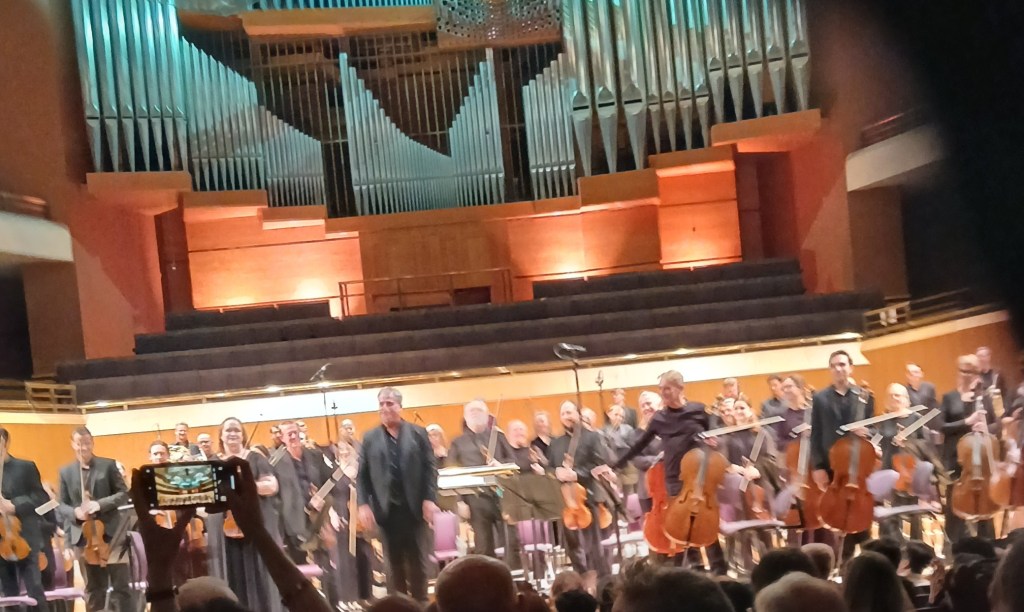
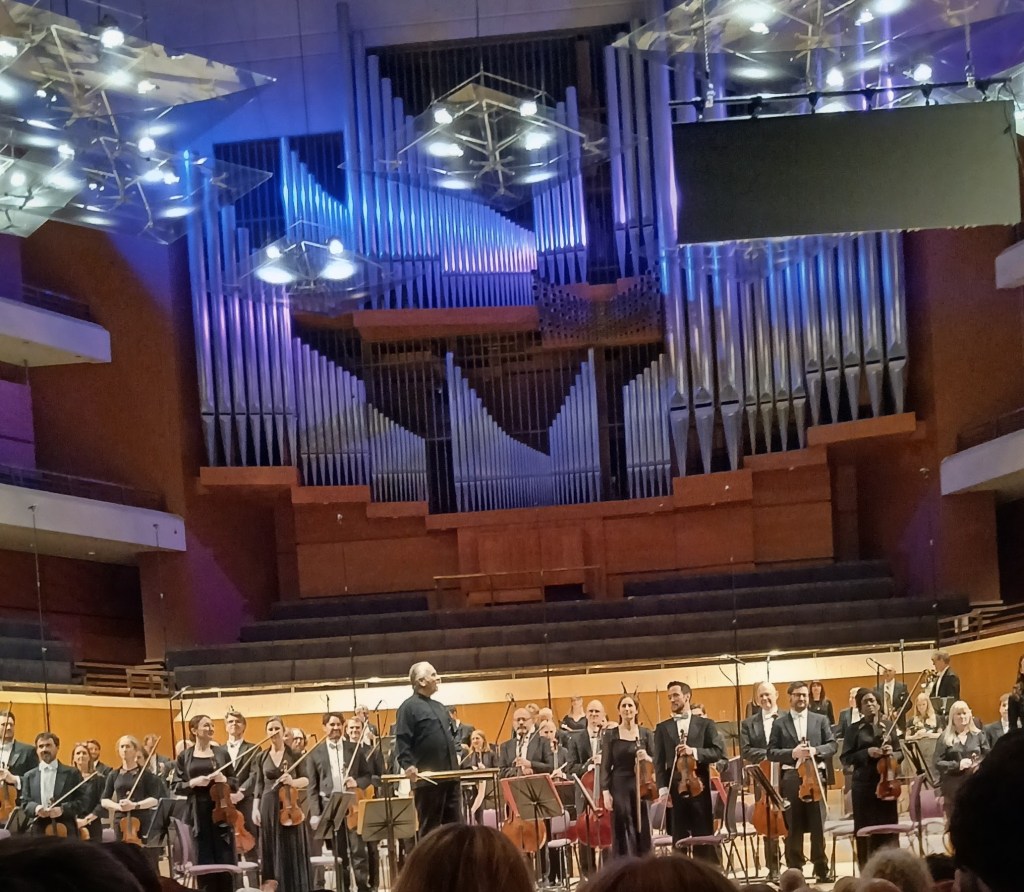
BBC Philharmonic Orchestra, John Storgårds conductor, Simone Lamsma violin. Rautavaara, Cantus Arcticus; Sibelius, Violin Concerto; Nielsen, Symphony No. 5
This was an absorbing concert and one I enjoyed very much. It also had quite a full and very appreciative audience. The BBC Philharmonic sounded glorious – really at the top of their game, and this must have a lot to do with the leadership of John Storgards, who as chief conductor really does spend a lot of time with the orchestra giving concerts in Manchester and elsewhere in the UK. I made a note to myself that I really must check out their 26/27 season carefully when it is published. Because they don’t have quite as tight a commercial imperative as the Halle in constructing their programmes, they can often be more interesting. The Halle 26/27, though with some interesting programming of James MacmIllan works and Thomas Ades as conductor (Ades’ Elgar 1 sounds fascinating) on the whole is disappointingly unoriginal and features relatively few concerts conducted by their chief conductor Kahchun Wong.
The Cantus Arcticus I have a recording of but have never heard live before. It is a more substantial work than i remembered, and I particularly enjoyed the third movement, the calling of the wild swans, with the massed woodwind mirroring the cacophonous swans, and the movement resolving (I think) into the beautiful melody introduced in the Marshes first movement. Someone behind me was asking his companion whether concerts always used exactly the same recording of bird cries, given that the work was first performed in 1971. I don’t know the answer to that – nor did the companion! I have never really understood the Sibelius’ violin concerto. I have never got my head round the structure of the first movement, and the meanderings of the second. It came as no surprise in the programme booklet to read that Sibelius was almost permanently sozzled during the concerto’s composition, and wrote the 2nd movement during an almighty 3 day hangover. That would explain some of my feelings about the work. Anyway, Simone Lamsma gave it a virtuoso and dazzling performance which signalled her as a major upcoming star. Her encore was a beautifully played Bach Largo, which I found much more moving than the whole of the Sibelius concerto.
I wrote right at the beginning of this blog, back in 2019, reviewing a Halle performance, that I have always struggled a bit with the structure of Nielsen’s 5th Symphony – the first part sounds so magnificent that the second can seem less impressive, with not so memorable thematic material, and can sound as though it ends too abruptly. This was certainly a performance that made the best possible case for the work – I was gripped throughout, and somehow (maybe it was a specific emphasis the conductor gave to the sectional differences of voice, perhaps ensuring the cohesion between the different movements) the second half seemed to constantly increase in tension, broadening out in the closing moments to provide a very convincing ending – taut, but with a sense of finality and resolution. Throughout the work, Storgards helped the orchestra to balance itself effectively – you could always hear the woodwind chewing away at the thematic material below the heavy brass. I was intrigued by how much some of this symphony sounded like Shostakovich…..I’ve never heard of a connection between the two………..
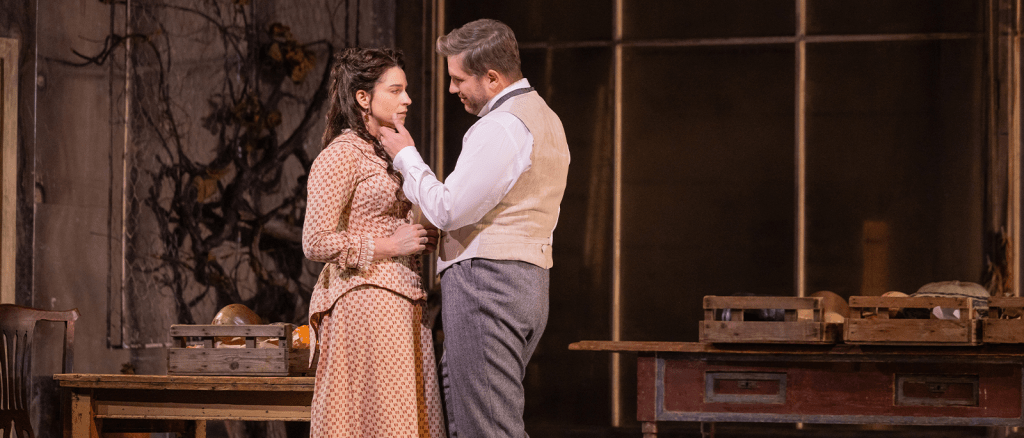
Kip Williams, Director; Marg Horwell, Designer,Allison Cook, Mrs X E; Rodney Earl Clarke, Mr X E; Matthew McKinney and Mariam Wallentin, Angels; Kantos Chamber Choir;BBC Philharmonic; conductor Baldur Brönniman
This production is the UK premiere of this opera, by the Chinese-American composer Du Yun and Canadian librettist Royce Vavrek, staged by Kip Williams, some of whose work has been very successful in the West End recently, apparently. The opera won the 2017 Pulitzer Prize and it, and this production in Manchester, has received on the whole warm plaudits from UK critics. I was seeing the final show. It has received a lot of attention as being the first Manchester-specific large-scale commitment of ENO following its temporary defunding by the Arts Council and the subsequent agreement to work partly out of Manchester. The production’s been put on at a venue which hasn’t seen opera before, and which I haven’t hitherto been to – Aviva Studios, used for the Manchester International Festival in July. This venue, to quote the publicity blurb, is the home of Factory International, “a landmark new cultural space for Manchester and the world. Built with flexibility in mind, the multi-use space can adapt to host any kind of set-up — from intimate theatre shows and intricate exhibitions, to huge multimedia performances and warehouse-scale gigs fit for the greatest artists of our time.”
My impression of the space used for this performance – The Warehouse (a name rather than a description) – for the performance is that it’s a big black painted/curtained space which had, at least on this occasion, a large central stage and four screens, one on each wall. The audience stood on three and a half sides of the stage, with a couple of raised blocks of seats on two of the walls for the more elderly of us (including me). The audience for the show must have been 450 plus, mostly below the age of 50, I would say -in itself impressive for an ENO audience,…..
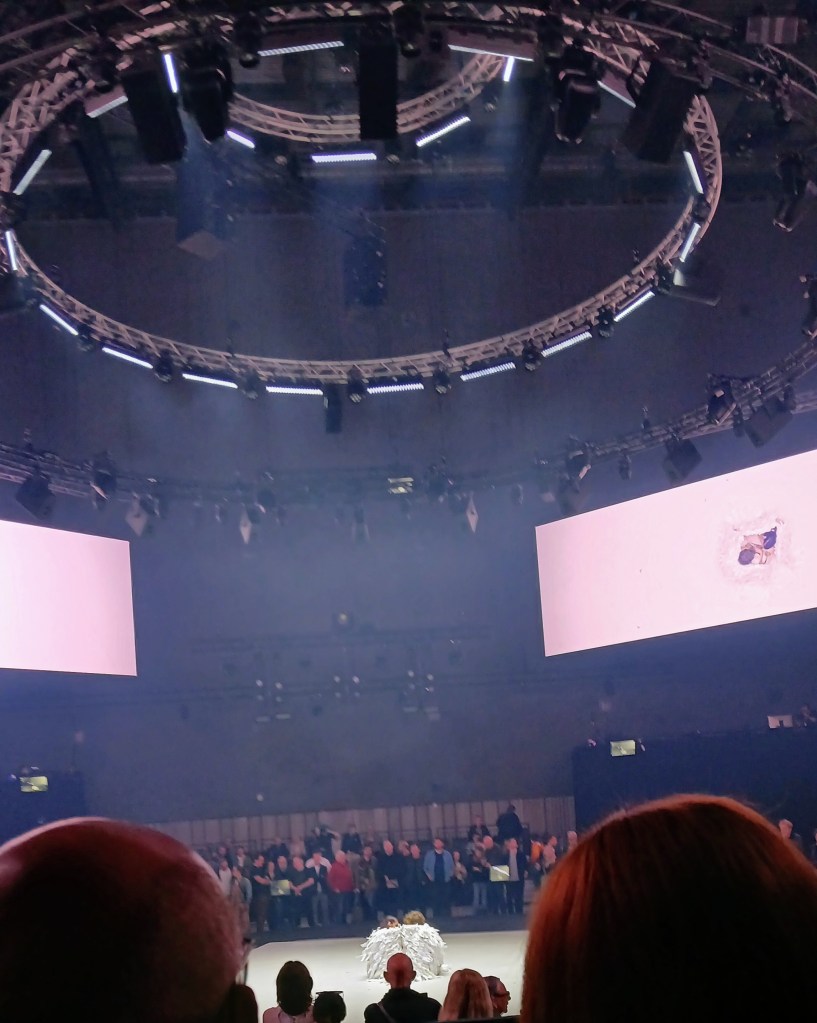
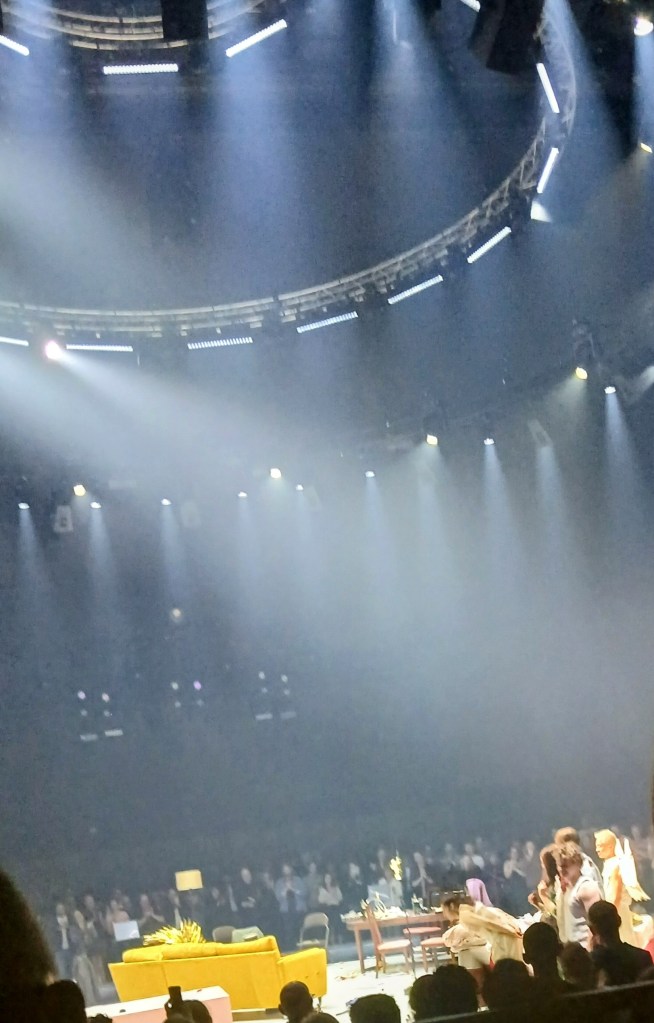
The opera lasts for about 80 minutes. Its story is searing and at times difficult to watch. Two angels, one male, one female, who have somehow fallen from Heaven, or have been sent from Heaven, are seen huddled together before the start – see photo below. Coming in with the start of the work is an angelic chorus, circling the stage, with a chief angel providing commentary. There’s a couple on stage at their chic-looking home, clearly at the end of their relationship, the woman dominant, the man submissive. They quarrel continually, but then the husband discovers the two angels in the garden and brings his wife one of their feathers. She is entranced by its softness and beauty. She wants more feathers and orders the husband to get them. The husband ruthlessly pulls feathers out of both angels, drawing blood. There then occurs a sequence of horrific scenes where the wife calls a party of her friends in to the couple’s house, where she asks her guest to pay to be ‘blessed” by the angels – in practice ‘blessing’ seems to mean the guests physically and sexually abusing the angels. The party goers want things from the angels the latter cannot possibly give them – like a resolution of all their interpersonal and emotional difficulties. The angels are kicked, punched and rendered almost unconscious, bloodied and exhausted. As the party quietens down, it seems -it’s a bit unclear – that the husband feels remorse for how he has treated the angels and throws their feathers back at them, encouraging them to escape, after further rejection by his wife. He, then, commits suicide or at any rate dies in some way. The angels do make an escape – I think. The wife continues to remain in her abusive bubble – she creates a media circus by announcing she was forced by the husband into prostitution and the angels were similarly manipulated by him. She proudly announces that she is now expecting a baby by the male angel. The opening chorus number returns and the opera ends with the triumphant wife in a blaze of. golden feathers.
The staging was obviously specific to this space and it would be fascinating to see how the projected London Coliseum October performances would differ from this. Here in Manchester, in the round, what we had was a series of slowly revolving rooms with windows to see through into. At the same time three camera operators are filming all the action, then mixed on to the 4 overhead screens, together with surtitles. As you can see from the photos, harsh stark lighting was an important aspect of the staging. From my slightly elevated position I could see everything pretty well on 3 of the screens and at times on stage when the right revolutions came round. I think people standing near the action possibly saw less than I did.
The pre-performance publicity suggested this work was really all about people trafficking. Frankly I don’t agree, though maybe that is a background allusion. But the major reference, explicitly in the libretto, is to the Annunciation, and the contrast between Mary (‘Be it unto me according to thy word’) and the wife, full of contemporary self-absorption, narcissism and hedonism. It is a very bleak view of contemporary humanity.
Musically, and contrasting this perhaps with Jake Heggie’s `Dead Man Walking’, this felt very much like a real opera and not one with words predominating and the music having leanings towards a sung film score. The music is there, colouring and foregrounding the words and the action, through a dizzying range of styles – an opening of Gregorian-type chanting, jazz, Britten-like slow melodies, rock and much else. I was always gripped, never lost concentration. The libretto wasn’t too wordy and had the right sort of elevated language where needed for lyrical and reflective passages. Interestingly the opening few minutes of dialogue between the couple are spoken, and when they start singing you immediately feel a deeper engagement. That to me is the mark of an opera. All the singers were excellent, but particularly a shout out for:
– Alison Cook, who I last heard in Buxton singing a Bernstein and Poulenc double – bill last July, and whose singing and acting was wholly compelling, even under the scrutiny of close-up filming
– Rodney Earl Clarke, absolutely believable as the submissive husband, who as part of the role does a wonderful impersonation of Louis Armstrong
-The Kantos Chamber Choir, who are both the cathedral-like angelic choir at points and also acted – with horrific impact – as the party-goers. They were remarkably good – I’d love to hear them in other contexts
– The orchestra had 10 players in it, from the BBC Philharmonic, who were extraordinarily busy and made the whole piece sound as though it was being accompanied by a full orchestra (there is apparently a full orchestra version which will be used in London.
Conductor, Jakub Hrůša. Peter Grimes, Allan Clayton; Ellen Orford, Maria Bengtsson; Captain Balstrode; Bryn Terfel, Swallow, Clive Bayley; Ned Keene, Jacques Imbrailo; Auntie, Catherine Wyn-Rogers; Mrs Sedley, Christine Rice; Bob Boles, John Graham-Hall; Hobson, Barnaby Rea; Rev. Horace Adams; James Gilchrist; First Niece; Jennifer France; Second Niece, Natalia Labourdette. Director, Deborah Warner; Set designer, Michael Levine; Costume designer, Luis F. Carvalho;Lighting designer, Peter Mumford
This was a very starry cast in prospect – Allan Clayton has made quite a name for himself in this role, Maria Bengtsson I saw as an admirable heroine in Strauss’ Intermezzo last year, Bryn Terfel, Christine Rice, Jacques Imbrailo, Clive Bayley – a lot of excellent singers. I had been due to see this production in its first run when it was new, in March 2022 – unfortunately I had my first bout of Covid the week I was booked to see it and so had to miss it, so this is the first opportunity I’ve had to see this much-praised production, four years on. It was also going to be interesting to hear Jakob Hrusa’s take on the music. It’s the 4th production of the work I’ve seen – the 1970’s Elijah Moshinsky one at ROHCG, an ENO Alden one and a Stefan Herheim production in Munich. All of them have been good productions with good casts, though the Moshinsky production had the incomparable Jon Vickers for a number of years in the role. I seem to remember reading that Britten hated his portrayal, but, for me, I hear him singing still whenever I go to a Grimes performance.
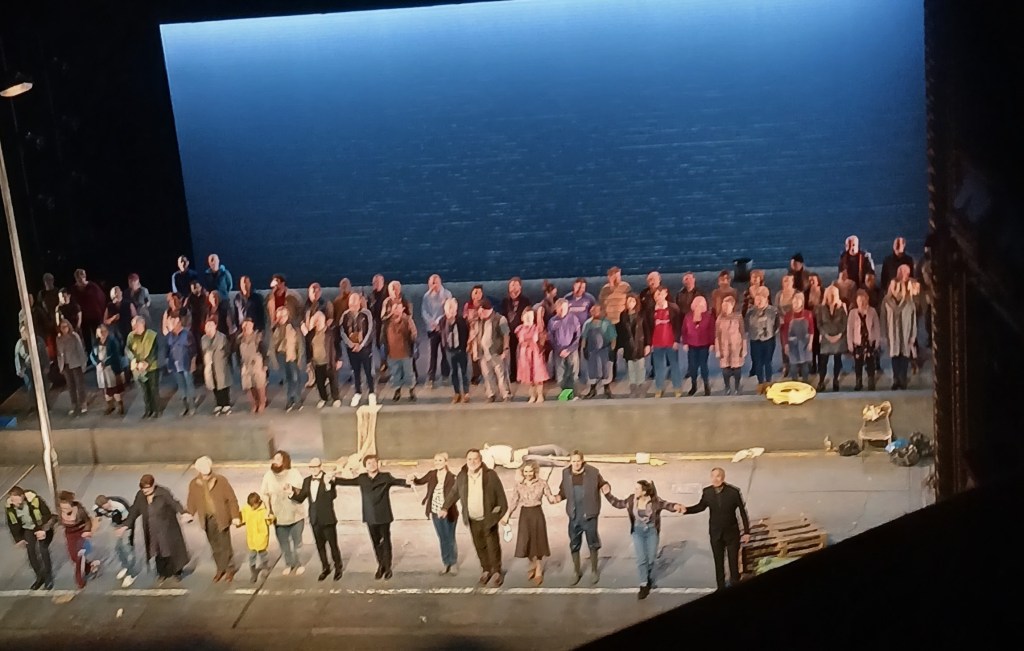
The design setting was effective – the whole full stage was used for many of the scenes with a back drop of a silvery, sometimes blue, rippling sea. The beach was a shambles, full of bits of wood, half-built boats and traffic cones, full of litter (seemingly – there seemed to be a Sunday activity to collect it) – a touch of private affluence and public squalor, perhaps? There were also convincing structures for the pub in Act 1 and Grimes’ hut in Act 2 ( but in the latter case still keeping that whole sweep of the stage in view). The costumes were modern, with no particular colour emphasis – at times the lighting became quite dark and it was difficult, with a large number of people on stage in a range of costume colours, to work out who exactly was singing sometimes among the minor characters. An arresting image was to have at various points, including the opening orchestral prelude, somebody, presumably Grimes’ first apprentice, gyrating across the stage, and up and down it, held by wires, like a body tossed about by the waves. Most of the staging was relatively conventional, though very well done – the innovative scene was the first where instead of a court / coroner’s inquest, Grimes seems to be having a dream of the encounter with the coroner, and the Borough mob pursue him in his dream, with electric torches
Clearly a major task for the director in any production of Grimes is deciding what to do with the chorus – do you regiment them or make them all individuals. How do you create a sense of the small town narrow-mindedness on the one hand in how the chorus is presented, and a baying mob on the other? I seem to remember that in the ENO production they went for the regimented approach – movements, for instance, were often coordinated, almost choreographed. And how are the many minor characters, Auntie, Mrs Sedley, the Nieces, Rector etc etc to be depicted? In this ROHCG production there are I think also 6 dancers to manage, who enlivened the Act 1 fishing song and the party in Act 3, as a further complexity. One of the things I noticed about how Deborah Warner handled this issue is that often the chorus took its time getting onto the stage – a lot of their singing started off stage and they took their time appearing…..I was in a strange way often scarcely aware of their presence. To me, perhaps over-imaginatively, it seemed as though the director was emphasising the narrow grey private lives of the Borough residents, people keeping to themselves, not interacting much with their neighbours, grey figures, and only coming into view for the audience when their blood-lust is up for finding Grimes snd they become a vengeful mass. The minor characters are all in one way or another caricatures set in exaggerated opposition to that greyness, whether Auntie and her Nieces, the laudanum-taking muck-raking Mrs Sedley, the drunken Methodist preacher – in a sense as much in thrall to the greyness, defining themselves through contrast to it, as the chorus. The only characters allowed any sense of normality, of balance, are Bulstrode, and Ellen Orford. Grimes himself repeatedly defines himself in opposition to the Borough. I found this approach – if that was what it was – a convincing one. Certainly it gave a more effective impression of a vengeful mob than did the choreographed approach, when the crowd coalesced into that role, and through directoral understatement reinforced the contemporary relevance – the mobs outside asylum-seekers hotels/refuges last summer, for instance.
Nobody is ever going to replace Vickers in my estimation of people playing Peter Grimes, but Allan Clayton has many strengths, not least his ability to sing softly and beautifully in the lyrical passages in a way Vickers couldn’t in the same way (Clayton’s recollections of a ‘woman’s care’ for instance). He has the heft of voice and the figure for the role, and was utterly convincing. I felt maybe sometimes his portrayal made Grimes so anti-social, so much a loner, that on occasion he did not quite become the centre of focus he should have been, and which Vickers always was, but his is certainly a justified reading. Just as an aside I remember Vickers singing/shouting the line ‘The sea is boiling with fish’ (or something like that) in Act 2, in a startlingly frenzied manner – almost screamed – whereas for Clayton it was a throw-away line. Vickers brought out the inner madness whereas Clayton ‘just’ played him as an odd grumpy loner. Both the other two main roles were sung and acted extremely well. Bryn Terfel was a completely commanding and compelling presence, dominating the stage when he appeared. And Maria Bengtsson was outstanding as Ellen, making her a much fuller and dominant character than she sometimes is (and with no trace of an accent).
The other really compelling aspect of this performance was the orchestral contribution under Hrusa, which sounded magnificent. I have never heard such a compelling and moving performance of the Passacaglia, and the storm music was tremendous. A curtain came down during the orchestral interludes which emphasised their role, and the orchestra’s, in the drama, a good idea. The choral singing was incisive and clear. The point in the second act when the women – Auntie, the nieces, and Ellen – reflect on their relationships with men was a really beautiful highlight – I have never heard it sung so compellingly before.
I had one or two grumbles – it is ridiculous to have a second interval between Acts 2 and 3, as happened here. It dissipates the drama. And I still feel aspects of the libretto are toe-curling (perhaps particularly so given that around me there seemed to be a number of parents with 20’s-ish children). Whiile the heightened language of the lyrical passages (‘Great Bear’ etc) works well, some of what the villagers say to each other just sounds odd and off-putting to someone new to opera – neither obviously related to Crabbe, or the 1940’s or contemporary.
But all in all, I now understand and share the high praise this production has received
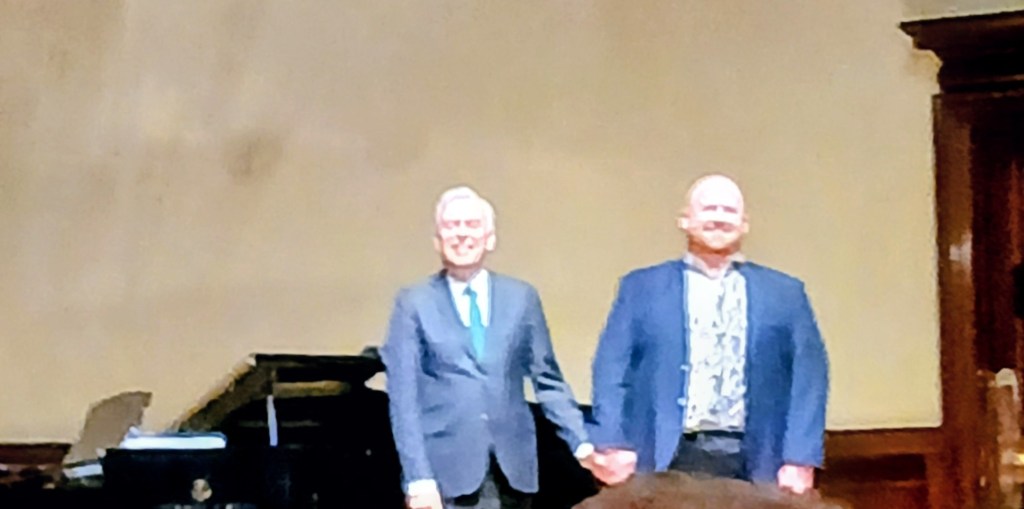
Nicky Spence tenor; Malcolm Martineau piano. Howells The little boy lost; Britten Midnight on the Great Western; Fauré Les berceaux Op. 23 No. 1. Tippett, Songs for Ariel: Full fathom five. Orr, Songs of a Childhood: No. 5 Shy Geordie; Frederic Rzewski, Dear Diary: No Good; Britten, Who are these Children? Op. 84: No. 8 The Larky Lad; Tchaikovsky Sred’ shumnovo bala (Amid the din of the ball) Op. 38 No. 3; Wolf Ihr seid die Allerschönste; Britten, Proud songsters; Larsen, Pregnant; Wood, Litter Bin; Wolf, Storchenbotschaft. Bolcom Waitin; Dunhill, The Cloths of Heaven; Ireland, Baby; Schumann An meinem Herzen, an meiner Brust; Barber, A slumber song of the Madonna; Britten The Highland Balou; Mahler, Um MitternachtL Previn, Will there really be a morning? Minchin, Lullaby; Orr, The Boy in the Train; Legrand, Pieces of Dreams (Little Boy Lost) This was a delightful concert – I sort of expected it to be but was still enthused by the panache and intelligence brought to bear on it. The theme of the concert was fathers and sons, perhaps more generally parents and children. Nicky Spence is of course a distinguished performer on UK opera stages and elsewhere, as well as a recitalist. The theme of the concert was very close to Mr Spence’s heart (he told us near the end, rather wisely perhaps rather than at the beginning of the recital) as he and his husband had a year or more ago adopted a child as their own. The recital was therefore conceived around that profound new relationship and explained why a song like ‘Frauenliebe und leben’’s ‘An meinem Herzen, an meiner Brust’ was included. Some of the songs reflected on the broader feelings and moral choices involved in parenthood, like Mahler’s Un Mitternacht’. There were two more cabaret’- style songs by contemporary (more or less) comedians – the late Victoria Wood’s ‘Litter Bin’, and the wicked, and very funny, ‘Lullaby’ by Tim Minchin (about a father’s feelings trying to get his baby to go to sleep). The songs were well placed in their chosen spots to contrast with each other, and Mr Spence delivered them all with sensitivity an character. Malcolm Martineau accompanied with deftness, and in one number had a spoken role to play too…… A pity the Hall wasn’t fuller, but the recital was very well received by those there
Pierre-Laurent Aimard, piano. Bach: The Well-Tempered Clavier Book 2, BWV.870-893
It is a bit of a shock to the system – auditory, mental, emotional – to sit down and listen to two and a quarter-ish hours of Bach piano music, 48 separate pieces, which are without any sort of narrative or clear structure (unlike the Goldberg Variations, where the end is the beginning). Neither book of the Well Tempered Clavier was ever composed as a piece for audiences to listen to (though the programme booklet did point out that some of the preludes borrowed material from other works Bach did write for public consumption such as his church cantatas.). They were meant as teaching tools and as an incentive to rigorous study and playing. Whereas I would never dream of doing this with the Goldbergs or the Passions, I have tended to listen to the WTC books at home while cleaning, or doing personal admin things, mainly using the recordings by Gulda, Gould and Tureck. So I both know in a way and yet don’t know Book 2, and certainly there were some preludes and fugues i don’t recall ever having heard before sitting through this concert. In a sense it felt like going to a large art gallery you’d never been to before and having to take a moving walkway to see everything – it’s as though the whole world is there, sometime delighting you, maybe sometimes boring you, and too often the image has whooshed past before you have really made up your mind how to react. In the two and a quarter hours I must have lost concentration maybe for about a total of 10 minutes, but that still meant i was enjoying over two hours of this work. And I did enjoy it – there are some beautifully ethereal preludes, and some that have that quintessential Bachian melancholy. I loved some of the more ferocious fugues – 4 or 5 seemingly random notes announced and then a following blitz pf a fugue…. Pierre-Laurent Aimard has a considerable reputation for his Bach performances (and indeed I have a recording of his playing The Art of the Fugue). There were a few times when, in some of the Preludes I knew, he seemed to me to be playing on the fast side and to my ears not lingering sufficiently (eg prelude no 3, compare Tureck). But his performance sounded energetic, straight-forward and clear and he got a standing ovation at the end from many in the audience ( I noticed a number of people around me following scores). Perhaps he lacks the outrageousness you can sense in Gould’s playing, or the quiet seriousness of Tureck, but I enjoyed these two hours of total absorption very much indeed (and have only unqualified admiration for somebody prepared to play this much music with the degree of intensity displayed before a live audience). It was a very diverse audience too – lots of younger people and more of a mix of ethnicity than you might sometimes see on the South Bank
Halle Orchestra, Sir Mark Elder conductor. Kostas Smoriginas baritone. Hallé Choir, Matthew Hamilton, choral director. Stravinsky Song of the Nightingale; Rachmaninov Spring; Glinka, Ruslan and Ludmilla Overture; Tchaikovsky Symphony No.2
This was a nicely designed programme featuring a couple of rarely heard works (and unknown to me) and a popular symphony (which, despite that popularity, I don’t think I’ve ever heard live before) – also different variants on what being Russian might mean musically. And it was good to see Mark Elder again conducting the Halle – he is perhaps a little slower getting on and off the podium, and a little less exuberant in gestures but he clearly gets all he wants from the players despite or perhaps because of increasing age. Radio 3 was broadcasting the concert live.
‘Ruslan and Lyudmila’ overture is always a great concert starter, as it proved again here – what always surprises me is how early in the 19th century it was composed, a long time before other Russian nationalist composers started getting published. The Halle was easily able to withstand Elder’s fairly bracing pace – and, throughout the concert, it was good to note that, as also often with his successor Kahchung Wong, Sir Mark spread the 1st and 2nd violins on either side of the stage, which is how the 19th century would have heard the music and which allows interplay between the two sections to be clearly heard.
I can only have heard Le Chant du Rossignol once, more than 50 years ago at the Proms when Pierre Boulez was chief conductor of the BBCSO. It’s from a piece composed around the same time as Petrushka, as an opera, and Stravinsky recycled some of the music from it 4 years or so later for a 20 minutes or so Diaghilev ballet. It has the same jewelled glitter, the same glistening crowded textures, spikey rhythms and veiled use of folk song-like material as Petrushka, but of its nature is episodic. To me it felt as though Stravinsky had reached a bit of a dead end creatively with this sort of sound and orchestral texture , and it was indeed after this was reworked that he started writing in a sparer, more neo-classical, stye, I think. I can’t imagine I’d willingly reach out to hear it again.
The Rachmaninov piece, Spring, extravagantly (for a 17-minute work) was scored for large chorus and orchestra plus solo singer. I thought this was a lovely piece, about the coming of Spring to a Russian household in trauma, where a man, with murderous intent towards his wife because of her perceived unfaithfulness, forgives her and asks himself to be forgiven because of feelings evoked by the Russian Spring after the long cold winter, giving new hope and life. The Lithuanian baritone Kostas Smoriginas had the right sort of Russian tinge to his voice. Unlike Stravinsky and Tchaikovsky Rachmaninov is not using folk-song sources for his music, which still, to Western ears, evokes the brooding melancholy of so much 19th and early 20th century Russian music.
Tchaikovsky’s 2nd Symphony is in essence a compendium of folk tunes, dazzlingly orchestrated and slightly varied with each repetition. In retrospect much (not all) of Tchaikovsky’s music is very different from his 19th century European counterparts – less concerned with self-dramatisation and journeys from darkness to light (though the 4th – 6th symphonies would be one exception; there are others). Despite this symphony he was also not really aligned with the Russian nationalist composers like Borodin or Balakirev. As Simon Morrison says in his excellent book “Tchaikovsky’s Empire” “his music was too urban, too regal, too smitten with the Romanovs, too idiosyncratic, and frankly too cheerful”. The 2nd Symphony seems to me to be the work of an excellent craftsman, using his skills to focus less on originality and inspiration and more on technical brilliance in the different ways the folk songs are presented. The Halle relished all the challenges given to them to shine as individuals and in instrument groupings – even the percussion section gets quite a work out (with a more than usually spectacular gong crash). The danger in this music is that the conductor drives it too hard and one of the good things about this performance was that it was more relaxed than some and Elder gave space for the players to breathe and maximise expression – for example the 2nd subject of the finale had a lovely lilt. His approach also meant that the climaxes were clearly signalled and didn’t come excitably one after the other. There were a few occasions in the finale where tight rhythms got a bit smudged, but these did not detract from the overall impact of the performance, which I enjoyed very much
Conductor, Timur ZangIniev; Asmik Gregorian, Tatiana; Maria Barakova, Olga; Iurii Samoilov,Eugene Onegin; Larissa Diadakova, Filippyevna; Stanislas De Barbeyrac, Lenski; Prince Gremin, Alexander Tsymbalyuk. Production, Deborah Warner, Set Designer, Tom Pye; Costume Designer; Chloe Obolensky; Lighting Designer, Jean Kalman
I really haven’t seen many productions of this work – I remember the Peter Hall one in the 1970’s at ROHCG with Ileana Cotrubas, a production I can’t recall at all in Vienna in 2015 with Netrebko and Maltman (both singing at the top of their form) , and there was also the recent Huffman production in London, but that’s about it – I don’t recall seeing this at ENO (though this Met production is in fact a co-production with ENO, and seen there in 2011). The draws for me in wanting to go to this screening were seeing a production by Deborah Warner, always a director to watch (and I am looking forward to seeing her Peter Grimes at ROHCG on May 12th), hearing and seeing Asmik Gregorian, and also watching the development of Stanislas De Barbeyrac (although he is in his early 40’s and has been around for quite a while in smaller role), who is being taken up in a big way by ROHCG (Siegmund already and then next season Parsifal)
In many ways this was quite a traditional production, with the focus rather being on the interplay between the characters. One of the things I felt, viewing the work in this traditional mode, is that Onegin is an opera whose action does rather lurch forward not very credibly at points – the very sudden falling in love of Tatians, the very quick declension of Onegin and Lensky’s relationship into duelling-mode. The Huffman production I saw at ROHCG was on the whole I thought more effective than this one in handling these ‘lurches’, and some of Huffman’s glosses on the action – like Olga being absolutely smitten by Onegin in Act 2 and very explicit sex scenes – made more sense of some of the weaknesses in the plot. The very realistic early scenes in the Met production of Tatiana’s family’s provincial country house, with walls, curtains and windows, bowls of fruit, and so forth, here seemed cramped, given the size of the chorus – I guess intentionally, to emphasise the provincial nature of the establishment – but it looked muddled, even if it was cleverly choreographed, whereas Huffman used the whole of the Covent Garden stage with minimum props, which seemed to make the action flow more easily. However the Met production, in scenes from the duel onwards, used the full massive space of the Met stage, giving grandeur to the Gremin palace, and bleakness to the duel and the last scene, with suggestive wisps of scenery rather than the enormous detail of the country house.
Vocally and acting-wise, this production was impressive. Asmik Gregorian said in an interview during one of the intervals that, at 44, this might be one of the last times she sings this role; that, she feels, it needs a younger singer to bring it off well. But in fact she is such a consummate actor that she conveys very effectively the sense of a young woman falling in love, she (more or less) looks the part, and, while she hasn’t got a conventionally beautiful voice, she uses it in such a convincing and expressive way that you feel she is conveying the essence of Tatiana’s personality. The intensity of the Letter Scene, of her emotions in the final scene, were overpowering. Iurii Samoilov as Onegin has an extremely beautiful and fine baritone voice, and was credibly callous, insensitive, insouciant and unpleasantly unfeeling in a way that any Onegin has to be on stage. It’s a difficult role for a singer to engage with and I thought he did very well.
Stanislas De Barbeyrac had a well focused voice which had both the heft for the scene in the ballroom leading up to the duel, and the sensitivity for his famous and beautiful aria before the duel. I was also very taken with Maria Barakova as Olga (pinpointing a very different personality to Tatiana’s) , and Alexander Tsymbalyuk as Gremin (the latter a classic ‘Slavonic’ bass sound). I thought that Timur ZangIniev conducted the opera in a quite measured way at times, which didn’t at all seem to reduce the impact of the drama, so intense was the singing and acting, but his approach did allow singers to move, breathe and sing naturally amidst the tension. It also created helped to create clarity in the layers of sound – in the dance at the provincial house (for Tatiana’s Name Day), I heard string accompaniment and woodwind commentary which I have never come across before There was some spectacularly good playing from the Met Orchestra, particularly from the lower strings. I am looking forward to hearing this orchestra at the end of August at the BBC Proms in the RAH.
Bartholomew LaFollette, ‘cello; Hyeyoon Park, violin; Caroline Palmer, piano. Nadia Boulanger; Three Pieces for cello & piano; Rachmaninoff, Cello Sonata in G minor Op.19; Schubert, Piano Trio in E flat D929
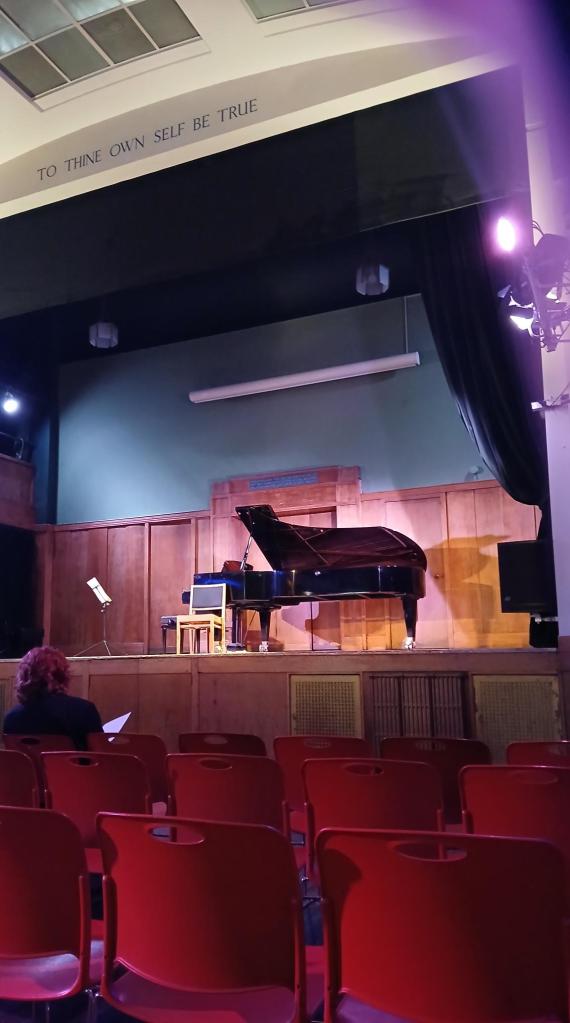
I’ve never been to the Conway Hall before. According to its website it is “a hub for ethical thought and dialogue since it opened in 1929 as the home of what is now the Conway Hall Ethical Society. As an independent home for ideas and culture, it supports diverse communities to engage with ethics through learning, conversation, and creativity, exploring the defining questions that shape our daily lives. Named after Moncure Conway, the abolitionist, freethinker, and former leader of the Ethical Society, Conway Hall was built to foster ethical discussion through lectures, debates, concerts, and social gatherings.” Obviously within this context it also hires the hall our as a venue – hence this concert. The hall itself is rather spartan and slightly art-deco-ish, with other meeting rooms flanking the hall, and with hard seats. But it has a very lively and warm acoustic (lots of wood) and is ideal for chamber music. The inscription ‘To thine own self be true’ is in capital letters above the stage (I have always found this an odd statement for Shakespeare to make – selves are made through dialogue, not by looking inward – but perhaps he was seeing this as a Polonius-type remark). The hall seats I would guess about 350 people – there must have been about 100 people present, so it didn’t feel very full….
I thought this was one of the best chamber music concerts I have been to for a long time. This was to do partly with the experience of the warm acoustics, giving a wonderful edge to the string instruments – but also to the depth of knowledge and understanding these experienced musicians had of the pieces they were playing, particularly the Schubert, where the performance was much more engrossing, and offered much more of a narrative than the Ensemble 360 reading of this work I heard in Sheffield about 18 months ago. Particularly significant to me was how they handled the Schubert finale. This can seem repetitious, particularly when the plodding Winterreise theme of the slow movement comes back to haunt the finale, and comes again….and again,…..like a threatening ghost at a feast. In this performance, a subtle slowing down before the final transformation of the Winterreise theme into the major key, and the intensity of the string sound at that moment, felt like a real sea-change, a sudden burst of hope in this increasingly desperate movement, going round and round in circles. The trio were good in the other movements too – they took the first movement repeat and made the whole movement much more structurally clear than I have ever heard it before. The slow movement had some agonised and intense playing at its climaxes – savage-sounding at points. This was one of the few late Schubert pieces which had a performance in his lifetime and in his presence – what on earth must people have made of its grief and manic despair? The third movement had, where needed, the Viennese laendler lilt. This performance strengthened my view that this is one of the darkest works Schubert wrote, but also one of the most cogent. This group very effectively avoided ‘heavenly length’ as an implicit criticism.
I also enjoyed the Rachmaninov Cello Sonata very much, the broad swinging cello melodies sounded very resonant and ample in the acoustics of the hall and the cello playing in particular had a seriousness, an intensity which was vividly communicated. While it is a bit of a wallow, truth be told, this performance never made it sound like salon music, and it reminded me how much Russian music, Russian literature, Russian visual arts are part of our shared European culture. I am glad no-one is advocating a WW1-type ‘ban on Bach’ type approach in the current political context, and sincerely hope that before I die I will once again be able to travel to Moscow and Petersburg for music. The first piece in the programme was surprisingly by Nadia, the famous teacher, not her short-lived talented younger sister, Lili, Boulanger, who has been much promoted of late. To be frank, it was not very inspired, but a good curtain-raiser.
François Collin de Blamont, Diane et Endymion, overture; Sébastien de Brossard, Sonate en Trio in E minor SdB. 220; Michel Corrette Sonata in B flat Op. 20 No. 4 ‘Les délices de la solitude; Louis-Gabriel Guillemain, Sonata in A minor Op. 17 No. 6; François Couperin, La sultane; Jean-François Dandrieu, Sonata in G minor Op. 1 No. 3; Michel-Richard de Lalandel, Simphonies pour le Souper du Roy
I got into a huge planning muddle over this day. I had originally planned to get an early Eurostar to Amsterdam, see an opera (Weinberg’s The Passenger, on my bucket list) in the evening, have a quick look at a bit of Amsterdam on Sunday afternoon/Monday morning and go back to the UK about midday the next day. THEN I discovered there was a Monday morning meeting of great importance I had to be at in the UK near where I live. AND THEN I also discovered that The Passenger performance was actually a matinee and there would only be 40 mins between my train’s projected arrival in Amsterdam and the performance starting! For a while I thought of going to Amsterdam and coming back to the UK the same day (ie 26 April) and changed rail and hotel bookings on that basis. In the end, though, I thought it was all too risky (I also had an email warning of long queues on Eurostar) and too wearing, and managed to shift my Eurostar booking to something else I was doing in July, and the Dutch Opera kindly gave me my money back. I still had two day’s worth of London hotel bookings, though, so decided to spend the day in London on Sunday. There wasn’t much on musically, but I did manage to find two concerts of chamber music.
This was the first of them – a programme of pretty obscure Baroque music from 18TH century France (Couperin being the only composer I had heard of – possibly Lelande too). The concert was the debut of this ensemble at the Wigmore hall. The group, on this showing, consists of a harpsichord, period flute, period bassoon violin and viola da gamba, all very well played and the group was well balanced ,as an ensemble. As for ‘Hidden Gems’ -well, hidden certainly but whether gems is another matter. If Vivaldi has written 50 operas and only say 10 have been performed in modern times, then it is worth assuming that there’s plenty to be explored in the remaining 40 by a proven inventive and eminently-worth- listening-to composer. But if completely unknown composers from the Baroque period have written 1000’s of unknown pieces how many of them are likely to be ‘gems’? I am afraid that to my mind few of these pieces were in that category. The one I liked best – it seemed to have a lot of character with a special role for the bassoon – was the Michel Corrette Sonata in B flat. The LeLande piece ‘for the king’s supper’ was also interesting and slightly more memorable than the test.
But too many of the pieces were easy on the ear but rather unmemorable. Of course I get that an ensemble making its debut doesn’t want to perform yet another version of The Musical Offering, or a version of the Brandenburg Concertos, but this concert needed a bit more zing. What might have helped is members of the ensemble talking a bit about some of the composers or the contexts for which the music was written. Perhaps they thought it might be a naff thing to do in such an august venue, but if Roddy Williams or Andras Schiff can do it, why not this ensemble?
So….pleasant enough, but a bit unmemorable and could have been better presented………
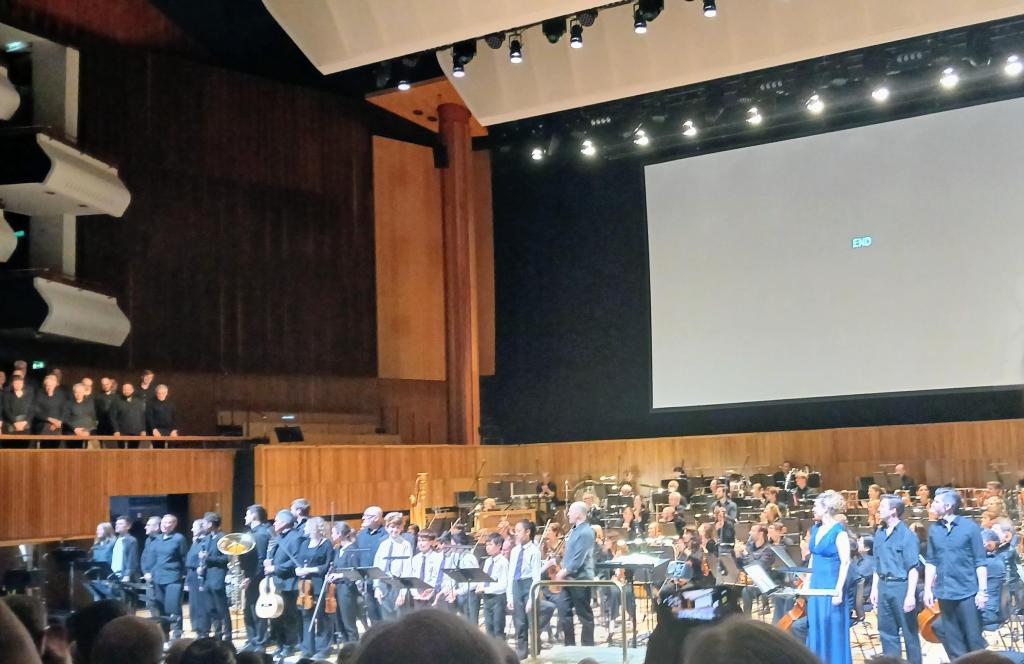
London Philharmonic Orchestra, Edward Gardner conductor; Stéphane Degout, Wozzeck; Annette Dasch, Marie; Peter Hoare, Captain; Brindley Sherrat, Doctor; Christopher Ventris, Drum Major; Eirik Grøtvedt, Andres; Kitty Whately, Margret; Adrian Thompson, The Fool. London Voices
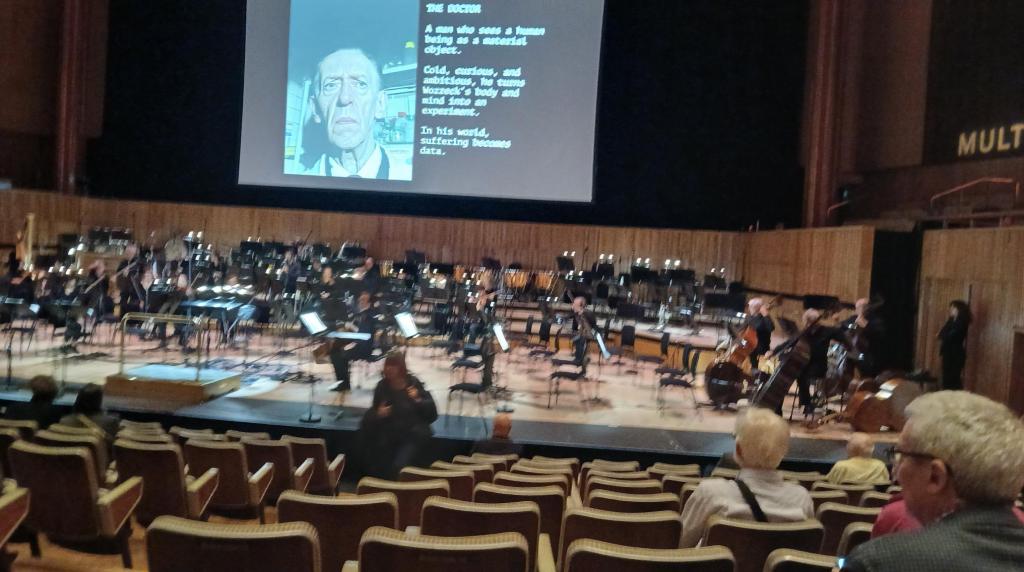
Comments come to mind about London buses…. but I booked this a year ago, long before I knew about the Vienna Wozzeck I went to earlier in April, and it’s not as though I know the work very well…… So, I decided to stick with this and go to London as planned. I’d forgotten, though, that it was part of the ‘Multitudes’ Festival on the South Bank, their yearly multi-medium arts festival ‘powered by orchestral music’. I went to a couple of these events, with some rather mixed responses, last year. In this case the London Philharmonic Orchestra “joins forces with acclaimed film-maker and video artist Ilya Shagalov, who accompanies the searing music with an atmospheric and expressive photo-film inspired by British social realist dramas. Reimagining Wozzeck for the modern day, Shagalov translates the story through the lens of a migrant worker, whose life is shaped by the pressures to survive and the casual cruelties of a fractured modern society.”. Hmmmm – I approached this event with some scepticism – it seemed a somewhat strange concept to have an opera (semi-staged) coupled with a film (though of course many staged operas make use of film). How would you cope with one story on stage and another on film? Why noy just put the opera on in an opera house? I guess it depends on what a photo-film is…………
In the event I am sure that some of the critics reviewing this will trash the concept (and indeed there was in the event, with a sub -trail complaining that the photos were ‘AI slop’. But (and there have been some similarly extreme pro-and-anti print and online comments for a multi-media synaesthesiac performance of Turangalila by the RPO/Petrenko a couple of evenings before) I found it worked quite well. In this particular case it was good that music stands were on stage and no-one – apart from Peter Hoare and Brindley Sherrat – really interacted with anyone else. One’s eyes and engagement could then move between the singers, fairly static, the text on the screen behind the orchestra, and the immense number of still shots produced by Ilya Shagalov (whether with or without AI I’m not too fussed by, in this context) giving his photographic version of the story. He has photographed people representing all the characters, sometimes clear, sometimes distorted and when needed more abstract shots – for instance around the murder. The photographed Marie has a particularly haunting face, and Wozzeck’s face too seemed infinitely capable of expressing fear and madness. The setting looked possibly Russian, possibly Eastern European. The migrant worker idea underlying the photographs was there an underlying theme but not so obtrusive as to distort our understanding of what was happening in the story the opera was telling – indeed that was a strong point for me of the whole event, that the photos supported a focus on the narrative, and the grimness of the lives these individuals were living. Perhaps because of the tellingness of the photographs, the contrast between the Doctor and the Captain’s atheism and Marie’s reflections on Mary Magdalene and the Woman taken in Adultery came across more strongly than in the Vienna production two and a half weeks ago.
In terms of the singers and their presence on stage, I was impressed by Stephane Degout, not a singer I have come across before. He personified Wozzeck, I have to say, far more effectively than Kranzle in Vienna two weeks ago – determined, gruff, self-absorbed, tense – he very much looked the part and his voice was richly compelling. He did little that could be called acting but his presence said it all. Peter Hoare was his usual very capable self – funny, manic, strongly-voiced and the best actor on stage, and Brindley Sherrat nearly his equivalent. Christopher Ventris was a more convincing Drum Major than his Vienna equivalent. About the performance of Annette Dasch, I was less convinced – somehow, she didn’t have the compelling vocal and stage qualities you’d want to see in this role, even in a concert version, though she was perfectly adequate. Vocally hers was quite a small voice, disappearing under the orchestra once or twice, but she offered us some beautifully floated high notes. All the other roles were well taken.
When I got back home after the trip to Vienna I listed to the old 1960’s recording I have of Karl Boehm, Fischer-Dieskau and Evelyn Lear in this work. One of the things that struck me was how much more exciting this was than either of the two performances I have recently heard, which in part has perhaps something to do with the forwardness of the recording but also with the much greater use of sprechtstimme by Lear and DFD (and Boehm was of a generation old enough to know how this music should go, I guess). However, Ed Gardner and the LPO gave a wonderful performance of the score which was at least as compelling as the VPO performance two weeks ago (some stunning trumpet playing) – and in the final verwandlung was even more expressively powerful. I found also (not that it wasn’t there two weeks ago but I noticed it more clearly here) that not only are there the powerful expressionist, the haunting Mahler throw-back, moments, in the score, but also wonderfully delicate sound effects – quiet string strokes, magical bells. The more you hear the work, the more you find yourself listening to the detail and the more haunting the work becomes.
There was a messy ending – part of it perhaps to do with the fact that (according to its manager anyway) 59% of people coming to this Festival last year were new to classical music at the South Bank). Gardner tried to hold the silence after the final chord, a few people clapped and then fell silent, but the spell was broken.. A pity, but maybe OK in the context of getting new audiences in…… Worse, after one inevitably, given the forces involved, messy and elongated curtain call, some idiot in charge of the lighting brought up the houselights so that the audience stopped clapping – a pity, because this was a very fine performance and I am sure the audience would have been up for 2 more curtain calls at least. It seemed very disrespectful to the artists