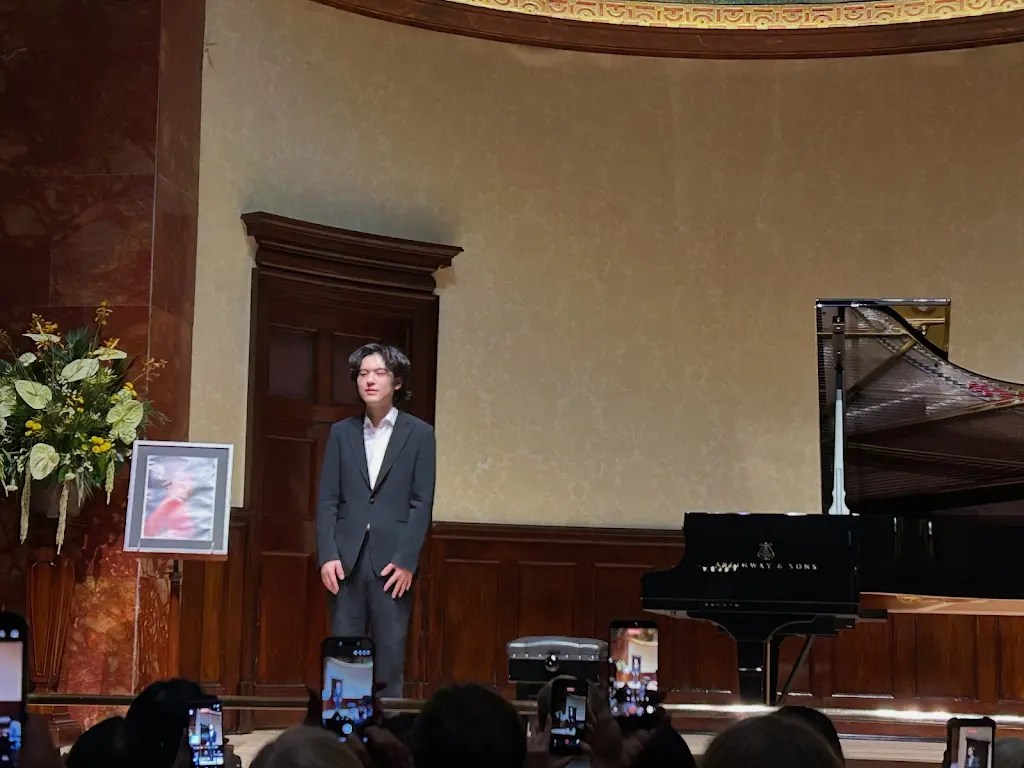
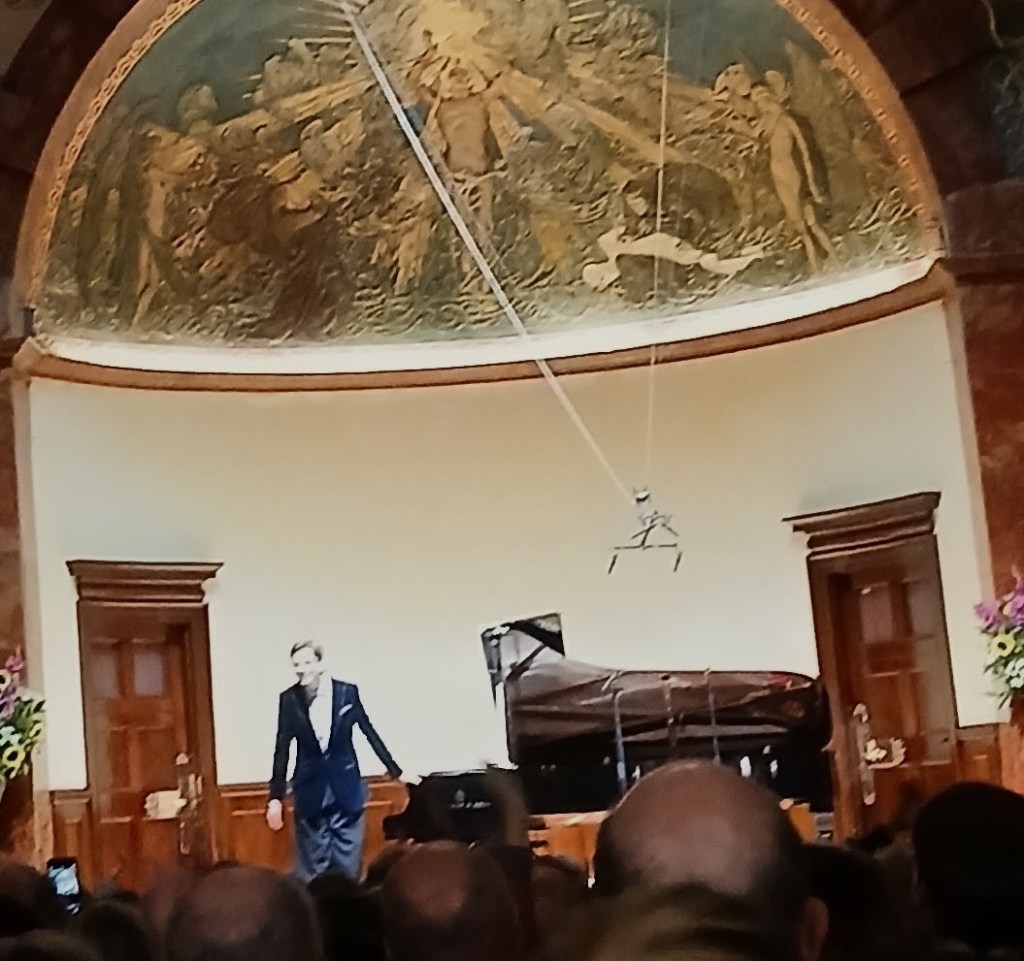
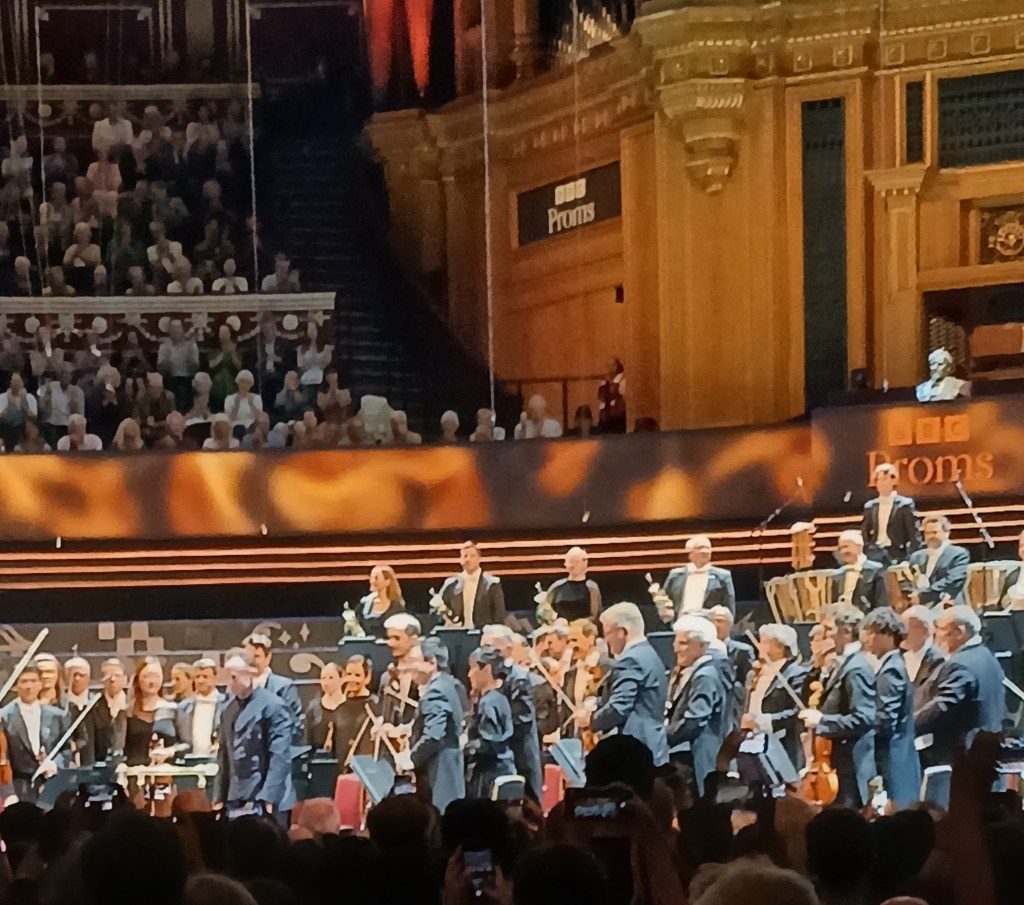
Yunchan Lim, piano. Mozart: Piano Sonata in C K279; Piano Sonata in D K284; Fantasia in D minor K397; Piano Sonata in F K332; Piano Sonata in A minor K310.
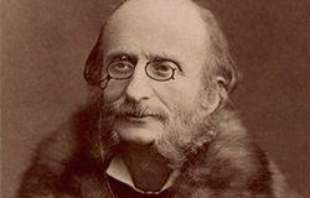
This is only the second time I have heard Yunchan Lim play live – the first being a Prom not long after lockdown – maybe 2023, his playing impressing me greatly with its poeticism and delicacy, but somewhat subverted on that occasion by a conductor whose approach was a lot more propulsive and energetic. Since then, his reputation has gone orbital……He is playing a whole set of Mozart sonatas this season at Wigmore Hall, roughly in chronologically-ordered groupings, and I am able to get to this one and the December recital.
He’s not seemingly a stage animal – he rushes on stage, head bowed, and with scarcely a pause charges into the work he’s playing; at the end of the piece there are curt bows and a quick exit (though he did play an encore – I think the finale of one of the two early sonatas in the programme). He’s also clearly a hummer, in the Glenn Gould tradition, never distracting and not in some of the magical slow quiet moments, but there most of the time nonetheless.
I am probably not best placed to comment on the details of his playing – I am not a pianist, and also my recording of the complete sonatas is on a forte-piano, a very different sound indeed to the clangourous Wigmore Hall instrument, especially in the hall’s very lively acoustic. I will have a go, though, at putting down my reactions. That his technical skills are extraordinary goes without saying – remarkable clarity and crispness on some of the runs, for instance. He clearly favours a wide dynamic range, from the thunderous to the soft whisperings of some of the slow movements. His playing in the slow movements of the sonatas and in the Fantasia was wonderfully gentle and, yes, that word ‘poetic’ again – introspective too – with great sensitivity of phrasing, and a feeling of inwardness. In general there’s a lot of pedal used, I think – though others may contradict – and the sound is ‘big’. Sometimes – I heard someone say this walking out of the hall – he was ‘playing to catch up with the notes’ – the fast movements were sometimes extremely fast – accurate but sounding a bit hurried. I thought this was extraordinarily good playing, and quite possibly Mozart would have loved it – the concert grand is in any case very far removed from the instrument he himself would have been playing. Overall, it was a very ‘romantic’ sound and style, and highly imaginative – at times a piece like the Fantasia sounded more like Chopin. If there was anything missing, I would say it was perhaps the ‘wit’ and ‘poise’ you might associate with someone like Brendel, a sense of classical balance, in music that admittedly teeters on the edge of what the 18th century thought music could express, even in these relatively early works. Perhaps also at times, in some of the more dance-like music, more of a lilt, a sense of delight, was needed. But this is all a matter of taste really, and above all, Yunchan Lim clearly has a strong vision of how he wants this music to sound. This was a wonderfully well-played concert, exploring works I don’t know very well, and with this pianist as an assured and sensitive guide.
Of the works themselves I was amazed by the fertility and invention of the 2nd sonata in the programme – K284, written in Munich when Mozart was 18/19 – in particular the extended finale with a theme and 12 variations, which are gorgeous, particularly the 11th one. The overall highlights for me were the Fantasia and the last sonata played, K310. I hadn’t realised that this latter work was written around the time Mozart’s mother died in Paris, when Mozart was 21. The slow movement is almost frightening in its sadness, and very well-suited to Lim’s thoughtful introspective playing. He made it so much more a work of poetry than my forte-piano recording – the storm of sudden emotion two thirds of the movement was quite alarming in its intensity. The third movement of this sonata was driven forward with energy and passion. The Fantasia, with its melancholy main theme, and sudden flourishes and byways, its overall sense of something dark and tragic, was again ideally suited to this pianist’s talents.
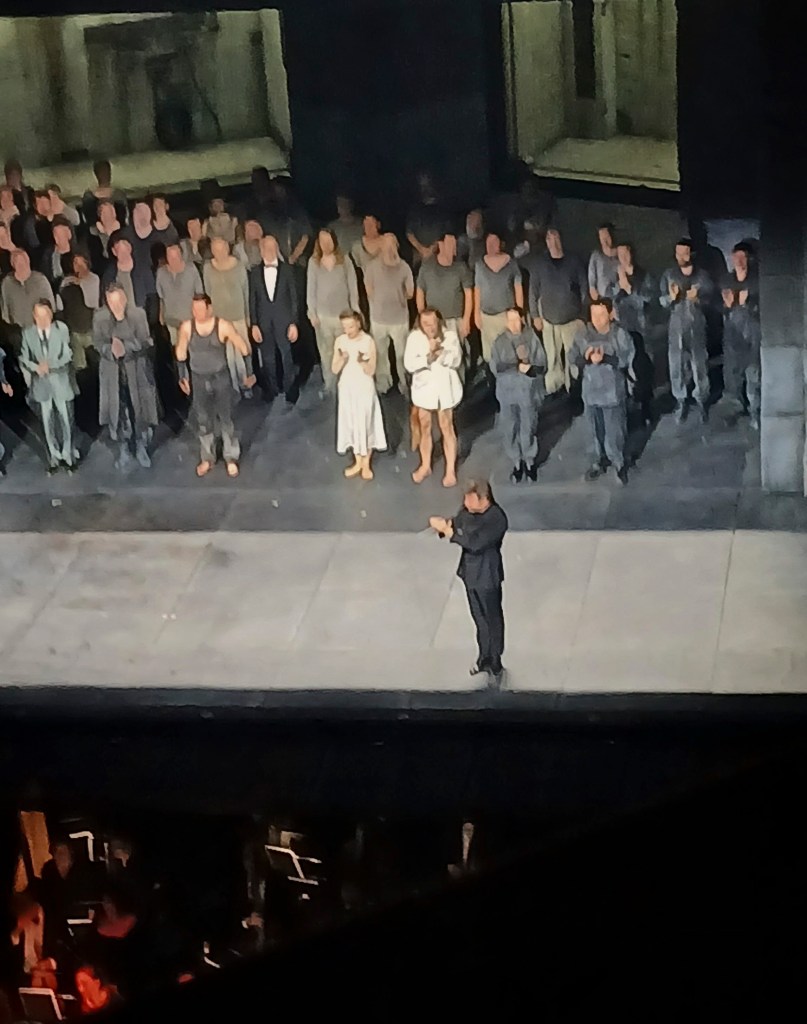
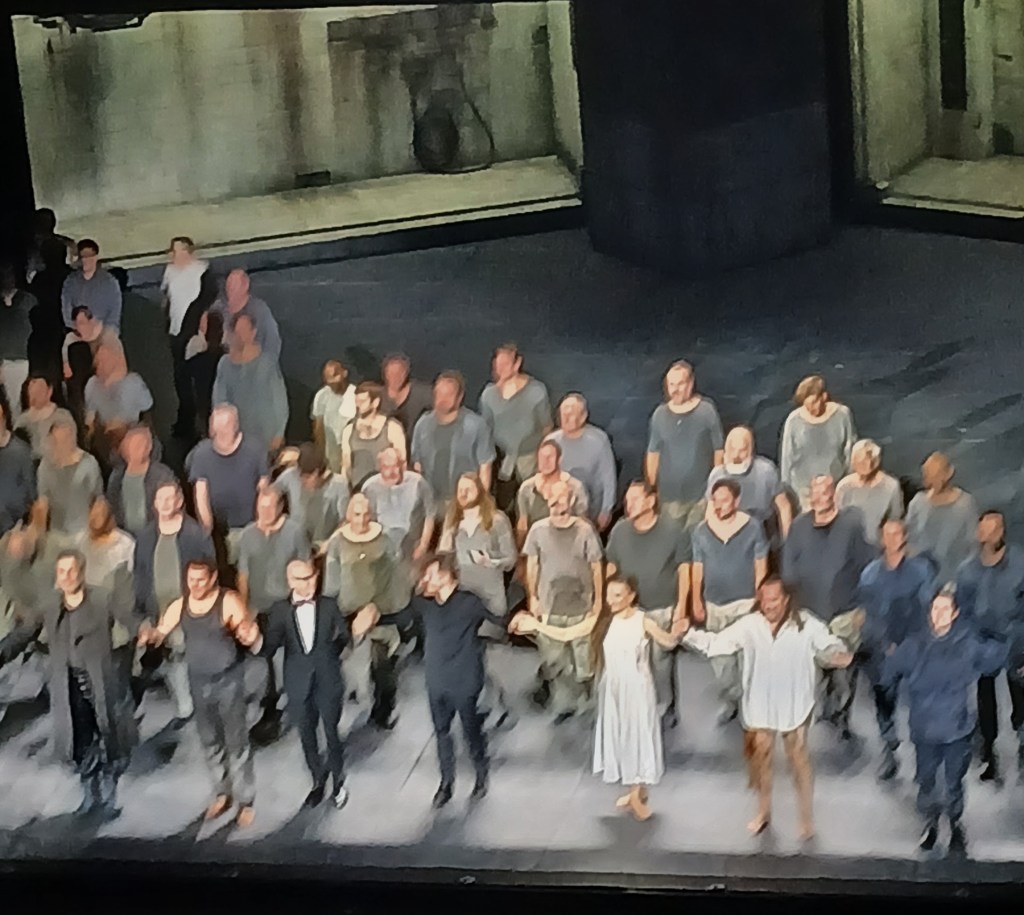
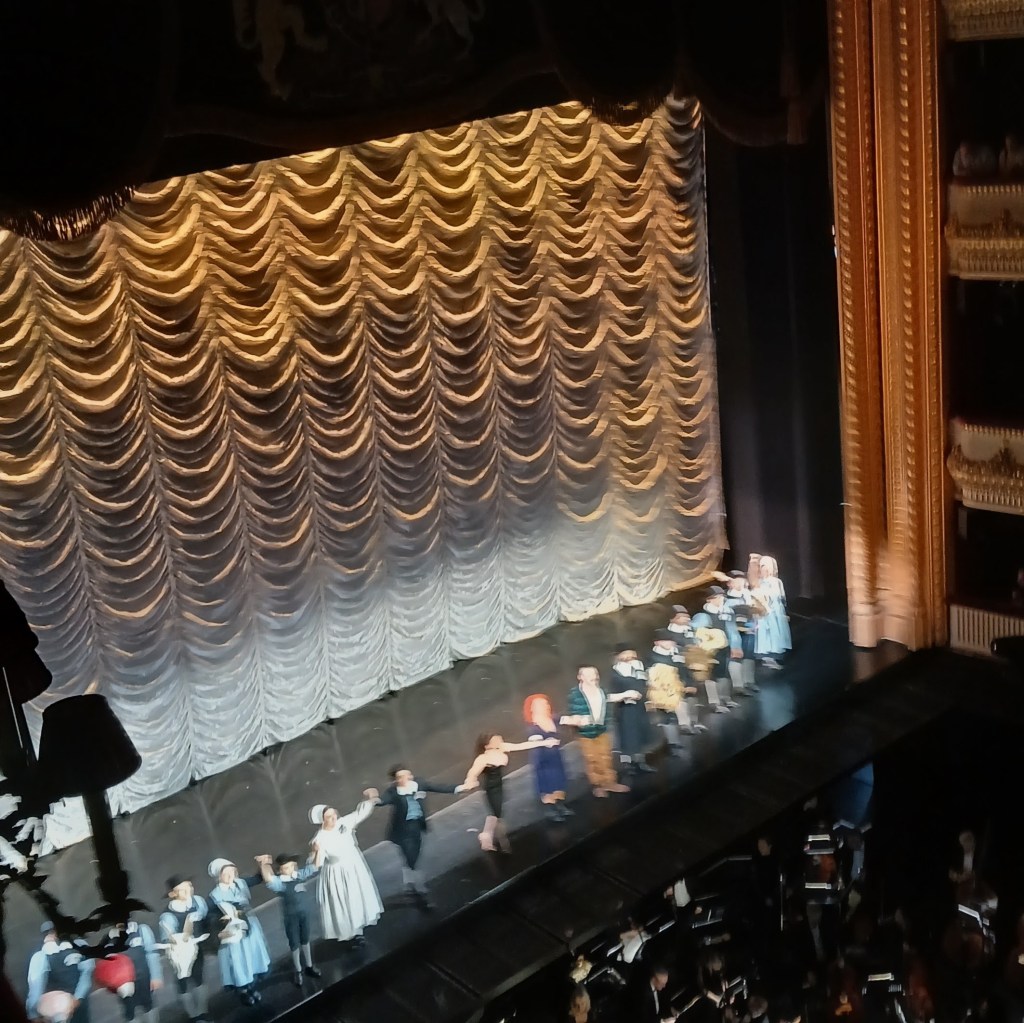
The ROHCG website announced that “This production contains nudity, blood, violence and self-harm.” To which, I suppose, one could reply – ‘and so does the Bible….’. My forebodings about this new production were fed by the ROH publicity – “This bold and dystopian staging gives a science-fiction twist to Wagner’s religious epic, which explores themes of power, gender and ideology” (NB no reference there to the exploration of religion or religious experience, which is the whole focus of the work); “Breathtaking lighting and a hallucinatory, dystopian set design bring Wagner’s all-consuming final opera to pulsating life in Evgeny Titov’s bold, dreamlike and disturbing debut production”. Oh dear……some preview photographs of sets suggested something indeed very different from woodland glades for Act 1. I read the headlines of an interview with the director Evgeny Titov which also did not get me enthused – ‘it’s an ugly, sexist piece’ he said, before the article disappeared behind the Times’ firewall (I agree that the Act 1 Grail community is a flawed one – that goes with the plot – and that sexism might well be part of those flaws, but it is precisely redemption from such flaws that Parsifal is offering). Media reviews of the first night were uniformly enthusiastic about the musical side and varied considerably in their enthusiasm or lack of it for the dramatic presentation – AN Wilson wrote a Substack piece calling it a ‘Catastrophe’ dramatically, others were much more positive, including Mark Berry’s Boulezian blog review, which I always pay particular attention to – however I only skimmed this; I’ll return to read in more detail after seeing the production. Anyway, I sat in the theatre, I hoped with an open mind, before curtain-up, for the best, and these are my thoughts after the event…………
Positives first:
I was gripped and kept focused by what was happening on stage throughout the over-4 hours of this performance. Not for a minute did I find my mind wandering. That’s a huge credit to singers and director as indicated further below
My memory doesn’t really go back to the details of what the 70’s/early 80’s productions of Parsifal were like, but in recent years I can’t recall a better acted production, and a better use of personenregie by the director, particularly in the second act. And that’s even with a jump-in for Gurnemanz, Brindley Sherratt being suddenly taken ill, who could not have had much time to work out in detail what he was meant to be doing on stage. All the characters were utterly believable, and there were many compelling touches – Kundry breast-feeding Parsifal; the naturalness of Kundry and Parsifal’s interactions later on in that act; the more than usually attentive and believable squires and pages attending Gurnemanz; the only time I have seen Flower-maidens (to give them their daft Victorian name that seems to have stuck with them) move in ways which weren’t faintly embarrassing, and who were, indeed, positively intimidating; the aggressive movement of the Grail knights in Act 3 towards Amfortas, and the latter tottering around the stage, a pathetic figure. I thought the way Kundry died during the Good Friday music was wonderfully done, and gave her character extra stature and enhanced agency – in some productions she just slinks out of view to die.
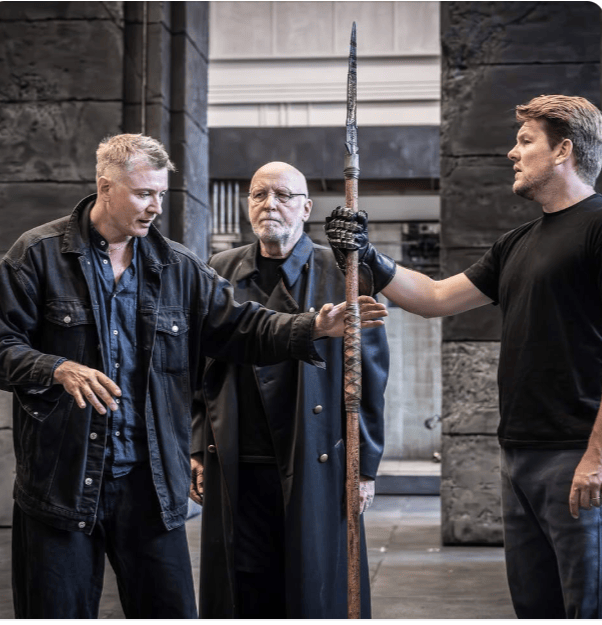
Except for those elements I’ll touch on below, the directing of the singers was focused on telling the story, for long stretches in a straightforward compelling way, particularly in Act 2, but also in Act 1 Scene 1, and Act 3 Scene 1. Coupled with this there were, for the most part, some of the key stage props referred to (on the Grail, see below) in the text, which help newcomers to the story work out what’s going on – thus, there was a spear (for once, praise be!), there was a water bowl for washing feet etc, Parsifal appeared in black armour in that act (kind of…..) and with head covered; Kundry had a white baptismal dress. And all the characters looked credible – Kundry, Parsifal (even when mostly naked during Act 2), Amfortas, Klingsor; this again is helpful to those new to the work.
Musically, this must be one of the best Parsifals I have seen. There were no weak links. In no particular order then: the choruses of the knights I have rarely heard sung so well and so sensitively – perhaps only equalled, but not surpassed, by Bayreuth’s, while their unseen counterparts, appropriately and sensitively distanced in some electronic way, sung beautifully; Stanislas de Barbeyrac’s Parsifal had no problems in hitting the top notes, or having the power for, say, his end of Act 2’s destruction of Klingsor’s castle, but he also sang his contributions to the Good Friday music most poetically; Christian Gerhaher’s Amfortas was astonishing in his diction, his shading of words, the way his voice could on occasion assume a kind of attenuated sound to convey his suffering – this must be the best account I have ever heard of this role; the Gurnemanz of Andreas Bauer Kanabas (replacing Brindley Sherratt) was deeply impressive – he has a huge voice which resonates far back into the Amphitheatre, and he used it very well – maybe Brindley Sherratt might have given more poetry to some moments, but this was imposing and just right for the role (touchingly he missed a line out just before the Act 1 Transformation Scene, but was completely unfazed by it – he got a huge cheer at the curtain calls); I have heard Ekaterina Gubanova’s Kundry in several different productions now but this was as good as I have ever heard her in the role, while the Klingsor, Mark Stone, did all that was required of him. This was Jakub Hrůša’s first ever set of performances of the work, and I found his reading very compelling indeed. If I were to sum up how it came across, I’d say ‘intense and flexibly compelling’. This was not a ‘slow’ or a ‘fast’ Parsifal but one where tempi were judged very well in relation to dramatic impact – on occasion in Act 2 fast, even violent, at other times among the slowest I’ve heard. But most of the time, one wasn’t feeling ‘slow’ or ‘fast’ tempi but just sensing ‘rightness’. There was great clarity at times in the orchestral playing – the often-quoted Debussy comment about the music being lit from underneath came to mind in the Prelude – but also energy, depth and passion where needed, and some remarkably intense string playing, particularly from the violas. This was an enormous personal achievement for Hrůša.
I’ll now describe sets and costumes, which were a mix of the appropriate and the mystifying. Colours throughout – for costumes and for sets – were black, white or grey – not a flash of other colours, except for the rather creepy ‘flower-maiden children’. The ‘woodland clearing’ of Act 1 Scene 1, and the similar setting, with meadows and flowers, in Act 3 Scene 1, had become a dark and gloomy set of dungeon-like rooms, with mildew stains and no evidence of recent attention or cleaning. Amfortas’ bath in the lake had become almost a torture chamber, again gloomy and stained. The Grail castle scenes were much the same – some large imposing pillars were moved on stage but essentially no change in atmosphere. In all these scenes there was evidence of an electronic surveillance system – picking up on Parsifal’s murder of the swan quickly. Act 2 is brighter and has a set of screens to stage left and a sort of office space for Klingsor – again there’s surveillance equipment. The images on the screen were, to me, mystifying – animated images at first from 600 years of Western art, mostly religious in focus, The spear and other religious artefacts seemed to be held in a mini-gallery of cases, so there is something here maybe about external possession of a religion rather than inner understandingand; there was also later 20 or more images of a face, grimacing, smiling, contorted – not recognisably any of the characters. I couldn’t work out what was intended by these. The idea of having the flower-maidens as robot – like, in grey tight-fitting metallic-looking trousers, is clever, appropriate and well-managed. What we have then is a gloomy dark dystopic Grail castle and surroundings, and a fiercely lit oppressive opposite in Klingsor’s castle
My concerns about the production were a lack of clarity on what, by the end, it all amounted to – what was it that was meant to have happened? The stage directions clearly indicate that the Grail community is made whole, ‘redeemed’, by the coming together again of Grail and Spear, and that Parsifal is ‘the redeemer’. Some have argued that Buddhism is a more important influence on the work than Christianity, and that Parsifal is a sort of Boddhisatva, who has reached enlightenment but remains on earth to help achieve others’ enlightenment (see the excellent Monsalvat website for much more along these lines). The two key elements that generated confusion, for me, anyway, were (1) where the Grail was in Acts 1 and 3 scenes’ 2, and (2) what is it that’s happening at the end of Act 3. The ‘Grail’ scenes as such have nothing in them that functions like a chalice, or glowing stone, that might traditionally represent the Grail. The Grail service involves the knights taking small cups to Amfortas’ body and drinking his blood from the wound. Essentially, they, led by Titurel, are torturing Amfortas, who wants only to die, and keeping him alive to feed on him. My assumption, from the way that he was lit, was that Amfortas himself is the Grail (this of course raises the question of what the Grail service looked like before Amfortas’ wound – but let’s not go there………). You could assume perhaps that Amfortas had become Christ on the cross, given the language used, but this only serves to complicate things more by the end. The other problem is about how the production ends. As Parsifal enters with the spear. the knights disappear, curiously, and the lighting becomes brighter – Amfortas and Parsifal are left alone on the stage. Amfortas motions to Parsifal to put the Spear over his wound, to heal him. Parsifal does this, does it again, and again, Amfortas continuing to encourage him. Suddenly Parsifal in a frenzy stabs him repeatedly, Amfortas dies, and Parsifal then crawls into a foetal position beneath Amfortas. It is very difficult to work out what is happening here. Both Amfortas and Kundry in different ways have escaped the wheel of suffering. But Parsifal despite his status as ‘redeemer’ still seems to be on that wheel at the end. Is the director trying to say that people are saved by God’s grace alone and no-one through purely human efforts can ‘redeem’ someone else or become a redeemer/ Or is it just that human life is irredeemably full of suffering. Whatever the intention, what we see on stage seemed to me to be in contradiction to what the music is saying – peace, fulfilment and reconciliation. Perhaps the director sees the final 5 minutes as celebrating Kundry and Amfortas’ escape from suffering? But what we see is a failed Parsifal before us.
To my mind, Amfortas as Grail, and the torture he is put to, is justifiable from text and music; Amfortas’ death is also justifiable – he spends most of his scenes in the opera asking for it. But the way Parsifal behaves at the end seems to me to be contradictory to the music – obviously music is not something you can put labels around, but I would challenge anyone to describe those last 5 minutes as despairing, troubled, or anxious music. So either the director is intentionally creating an ironic contrast (which may be what he intends) or he’s just got it wrong.
In a way I thought the Serebrennikov production I saw in April in Vienna had the more effective ending. But, until those last 5 minutes, I thought in many ways this Titov production was truer to the work, and more effective in bringing forth insights about it which I hadn’t thought of before. My forebodings by and large were unjustified, I’m glad to say………………….
I do think though there is a difficult balance that ROHCG has in commissioning directors to work on big pieces like this. It has two sets of people to keep happy – there are the old lags like me, who can place the production in the context of others they’ve seen, and be interested in different approaches; but there are others seeing it for the first time. What would they have made of it, and would they have come away about misconceptions about the work? Food for thought, anyway…………….
The Hallé, ENO Chorus, Opera Rara. Paul Daniel Conductor; Alistair McGowan, narrator; Loïc Félix, Bababeck; Mathias Vidal, Saëb; François Piolino, Kaliboul’; Philippe Talbot, Xaïloum; Anne-Catherine Gillet, Maïma; Valerie Eickhoff, Balkis; Katia Ledoux, Périzade; Thibault de Damas, Le grand Mogol.
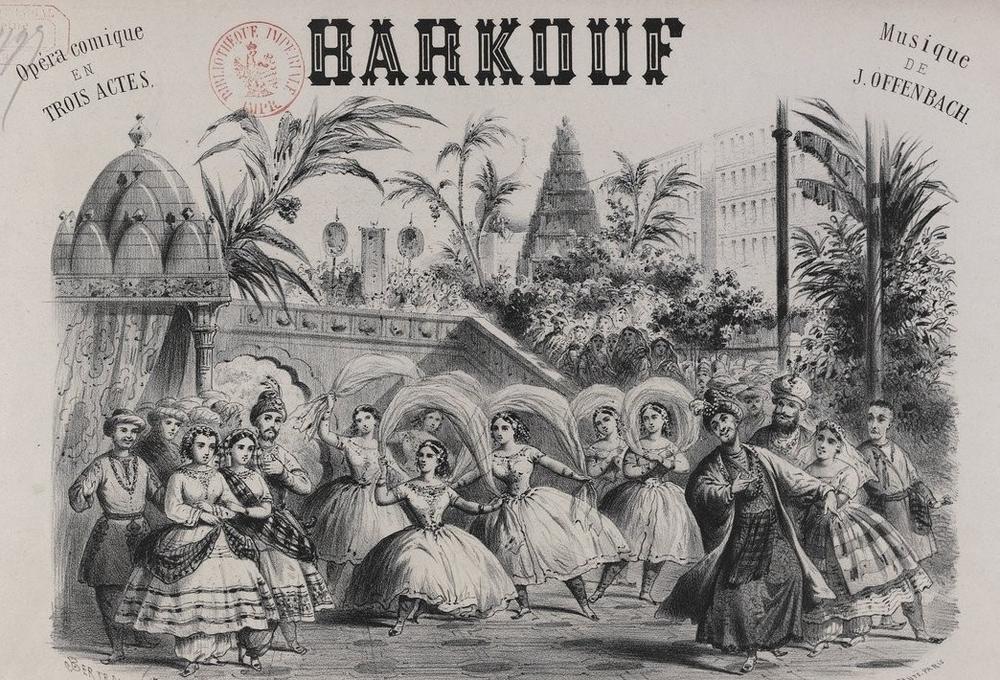
This is not a well-known work – as I suppose its appearance under the auspices of Opera Rara would indicate – and not one I’ve even heard of before. The Great Mogul of Lahore, the ‘ruler of all rulers, star of all stars’ appoints Barkouf, the dog, as the head of government to humiliate his rebellious people, in a country where, to quote the Bridgewater Hall blurb, “corruption runs wild, flattery is an art form and the only thing more dangerous than power are the incompetent politicians desperate to win it …The dog rallies the people and proves that even the unlikeliest hero can change history. …………….. Barkouf is a riotous romp through pomp, politics and power that is as relevant today as it was when it was first performed in 1860” (where after a few performances it was shut down, as being too critical of the 2nd Empire political establishment, and because of a whole series of mishaps with cast rivalry and illness). The story features a baddy, also Grand Vizier of Lahore – Bababeck – and a young woman who runs a fruit stall – Maïma. The Sultan appoints the dog he’s encountered as ruler of Lahore and Maima then realises that the dog is hers. She persuades Bababeck that only she can interpret what Bakouf is ‘saying’ and then issues some very liberal pronouncements in her interpretations, which shock Bababeck and his cronies. At the same time Bababeck is trying to marry off his annoying daughter to Saeb, through blackmailing his father – but Saeb is also Maima’s boyfriend. Barkouf’s woofs are translated by Maima to mean that he wants the marriage annulled, to the fury of Bababeck, who then, with his friends, plots a revolt but eventually is foiled by Maima – though Barkouf gets killed in the ensuing fight. All ends happily for Maima and Saeb
In a conversation between Flora Willson and Paul Daniel, the conductor, before the show, Paul mentioned that Offenbach had written about 130 musical stage works, including comic operas – of which only 4 or 5 are in the repertory. Many of the 130 musical stage works’ full scores have been lost and in the case of Barkouf a lot of detective work has been undertaken by Jean-Christophe Keck, rooting out manuscripts from members of the Offenbach family, and French and American libraries (M.Keck was actually part of the performance, playing the part of the dog Barkouf off stage with a terrific collection of doggy growls and snarls). There are apparently other Offenbach works M.Keck is working on.
Opera Rara I realised I didn’t know much about. They apparently receive no public funds and rely on private funding of approx £1 million a year to bring at least one or two unknown works to the public’s attention annually. Their primary focus is on producing a recording, as with this show, and then the live performance is the icing on the cake – so orchestra, chorus and soloists have just finished their recording in Halle St Peters after two weeks of intensive work. Opera Rara clearly has the funding to do things in style – hiring the Halle, hiring Paul Daniel (not only a very experienced opera conductor, but also with a lot of experience in France) and bringing together a really first-rate group of mainly French or Francophone singers, all with international experience.
Paul Daniel in his pre concert conversation talked about the superiority of Offenbach’s music to Gilbert and Sullivan, who are the nearest comparison that comes to mind (and Offenbach was in the UK for a couple of years at the time of the Franco-Prussian war, so connections could have been/?were made). Paul Daniel described G & S as ‘piano music’ transposed for the orchestra, rather 4 square and routine, whereas Offenbach is much more innovative (he was a keen student of Berlioz’s orchestration – Berlioz never learned the piano). Apart from that there’s a certain “zing” in Offenbach’s music, a fizz you never get with G&S. Of course ,Gilbert’s text is sometimes very funny – as a box office success Offenbach was paired with the most eminent librettist of the mid 19th century opera house, Scribe. There’s not much sparkle in the sung text – however for this performance Jeremy Sams (who else?) had prepared a narrative to replace the characters’ spoken exchanges. More on that below.
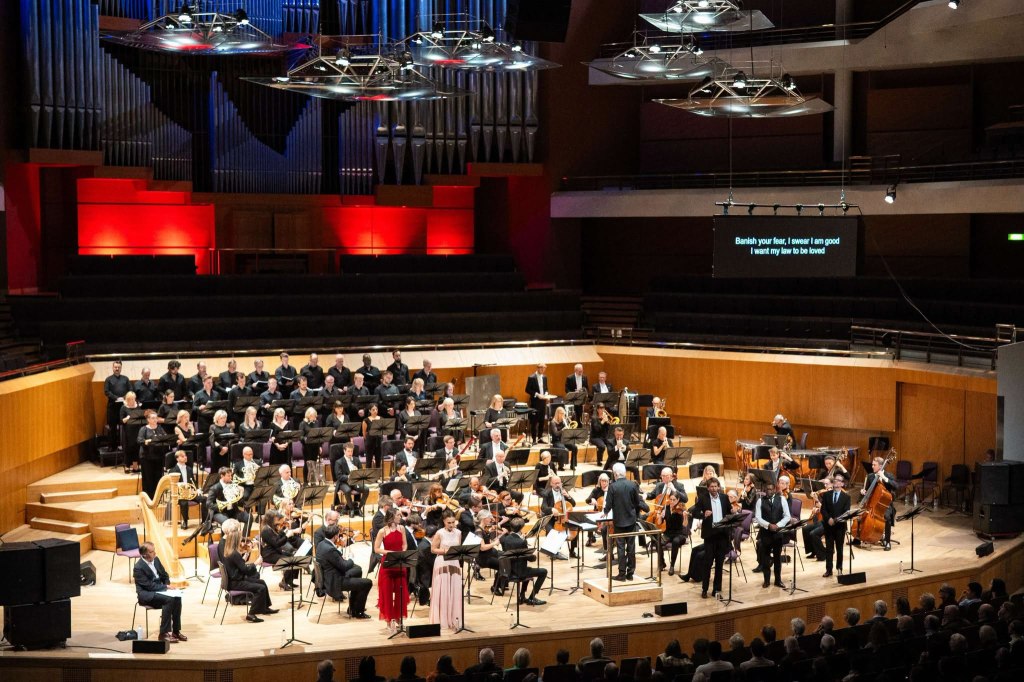
The singers were lined up behind music stands but – from my close-by position (Row B) – they were all engaging with each other, with even a very passionate kiss towards the end between Maima and Saeb. They were also all experts at this sort of music and had the ability to deal with staccato singing at speed, as well as shaping the more lyrical aspects beautifully, The people with the most to do – and absolutely able to make the most of it – were Anne-Catherine Gillet, as Maïma, and Loïc Félix, as Bababeck. Ms Gillet I fell in love with by the end of the first act – in movement, in singing, in pointed characterisation she was superb. Loic Felix has to project a suitably nasty manner and deal with the Offenbach equivalent of patter songs, and he did this brilliantly. All the other cast members were in their different ways equally capable but a special shout for Katia Ledoux, as Bababeck unmarried daughter, Périzade, a wonderful character actor. The Halle, reduced in numbers naturally (4 cellos for instance) were incisive and the ENO Chorus and RNCM singers all made the most of their parts. Paul Daniel presided over the whole thing with extreme economy of movement but total control. The one question I had was over the narrator, Alistair McGowan. He is apparently a stand-up comic as well as an actor, and a brilliant mimic (he did 8 of the political voices in Spitting Image some years ago). He read the actual narrative very well, with effective pointing, but kept putting on different voices for any quotes from Maima – Cockney, Welsh and something else. He was also given – for no particular reason unless it was simply to pad out a rather short second half – a stand-up comic slot at the beginning of the 3rd Act – lots of different accents and various Mancunian jokes, particularly about the current travails of Manchester City FC (I don’t know how that went down with those in the audience – the majority – from Manchester). I thought he was a bit too much of a good thing.
Conductor, Stefano Montanari. Gordon Bintner, Don Giovanni; Roberto Tagliavini, Leporello; Lydia Katarina, Donna Anna; Aigul Akhmetshina, Donna Elvira; Bogdan Volkov, Don Ottavio; Chelsea Zurflüh, Zerlina; Dingle Yandell, Masetto; Andreas Bauer Kanabas, The Commendatore. Director, Kasper Holten; Set Designer, Es Devlin; Costume Designer, Anja Vang Kragh; Lighting Designer, Bruno Poet
I last heard Stefano Montanari conduct last December at ROHCG, when he worked with the orchestra on an excellently played Ariodante, joining in with his violin on occasion. He was one reason why I wanted to hear this revival) the other being of course Aigul Akhmetshina as Donna Elvira. I last saw the production in 2021 – here is my blog write-up of it then – Don Giovanni, Mozart: ROHCG, 18/7/21 – John’s musical journey. I remembered this as a good production, and Don Giovanni is a work one can hear again and again. In addition, I have been reading (courtesy of Kindle’s bargain basement = £0.99p) a book called Mozart The Dramatist written by Brigid Brophy, first published in the 60’s and revised in 1988. It has many fascinating perspectives on Mozart* and the Enlightenment, not least on the male seducer as a type, in one way valued by the 18th century for their spear-heading of pleasure as an alternative goal to the 17th passion for the godly life, in another too easily getting out of hand and having to be reined in by the very supernatural religion the Enlightenment claimed to be against. To quote Brophy “Everyone knows (thanks to Tom Paine, who christened the enlightenment the Age of Reason) that the immediate duty of the emancipated Ego was to reason out its own moral judgments. However, as soon as reason was set free to act on behalf of the individual Ego, it began to accomplish another liberation even more fundamental to the character of the age: the emancipation of pleasure.” And ”Having nothing but love and the love of pleasure on which to found its hopes of social coherence, the enlightenment was particularly alert to the disruptive effects of those forces when people acted on them in personal relationships without first consulting either rationality or external constraint. The figure of whom its literature is most wary, and against whom the most stringent of its moralisings are directed, is the seducer.”It’s a short, though, odd step from Don Giovanni to the French Revolution
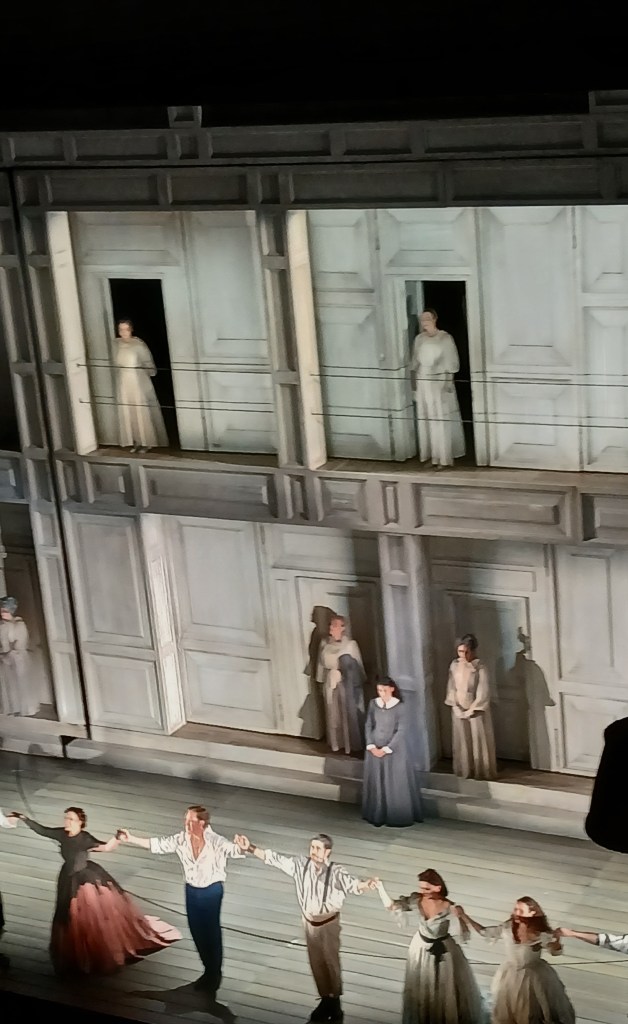
I found the production this time less satisfying than 5 years ago (perhaps, two months after the opening of the theatres after Covid, I was more generous and thankful). The various levels of staging, with lots of doors and superimposed images, means that it is always easy to see the singers, but all these split-up rooms and stairs allow you never to see the chorus, and makes many of the interactions between the characters have to happen at different level. This may well be deliberate, a presage of the total isolation which is hell for Don Giovanni at the end, showing a society where everyone is an isolated individual. But to me, it seems clear that Mozart and Da Ponte wanted the final scene – commenting on the justice of what has happened to the Don, and saying how we ought to behave – in place as a balance to the scene with the Commendatore (this production is unique among those I have seen in omitting it) and in the same way there should be some sense of a wider society behind the main characters, and a more open stage, at least at time, so that there is ‘another way’ beyond the total emancipation of pleasure. I also thought the handing of the Commendatore’s death is confused in staging – Donna Anna is clearly having fun with Don Giovanni (indeed she has another fling later on in the first act, I think) and the staging to me suggested she knows from the beginning he is the killer of her father – did she go into the house before the Commendatore’s killing? I don’t remember her doing so. Obviously she then has to pretend to Don Ottavio she doesn’t know at first who killed him– it all seems a bit clunky.
The other problem – to my surprise – was Stefano Montanari. In place of wielding a violin he conducted and played a centre-orchestra harpsichord for the recitatives. Many of his ad hoc harpsichord responses to the characters were really quite funny, and he occasionally added the harpsichord to the orchestral textures – doing then exactly what Mozart would have done in this work. But his speeds were in general too fast – gorgeous bits of interplay between strings and woodwind became smudged, notes were gabbled, harmonies submerged, and singers often rushed. This was really not good Mozart playing, and such a contrast to what I remember in 2021 when a German conductor called Constantin Trinks was conducting. Just very occasionally things were a bit more relaxed – Anna and Elivira’s last big arias were taken at a more measured speed, presumably to allow them to handle the coloratura, and these were then so much more enjoyable.
The men were the stronger element among the singers. Gordon Bintner was a first rate Giovanni – he has the looks, the energy, the ease on stage and a golden warm voice which sounded lovely in his serenade in Act 2. He also was very credible in suggesting the character’s violence and menace. Roberto Tagliavini was utterly convincing as Leporello, with a big voice, good projection of words (when not hassled by Montanari) and in particular an excellent ‘Catalogue’ aria. Bogdan Volkov (and admittedly Montanari was helpful here too in his arias) made Don Ottavio less of a bore than he sometimes is, and his voice was bigger than some in this part – his ‘Il mio tesoro’ was really enjoyable and with excellent coloratura runs (and must be a first for me to say that). Masetto and the Commendatore were both well done. None of the three female singers really offered outstanding performances, though none were in any way less than wholly adequate. Aigul Akhmetsshina as Elvira was passionate , she can act well, and she has a gorgeous voice but somehow she doesn’t sound quite right for Mozart – the voice is too big, the coloratura runs a bit approximate; Lydia Katarina as Anna and Chelsea Zurfluh as Zerlina had good stage presences, both looked their parts and were very credible, they did nothing wrong, but were simply not as good in their singing as, say, among contemporaries, Lucy Crowe (for Anna), let alone (in that role) the likes of Margaret Price – not as colourful, not as agile.
It was wonderful to hear the music again but I don’t think I’ll return to this production without some very special singers in prospect.
*A very interesting insight is the relationship between Dorabella and Fiordiligi in Cosi Fan Tutte, and the two Weber sisters who Mozart both courted
Director, Richard Jones; Designer, Antony McDonald, Lighting Designer, Lucy Carter, Conductor, David Bates. Alcina, Lisette Oropesa; Ruggiero, Emily D’Angelo; Morgana, Mary Bevan; Bradamante, Beth Taylor; Oronte, Ru Charlesworth; Atlante, Edward Grint
I loved this this award-winning production when it was new in 2022, and now it’s back with some of the same cast – notably Oropesa – but with Beth Taylor Bradamante instead of Varduhi Abrahamyan, and a different conductor. I hugely enjoyed it in 2022 and I was as impressed by it in 2026. The story involves Alcina, an enchantress on a magic island, using her powers to lure her lovers to her island. When she tires of them, she transforms them into animals. Ruggiero is her latest lover – but his wife, Bradamante, is intent on rescuing him. She arrives on Alcina’s island, disguised as ‘Ricciardo’, a man. Morgana, Alcina’s sister, is immediately attracted to him, and Morgana’s jealous lover, Oronte, falsely states that Alcina is in love with ‘Ricciardo’ too. We feel increasingly sorry for Alcina as she tries to sort out this mess………………..
I asked myself afterwards why was this so enjoyable – the best Handel production I’ve ever seen, apart arguably from Saul at Glyndebourne directed by Barrie Kosky. I think it’s a fairly simple answer in fact – great singing and an extremely inventive production, and one where all the singers are invested in the production and look as though they are thoroughly enjoying themselves; also it is one of Handel’s greatest operas, in my view, in terms of the quality of the music and the way one feels for the characters in this huge entanglement they’re all in. And, in this production, it’s fun!!………
The singing first: there are no weak links in the singing. As a matter of personal taste I am less enamoured of Emily D’Angelo’s voice than Oropesa’s, Bevan’s or Taylor’s – it always sounds just slightly constricted/tight and insufficiently colourful – but she offers all the stylish singing and the athletic coloratura one could wish for (and she is a much more convincing male than many singers in trouser roles on stage, in movement and stance), and also I think the house disagreed with me; she got a bigger cheer than Bevan. But, for me, I was really blown over by the other three females. Oropesa’s virtues have been praised in this blog on several occasions over the last 5 years since I first heard her in Rigoletto; here she was supreme. She has relatively little to do in the first act but her singing in the second and third acts, expressing rage at what she sees as Ruggiero’s betrayal and her sadness at the loss of her magical powers and her lovers was very finely done – powerful top notes, the voice fined down on occasion so that it appeared to have the same resonance as a flute, pure and clear, the elaborate clarity of the coloratura, the pointing of words; all this was extremely well done. And she acts well too, creating a credible mischievous, energetic and lively personality without ever overdoing it. Mary Bevan I thought was even better than 4 years ago, floating her high ‘white’ voice beautifully in Tornami a Vagheggiar, and her silvery coloratura was precisely judged without a single smudge. It’s not a big voice but she makes it carry. Her energy was engaging – she threw herself round the stage and was the most active dancer among the singers. Beth Taylor, who I heard in Les Troyens at the Proms few years ago and who has been making a name for herself in Europe and most recently at the Edinburgh Festival has a wonderful voice, full and dark, and again supple enough to deliver accurate coloratura. She only won the BBC Cardiff Singer of the Year in 2023 and is clearly destined for great things. She also was utterly engaged with her part, expressing her fury at Ruggiero’s spell-driven love for Alcina vigorously. Ru Charlesworth as Orontes has more to do than I remembered and he again was very fine, with all his arias (and there must be at least 3 of them) all delivered with distinction.
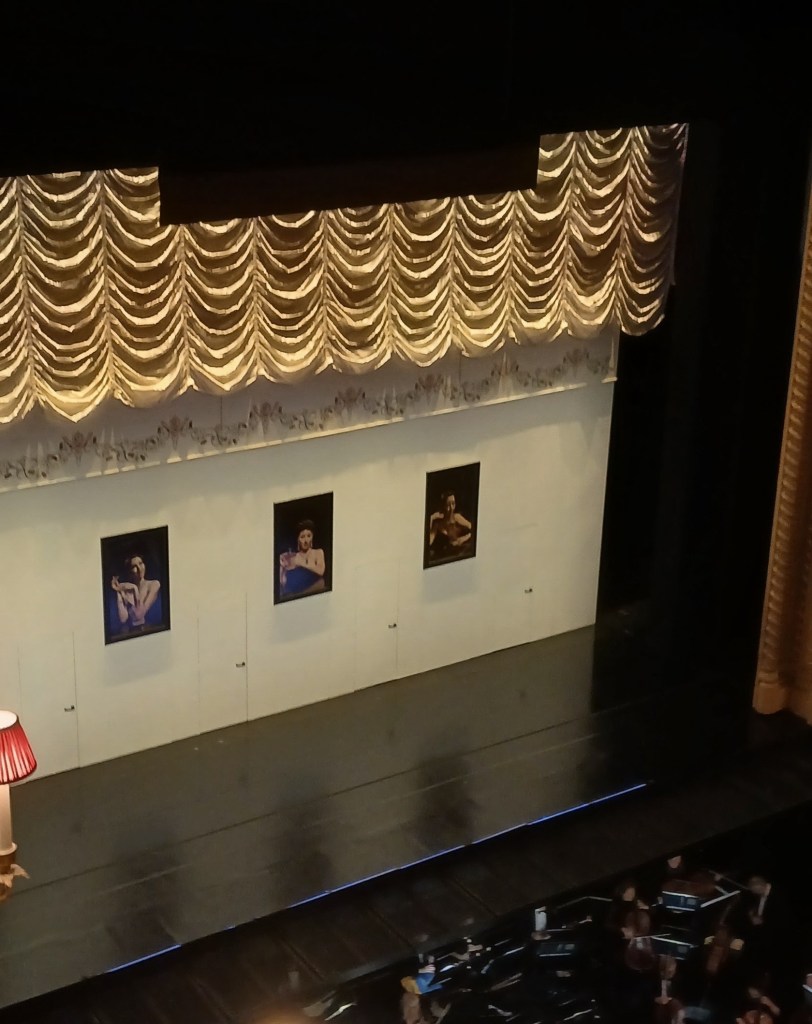
The main thing that distinguishes the production, I think, is its energy. The whole design concept serves this – there are two screens that go up and down (one of them with doors – in the photos below), curtains that can be raised and lowered, and a whole range of shiftable bits of set which can be moved around, and brought on and off stage – a wooden shed for Orontes the gardener, various bits of foliage, hillocks and trees, Alcina’s magic perfume bottle, the huge bed. In addition, of course, there are the 12 or so dancers who form the troupe of enchanted lovers turned into animals, with their wonderfully crafted heads – they form the backbone of the various dance routines, and are constantly on stage, moving things around and reacting to the main characters. What all this means – and it’s been done here to a much greater extent than in most of the Handel productions I’ve seen – is that there is always something going on, something to watch, somebody opening and closing doors, in the big da capo arias, and not one of them seemed over-long. Yet at the same time, the production allows Alcina to be alone, on the big dark Covent Garden stage, with nothing around her, in her arias of sadness and betrayal – so the energy always feel appropriate to the musical mood. ‘The concept’ – which I’d completely forgotten about from 2022 – doesn’t get in the way either: the enchanted animal lovers, and Bradamante/Ruggiero, are all 17th century Puritans, as is Atlante (why Puritans, goodness knows, since they are neither related to Handel’s time nor Ariosto’s, but anyway…..) focused on love, duty and Bible-reading. The opera begins and ends with them in Puritan clothing, seduced by Alcina at the beginning, and subverted by her and Morgana at the end (replacing the Bible with The Joys of Sex!). It’s all extremely well done, funny and touching, moving as well – we really feel for these characters. David Bates energised the orchestra and made them sound like a period instrument band – even though they aren’t!
After a very crowded, but respectful, Choral Evensong at Westminster Abbey (lots of Byrd and Orlando Gibbons) I went to my last Prom. I had said to myself a few years ago that I would give Mahler a miss for a while (this Symphony I must have known for 57 of my 74 years) and have then repeatedly broken that vow. This is something I should have avoided – not because there was anything wrong with it but because I just wasn’t in the right mood to engage with it (perhaps still recovering from Olafsson the previous evening).
The performance was an appropriately sombre choice for the 25th anniversary of 9/11 (not that that was mentioned). It was billed as a period instrument/style orchestral performance, with some enthusiastic promotion beforehand from Tom Service (BBC/Guardian). Like any similar performance of Elgar’s music would be (though to a lesser extent) it does raise the question of why it’s necessary when we have some sort of recorded benchmark. In the case of Elgar he recorded all his major works with British orchestras, whose performance and sound he presumably found acceptable. In the case of, specifically, Mahler 9, we have the famous live recording of Bruno Walter in 1938 (a couple of months before the Anschluss) with the Vienna Phil, still with Mahler’s brother-in-law Arnold Rose as leader, which must reflect – even 27 years after Mahler died – some elements of the orchestral sound he would have envisaged for this work – certainly the portamenti are there…… and Walter conducted the first performance in 1912.
Anyway, to quote its web site “The Mahler Academy Orchestra’s originalklang project sheds new light on the performance practice of Mahler’s time. For this unique project, the young artists of the Gustav Mahler Academy ….. under the direction of Philipp von Steinaecker ……. brought the music of the turn of the century to new life on historical instruments. To make the project possible, the Euregio Cultural Centre Dobbiaco Foundation has created a collection that unites the instruments used by the Vienna Philharmonic Orchestra around 1900. The Mahler Academy Orchestra is part of the Gustav Mahler Academy Bolzano-Bozen, which was founded by Claudio Abbado to create a place where …..exceptionally talented young musicians from all over the world receive decisive impulses for their entire musical lives under ideal conditions……….”
The big question is – so what? Yes, the orchestral sound is different in many ways, and it offers an aural equivalent of a restored painting. Much is fascinating – there’s more pungency to the woodwind (some wonderful bassoon sounds in the last movement), harder sounds from harp and timpani, a more cutting, intense sound to the strings, more rasp in the trombones, a sharper, tangy sound from the trumpets, and, actually, a mellower sound from the horns. There was a lot of portamenti, particularly in the first and last movements – I wasn’t looking out for (a lack of) vibrato, but Mahler apparently did ask for it in his score markings at times. But having said all that, it’s still the same score, still the same notes, and the same choices to be made about structure, about dynamics and tempi. And of course you have to factor into the complex mix the fact that orchestral standards have risen over the last century – even in my lifetime, How would the competence of a 1912 orchestra strike us?
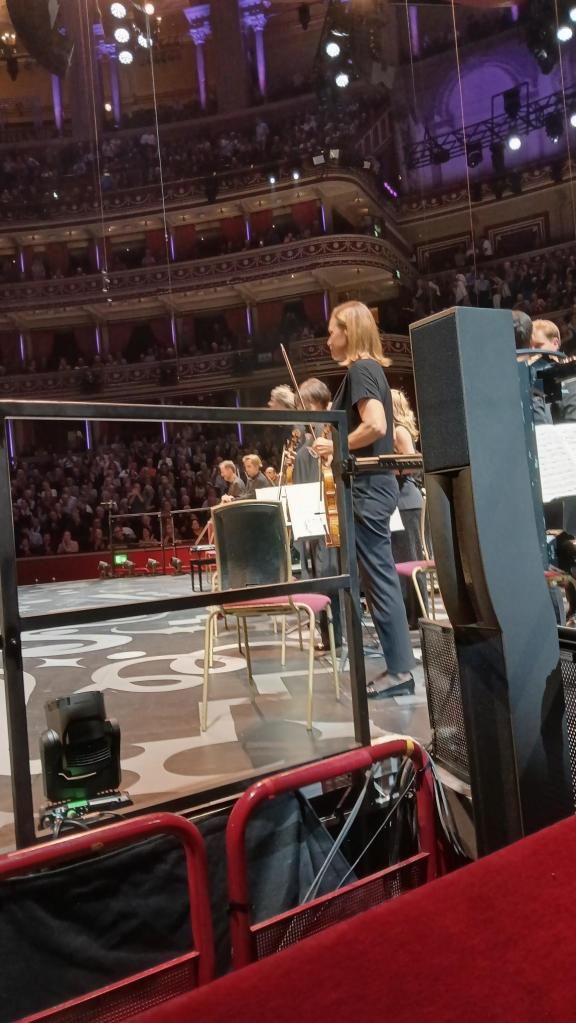
Clearly of course the score doesn’t play itself, and the orchestra – full of select young and a few older musicians – by and large sounded wonderful. I had a most odd seat at the end of Row 1 of the stalls, stuck about 3 feet from the second violins, but even from that vantage point they sounded very good indeed (I heard one or two too-early entries, but I was right on top of them) and I am sure the positioning of the orchestra – split violins, basses right at the back – would have contributed to the appreciation of the sound by those in better positions. But I did have some concerns about the conductor’s handling of some of the music: in the first movement, there was to me insufficient sense of progression and of structure – all the big climaxes sounded the same, there wasn’t a sense the music was moving forward emotionally; I also thought the basic tempo was too fast. In the 2nd movement, though the main laendler theme was taken appropriately slowly (and therefore allowing for the woodwind to make some gorgeous burbling sounds) the counter theme was set at too fast a pace, and notes got lost. The third and fourth movements went, to my mind, much better, though again I wondered about the structure of the last movement and the gradation of climaxes – some of the tempi seemed to be on the slow side. All in all, my reactions to this I think were on the whole more based around my not being in the right listening mode for this great work, rather than any real problems with the performance. The orchestra was particularly good in the closing bars – beautifully whispered, slowly moving into infinity; they had just finished and the players and audience were sitting in silence (something Proms audiences have been very good at this year for works ending quietly) when after a second some idiot at the back shouted ‘bravi’ and people started to clap. Why do people do that?
All in all, then, this was a fine performance I didn’t really enjoy for reasons that were to do with me, but I do wonder in this case how important the ‘authentic’ approach is for a work of this kind (I agree it IS important for Bach and Handel). I listened again to parts of the Bruno Walter recording from 1938 a few days later – what that recording has, which perhaps this performance lacked, was drive and passion (but I may be being unfair)
Bach, Prelude in E BWV854 from The Well-tempered Clavier Book I; Beethoven, Piano Sonata No. 27 in E minor Op. 90; Bach, Partita No. 6 in E minor BWV830; Schubert, Piano Sonata in E minor D566; Beethoven, Piano Sonata No. 30 in E Op. 109
On then to the conclusion of the Proms and the advent of rock-star pianists at the Wigmore Hall – Olafsson here and Yunchan Lim next month. The last time I heard Olafsson he was in Liverpool as part of his world tour of the Goldberg Variations, also on a DG CD/stream; this time his CD is a collection of Beethoven, Schubert and Bach but centred round Beethoven Op 109, and the keys of E minor and major. Again he’s been doing an extensive international tour, ending this week in London. I suspect he’s not a pianist that everyone will like but I have to say I love his crystal-clear sound and meditative approach, and the thunder when he gets energised, and this is much more important to me than what could be to some people the off-putting DG-promoted branding – the sharp suits, the designer glasses, the immaculately combed short hair……I’ve heard him described as ‘mechanical’, but I just don’t understand such an accusation.
For me, there were 4 profoundly moving and beautiful pieces of music in this programme – the opening Bach Prelude in E, remotely and purely haunting; the folk-song like Op 90 second movement, the Sarabande from the Partita full of the world’s grief and Beethoven Op 109’s 3rd movement – stupendously energetic, beautiful and moving. They are pieces of absolute music, they don’t ‘mean’ anything – they are just in their different ways perfectly formed, heart-gripping, towering, and utterly memorable. Olafsson’s programme was dedicated to the exploration of the relationships between Bach’s music and Beethoven, and between Schubert’s and Beethoven. In terms of the first pairing, as he writes in the programme notes (and said in an after-concert speech) “Their (Beethoven’s late piano sonatas and quartets) wild inventiveness and transcendence of traditional form is rooted in a deep engagement with Baroque elements. They are the music of the future, and yet they are fuelled by the music of the past – the music of Bach.”. You could really hear this in the tumultuous sounds of the mighty Toccata from the Partita and the Op 109 (moments of all three movements but particularly the 3rd), and the inventiveness of both. You could also hear the similarities between the Schubert 2nd movement and the Op 90 2nd movement (the Schubert written in 1817 two years after the Beethoven was published). As I had bought Olafsson’s recording a year ago or more, all these pieces were to some extent familiar – or at least recognisable – but I made far more of the Partita and the Schubert piece listening to them live. Olafsson makes the point that not only Beethoven but also Bach was moving into something new in these late works – “it is worth noting how Bach, too, is testing and transcending the limits of his chosen compositional form in his final Partita, taking elements that originated in dance and turning them into formal abstractions, free to travel into uncharted musical territory.”
Olafsson’s recording makes the piano sound as it would in your average large concert hall, but the Wigmore Hall is a much more intimate space – ?470 people, maybe? – and ‘thundering’ would be the right word at times for some of Olafsson’s playing here. But there was also great delicacy, a sense of line, and I was utterly gripped. It’s all a matter of taste, but nobody else holds me in the same way playing this repertory. I felt also that his performances were still being thought through, still explored – faster and slower at points than in his recordings, particularly the last movement of the Beethoven.
There was a bit of a disaster in the middle of the Sarabande – at its most intense, Olafsson suddenly stopped, and said loudly and firmly something to the effect of ‘There’s a malfunctioning hearing aid in here. Can it be switched off, please?”. Much consternation….lights came on, Olafsson went off stage; no transgressor was identified (though an elderly gentleman did walk out), and Olafsson came back to re-play the Air and then on to the Sarabande. He was very gracious about it afterwards – saying it was an interesting experience, to have to start again half way through the Partita and pick up the threads, but it was at least a variation on doing the same programme again and again!
After quite a talk at the end about the issues I’ve written about – the influence of Bach on Beethoven – he played as an encore no less than a transcription Olafsson had made of the ‘Air on a G string’ (a 5th perfect piece’, which he said (a bit of perhaps understandable showing-off here) he had played for György Kurtag on his 100th birthday in Budapest earlier this year……It was indeed perfect!
Vaughan Williams Fantasia on a Theme by Thomas Tallis; Britten Violin Concerto; Carmel Smickersgill A Brick Thrown with Love ; Vaughan Williams Symphony No. 9 in E minor . Simone Lamsma violin; Royal Liverpool Philharmonic Orchestra, Andrew Manze conductor
The puzzle I pondered over in relation to this concert before the event was why it was one of the first Proms to sell out and provide an audience almost as big as for the BPO the two previous evenings. Was it simply the lure of the Tallis Fantasia? Was it the assumption by a lot of people that the 9th Symphony must be like the Tallis Fantasia or The Lark Ascending? Is Carmel Smickersgill a rock star (I think not – her bio says she “is an award‑winning UK composer and performer whose work spans concert music, opera, electronic releases, theatre sound design, and live performance. She studied composition at the Royal Northern College of Music (RNCM”, The violinist is very good, but not, I would say, well known. I doubt if the Britten Violin Concerto would draw the masses. RLPO groupies? Who knows – anyway, whatever, the hall was packed out, and obviously that’s all to the good.
It was certainly a concert I really enjoyed, with one work I and indeed everyone else had never heard before (being a world premiere), two I have listened to but never really ‘got’ and I don’t think have heard live, and one old favourite (obviously, ‘the Tallis’). The programming I guess was intended to balance the serenity of the Tallis against the other three works – all troubled pieces for troubled times.
I can’t remember how other orchestras have been arranged for the Tallis piece. Here, Andrew Manze (a tall, very serious, slightly awkward presence on stage) had put the chamber strings group at the back of the stage above the orchestra, while at the same time the 4 string principals also offered commentary as the work proceeded. It was a fine performance, the RLPO strings sounding sumptuous when they were allowed to go at full tilt – they certainly didn’t sound an embarrassment after the two evenings of the Berliners.
The Britten piece I am gradually getting to know and understand. The overall feel of it for me is of uncertainty – the piece has an unresolved feel at its very end. It speaks of its time – Spanish Civil War, Germany’s occupation of Austria and Czechoslovakia. The first movement feels to me about a simpler past, yearning for it perhaps – the opening timpani notes of course must indicate some nod of recognition to the Beethoven concerto the previous evening. Even this first movement is complex in mood – sometimes hurried forward (perhaps how Britten felt in London as a student after his childhood), sometimes yearning and nostalgic – though with a clear identifiable main melody. The melancholy of the violin part fits well with the Albert Hall – a lone voice within a huge structure. The second movement moves on to different terrain – an unstoppable momentum towards some dark future, with protests from the violin solo (there’s some brilliantly imaginative orchestral colour in this movement), or perhaps a dance of death (and there’s a Spanish twist to the music at one point reflecting the civil war). The final Passacaglia (a set of variations on a ground bass) seems to be a dialogue between soloist and orchestra – the soloist perhaps representing the individual crushed by global conflict they have no control over, and the orchestra seems to finish on what sounds to me like a major chord, while the soloist is left on an undecided trill. Lamsma played it brilliantly – there was some remarkable playing in the cadenza after the 2nd movement, reflecting on the past again in the return of the first movement’s main theme. All in all this was the first time I have really felt I had got onto the wavelength of this work……….and also realised how compact and approachable it is (as is always the case with this great composer). So thank you Mr Manze and Ms Lamsma.
The Carmel Pickersgill work was approachable enough but I couldn’t understand the emotional journey – perhaps I should have bought a £7 RAH programme (but then why should I?). The audience anyway was appreciative, and the composer there to hear and see the enthusiasm.
The Vaughan Williams piece completely passed me by in my teenage years and 20’s. It was only recently – after reading enthusiastic reviews of Pappano/LSO’s performance of the 9th – that I realise I had no version of it in my streaming library. It still takes some getting-of-the-head round – I am sure I have recounted before in this blog Pierre Boulez in his days as Proms supremo in the 70’s referring dismissively to Elgar but saying of Vaughan Williams that he was innovating, thinking through new things, all the way from the early 1900’s to the 1950’s – Boulez appreciated him for that. It’s scored for a huge orchestra, including a trio of saxophones, and a flugelhorn. The symphony starts out broadly like the 4th and 6th, but with a wider range of emotions. It’s in four movements – conventionally a 2nd slow movement, a 3rd scherzo and a finale, andante tranquillo. Its general mood is one of darkness and doubt, little resolution, but the enormous crashes at the end in a major key (E?), fading away into silence, give a reminder of Job, 20 years earlier, and sense of hope – different to the entirely bleak ending of the 6th. I would say that its mood is altogether more complex than the 4th and 6th symphonies. It’s also interesting that, though there are plenty of VW musical tics and memories of other compositions, this work still feels as though it is saying something new. I was very moved by this performance.
Throughout the RLPO played magnificently – I noted one tiny slightly-too-early entry, but that was all in the way of glitches.
I feel very lucky to be nearly 74 and still exploring works I don’t know, and appreciating them so much…………..
I was intrigued by my neighbour in the seat next to me, a (to me) youngish smartly-dressed man in his maybe early 40’s. He seemed to have little interest in the Tallis or Britten (or the Pickersgill), alternating between looking at his phone and the stage. Suddenly, at the start of the Vaughan Williams, he seemed transfixed, and remained motionless and phone-less throughout, applauding vociferously at the end. Was he an example of a VW groupie?
Beethoven Violin Concerto in D major; Scriabin Symphony No. 3 in C minor, ‘The Divine Poem’, Augustin Hadelich violin, Berlin Philharmonic, Kirill Petrenko conductor
This was the fourth performance of the Scriabin work at the Proms – the others being 1918, 1921 and 2010 (with Vladimir Ashkenazy conducting). The concert looked to be a more substantial one (time-wise) than the previous evening – and Hadelich has been making a big impression recently (he performed the Brahms concerto with Thielemann and the VPO in Salzburg 10 days or so ago); the Scriabin work I don’t really know at all.
It was a decidedly large body of strings which emerged to play the Beethoven – probably needed, given the size of the RAH. I have to declare that the Beethoven concerto is not my favourite – in particular I often lose focus in the first movement. I recognise the extraordinary skill in the way Beethoven puts it together – all the thematic material is related to the first 4 drumbeat notes and the woodwind response, but I do find it meanders a bit. And it meanders particularly when a slow basic tempo was used, as was the case here…..Hadelich’s approach seemed sweet and dreamy – most beautifully so; perfectly legitimate, but somewhat soporific (not helped, I admit, by the fact that I was in a Choir seat – great for listening to an orchestra, less so for a soloist). The few orchestral tuttis occasionally galvanised the proceedings, Petrenko back into stick jabbing mode, but then we sank once more into meanderings….The slow movement was better (because it is MEANT to meander) and was intensely beautiful – extremely lovely playing from Hadelich. The third movement – always my favourite – was beautifully sprung and taut, the BPO sounding like an orchestra twice its size, and, apart from Hadelich, there were also some very perky contributions from woodwind and horns. Hadelich’s artistry and technique was remarkable, and he was received ecstatically by the packed-out RAH and played his own arrangement of a Schumann piano piece as an encore.
The Beethoven had obviously been programmed as a crowd-pleaser to bring in the punters who might (understandably) be put off by Scriabin. I wish I could confidently refute a reviewer of that first Prom performance of the Symphony in 1918, who described it as ‘having little to say but a great command of language’ and said it was ‘a long moan of most articulate anguish’. But, actually, that sums the experience; nearly 100 years later on its 3rd outing, the Independent reviewer wrote in 2010 ‘the will to live comes and goes during Scriabin’s protracted 50 minutes. Was music ever so static?’ I did have a prior listen on YouTube which confirmed my suspicions that it was essentially a bucket of chromatic soup. However I had a (slightly) more positive impression of the work, listening to it live. I hadn’t appreciated there was a Nietzsche-style programme (try to become a god and fail; fall into voluptuousness, try again and become god-like, approximately) and that there are three movements (though the boundaries are a bit hard to identify). There are also identifiable themes,which are developed and recapitulated along recognisable symphonic lines. But it is very densely and turgidly orchestrated (this makes the programme of the previous evening more pointed – both Elgar and Tchaikovsky were wonderful orchestrators); even though a huge orchestra is used (8 horns, triple woodwind) there is little in the way of brilliant sound (there’s no percussion) and mostly the only variation is in terms of volume. I have to say I never day-dreamed in the way I did in the first movement of the Beethoven – watching Petrenko manage these huge forces is a delight in itself – and i can’t say I ever felt restless. But the work did go on……and the emotional journey signed by the movements was less than totally clear. Enervated was probably the best description of my state at the end of it all!
Still, I am glad to have heard it, and of course it was wonderfully performed
Elgar ‘Enigma’ Variations; Tchaikovsky Symphony No. 4 in F minor. Berlin PhilharmonicKirill Petrenko conductor
So – the big one; more or less the first classical BBC Prom to sell out this year on Day 1 online (at c. no 6000 in the online waiting on the first day of booking I couldn’t get my first choice of tickets). It’s a characteristically short programme – and you know from the outset that these guys don’t do encores……But….it is the Berlin Phil, and, what’s more, the Berlin Phil playing Elgar, a composer Petrenko has conducted since his first appearances with them 15 years ago (Elgar 2 and possibly other works – a positive view very different to the von Karajan view that ‘Elgar is a second-rate Richard Strauss’). Petrenko is also presenting this programme with the BPO in their first concert of the season in Berlin – nice to have Elgar in high profile on the ‘Continent’. It’s not that easy to see the programming logic of bringing together these two great works, though, except perhaps that both were by composers who were outsiders in their society – Elgar, self-taught and Catholic at a time when the latter was still an issue for many people; Tchaikovsky as a gay man in Tsarist Russia, both are introspective and surprisingly they are both Op. 36’s!.
This was an extraordinarily good concert – and the programme chosen was, as it unfolded, actually very effective also because it showed the ability of the Berlin players in the two pieces both to handle the delicate, almost chamber-music aspects of the Elgar and Tchaikovsky beautifully, alongside delivering the romantic sweep and flair of much of the Tchaikovsky, and which also features in some of the Enigma – e.g. the finale and Nimrod as well as the beautiful melancholy variation 12, B.G.N. Both works also allowed the Berliners to demonstrate their astonishing dynamic range, from the whispered start of Nimrod and the delicacy of the first few bars of the pizzicato 3rd movement of the Tchaikovsky to the roar of the final moments of the Elgar and the manic announcement of the ‘Fate’ motif in the Tchaikovsky final movement, and with no sense at all of any deference having to be paid to the quirky acoustics of the RAH. And, of course, both these works gave opportunities for soloists to do their utmost – with wonderful phrasing or spectacular pyrotechnics (the solo ‘cello playing in B.G, N, and the quite tremendous piccolo in the trio of the Tchaikovsky Scherzo, not to mention the horn and the oboe at various moments.
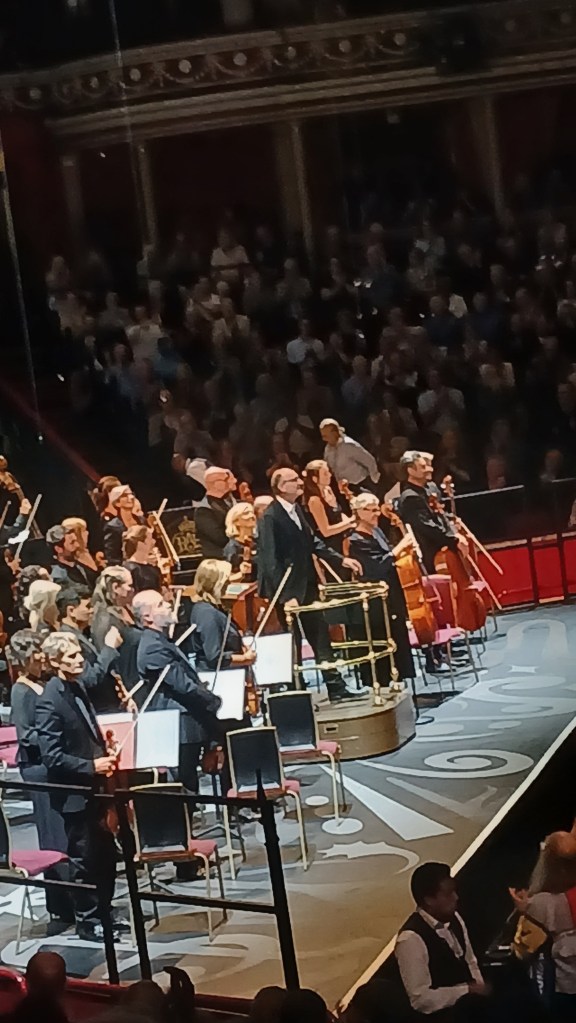
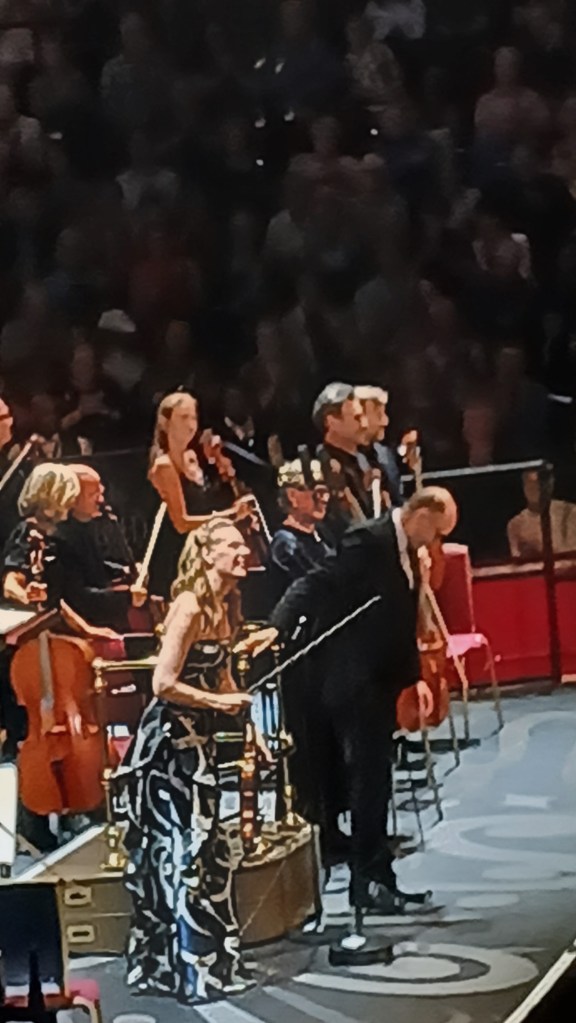
Kirill Pterenko is riveting to watch as a conductor – he manages to deliver a high-intensity rostrum performance which is wholly focused on the orchestra and with not a hint of playing to an audience. He crouches, he waves his stick exuberantly at the brass or woodwind or percussion, he scoops up the first and second violins with his left arm, he jabs his stick at solo instrumentalists, he almost jumps at the climaxes, but all with a manic gleam in his eyes daring his musicians to give beyond what they think they can achieve. And occasionally he just stops conducting and moves gently to the music, listening to the orchestra.
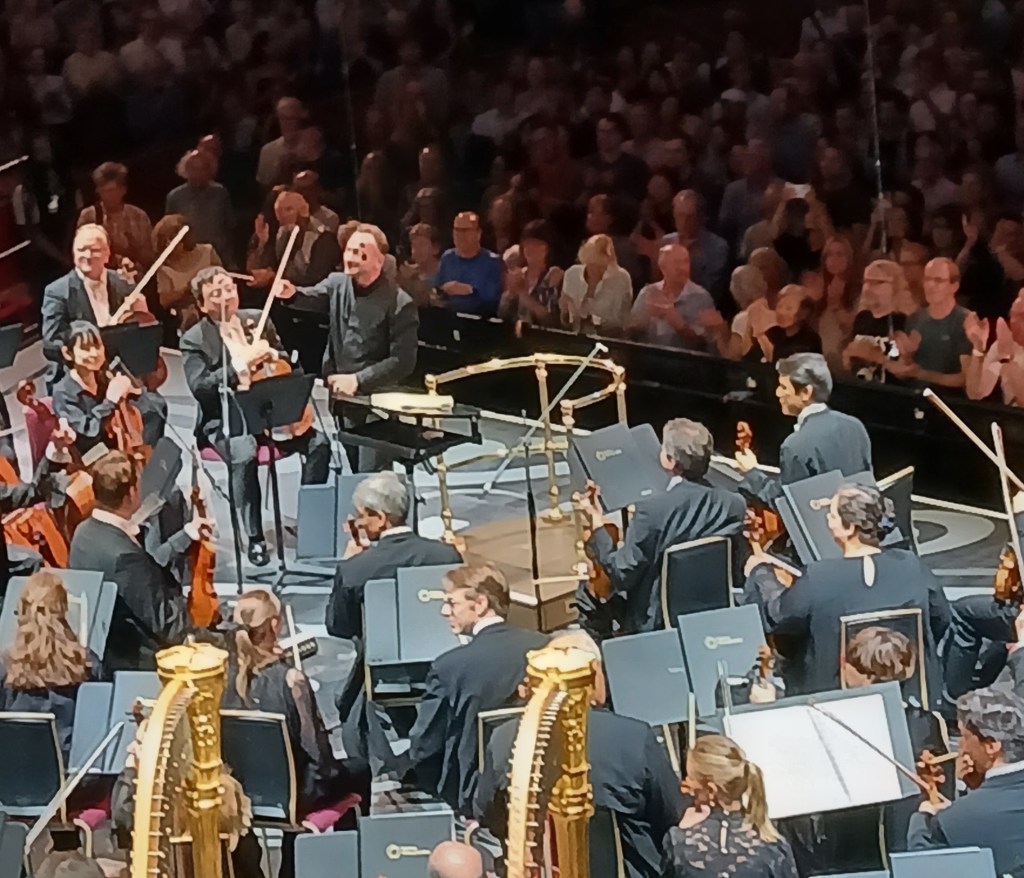
Inevitably the hall was packed out, and with a big buzz in the audience. The Enigma Variations was receiving its 106th performance since 1900 at the Proms!! I guess the overall pacing Petrenko went for was quite brisk, but with many moments of lingering and sensitivity…..There were so many good things about this performance – the achingly slow and serious account of the ‘theme’, the way it was so subtly phrased, the complexity of the orchestral sound in its repetition (when normally you only hear the strings – here there were all sorts of woodwind undertones); there was the nobility of the horns in variation 1, the complexity of texture in Variation 2, all fantastically clearly articulated. In Variation 4, the sudden immense noise of the BPO in forte mode, indicating how delicately they had been playing hitherto, and in Variation 5 the shades of light and dark beautifully brought, with some lovely string and woodwind playing; in Variation 7 the most spectacular timpani playing…… Nimrod was overwhelming – the depth of the string sound was extraordinary, the aching oboe, the seemingly natural build-up to the most wonderful full orchestral sound, the lack of any coarseness in the brass, and the final slow-down again to ppp ppp (or that’s how it sounded). I could go on (and on). The finale was taken fast, very convincingly, but loved where needed. I have never heard a better performance……
After the interval, Tchaikovsky……and I have begun to run out of superlatives. The 4th Symphony is in a sense a work more complex and denser than the Elgar, and, again, what was remarkable was how often you heard both complexity and then the transparency growing from it – different strands of instruments being heard e.g. in the restatings early on of the main theme of the first movement, after the ‘Fate’ motif. The rhythmic pointedness of the first movement was more exciting than I have heard it before, the slow ‘folky’ second theme of the first movement most delicately, yearningly, phrased, the brass and strings of the development section overwhelming at its climax as the Fate motif is repeated again and again, and the coda of that movement frighteningly powerful and intense. Throughout, one had that sense – as one did with the Met Orchestra – of players listening to each other and responding almost in the moment. One of the things I wasn’t expecting was at what a measured pace Petrenko took the first movement – really allowing acute rhythmic pointedness and soloists able to make their point, and giving a sense of grim inevitability. By contrast I did think – my only real criticism of the whole concert – that maybe the last movement was a bit too fast for all the off-beat emphases to come through effectively, and that excitement was holding sway over clarity and expressiveness. But it was tremendous……! I cannot imagine the second or third movements being better played – both taken on the fastish side, but with gorgeous phrasing and wonderful string playing
What an amazing orchestra and conductor………………every phrase of both works seemed newly minted, and the whole offering insights and sounds I had never heard before