Director, Richard Jones; Set Designer, Hyemi Shin; Costume Designer, Nicky Gillibrand; Lighting Designer, Adam Silverman; Movement Director, Sarah Fahie; Video Designer, Sasha Balmazi-Owen. Conductor, Riccardo Frizza; Lord Arturo Talbot, Francesco Demuro; Elvira, Lisette Oropesa; Sir Giorgio Valton, Ildebrando D’Arcangelo; Sir Riccardo Forth, Andrzej Filończyk; Enrichetta di Francia, Marcela Rahal; Lord Gualtiero Valton, Blaise Malaba; Sir Bruno Roberton, Giorgi Guliashvili
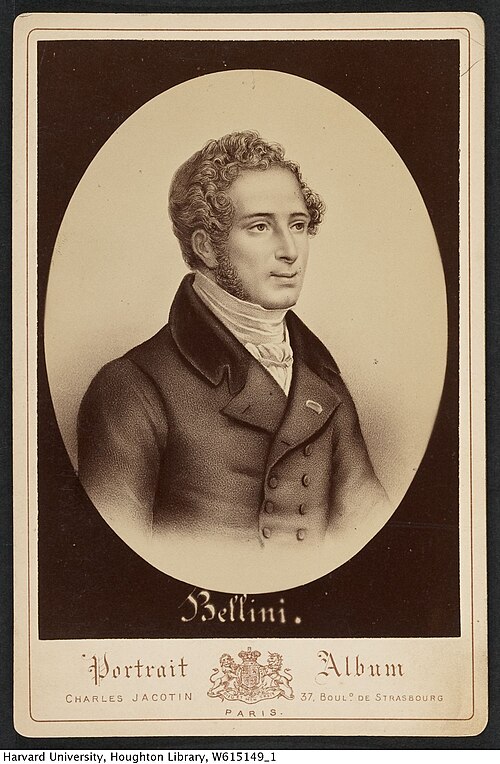
This work was a complete unknown to me – I decided to go to the dress rehearsal of this new production because I admire Oropesa as an artist (and hoped she would be singing and not marking in the role), and also because Bellini’s music was of interest to Wagner, so I wanted to further explore and listen to the connections. Indeed, at one point in his twenties, Wagner positively worshipped Bellini, and exalted Italian song above all other forms of operatic music. He had “Norma” performed for his benefit concert on Dec. 11, 1837 in Riga when he was GMD there. It was also at a performance of Bellini’s opera I Capuletti ed I Montecchi, in his early 20’s that he heard for the first time Wilhelmina Schroeder-Devrient, and saw/heard how powerful the combination of words and music could be in the hands of a gifted artist – as late as 1872 he said, “Whenever I conceived a character, I saw her.” I have seen commentators noting that the horn fanfares at the start of Act 1 of Puritani are a distant ancestor of Parsifal Act 1 and describing how Wagner developed Bellini’s approach of building long lines of musical tension in creating Act 2 of Tristan……
At any rate, apart from Maria Stuarda, this was the most enjoyable bel canto opera I have been to, and my attention was held throughout. The story is engaging if hardly historical – Elvira’s true love is a Cavalier but she is from a Puritan family. A Puritan Riccardo aims to marry Elvira. The Cavalier Arturo is suddenly given permission to marry by Elvira’s uncle and the marriage ceremony is about to take place. Arturo then realises that the mysterious prisoner in Elvira’s castle is actually Henrietta Maria, the widowed Queen, and she is about to be taken to London to be tried by Parliament. Arturo gives her Elvira’s wedding gear and escapes with the Queen in disguise as a bride to avoid certain death. Riccardo connives in this escape in order to remove Arturo from the scene. Elvira then goes mad (of course!) until the third Act, where Arturo returns, having delivered the Queen to safety. They are briefly united but then Arturo, who has a death sentence on his head, is captured, and is about to be executed – but suddenly a decree arrives saying Cromwell has issued an amnesty to all Royalists previously accused of anti-Parliament activity. End of Story (though not quite in this production, as we shall see).
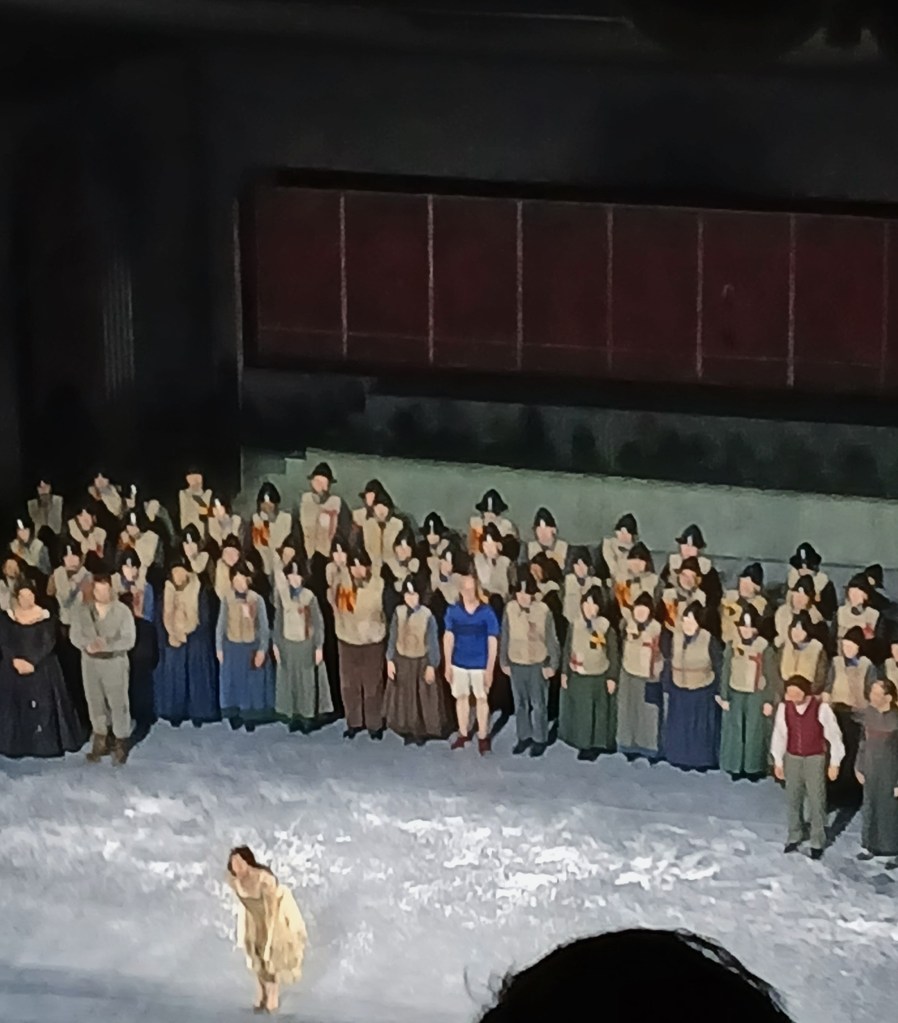
I found the production peculiarly bitty – quite strangely so, really. I have normally been impressed by Richard Jones’s productions, but this for me didn’t quite work. The sets were simple and fine enough – a whole-stage castle stone-looking interior with several fireplaces on each side and heraldic signs at the back, with a small room setting that moved on and off downstage as and when needed. There was also a raised platform, cleverly appearing from nowhere, for Arturo’s presumed execution. Ribbons came down from on high for the wedding-ceremony-that-doesn’t-happen and there are strangely short flurries of confetti and snow in Acts 1 and 3.
This seems to me to be a work that needs a director’s hand not just to tell the story but also to offer some sense of relevance to our own lives. The libretto was written by an Italian count with marked liberal sympathies and is full of references to ‘freedom’, which would to contemporaries have related to Italian nationalism and freedom from Austria. Roundheads and Cavaliers are also of course opposed political forces – something in all this mix might have been used more creatively. As it was there was well-handled simple story telling, with sudden furiously busy quirky stage scenes – at the end of Act 2, and the choral singing about freedom, a whirling set of barrows and cannons suddenly appears and as quickly disappears; at the beginning of Act 3, as Arturo tries to evade the Parliamentary forces hunting him, a huge steel searchlight is brought on stage. Something of the set up in Act 1 reminded me of a 1950’s New Bayreuth Die Meistersinger, with a massed chorus in line on a series of raised steps, moving slowly in ritual formation. But nothing here seemed either to particularly enhance the story-telling or to be putting that story in a wider context. The chorus turns up in metal helmets in the search party for Arturo but nothing is really made of that, in terms of visual impact. The final moments of the third act give us another one of those ending quirks which have been a feature of several recent ROHCG productions (e.g. Theodora and Semele) – Riccardo suddenly furiously stabs Arturo as the curtain falls. All of these are sensible enough ideas but they don’t seem to be serving any wider vision of what the piece is about.
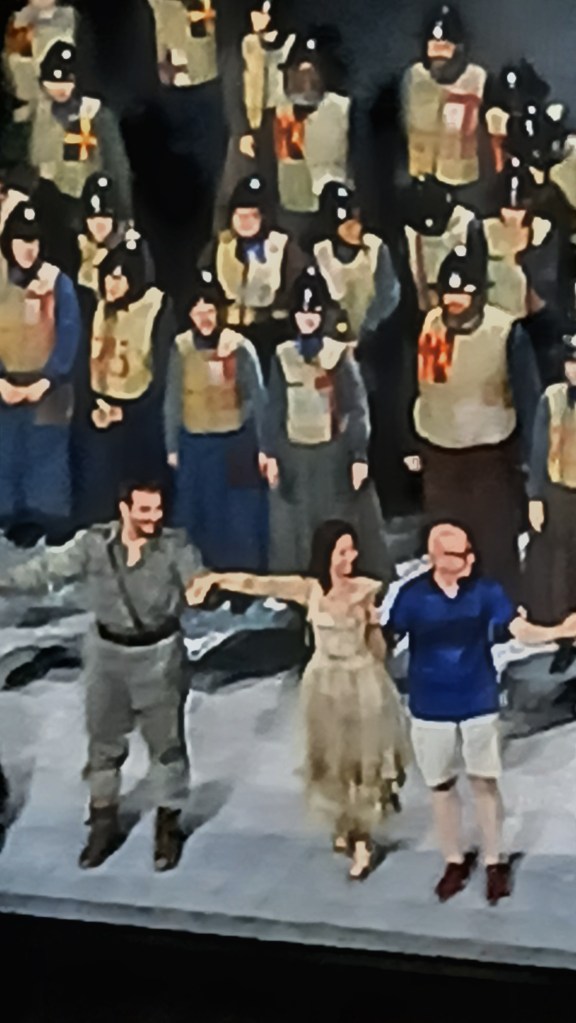
Happily, the singing and acting saved the day. Riccardo was excellently sung and acted by Andrzej Filończyk. He has a tall presence which he used in an effectively menacing and powerful way, and a warm expressive baritone voice, which could be both gentle (with Elvira) and demanding (with Arturo). I was also very taken by Ildebrando D’Arcangelo as Giorgio, Elvira’s uncle, who had the right note of authority, but also compassion as Elvira’s mental health collapses after Arturo’s disappearance. I can’t really comment on Francesco Demuro’s Arturo – as the performance went on, he seemed to be in some vocal difficulties, with his voice cracking under pressure frequently, though he managed some lovely legato singing, and some fiendishly high notes without any problems. It will be interesting to see whether he is well enough for the first night. Lisette Oropesa was an utter delight throughout. In this role she has a truly commanding and believable stage presence, and we fully understand the mental torment Elvira is going through – every movement serves a purpose and she is wholly invested in being Elvira on stage. Her very distinctive smoky voice with a quick vibrato was able both to handle some astonishing coloratura passages with clarity, some very high climatic notes, and convey Elvira’s passion without ever forcing her voice. I particularly remember her singing in the ‘mad scene (another one) in Act 2, and a form of lyrical folk song in the beginning of Act 3. One felt in the presence of greatness. I am looking forward to her singing Alcina again in September,
The chorus was both large (I counted 40 plus) and very, very good – powerful, tight, and justified the high-profile Jones’ production gave them. It’s in the nature of bel canto that orchestras accompany singers rather than being of equal worth with them, and some of the accompaniment is of the ‘oompah’ kind. But orchestral colour is needed at points and, in particular, the horns distinguished themselves. I have never heard of the conductor before but he moved the music along often with vivacity and bounce that kept your foot tapping even while one was asking oneself why such chirpy music was being written for such a sad set of emotions……