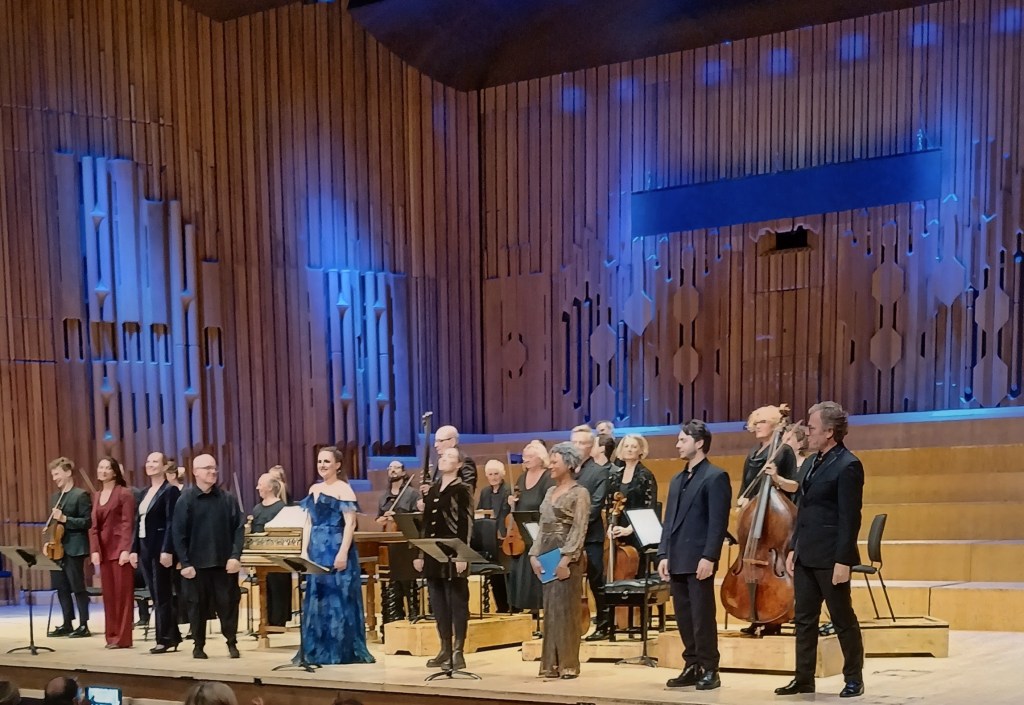
Academy of Ancient Music , Laurence Cummings director & harpsichord; Paula Murrihy, Serse; Louise Alder, Romilda; Rachel Redmond, Atalanta; Rebecca Leggett, Arsamene; Claudia Huckle, Amastre; Luca Tittoto, Ariodate; Thomas Chenhall, Elviro
I am pretty sure I saw Xerxes at ENO at some point in the last 20 years, maybe at the last ENO revival in 2014, but I have zero memory of it except for a very colourful first scene – with the plain tree – in ??yellows and blues. So going to this performance I was in essence listening to the piece as a whole for the first time.
It was fascinating to experience this as a concert performance. Unlike some operas, which really do need a stage – Mozart for instance – the focus in Handel usually on the inter-relationships between 5 or 6 key characters means that it is very easy to translate to a concert environment – the action and the emotions are in the arias, and with the singers who are singing to each other. The interior world of each of these characters is what is important, rather than their actions on stage. So here we had Serse, in love with Romilda, Arsamene (Serse’s brother) in love with Romilda, the scheming Atalanta, sister to Romilda, Amastre, Serse’s abandoned former love and a princess, with two minor characters Elviro (Arsamene’s servant) and Ariodate, father to Romilda and Atalanta. All that was needed was for the singers to react to each other, and to handle a modicum of character creation alongside the fiendishly difficult singing. It was lovely to be in the stalls and to be close enough to see these inter-reactions and facial expressions. Even the fact that there were three music stands and most of the singers were using, to a greater or lesser extent, scores, didn’t – as it does do in some other non-Handel concert versions of operas – really reduce their ability to be acting and responding to each other.
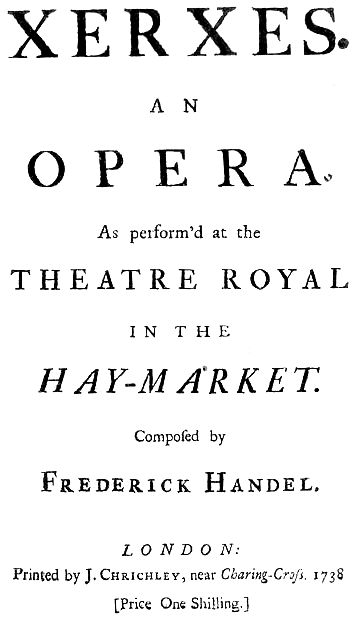
As Wikipedia points out – but I hope that I would have noticed this anyway – the work Serse is unusual in bringing together the opera seria and the comic modes of 18th century opera. It is often quite funny and the Barbican audience were moved increasingly to laughter as the evening went on – some of course generated by the daftness of the opera seria approach, but often the misunderstandings and mis-steps are genuinely funny. It was for this reason that the work was heavily criticised at its first run in 1738 – it was thought to be micing up that which should always be kept apart, and did not follow the path of decorum required by ‘proper’ opera seria. Charles Burney said “it is one of the worst Handel ever set to Music: for besides feeble writing, there is a mixture of tragic-comedy and buffoonery in it, which Apostolo Zeno and Metastasio had banished from serious opera” Wikipedia implies that Handel had recently seen the Beggar’s Opera, saw the good money it was making and decided to include something akin to it in Serse!
This is top drawer Handel musically. Maybe the famous ‘Largo’ which occurs as the first number in the opera is not replicated later on by arias of equal memorability, but there are a whole range of enjoyable pieces, fast and slow, for all the characters. The other comment about the music to make, which, had I not read the Wikipedia article, I would have assumed was the result of concert performance cuts, is that some – not all – of the arias don’t follow the a b a traditional da capo model but just have one melody, or have two, neither of which is replicated. This does give us more music in the time available (this performance, at 2 hours and 50 mis, was probably cut as well) and move the action along – again, maybe, the influence of John Gay.
The Academy of Ancient Music (AAM) had brought together a really first rate cast, with no weak links. For whatever reason a counter-tenors was not used for Serse in this performance. The male part of Arsamene has always been sung by women since the premiere. I’ve known Paula Murriyh was something of a Baroque specialist but have never heard her live in that repertory – she’s performed as Dido in Les Troyens and Countess of Essex in Gloriana in performances I’ve been to. Here she projected a remarkably effective regal presence, despite being smaller than Louise Alder, and she has both the ability for the pyrotechnics, spectacularly delivered, and some beautifully floated high notes; she could also use her voice expressively to demonstrate anger and affection with great credibility. Louise Alder, increasingly a UK stage favourite, is currently singing as Susanna in Figaro as well as performing this one-off Romilda, and I heard her not too long ago as Zdenka in Arabella, rather stealing the show in the latter – so a highly versatile singer. Romilda is a bit of a mopey role – she’s a somewhat passive character, pulled about by different men’s affections – but Alder sang it with distinction and variation in the various slow arias she has (and she could also do the coloratura bits with precision). Hers is a big voice, and a big presence, but one that’s totally under control and serving Handel’s intentions. Rachel Redmond, who I have come across at Irish Opera’s performances at the Linbury, was a spectacularly good Atalanta. This is a high soubrette -type role and her singing was in some ways the best conceived of the evening – she got across the comedy of her part and the flirty nature of the role superbly well, and her coloratura was glitteringly precise and bell-like. Rebecca Leggett had a slighter voice than some of the others on stage and very occasionally she had to push it a bit too in expressing emotion, but she got across the frustration and ardour of Arsamene’s character. Claudia Huckle, a young singer, had a remarkable contralto voice as Amastre – she is definitely someone to look out for. All the other characters were well taken and the AAM were the perfect accompaniers, never obscuring the singers’ voices, while Laurence Cummings bounced around in front of his harpsichord to encourage energy and life in the performance.