Wagner Siegfried Idyll; Wagner Excerpts from Götterdämmerung. London Symphony Orchestra, Sir Simon Rattle conductor. Anja Kampe Brünnhilde. Elizabeth DeShong Waltraute
This concert was organised in probably the best way to arrange these ‘bleeding chunks’. Dawn and Siegfried’s Rhine Jourmey, plus Waltraute’s narration in the first half; Sigfried’s Idyll, leading to the Funeral March and the concluding Immolation Scene in the second. I have not, I think, heard either of the singers live before – Elizabeth DeShong’s name is new to me though she has a strong operatic CV and Anja Kampe is one of the go-to European Brunnhildes
My journey down to London was a bit arduous, going needlessly back to and onward from Stockport in completely crowded trains but I got the train I was booked on at Doncaster, only to be greeted, coming out of Kings Cross, not only by a blast wave of heat (we are now in the first heatwave of the year) but also crowds of very drunk, very noisy but good humoured Arsenal supporters, their club having just finished top of the Premier League. Anyway, I got to the Barbican without further ado, and in the course of the evening found myself sitting a row behind Michael Portillo, who I vaguely knew as a friend of friends at Cambridge (who was little changed except for his hair, which has become brown) and met quite by happy accident a work colleague I hadn’t seen for 9 years.
It is glorious listening to the LSO playing full-on Wagner – the sweetness and depth of the string playing, the power of the brass, the brilliance of timpani and percussion, the vigour and energy they give to the music they play – and the noise they made in the orchestral postlude to Gotterdammerung was quite something to experience……The maybe 15 players involved in the Siegfried Idyll operated at the other extreme, with chamber-music delicacy of expression and a real sense of players listening to each other and enjoying playing together (lots of smiles and nods).
Rattle’s conducting I found a little annoying at times – tempi were quite fast, but there were some fidgety gear shifts – eg in the funeral march. He did broaden out though mercifully for the very ending of the Immolation Scene – the final appearance of the ‘redemption’ or ‘Brunnhilde’s exaltation’ theme –and also slowed down at points where the Brunnhilde clearly wanted to maximise expression eg ‘alles, alles, alles Weiss ich’.
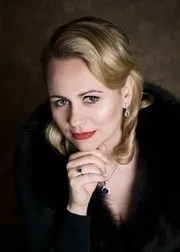
Anja Kampe I was very, very impressed by. I have never heard her live in this repertoire – or any other come to that – and of course I don’t know how she’d sound in an opera house, conserving her voice during a full performance. But, in this concert, she showed she had:
- a strong, big, voice, with a resonant chest register. She has the power for the top notes, too, but they sound warm rather than steely
- she has excellent diction and there were so many occasions when she was giving expressive poignance to phrases – words and music beautifully aligned
- she had a knack of drawing you in to what she was singing, making it almost personal (difficult to describe, but that’s the effect it had on me). She was particularly affecting in singing of her love for Siegfried in her response to Waltraute’s narration.
I would love to hear her sing Brunnhilde in the opera house. She is in her late 50’s now, but there were no signs of her voice waning or under strain.
Elizabeth DeShong was perfectly acceptable as Waltraute but not really in the same league of awareness of text and character.
As I listened to Wagner’s 5 minute or so orchestral postlude to Gotterdammerung I reflected how ambiguous it is as an ending in Wagner’s text, and how directors can give thereby both a positive ora negative perspective to the ending (the previous ROHCG Warner Ring had a gleaming Ring with a beautiful androgynous figure on top of it, which gave a sense of new creation/new beginning; the Schwartz Bayreuth Ring had an empty swimming pool at the end). The detailed stage directions for the ending given in Deathridge’s Ring translation, which includes Heinrich Porges’ notes from Wagner’s rehearsals, mentions the Rhinemaidens happily swimming in the now calm Rhine with the Ring, the gods sitting in Valhalla with the flames surrounding them, and ‘men and women, extremely moved, watch the growing glow of fire in the sky’. If I were a director of this work, I would portray the people watching as bearing the hopes of a better way of living life on earth. What was clear about the rendition of the last 5 minutes or so in this performance is that – left to itself in the concert hall – the music has a sweeping power and beauty that can only be positive. I cannot see how you can listen to that final repeat of the ‘redemption’ theme and feel that Wagner intends anything other than a positive outcome to the whole story.
The other thought I had, listening to people around me and beforehand/during the interval, is that there were a number of audience members not really very knowledgeable about Wagner’s music present. It is a sad comment on the difference between now and 50 years ago in the UK that the only chance now most people will have to see this work in the theatre will be at ROHCG – which does its best, but which simply cannot offer the range and number of cheap tickets to people, particularly young people, exploring this work for the first time in the way ENO could back then. Moreover ENO was touring the regions with its Ring, performing in Manchester, Bristol and other places. This is part of a broader problem about the economics of putting on Wagner. A noted Wagner bass singer was telling the Manchester Wagner Society 2 months ago that in 2026 there was just one – one! – run of performances of The Mastersingers anywhere in the world. recorded on Operabase…………….