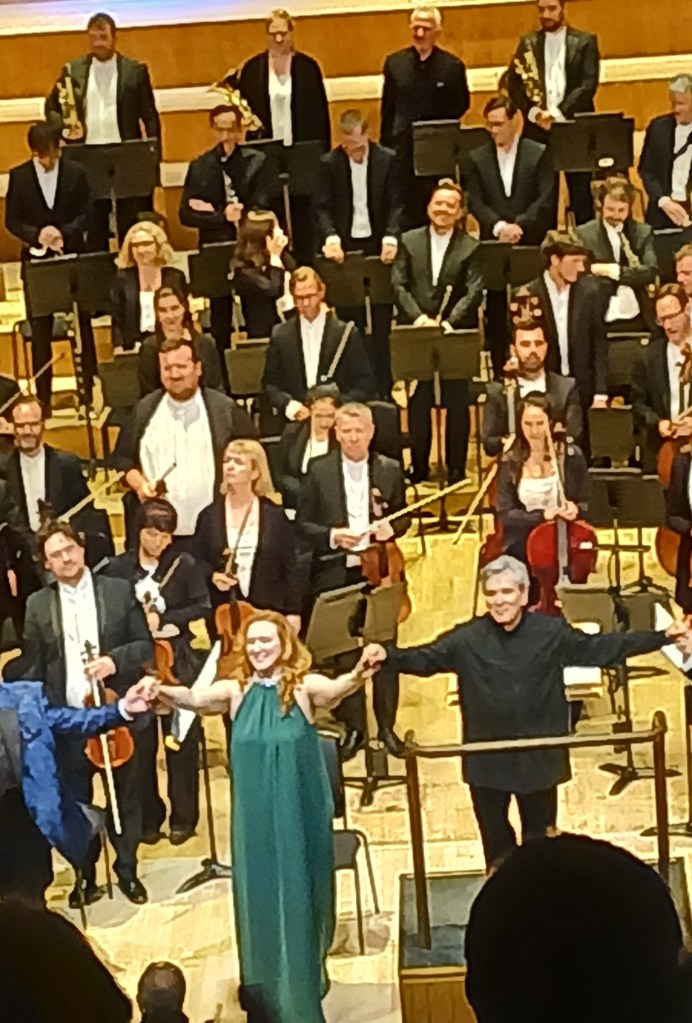
London Symphony Orchestra, Sir Antonio Pappano conductor; Clay Hilley Tristan; Sara Jakubiak Isolde; Marina Prudenskaya Brangaene; Franz-Josef Selig King Marke; Gyula Orendt Kurwenall Neal Cooper Melot; Michael Gibson Sailor/Shepherd; James Emerson Steersman; London Symphony Chorus
I got myself into a ridiculous situation over this concert. I bought the ticket over a year ago and had been much looking forward to it. I was very pleased when I worked out going to it was compatible with the travel arrangements for my son’s wedding in Sweden! About a week prior to the concert, without thinking, I signed myself up to be involved in a teacher recruitment exercise for one of the schools I am a governor for and then realised that the morning I’d agreed to do this would prevent me from getting to Act 1 of Tristan…..!! So I could only make the 2nd and 3rd Acts. I was very annoyed with myself but there was no way I could change this. I got to the venue about half way through the first Act and heard the loud bits sitting outside the Barbican Hall. Anyway, I still had about two and a half hours of music to go……………
My comments of a few weeks ago about Handel opera applies also to Tristan. This is again one of those operas which are fairly static, heavily focused on character, words and singing rather than action, and therefore well suited to concert performance. What then is important is that one feels and understands the nature of each character from the stance of the singer on the concert platform, and what they do with their face and hands. Scores and music stands can be an obstacle to this happening.
In this performance, or rather in the Acts 2 and 3 I heard, Pappano’s reading had the same passionate sweep which makes his Ring conducting attractive. I was particularly struck by the rhythmic pointedness of some of the cello and double bass playing in the third act, and the depth and intensity of the strings in the Act 3 Prelude. The mournful cor anglais playing was very fine, and throughout there were many instrumental voices Pappano revealed which had never struck me before . The pace was fastish throughout – for the most part this was a positive feature of the performance but for me, the Liebestod was simply too fast for the singer to craft the phrasing and pointing of words compellingly.
I found Clay Hilley even better than his performance with Lise Davidsen in January in Barcelona. Jon Vickers is the benchmark here in my experience of the work in the opera house. But Hilley not only had the heft Vickers possessed but also a poetic refinement with certain phrases which (dare I say it) Vickers never reached in this role. His 3rd act acting was tremendous – hanging from the rostrum, half lying on the floor, he was every inch the tortured hero. Sara Jakubiak in her role debut has the big-hitting voice for the part and was excellent in Act 2 in the love duet. She also seemed to be stirred by Hilley’s singing in Act 2 to more variation and colour as the act progressed. The Liebestod was a bit of a work in progress, rather unrelentingly loud – and I could still remember how Davidsen (in her role debut too) delivered some of the phrases. Jakubiak’s stage presence was inevitably not helped by her need to check in with score/music stand frequently and Hilley and she barely acknowledged each other’s presence in the love duet. Gyula Orendt was one of the finest Kurwenal’s I have heard, singing some of the more lyrical passages with great beauty of tone. Franz-Josef Selig as King Marke reinforced the positive impression I had of him from the April Vienna Parsifal, singing with impressive resonance and beautiful diction. As for Marina Prudenskaya as Brangaene I couldn’t give much of a judgement on her, as most of her role is in the 1st act. She sang the ‘Hab Acht’ passages from the back with great beauty but sometimes sounded squally earlier in the Act, and words were sometimes indistinct.
I felt overall this was a very good performance, but perhaps not one for the ages, apart from Hilley’s Tristan