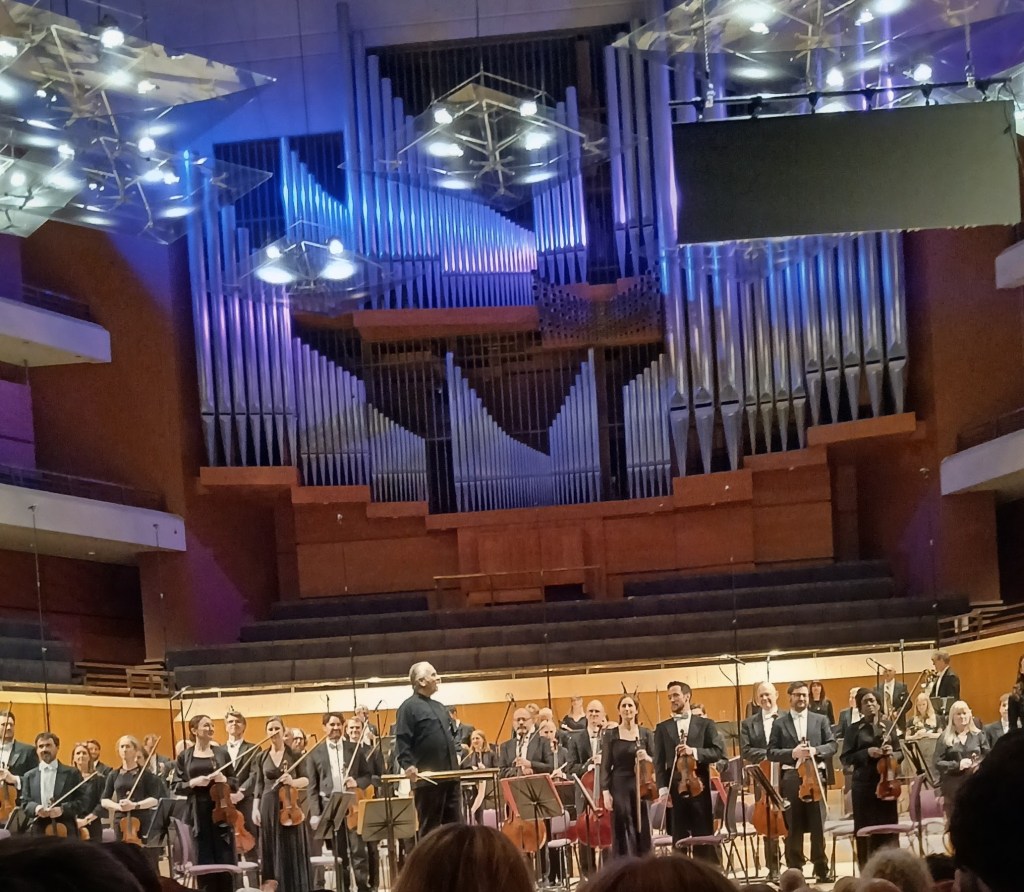
Halle Orchestra, Sir Mark Elder conductor. Kostas Smoriginas baritone. Hallé Choir, Matthew Hamilton, choral director. Stravinsky Song of the Nightingale; Rachmaninov Spring; Glinka, Ruslan and Ludmilla Overture; Tchaikovsky Symphony No.2
This was a nicely designed programme featuring a couple of rarely heard works (and unknown to me) and a popular symphony (which, despite that popularity, I don’t think I’ve ever heard live before) – also different variants on what being Russian might mean musically. And it was good to see Mark Elder again conducting the Halle – he is perhaps a little slower getting on and off the podium, and a little less exuberant in gestures but he clearly gets all he wants from the players despite or perhaps because of increasing age. Radio 3 was broadcasting the concert live.
‘Ruslan and Lyudmila’ overture is always a great concert starter, as it proved again here – what always surprises me is how early in the 19th century it was composed, a long time before other Russian nationalist composers started getting published. The Halle was easily able to withstand Elder’s fairly bracing pace – and, throughout the concert, it was good to note that, as also often with his successor Kahchung Wong, Sir Mark spread the 1st and 2nd violins on either side of the stage, which is how the 19th century would have heard the music and which allows interplay between the two sections to be clearly heard.
I can only have heard Le Chant du Rossignol once, more than 50 years ago at the Proms when Pierre Boulez was chief conductor of the BBCSO. It’s from a piece composed around the same time as Petrushka, as an opera, and Stravinsky recycled some of the music from it 4 years or so later for a 20 minutes or so Diaghilev ballet. It has the same jewelled glitter, the same glistening crowded textures, spikey rhythms and veiled use of folk song-like material as Petrushka, but of its nature is episodic. To me it felt as though Stravinsky had reached a bit of a dead end creatively with this sort of sound and orchestral texture , and it was indeed after this was reworked that he started writing in a sparer, more neo-classical, stye, I think. I can’t imagine I’d willingly reach out to hear it again.
The Rachmaninov piece, Spring, extravagantly (for a 17-minute work) was scored for large chorus and orchestra plus solo singer. I thought this was a lovely piece, about the coming of Spring to a Russian household in trauma, where a man, with murderous intent towards his wife because of her perceived unfaithfulness, forgives her and asks himself to be forgiven because of feelings evoked by the Russian Spring after the long cold winter, giving new hope and life. The Lithuanian baritone Kostas Smoriginas had the right sort of Russian tinge to his voice. Unlike Stravinsky and Tchaikovsky Rachmaninov is not using folk-song sources for his music, which still, to Western ears, evokes the brooding melancholy of so much 19th and early 20th century Russian music.
Tchaikovsky’s 2nd Symphony is in essence a compendium of folk tunes, dazzlingly orchestrated and slightly varied with each repetition. In retrospect much (not all) of Tchaikovsky’s music is very different from his 19th century European counterparts – less concerned with self-dramatisation and journeys from darkness to light (though the 4th – 6th symphonies would be one exception; there are others). Despite this symphony he was also not really aligned with the Russian nationalist composers like Borodin or Balakirev. As Simon Morrison says in his excellent book “Tchaikovsky’s Empire” “his music was too urban, too regal, too smitten with the Romanovs, too idiosyncratic, and frankly too cheerful”. The 2nd Symphony seems to me to be the work of an excellent craftsman, using his skills to focus less on originality and inspiration and more on technical brilliance in the different ways the folk songs are presented. The Halle relished all the challenges given to them to shine as individuals and in instrument groupings – even the percussion section gets quite a work out (with a more than usually spectacular gong crash). The danger in this music is that the conductor drives it too hard and one of the good things about this performance was that it was more relaxed than some and Elder gave space for the players to breathe and maximise expression – for example the 2nd subject of the finale had a lovely lilt. His approach also meant that the climaxes were clearly signalled and didn’t come excitably one after the other. There were a few occasions in the finale where tight rhythms got a bit smudged, but these did not detract from the overall impact of the performance, which I enjoyed very much