Conductor, Timur ZangIniev; Asmik Gregorian, Tatiana; Maria Barakova, Olga; Iurii Samoilov, Eugene Onegin; Larissa Diadakova, Filippyevna; Stanislas De Barbeyrac, Lenski; Prince Gremin, Alexander Tsymbalyuk. Production, Deborah Warner, Set Designer, Tom Pye; Costume Designer; Chloe Obolensky; Lighting Designer, Jean Kalman
I really haven’t seen many productions of this work – I remember the Peter Hall one in the 1970’s at ROHCG with Ileana Cotrubas, a production I can’t recall at all in Vienna in 2015 with Netrebko and Maltman (both singing at the top of their form) , and there was also the recent Huffman production in London, but that’s about it – I don’t recall seeing this at ENO (though this Met production is in fact a co-production with ENO, and seen there in 2011). The draws for me in wanting to go to this screening were seeing a production by Deborah Warner, always a director to watch (and I am looking forward to seeing her Peter Grimes at ROHCG on May 12th), hearing and seeing Asmik Gregorian, and also watching the development of Stanislas De Barbeyrac (although he is in his early 40’s and has been around for quite a while in smaller role), who is being taken up in a big way by ROHCG (Siegmund already and then next season Parsifal)
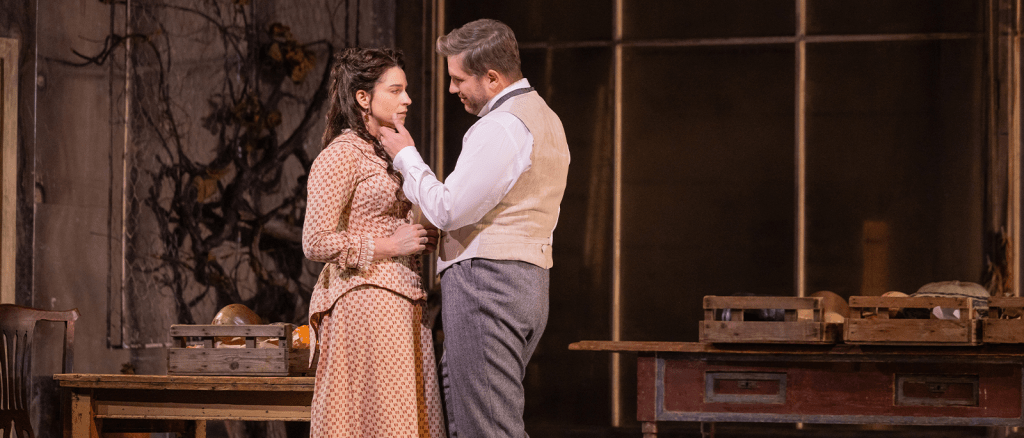
In many ways this was quite a traditional production, with the focus rather being on the interplay between the characters. One of the things I felt, viewing the work in this traditional mode, is that Onegin is an opera whose action does rather lurch forward not very credibly at points – the very sudden falling in love of Tatians, the very quick declension of Onegin and Lensky’s relationship into duelling-mode. The Huffman production I saw at ROHCG was on the whole I thought more effective than this one in handling these ‘lurches’, and some of Huffman’s glosses on the action – like Olga being absolutely smitten by Onegin in Act 2 and very explicit sex scenes – made more sense of some of the weaknesses in the plot. The very realistic early scenes in the Met production of Tatiana’s family’s provincial country house, with walls, curtains and windows, bowls of fruit, and so forth, here seemed cramped, given the size of the chorus – I guess intentionally, to emphasise the provincial nature of the establishment – but it looked muddled, even if it was cleverly choreographed, whereas Huffman used the whole of the Covent Garden stage with minimum props, which seemed to make the action flow more easily. However the Met production, in scenes from the duel onwards, used the full massive space of the Met stage, giving grandeur to the Gremin palace, and bleakness to the duel and the last scene, with suggestive wisps of scenery rather than the enormous detail of the country house.
Vocally and acting-wise, this production was impressive. Asmik Gregorian said in an interview during one of the intervals that, at 44, this might be one of the last times she sings this role; that, she feels, it needs a younger singer to bring it off well. But in fact she is such a consummate actor that she conveys very effectively the sense of a young woman falling in love, she (more or less) looks the part, and, while she hasn’t got a conventionally beautiful voice, she uses it in such a convincing and expressive way that you feel she is conveying the essence of Tatiana’s personality. The intensity of the Letter Scene, of her emotions in the final scene, were overpowering. Iurii Samoilov as Onegin has an extremely beautiful and fine baritone voice, and was credibly callous, insensitive, insouciant and unpleasantly unfeeling in a way that any Onegin has to be on stage. It’s a difficult role for a singer to engage with and I thought he did very well.
Stanislas De Barbeyrac had a well focused voice which had both the heft for the scene in the ballroom leading up to the duel, and the sensitivity for his famous and beautiful aria before the duel. I was also very taken with Maria Barakova as Olga (pinpointing a very different personality to Tatiana’s) , and Alexander Tsymbalyuk as Gremin (the latter a classic ‘Slavonic’ bass sound). I thought that Timur ZangIniev conducted the opera in a quite measured way at times, which didn’t at all seem to reduce the impact of the drama, so intense was the singing and acting, but his approach did allow singers to move, breathe and sing naturally amidst the tension. It also created helped to create clarity in the layers of sound – in the dance at the provincial house (for Tatiana’s Name Day), I heard string accompaniment and woodwind commentary which I have never come across before There was some spectacularly good playing from the Met Orchestra, particularly from the lower strings. I am looking forward to hearing this orchestra at the end of August at the BBC Proms in the RAH.
Here’s a still and a trailer from the Met web site (photograph not given a credit by them) https://www.metopera.org/discover/video/?videoName=tchaikovskys-eugene-onegin-letter-scene-asmik-grigorian&videoId=6393305701112
 John's musical journey