Kip Williams, Director; Marg Horwell, Designer, Allison Cook, Mrs X E; Rodney Earl Clarke, Mr X E; Matthew McKinney and Mariam Wallentin, Angels; Kantos Chamber Choir; BBC Philharmonic; conductor Baldur Brönniman
This production is the UK premiere of this opera, by the Chinese-American composer Du Yun and Canadian librettist Royce Vavrek, staged by Kip Williams, some of whose work has been very successful in the West End recently, apparently. The opera won the 2017 Pulitzer Prize and it, and this production in Manchester, has received on the whole warm plaudits from UK critics. I was seeing the final show. It has received a lot of attention as being the first Manchester-specific large-scale commitment of ENO following its temporary defunding by the Arts Council and the subsequent agreement to work partly out of Manchester. The production’s been put on at a venue which hasn’t seen opera before, and which I haven’t hitherto been to – Aviva Studios, used for the Manchester International Festival in July. This venue, to quote the publicity blurb, is the home of Factory International, “a landmark new cultural space for Manchester and the world. Built with flexibility in mind, the multi-use space can adapt to host any kind of set-up — from intimate theatre shows and intricate exhibitions, to huge multimedia performances and warehouse-scale gigs fit for the greatest artists of our time.”
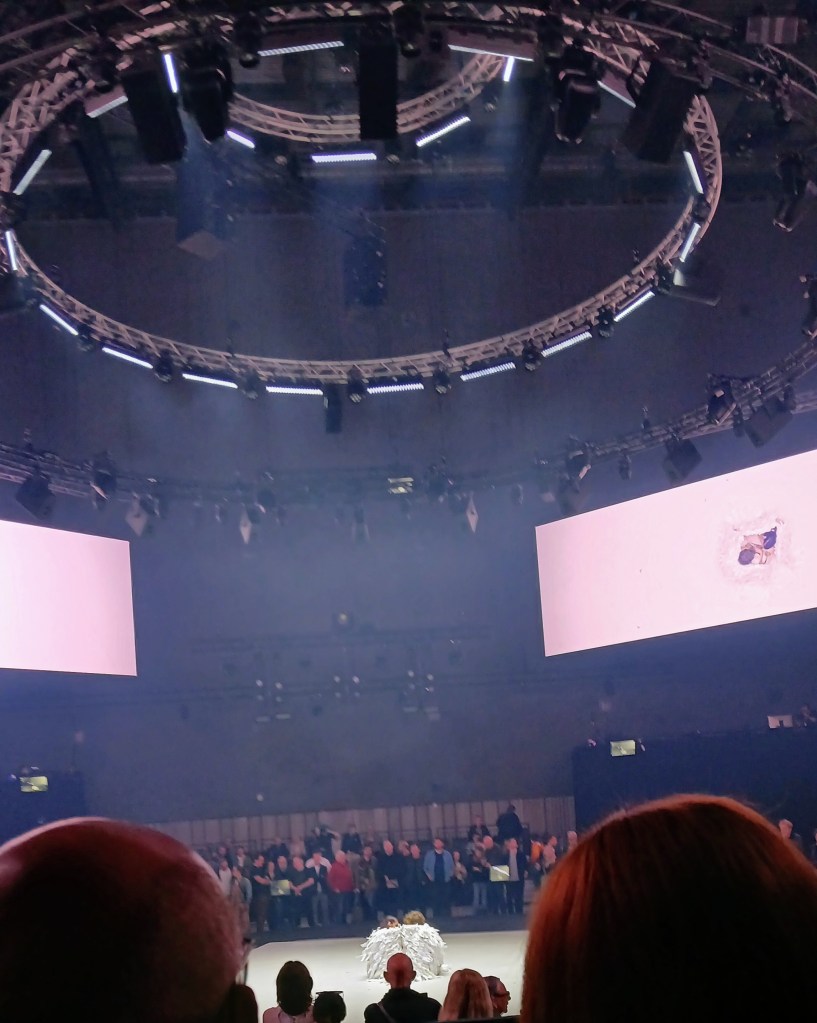
My impression of the space used for this performance – The Warehouse (a name rather than a description) – for the performance is that it’s a big black painted/curtained space which had, at least on this occasion, a large central stage and four screens, one on each wall. The audience stood on three and a half sides of the stage, with a couple of raised blocks of seats on two of the walls for the more elderly of us (including me). The audience for the show must have been 450 plus, mostly below the age of 50, I would say -in itself impressive for an ENO audience,…..
The opera lasts for about 80 minutes. Its story is searing and at times difficult to watch. Two angels, one male, one female, who have somehow fallen from Heaven, or have been sent from Heaven, are seen huddled together before the start – see photo below. Coming in with the start of the work is an angelic chorus, circling the stage, with a chief angel providing commentary. There’s a couple on stage at their chic-looking home, clearly at the end of their relationship, the woman dominant, the man submissive. They quarrel continually, but then the husband discovers the two angels in the garden and brings his wife one of their feathers. She is entranced by its softness and beauty. She wants more feathers and orders the husband to get them. The husband ruthlessly pulls feathers out of both angels, drawing blood. There then occurs a sequence of horrific scenes where the wife calls a party of her friends in to the couple’s house, where she asks her guest to pay to be ‘blessed” by the angels – in practice ‘blessing’ seems to mean the guests physically and sexually abusing the angels. The party goers want things from the angels the latter cannot possibly give them – like a resolution of all their interpersonal and emotional difficulties. The angels are kicked, punched and rendered almost unconscious, bloodied and exhausted. As the party quietens down, it seems -it’s a bit unclear – that the husband feels remorse for how he has treated the angels and throws their feathers back at them, encouraging them to escape, after further rejection by his wife. He, then, commits suicide or at any rate dies in some way. The angels do make an escape – I think. The wife continues to remain in her abusive bubble – she creates a media circus by announcing she was forced by the husband into prostitution and the angels were similarly manipulated by him. She proudly announces that she is now expecting a baby by the male angel. The opening chorus number returns and the opera ends with the triumphant wife in a blaze of. golden feathers.
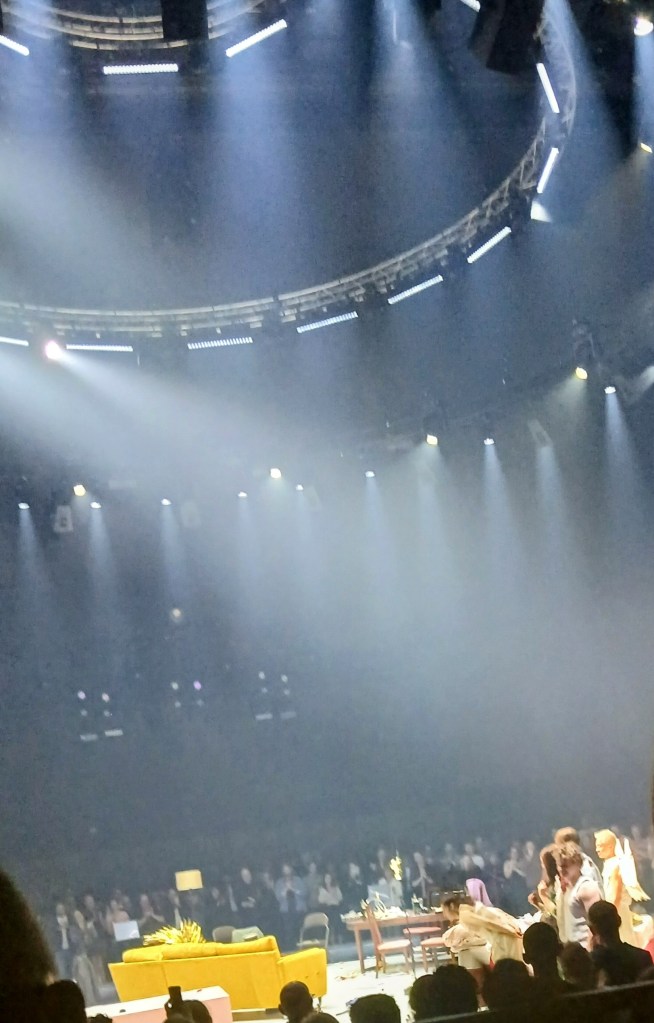
The staging was obviously specific to this space and it would be fascinating to see how the projected London Coliseum October performances would differ from this. Here in Manchester, in the round, what we had was a series of slowly revolving rooms with windows to see through into. At the same time three camera operators are filming all the action, then mixed on to the 4 overhead screens, together with surtitles. As you can see from the photos, harsh stark lighting was an important aspect of the staging. From my slightly elevated position I could see everything pretty well on 3 of the screens and at times on stage when the right revolutions came round. I think people standing near the action possibly saw less than I did.
The pre-performance publicity suggested this work was really all about people trafficking. Frankly I don’t agree, though maybe that is a background allusion. But the major reference, explicitly in the libretto, is to the Annunciation, and the contrast between Mary (‘Be it unto me according to thy word’) and the wife, full of contemporary self-absorption, narcissism and hedonism. It is a very bleak view of contemporary humanity.
Musically, and contrasting this perhaps with Jake Heggie’s `Dead Man Walking’, this felt very much like a real opera and not one with words predominating and the music having leanings towards a sung film score. The music is there, colouring and foregrounding the words and the action, through a dizzying range of styles – an opening of Gregorian-type chanting, jazz, Britten-like slow melodies, rock and much else. I was always gripped, never lost concentration. The libretto wasn’t too wordy and had the right sort of elevated language where needed for lyrical and reflective passages. Interestingly the opening few minutes of dialogue between the couple are spoken, and when they start singing you immediately feel a deeper engagement. That to me is the mark of an opera. All the singers were excellent, but particularly a shout out for:
– Alison Cook, who I last heard in Buxton singing a Bernstein and Poulenc double – bill last July, and whose singing and acting was wholly compelling, even under the scrutiny of close-up filming
– Rodney Earl Clarke, absolutely believable as the submissive husband, who as part of the role does a wonderful impersonation of Louis Armstrong
-The Kantos Chamber Choir, who are both the cathedral-like angelic choir at points and also acted – with horrific impact – as the party-goers. They were remarkably good – I’d love to hear them in other contexts
– The orchestra had 10 players in it, from the BBC Philharmonic, who were extraordinarily busy and made the whole piece sound as though it was being accompanied by a full orchestra (there is apparently a full orchestra version which will be used in London.