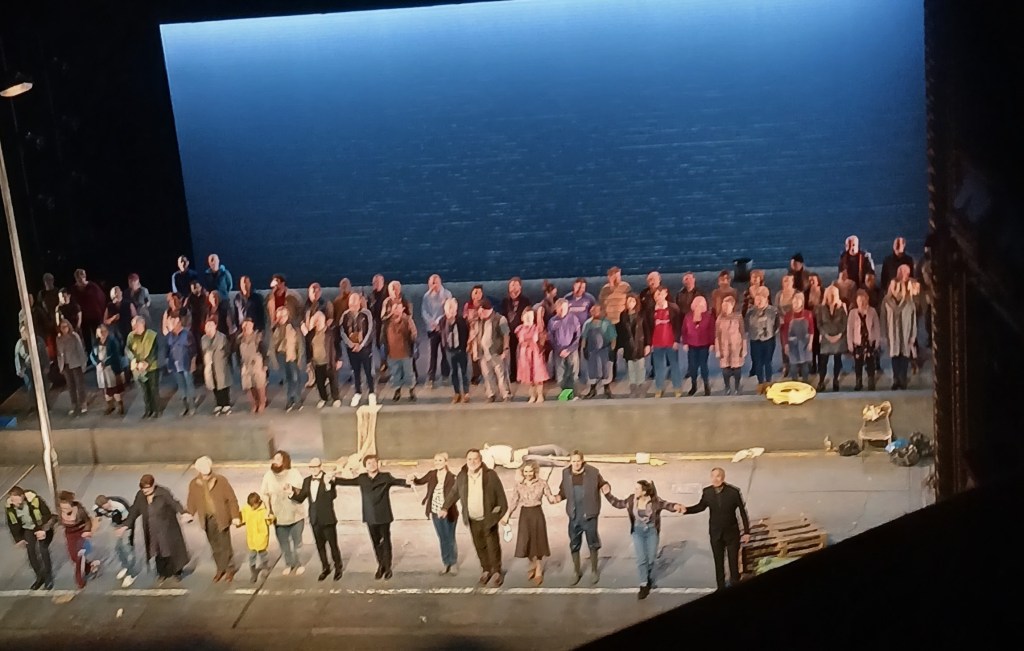
Conductor, Jakub Hrůša. Peter Grimes, Allan Clayton; Ellen Orford, Maria Bengtsson; Captain Balstrode; Bryn Terfel, Swallow, Clive Bayley; Ned Keene, Jacques Imbrailo; Auntie, Catherine Wyn-Rogers; Mrs Sedley, Christine Rice; Bob Boles, John Graham-Hall; Hobson, Barnaby Rea; Rev. Horace Adams; James Gilchrist; First Niece; Jennifer France; Second Niece, Natalia Labourdette. Director, Deborah Warner; Set designer, Michael Levine; Costume designer, Luis F. Carvalho; Lighting designer, Peter Mumford
This was a very starry cast in prospect – Allan Clayton has made quite a name for himself in this role, Maria Bengtsson I saw as an admirable heroine in Strauss’ Intermezzo last year, Bryn Terfel, Christine Rice, Jacques Imbrailo, Clive Bayley – a lot of excellent singers. I had been due to see this production in its first run when it was new, in March 2022 – unfortunately I had my first bout of Covid the week I was booked to see it and so had to miss it, so this is the first opportunity I’ve had to see this much-praised production, four years on. It was also going to be interesting to hear Jakob Hrusa’s take on the music. It’s the 4th production of the work I’ve seen – the 1970’s Elijah Moshinsky one at ROHCG, an ENO Alden one and a Stefan Herheim production in Munich. All of them have been good productions with good casts, though the Moshinsky production had the incomparable Jon Vickers for a number of years in the role. I seem to remember reading that Britten hated his portrayal, but, for me, I hear him singing still whenever I go to a Grimes performance.
The design setting was effective – the whole full stage was used for many of the scenes with a back drop of a silvery, sometimes blue, rippling sea. The beach was a shambles, full of bits of wood, half-built boats and traffic cones, full of litter (seemingly – there seemed to be a Sunday activity to collect it) – a touch of private affluence and public squalor, perhaps? There were also convincing structures for the pub in Act 1 and Grimes’ hut in Act 2 ( but in the latter case still keeping that whole sweep of the stage in view). The costumes were modern, with no particular colour emphasis – at times the lighting became quite dark and it was difficult, with a large number of people on stage in a range of costume colours, to work out who exactly was singing sometimes among the minor characters. An arresting image was to have at various points, including the opening orchestral prelude, somebody, presumably Grimes’ first apprentice, gyrating across the stage, and up and down it, held by wires, like a body tossed about by the waves. Most of the staging was relatively conventional, though very well done – the innovative scene was the first where instead of a court / coroner’s inquest, Grimes seems to be having a dream of the encounter with the coroner, and the Borough mob pursue him in his dream, with electric torches
Clearly a major task for the director in any production of Grimes is deciding what to do with the chorus – do you regiment them or make them all individuals. How do you create a sense of the small town narrow-mindedness on the one hand in how the chorus is presented, and a baying mob on the other? I seem to remember that in the ENO production they went for the regimented approach – movements, for instance, were often coordinated, almost choreographed. And how are the many minor characters, Auntie, Mrs Sedley, the Nieces, Rector etc etc to be depicted? In this ROHCG production there are I think also 6 dancers to manage, who enlivened the Act 1 fishing song and the party in Act 3, as a further complexity. One of the things I noticed about how Deborah Warner handled this issue is that often the chorus took its time getting onto the stage – a lot of their singing started off stage and they took their time appearing…..I was in a strange way often scarcely aware of their presence. To me, perhaps over-imaginatively, it seemed as though the director was emphasising the narrow grey private lives of the Borough residents, people keeping to themselves, not interacting much with their neighbours, grey figures, and only coming into view for the audience when their blood-lust is up for finding Grimes snd they become a vengeful mass. The minor characters are all in one way or another caricatures set in exaggerated opposition to that greyness, whether Auntie and her Nieces, the laudanum-taking muck-raking Mrs Sedley, the drunken Methodist preacher – in a sense as much in thrall to the greyness, defining themselves through contrast to it, as the chorus. The only characters allowed any sense of normality, of balance, are Bulstrode, and Ellen Orford. Grimes himself repeatedly defines himself in opposition to the Borough. I found this approach – if that was what it was – a convincing one. Certainly it gave a more effective impression of a vengeful mob than did the choreographed approach, when the crowd coalesced into that role, and through directoral understatement reinforced the contemporary relevance – the mobs outside asylum-seekers hotels/refuges last summer, for instance.
Nobody is ever going to replace Vickers in my estimation of people playing Peter Grimes, but Allan Clayton has many strengths, not least his ability to sing softly and beautifully in the lyrical passages in a way Vickers couldn’t in the same way (Clayton’s recollections of a ‘woman’s care’ for instance). He has the heft of voice and the figure for the role, and was utterly convincing. I felt maybe sometimes his portrayal made Grimes so anti-social, so much a loner, that on occasion he did not quite become the centre of focus he should have been, and which Vickers always was, but his is certainly a justified reading. Just as an aside I remember Vickers singing/shouting the line ‘The sea is boiling with fish’ (or something like that) in Act 2, in a startlingly frenzied manner – almost screamed – whereas for Clayton it was a throw-away line. Vickers brought out the inner madness whereas Clayton ‘just’ played him as an odd grumpy loner. Both the other two main roles were sung and acted extremely well. Bryn Terfel was a completely commanding and compelling presence, dominating the stage when he appeared. And Maria Bengtsson was outstanding as Ellen, making her a much fuller and dominant character than she sometimes is (and with no trace of an accent).
The other really compelling aspect of this performance was the orchestral contribution under Hrusa, which sounded magnificent. I have never heard such a compelling and moving performance of the Passacaglia, and the storm music was tremendous. A curtain came down during the orchestral interludes which emphasised their role, and the orchestra’s, in the drama, a good idea. The choral singing was incisive and clear. The point in the second act when the women – Auntie, the nieces, and Ellen – reflect on their relationships with men was a really beautiful highlight – I have never heard it sung so compellingly before.
I had one or two grumbles – it is ridiculous to have a second interval between Acts 2 and 3, as happened here. It dissipates the drama. And I still feel aspects of the libretto are toe-curling (perhaps particularly so given that around me there seemed to be a number of parents with 20’s-ish children). Whiile the heightened language of the lyrical passages (‘Great Bear’ etc) works well, some of what the villagers say to each other just sounds odd and off-putting to someone new to opera – neither obviously related to Crabbe, or the 1940’s or contemporary.
But all in all, I now understand and share the high praise this production has received