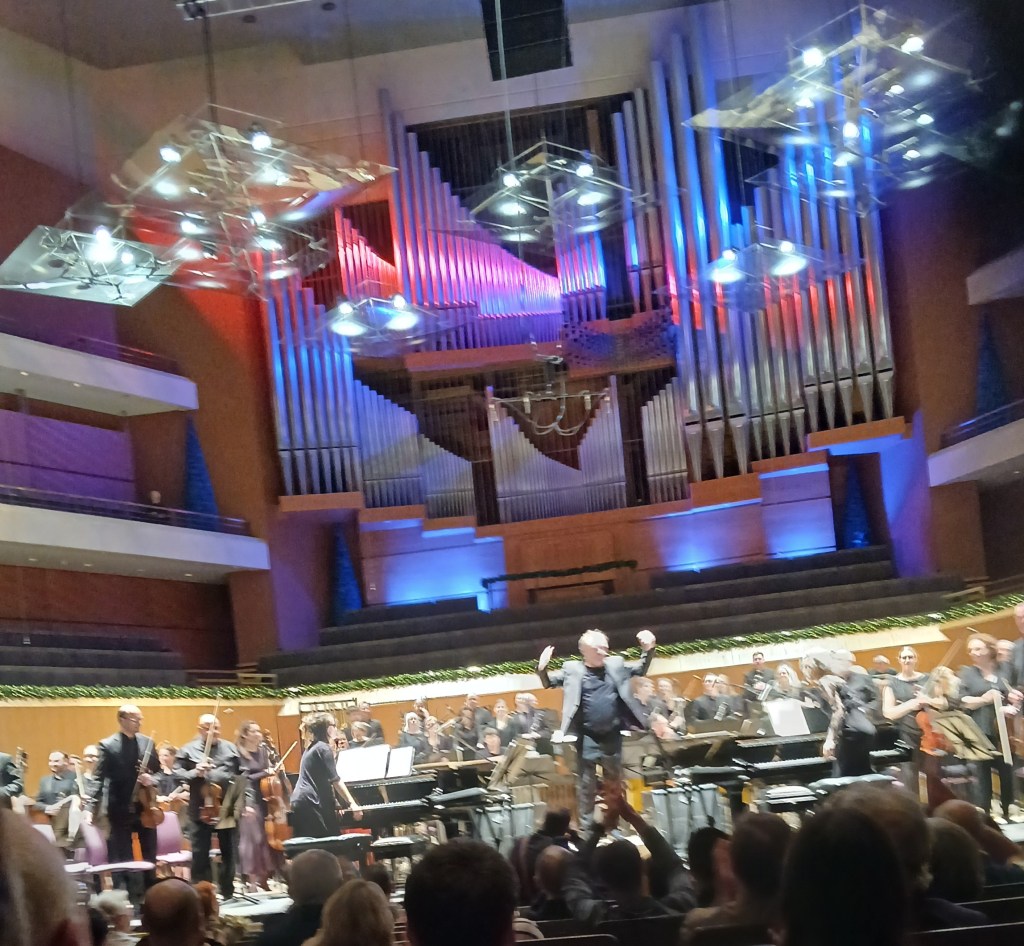
Halle/Wong. Bridgewater Hall, 25/9/25

Kahchun Wong conductor, Truls Mørk cello. Shostakovich, Festive Overture; Elgar, Cello Concerto; Rachmaninov Symphony No.2

This was the Halle’s opening concert of the 25/26 season. The Halle, much more obviously than the BBC Phil in Manchester, has to balance innovation in concerts against the need to balance the books, and this was unashamedly a popular concert – and was responded to very warmly by a packed audience. I perhaps wouldn’t have bothered too much about missing this in other contexts, but I was interested to see what Kahchun Wong made of the Rachmaninov, which seemed to fit his interpretative gifts well.

There was a pre concert session with David Butcher CEO of the Halle interviewing Kahchun Wong. Mr Wong again impressed by his modesty and his gentle collaborative approach, as well as his enthusiasm for the orchestra’s sound, which he described as Germanic but flexible. He said in answer to a question that he hoped to do more Elgar but had kept away from it in his first year, out of respect for Mark Elder. He was similarly keen on doing some concert opera performances in the future – there was then an oddball question about whether he’ll be conducting Gilbert and Sullivan. I am not sure Mr Wong understood the question…..

The Shostakovich Festive Prelude (25th September is Shostakovich’s birthday) was a resounding example of the sound he gets from the orchestra – Kahchun Wong has the knack of choosing tempi that are just right, that allow clear articulation of fast passages. The violins were split to promote maximum clarity and he can somehow bring out some of the underlying accompaniment to the main theme to be clearly heard without over-balancing the overall performance

Rachel Helleur-Simcock  has just been appointed as lead cello of the Halle (she’s coming from the Betlin Philharmonic after 16 years there) and 3 weeks before the concert, when the advertised soloist fell ill, she offered to take over. The Elgar concerto isn’t one I’ve heard live in a concert for a long time. This struck me as a quiet and poetic reading with a particularly moderately paced first movement. The third movement was full of poignant regret.  Some of the performances I’ve heard have emphasised more the emotion. the loss, even the anger contained in this work and Ms. Helleur-Simcock consistently understated these dimensions – but it’s a perfectly valid way of playing it. I was struck by both the work’s concision and its waywardness – its constantly curving off in unexpected directions. It is a remarkable piece – the ‘cellist did that wonderful growl at the end superbly, where Elgar seemingly says, in his bluff mode, ‘enough of this introspection – I am off to the races’

Rachmaninov 2 is not, as I’ve said above, a particular favourite of mine – I’m not that sweet- toothed…… But this to my mind was as good a performance  as I am ever likely to hear in the ultra-sweet-toothed mode (I would have loved to hear Gergiev and the LSO ‘perform it). Mr Wong chose the uncut version of the work to perform, though with no repeats in any movement. He gave an interesting ‘programme’ for the work in the talk beforehand, likening the Symphony to a depiction of the seasons – first movement, Autumn (and you can hear the whirl of dead leaves on occasion), the second, Winter (with perhaps a sleigh ride starting off the movement). Then a very Russian Spring with some cold spells, and fourthly a Summer finale. The Halle sounded, despite a few wobbles, gorgeous – a huge lush string sound, the split violins contributing to that sense of spaciousness, the woodwind deftly weaving around each other, and a strong horn and brass section. It was a homogenous sound, firmly grounded, without being smoothed out too much. Mr Wong lent into the music, and perhaps was a bit too free with some very large rallentandos, particularly at the end. But the strong emotion was tethered by the way in which the subordinate instruments and harmonies, the filigree of woodwind sounds, were brought out by Mr Wong, underpinning the big tunes, and also by the energy and spring he conveyed to the orchestra. A particular shout to the clarinet, horn and cor anglais principals. Maybe it was a bit too pulled-around, a bit too over-the-top, but then the work is so over-the-top anyway, it’s hard to be too bothered by this.

I am hearing Mr Wong perform the Enigma Variations with the Halle next week. That should be fascinating……..

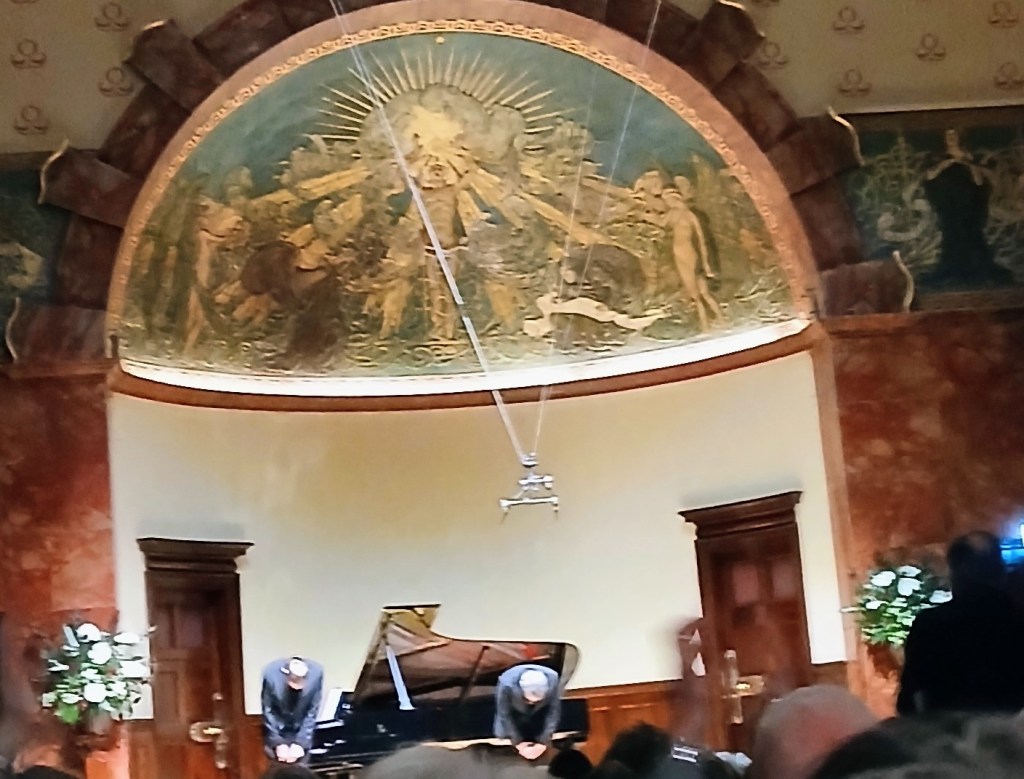
Elisabeth Leonskaja, Wigmore Hall, 19/9/25

Elisabeth Leonskaja, piano: Programme – Mozart, Fantasia in C minor K475; Shostakovich, Piano Sonata No. 2 in B minor Op. 61; Schubert, 3 Klavierstücke D946; Fantasy in C D760 ‘Wanderer’

After my three Proms in the Arena, my final Prom of the 25/26 season was going to be Bruckner 9 with the Vienna Philharmonic Orchestra, and Franz Welser-Möst as conductor (it was also on my birthday!). Sadly Covid got in the way – I tested positive for Covid on the morning of the concert and spent my birthday in a hotel room with an Indian take-away listening to the VPO on my lap top. A pity…. (it was an interesting performance – jagged and faster than some, but good at revealing the darkness of the music, and, of course, gloriously played)

By the following Friday week I was full recovered and looking forward to this concert at the Wigmore Hall. I have never heard Leonskaja before live – and indeed had never heard of her at all until a few years ago when I started reading very enthusiastic reviews, particularly of her Schubert performances. She is nearly 80, of Polish Jewish parentage, and she was born in Georgia in the USSR. She studied at the Moscow Conservatoire, collaborating with Sviatoslav Richter on several projects and then emigrated to the West in 1978, living in Austria ever since. She has become a great favourite of the Wigmore Hall audiences, who were there in force to greet her this evening (it was a totally sold-out hall).

The programming theme was around fantasy/fantasia – that’s obviously the name of two of the big pieces in the programme, and the Shostakovich has something akin to a fantasy in the theme and variations of the third movement. I understand by the word something that is less structured, more fanciful and perhaps more episodic than a ‘theme and variations’, often using changes of key, and a recapitulation of the main theme at the end.

The revelation of the performance for me was the Wanderer Fantasy. I am, as I have said before in this blog, not a pianist and my ability to differentiate pianists’ playing is limited. But this was very clear. Leonskaja was Russian-trained as a pianist and it is startling to hear, in Schubert in particular, how different she sounds from players like Brendel and Lewis. This is a big piano sound, in the grand Russian tradition, with plenty of use of the pedals, strong bass notes and clear crisp articulation of themes. It’s definitely not a light sound – it’s heavy and serious, and Leonskaja gave the quasi-fugue theme towards the end a major pounding. What’s interesting about Leonskaja is how she combines this forceful power with the ability to ‘float’ melodies, in the slow movement of ‘the Wanderer’ for instance, to phrase beautifully and to offer a sense of inwardness in the quieter passages that is very compelling. She also made the logic of the piece’s structure very clear – I have always got a bit lost listening to this work, and Leonstaja’s is the first performance I have heard live which made this fantasy sound seamless, with one section following on somehow inevitably from another. This was a wonderful performance, and I loved too the Schubert smaller pieces – -the way she made them sound at times like something Schubert would have danced to with his friends. This mixture in her playing of grandeur and poetry is very appropriate and moving for Schubert’s music.

The Mozart is a difficult piece to listen to – quirky, going in different directions, sounding as though at times it is going to loosen up, and then returning to dark introversion. I have heard it before without warming to it and I didn’t feel Leonskaja encouraged any further enthusiasm on my part for the piece.

It’s a pity in a sense that Leonskaja played the Shostakovich 2nd piano sonata, when Yevgeny Kissin had played it in London less than 3 months earlier I really liked this piece when Kissin played it (and I was hearing it for the first time) and this performance was also very good. I thought the technical wizardry of Kissin in the first movement and aspects of the third were – from my indistinct memory – superior, but Leonskaja’s sense of inwardness in the last two movements was very moving. There were also 2 encores – one was a waltz by Tchaikovsky from Six morceaux Op. 51; the other I didn’t catch. Both were rapturously received as was ‘The Wanderer’

Altogether an excellent concert – I am glad I have finally heard this pianist

Bliss/Oramo/BBCSO – RAH, BBC Proms 7/9/25

Gipps Death on the Pale Horse; Grieg Piano Concerto in A minor; Bliss The Beatitudes. Elizabeth Watts soprano, Laurence Kilsby tenor, Lukas Sternath piano, BBC Singers, BBC Symphony Chorus, BBC Symphony Orchestra, Sakari Oramo conductor

The programming intent with this concert was fairly obvious. Put down an evergreen favourite to draw the crowds with an up and coming young pianist, add a brief work by a neglected British female composer (but short so as not to frighten the horses) and hope that people will cope with the Bliss, or be interested to come along. For me, I saw it as an obligation to at least give it a try – and, I said to myself, it surely couldn’t be a more dismal experience than Delius’ Mass of Life (see blog from a few weeks back). And maybe it would be a sensational neglected masterpiece……..

Whenever I hear the BBC Symphony play, I am always struck by how good they sound nowadays – and all credit to Sakari Oramo for encouraging and guiding the players to be the best they can be. In fact this Sunday 7/9 I’ve heard two great orchestral trainers – Oramo and Petrenko – who have spent time with UK ‘provincial’ orchestras (RLPO and CBSO), honing their skills. The BBC Symphony played superbly in this concert.

First up was Ruth Gipps, whose Death on the Pale Horse (a drawing by William Blake) sounded much the same as other short works I have heard by her – pleasing on the ear, vaguely ‘English’ sounding, clearly very competently orchestrated and not very memorable. The young player (24) of the Grieg concerto, Lukas Sternath,  is Austrian, a BBC New Generation artist, being taught currently by Igor Levit and Paul Lewis (a pretty fine bunch of teachers) and clearly an up-and-coming star pianist. I liked his performance of the Grieg very much – it was crisp and clear (perhaps a bit like Paul Lewis’ playing) and he chose tempi that didn’t focus so much on display as on articulation and poetry. There was also the heft to give the piano an almighty thumping in the closing bars. He played some of the quieter moments particularly well – the magical first appearance of the slow movement’s main theme, and the ‘big tune’ in the finale, for instance. Oramo and the orchestra never overwhelmed Sternath in what was a subtle performance.

And so, teeth grated, on to the Bliss. I saw Arthur Bliss conduct at least once at the Proms, in 1969, when he was in his late 70’s, with a rather epic programme that involved lots of British classics and which also featured Malcolm Arnold as a conductor. Bliss conducted his piano concerto for 3 hands. I have zero memory of the concerto and have never really sat down to listen to any of his other scores – the Colour Symphony, and the ballets – but I have a vague recollection of someone who seemed a nice old buffer, much more likeable on the podium than the austere almost regal Sir Adrian Boult. As an example of that amiability, and contrary to what I am sure I read somewhere, Bliss was (according to the programme notes) not upset particularly by the treatment of ‘The Beatitudes when it was premiered in 1962 (it was commissioned alongside Britten’s War Requiem for the reconsecration of Coventry Cathedral, but shunted off to a theatre for the first performance giving pride of place to the Britten in the Cathedral) – he knew Britten was the better composer and accepted the (apparently not very effective) first performance with equanimity. The work has been given one outing at the Proms before (1966) and then seemingly totally ignored (I had never heard of the piece before this year) by everyone.

So…….is it a neglected masterpiece? Not really – but much more enjoyable than the Mass of Life! I think I would describe it as workmanlike, with some beautiful moments. There are a couple of general problems: one is (and he must surely have realised that they would be compared) that Bliss sets some of the same George Herbert texts as Vaughan Williams does in the 5 Mystical Songs, which are simply much more memorable pieces of music. The other concerns structure – the piece contrasts statements in turn of the 9 Beatitudes from Matthew’s Gospel with various mainly 17th century poems/prose and a few Biblical texts. However, the poems/texts chosen don’t always seem to relate to the Beatitude in question – e.g. it’s not clear what ‘Blessed are the meek’ has to do with Herbert’s poem, The Call.  But there are some lovely moments – all the statements of the Beatitudes are very moving, with a fine repeated melody beautifully introduced by the soprano. Despite the Vaughan William’s comparison, The Call is a memorable setting, more complex than RVW’s (but Herbert after all is a Metaphysical poet) but touching. A lot of the choral writing is in the very best English Cathedral/Choral tradition, and the Dylan Thomas setting ‘And Death Shall Have No Dominion’ stands well beside say Elgar’s choral devils in ‘Gerontius’. The BBC Chorus and Singers, and the orchestra, gave the work the best possible rendition. I am glad I went to hear it.

Vaughan Williams, RPO Petrenko – RAH, BBC Proms 7/9/25

Respighi, Pines of Rome; Milhaud, Le boeuf sur le toit (version for violin and orchestra); Vaughan Williams Symphony No. 2 (A London Symphony). Arabella Steinbacher violin, Royal Philharmonic Orchestra, Vasily Petrenko conductor

 Petrenko and the RPO represent an A1 team, and it was surprising to be hearing them on a Sunday morning rather than an evening slot. Maybe the RPO is deemed to have already had its evening slot in one of the earlier cross-over Proms……. Again, I wonder what the programmers were aiming for in putting this together. At first, I found no obvious connection between these three works,  other than that they were all written in the first couple of decades of the 20th century. At £7 a go, I was disinclined to buy a programme to discover if clues are given there but I guess the other main connection may be that all three works are aiming to describe in sound aspects of cities, though that is a bit tentative with the Milhaud piece, and only superficially true of the Vaughan Williams work.

Anyway, all these pieces of music have their individual fascination and appeal and I was looking forward to this concert, with this group of musicians.

I don’t think I’ve heard the Pines of Rome live before. Critics are always in my experience a bit sniffy about the three Roman tone poems Respighi wrote. And yes, it’s true that they don’t transcend their subject and become something more universal in the way Vaughan Williams London Symphony does (and if this one does it veers rather darkly, given its geographical and historical origins, towards a celebration of fascism in the final March). But the Respighi work is gloriously orchestrated and huge fun to listen to. It’s also a perfect work for the Albert Hall, and Petrenko made the most of it, with at least 6 extra trumpets and trombones coming on stage for the final march, plus the RAH organ belting away. The orchestra was snappy and alert in the first movement, and there was subtle colouring in the gardens- plus a very chirpy sounding nightingale. It’s not a masterpiece but great to listen to. The German children near me were entranced by it all

The Milhaud piece again is something I’ve never heard live before (incidentally there is still a very pricey restaurant of that name in Paris). I like it a lot but have only heard it in its orchestra-only version. However, Milhaud made various arrangements of the piece, including one for violin and orchestra. For me, in the RAH context, it seemed not to be a terribly good idea – the violinist was often not heard over the orchestra, while at other moments the violin obscured the bonkers orchestration and some of the quirky notes. This could have been an issue of where I was standing or the violinist’s approach. But I would have preferred to hear the orchestra play this by itself. The added cadenza for the violinist didn’t do much for me either.

The Vaughan Williams piece received a very fine performance, though it was a pity the revised shorter version was used rather than the original which makes more sense of the finale. Courtesy of Wikipedia, this is a summary of what was excised from the score by the time the usually played version was completed in 1933 compared to the original. It shows the number of bars in each movement and the total for the whole symphony:

VersionMvt IMvt IIMvt IIIMvt IVEpilogueTotal
19144082023862271091322
1920407162398173851225
1933407150398162601177

The symphony seems to contrast the bustle and vulgarity of ‘external’ life with an inner melancholy and need for peace and reflection.  The times of stillness and inner reflection draw on not just English folk song idiom, but also Tudor church music. It’s also of course an immeditaly-pre-WW1 piece, and has all the unease of that era. Petrenko and the RPO’s performance began splendidly with a very hushed prologue, immediately drawing us into that reflective world which is represented again in the 5th Symphony. The bustle after the Big Ben sounds was brisk but tight – some excellent percussion playing. The meditative moments in the middle of the movement, with solo violins and cello, was magically done. The slow movement seemed slower than some readings – gorgeous cor anglais and horn playing – again emphasising its reflective nature, and the elements that might disturb it seemingly sounding more threatening as a result. The scherzo was fast and breezy – the flickering woodwind sounds very effective. The playing of the final movement emphasised the cry of despair, or the lament, however you hear it, and the threatening march – it was unclear, from the version we heard, what the true resolution might be – the stillness and quiet was regained, but would it last?

Golda Schultz sings Gershwin and Bernstein: RAH , BBC Proms 6/9/25

Schreker Chamber Symphony; Stravinsky The Firebird – suite; and songs/arias from: Bernstein West Side Story, Gershwin Porgy and Bess, Korngold Die tote Stadt, Stravinsky The Rake’s Progress, Weill Lost in the Stars. Golda Schultz soprano, Chamber Orchestra of Europe, Robin Ticciati conductor

The next three Proms I’m going to are all ones where I’m standing in the Arena. As I have said before in this blog, this is the best place to hear the fully rounded sound of an orchestra and I have established a place where it’s fairly easy to haul myself up and down minimising the encumbrance of my arthritic legs. It’s a joy to be part of the Arena atmosphere, which I have loved since I was 16.

This was a varied and very enjoyable Prom, which I appreciated for two principal reasons – an absolutely fabulous rendition of ‘Marietta’s Lied’ from Korngold’s Die Tote Stadt, sung by Golda Schulz, and rather surprisingly – see below – the 1945 version of the Firebird suite.

The programming here was very interesting, though goodness knows how the Firebird Suite fits into a collection of music that encompasses the links between music of the Weimar Republic and American musicals. I guess the Firebird and the Schreker book-end the concert to show how new musical experiences were being developed in the early 20th century, but, again, the Rake’s Progress aria seems an oddity in this company.

The Schreker piece immediately established the classiness of the orchestra. The Chamber Orchestra of Europe has a limited number of strings – eg 5 cellos, 4 double basses –  but they play for their lives, utterly committed, while the woodwind and brass are refined, sensitive and produced some beautiful sounds in this work and the Firebird. I bought the Schreker piece on MP3  a year or so and have listened to it a couple of times – it didn’t make a great impression on me then, and I can’t say I was overwhelmed by the work in this performance, beautifully as it was played. The shimmering opening is likened by the RAH programme booklet to a kind of aural version of Klimt’s paintings, and that does make sense. The work is sensuous and impressionistic – it is also fascinating to listen to the complex harmonies and the play of different orchestral colourings. But I did lose concentration a number of times. The four movement structure is clear but I couldn’t really establish a clear narrative for myself while listening to the work. I must listen to it again (I am sure with a lot of these works that I don’t appreciate, had I listened to them and got to know them as a teenager, I would hear them as old friends and love them)

Golda Schulz, who I heard in Cosi Fan Tutte last year at ROHCG, was a great soloist, showing her range of accomplishment in Gershwin, Bernstein, Weill, Stravinsky and Korngold. To my ears, she was excellent in the musicals’ excerpts – she had the diction and the pizazz to deal with them, and she also excelled in the more operatic pieces – the Stravinsky and the Korngold. There was all the vocal flexibility needed in the Stravinsky, plus a splendid top note. The Korngold was beyond praise – beautifully floated high notes, a lovely rich and warm tone. When I heard this opera for the first time in 2023, I couldn’t stop playing this aria on my laptop……..

The Firebird suite has assumed in my mind the status of a instant turn off. I am not quite sure why – maybe because it is so often featured in concert programming playing it safe. If I see it on a concert listing, automatically I usually decide not to go to that concert (I have much the same reaction to the Daphnis and Chloe Suite…….). On this occasion because of the other elements in the programme I went along and thoroughly enjoyed the piece. Much of this was due to the orchestra and Ticciati. The 1945 suite is the pared back version, and the orchestra played the earlier part of the piece exquisitely. Maybe because of the orchestra, maybe because of the pared down orchestration, many different strand of the music were highlighted in ways I haven’t normally heard so clearly, and there was some most beautiful woodwind playing from, particularly, the oboe and the flute. At the same time, the Infernal  Dance had all the energy and bite you could want, and Ticciati’s smallish orchestra built up to a tremendous climax at the end. There was much cheering by the (yet another) packed audience and an encore of an orchestration of Satie’s Gymnopedie no 3. Ticciati impresses me whenever I hear him conduct –Pelleas and this at the Proms, and Parsifal and Rusalka at Glyndebourne. His meticulous signalling and careful control was an important element in the evening’s success

Mendelssohn on Mull Festival 2025

I recently spent several days visiting the Mendelssohn on Mull Festival, which is an annual residency where the Artistic Directors – this year the Maxwell Quartet –  ‘invite eight young artists on the brink of a professional career for an immersive week of rehearsals and performances on the island of Mull’, to quote the publicity blurb. Previous Artistic Directors have included the Chillingrian and Doric Quartets. I thought I hadn’t come across the Maxwell Quartet before – to quote the Festival publicity material they were “1st Prize-winner and Audience Prize-winner at the 9th Trondheim International Chamber Music Competition in 2017, with performances hailed as “superb storytelling by four great communicators” by the Strad Magazine . The quartet performs regularly across the UK and abroad, at venues including London’s Wigmore Hall, Purcell Room, Queen’s Hall Edinburgh, and Perth Concert Hall. The quartet has toured widely across Europe, with performances in France, Italy, Germany, the Netherlands, Belgium, Denmark, Norway, and Portugal…….”  However – in fact I discovered this evening that I had a record of some Haydn quartets played by them, coupled with some Scottish folk fiddle music. Alex Ross, the New York Times music critic, went to this Festival in Mull last year, and subsequently gave it considerable publicity in an enthusiastic article, but it has been going in one form or another since 1988 (the date comes from Ross’ article).

The first of the concerts I was due to go unfortunately I couldn’t make….I arrived by train in Oban to find all ferries for the day to Mull cancelled due to strong winds (particularly problematic when berthing and southerly, apparently). A pity – the concert was of works by Haydn and Beethoven (the latter’s being Op 132, which I have never heard live – I’ve had to miss it, though booked to go, on two previous occasions!) I wandered rather aimlessly around Oban for the rest of the day, had a night in the Premier Inn on the harbour, and then set off to Mull at 1000 the next morning (see picture of a stormy Sunday in Mull below, and the Mull coastline).

The concerts take place in various community halls and churches around the island. Only the concert I missed had the Maxwell Quartet playing on its own, as it were. In all the other concerts, the Maxwell Quartet was working with one or more young musicians who joined members of the quartet to play this year’s repertory – pieces by Beethoven, Mozart, Haydn, Brahms, Shostakovich and Mendelssohn. The atmosphere of the concerts is very relaxed – there’s no ticketing, you just pay what you feel you want to give; the artists mill around outside with the audience afterwards, and you see them wandering around in the street

Craignure Village Hall, 1/9/25.  Maxwell Quartet (with Finn Mannion): Mozart – String Quartet in E flat, K428; Schubert – String Quintet in C, D. 956

The first concert I went to was in Craignure, to hear the Mozart Quartet K428 and the Schubert String Quintet, in the beautiful wooden new hall there. These works were prefaced by an excellent performance of various Scottish fiddle tunes by young musicians – say 8-18 – from Mull who had been coached by tutors from Mull Music Makers, allied to the Festival, with the Quartet playing with them in the performance. There was also an arrangement of ‘Eleanor Rigby’. Mums and Dads were there, cheering their children on, and staying for the Mozart and the first movement of the Schubert afterwards. The audience was quite an eclectic one – in addition to Mums and Dads there were people clearly locally based, others from the mainland, and I heard just around me American and German voices as well, maybe 150 people or so in all.

The Maxwell Quartet played the Mozart by themselves and then brought in one of the students as the 2nd cellist for the Schubert. I was impressed straight away by the quartet’s sound in the Mozart. Immediate impressions were

  • A light flexible sound, balanced, and with a wonderfully sweet tone
  • The skill of the quartet in creating a uniform sound which enabled individual lines to be clearly heard, which didn’t allow one player to dominate, but gave a clear sense of much hard work by the Quartet listening to each other carefully
  • There was a great emphasis on rhythmic spring and punch in their performance
  • While still being part of the team, the first violin had an extraordinary ability to ‘sing’ his music and to support the rhythmic propulsion of the whole group.

The Mozart gave me a clear sense of how the Quartet in its normal configuration  would play, and I realised how interesting it would then be to see how that configuration and the Quartet’s sound would be affected by the various students joining the group .

The careful balancing of parts in the Mozart K428 paid dividends in the slow movement, where the harmonies so important in Mozart were very clearly presented, and a beautifully dream-like feel established. I also very much enjoyed the third movement, played with great energy, but also with deftness and humour.

The Schubert of course is one of the great Everests of the chamber music repertoire, and one I first got to know when I was 13 or 14, listening to it on a transistor radio in London’s Finsbury Park. I marvelled then and I marvel now at the second theme of the first movement – haunting, poignant, full of regret for a world and life about to be given up. As I have grown older, I have appreciated the numbness, the gravity and the resignation, and the contrasting violent fury, of the slow movement, and the energetic joy, coupled with the sad sense of abandonment, in the third movement. I have never quite known what to make of the 4th movement…..The Maxwells were joined by a young Scottish cellist currently studying in Basel.

In summary, I thought this must probably be the best performance I have heard live of the Quintet, though I remember with affection an Ensemble 360 Lindsay Quartet performance in Sheffield with Peter Ceopper about 2010 or so. The Maxwells:

  • Gave the repeat of the first movement exposition – always important in my view
  •  Throughout played with that sharp sense of rhythm I’ve noted above, particularly of course in the 3rd movement
  • At the same time, gave a darker and more violent reading than many others. I thought this was particularly the case in the finale, which sounded angry and bitter, sardonic in the way the sweet-toothed Vienese dance music was played. The final moments of the finale sounded very much like the Commendatore’s knocking on the door repeated notes you hear at the end of the 9th Symphony, a summons to death
  • Helped me to hear how the original theme of the slow movement turns into something less austere, more real, and more consoling in its repeat after the violent middle section.

The way the Maxwells and their young colleague played offered a real sense of acceptance, and reconciliation, with our inevitable mortality

Aros Hall, Tobermory, 2/9/25. Maxwell Quartet and young Scottish players. Brahms: String Quartet in C minor, Op. 51 No. 1. Shostakovich: String Quartet No. 3 in F major, Op. 73

The second concert I went to was in the Aros Hall in Tobermory, programme as above. This was the full concept of Mendelssohn in Mull on display – one member of the Maxwell Quartet and three young professionals. In the case of the Brahms the Maxwells leader was the first violin. The Aros Hall is well equipped and has a good lighting system but is an older building, the stage having a curious Jack and the Beanstalk surround frame as though from some long gone Tobermory Pantomime (see photo). The workshop and tutoring had clearly been very effective – the playing and sound was that of a well established quartet, all the players utterly confident in what they were doing.

The Brahms piece – not one I’ve ever heard before – made a less positive impression on me than the Shostakovich quartet.  Perhaps, in this, the first quartet he allowed to be published, Brahms was trying too hard to be Beethoven. Interestingly I am just starting to read An Equal Music by Vikram Seth, about a player in a string quartet; in its opening pages the string quartet which the principal character is part of is struggling with precisely this Brahms quartet –  “It sort of lacks tunes….Not melody exactly but melodicity. …Melodiousness said Helen” . It does indeed lack melodiousness. The first movement was perhaps the most enjoyable – with driving energy and that denseness of Brahms’ music from which rich harmonies emerge. Surprisingly after the first movement , Brahms’ normal fertility for memorable melodies seems to desert him. The slow movement is on the dull side, the third movement seems too long and not in balance with the other movements, and the last movement, fiery and serious. isn’t as memorable as the first. The dexterity and sweetness of the Maxwell leader was again in evidence

The Shostakovich quartet was a much more memorable experience, I felt. This time the leader of the four musicians was one of the young professionals and the Maxwell input came from the 2nd violin. I realised it was one of the Shostakovich quartets I have heard before and this helped maybe with my reception of it. It was written in the uneasy period between the end of WW2 and Shostakovich’s denunciation in 1948 as a formalist and insufficiently Soviet composer, and bears some resemblance, thematically and in mood, to the 9th symphony. It starts off like the Symphony in light hearted mood. The 2nd violin in an introduction likened it to the weather on Mull – plenty of sunshine but dark clouds often in evidence, and with sudden flurries of violent rain. The second movement begins darkly and turns into a subdued muted waltz. The third movements is violent, the beginning not unlike the scherzo of the 10th symphony.  The fourth was one of those slow moving despairing pieces, a lament for the dead, which Shostakovich does so well.  And, perhaps predictably, the last movement was ambiguous, light hearted but with veiled threats, and fading into silence. The Russian born young professional leader and the other performers gave a driven, exciting performance that just seemed to speak to me so much more directly than the sometimes academic-seeming Brahms piece.

 Iona Village Hall,  3/9/25 Maxwell Quartet and young Scottish players. Mendelssohn: String Quartet in E flat, Op. 12; Brahms: String Quartet in C minor, Op. 51 No. 1

The last performance I went to was at the Iona community hall, involving an hour and three quarters’ drive from Tobermory, and a ferry journey. The hall is new and beautiful – full of light high ceilings and large windows overlooking the coast and sea. As you can see in the photo, the musicians were placed in a corner of the building, with the sea behind them.

It was particularly appropriate to be listening to Mendelssohn so near to the island of Staffa, where Fingal’s Cave is. The hall was crowded, with the Iona and Bunessan primary schools there en masse. (I think they were having a session with the Quartet after the performance). Again, I heard Germans, American and ?Dutch voices around me.  It’s always the case that I approach Mendelssohn with low expectations, and I am pleasantly surprised when those expectations are surpassed – which they were with this work. It’s from Mendelssohn’s early 20’s, is tuneful and direct, but not facile. In this performance, the Maxwell tutor was the cello player.  The first movement was bright, melodious and elegant – it somehow to me expressed a joy in life which was lovely to hear. The second,  as the cellist reminded us, sounds a bit like the fairies in Mendelssohn’s Midsummer Night’s Dream music . The third has a solemn rather beautiful hymn-like melody and the last movement is more complex – questing, and ending with a repetition of the opening movement’s first theme. Sometimes Mendelssohn can just sound rather easy on the ear, almost too easy at times, but this was life enhancing in its unaffected simplicity.

I was interested to see if a second hearing of the Brahms piece made any more impact on me. I am afraid it didn’t……though the performance in retrospect seemed tighter and more focused than the one the previous day

Altogether a very impressive and enjoyable set of concerts. I’ll be looking out for the Maxwells if they visit Manchester, Sheffield or London…….

Leipzig Gewandhaus Orchestra/Nelsons. RAH, BBC Proms 26/8/25

Arvo Pärt Cantus in memoriam Benjamin Britten; Dvořák Violin Concerto in A minor; Sibelius Symphony No. 2 in D major. Isabelle Faust violin, Leipzig Gewandhaus Orchestra, Andris Nelsons conductor

Again, not a totally obvious bit of programming, but I guess the common theme is new nations asserting themselves against dominant powers (Finland/Russia – Czechia/Austro-Hungarian Empire –  Estonia/Soviet Union) with obvious contemporary reference. It was great to be hearing the Leipzigers again – I last heard them in 2023 powering their way through Mahler 8 – and also it was very good to see Andris Nelsons The last time I saw him – two years ago, Boston Symphony at the Proms –  he looked grossly over-weight, he struggled onto the stage and his conducting seemed impeded by his weight. Tonight, he was half the size, thin and trim, and very active on the podium. He is either a very ill man (in which case I wish him a return to good health) or, much more likely, he has been on a very serious weight loss programme…..Unusually for me at the Proms, I was sitting  in the centre of the Stalls, experiencing another aspect of the RAH’s quirky acoustics.  At least the sound wasn’t unbalanced, though a bit echoey.

The Part piece is the kind of work well-suited to the hall – whispering violins slowly becoming audible from silence (beautifully played by the orchestra), brightly clanging bell, a swelling sound of string scales . The violins were split throughout the concert which here added to the richness of sound. It’s hard to imagine the work being better performed.

Isabelle Faust was a late replacement for Hilary Hahn. I’ve heard her a number of times in recent years and have always thought her a soloist who was a little cerebral and cool, with a beautiful, inward sort of sound. I wondered how she would sound in this concerto and in this hall…..the answer was that she sounded completely different from the last performance of hers I heard, the Brahms concerto. She gave a wonderful folksy lilt to the music, slightly accentuating some notes so that in the third movement her playing had an impetus that made you feel like dancing- and in fact an important aspect of her contribution was that she herself danced, swaying to the music in a folksy dress (and the Leipzig strings swinged in time with her!) . She was also able to project well the warmth, the beauty and melancholy of Dvorak’s first two movements (which maybe outstay their welcome a bit), with playing of great tenderness. Her playing was very clear and audible from where I was sitting, helped by Nelsons’ sensitive accompaniment, keeping the orchestral sound down to let Faust be heard fully (the final few bars showed what they could do when off the leash). The orchestra offered also some beautiful woodwind playing, the flutes outstanding. This must be one of the finest of the (not very many live) performances i have heard. Ms Faust played an encore, a Baroque piece by Nicola Matteis Jr, (Fantasia in A Minor )whose opening sounded curiously like one of the Dvorak melodies….). He was according to Wikipedia the earliest notable Italian Baroque violinist in London.

I realised as I prepared for the second half that I had never thought very much about Sibelius 2!  I must have bought a recording of it when I was 14 or 15 (maybe Reiner and the Chicago Symphony), played it a lot, got to know it very well without really thinking much about why it was as it was, and how the different elements fitted in with one another – beyond vaguely summoning up images of tundra, pine forests and Finnish nationalism. Listening to it tonight, it was startling to hear how disjointed the first three movements were. The first movement throws around snatches of melody abruptly, with chasms of growing volume and silence. The second contrasts its solemn pilgrim-like trudging main theme with violent episodes and outbursts. The third movement contrasts manic activity with the time-stopping oboe melody. Even the triumphant ‘big tune’ of the finale has an alternating theme that suggests whirling wind-driven snow blowing everything off course. The whole work seems disturbed, fragmented, introspective. If there is a triumphant climax, that victory seems likely to be short-lived.

So I would want to hear a performance of this work which reflected its fragmentation and unsettling nature and didn’t make the ‘victory’ of the final bars more than provisional. I thought the first movement in this performance was very effective in that context – the intensity of the strings, the careful attention to dynamics, the wonderful brass playing near the opening were all supporting the unsettled nature of the music – as did some of the speed changes in the slow movement, alternating between faster than usual and very slow, with pregnant pauses, and some violent unsettled outbursts. These two movements had some superb woodwind and string playing, plus impressive solo trumpet playing of the ‘pilgrim’ theme. The third movement ‘tarantella’ was taken at a truly manic pace, with some beautiful woodwind and string playing in the ‘Trio’, and there was a flexible opening to the finale, with speedings up and slowing downs in the prelude to the ‘big tune’. Again, the ‘alternating theme’ was treated flexibly, gradually increasing in menace. Altogether I found this to be an unconventional reading but which very much conveyed the unsettling and provisional nature of the work. And as the finale moved to an end, the dynamics of the strings and brass were handled beautifully and they just made an utterly glorious sound, particularly the trumpets and timps…….I particularly appreciated the very careful handling of dynamics in the closing bars so that the end really did seem overwhelming – despite the reality of before and after………………..

R.Strauss/Puccini – LSO, Pappano. RAH, BBC Proms 19/8/25

R. Strauss Die Frau ohne Schatten – Symphonic Fantasy; Puccini, Suor Angelica. Carolina López Moreno, Sister Angelica. Kseniia Nikolaieva,  Princess; Elena Zilio, Monitress. Angela Schisano, Mistress of the novices. Sarah Dufresne,  Sister Genovieffa. Tiffin Choir, London Symphony Chorus, London Symphony  Orchestra, Sir Antonio Pappano conductor

This promised to be an exciting concert. Pappano conducting Strauss with the LSO is always going to be a stand-out, and ditto his Puccini – his previous venture with the LSO into Puccini opera concert performances was La Rondine last December at the Barbican, which also featured a great performance from Carolina López Moreno in the lead part, as a last-minute stand-in for Nadine Sierra.

The combination of works is quite a clever piece of programming – being a mother, or wanting to be or devastated by motherhood, is central to both works and both end in hope for human beings and their future.

The Strauss symphonic fantasy I suppose in its title gives Strauss the liberty to forget about any attempt to tell the story and just run through a few disconnected parts of the opera – the Keikobad theme comes in at the beginning but then we immediately jump to the music for Barak and his wife and so on…..there’s nothing from the music for the Emperor and Empress except for the final blast at the end, no falcon, no well of life….well, most things really. Nor does it sound particularly effective in the concert hall – the orchestration’s density is fair enough in the pit with the voices riding over the top, but when the LSO is tackling it in full view it all sounds a bit messy, even with Pappano’s expert hand guiding the orchestra. I am not sure what anyone who didn’t know the opera would make of this…..

Suor Angelica I guess is something you love or loathe. Me – I love it, at least when it is sung and played as well as it was here. This is opera at its most visceral, its most compelling, and it was a quite stunning performance……. For me, although the opera is in some ways grossly sentimental (maybe cross out the ‘in some ways’) and arguably manipulative of the audience’s emotions, it reflects upon a common social issue in many societies (including Ireland till quite recently) about what attitude to take towards illegitimate children and unmarried mothers, and although the Mariolatory, convent life and fear of damnation seem far removed from 21st century British lives, these things again are still real and living for many places in the world (and, errrm, for me, actually). So it’s not an unworldly out of date fantasy that’s being described here, and although the drama is perhaps crude it is very powerful and effective in the concert hall – as long as you have great voices and a great orchestra (and surtitles which make sense). For once I got lucky with my Side Stalls position and from my row 3 seat was on the side of the stage which had the visiting Princess and Sister Angelica, so was really caught up in the action. Neither of these two were reading from scores (some of the bit part singers were) which helped a great deal in maintaining concentration – I have rarely heard the Prom audience listening so intently.

Carolina López Moreno has it all – she’ looks the part, she has an ability to present herself as fully ‘inside’ the role, and, though a slight figure she has a really powerful voice. It was utterly thrilling to hear her letting rip with her top notes, and feeling the sound waves pulsating round the RAH. Hers is also a warm, not a steely, voice, and she has the ability to fine it down to exquisite high pianissimo notes, beautifully controlled (with a blip at one point), in for instance Senza mamma. Her final scene was unbearably moving, and it was wonderful too to see the collaboration between Ms Moreno and Pappano, the latter encouraging her to linger over some phrases and carefully giving her the lead in her big moments, judging exactly when to bring the orchestra in. And all of this very near to where I was sitting….! Although with a very different acting style – much more standard operatic semaphore and externalised – Kseniia Nikolaieva was also deeply impressive as Angelica’s aunt – she has a remarkably rich and deep mezzo voice. All the other roles were well characterised and sung. And then, on top of this, we had the LSO Chorus women, the Tiffin Boys Choir, the RAH organ going full pelt at points and the LSO itself – some of their string playing was gorgeous (the long chamber music-like passages near the end when Angelica is taking the poison), and, as always with Puccini, there’s so much that’s interesting in the orchestral accompaniment of this relatively late opera, all the details of which the players brought out clearly.

The final 10 minutes brought tears to my eyes . One of the great Proms’ evenings…..one for the ages……

Delius, Mass of Life. RAH, BBC Proms, 18/8/25

Jennifer Davis soprano, Claudia Huckle mezzo-soprano, David Butt Philip tenor, Roderick Williams baritone. BBC Symphony Chorus, London Philharmonic Choir, BBC Symphony Orchestra, Sir Mark Elder conductor

 This was a work completely new to me – and so was a ‘must’ when I saw it on the Proms schedule. I have never heard it live, never heard a recording and in general have never felt the need to explore it as I have a major Delius aversion – I find myself feeling something akin to nausea after a few minutes of those Delian chromatic harmonies in Brigg Fair etc. So this was a bit of a challenge to myself, buoyed up by the very strong forces brought together for the work.

The work was completed in 1905. Part 2 was first performed in Munich in 1908, with a complete performance in London a year later. It was last performed at the Proms in 1988, but with only one or two complete performances before that.

I was reading recently in the excellent web-site ‘The Conversation” (The Conversation UK ) about recent research into people’s response to music. The research suggested about 25% of people in their sample group were intensely stimulated by music, about half were mildly affected and 25% were indifferent to it. The research then looked into why this was and concluded for the indifferent 25% that “while the brain networks underlying music perception and reward are both intact in people with music anhedonia, the communication between them is severely disrupted. There is little to no traffic between the auditory processing parts of the brain and the reward centre/” I was wondering at the time – what would it feel like to be indifferent to music (as, obviously, I am among the 25% stimulated by it)?  I might not be interested much in pop and rock, but I am certainly affected by it – I just don’t feel I have the time or the energy to listen to it properly. Much the same for folk and world music  – I like them, in some cases very much – though Indian classical “. music is beyond me (but would be accessible if I put time into learning its codes and structures – ditto jazz) but choose not to prioritise listening to them.

However…this was an evening of music about which I felt utterly indifferent, despite my best intentions…..!!!

I knew it had the potential not to be very inspiring but it went below my gloomiest expectations. The first thing to be said is that this had nothing to do with the quality of the performance itself, and everything to do with the work. The combined choruses of the BBCSO and LPO in particular were most impressive – in the sort of writing Delius offers for choirs there is a lot of quite difficult close harmony writing which must take a lot of practice and care to get right. There were no ragged edges and no-one conspicuously out of tune, in the choral singing, and the choirs sounded most impressive in the solidity and weight of their singing, particularly, the final chorus (the text for which is the same words Mahler uses in his 3rd Symphony). The soloists – with Roddy Williams having the lion’s share of the singing – did, as far as I could tell, all that was required of them. My Side-Stalls position once more meant I couldn’t really tell how they were coming over in the hall but Roddy W certainly seemed to be singing with a warm and glowing tone when the words demanded this, and with clear diction.

The problems in the evening were:

  • The text. Seemingly random chucks of Nietzsche were thrown together by the compiler/librettist Delius used, with little attempt at overall coherence and no proper suggestions of context. My feeling – perhaps wrongly – is that Nietzsche was so much part of the zeit-geist in the first decades of the 20th century that the public likely to be listening to this work understood the backgrounds to these disparate texts, and what Nietzsche was trying to achieve, so that they could fill in the gaps in the text and intuitively relate the concepts of the New Man, the death of Christianity and ‘life in all its fulness’ re-imagined, and the need for a new morality to Delius’ music. But to an audience 110 years later a great deal more explanation was needed as to what all the references to dance, midnight, green fields and eternity were getting at. Simply saying ‘it’s all about the beauty of nature’ is not nearly enough. The use of surtitles rather than a printed text in the programme oddly made things more confusing  – pronouns swirled around without it always being clear what they referred to. In summary, then, it was very difficult to get a sense of the structure of the work and where it was heading
  • Apart from the final chorus and one or two of RW’s solos up in the mountains (some rather fine horn music) the music just passed over me in a chromatic swirl, meandering over a never-ending prospect of hills of slow ascents and descents, and with too many clogged up pathways en route (it’s instructive to compare the opening chorus of the Mass with the beginning of Vaughan Williams’ Sea Symphony, both expressing similar sentiments but the latter incomparably more powerful and memorable, and also much clearer in texture – the opening of the Mass’ choral writing obscures some fine orchestral passages). Too much of the Mass moved at the same speed, too much of it sounded the same, too much of it seemed not to be going anywhere. There was, I suppose, little that was actively distasteful, just a lot of music that went on far too long and to which I felt totally indifferent

I will try again on BBC Sounds with this performance but I will have, I am sure, the same reaction,

POST SCRIPT. I did hear it the next day on BBC Sounds and got on a bit better with the work. But I still will not be rushing to the box office for another chance to hear it

BBC NOW, Bancroft. RAH, BBC Proms 15/8/25

Sofia Gubaidulina Revue Music for Symphony Orchestra and Jazz Band; Ravel Piano Concerto in G major ; Shostakovich Symphony No. 13 in B flat minor, ‘Babi Yar’. Benjamin Grosvenor piano, Kostas Smoriginas, bass; Synergy Vocals, BBC National Chorus of Wales (lower voices), BBC National Orchestra of Wales. Ryan Bancroft conductor

Yet another Prom completely packed out…..this just wouldn’t have seemed possible for a programme like this 20 or 30 years ago. Nevertheless, Proms programming can sometimes be a bit mystifying and one wondered about the rationale for putting these three works together. While Gubaidulina and Shostakovich go together well enough, and maybe the former also with Ravel, given jazzy inflections, it’s difficult to see much connection between Ravel and Shostakovich, other than the stark contrast between French levity and Slavonic gloom. Anyway, an interesting mix of works to look forward to……..I heard the Shostakovich work for the first time live last November, and this Prom was one of the first concerts I decided on for this season.

Sofia Gubaidulina died in late March this year, her death perhaps coming too late to have too much influence on Proms programming. The Revue music was commissioned for a planned-for popular music venue which never happened, when she was at a low ebb financially.  There has been intermittent attention to her work in previous Proms (including an all-Gubaidulina programme conducted by Gergiev with Maryinsky forces in 2002!). This work is a peculiar combination of jazz band, with four close harmony vocalists, and Gubaidulina’s more usual preoccupation with slow dark orchestral timbres, gongs and bells, and a sense of sacred mystery. There are several sequences of these two alternating kinds of music, some whispered text about stars, eternity and stillness, followed by a rousing mix of the two, finishing, as it started, with bells and gongs. Strange…..but I rather enjoyed it……

The Ravel piano concerto I last heard a few years ago in Sheffield,with Steven Osborne, Mark Elder and the Halle. This performance didn’t make quite as much impact on me. The cor anglais (I think, maybe an oboe) solo in the slow movement was most beautifully played, and Grosvenor’s playing was light and agile, but somehow the performance overall lacked the grace, the finesse, the easy wit it should have. This might have been due to a number of factors – I think the first movement was taken too fast and sounded pressurised and at times the orchestra sounded a bit ragged (a friend at the interval who knows the work better than me said the first horn missed, or miscalculated, an entry in the first movement).

Shostakovich 13 has only been played at the Proms three times before this evening – its Proms premiere was as late as 1992 (ie 15 or so years after his death) and 2006 saw Gergiev, with Maryinsky forces, conducting the work. I find this symphony increasingly impressive, the more I listen to it.  The combination of Shostakovich’s spare, stark music, and Yevtushenko’s poetry is very powerful. The work seemed particularly apposite on the day of Trump’s meeting with Putin in Alaska to discuss the ending of the Ukraine war, in reminding us of a very different Russia beyond the walls of the Kremlin, of the suffering of its people over the ages and the greatness of its artists. The work also, in its first movement, reminds us, beyond the egregious war crimes of Israel’s current government (and Hamas’) of the horrors of 19th and 20th century anti- Semitism. 

My peculiar seating position for this concert didn’t help my appreciation of the performance (at the very end of the side stalls nearest the stage, so slightly behind and to one side of the singer – I don’t understand the logic by which the RAH allocates seating …. I must have been one of the first to book for this concert yet had one of the worst seats in the category I booked for). From where I was the men’s chorus sounded a bit disjointed at times. The singer, a Lithuanian, clearly had excellent Russian diction – he didn’t quite have that black Russian bass sound that maybe the music needs, and I didn’t get much sense of variety in his singing. The orchestra sounded, to me, more on the ball than for the Ravel, with Bancroft whipping up some enormous climaxes. 

Altogether a very rewarding concert