The musicians were Benjamin Nabarro violin, Claudia Ajmone-Marsan violin, Rachel Roberts viola, Gemma Rosefield cello
I had seen and enjoyed Ensemble 360 performing op131 late in October last year, before lockdowns 2 and 3. I’m not sure why they were performing it again so soon afterwards but it is a wonderful work and I’m certainly not complaining.
The Op 18 no 6 is an interesting work – Haydn-esque in many ways but with a strange slow introduction, ‘La Malinconia’, to the finale, which seems to each across almost to the late quartets. A witty Allegretto then follows – almost like a quick waltz – but with, half-way through, a reminder of the ‘Malinconia’ music. Ensemble 360 played it with energy and, where needed, lightness of touch.
Op 131 followed after a slightly inconsequential reading of one of Beethoven’s letters that didn’t really tell us anything about either work, instead informing us he was rather keen on royal honours and notice, even as he was writing the late quartets in the final year of his life….. I was perhaps a little less impressed by the performance of the op 131 compared to what I heard last year – it sounded, to my ears anyway, a little scrappy at times, with players slightly out-of-synch with each other – maybe playing this work twice in a day is a bit too tough for them (I went to the 7pm performance; there was also a 1pm one….). But there was massive energy in the final movement that drove all before it. The first movement sounded at times a bit too bright and forward, not introspective enough or slow enough (Wagner said “nothing more melancholy has ever been expressed in sound”, but the theme and variations in the Andante ma non troppo e molto cantabile was well characterised (I loved the loud plonks on the cello!_
Tristan: Simon O’Neill; Isolde: Miina-Liisa Värelä; Brangäne: Karen Cargill; Kurwenal: Shen Yang; King Mark: John Relyea; Melot: Neal Cooper; Shepherd/Young Sailor: Stuart Jackson; London Philharmonic Orchestra, conducted by Robin Ticciati
What a work this is…I feel incredibly privileged to have seen in just over a month two Wagner operas in these very difficult times. I last heard Tristan live at Bayreuth in 2017, with Thielemann conducting an extraordinarily powerful performance, and with the excellent Stephen Gould as Tristan, though in a problematic production by Katharina Wagner. The intensity of the experience of watching Tristan, particularly with a translation to hand, is extraordinary, and in a sense enhanced by this semi-staging (a full staging at Glyndebourne being prevented by Covid), which focuses attention on the characters and their thinking and reactions to each other. It was more than a concert performance – there was a set of narrow raised platforms, for the singers to move along, and go and up and down on, together with some effective subtle lighting; having clear large subtitles also helped. There were some, but fairly minimal, props – swords, crowns for Marke and Isolde, and the chalice, together with a rather mysterious Greek actors’ mask for the shepherd which I didn’t understand and a curious staff for the same figure. Costumes were modern-ish – Isolde wore a blue cloak and dress, while Tristan, Marke, Brangaene, Kurwenal were in shades of black and white. Within the constraints of the narrow platforms the singers acted with as much credibility as they could muster, though there was little or no physical contact between Isolde and Tristan – this however might have been a feature of the original Lehnhoff production on which this was based. The part of the third Act where Melot, and Kurwenal both die, and Marke and Brangaene come on stage got a bit muddled, in terms of who was where and when.
Miina-Liisa Värelä received rather tepid reviews in the newspapers but I thought she was the star of the show. She could ride above the orchestra with her high notes and offered some beautifully soft singing in ‘O sink hernieder’ and the final ‘mild und leise’; she could also convey effectively Isolde’s rage in Act 1. Neither she nor Simon O’Neill made for a very passionate couple but that might, as I say, have been more to do with the semi-staging context and original production context. Simon O’Neill’s voice cuts through the orchestra well enough but I don’t find him in this role to be a singer sensitive enough to words, and he wasn’t varying his tone sufficiently. However as usual with heldentenors, you have to be grateful that they’re there at all and up to singing the role…..except that O’Neill didn’t make it all the way through!! The love duet sounded fine in its louder parts but O’Neill’s voice seemed a bit frayed in its lower registers in the quieter parts. An announcement was made that he had lost his voice, before the Third Act began, and that his cover, the singer playing Melot, Neal Cooper, would sing the role of Tristan from the side of the stage, while O’Neill acted it. Unfortunately he was on the opposite end of the stage from where I was sitting , so I didn’t really get a sense of the full power of his voice, but Neal Cooper seemed to make a very good job of Act 3 when I listened the next day on BBC I-Player, and having him there at the side in no way detracted from my enjoyment of the performance – he was a very worthwhile singer to hear.
Karen Cargill was in great and expressive voice. Shen Yang had a beautiful voice as Kurwenal, but maybe was slightly wooden as a stage presence. John Relyea did all that was required of him as King Marke.
Robin Ticciati was very effective in accompanying the singers. The orchestra under his direction had a very wide dynamic range, sometimes almost chamber-music in sound and scale, and Act 1 was particularly effective in ratcheting up the tension minute by minute. In Act 2, good use was made of the RAH spaces by the offstage horns and trumpets. Perhaps the orchestra was not whipped up into the same sort of passionate frenzy that Thielemann had created in the love duet and Tristan’s Act 3 monologues but there were moments of great beauty in some of the quieter music. There was outstanding work from the LPO – particularly the woodwind (flutes especially) and brass – but really the whole orchestra played marvellously. The chorus was pre-recorded (Covid, I think, rather than cost) and there were slight lapses of synchronicity in Act 1. I wasn’t wholly convinced at all points by Ticciati’s conducting, which seemed at times to be slowing down and speeding up too often, but it was a good enough pacing of the work, and there was much that was exciting and beautiful in what he and the orchestra offered.
Altogether it was wonderful to hear this work again and once more seek to understand its mysteries and beauties, which is the work of a lifetime
This production received a fairly savage review from ArtsDesk. Words like ‘chaotic’ and ‘misjudged’ were used. I’ve just made up my own mind based on what I saw and heard, and what I felt, as a result, is that the review was unfair. Also, this whole performance and the organisation behind it is about supporting young singers at the beginning of their careers and they need to be cut a bit of slack, I’d suggest. Maybe, as well, the singers probably need to experience a bit of regie theater as part of their professional development!
The story was relatively clear – up to a point. A theatre company is rehearsing Hansel and Gretel, though they are a bit behind schedule. Two disruptive kids come along with annoying parents to try to take part in the rehearsals. They are chased away and the parents are cross and take away the childrens’ phones; the latter then get lost, their parents can’t find them and they spend the night in the theatre. What doesn’t then quite hang together is what the wicked witch/dew fairy and others are doing there the next morning. So, I sort of got a bit lost at that point, but, on the other hand, this is where the music and text of this production were following fairly clearly the ‘normal’ version of the opera, so it didn’t much matter, and all ends well. The parents find the children and everyone sings a hymn to the power of music. I later learned that the parents had done a deal with the company to allow them to perform in the play – so that’s finally clear, then; I hadn’t appreciated the lady with clipboard directing the play at the beginning doubled as the witch!
The fact is that unless you just play it lavish, sugar-coated and straight, behind a proscenium and with a post-Wagnerian full orchestra, this work is always going to be a nightmare to present meaningfully to a modern audience. Reading the programme, I see that the director intends the production to be about the discovery of the theatre and opera by young people and celebrating creativity after lockdown. This does come across quite well – the climatic parts of the opera like the dream sequence use bric-a-brac, cloths and costumes to create a shimmering effect, as members of the chorus and the two children scrabble around with what’s backstage (the Sandman has some impressive blue flares).
I wouldn’t say this production was wholly successful but it did offer a scenario that was less than embarrassing and both kids and adults of all ages appeared to be enjoying it hugely
There were two, as it were, gimmicks. One was to issue each member of the audience with headphones that allowed you at points to differentiate what the parents were singing from what the children were singing or saying and which essentially amplified voices and ensemble. The other, apart from leaving out the overture (why?), was to have in addition to an ensemble of about 7 players a recorded full orchestra for some of the big moments like the dream music. There are also some electronic sound effects at points
At the end of the day I was as moved as I usually am by this odd work which shouldn’t do this but – the power of myth – really tugs at the heartstrings . The emotional centre of the piece – the Dream music – was very powerful.
Musically, all the young singers were good. If there was a standout it was Lauren Young as the witch who performed with rare energy and stage presence as well as having a very good voice. I see she’s covering for various roles at ENO in the 21/22 season and looks like being one to watch. Charlotte Bowden and Amie Foon as the two young children were also extremely good
All in all a worthwhile afternoon. My only question that leaves me a bit bothered at the end was why the witch seems to use the German text so often. If there is an equation here – speaking German = enhancing evil – this seems to be, to say the least, worrying.
The programme was: Prokofiev: Symphony No 1 in D major, ‘Classical’; Bach: Keyboard Concerto in F minor, BWV 1056; Mozart: Piano Concerto No 24 in C minor, K 491 and Shostakovich: Symphony No 9 in E flat major
Of the Proms I’ve been to this year, this was (a) the fullest, with the choir nearly fully occupied, and the upper areas quite full; also, (b) the first one this year where I was standing in the Arena (out of respect for those I live with and my neighbours, for the other Proms to date I have been in relatively socially distanced stalls seats). I was reminded again why standing in the arena is such a fantastic experience – 1. The sense of community; 2. The fact that the front half of the Arena offers actually the best sound in the Albert Hall.3. it’s quite a liberating experience to be standing – you can actually slightly sway with the music, tap your feet / use your body to express emotion without annoying your neighbour….I found it interesting this was the fullest Prom to date – I am sure part of the reason is that it offered full measure, as opposed to the measly 62 minutes scheduled in all for the Rattle / LSO Stravinsky programme. The BBC have also reined in a bit the space allowed for the wretched camera boom in the Arena, after, I am sure, a lot of complaints.
The concert had meant to be conducted by the Philharmonia’s new chief conductor, Finnish conductor Santtu-Matias Rouvali, but he was unable to perform due to ‘scheduling difficulties’ – presumably problems with quarantining, but this still didn’t look too good – to stand down your new orchestra on their first performance with you after the appointment. It’s worth noting that Rouvali seems to be the only boss or departing boss of the London orchestras not to get all his ducks in a row (Rattle, Jurowski and Petrenko appear to have none of those mysterious “scheduling difficulties”). He replaced the great Esa-Pekka Salonen, whose loss, like Jurowski, is a major blow for London. The Estonian conductor Paavo Järvi was a more than acceptable and welcome substitute on this occasion – as the soloist put it a ‘super-sub’!
The major attraction of the concert (it was the first one of the Proms to run out of socially restricted tickets in June) was hearing the young Icelandic pianist Vikungur Olafsson, who has received much praise for his solo recital albums of Philip Glass, Bach and Debussy/Rameau – all of which I’ve got on MP3 and which are very good indeed.
First though we heard the Prokofiev, which was controlled, elegant, and not an obstacle race for the orchestra, as it’s sometimes played. There was lovely woodwind playing, and sharply pointed strings, encouraged by Jarvis discreet gestures. When I’ve heard this performed eg by Gergiev and the LSO it has been a manic scramble – fascinating to watch and list en to, like an athletics match – but not the best way of presenting the music
Both the Bach and Mozart were superb performed by Olafsson and the orchestra. Tempi in the Mozart were, to my ears, decidedly slower than in many performances, but this seemed part of the overall conception of the work. Olafsson produced some beautifully soft playing in the slow movement of the Bach and throughout the Mozart – his playing throughout was crystalline and led you inwards into yourself, in the way all the best pianists do – he seemed to be having his own conversation with the music. How he would sound in a Brahms or Rachmaninov concerto I have no idea, but this sort of reflective subtle playing seemed absolutely right – though not the only way – for Mozart and Bach. He was also imaginative with decorations in the Mozart. I shall look forward to listening to these performances again on TV. As his first encore – a special treat – he played a transcription of the Bach Organ Sonata No 4 Andante. This was a lockdown favourite of mine, on his DG Album of Bach transcriptions. He also played some more Mozart – I recognised it but could not remember what it was; I read later it was Mozart’s Ave Verum Corpus. Altogether he reminded me of Radu Lupu – a similar pianist poet. As befits a super-star, lots of people were holding up their phones for photos at the end!
Finally, the Shostakovitch 9……. This was very well done. I last heard this live in Munich about 5 years ago with Gergiev and the Munich Philharmonic. That was very good but this performance – and of course Jarvi, like Gergiev, grew up in the Soviet era – I thought was better. It projected more of the extremes and darkness and forced jollity in the movements, and gave more of a sense of the anguish and terror behind the brightness. The way the mournful long bassoon solo in the penultimate movement morphed into the falsely jolly last movement was superbly played – and the brass and percussion were encouraged, rightly, I think, to be over-bearing and bombastic in that movement and some of the earlier ones. Shostakovitch’s comment about this work, that “a transparent, pellucid, and bright mood predominates” , hardly seems ‘transparent’, and I am sure the Soviet authorities thought likewise – that this was Shostakovitch bluffing It was inevitable that the work played its part in Zhdanov’s denunciation of Shostakovitch in 1948.
My 6th Prom this year! – so far this one and the LPO two days earlier have been the best. I have 3 more mountains to climb – Tristan and Isolde, Mahler 5 and the St Matthew Passion in late August/September
The programme was: – Anthony Payne: Spring’s Shining Wake; Berlioz: Les nuits d’été; and Beethoven’s ‘Pastoral’ symphony. It was originally to be conducted by Sir Andrew David, but sadly he was in mourning for his late wife, and Martyn Brabbins took over instead.
To me, this concert seemed to be a tale of two halves. The first half frankly left me a bit restless. Anthony Payne, who died recently, to me is always going to be associated with his wonderful performing version of Elgar’s Third Symphony, and all praise and honour to him for that, but he was also, of course, a quite widely performed composer in his own right. In ‘Spring’s Shining Wake’ , now about 30 years old, I understood what he was trying to do – to achieve a contemporary equivalent to Delius’ ‘In a Summer Garden’ and I could appreciate the cleverness of the textures – but , my goodness, it was tedious, and seemed to go round and round in circles to no great effect. Sorry, but….
Les nuits d’été is one of those works I always feel I should like more than I actually do. I have been able to listen live in concert to several very, very good performances, probably the best being the one sung by Janet Baker and conducted by Pierre Boulez in August 1971 at the Proms, the concert also including Mahler’s 9th. Those were the days…..And this was another excellent performance, with Sarah Connolly’s singing being quite beautiful and also sensitive to the nuances of the poetry. But I find the combination of the over-ripe almost exaggerated Romantic verse, and the fact that Berlioz’s songs are not that strong – as I hear them – in melodic content, means that I find myself getting bored or just dropping off to sleep. This is my problem, I know – just saying……But it – to stress- was a VERY good performance
Suddenly, and rather surprisingly, thing perked up in the second half. I was feeling a bit despondent and not thinking the Beethoven would be all that special. But it was! Maybe just as a reaction to the first half, maybe because of where I sat (close to the strings, almost in the bowels of the orchestra in the Side Stalls) but I felt this was an extremely well-balanced and well-played performance that kept me engaged throughout. My complaint with all the live performances I’ve heard of this work, and many of the recorded ones (maybe only Furtwanger, Cluytens and C.Kleiber on record would not be in this category) is that they’ve been too fast, particularly in the 2nd and last movements. I remember being particularly irritated hearing Karajan and the BPO perform the work live in 1972 and reacting to their speeds – and also with Colin Davis, whom I heard conduct this piece several times. So, it was remarkable that I felt Brabbins’ performance was absolutely right, and indeed this was probably the best live Beethoven 6 I have ever heard. There were several reasons for this – extremely fine orchestral playing, including some beautiful work from the oboes, clarinet and flutes; well-judged tempi that allowed the melodies to be enjoyed but Not over-savoured; the orchestra was extremely well-balanced and the climaxes were very well-judged (a very wide sonic range). Somehow, for once, the speed of the 2nd and last movement didn’t matter, and the orchestra really seemed to enjoy Brabbins’ unobtrusive, careful, attentive and supportive conducting. A fine performance that, as I thought it should, got an extremely favourable audience response at the end.
The programme was: Stravinsky: Jeu de Cartes; Walton: Cello Concerto; Bach: 14 Canons (Goldberg Variations) arr F.Goldmann (UK premiere); Hindemith: Symphony ‘Mathis der Maler’
This was very clever programming – a cluster of works from the mid-century, and the Bach connecting to the Hindemith in its use of fugue-like methods and was a really interesting and enjoyable concert. I have recordings of the Walton and the Hindemith works but it’s ages since I listened to them. I might have heard the Stravinsky at the Proms almost 50 years ago (1974) but possibly not……I’ve never heard the Hindemith piece ‘live’, and the only time I’ve sat down and heard the Walton ‘Cello Concerto all the way through in a focused way was in 1970 when Adrian Boult conducted it in a memorable concert which also included the VW Tallis Fantasia and Elgar 1. As an aside, I did see Walton conduct at least once – the concert I remember was in 1968 with an assorted collection of choral societies – Huddersfield etc – when he conducted Belshazzar’s Feast and extracts from Facade, seemingly not very engaged and as though this was music he had little to do with.
The first item in the programme – the Stravinsky – I have to say I didn’t really warm to; there were the neo-classical touches later exemplified by the ‘Rake’s Progress’, and the motor rhythms of an earlier period of his work, but the piece didn’t really engage me; and, to be fair, it might have seemed different seeing it as a ballet. But the Walton piece I was very impressed by. I had rather thought that the ‘Cello Concerto was a pale after-thought compared to the Violin and Viola Concerto of the 30’s (the Cello Concerto was premiered in 1956) but listening to it again, I thought it was a wonderful work, full of something ‘rich and strange’, to quote Ariel, with a special sound world – maybe a bit like the 2nd Symphony. I loved the opening – maybe something a little like Prokofiev – ticking accompaniment to the melody played by the cello, and indeed it is a wonderfully tuneful work throughout (again, the Prokofiev comparison seems apt). There is also the sharpness and snappiness of the 30’s Walton in the second and parts of the last movement, and I enjoyed the soliloquies given to the cello in that movement too, and the way the opening theme comes back in the closing moments of the work. I was a bit off centre seat-wise so Steven Isserlis sometimes sounded a bit distant, but he was playing it wonderfully well, as far as I could tell. What a pity the musical establishment dismissed Walton’s works from the 50’s, like this and Troilus and Cressida (I have just bought Mirga/CBSO’s account of the symphonic suite from that opera – I must remember to hear it, I would love to see it live). I remember Andre Previn in the 70’s trying to persuade Walton to write a Third Symphony, but he was , I think, too disheartened to really take this up.
The Bach was an oddity – 14 canons discovered 50 years ago, authentically deemed to be written by Bach, which used the ‘Goldberg’ theme, but not used in the Goldberg Variations, and then orchestrated by a German conductor/composer. The orchestration, I felt, really didn’t work – it almost trivialised music which would have sounded sonorous and impressive on a keyboard. Hearing a trombone and a trumpet play a Bach canon is not at all the same thing…..
The Hindemith again was a bit of a revelation. A problem with MP3 downloading is that you often have no sleeve or CD notes to refer to, so I had only a sketchy idea of what the work was about or its place in German musical history. I had assumed that Hindemith’s music had been from 1933 outlawed by the Nazis as a ‘decadent’ and hadn’t realised that Furtwangler on behalf of the Berlin Phil had actually commissioned this work (ie a symphony based upon music from the opera), which was performed in March 1934, and was heard by many, in its blazing conclusion, as a statement asserting artists’ right to independence and affirming the power of art against political interference. I had always also thought that Hindemith was a bit of a note-spinner – too many notes, too much chugging along without much happening, too much, in a sense, fertility. Actually sitting down to listen to this music, with a programme book in front of me, made me recognise what a life-affirming and strong work this was. I loved the first movement’s energy and the final statement of its main theme with full orchestra including glockenspiel was thrilling. The anguish of the first part of the third movement – given the political context – was very moving, as was the quiet violin trills leading to a new affirmative theme, which is blazed out at the end by the full orchestra like a chorale, after more fugal turmoil (or was it the first movement’s theme being proclaimed?). I felt very privileged to get to know this work fully for the first time.
Throughout the LPO and Jurowski performed wonderfully well. The LPO made a glorious expansive sound, with outstanding solo work from the woodwind and brass, and, as a whole, just sounded more glowing and emphatically together than some of the orchestras I heard last week. It is sad Jurowski is leaving London as a chief conductor; his programming has always been interesting and he has brought many neglected works to London. The Royal Philharmonic Society gave him a medal after the concert, which was thoroughly deserved.
Ensemble 360 musicians Ruth Gibson and Tim Horton performed the 1919 Viola Sonata by Rebecca Clarke and Schubert’s Arpeggione Sonata, transcribed for the viola
A worthwhile concert. Though I have a recording of the Schubert, I have never really listened to it and it was lovely to hear this work live, when there was time to concentrate and focus, and to enjoy both the characteristic melancholy and freshness of the sonata. The Clarke sonata was interesting, though I am not sure I would ever search it out to hear again – like the previous evening’s Ruth Gipp work, Vaughan Williams was the obvious influence. It has to be said – and this would be true of both this work by Clarke and the work by Gipp – that they are no better and no worse than many other pieces by Moeran, Bliss, Ireland, Bridge etc, and that the fact that both pieces were written by women has played a part in their being buried by history – however it doesn’t mean their neglect is unjustified, any more than the neglect of many other works written by the aforesaid males!
The programme was: Ruth Gipps: Symphony No. 2 in B major, Thomas Adès: The Exterminating Angel Symphony, and Brahms 3.
It’s staggering to think that just on Monday the CBSO would have been performing Rhinegold with BOC, and they performed this same concert in Birmingham on Wednesday evening. They must have had very little time to rehearse these pieces and get down to London. All the more reason then to admire the quality of their playing, and of the interpretations. The CBSO had clearly decided to define their own boundaries in the RAH for their COVID-framed performance and to increase the orchestra (and therefore the utilised hall space) rather than fit within the RAH-determined limits of the ‘stage’. The violins and double basses were therefore extending way into the RAH side stalls. This seemed to me to be a good solution that increased the power and urgency of the music-making. It was great to see Mirga conducting – close-up I was more aware of her quite unorthodox (or so it seemed to me) conducting technique, with very little phrasing encouraged – her arms go up and down together – though with a lot of use of head and eyes for cues. Anyway, whatever the technique, it certainly gets results…..!
The symphony by Ruth Gipps was clearly a journey from some sort of innocence or calm through distress to resolution. There was a memorable main theme that was symphonically developed and worked on throughout. The work is in one continuous movement which, however, falls into several clearly-defined sections, with a tempo di marcia serving as the scherzo, and a nostalgic and heart-felt adagio to follow. The overall thrust is one of optimism, despite some shadows along the way, and the work ends affirmatively. While it had obvious influences from Vaughan Williams and had some of the qualities one might associate with Malcom Arnold, it seemed to have a status of its own and to me seemed a well-crafted and effective piece – another work I don’t know which I will buy a recording of. Indeed I’d never even heard of Ruth Gipps until the Proms brochure came out. It called for a large orchestra, and Mirga and the CBSO played it extremely well. It might not be a masterpiece but it was definitely worth hearing.
The Adès work calls itself a Symphony, and the programme note made a case for this. To me the case is not convincing, and the point of this Ades ‘symphony’, it seems to me, is to provide a summary and showcase, a set of profiles, for some of the brilliant and exciting episodes of music Ades has written for the Exterminating Angel opera. There were four movements with mad waltzes – maybe even a hint of tango – a la Ravel – and sinister quiet pieces, maybe also a glimmer of light and hope at one or two points. I found it – as I found the opera – extremely absorbing, and want to listen to it again. I am very disappointed Covid cancellations meant that I never got to hear a planned performance at the RFH of Ades’ ‘The Tempest’, said to be his best opera to date. I am really looking forward to his ballet the Dante Project at ROHCG in October (insh’allah). The performance by the CBSO was exuberant and overwhelming – a magnificent sound!
The Brahms I found less convincing – it is a much more difficult work to carry off, with an uneasy mixture of melancholy and raw agitation, and my more equivocal response might be to do with the way the RAH’s acoustics. conveyed the performance While the inner two movements were beautifully shaped and played, particularly the second movement, the first movement to me sounded marginally too fast to give room for nuances and pointing, while the finale seemed to lack – maybe the social distancing factor – a really powerful string sound (that may be because of where I was sitting, I will listen again on I-Player) which is needed to give a propulsive forward motion to the music. Also the final fluttering repetitions, like falling leaves, of the symphony’s opening theme in the strings seemed to be lost in the over-loud brass and wind chords at the end. The performance, as it faded into silence, was marred by an idiot shouting ‘bravo’ as soon as the last chord had sounded – he should have been summarily arrested by the ushers and interred in the depths of the RAH.
This was the first Prom concert I’d been to this year which was televised. An already squeezed Arena had even more space roped off to accommodate a giant crane-type object which held a camera ranging across the stage. As all the Proms seem to be far from full this year, it’s not a big issue, but I have seen this machine in use in previous years without taking up anything like as much audience space. I hope this is not setting a precedent for future years……!
The programme was Vaughan Williams: Fantasia on a Theme by Thomas Tallis, Respighi: Concerto gregoriano, and Mendelssohn: Symphony No. 5 in D major, ‘Reformation’. The RPO’s new chief conductor, Vasily Petrenko, was in charge, with Japanese violinist Sayaka Shoji in the Respighi piece. This was Petrenko’s first concert in his new role with the RPO
This was a really engaging and excellent concert, with one work I have never heard before – the Respighi – and one work I know extremely well, the Vaughan Williams, with the Mendelssohn in-between
Petrenko’s conducting was detailed, expressive and vivid, clearly inspiring his players throughout all three works – we are lucky to have him regularly appearing in the UK (very different from yesterday), given his commitments to one of the major orchestras in Russia. He conducted from the score but was very far from having his head in it!
The programming of this concert was very clever -to bring together three pieces of music with a religious theme, and two of them in close fundamental relationship through Gregorian chant being at the historical roots of Tallis’ music as well as the Respighi piece.
In the Vaughan Williams Tallis piece the RAH’s space and elevations were used to good effect – there was a clearly separate string section of 7-8 players behind the main orchestral strings, and a quartet of soloists within that main group. The Tallis was taken faster than I’ve heard it some times, but felt suitably spacious and solemn
The Concerto Gregoriano is a violin concerto by Respighi, inspired by the history and music of early Christianity, such as plainsong and Gregorian chant.. Seemingly an early work, written in 1921, it was premiered the following year in Rome. I was unaware of its existence until the Proms brochure came out. Scored for a big orchestra – 5 horns and a celesta and harp, for instance – it was a lively and colourful piece and I enjoyed it much more than I thought I would, with a particularly beguiling last movement (splendidly brazen horn opening). The soloist from what I could tell performed her part very well. I am not sure whether impetus for choosing this work came from Petrenko, the BBC or the RPO, but Petrenko clearly has a good nose for neglected works (see for instance his recent disc of Schreker and Zemlinsky. I want to buy a recording of this work to get to know it more – it’s not a masterpiece but it is good fun, and both touching and exciting at times
Readers of this blog may know that Mendelssohn is not my favourite composer but the drive and energy Petrenko and the orchestra gave to their performance kept me listening attentively and to my surprise I found the work not too tweely Victorian or sentimental, and the use of the Lutheran hymn Ein Feste Burg and the Dresden Amen didn’t sound trite. I thought Petrenko and the RPO’s performance of this work was about as good as it gets!
Somehow the whole evening felt as though the Proms spirit was picking up steam – there was a lot of cheering at the end and some of the really special Proms silences – eg in the slow movement of the Mendelssohn. Is understandable concern about returning to live big events beginning to recede? I hope so…..
I am looking forward to the performances Petrenko is giving (I already have tickets for them) of the Britten War Requiem and Mahler 8 in 2022.
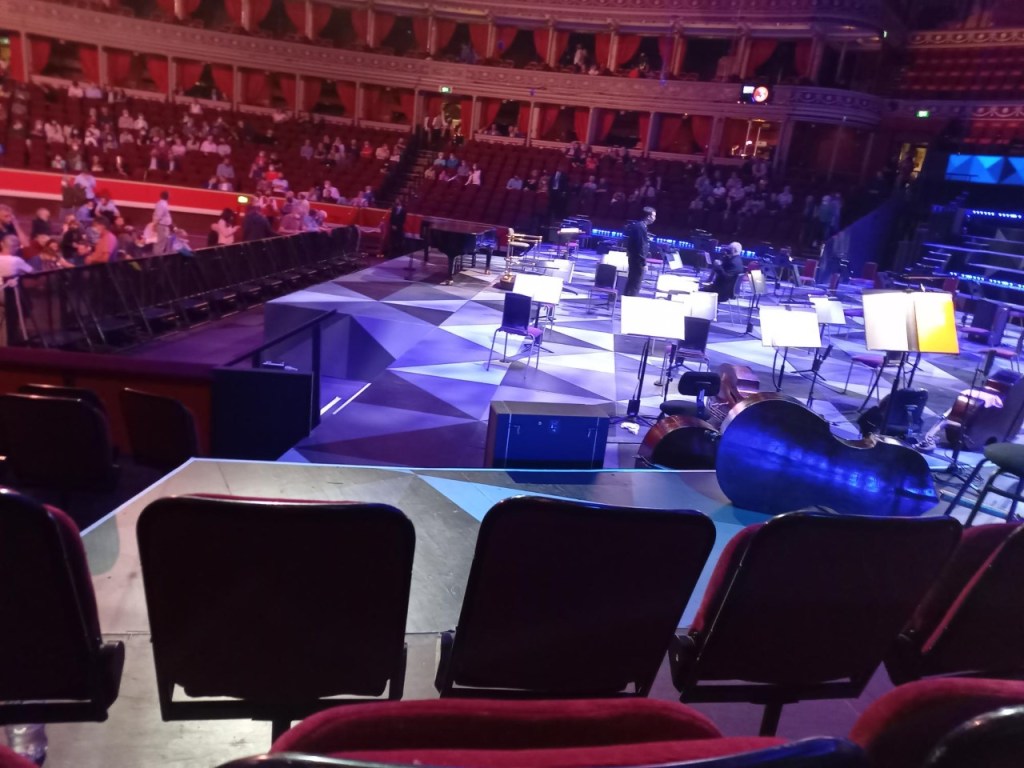
The programme was Haydn Symphony No. 103 in E flat major ‘Drumroll’, Mozart Piano Concerto No. 23 in A major, and Beethoven Symphony No. 4 in B flat major. The conductor was Ben Gernon and the soloist Elisabeth Brauss with the BBC Philharmonic. This was my first Prom in just over 2 years and it felt quite emotional to be back in that enormous arena which I have inhabited most years at some point since 1968. Things were very different though, and of course it is a huge achievement to have got 6 weeks of Proms up and running, given the huge challenges involved over the last few months (indeed tickets for some parts of the Hall only went on sale 10 days ago). Inside the Hall, half the arena was taken up with an extended stage. The Hall Stalls and Loggia / Grand Tier areas felt pleasantly full but most of the upper circle was empty – I guess due to both the vagaries of ticket sales, and that there’s still quite a lot of people worried about attending mass events. I was seated at the side stalls which, in the current reshaped context, meant being right behind the double basses – hence the sound I heard was inevitably unbalanced – though it was great to be so near the players.
Both the Haydn and the Mozart works in the first half were performed very well, I thought. In the Haydn, the woodwind playing was beautiful, trumpets, horns and drums weren’t over-bearing, rhythms were springy, and the whole performance radiated a sense of enjoyment in shared music-making – nothing was over-driven. The uncomfortable drum roll and the slightly eerie – dies irae-like – string harmonies at the beginning and end of the work weren’t overdone.The darker harmonies and tones in the Mozart were also well conveyed – again, excellent woodwind playing…..The soloist – but it was difficult to hear how she might have sounded from the front (I was listening to her from the side)….sounded as though she had a small precise tone for Mozart, but that is not inappropriate and she produced some sensitive phrasing, as well as precision.
I was not so convinced by the Beethoven – this might have been again a problem from where I was sitting, but there didn’t seem to be enough energy and bite in the string sound. This could have been a problem with the socially distanced strings, and there simply being not enough of the violins and violas, so that woodwind tended to predominate (something they didn’t do in the Haydn and Mozart – Beethoven’s sound is richer and thicker,), or maybe something to do with the orchestra not using period instruments (I missed the thwack of early 19th c timps) or maybe (looking at his podium posture). There was also some imprecision in the strings at time – e.g. at the beginning of the first movement. Mr Gernon just wasn’t energetic enough in his approach, or not conveying that energy to the audience. Beethoven – unlike Mozart! – does need to be driven, I find
But these are minor qualms – this was a really enjoyable return to the Proms!