Bach, Prelude in E BWV854 from The Well-tempered Clavier Book I; Beethoven, Piano Sonata No. 27 in E minor Op. 90; Bach, Partita No. 6 in E minor BWV830; Schubert, Piano Sonata in E minor D566; Beethoven, Piano Sonata No. 30 in E Op. 109
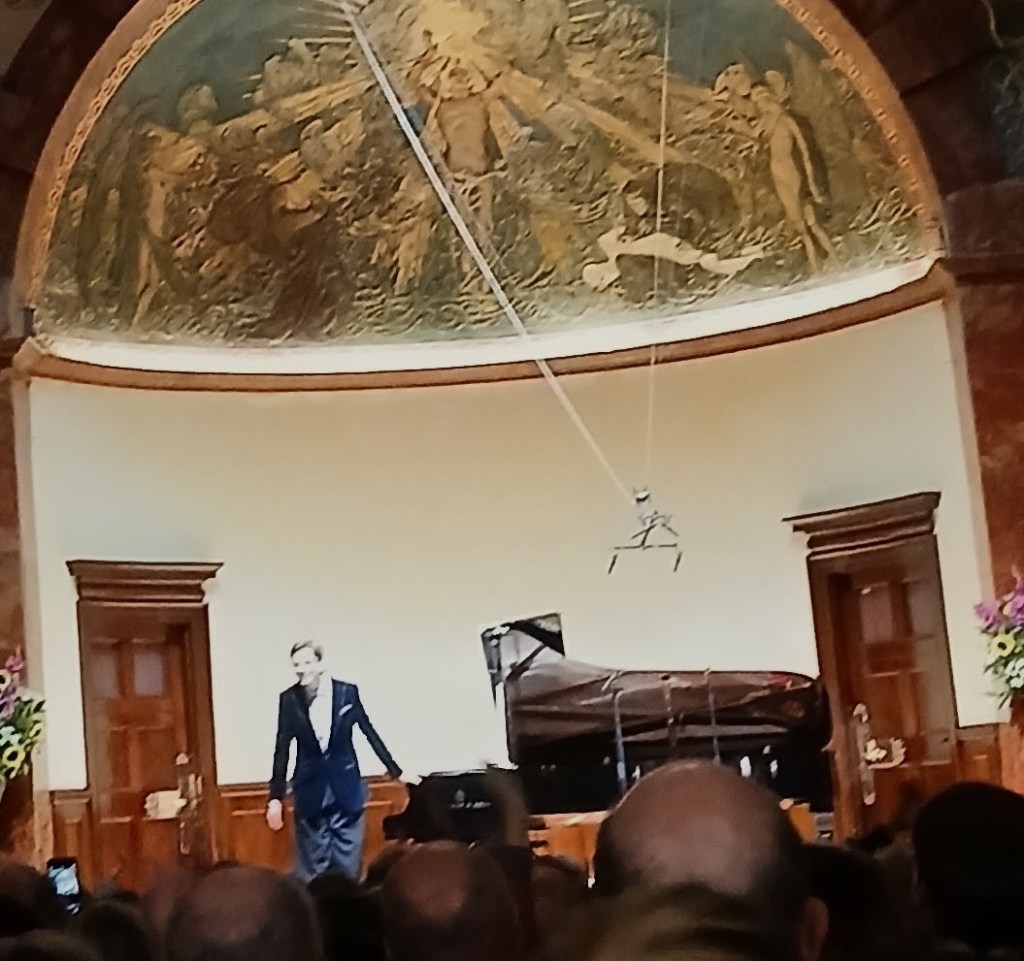
On then to the conclusion of the Proms and the advent of rock-star pianists at the Wigmore Hall – Olafsson here and Yunchan Lim next month. The last time I heard Olafsson he was in Liverpool as part of his world tour of the Goldberg Variations, also on a DG CD/stream; this time his CD is a collection of Beethoven, Schubert and Bach but centred round Beethoven Op 109, and the keys of E minor and major. Again he’s been doing an extensive international tour, ending this week in London. I suspect he’s not a pianist that everyone will like but I have to say I love his crystal-clear sound and meditative approach, and the thunder when he gets energised, and this is much more important to me than what could be to some people the off-putting DG-promoted branding – the sharp suits, the designer glasses, the immaculately combed short hair……I’ve heard him described as ‘mechanical’, but I just don’t understand such an accusation.
For me, there were 4 profoundly moving and beautiful pieces of music in this programme – the opening Bach Prelude in E, remotely and purely haunting; the folk-song like Op 90 second movement, the Sarabande from the Partita full of the world’s grief and Beethoven Op 109’s 3rd movement – stupendously energetic, beautiful and moving. They are pieces of absolute music, they don’t ‘mean’ anything – they are just in their different ways perfectly formed, heart-gripping, towering, and utterly memorable. Olafsson’s programme was dedicated to the exploration of the relationships between Bach’s music and Beethoven, and between Schubert’s and Beethoven. In terms of the first pairing, as he writes in the programme notes (and said in an after-concert speech) “Their (Beethoven’s late piano sonatas and quartets) wild inventiveness and transcendence of traditional form is rooted in a deep engagement with Baroque elements. They are the music of the future, and yet they are fuelled by the music of the past – the music of Bach.”. You could really hear this in the tumultuous sounds of the mighty Toccata from the Partita and the Op 109 (moments of all three movements but particularly the 3rd), and the inventiveness of both. You could also hear the similarities between the Schubert 2nd movement and the Op 90 2nd movement (the Schubert written in 1817 two years after the Beethoven was published). As I had bought Olafsson’s recording a year ago or more, all these pieces were to some extent familiar – or at least recognisable – but I made far more of the Partita and the Schubert piece listening to them live. Olafsson makes the point that not only Beethoven but also Bach was moving into something new in these late works – “it is worth noting how Bach, too, is testing and transcending the limits of his chosen compositional form in his final Partita, taking elements that originated in dance and turning them into formal abstractions, free to travel into uncharted musical territory.”
Olafsson’s recording makes the piano sound as it would in your average large concert hall, but the Wigmore Hall is a much more intimate space – ?470 people, maybe? – and ‘thundering’ would be the right word at times for some of Olafsson’s playing here. But there was also great delicacy, a sense of line, and I was utterly gripped. It’s all a matter of taste, but nobody else holds me in the same way playing this repertory. I felt also that his performances were still being thought through, still explored – faster and slower at points than in his recordings, particularly the last movement of the Beethoven.
There was a bit of a disaster in the middle of the Sarabande – at its most intense, Olafsson suddenly stopped, and said loudly and firmly something to the effect of ‘There’s a malfunctioning hearing aid in here. Can it be switched off, please?”. Much consternation….lights came on, Olafsson went off stage; no transgressor was identified (though an elderly gentleman did walk out), and Olafsson came back to re-play the Air and then on to the Sarabande. He was very gracious about it afterwards – saying it was an interesting experience, to have to start again half way through the Partita and pick up the threads, but it was at least a variation on doing the same programme again and again!
After quite a talk at the end about the issues I’ve written about – the influence of Bach on Beethoven – he played as an encore no less than a transcription Olafsson had made of the ‘Air on a G string’ (a 5th perfect piece’, which he said (a bit of perhaps understandable showing-off here) he had played for György Kurtag on his 100th birthday in Budapest earlier this year……It was indeed perfect!