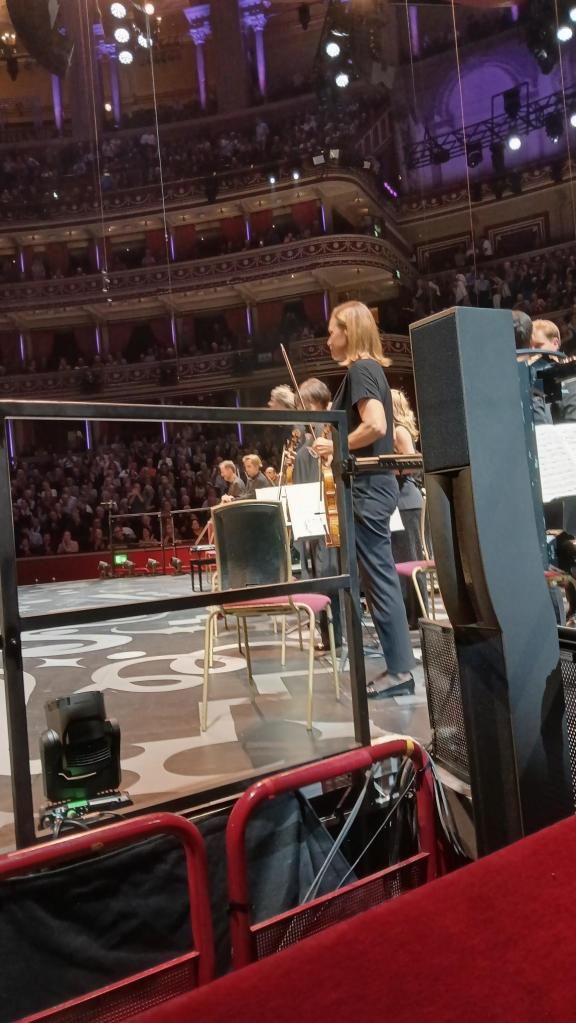
Mahler Academy Orchestra, Philipp von Steinaecker
After a very crowded, but respectful, Choral Evensong at Westminster Abbey (lots of Byrd and Orlando Gibbons) I went to my last Prom. I had said to myself a few years ago that I would give Mahler a miss for a while (this Symphony I must have known for 57 of my 74 years) and have then repeatedly broken that vow. This is something I should have avoided – not because there was anything wrong with it but because I just wasn’t in the right mood to engage with it (perhaps still recovering from Olafsson the previous evening).
The performance was an appropriately sombre choice for the 25th anniversary of 9/11 (not that that was mentioned). It was billed as a period instrument/style orchestral performance, with some enthusiastic promotion beforehand from Tom Service (BBC/Guardian). Like any similar performance of Elgar’s music would be (though to a lesser extent) it does raise the question of why it’s necessary when we have some sort of recorded benchmark. In the case of Elgar he recorded all his major works with British orchestras, whose performance and sound he presumably found acceptable. In the case of, specifically, Mahler 9, we have the famous live recording of Bruno Walter in 1938 (a couple of months before the Anschluss) with the Vienna Phil, still with Mahler’s brother-in-law Arnold Rose as leader, which must reflect – even 27 years after Mahler died – some elements of the orchestral sound he would have envisaged for this work – certainly the portamenti are there…… and Walter conducted the first performance in 1912.
Anyway, to quote its web site “The Mahler Academy Orchestra’s originalklang project sheds new light on the performance practice of Mahler’s time. For this unique project, the young artists of the Gustav Mahler Academy ….. under the direction of Philipp von Steinaecker ……. brought the music of the turn of the century to new life on historical instruments. To make the project possible, the Euregio Cultural Centre Dobbiaco Foundation has created a collection that unites the instruments used by the Vienna Philharmonic Orchestra around 1900. The Mahler Academy Orchestra is part of the Gustav Mahler Academy Bolzano-Bozen, which was founded by Claudio Abbado to create a place where …..exceptionally talented young musicians from all over the world receive decisive impulses for their entire musical lives under ideal conditions……….”
The big question is – so what? Yes, the orchestral sound is different in many ways, and it offers an aural equivalent of a restored painting. Much is fascinating – there’s more pungency to the woodwind (some wonderful bassoon sounds in the last movement), harder sounds from harp and timpani, a more cutting, intense sound to the strings, more rasp in the trombones, a sharper, tangy sound from the trumpets, and, actually, a mellower sound from the horns. There was a lot of portamenti, particularly in the first and last movements – I wasn’t looking out for (a lack of) vibrato, but Mahler apparently did ask for it in his score markings at times. But having said all that, it’s still the same score, still the same notes, and the same choices to be made about structure, about dynamics and tempi. And of course you have to factor into the complex mix the fact that orchestral standards have risen over the last century – even in my lifetime, How would the competence of a 1912 orchestra strike us?
Clearly of course the score doesn’t play itself, and the orchestra – full of select young and a few older musicians – by and large sounded wonderful. I had a most odd seat at the end of Row 1 of the stalls, stuck about 3 feet from the second violins, but even from that vantage point they sounded very good indeed (I heard one or two too-early entries, but I was right on top of them) and I am sure the positioning of the orchestra – split violins, basses right at the back – would have contributed to the appreciation of the sound by those in better positions. But I did have some concerns about the conductor’s handling of some of the music: in the first movement, there was to me insufficient sense of progression and of structure – all the big climaxes sounded the same, there wasn’t a sense the music was moving forward emotionally; I also thought the basic tempo was too fast. In the 2nd movement, though the main laendler theme was taken appropriately slowly (and therefore allowing for the woodwind to make some gorgeous burbling sounds) the counter theme was set at too fast a pace, and notes got lost. The third and fourth movements went, to my mind, much better, though again I wondered about the structure of the last movement and the gradation of climaxes – some of the tempi seemed to be on the slow side. All in all, my reactions to this I think were on the whole more based around my not being in the right listening mode for this great work, rather than any real problems with the performance. The orchestra was particularly good in the closing bars – beautifully whispered, slowly moving into infinity; they had just finished and the players and audience were sitting in silence (something Proms audiences have been very good at this year for works ending quietly) when after a second some idiot at the back shouted ‘bravi’ and people started to clap. Why do people do that?
All in all, then, this was a fine performance I didn’t really enjoy for reasons that were to do with me, but I do wonder in this case how important the ‘authentic’ approach is for a work of this kind (I agree it IS important for Bach and Handel). I listened again to parts of the Bruno Walter recording from 1938 a few days later – what that recording has, which perhaps this performance lacked, was drive and passion (but I may be being unfair)