Bayerische Staatsorchester, Jurowski – Poleva/Berg/R.Strauss: Barbican 18/9/23

Victoria Poleva –  White Interment (UK premiere); Alban Berg – Violin Concerto; Richard Strauss –  Eine Alpensinfonie. Bayerische Staatsorchester, Vladimir Jurowski conductor; Vilde Frang violin

I have never seen a live performance of the Alpine Symphony before, so I was looking forward to this concert a lot. I had missed going to what must have been a very special Proms performance of the work in 2014, by the Vienna Phil and Haitink, and I was thwarted by a train strike from going to a BBC Philharmonic Alpine Symphony last year.

The Bayern Staatsorchester a.k.a the Munich Opera orchestra is yet another great German orchestra, with weighty stylish strings, superbly confident brass and dextrous woodwind. It is a national embarrassment to see this wonderful visiting orchestra – albeit a monstrously large one for this outsize work – so cramped together on the inadequately small Barbican stage (and with the organ having to be an electronic one). With 10% more space the sound would have been better – it might have bloomed more and not be the tight restricted sound people have complained about since the place was opened – and the visual impact would be improved. Why it had to be the space it was is beyond me…..

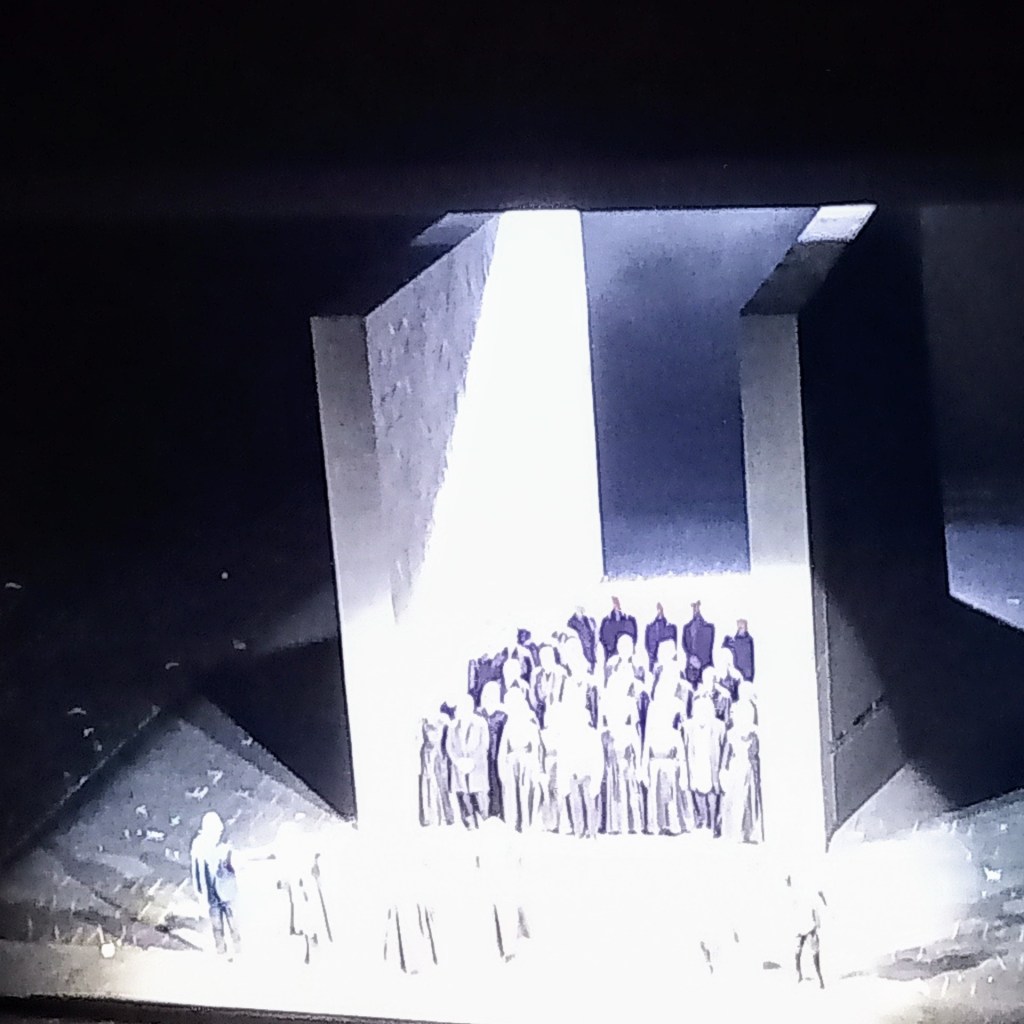
Anyway…..this was an excellent concert. It opened with a new work by a Ukrainian composer, Victoria Poleva. This was ‘White Internment’  , about the experience of being surrounded by snow. It reminded me of a work by John Luther Adams – tonal, slow moving blocks of sound, suggestive of massive natural forces and some fairly obvious connections to the Alpine Symphony. There was something like a quirky folk tune towards the end, which seemed to be an attempt to break through the weighty unshifting chords – or maybe even suggesting an escape.

Quite how the Berg Violin Concerto fitted into the overall programme I’m not sure. I can never quite get my head round this work, despite having heard it live and in recordings a number of times. Somehow its structure eludes me and I feel sometimes the violin is a bit too busy – I felt it would be good to hear the orchestra off the leash. As far as I could tell this was a fine sensitive performance….but I’m afraid this work leaves me unmoved except for the last 5 minutes or so.

As for the Alpine Symphony, this performance was all I wanted it to be – sumptuous, brilliant and very very loud at times. Like, more obviously, Ein Heldenleben, the work is perhaps a metaphor for the journey we all take as humans, with all its glories, tribulation, terror and joy, and speaks to me in a way that some of the other Strauss symphonic poems eg Don Quixote don’t.  And while there are some Straussian melodic tics in the Alpine Symphony which pop up in other works, the melodic material of the piece is rich and varied enough for you not to be saying every few minutes – oh, there’s a bit of Rosenkavalier there, or that sounds just like Die Frau ohne Schatten!

The great virtue of the performance apart from the wonderful and precise playing of the (huge – 6 oboists for instance) orchestra was the clarity of sound Jurowski got them to produce and the way each episode of the work was characterised. I have never heard the chattering woodwind undergrowth of some of the climb in the mountain so clearly. Compared to the old Kempe recording, which is the one I got to know this work from, some sections were faster than I expected, but everything hung together very well, moving inexorably towards the final ascent of sumptuous strings, wonderful horn playing and thrilling cymbal crashes. The whole didn’t feel at all episodic (which by its nature I suppose it is in fact) but very much purposefully moving forwards towards the dark ending. R.Strauss’ music can sometimes feel garrulous and contrived, cynically pushing the buttons,  but this was his music at its brilliant best. I hadn’t heard before how some of the work sounds startlingly similar to Mahler, not just the pastoral cowbell bits, but also shrieking clarinets at times in the run up to the storm.

Amazingly after all the effort of the Strauss the orchestra also gave an encore- a beautifully meditative Prelude to Act 3 of Meistersinger.

By chance I saw a white suited Jurowski with a group of people in the pub afterwards, downing a pint. He looked pretty pleased with himself, as well he might……

At the Venice Fair: Salieri (UK premiere run). St Johns Smith Square, Bampton Classical Opera 13/9/23

Iúnó Connolly; Andrew Henley; Philip Sheffield, Guy Beynon, Aaron Kendall; Ellen Mawhinney; Sarah Chae. Thomas Blunt, Conductor; Jeremy Gray, Stage Director

How best to describe this experience? It was like being invited to have dinner with an uncle of one of your oldest and best friends. You accept willingly and at first you are astonished at how similar to your friend his uncle is – very similar features, expressions, ways of holding himself and voice…..And you’re initially very engaged in chatting with him. But then gradually the feeling comes over you – this man is really a bit of a bore; superficially he’s like your friend but he lacks the anecdotal punch and sparkle of your friend, his way of telling a story and the range of things to talk about, the reliable attractiveness of your friend’s conversation.

And that’s how it is with Mozart and Salieri. The story about the latter poisoning the former of course is almost certainly nonsense ( Salieri claimed he’d done so in later years when suffering from dementia but in his lucid moments always denied it). Mozart apparently got on well with the slightly older man (born 1750) and certainly was not above borrowing from him – the masked ball scene in this work might well have been the inspiration for the not dissimilar idea in Don Giovanni. Salieri was more popular than Mozart, biographers say, but maybe slightly envied the latter’s prodigious talents.

Given my grumbles below, it’s worth saying that this opera was written when Salieri was only 21. It was hugely popular at first, receiving something like 30 productions in Salieri’s lifetime, but by the 1790s was being viewed as old fashioned – Leopold Mozart was commenting on it unfavourably even in the early 1780s. If you were to listen to it casually, dipping in for a few minutes you’d think it was Mozart – very similar orchestration, turns of phrase, musical mannerisms. What you begin to miss soon though is the lack of complex harmonies, the ebbing and swelling of different emotions, the characterisation of different scenes, the absence of memorable melodic material. In truth it’s pretty boring. It bounces along amiably – one pleasant aria follows another. But there’s no wit, no dynamism. The denouement in Act 3 is appallingly below the standards of Mozart’s finales……..Nor was the librettist (brother of the composer Boccherini) up to the standard of Da Ponte or even Schikaneder  – the opera’s protagonists are cardboard cutouts, the plot plain silly (though of course Cosi Fan Tutte is bound to some to seem as ridiculous) – nobleman comes to Venice with his aristocratic fiancée but at the same time wants to have a fling with a local Venetian girl, who’s scheming and wily. She pops up from time to time to embarrass him when the nobleman is with his fiancée, and when the latter gets to realise that she’s got a rival she uses the opportunity to dress like her at the masked ball and humiliate the nobleman. Eventually all are reconciled with the aid of large wodges of cash and the engaged couple are married.

Bampton Opera I’ve not come across before – one of the smaller country house opera companies, it specialises in putting on long forgotten 18th century operas with young singers. It was using St Johns Smith Square for this performance. The church like most churches was not an ideal musical performance space- quite echoey, so that the English translation got swallowed up in the acoustic depths and little could be understood of what was being sung (the men in recitatives being an exception). The staging was fairly minimal – the scenery being a series of advertising boards for Venice, and various props further reducing the space for singers to move in. There was some good lighting, making effective use of the church’s massive pillars, and a rather clever silent fireworks display projected onto the church roof during the final wedding scene.

The singers did their best to make the characters interesting. Ellen Mawhinney has the most demanding acting role as Falsirena and she did very well in conveying her tricksy wayward personality. All the singers might be ‘young artists’ but the main three all have an impressive track record of UK and international performance. I was, of the three, most impressed by Sarah Chae as Marchioness Colloandra whose voice seemed to gain in agility and power during the evening. But Ellen Mawhinney and Andrew Henley as Duke Ostrogoto were very good too. I was also impressed by Iúnó Connolly.  Phillip Sheffield gets full marks for the audibility of his words. Occasionally, in some of the smaller roles, there were signs of straining, as though young voices were having difficulty in projecting their voice into such a large space.

The orchestra raised on platforms behind the singers was a small period instrument band who performed very effectively, though the lighting for their scores seemed to shine over the singers into the eyes of the audience, reducing the visibility of what was happening on stage.

All in all this was, despite everyone’s best efforts, a rather dull but undoubtedly fascinating evening that threw interesting light on what makes Mozart special. I’m glad overall I went. This run of performances by Bampton were the UK premiere of the work. I can’t see it cropping up again in my lifetime……

Berlioz Les Troyens: ORR, RAH Proms 3/9/23

Alice Coote, Cassandra; Michael Spyres, Aeneas; Paula Murrihy, Dido; Lionel Lhote, Coroebus; Adèle Charvet, Ascanius; Alex Rosen, Narbal; Ashley Riches, Panthus; Beth Taylor, Anna. Monteverdi Choir, Orchestre Révolutionnaire et Romantique. Conductor Dinis Sousa

After the only staged performance I’ve seen of this work so far (see July 2022 entry in this blog) in Munich, which was one of the worst examples I’ve come across of regie-theater at its most bizarre, I was looking forward to a concert performance, where nothing much can go wrong, albeit in this case we were without the planned conductor, the much reported-on John Eliot Gardiner, who cancelled his conducting of the opera to ‘reflect on his behaviour’, having punched a soloist in the face after a performance in France. I was also looking forward to hearing this work played by a period instrument band – I haven’t heard the Orchestre Révolutionnaire et Romantique live before, though I’ve head the OAE, which covers a sort of similar range of period styles. Gardiner incidentally is credited by Slipped Disc, the rather gossipy website who broke the punching story, with being a conductor who has created more work for more musicians at his own personal risk for longer than anyone else in UK musical history………..  Certainly there was an impressively long list of names of the orchestra’s musicians and admin/musical staff at the back of the Proms programme for the concert. I hope Gardiner returns soon to lead this large and gifted band (and the others he has set up). I hope also someone has a succession plan for its leadership given that Gardiner is 80…..

This performance was part of a European tour that has taken these performers to Salzburg, Berlin and other festival stop-offs. Without in any way sounding routine, everyone sounded well played-in, utterly compelling and confident in what they were doing. It must have been heart-warming for them that they got a huge cheer as they came on stage, and a particularly vociferous ovation for the replacement conductor, Dinis Sousa.

It was great to hear this work live again. I did find that, shorn of sets and dramatic concept, the ‘French Grand Opera’ form of the work is occasionally a bit wearing – the slaves’ dances,  the songs of Iopas/Hylas for instance while lovely are not integral to the drama. Dido’s death seems to go on for too long, not something I remembered from the staging I saw last year. Part 1 is dramatically tighter than Part 2, I felt. But the best elements of the work – the love scenes, the grand choruses, the Royal Hunt and Storm  – are just glorious.

Although billed as a concert performance this was in effect a semi staged one – in particular in Part 1 varied use was made of the whole stage, including singers weaving around the Orchestra’s music stands. The young lively Monteverdi chorus ran about frantically as the fighting started and a group of the women joined Cassandra at the front to swear death rather than dishonour, with clenched fist out-stretched. There was also a varied use of lighting. Nobody had a score anywhere near them among singers and chorus and everyone responded quickly to each other with vivacity, sincerity and realism as they sang. Some were better than others – Paula Murrihy had a compelling queenly presence, and her movements were spare and dignified – she was utterly credible as Dido. Michael Spyres was slightly more off hand in his acting and Alice Coote maybe veered towards the melo-dramatic (but perhaps that’s inherent in the role).

As I mentioned, I have not heard a period instrument band before for this kind of Romantic repertoire, and it was wonderful to hear the occasionally mellow, occasionally snarling trombones, the softer horns, the cutting trumpets and the quieter yet more penetrating percussion, as well as the bright strings and different sounding, more earthy somehow woodwind. The mellow sound of the solo horn in the Royal Hunt and Storm was particularly glorious. The opening of the work sounded quite different from how it does in the early 2000’s LSO recording – buzzing oboes, harsh bassoons, an altogether more complex less bland sound. The orchestra played magnificently and Gardiner’s replacement Dinis Sousa didn’t at all feel like a second-rate substitute. The orchestra clearly appreciated his presence. The chorus too sounded tremendous – sharp attack, no fuzziness and a lot of volume…..!

Of the singers the three principals vocally were all very strong (they seemed to be miked up but I think this was more about getting the radio sound right rather than hall audibility. Michael Spyres is deeply impressive – gleaming top notes, powerful projection, and a bright appealing sound. His big Act 5 aria was superb.  Alice Coote impressed as always with some lovely soft singing as well as strong top notes and revelling in the dramatic possibilities for her voice in this role. Paula Murrihy I was also impressed by, though, when under pressure, her voice can develop quite a strong vibrato.  She has a warm glowing voice – she offered us some beautiful sounds and carefully shading of phrases.  It’s not a large voice, I felt, but she seemed to project well in the difficult acoustics of the RAH. The voices of Spyres and Murrihy blended beautifully in ‘nuits d’ivresse’ in Act 4. The other two singers I was particularly impressed by were Laurence Kilsby (Hylas/Iopas – lyric high tenor) and Beth Taylor (Anna – contralto) who both clearly have great futures ahead of them (the latter has already sung Erda and a Norn at the Deutsche Oper, Berlin).

Altogether a great evening, and I met people I knew as well.

Boston Symphony Orchestra: Stravinsky, Gershwin, Ravel – RAH Proms. 26/8/23

Carlos Simon Four Black American Dances (European premiere); Stravinsky Petrushka (1947 version); Gershwin Piano Concerto in F major; Ravel La valse. Jean-Yves Thibaudet Piano, Boston Symphony Orchestra. Andris Nelsons conductor

This was a well-planned programme, centred around dance and jazz rhythms, as well as framing two American pieces in each half with two Diaghilev ballets, and it was well-suited to the BSO’s world-class talents. A completely full and very attentive hall, this time, but, like the Friday concert, the BSO left the stage without an encore. This was however a quite full and taxing programme, from the musicians’ perspective, so fair enough really.

The Carlos Simon piece was altogether a bit of a riot – various sorts of highly rhythmic infectious dances, with the amazingly proficient BSO percussion section very prominent. The composer was in the audience and received wild applause. It’s not profound music, but certainly great fun, and was just about the right length.

Petrushka of course is not great fun in the same way, though similarly based on dance rhythms. There was something not quite right about this performance, though I find it hard to pin down what it was. It goes without saying that the BSO played it wonderfully – spectacularly good trumpet playing and many beautiful woodwind solos. Perhaps it was something to do with Nelsons’ relatively slow tempi – there was something about it that lacked bite and needed a harder edge; it felt a little sugary, and at times my attention wandered. Some of the menace and panic in the work didn’t quite come across. What the slower tempi did reveal was lots of the inner voices in the orchestra you would not normally hear.

The Gershwin concerto I have heard live before but I don’t know it that well; it doesn’t really feature in my home listening choices. As far as I could tell, this was a very good performance indeed – utterly idiomatic, superlative playing by Thibaudet and the orchestra, and it kept my attention throughout, with both Thibaudet and Nelsons giving it lots of swing. The work is maybe a bit episodic, and in particular I found it difficult to work out what was going on in the first movement – but it’s all so enjoyable it didn’t seem to matter, and it has some great tunes! First trumpet and trombone were particularly good in their various solos

And finally, La Valse – I have hear performances with a more cataclysmic ending -but no matter; it was beautifully played and thoroughly enjoyable

It was great to hear the BSO twice in one weekend. I think it’s only the Cleveland Orchestra I’ve not heard live until now, over the years, among the great American orchestras………..

Afternoon organ recital, RAH Proms 26/8/23

Wagner, transcr. Demers The Mastersingers of Nuremberg – Prelude to Act 1; Rachel Laurin Prelude and Fugue in G major; (World premiere); J. S. Bach, arr. Dupré  Cantata No. 146, ‘Wir müssen durch viel Trübsal’ – Sinfonia; Coleridge-Taylor Three Impromptus; Reger Chorale Fantasia on ‘Ein feste Burg ist unser Gott’; Still Elegy, transcr. Demers Romeo and Juliet – excerpts. Isabelle Demers organ

I went to this rather at the last minute. I had a weekend Proms arena pass so was able to make that decision quickly. Having breezed up with little notice about 10 minutes beforehand I am glad I went. It is always fun to hear the Albert Hall organ being put through its paces. I did wonder why there was such a preponderance of transcriptions of orchestral pieces. If I wanted to hear the Mastersingers overture or the Romeo and Juliet suite I would much rather go to orchestral performances – the organ transcriptions tend to point out that organ’s inadequacies, its relative inflexibility rather than its strengths (though it was fun to hear some extraordinarily high percussive clings the RAH organ can produce ). It follows that the piece of music I enjoyed most was the monstrous Reger piece, conceived for RAH sized organs, and the unpretentious but attractive Coleridge Taylor pieces. But it’s a pity that alongside these three wasn’t some French or English 20th century pieces or some more arranged Bach organ works. Anyway, a very well-played programme

Bach late night concert: RAH Proms. 25/8/23

J. S. Bach: Cantata No. 170, ‘Vergnügte Ruh, beliebte Seelenlust’; Brandenburg Concerto No. 3 in G major; Cantata No. 35, ‘Geist und Seele wird verdwirret’. Iestyn Davies counter-tenor, The English Concert. Kristian Bezuidenhout harpsichord/director

 The Proms is really a remarkable institution. How can it possibly be that about 3000 people should be milling around the RAH at 10pm waiting to get into a late night Bach concert on the evening before a rail strike? Moreover, while Iestyn Davies is a big star and an obvious audience attraction, the Bach cantatas to be performed are frankly not among the more memorable ones, I thought at the time, while their sentiments are unlikely to be shared or in some cases even understood by the majority of the audience. Nevertheless there was cheering and whooping at the end of it all, to my astonishment.

I didn’t help myself by downing two pints of IPA in the Queen’s Arms having an enjoyable chat with someone I know, beforehand, and by choosing to sit at the back of the arena, allowing the clarity of the English Concert’s playing to be reduced to a harmonious soup by the RAH’s acoustics.

I listened to the concert the next morning on I-Player to make amends and thoroughly enjoyed it; Iestyn Davies’ singing is wonderfully sensitive.  And actually the cantatas’ arias are really rather good, particularly the final one of BWV 170

Boston Symphony Orchestra, Nelsons: R.Strauss, Prokofiev – RAH Proms. 25/8/23

Julia Adolphe Makeshift Castle (European premiere); R. Strauss Death and Transfiguration; Prokofiev Symphony No. 5 in B flat major. Boston Symphony Orchestra – Andris Nelsons, conductor

 Three months after seeing him conduct Mahler 8 in Leipzig, it was good to see Andris Nelsons looking healthier at this Prom than he did back then. He had lost weight, walked relatively quickly to the podium, and conducted energetically (although he did seem to bring his own podium with him). This is good news concerning an extremely talented young-ish (as the breed goes) conductor. The hall was pretty – though not completely – full  (the following BSO concert the next day is sold out). I had a family next to me in the Arena consisting of 4 small children under 10 and three adults – very brave to take such small children to a long concert. I take my hat off to the grown-ups for keeping the children relatively silent – the oldest of them was bopping along in the faster rhythmically energetic bits of the Prokofiev – or asleep throughout the concert despite occasional rustling of sweet papers – I think promises of ice-cream at the interval helped in the first half………….

I am not sure I’ve heard the Boston Symphony live before – their appearances at the Proms have all been when I was away overseas or on holiday. As you would expect, they sound very fine indeed – almost a cliché of how American orchestras are ‘meant’ to sound – full-bodied bright sound, immaculate ensemble, bright brass, stunning woodwind, and a string sound that is warm without having the lustrousness of the big German orchestras. And it’s large – 10 double-basses, I counted.

The first, Julia Adolphe, piece I wasn’t’ hugely taken with, though I enjoyed the second movement. It combined reflections on past and present, meditating on the first time she saw her father cry and her first memory of a beautiful sunset. The first movement didn’t really convey to me any sort of childhood memory in musical language and thematic material, sounding ‘merely’ threatening. The ending was lovely, though. The work overall was approachable, listenable to and I’d happily hear it again (though didn’t get the relevance of the title).

I remembered again Stephen Johnson’s before-concert talk in Leipzig when he described (not a story I’d heard before) Mahler and Strauss having a bet that each of them would write a piece about death and the after-life. Mahler produced Totensfeier (eventually becoming the first movement of the 2nd Symphony) and Strauss wrote Death and Transfiguration (aged 25). I first got to know this piece in an old Furtwangler HMV recording and oddly it is the first time I’ve heard it live. I’ve always loved it, though over the years I’ve seen how comparatively superficial it is compared to Mahler’s part of the wager, how relatively almost cynical in its adoption/manipulation of particular harmonies and the certainty of its outcome. But it is brilliantly put together and I always love listening to it. The performance was stunning – a most beautiful oboe solo in the opening, a lovely violin solo, powerful brass and dark cellos and double-basses, and soaring upper strings at the end. The orchestral power unleashed at the climaxes of the protagonist’s struggles and the end of the piece (taken more slowly than some I’ve heard) was quite something……..

The best performance I’ve ever heard live of Prokofiev 5 was by Gergiev and the LSO in 2011. I have to say this one was at the same level of achievement – a wonderful performance. As I listened to the music. I found myself thinking – how DID Prokofiev get away with this? How did he convince the Soviet nomenklatura that this was a celebration of Russia’s turning round of the German invasion, the likely victory and the ‘greatness of the human spirit’? That may be part of Prokofiev’s aim, but there seems to be a constant undermining of this positive spirit – the dance music in the scherzo and finale which sounds ironic, like dances being led by mechanically-moving marionettes, and the distance, the sadness of the third movement, together with the terrifying madness of the cartoonish ending, like one of those Bugs Bunny films where they all go over the top of the cliff, run along the air for a bit and then plunge into the abyss; all these elements feel to me to be undermining the ‘nobility’.

I thought Nelsons shaped the first movement brilliantly, with a very careful grading of climaxes, quite moderately paced (but then it certainly isn’t marked as allegro). The second movement was also less than frantic, at a pace which to me allowed more pointing, more of the mordancy to come through, more of the terrors lurking behind the jolliness, though some critics I think felt it was too soft, not pointed enough! The slow movement has that Romeo and Juliet sound at its beginning, but without human beings dancing, the overwhelming effect is of something distanced, behind a gauze, Miss Haversham-like – I find the waltz theme coming in after a couple of minutes one of the most haunting themes I know. The finale was brilliantly done, with the percussion excelling themselves!

BBC SO/ Oramo: Weir, Schumann, Elgar – RAH Proms 24/8/23

Judith Weir: Begin Afresh; world premiere; Schumann: Symphony No. 1 in B flat major, ‘Spring’ ; Elgar: Violin Concerto in B minor. Christian Tetzlaff, violin; BBC Symphony Orchestra; Sakari Oramo, conductor

 I hadn’t intended to go to this, though I thought it looked like a good Prom – however, for various reasons I can’t go to Rattle’s Mahler 9 on Sunday (not such a huge loss. I have heard him perform this with the LSO before, and it is being televised, plus I heard a superlative account of the work in Leipzig three months ago) so this concert seemed a good way to replace it at a time when I was available.  I got a last minute Choir seat right at the back and near to the organ, so a bit problematic for the violin concerto in prospect…….I plan to stand for the two Boston Symphony concerts and have taken an arena seat for the late night Bach concert.

I really enjoyed this concert, and, actually, being right at the back of the Choir is probably preferable to being at the front, overwhelmed by brass, timpani and percussion.

The Weir piece was about trees, and their progression through the seasons, starting in April and ending in February, with a particular richness in October in the central part of the work (about 15 mins in all) and tougher sounds, ushered in by a piano, where the movement of the roots and the winter winds are portrayed. I am not sure the ending was successful – it seemed simply too abrupt. It was very accessible, though (or perhaps that’s an ‘and’?) reminds me of Bax, Britten and even Vaughan Williams at times. I would like to hear it again.

I am not sure I have ever heard Sakari Oramo conduct live before. Sitting in the choir, it was noticeable how clear his beat was and how energetically he encourages the orchestra. I am pretty sure this was the best performance of this work I have heard live – it was fastish, but in a way that encouraged energy, freshness and a rhythmic spring (as it were) rather than slurred phrases and gabble, and with a sure sense of dynamics. I was very impressed by the orchestra too – responsive to every gesture Oramo made, with some outstanding woodwind playing, particularly by first flute and oboe (and notably in the finale), and a very emphatic hard-sticked timpanist, which I liked. The ending of the finale was quite remarkably exciting – that’s not normally a phrase that comes to mind when I think of Schumann….The most controversial movement in terms of speed  was the slow movement, which was really quite quick, but beautifully shaped by these performers (Oramo using his hands rather than baton for this movement only).

I am also not sure I have ever heard the Elgar Violin Concerto live before, which is a bit of an admission. I may be wrong – looking at the Proms Archive for 1972, when I went to the Proms most nights when in London, there was what must have been a remarkable performance by Menuhin (who of course as a teenager famously recorded the work with Elgar) and Boult – but I think I might have been on my first visit to Bayreuth then, or have totally forgotten it…….

Somehow I have never quite held the Violin Concerto in the same regard as some of Elgar’s other works – I find the structure of the first movement difficult to follow, and to a lesser extent the finale.  In this performance I found myself bothering less about the structure and just enjoying  the glorious music. There’s a good argument for saying that the dedication in the score to the ‘soul of XXXXX’ represents a dedication to Elgar himself (also 5 letters) and the work offers us the deep feelings of a conflicted, restless soul, nevertheless able to find great beauty within himself, as well as the sadness for paths not taken.

Being at the back of the choir is indeed not a great way to hear this piece. What was notable for me was the introspection of both soloist and conductor – this was a poetic often slow-ish reading (probably less restless than Elgar’s own recording of the work), with some extraordinarily quiet meditative playing by Tetzlaff – and the extent to which Oramo reined in the dynamics so that Tetzlaff came over very clearly even when hearing him from the rear (the volume when Oramo let the orchestra off the leash was startling). Sometimes in the first movement I felt that a bit more bite and angst from the orchestra would have been a good idea, but for the most part I just succumbed to the beauty of the work. The second movement has always seemed to me to be the most accessible part of the work (i.e. with a clear structure) and this was gloriously performed, quite slowly, and deeply moving – that sense of an interior place of quiet beauty and longing always there, whatever the outward circumstances. Tetzlaff’s cadenza in the last movement was remarkable too.

Kreisler, the first performer of the work, thought that this was the finest violin concerto after Beethoven’s and Brahms’. Although there are occasional phrases in his works that sound like Brahms, R.Strauss or even a Wagnerian turn, as in this concerto, Elgar is one of those truly great composers, instantly recognisable, always himself, whose major works never fail to move and nourish me.

Kurtág – Endgame: BBC SSO, Wigglesworth – RAH Proms 17/8/23

György Kurtág Endgame (UK premiere). Frode Olsen, Hamm; Morgan Moody, Clov; Hilary Summers, Nell; Leonardo Cortellazzi,  Nagg; BBC Scottish Symphony Orchestra, Ryan Wigglesworth, conductor. Victoria Newlyn, stage director

This is an event that I really felt duty-bound to go to, without necessarily a huge amount of enthusiasm – but a new work by the last of the great European post-war modernist composers still alive, and a magnum opus of his being given its UK premiere both felt like ‘musts’; it was time to grit my teeth and embrace the new.

It’s interesting how – relatively speaking – full the RAH seemed for this performance. The upper ranges were more or less empty but the stalls and boxes were full and so as well was the arena – surprising for what one might have assumed in advance to be a somewhat tough-listening experience. I remember reading about a Proms performance of Messiaen’s Francis of Assisi opera given at the Proms about 40 years ago and the reviewer referring to rows of empty seats, and it being a thoroughly dismal concert. Kurtag’s work by contrast had a warm and appreciative audience last night – there was a lot of hype about this performance in advance (e.g. an article in the Guardian) which might partly explain the crowd but I’ve noticed generally increased numbers at all the Proms I’ve been to this year – partly based on the huge numbers of tourists, in London no doubt – but this was one, obviously based on my purely subjective views, that didn’t seem to have tourists boosting the numbers . A few people left as the performance proceeded but the overwhelming majority stayed to the end and cheered.

Nor indeed was the work as rebarbative as I’d feared. OK, the combination of Beckett and Kurtag isn’t going to make for a Barber of Seville experience, but I was surprised by the relative absence of dissonant grinding chords and also the way in which the text was used to create wisps of melody, based on speech patterns, throughout the work (slightly like Janacek, I suppose). It was all thoroughly listenable to and there are moments of great beauty – Nell singing about boating on Lake Como, for instance. I guess Endgame is in fact an odd work to wish to set as an opera, given that the point of the play is that none of the characters can communicate effectively with each other, and that silences are at times as important as words – whereas music is precisely all about communication (though silence is also important)……..It is however a tribute to Kurtag’s skill that somehow the opera was a different experience to watching the play – not just a theatre piece with some incidental music, but Kurtag has created something new artistically, and the music provides connections that the words of the characters cannot . The text – allusive, gnomic, spare – and music seemed well suited to each other.  The orchestra is large, but with less than the normal number of strings, making for a sharp, crystalline musical sound world, heavy on brass, wind and percussion, all of which are used sparingly and often very quietly.

This is an ideal opera for a concert performance – static, no real need for scenery or indeed props apart from the two barrels for Nell and Nagg and Hamm’s toy dog. The singers performed on the upper level of the stage below the organ, lit as they would be in the theatre (with Sir Henry Wood being an occasional unintended participant). Clov is the only person who moves around and he had the full length of the stage to do so. Some shapes and scenery were projected onto the wall immediately below the Choir area – these were intermittent and didn’t really add much. The only slight setback in the staging was the strange English sometimes used in the surtitles – Hamm calling a walking stick a stanchion, for isntance. It became apparent why when a Iook through the programme credits disclosed that the surtitles were provided by Flemish Opera.

All the singers were utterly credible in their roles. Nagg has the most ‘characterful’ role and this was very well done by Leonardo Cortellazzi. Hamm has to do the lion’s share of the singing and did so magnificently. Ryan Wigglesworth seemed totally in command of the music and had indeed met Kurtag earlier in the year in Budapest to discuss the work

Was this an utterly absorbing experience ? – yes, it was. I really enjoyed listening to this – perhaps ‘enjoy’ is not quite the right word, but certainly it felt like time very well spent – it was an intense experience.  Would I want to repeat it? – not soon, but yes. Currently Kurtag has only set some 60% of the play . There is a hope – perhaps forlorn- given that he is now 97 – that he may yet be able to set more of this to music.

There is sometimes a bit of an Emperor’s New Clothes aspect to responses to new music by famous composers, and so, analysing my reactions to the work and what I’ve written above, my only query would be about seeing it in the opera house – it made a lot of sense for it to be a staged concert version, but what would it feel like in the opera house – is there enough action for it to absorb the audience in the same way? There were a few times when I felt things were moving very slowly – at such points in a concert there is plenty look at in the orchestra, but obviously that’s not an option in the opera house

Britten: Midsummer Night’s Dream – Glyndebourne Festival Opera, Glyndebourne. 8/8/23

Conductor, Dalia Stasevska; Original Director, Peter Hall; Revival Director and Original Choreographer, Lynne Hockney; Designer, John Bury; Revival Choreographer, Lauren Poulton; Lighting Designer, Paul Pyant; London Philharmonic Orchestra, Trinity Boys Choir. Puck, Oliver Barlow; Oberon, Tim Mead; Tytania, Liv Redpath; Lysander, Caspar Singh; Hermia, Rachael Wilson; Demetrius, Samuel Dale Johnson; Helena, Lauren Fagan; Quince, Henry Waddington; Snug, Patrick Guetti; Starveling, Alex Otterburn; Flute, James Way; Snout, Alasdair Elliott; Bottom, Brandon Cedel; Theseus, Dingle Yandell; Hippolyta, Rosie Aldridge

Another day, another revelation, facilitated by Glyndebourne. I have never really got to know this work in the way I know Peter Grimes, Billy Budd, Turn of the Screw and Death in Venice. This I guess is partly about the productions that were easily viewable in the UK in the period 1969 to 1983 when I was going to music events regularly  – there was no MSND production gettable-to that I ever saw of the work in that period (and I wouldn’t have ever contemplated going to the first performance of this production in the early 80’s). Between 1982 and 2010 or so, with the combination of working overseas and young families, I saw very little of anything, and there has only been one production I’ve been to since that time – the ENO production around 10 years ago, set in a grey dark 1950’s prep school which left little in the way of memories or enthusiasm for the work. I have a CD set of this opera, and then an MP3 recording, but have never really played these until I knew I was going to this performance.

Glyndebourne was externally not at its most magical on the day I went – drizzling rain before and throughout the performance; I was on my own, and sat in the interval in one of the few sheltered spots outside not rained on, munching my Pret sandwich and looking out over an entirely deserted lawn and green area – not a picnic hamper in sight. But I am pleased to report that inside the auditorium the atmosphere was absolutely magical.

The reworking of the play by Britten and Pears focuses very much on the fairy world, and less so on the aristocratic humans and the ‘mechanicals’. That gives a tightness to the opera but it does leave the back story a bit loose – you would have to know the play to know who Lysander, Hermia, Demetrius, and Helena were and why they would be running around in the woods; likewise, who on earth Theseus and Hippolyta were when they suddenly pop up towards the end of the work. It’s inevitable, I guess, that something has to be removed to turn this into an opera, and the great advantage of the reworking and emphasis on the fairies is some of the wonderful music Britten was inspired to write for them. I kept asking myself as the evening progressed – why do I not know this music better; why have I not appreciated it more for what it is? The answer, probably, is that I have never seen an effective production of it before. 40 years on, the sets for this production seem very effective. Until the scenes with Theseus and Hippolyta, the scene is the forest, and this is very effectively done, with a dark glittering floor that can sometimes seem as though it has pebbles or ponds, and a darkness that allows you to just about see the trees and bushes, somehow almost alive (and there seem to be lots of stagehands and fairies moving them around) while there is clever lighting for the singers on stage. The fairies glisten in the darkness in black and silver, except for Puck who has a red cap. The general effect is both delightful and also a little sinister – this, I guess, mirrors the way the fairies are to be seen: the familiar Britten theme of innocence distorted or corrupted in some way. Oberon is malicious, motivated by annoyance with Titania – he treats Puck badly at one point, and the latter’s escapades do a lot of human harm. This mix of the sinister and innocence is beautifully captured by the opening, where branches rustle and things move, ambivalent in their meaning. The set for the palace of Theseus and Hippolyta is simply done with a few framed arches and windows, and these melt convincingly back into the darkness at the end of the opera. The costumes for aristocrats and humans  is sort of neo-Elizabethan, and the fairies have their own dark and silvery costumes that has some relationship to some of the more extravagant of Elizabeth’s ruffs and dresses

Toe-curling comes easily to me with Britten’s operas, certainly in the works I have known for a long time, so it’s a relief to report that the combination of Shakespeare and Peter Hall removes any trace of tweeness. Puck could be a danger-point, but in fact Oliver Barlow is very effective in this (spoken) role, scurrying around madly with very clear diction. The movement of the characters is easy and natural – things just flow. I thought the scenes with the mechanicals were particularly well done – very funny but not over the top. I had completely forgotten the very funny Donizetti imitations in the Pyramus and Thisbe play, and I think there’s also some fun with something that sounds like Verdi at one point.

The singers were uniformly excellent and had that sense of having worked together and grown into their characters that you get with festivals. Oberon is probably the biggest role and I thought Tim Mead did this very well, with no sense of counter-tenor hooting that can be off-putting. I was particularly taken by Lauren Fagan and Liv Redpath, but all were good. Dalia Staveska seemed to be very effective at creating the right flow for the music – it’s constantly changing in character so can’t be easy to conduct. She never drowned the singers, nothing dragged, and she seems well-liked by both orchestra and audience. I saw her on the train afterwards going back to London, talking animatedly to a group of people – she seems very dynamic and, relatively young, a conductor to watch..

So thank you, Glyndebourne, for giving me two operas to re-assess in two days