Schubert: Piano Sonata No. 4 in A minor, D537; Piano Sonata No. 9 in B, D575[ Piano Sonata No. 18 in G, D894
5 July was of course the day after the General Election polling day and as I had been at the local count all night and didn’t get to bed till 6am I was not best prepared for this concert. The first two sonatas aren’t ones I know and I confess I dropped off at one or two points during them. I once again experienced the acoustics of the church as being harsh and clangourous, and not very flattering to Lewis’ playing. My ears pricked up in the middle movement of D537, which has exactly the same melody as the finale of D959, played at a slower pace. ! I enjoyed the clarity, the attack and precision of Lewis’ playing, as well as the impression he gives of thinking through each note afresh, through subtle changes of shading. More than that I can’t really remember 18 hours later, though I was aware of a general Beethovenian tinge to these sonatas (e.g. the 4th movement of D575).
Fortified by time in the churchyard during the interval and a strong coffee, D894 was a very different experience. Like the last three sonatas it feels death-haunted and melancholy – when the sun shines, as in the last movement, you sense the gathering clouds. Paul Lewis played this superbly – I was particularly struck by the measured pace in the first movement and the different weighting given to the repetitions of the opening theme. He also generously played the first movement repeat. The second movement was riveting, with its contrasts of wistful and passionate responses to oncoming death and to the extinction of such potential unfulfilled. The last two movements’ highlights were the peaceful trio of the third movement and a final movement where nothing was nonchalant but full of aching regret. I thought this was as gripping a rendition as the Brendel performance I heard some 17 years ago at the Bridgewater Hall – and of course Lewis is a pupil of Brendel’s.
Norwegian Chamber Orchestra, Pekka Kuusisto director, violin
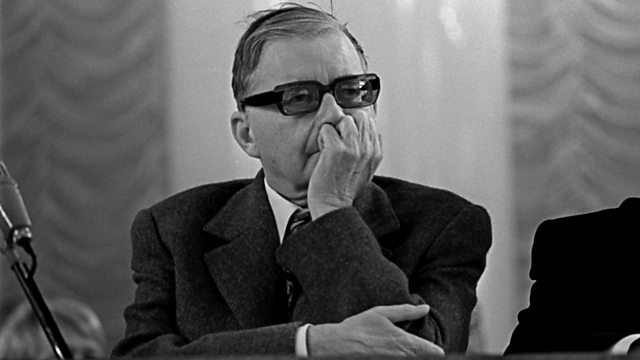
This was described on the South Bank website as ‘showcasing the works of Shostakovich, DSCH is a musical experience fusing theatre, lighting and visual elements to challenge the traditional concert form’.Hmmm, I thought, but having heard and enjoyed broadcasts of some of Kuusisto ‘s Proms performances over the last few years I thought I’d go along to this…..
The performance was built around some if not all of the following works
Excerpt from Moderato from Sonata for viola & piano, Op.147
Romance from The Gadfly
Polka (Allegretto) from 3 Fantastic Dances, Op.5
Largo from String Quartet No.8 in C minor, Op.110
Waltz from 5 Pieces for 2 violins & piano
Allegretto from String Quartet No.7 inF sharp minor, Op.108
Allegretto from Cello Concerto No.2, Op.1 26
Excerpt from Allegretto from Sonata for viola & piano, Op.147
Intermezzo (Lento) from Piano Quintet in G minor, Op.57
Polka from 2 Pieces for string quartet
Waltz 2 from Suite No.2 for jazz orchestra
Excerpt from Allegretto from Cello Concerto No.1, Op.107
Andante from Piano Concerto No.2, Op.102
Excerpt from Adagio – Allegro non troppo from Symphony No.8 in C minor, Op.65
Excerpts from Andante & Allegretto from Piano Trio No.2 in E minor, Op.67″
Scherzo from 2 Pieces for string octet, Op.11
Romance from Dance of the dolls for piano
Chamber Symphony in C minor, Op.1 10a arr. Barshai from String Quartet No.8
Excerpt from Sonata for viola & piano, Op 147
The format was intriguing – one and a half hours (without interval) of Shostakovich as a quasi- theatrical experience. The QEH concert platform became a stage with various screens and drapes on which images were projected consonant with the music being played. These were not as you might have expected images of Stalinist Terror – marching troops, prisoners, the Lubyanka – but natural phenomena: (water, trees waving in the wind, a bleak looking moon) and abstract shapes – criss-cross grids, a web. There was one image that could have been a bombed-out cityscape, but it had been made so fuzzy it looked like a series of boxes. So certainly not Shostakovich and his times….the orchestra was costumed and lit, moving eerily in and out of the darkness in dress that looked partly Slavonic, partly clown-like. There was also an effective use of lighting to create mysterious shadows. At points large images of the players marched towards us on the screen. The overall impact was to emphasise the personal trauma, the deep grief, in this music rather than anything that suggested the political context. The orchestra was a fine band as well as being an intrinsic part of the stage experience (occasionally with exaggerated coordinated movements). Most of the music was in some way or other rearranged (string quartet extracts often had 8-10 players). The most substantial piece, the Barshai arrangement of parts of the 8th string quartet, was thrillingly played, particularly the klezmer tune; as was the first 5 minutes of the 8th Symphony. Occasionally an accordion player was introduced into the mix – eg I think covering the piano part (or aspects of it) in the slow movement of the second piano concerto.The hall was packed, with, in term of age anyway, a diverse audience, including many primary age children. There were whoops and cheers at the end, a very positive audience response.I did wonder a bit what the point of the concert was. Clearly if you’re familiar with Shostakovich’ s music, you’ll be going straight to listen to a string quartet rather than the edited dramatised version presented here. If you’re not at all familiar with the music, would this lead you to want to explore Shostakovich’s music in more depth? Possibly – or you might just feel you had watched a great show, appreciated it and you’ll then move on to the next one. So I am not sure this is the future of classic music. However the show is undoubtedly keeping a group of first-rate performers in paid employment, to much public satisfaction, and that must be a good thing!
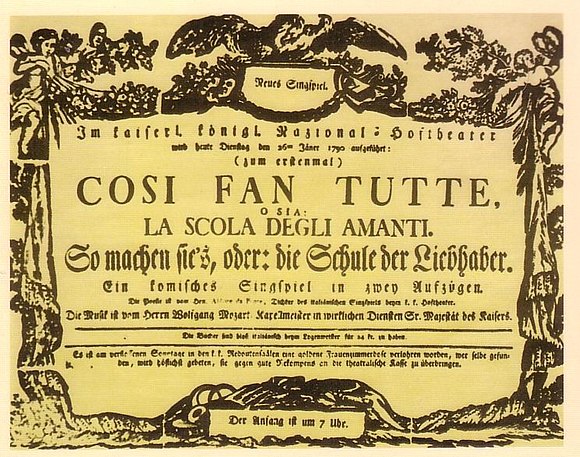
Conductor Alexander Soddy; Fiordiligi, Golda Schultzr; Dorabella, Samantha Hankey; Ferrando, Daniel Behle; Guglielmo, Andrè Schuen; Don Alfonso, Gerald Finley; Despina, Jennifer France. Director, Jan Philipp Gloger; Revival Director, Oliver Platt; Set Designer, Ben Baur; Costume Designer, Karin Jud, Lighting Designer, Bernd Purkrabek
I was not planning to go to this but then decided to campaign in Brighton for the Green Party for the upcoming elections on Saturday 29th. As I was seeing family the next day and staying overnight in London, I bought a £20 standing ticket for this performance. And having looked at the cast, I thought it rather a distinguished one, with three well known female singers, Gerald Finley no less as Don Alfonso, and conducted by Alexander Soddy, a young (in conducting terms – early 40’s) Brit who’s spent his career to date in the old-fashioned way, building up experience with the smaller regional opera houses and orchestras in Germany, and of whom I have read good things (I see he is also conducting Fidelio at ROHCG in the Autumn).
I arrived at the theatre really exhausted after 6 hours of door knocking in Brighton and was feeling a bit concerned about standing for 3 hours, particularly when I’d not eaten that much – I was therefore extremely grateful to the lady who offered me a seat in the stalls circle (one member of her family group had cancelled)!
I saw this production in July 2022 and reviewed it then in this blog. Looking back I see I was more incensed by the eccentricities and waywardness of the production in 2022 than I was this time round. Perhaps it was where I was sitting yesterday – in the Stalls Circle very near the stage, rather than the Amphitheatre, so very much nearer the singers, and I was able to be gripped by the emotions, the facial expressions and movement of the two couples much more closely. Despite all the (for the most part needless) complexity, the basic story remains clear – two couples pushed into swapping partners by a cynical old man and, when the mists clear and the plot is revealed both partners feel uncomfortable with their original lovers, and the opera ends in some mystery and darkness. This time round, I was much more aware that in this production, the two women know from very near the first appearance of their men in disguise who these two are. I was also more aware they know that their male partners have swapped them as lovers. I should also say that, whatever the doubts about what they intend, the appearance of several of the sets are stunning- the tree with the serpent, the 18th century tapestry, the bar, the Brief Encounter rail station. In addition, though liberties I think have been taken, the translation of the text is clear, wry and made people laugh.
Maybe I was more positive about the production because musically this was better than the 2022 performance. Things though didn’t get off to a very good start – Alexander Soddy set a ridiculously fast pace for the overture, as a result of which the timpani fell to pieces in the overture’s closing bars. After that though, things improved. Though without the gracious utterly captivating bounce that I remember when I heard Karl Bohm conduct the work at ROHCG 45 years ago, Soddy let the music expand once the singers appeared on stage, and tight rhythms supported the singers rather than sounding just hard driven. It was still fast, but crispness is sometimes better than sogginess…..
The female singers and Don Alfonso were the best elements among the singers. Golda Schultz has a lovely warm voice – she can, though, also hit the high notes and the vertiginous leaps of ‘Come scoglio’ with ease. Her predominantly slow quiet ‘Per Pieta’ in the second Act was beautifully done. She handled the coloratura well and also the deep notes given to the role didn’t cause any problems for her. She’s not a stage natural but entered fully and energetically in what she was asked to do. Samantha Hankey doesn’t really have the big arias Fiordiligi has to show off in, but acted excellently and her voice was secure and flexible. Jennifer France was remarkably good as Despina – one of the best I’ve seen. She could ping out the top notes, had a great sense of comic timing, exuded manic energy racing around the stage and clearly relished the silly voices she puts on for Dr Mesmer and the Notary. Gerald Finley was another top-class performer. Some Don Alfonso’s quickly go over the top in this role and ham it up, but Finley remained downbeat but quietly malevolent under the guise of wisdom – a truly Satanic presence, but beautifully sung; his contribution to ‘Soave sia il vento’ was outstanding . The two male lovers were less memorable. Guglielmo had a very good voice and a strong stage presence but maybe didn’t make enough of the musical possibilities of the role. I was a bit put off Ferrando by his head notes which went a little too far into falsetto for my comfort.
All in all, the production didn’t affect the reception of the stunning music and the singing, and I really enjoyed the evening – as did the rest of the audience, who whooped and cheered at the end.
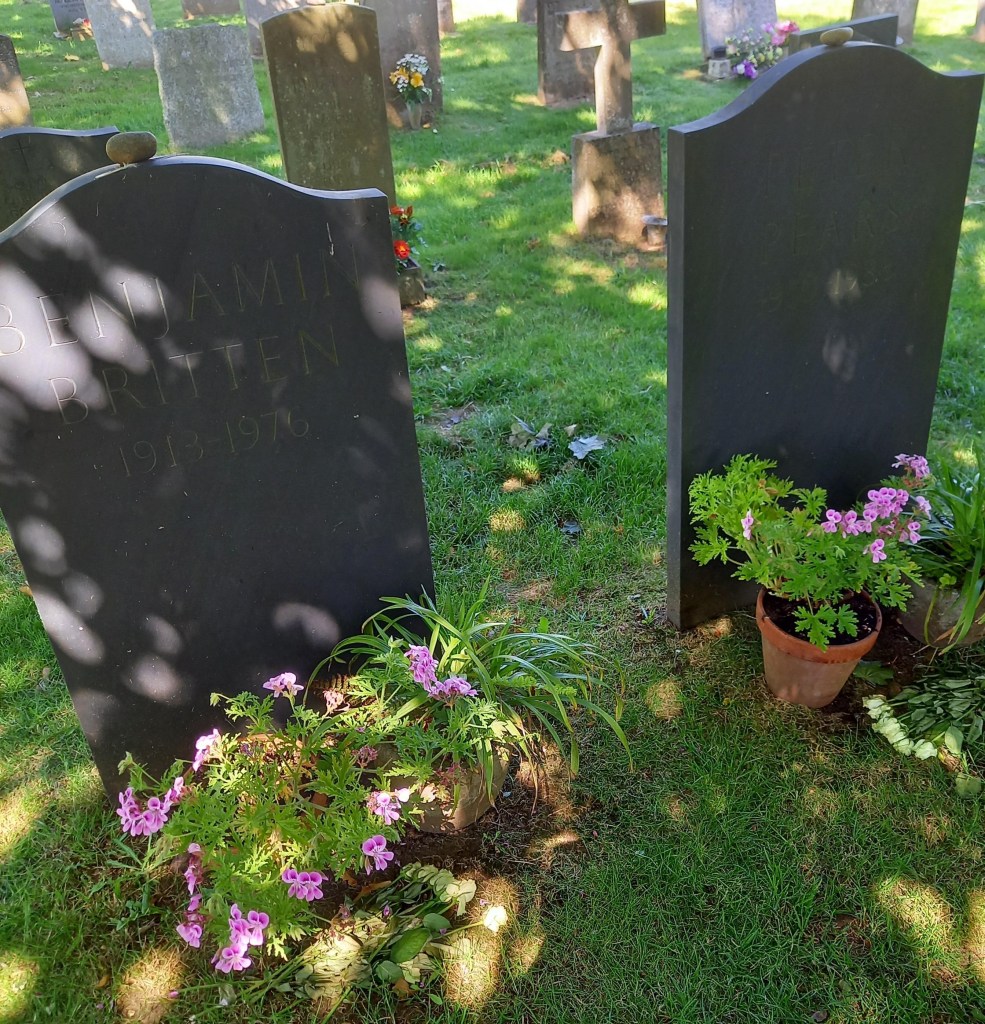
Britten: Curlew River – A Parable for Church Performance, Op.71. Ian Bostridge tenor, Willard White baritone, Duncan Rook bass-baritone; Marcus Farnsworth., baritone Chorus of Britten Pears Young Artists, Deborah Warner director; Audrey Hyland music director; Christof Heter, designer.
This was the first of two performances to mark the 60th birthday of the work, first seen in Orford Church in 1964. The wide space of Blythburgh church seemed equally suited to the work, and, in addition to its internal medieval features, particularly the carved angels, the fact that it is situated near a river and fens helps with the placing of the work in this church. The BBC was present at this performance to film it, hoping to show the work on TV in the Autumn.
The whole space of the church was used – singing actors entered by the south door and processed up the central aisle of the nave towards the chancel. There was a raised platform at the front of the chancel, facing towards the audience, but the aisle and indeed the western end of the nave near the font was also a performing area. In addition, a gradually ascending series of three rough planks started at the west end of the aisle, moving upwards to the chancel platform, and people acted and sang on this too. There was a sail that could be raised, hitched to the rood screen, a clever device.The music ensemble were over to the right as you looked at the stage, and from where I was sitting you couldn’t see them
I realised I hadn’t been thinking straight about how this work would be performed at one of the Aldeburgh Festival churches – I had assumed a darkened space and spotlights, but of course that is impossible to achieve in the middle of a sunny summer evening in a light and airy church, and so the performance was mainly lit by natural light, possibly aided by some artificial spots streaming through the west windows through a large BBC gantry positioned outside. There was some additional lighting for the chancel platform at points, particularly as the sun began to set.
Again, I had no programme notes with me, and though I’m aware of the connections with Noh plays, it seemed to ne the connections were not that clearcut. The use of male performers only, I assume is part of that, and of course there is a Japanese tinge to some of the music. But there are no masks, and no stylised movements – though I suppose the positioning of the musicians, and the slow movement of the story might also be aspects relevant to Noh. It is more the English medieval mystery plays that to me formed the background to the work – ordinary people coming on stage at the beginning in ordinary modern clothes singing plainchant and gradually changing to a different ‘workers’ smock, and setting up the stage, surrounded by the audience. The ferryman and traveller also looked vaguely medieval in their costume as did the Abbot and the monks/workers. The mad woman was more singularly dressed, coming on stage with a turned-inside-out umbrella and a yellow ball gown plus a man’s jacket, and clutching a thick quilt.
Deborah Warner has created a production that was entirely natural in movement, and there were no false steps. The coup de theatre of the clanging of the bell at the climax and the singing of the dead boy was beautifully realised and very moving. There was no imposition of a directorial vision at odds with the work. The only slightly controversial aspect of her direction was having one of the three boys involved in the singing walk down the central aisle after his voice has been heard because of the Mad Woman’s prayer, but that seemed to me perfectly legitimate .
I had been very much looking forward to going to see this, and I was not disappointed – this was a wonderful performance. There were, to my mind, several reasons for this:
it’s more difficult to listen to this work just through an audio recording. Seeing as well as hearing it makes it come alive in an entirely new way. I heard music I had never really heard before – eg the swish of the oars, the bird song – because it is paralleled by actors’ movements and what’s happening on stage. I realised, listening to the Mad Woman, that the characteristic upward ending to her musical phrases is meant to echo the curlew’s song. Curiously diction on the whole was better in this live performance than on the Decca original recording.
it was utterly riveting to be so close to great singers like Ian Bostridge and Willard White and see their consummate acting and see and hear their artistry – at times I was less than 5 feet away from them
Ian Bostridge’s performance was quite remarkable. Obviously Pears has a unique status in this role, but it is difficult to imagine anyone else doing this better than Bostridge – he produced some beautiful singing that was very moving, and he acted with utter conviction, in a part which I can imagine others might exaggerate too much in. He did indeed throughout look haunted, with a distant look in his eyes.
Hearing the work in this location was also important – you could feel, and almost see, the presence of the river and the fens beyond the stained glass windows
Listening with concentration as you do in a live performance means you become immersed in the work’s sound world. It is utterly different to pieces written around the same time such as Midsummer Night’s Dream and the War Requiem, and yet you realise what a compelling and beautiful work it is. It makes me want to hear the other Church Parables, which I don’t know at all.
Unsuk Chin: Cello Concerto; Bruckner: Symphony No.7 in E . BBC Scottish Symphony Orchestra: Alban Gerhardt cello, Ryan Wigglesworth conductor
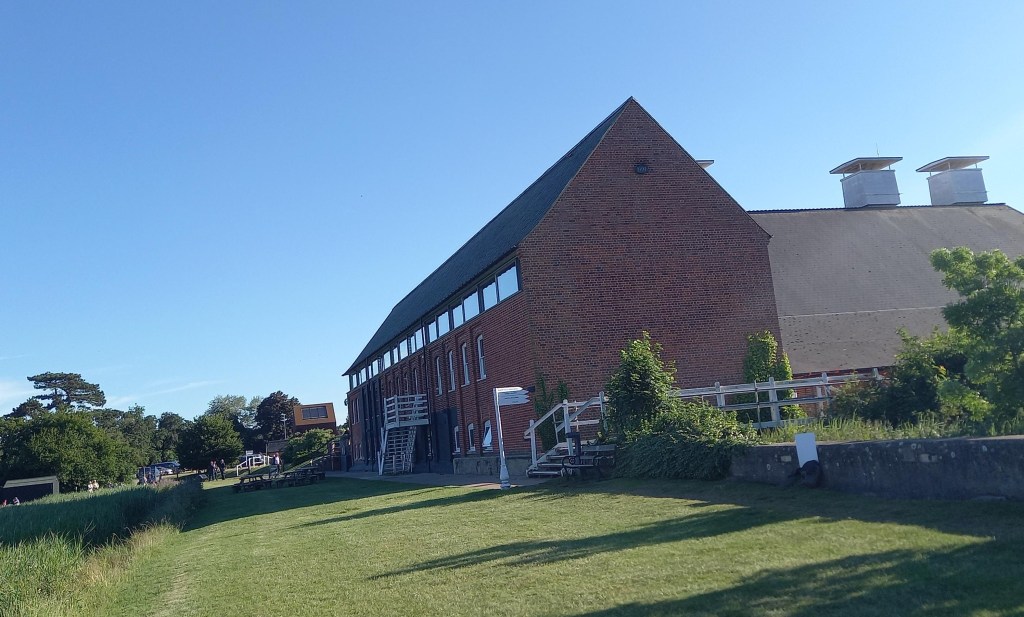
I have never been to the Aldeburgh Festival before – ever – and the last time I went to Snape Maltings was late October 1990 for a chamber music concert. I don’t wear this as a badge of honour – rather, Snape is just highly inconvenient to get to by public transport from where I live in the Peak District, and relatively expensive, in terms of pubs and B&B’s. I do have fond memories of the Maltings in the 1970’s – Reggie Goodall conducting Act 1 of Walkure with the ENO in 1974, and Peter Pears singing the Evangelist in the St Matthew Passion in 1975. Probably I might have gone on not going to the festival, but this year I saw a must-see item – Curlew River, performed as it was at its premiere in an Aldeburgh Festival Church. In order to make sense of an 8-hour trek across England, I also decided to go to this concert.
Bruckner 7 I have heard many fine performances over the years of – conducted by Jochum, Solti, Goodall, Kempe, Haitink and more recently Rattle come to mind. I did also almost hear Klemperer conduct it – but he fell ill (and subsequently died- a great might-have-been). In the normal run of things, I would probably have given this concert a miss, but decided to make it a package with Curlew River.
The Unsuk Chin piece I approached without a programme note, so I was a bit unclear on its structure, though I think it was in four movements. I thought at first it might be a relatively dignified conversation between cello and orchestra, with a mournful, thoughtful contribution from the cello in the first movement. But the orchestral comments become increasingly violent – short stabbing surges by the 4th movement and in response to this the cello bristled with angry splashy runs. So more of a battle than a dialogue. There were some amazing orchestral sounds – wonderful combinations of bells and woodwind, and whizzing firework sounds! Such was the bristling nature of Gerhardt’s playing in the final movement that he broke a string, and had to grab an orchestral player’s cello to finish the work. All in all I found this heavy-going on a first listen, but would welcome an opportunity to hear it again.
Listening to Bruckner 7 in the Maltings is a curious experience. It is a building constructed for smaller forces and though a warm acoustic it is not particularly resonant, and it’s therefore not an ideal place for a spacious approach to Bruckner – the silences seem a little dead, and the climaxes can sound coarse. Whether because of the conductor’s approach or the acoustics (but certainly the splitting of the violins helped), one of the most enjoyable aspects of this performance was listening to the inner voices of the score, and the sometimes-extraordinary harmonies the woodwind and strings produce. This was a performance that by timing was brisk – certainly less than the advertised and standard 70 mins – but never seemed rushed. It was tightly controlled, but also with time for lyrical grace. Wigglesworth is clearly of the school that believes in speeding up rather than slowing down for Bruckner climaxes and so the big one in the slow movement was certainly exciting but not overwhelming – and, sadly, without a cymbal crash. On the other hand, the postlude to the slow movement, the scherzo and the finale were all extremely well done. Throughout there was some lithe sweet string playing and some excellent horns/Wagner tubas, and also occasions of extreme clarity – I’m not sure I’ve ever heard the final bars of the finale so clearly laid out. Maybe at the end of the day not one for the ages, but this was a very enjoyable performance.
The Aldeburgh audience was slightly curious – there were people who, I suppose, like me, go to lots of concerts like this, but there were also a number of people (maybe local to Ipswich and surrounding Suffolk towns) who clearly were hearing this work for the first time, and who sounded (in the snatches of conversation I heard afterwards) a bit non-plussed by the length of the work and the noise!!
Director, David Mcvicar; Set Designer, Robert Jones; Costume Designer, Jenny Tiramani;Lighting Designer, Adam Silverman. Andrea Chénier, Jonas Kaufmann; Maddalena Di Coigny, Sondra Radvanovsky; Carlo Gérard, Amartuvshin Enkhbat; Bersi, Katia Ledoux; The Incredibile,Alexander Kravets; Roucher, Ashley Riches; Contessa Di Coigny, Rosalind Plowright; Pietro Fléville, William Dazeley; The Abbé, Aled Hall
Since my posting about seeing Salome in Paris, general pressures on other parts of my life, particularly the General Election, and also an unexpected family visit, have meant that several concerts I had planned to go to I couldn’t make – Mark Elder’s last concert in Manchester as Music Director of the Halle, a recital by Angela Hewitt on a fortepiano, and a performance of Shostakovich and Weinberg string quartets by the Quatuor Danel. Hopefully I’ll catch up with the Mahler 5 at the Proms.
Andrea Chenier is another opera which I have not heard a note of before and doubt if I will ever again. I gather from Wikipedia that it was premiered in 1896 and so contemporary with the earlier Puccini operas. Nicholas Kenyon in The Telegraph described it in his review of this set of performances as “ a feeble, creaky opera based on events around the French Revolution, with little to recommend it except opportunities for top singers to shine at top volume.”. So there…………….
I arrived at the cinema to find that in a screen room of 100 seats, I was the only person there. My sole interaction of the evening was with a double gin and tonic, and the girl who sold it to me. This did not set me in a good frame of mind for the evening…….it led me to reflect generally on the decline of audiences and funding for classical music and the collapse of that impulse so prominent in the post WW2 era to bring “high culture” to as many people as possible. But then of course I wondered about the extent to which Andrea Chenier could be regarded as “high culture” anyway……I wonder what it’s equivalent would be today? I guess a kind of serious musical, but few would be as heart-on -sleeve as Italian verismo.
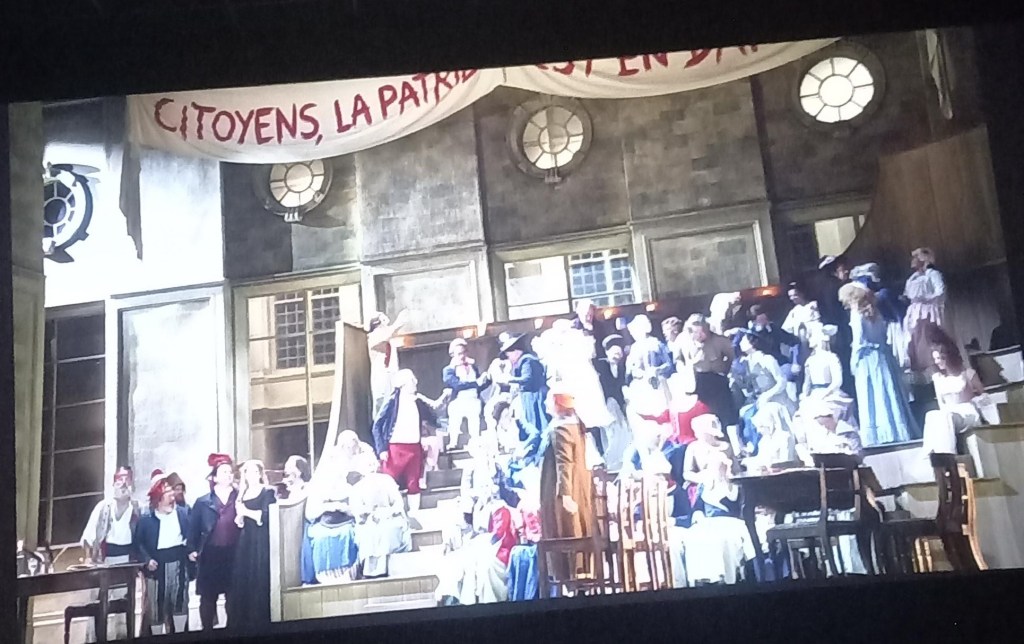
The work is about 2 hours 15 minutes long and in 4 acts. David MacVicar’s production unsurprisingly was utterly realistic in conception – specialist expertise had been hired to ensure that every detail seen on the stage – furniture, costumes, room design and props – was historically accurate. Not only the aristocratic house in Act 1 but also the various revolutionary interiors in the other acts were highly convincing. I did wonder if there was any other way you could stage this work. Had the French Revolution been anything more than a frame to hang a very traditional opera story on – soprano and tenor get together, a baritone gets in the way, soprano and tenor die together – there could be some variant staging scenarios, but, as it is, being realistic is perhaps the only way that makes sense of it.
Dramatically it is hard not to agree with Nicholas Kenyon – there’s not much about the work that’s beyond a display vehicle for star singers. The French Revolutionary elements are, as I have intimated, merely a backdrop. It’s interesting that Illica wrote the libretto for Chenier and then Tosca a few years later. There are things in common – Gerard is Scarpia, tenor and soprano get killed at the end. But Tosca, however you view it, is more engaging than Chenier – that’s partly because the characters are more clearly drawn in Tosca and partly because Puccini’s music is just so much better. In fact though much of Giordano’s music sounds sub-Puccini, there are some passages that are quite different – some decidedly Tristan-esque passages in Act 4, for instance. It is strange though how unmemorable most of the music is – I had a higher opinion of Fedora in that respect – with very little striking melodic content at a first listen. Having said that, while Acts 1 and 2 had me squirming in my seat for anyone coming to an opera for the first time, Acts 3 and 4 have more coherence and they do grip you – the orchestral explosions as Chenier and Maddalena go to their deaths are thrilling. But even then a glance at this Youtube extract from a Munich performance, again with Kaufmann but with Harteros as Maddalena demonstrates a whole dimension of visceral impact which is simply missing from the ROHCG performance – https://www.youtube.com/watch?v=U2Q4-_0ufaA
Almost everything seems to rest in this work on the relationship between Chenier and Maddalena and the chemistry in this performance just wasn’t right. Kaufmann is Kaufmann, looking much the same as he has for the last 15 years, and thoroughly credible in the role. But Sondra Radvanovsky, in the cruel close-up of film, is just NOT a teenage girl and looks faintly absurd – I am sure she would have come over better at a distance live in the theatre. But these two hardly looked at each other and both seemed unengaged.
In terms of singing and acting, the undoubted star of the performance was Amartuvshin Enkhbat as Gerard, who has a glorious voice and knows how to keep still and use his considerable presence sparingly. He was the best performer of the evening. It was wonderful too to hear Rosalind Plowright, in fantastic voice and acting with every ounce of her being, aged 75 – plus another veteran, Elena Zilio, as Madelon: equally impressive. Kaufmann was in good voice – only a bit of wavering on the ascent to top notes at time, but some lovely quiet singing with his glorious baritonal tenor. All his big arias came over well. Radvanovsky some critics were a bit sniffy about but I found her in good voice though she did less with it than Kaufmann does. The other person who was a stand-out was Ashley Riches as Roucher – I have only ever seen him in concert/oratorio-type roles, but he was very impressive here, with his deep rich bass and alert stage presence.
Of course, in many ways the hero of the evening was Pappano, and certainly the orchestra sounded glorious. What a pity I can’ t quite share his enthusiasm for this work
Mark Wigglesworth. Conductor; Lydia Steier, Director; Momme Hinrichs, Set design and video; Andy Besuch, Costume design; Olaf Freese, Lighting design. Lise Davidsen, Salome; Johan Reuter, Jochanaan; Gerhard Siegel, Herodes; Ekaterina Gubanova, Herodias; Pavol Breslik, Narraboth
I have never been to an opera in Paris before, and don’t have a clear idea of how the set-up of ‘The Paris Opera’ works. The Bastille building is new, massive and prominent in the life of the city – its steep steps outside seem to be a major hanging out space for Parisians, The auditorium is large, but the acoustics from where I was sitting were good (in the back of the stalls – however I did wonder how a Mozart opera would feel and sound here. Maybe they do them somewhere else). After an afternoon spent at the Pere Lachaise cemetery, saying hello to Oscar (appropriately given that his play is the basis for Salome), I did wonder how full the auditorium would be as I entered this large building. Absolutely packed is the answer! Clearly Parisians saw this as a major event, and in addition around me I could hear English, Australian, US, Dutch and German voices – people from all over the place coming to hear Ms Davidsen in this new role – and the cast as you can see doesn’t only offer star quality in Lise Davidsen – Johann Reuter I saw singing Sachs in Berlin in November and Edita Guberova is singing Venus and Kundry this year in Bayreuth. Gerhard Siegel, too, is distinguished – a Bayreuth Mime but also with heldentenor roles in his repertoire. One newspaper article likened Lise Davidsen’s singing Salome in Paris to Taylor Swift singing in a Parisian stadium nearby in terns of both being mega-events!
I may have heard Salome at ROHCG with Grace Bumbry or Hildegard Behrens in the title role and Solti/Mehta and others conducting, in the 70’s. If so I have no memory of the performances. The Salome I remember from my youth is the ENO one, with Josephine Barstow and Mackerras, which I chiefly remember for Barstow’s acting. Many years then followed when I never saw a performance – until ?2018 when I saw a disastrous production at ENO (the one with the bloody headless pink pony – say no more) which I don’t want to recall, and now this……..
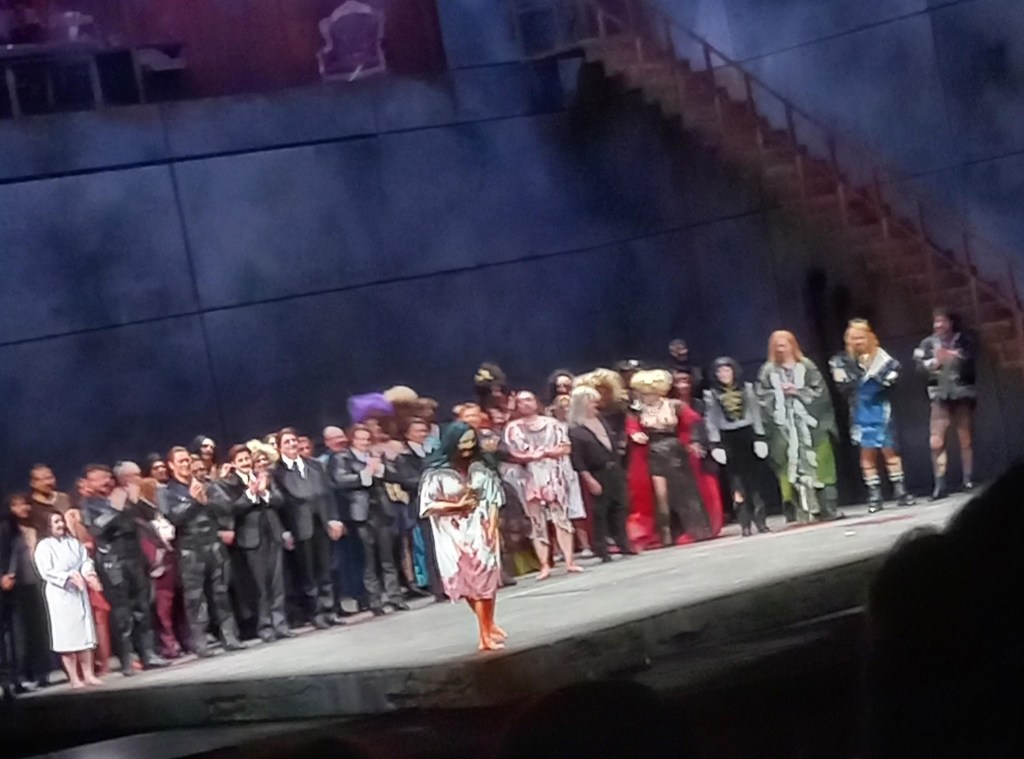
I thought this was a marvellous performance, dramatically as well as musically. The set was of a large stone-like wall with an upper room above it where some sort of orgiastic event is happening. Part of the wall moves away just before Salome’s dance and in its place there’s a series of steps down which Herod’s courtiers tumble to watch the fun. Costumes are basically fantastical with a mad Afro wig and short skirt for Herodias. Narraboth and other guards wear black special forces gear and have automatic weapons – and Narraboth and Herod both die by pistol. Dead bodies in body bags regularly appear hauled down the steps from the upper room steps and are carried off by 3 persons in Hazmat gear. Occasionally a skimpily clothed young woman is dragged up to the upper room. All in all an oppressive utterly amoral culture is being portrayed. Salome in the earlier part of the opera is the fairly conventional difficult teenager. Her encounter with Jokanaan takes place with him in a cage that is lifted from the cistern. After their encounter Salome writhes on the ground in a fairly obviously sexual way. The point at which this production became very interesting was the Dance of the Seven Veils. I had been wondering how this would be done – Lise Davidsen is a fairly statuesque figure whom it would be difficult to envisage racing round the stage shedding veils. It may of course by now be a standard way of handling this sequence, but I found the approach in this production very convincing – essentially the Dance is turned into a slow motion sexual assault by Herod on Salome, slowly removing her clothing at first (pocketing her knickers) and as the music grows faster and louder the rest of the court join in, performing a choreographed orgasm – one critic suggests she ravishes Herod but I’m not sure that’s how it felt for me. It’s not clear what’s happening to Salome, but she emerges at the end with her dress blood-stained. The other interesting aspect of the production is the last 5 minutes or so: a second Salome is on the ground kissing the head and writhing; the ‘real’ Salome suddenly emerges from the ground in the cage with Jokanaan, in loving embrace. I am not quite sure what the director is intending to ‘say’ here, but it gives far more weight to what Salome is singing and is a far better ‘objective correlative’ to what is happening on stage than the normal way (albeit the ‘normal’ way is what’s outlined in the stage directions. To me the way this is handled (a) makes Salome more of a victim of a terrible culture and less a product of it; (b) gives Salome a stature she doesn’t have when she’s simply rolling around the stage with a bloody head. I’d not come across the director before – she’s an American who’s worked mainly in Germany, initially with the Komische Oper.
Lise Davidsen was quite remarkable as Salome. She has a natural stage presence, which she used very effectively as the grand but demanding princess. Her singing was extraordinary – sailing over the orchestra in the climatic moments, with also many beautifully and softly sung phrases. I really don’t think I’ve ever heard it better sung, not even by Nilsson. Johann Reuter sounded fuller and warmer than I remember from Berlin – a nuanced and utterly appropriate rendering. Edita Gubanova has a powerful voice and projected well into the auditorium, even in the loudest passages. Gerhard Siegel didn’t overdo it and absolutely came across as the slimy unpleasant individual Herod is, with a strong bright tone to his voice.
Mark Wigglesworth, now going to the Bournemouth Symphony as chief conductor, was an excellent conductor of this work – not a Solti reading, but grand, loud and frenetic where it needed to be and while maybe a bit on the slow side never lost focus. He had an excellent orchestra too
I would be very surprised if this did not feature as one of my top ten performances of the year….The audience went bonkers at the end……
Very generously, Paris Opera have put these trailer videos up on YouTube. They do give a very good flavour of the excellence of singing and acting
Director, Daisy Evans; Set Designer, Molly O’cathain; Lighting Designer, Jake Wiltshire; Conductor, Peter Whelan with the Irish Baroque Orchestra. Clistene, Chuma Sijeqa; Aristea, Alexandra Urquiola; Argene, Sarah Richmond; Megacle, Gemma Ní Bhriain; Licida, Meili Li; Aminta, Rachel Redmond; Alcandro, Seán Boylan
Two years or so after Bajazet (an Olivier award-winning production for outstanding achievement in opera), the Irish Baroque Orchestra, Peter Whelan and the Irish National Opera were back in town, at the Linbury, with another hugely enjoyable Vivaldi opera. I’m beginning to have a sense of the difference between Handel and Vivaldi operas: Vivaldi goes on the whole for more medium to fast paced arias, often with intense rhythmic drive, and with exciting string ostinati. Handel seems somehow slower paced, more gentle and melancholy and more nuanced in terms of characterisation for the singers. But the fact that there are about 50 extant Vivaldi operas and I have only heard two of them means I have a lot to explore – very exciting…!!
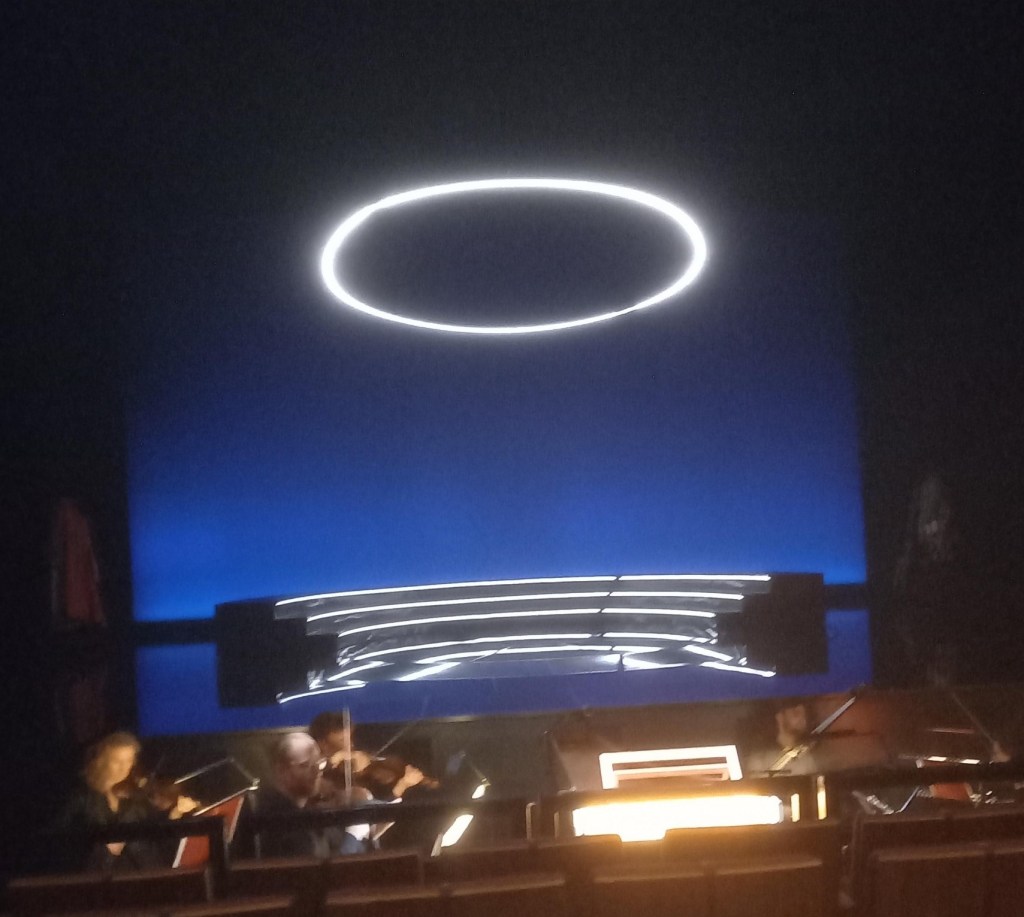
This was a well-conceived simple production. A bright ring over the stage was suggestive of the Olympics and changed colour as needed, with a floor lit back screen behind the singers, again changing colours. There was also a moveable Amphitheatre used and sometimes split in various ways. The singers were in contemporary gym / sports gear to begin with, and turned into character with the aid of a rack of clothes on either side of the stage – this helps makes the point about assuming identities- not to mention gender – which is the point if the ludicrously complex plot. The singers also function together as a chorus and – given the amount of orchestral only music they also perform actions from the story to fill in some of the gaps. It says something about the way the director managed the action that there were no silly laughs from the audience at the more ludicrous turns of the plot – these sometimes one would imagine cardboard figures really did come across a real people with real emotions, something emphasised by the energy of the young actiong team
People joke about the complexity of Baroque opera plots – l don’t normally have too many problems with the Handel operas I’ve seen but this one did defeat me for a time, so elaborate is the amount of disguise, assumed identities and confusion. There are the usual two couples, though impossibly entangled, and the equally frequent device of getting the right couples together by revealing that two of the four are brother and sister- it all just takes a lot longer and with a lot more chaos before this is worked through, I guess.
The music is very enjoyable. There were at least three stunning numbers By the side of the sleeping Megacle, Lucida sings a most beautiful aria ‘Mentre dormi amor fomenti” – this is absolutely of the same level of beauty as Handel numbers such as “Piangere” from Julius Caesar. The there’s “Siam navi all’onde algenti”, which is a fizzing coloratura aria to end the first half with Aminta (here’s a Cecilia Bartoli Youtube video –https://www.youtube.com/watch?v=Ep987vSTsVc) , and Aristea’s fierce aria expressing rage with Licida in the second half is another cracker. I also enjoyed Licida’s “Gemo in un Punto e Fremo”. But almost every number has a catchy tune- there’s little of the routine here in the arias, though some of the recitative are rather long and tedious. I detected a violin run which seemed to have been taken from The Four Seasons……
As with Bajazet, in many ways the musical stars are the orchestra – it is extraordinary how much energy they generate, despite being only two players to each type of stringed instrument, plus a theorbo and harpsichord, and Peter Whelan is extraordinarily generous with his engagement in this music. All the singers were good – the standouts for me were the coloratura singer Rachel Redmond as Aminta, who must surely be destined for more important international roles, plus the Chinese counter-tenor Meili Li as Licida – as readers of this blog may have noted, I normally am not too fond of countertenors and their hooting, but this man’s voice was utterly beautiful; world class singing…….Also Alexandra Urquiola as Aristea struck me as having a strong agile voice and good stage presence. But this was a team, and everyone played their part in what was happening on stage and in the music
I found this trailer, which gives a good idea of how the orchestra sounds in this work, as well as more details on costumes and sets – https://www.youtube.com/watch?v=xEI2hZaEJNk
MOZART Ach, ich fühl’s! (from The Magic Flute); MOZART String Quintet No.4 in G minor K516;TRAD. Se solen sjunker (Swedish folksong); SCHUBERT Piano Trio No.2 in E flat. Ella Taylor, Robin Ireland & Ensemble 360
I was listening, with one ear, while waiting for my car’s servicing to be finished, to the music on the radio in the car showroom today……I suddenly heard a song I remembered – the Pet Shop Boys’ ‘You are always on my mind’, dating I suppose from the early 90’s, about the last time when I really had some grasp of what was going on in the pop/rock world. It has a memorable tune, good lyrics, and the sort of driving crashing accompaniment you get from a Phil Spector arrangement (which for me is a positive thing) , and it put my mind back to the era it was created very quickly. Why don’t I listen to this sort of music more? – I quite like it after all. The answer came to me as I listened to the Schubert piece in the Ensemble 360 concert – works such as the Schubert are just so much longer, more complex emotionally, more engaging, and become something that you return again and again to. Very few pop/rock songs have moved beyond the 5-10 minutes’ duration and lyric format. I just don’t have the time to hear the Pet Shop Boys etc when there is so much classical music to be explored !
This was a concert with Ensemble 360 plus Ella Taylor, a soprano winner of Second Prize at the 2020 Kathleen Ferrier Awards, and Robin Ireland, who used to be the viola player in the Lindsay String Quartet (in the interval I saw a lovely photo of Robin with Peter Cropper and the other quartet members standing with Michael Tippet in 1992!). This was the only concert in Music In the Round’s Spring chamber music festival I could make, unfortunately, but it was one well worth going to. Each half began with an appropriate sung piece by Ella Taylor – ‘Ach, ich fühl’s!’ from the Magic Flute tying in nicely with the Mozart String Quintet, and the Swedish folk song ‘Se solen sjunker’ (‘see the sun is setting’), which Schubert had heard in the Fröhlich sisters’ house, sung by the tenor Isak Albert Berg, and which is used for the main tune of the second movement of the piano trio.
The Mozart piece is one I thought I knew but actually didn’t – I think it’s the K515 and K593 quintets I’ve heard, This is a complex piece – the first movement is more graceful than, and hasn’t quite the same urgency as, the G Minor 40th symphony; the minuet is distant and not easily approachable, again with a rather far-off vision of some elysian fields alongside the darkness. The adagio I found mysterious and not easily ‘placeable’ in any emotional framework. The finale, after a trudging and intense 3 minute adagio, suddenly veers into a totally different light-filled world. All in all, I found the trajectory of the Mozart piece difficult to follow – I need to listen to it again……… But the performance was excellent…..
The Schubert Piano Trio I am much more familiar with. It was composed around the same time as ‘Winterreise’ and has a similar death-haunted air. The performance was slightly, but only slightly, disrupted by the quest for what was at first thought to be a malfunctioning hearing aid, emitting an intermittent electronic quiet whine, but then turned out to be an errant fitting in the upstairs loo = light or hand-drier. This extended the gap between the first and second movements, but was accepted by the always good-natured MITR crowd with good grace. In the end the performers just ploughed on regardless. The Swedish song’s text makes the emotion explicit – ‘Farewell’; ‘Ere night comes with dark shadows, you flee, sweet hope now bleak’. There are moments where real terror breaks through in this work, and it begins to sound more like Tchaikovsky than Schubert. Maybe the performance slightly underplayed the moments when the music threatens to go off the rails, and emphasised the Schubertian grace, but still, it was delivered with a lot of energy and I liked it very much
Sir Mark Elder conductor, Halle Orchestra, Sir Stephen Hough piano: Dvořák Scherzo capriccioso; Stephen Hough Piano Concerto (The World of Yesterday); Butterworth A Shropshire Lad: Rhapsody for Orchestra; Elgar Variations on an Original Theme, “Enigma”
This was Mark Elder’s last appearance in Sheffield as the Halle’s music director so for once the hall in Sheffield was completely full. The audience has spent years not going to the Halle’s concerts, so that City Hall has rarely been more than half full for their appearances, even when Elder was conducting, so it is deeply ironic they only turn up when he’s leaving¬ There was flimflammery from the leader of Sheffield City Council who rocked up with a cardboard copy of a silver dish of the City Hall as a parting present for Elder – which was to ‘be ready in a few weeks’ time apparently'(clearly they had been bounced into this late in the day) – despite having sat on their hands for years in terms of providing better acoustics for the hall. Oh well…..
The audience as always in Sheffield was a mixture – there was a bloke next to me extolling the virtues of the Kleiber Tristan recording with Margaret Price, and at the same time people clapping after noisy variations in the ‘Enigma’.
The very dry dead acoustics in City Hall can play havoc with how an orchestra sounds – the wide shallow stage seems matched by a kind of compression in the sound, and a lack of richness and depth. It is to the huge credit of the orchestra and Elder that despite the acoustics, they sounded full and rounded in sound, and made use of the clarity that the hall undoubtedly possesses to offer some wonderful insights in the Elgar work.
The performance was prefaced by a much better gift than Sheffield Council’s – the Sheffield Music Academy produced a young composer and string players who performed a short piece called Waves, obviously playing on both waves as in water and waves as in saying goodbye to Mark Elder. This was excellent
When the concert finally got going, the Dvorak piece was pleasant enough, and extremely well played, if a bit inconsequential. Stephen Hough’s piece I liked, though I am not sure that it would bear much repeated listening. In a talk before the concert, Hough has described it as originally a film score he’d been commissioned to write, for a film about a pianist in the 1930’s commissioned to write a piano piece by a duchess. I got the impression the film had fallen by the wayside, so Hough reworked the music. The World of Yesterday, the title of the piece, is also the name of an (excellent) memoir by Stefan Zweig, about pre WW1 Vienna, while Hough’s work is a look back at the piano concertos of the 1920s and 30’s – think Rachmaninov, Prokofiev, Bartok, Gershwin etc. The piece was shortish – 22 minutes or so – and didn’t outstay its welcome, with passages both lyrical and glitteringly bright (I seem to remember a duet between the piano and the xylophone at one point).
After the interval, the Halle, and Elder came into its own with the Butterworth and Elgar. The Butterworth provides some sort of link, I suppose, with the Hough piece in terms of nostalgia – this time for a rural past, though the Butterworth also has anger in its central part, at the waste of young ‘lads’ lives in the Boer War. The Halle produced a glorious sound – wonderful clarinet and horn playing and transforming the usual sound of the hall into something rich and strange.
The Elgar work is a work I have heard Elder conduct several times and my reactions have been the same each time. Up until the finale, the way Elder conducts the piece, and the way the Halle performs it, is remarkably good. There were so many little touches in the orchestration coming out that you never normally hear – some wonderful detail in Ysobel and W.N, and all the tempi well-judged. Elder crafted the climax of Nimrod superbly -sometimes the horns can blare rather vulgarly, but here they were held back and enveloped in a wonderful mushrooming orchestral sound. Another touch was the more-than-usually audible sound of the side drum in Variation 13 (was it Elgar who talked about a penny rolled around the drum surface?) which coloured the rest of the orchestra’s sadness very effectively. I had the same thought on the finale as when I have heard this team perform it before – that somehow the basic tempo Elder sets for the movement is too slow and becomes flaccid, and not climactic enough; it’s very different from how Elgar himself conducted this movement. I’ll listen again to the radio broadcast on 22 May, and see if I think differently………..