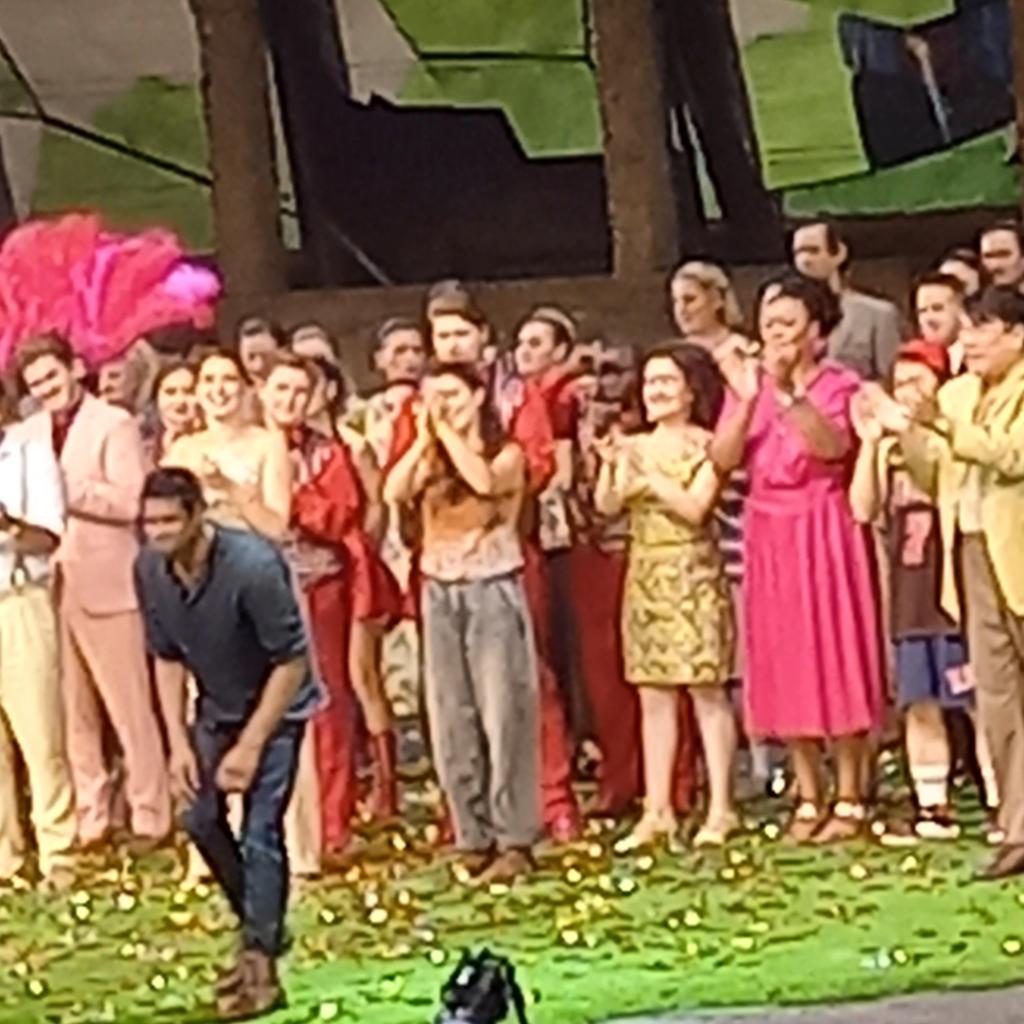
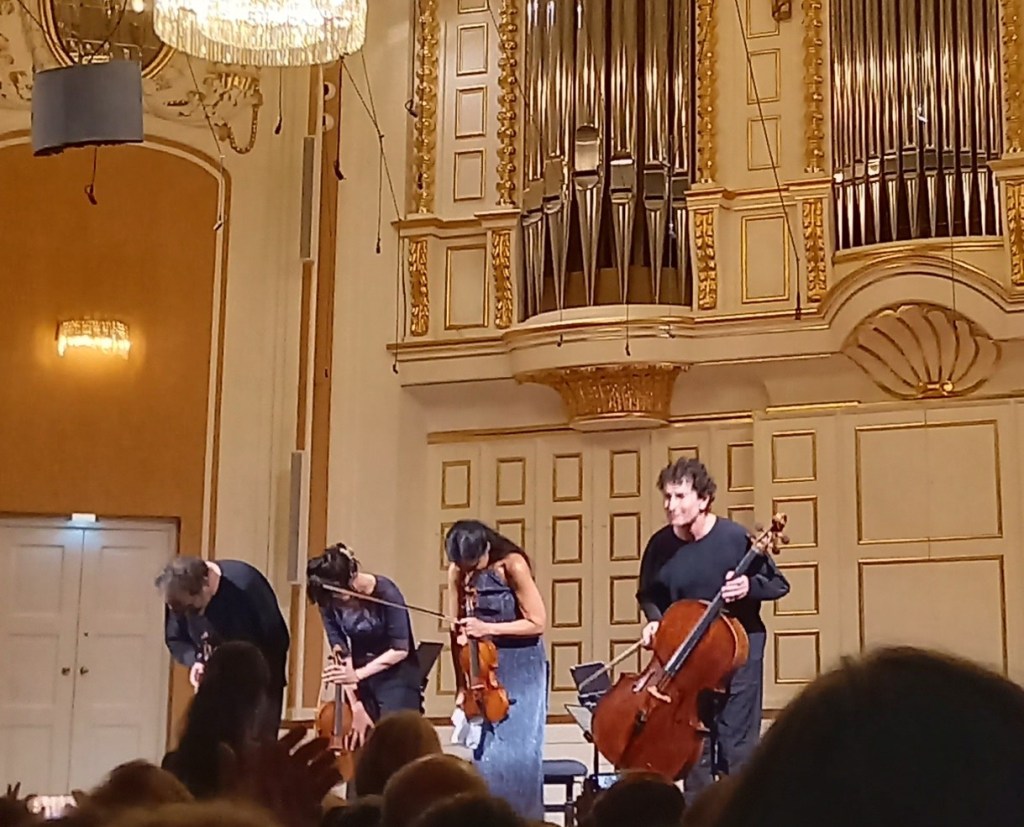
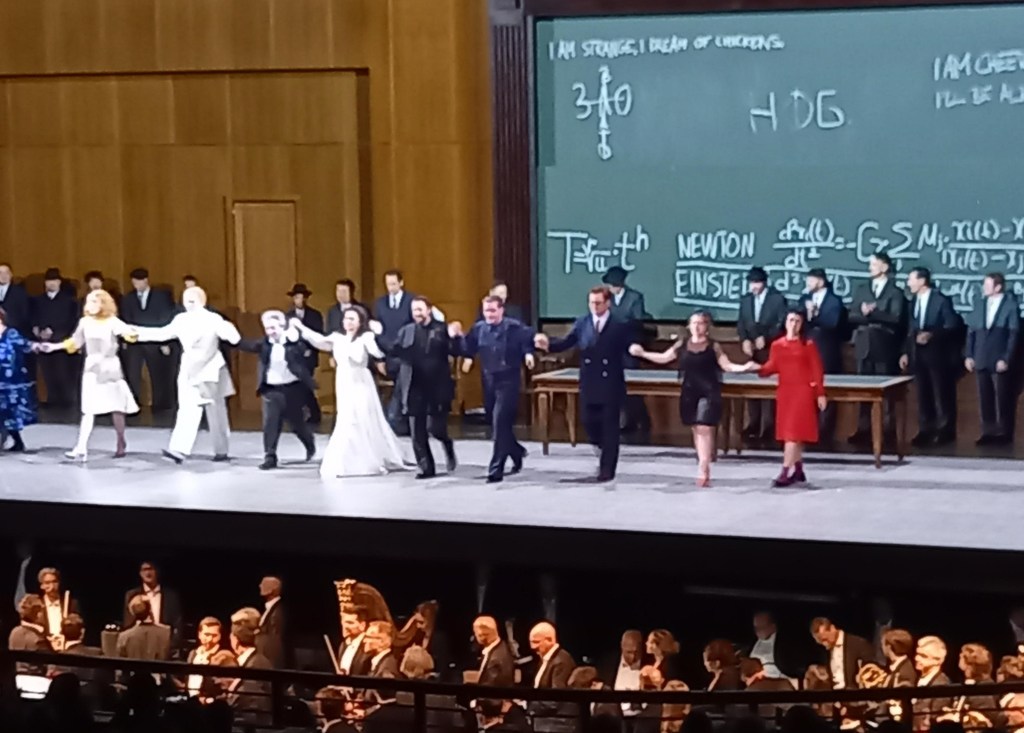
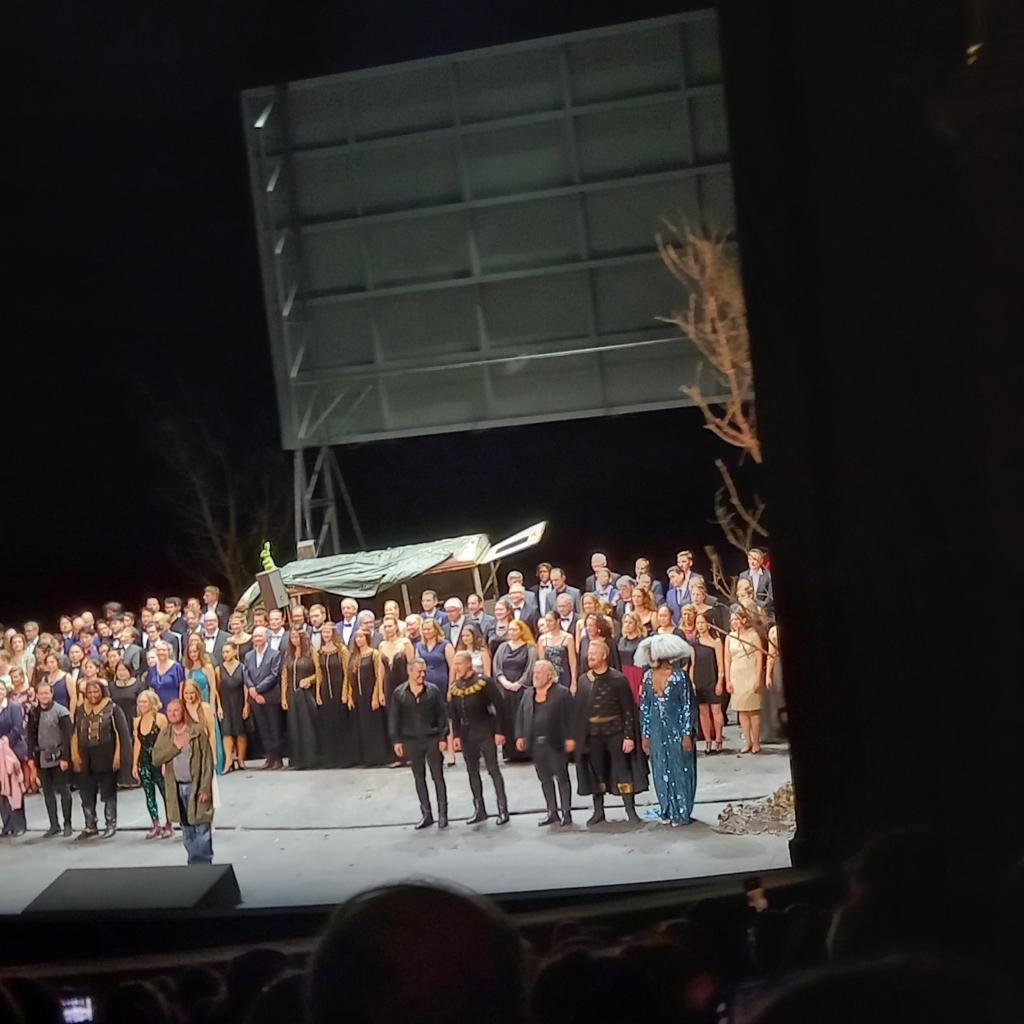
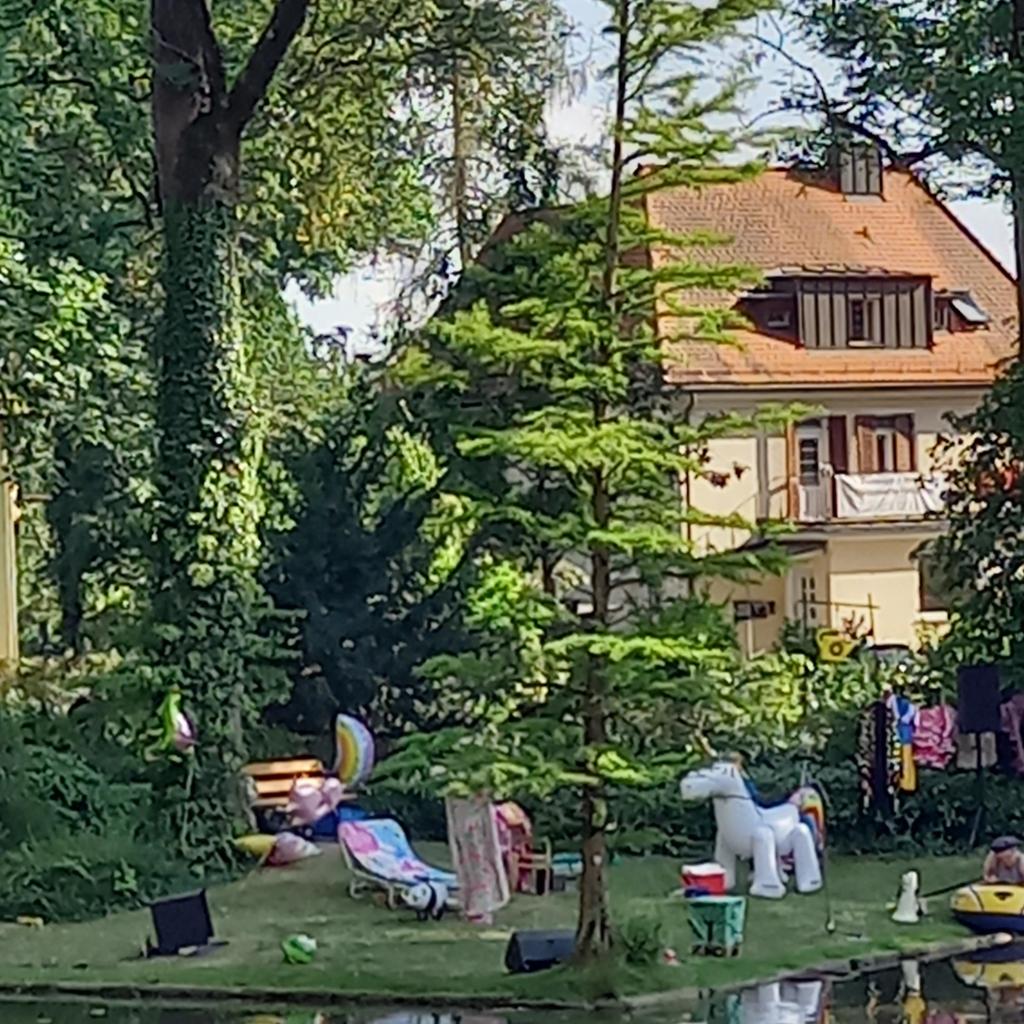
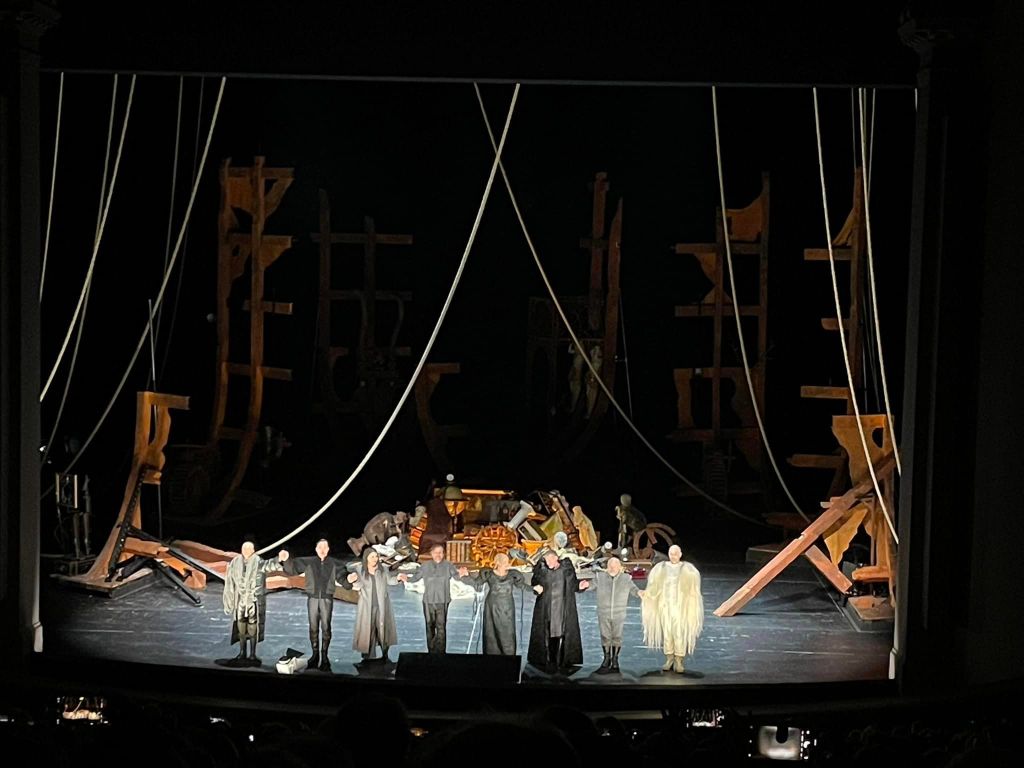
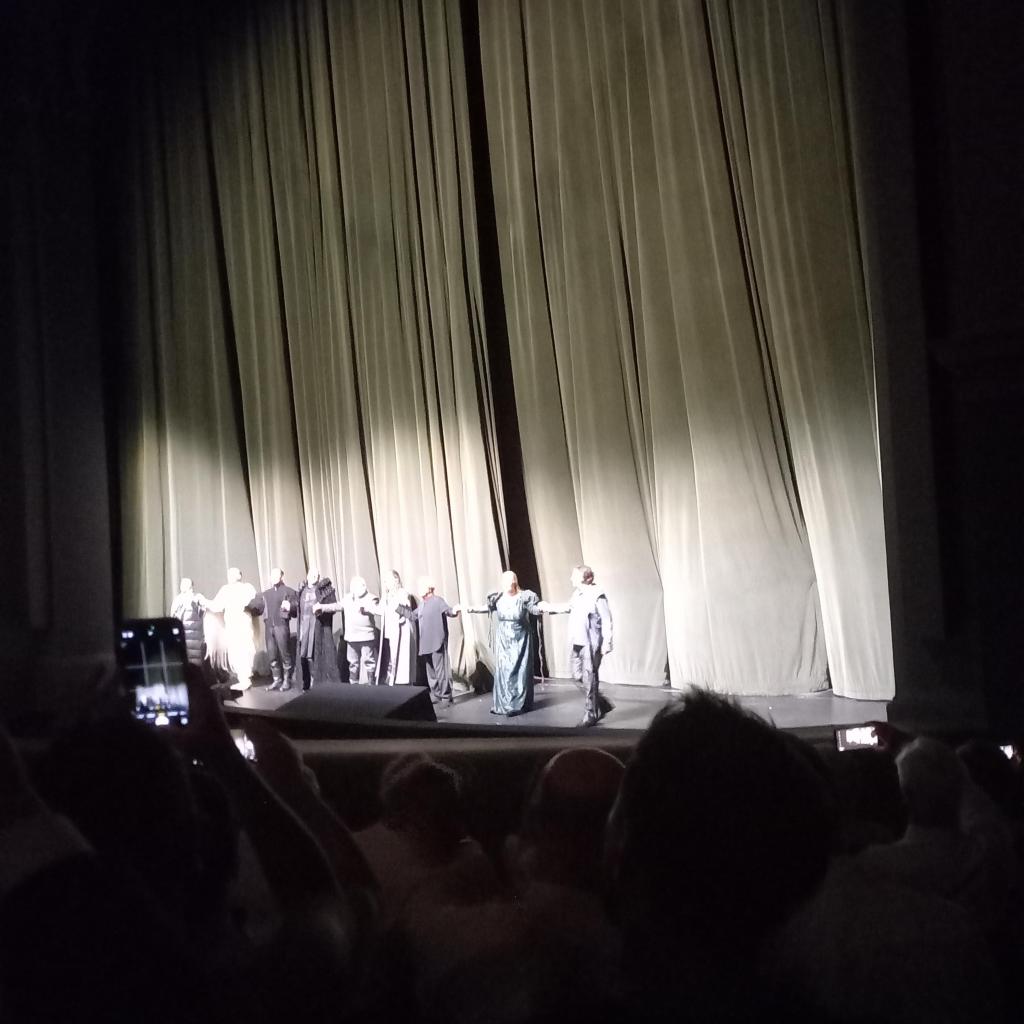
Bayreuth Festival – Wagner, Parsifal. 14/8/24

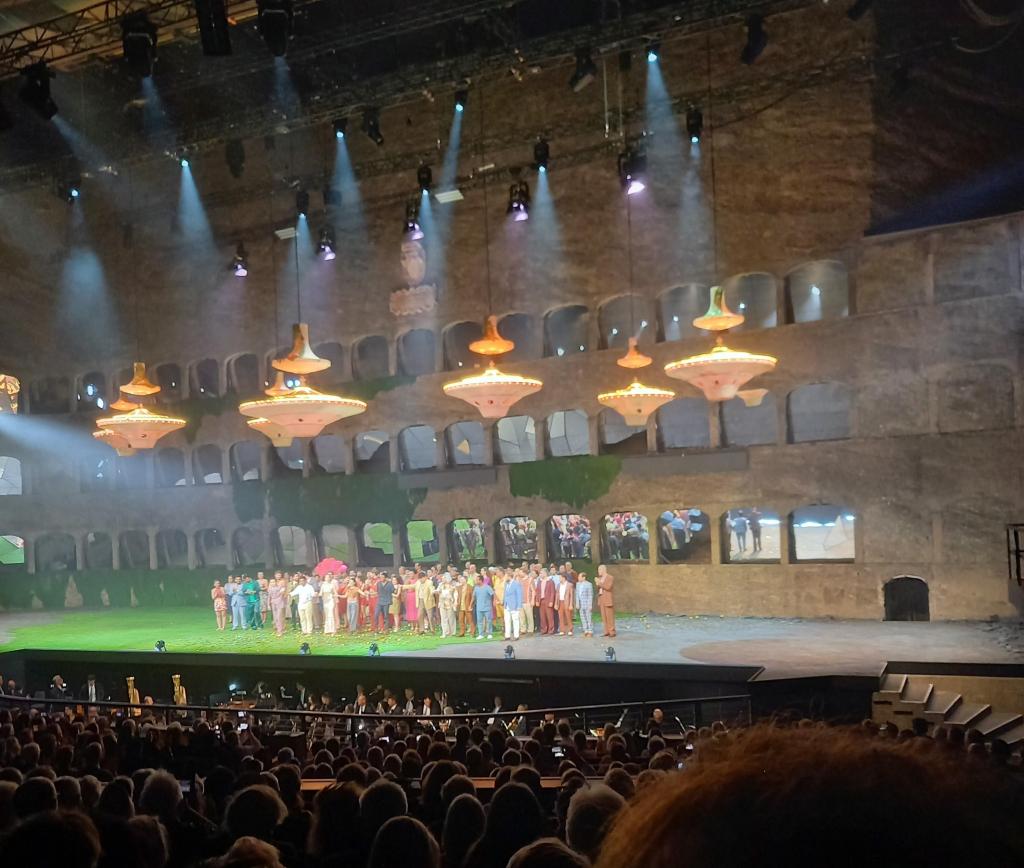
Conductor, Pablo Heras-Casado; Director, Jay Scheib; Stage design, Mimi Lien; Costumes, Meentje Nielsen; Lighting, Rainer Casper; Video, Joshua Higgason. Amfortas, Derek Welton; Titurel, Tobias Kehre; Gurnemanz, Georg Zeppenfeld; Parsifal, Andreas Schager; Klingsor, Jordan Shanahan; Kundry, Ekaterina Gubanova

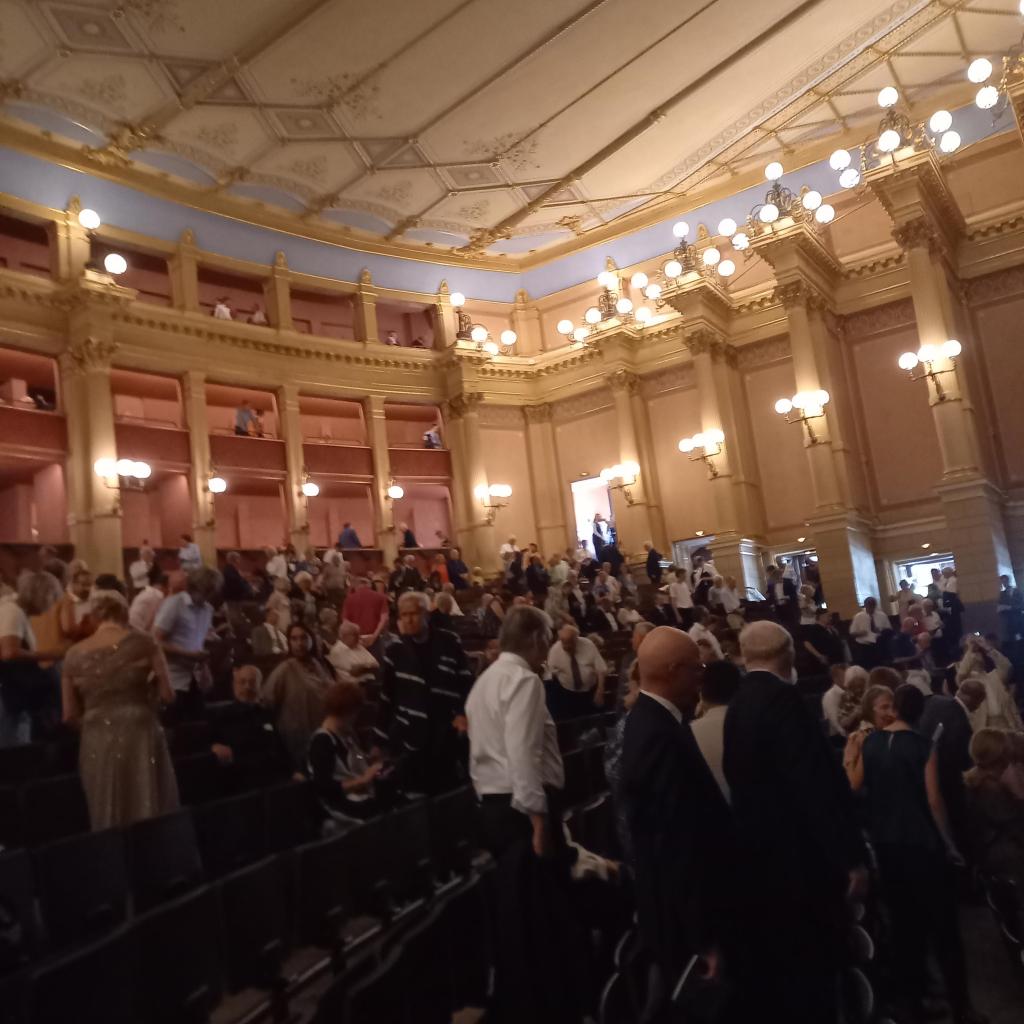
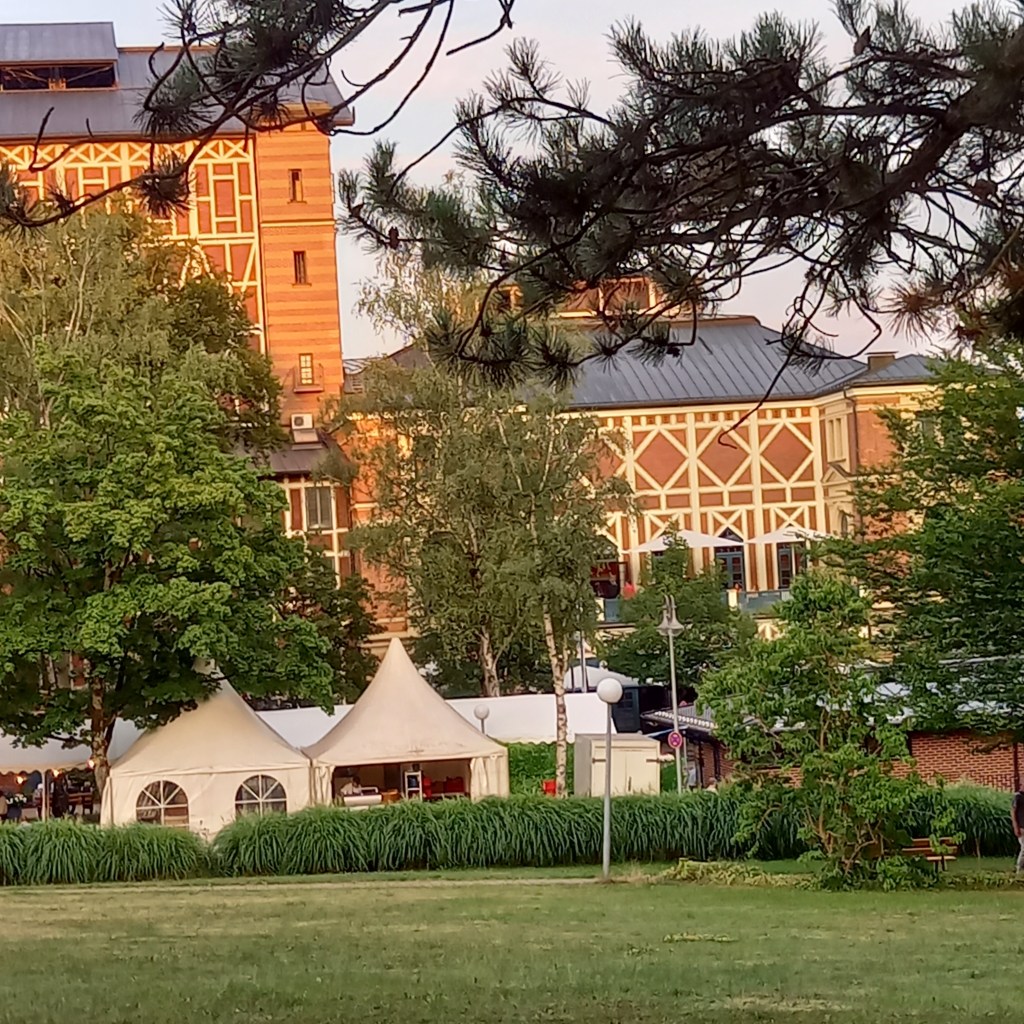
After a, by now almost normal, rather chaotic performance by DB I arrived in Bayreuth last night only an hour or so later than I had planned – my train to Frankfurt was late by 30 mins but then so was the train to Nuremberg!) So now, in extreme heat, I am in Bayreuth for 3 days to hear Parsifal, Tristan and Tannhauser. The Festspielhaus shimmered in the distance as I approached it, and most men had their jackets off.

I went to the previous Parsifal production when in Bayreuth in 2017 with some of the same personnel – Schager, Zeppenfeld and Welton – and thought it very effective, though musically quite fast (Haenchen).I saw video clips from this current Parsifal when it was a new production last year, and thought it, from the extracts I saw and heard, both musically well-led by Heras-Casado and  an interesting production which, whatever its quirks, did not deviate too radically from the settings and context laid out by Wagner, and warranted a closer look – all the fuss about the special augmented reality glasses being a bit beside the point for all but a minority of the audience. There were hostile critical reviews, though – the Financial Times was particularly upset: “None of the fundamental questions (who are these knights? What kind of society have they created? Who is Kundry? What is the Grail? What is redemption?) are addressed” in the production. So it’s as good a way as any of starting this review by seeing how I responded to those questions, having experienced the production live.

There are two preliminary point to be made about the production. The first is that, unlike some regietheater productions this is pretty faithful on the whole to Wagner’s stage directions – if Wagner says there are fallen heroes in Act 2, there they are, gruesomely beheaded; there is a grail and a spear, and a full set of ritual accompaniments – various bowls and relic-holders, plus a full acted out reception of the Grail, with processions; though the setting of Act 3 Scene 1 is very far from a sunny Good Friday woodland, some flowers are brought in for the Good Friday music.  These are just a few of many examples. The second is the extensive use of a live video-cameraman on stage, throughout nearly all of Act 2 and large portions of Acts 1 and 3, the video being then shown live on the huge back wall of the stage. Clearly there are points here the director wants to make, which we’ll come onto, but it is a very effective way of enlivening long relatively static scenes such as the encounter of Kundry and Parsifal in Act 2.

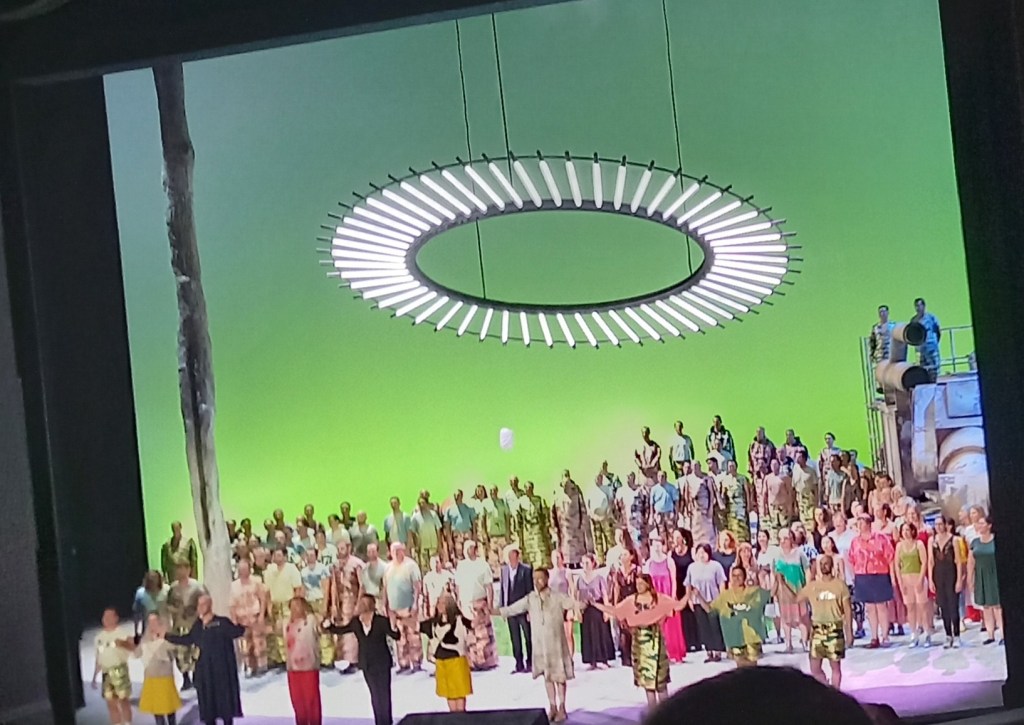
So….what of the Financial Times’ questions. It’s a mixed bag, I think. The society portrayed in Act 1 is a technological one – the setting is almost like some sort of quarry, with bright steel poles and a monstrous gleaming steel-sided Tower of Sauron affair, which flashes like a light-house during the Grail scene. The poles crackle when Kundry first approaches. The Grail Knights are military in appearance – large men, shaven heads – and wear camouflage uniforms. The latter may indicate that they are unable to show their true feelings to each other – life is transactional. Or it may be that they are people evading reality The extensive (maybe half of Act 1 Scene 1) filming of the repeated bandaging of the oozing blood from Amfortas’ wound shows they have compassion in terms of what to do with wounded bodies (or a wounded swan, who gets the same treatment)  but not in relation to wounded minds. The reference to wounded minds here mainly relates to Kundry, who is much more centre stage throughout the work than is usual –  she is there through the first grail scene – but it also refers to Gurnemanz: the prelude to Act 1 has a videoed encounter he has with a young woman in a dream sequence, who he is obviously deeply disturbed by. She appears at moments throughout the opera in a white gown – she is in the Grail Scene and she arrives as some sort of page to Parsifal in Act 3 scene 1 and remains on stage for the rest of the performance. So it’s fair to say that the knights have a problem with women (in particular no-one understands or can sympathise with Kundry) and that religious ritual is more important to them than real relationships……….Maybe also the video cameraman (who is dressed in military camouflage) is suggesting through the videoing something about people seeing themselves through social media and selfies rather than through the mirror of human relations. A pool of water is there in all three acts in the sets, perhaps representing a more honest way of life and the power to transform.

Act 3 shows a society that has undergone climate catastrophe – a stagnant green pool (perhaps an image for the knights themselves) in Act 3 Scene 2, though still alive for the baptism in scene 1)l there is a rusty piece of machinery in the quarry. Everything seems dead.  The woman Gurnemanz saw in his dream brings on the flowers for the Good Friday music

So far so good-ish. Where the problems come is in trying to see what ‘redemption’ means in this context. The director’s answer to this is to have Parsifal, once he has reunited spear and Grail, is to smash the Grail (which is a large maybe hexagonal stone – fair enough since this is how it is described in some of the sources). He and Kundry then wade into the pool and raise their hand towards the gas ring object that floats above it/the temple, maybe in recognition of something ‘above’ beyond religious ritual. Tentatively, Gurnemanz and the other woman also come together and acknowledge each other. So by this is the director saying that redemption is about restoring ambulant heterosexual relationships and (as one of the directorial team puts it in the programme ‘trying to be a bit friendlier with each other’)? This does not sound like a full understanding of the word redemption to me, and the director really doesn’t really get to grips with the religious element of the work – religion is not necessarily just about being nice to each other, though it should include that. It’s significant that the point of the text of the Good Friday music felt mainly ignored in this production. So much could have been done with ‘Entsuendigte Natur’ in a climate catastrophe context.

What’s good about the production is the increased focus on Kundry, on her humanity, on her being someone definitely different by the end. The crux of understanding her is in Act 2, and here also there was to me some confusion, perhaps inintended but brought to my mind by the fantastic performance of Elena Gubanova and the close up images from the video – so real does Kundry’s passion become that I lost the sense that she is doing what she does in Act 2 under a spell; it seemed to come from a genuine part of her nature. How then she becomes the penitent figure of Act 3 is then unclear. Meanwhile in Act 2 Parsifal’s T shirt has ‘ Remember Me’ on its back. Is this about Amfortas, or the rather solipsistic world Parsifal is still in? Again, apart from being naturally instinctive and not camouflaging his feelings, it is a bit difficult to understand Parsifal’s journey in this production

These comments are inevitably a bit unfocused, scribbled down during and after the performance, but I hope you can see something of the merits and problems of this production – the major defect being to remove it from the sphere of religion and what we might mean by ‘redemption’ in a modern context. The major achievement of the production is the way it focuses on the journey made by Kundry. One other thing to highlight is, as ever with Bayreuth, just how spectacular and colourful the sets and costumes are – they are extraordinarily good

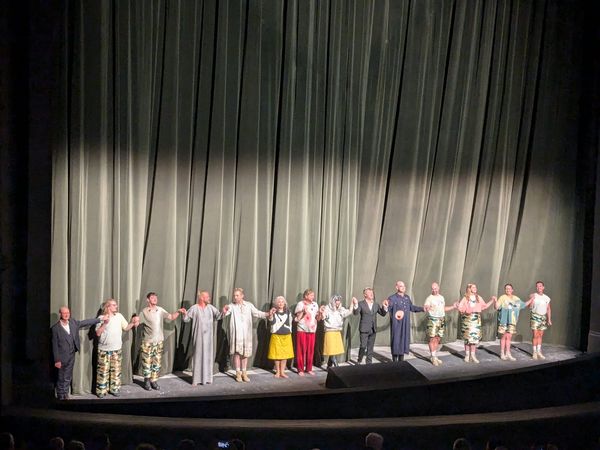
Musically this performance was wonderful. The five major roles all performed magnificently – Zeepenfield (maybe his voice a bit drier than when I heard him last in this role 7 years ago) articulated the words clearly and sang sensitively; Derek Welton has a marvellous voice and deployed it well; Jordan Shanahan was maybe less distinctive than others but did all that was required of him as Klingsor; Ekaterina Gubanova was (as I think the director intended) the star of the show, and I have never heard Act 2 sung better or been more gripping (eclipsing even the version given by Opera North a couple of years ago); Andreas Schager does what he does with all his heart and soul – I have never heard ‘Amfortas, die Wunde’ more strikingly sung on stage – and quite often with sensitivity too. You can’t but worry though about the amount he takes on at Bayreuth and in fact he was off last week with an infection. We’ll see how he gets on in Tristan tomorrow. There were some signs of wear and tear on his voice. Heras-Casado I was as impressed by as I was listening to last year’s performance on video – flexible, always bringing climaxes to a full conclusion, moving the music along but with sensitivity. He was full-throatedly cheered and stamped for by the audience at the end, as were all the singers except for the poor Flower Maidens for whom there was some silly and quite unjustified boo-ing in the worst Bayreuth fashion. There were a few over-the-top people around in the audience, including the chap in front of me who upbraided the Mum of a teenage daughter in front of him for the girl’s fiddling with her phone during Act 1 (I think the poor girl was just trying to follow the plot), muttering ‘Unmoeglich’ several times.

On to Tristan tomorrow

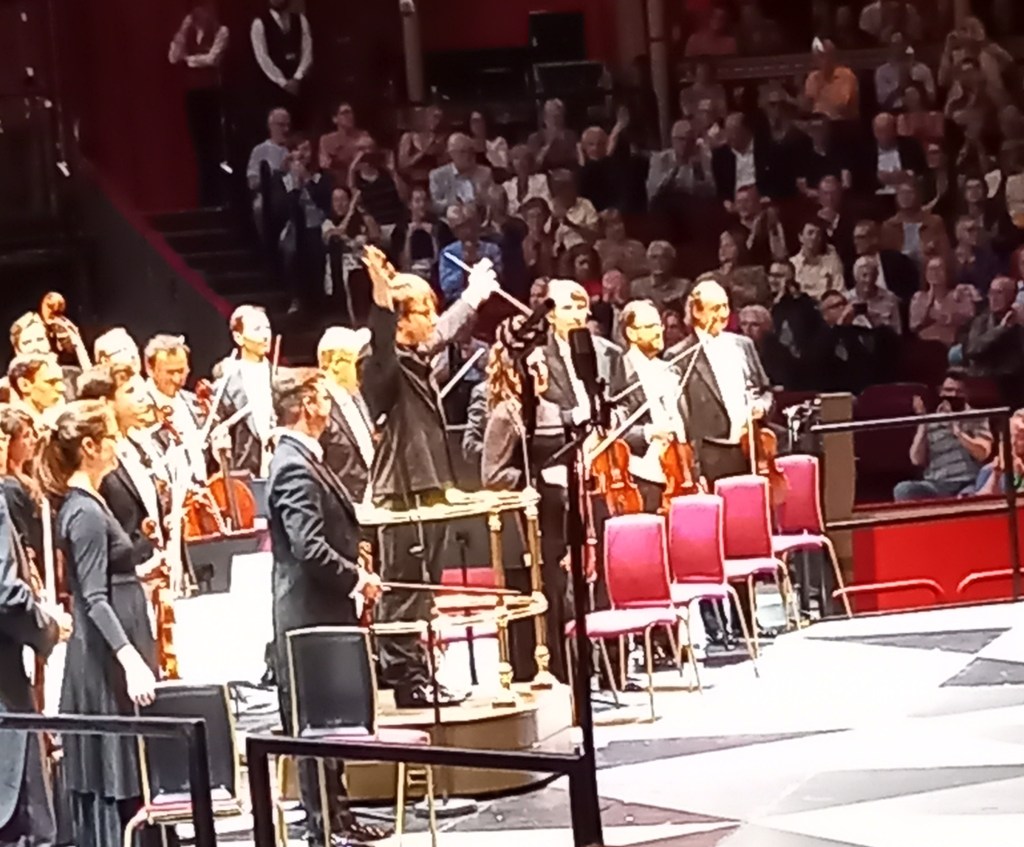
BBC Proms: Prom 32  – Beethoven , Jenkins, Farrenc, Williams. RAH, 12/8/24

G. Williams Concert Overture; Sir Karl Jenkins Stravaganza  (BBC commission); Farrenc Overture No. 1; Beethoven Symphony No. 7 in A major. Jess Gillam soprano saxophone, BBC National Orchestra of Wales, Nil Venditti conductor

 This is a concert I went to because I had to be in London in the evening in order to be ready for the early Eurostar train to Brussels and onward to Bayreuth, and I thought it would be a good way of entertaining myself. It wasn’t a concert I was articularly interested in, and I thought it would suffer by comparison with the magnificent Barenboim EWDO performance of Schubert 9 I heard from the Proms via BBC Sounds the previous evening – which was magisterial, wonderfully structured, Klemperer-like in its inevitability, and possibly the finest performance I have ever heard of that work.

The reality of this concert though confirms the excitement of live music and the special atmosphere of the Proms. I was standing in the Arena for this, leaning on a bar at its edge and confirming to myself again that the Arena offers the best sound in the RAH, full, balanced and sharp. It was a highly enjoyable event and despite its being the hottest day of the year in London, not too steamy in the RAH. I cooled myself in the Arena bar in the interval…. And the Hall was packed, which always helps in terms of atmosphere, if not always in terms of steaminess……………

Part of the pleasure was seeing the young Italian/Turkish Conductor Nil Vendetti. She has a very clear expressive way of using stick, arms and body to give the indications to the orchestra and the audience of what she wants- particularly when, in the Beethoven, she conducted without a score. She is also- without doing it to excess – a very physical conductor who crouched down and leaped up as the music demanded. And she got results- the BBCNOW played exceptionally well for her. Though I have never heard of her, she is clearly getting good gigs with good orchestras and her career is advancing quickly, with a well known agent in tow. 

The concert did get off to a rather lukewarm start with the Grace Williams overture, which was fun enough in a sub-Waltonian way but really not very memorable. The Karl Jenkins piece was a very different affair –  jazzy, very enjoyable, lyrical as well as punchy, and in 3 or maybe 4 varied movements. The BBCs relentless promotion of Jess Gillam as presenter and personality has always set my teeth on edge a bit – Northern, not posh and therefore, it feels sometimes, fulfilling a diversity quota – but she is a fantastic and gifted musician whose soprano sax made extraordinary sounds through her skills. I was in awe of what she was achieving by the end and how she effortlessly provides an engaging stage presence to complement her playing, swinging to the beat. This was great music-making….

The Farrenc Overture after the interval I think I’ve heard before played by the Halle (?). I thought better of it this time round – a clear structure and themes no less distinguished than say Schumann might offer. The Beethoven 7 was the polar opposite of the Barenboim performance the day before – fast, energetic verging on frenetic, exciting. ‘Rollocking’ someone near me said to a neighbour. It was not a great performance – the slow movement was simply too fast, so that many of the underlying harmonies were lost, and the outer movements moved at speeds that didn’t allow the climatic moments towards their end to make their maximum impact. But it was a young person’s reading, revelling in the propulsive rhythms,  and I found it very gripping and was very happy to hear it live.

A good evening! Now – on to the hallowed portals of Bayreuth…….

BBC Proms: Prom 14 – Beethoven, Bruckner and Tüür. RAH, 29/7/24

Erkki-Sven Tüür, Aditus; Beethoven Piano Concerto No. 5 in E flat major, ‘Emperor’; Bruckner Symphony No. 1 in C minor (1877 Linz version, ed. Nowak) Yunchan Lim piano, BBC Symphony Orchestra, Paavo Järvi conductor

I am trying, in my intensive July and August live concert listening, to pay particular attention to works I have scarcely ever heard – Prokofiev and Weinberg operas in Salzburg, the concert I reviewed last week at the Proms (Schoenberg and Zemlinsky), Ma Vlast (apart from Vltava I have never heard any of this), and Suk’s Asrael Symphony at the end of August, the Handel opera in Buxton – and this concert. Apart from Florence and The Machine, this was one of the first Proms to sell out. Initially I wondered why – Bruckner 1, which I have never heard live before, I was looking forward to hearing but it is scarcely a crowd-pleaser. And the Emperor concerto crops up all the time. Paavo Jarvi is undoubtedly a fine conductor, but he’s a fairly regularly visitor to the UK, and to the Proms. Then I realised that the big deal was Yunchan Lim, who is a 20-year-old South Korean pianist. At 18, he was the youngest pianist ever to win the prestigious Van Cliburn International piano competition in Texas, and he is now regularly referred to in the classical music press in hyperbolic terms (‘the most exciting pianist on the planet’, ‘Yunchan Lim’s playing is so good you think you’re dreaming’; ‘Is this 20-year-old the greatest pianist of our times? ; Yunchan Lim, the Korean about to electrify the Proms’ (The Guardian) etc). So I wondered how I would find his playing….

The house was, as indicated above, packed. First up though in the programme was a short work by Erkki-Sven Tüür (not a name I have come across before, a 64-year-old Estonian composer, who ran a rock band at one point in the 80’s). The work performed, ‘Aditus’, was in memory of his teacher Lepo Sumera (8 May 1950 – 2 June 2000) who was an Estonian composer and teacher. An ‘Aditus’ is the opening to some interior space or cavity. This first work seemed to consist of a series of vortices  – a strong statement followed by a gradual dissolution of sound. There were maybe 4 or 5 such attempts, including a much faster rhythmic section, all eventually ending in silence. It did not, at 9 minutes or so, outstay its welcome and I shall listen to it again on I Player.

Mr Lim is a diminutive figure who barely looks at the audience and seems utterly wrapped up in his playing. His playing of the Emperor concerto, as you would imagine, was immaculate technically. That sounds as though it is to be followed by a ‘But’ but it won’t be. There were wonderful poetic moments of feathery lightness; phrases lovingly sculpted. Many passages I felt I was hearing for the first time, particularly in the second and third movements and these two were probably the best elements of his reading. He also had magnificent support from the orchestra and Jaarvi who offered a propulsive performance, full of energy, nice pointing and bounce, with a hard stick timpanist adding to the excitement. What I did feel is some distance between what the orchestra was doing and the vision of the pianist – his playing suggested a more Schubert, maybe Schumann, – like grace, lyricism and melancholy that just didn’t seem to gel with the more robust approach of the orchestra. Of course the Albert Hall sonic experience can always be a factor but this was certainly not sounding to me like a barnstorming performance, and I thought maybe Lim might have needed maybe more time with Jaarvi to establish a common approach. Lim played beautifully a Bach transcription by Wilhem Kempff as an encore.

There were significant numbers of Koreans in the audience out to support the young pianist in the first half  and it was great that nearly all of the packed Albert Hall audience  returned for the Bruckner in the second half. The Bruckner symphony is in some ways a tentative piece from a famously late-starting composer- he was 44 when he wrote it- but nevertheless many of the characteristics of the later symphonies are there: the enormous full-stops-out brass passages followed by silence, the quirky woodwind inner voices, the folksiness in the Scherzo, the obsessive repetitions of phrases, the slow movement climax. What’s perhaps surprisingly not there so much is memorable melodic material in some movements. The Scherzo is the section most closely aligned with those of the later works, and the most memorable – a thumping tune, exciting brass and building to thrilling climaxes. The first movement starts with a trudging Schubert-like melody and follows the mature Bruckner pattern of having three subjects. I didn’t find it easy to follow the flow of the argument of the development section  but it has an exciting ending! The slow movement is slightly different to those that follow it in the later symphonies. Perhaps influenced by the previous, on the whole, gloomy first movement it starts in disarray – phrases that fall in on themselves, sounding as though they are about to break into song and then collapsing. The main theme enters tentatively – perhaps a gradually emerging faith – and gradually builds up to a thrilling climax and beautiful calm coda. The finale, as often with Bruckner, sounded to me the weakest movement, with a repeated 5 note motif thumped out, rather undistinguished melodically second and third subjects, lots of brass and a major key ending which is glorious.

I haven’t heard much of the BBC Symphony Orchestra in recent years and when I do I am always perhaps unfairly surprised by how good they are. In particular the trumpets blared out with utter precision, there were some beautiful woodwind solos (bassoon particularly distinguished)  and the strings in the slow movement glowed richly. Jaarvi pushed the music along at quite a pace, which I think is right with this work – it’s not one for Celibidache-like luxuriating.

All in all this was a deeply satisfying evening!

BBC Proms: Prom 5 – Schoenberg and Zemlinsky. RAH, 22/7/24

Schoenberg Pelleas and Melisande; Zemlinsky The Mermaid. BBC National Orchestra of Wales, Ryan Bancroft conductor

This was a concert I was looking forward to – two massive late Romantic pieces with a huge orchestra. The Zemlinsky piece I have a recording of but the Schoenberg work I have only heard once over the radio, I think, and I had little memory or knowledge of it other than that it was one of his pre-atonal compositions. Both works were originally premiered at the same concert in Vienna in 1905, and both have the fin de siecle/Freudian pre-WW1 Viennese obsession with sex and death. Both hover, though Schoenberg more obviously so, on the edge of tonality, with the impending collapse of the old world Austro- Hungarian order in plain sight.

It was great to be back in the Albert Hall even though the audience was sparse (Pappano in his recent book says that having Schoenberg on the programme of a concert – whatever the piece of music – immediately reduces your box office takings by 20%). Still, the Arena was fairly full and had plenty of enthusiasm for this music – much cheering at the end of both halves. And- for the Schoenberg – the orchestra WAS huge -Wagner plus: I counted 10 horns, quadruple woodwind, 2 sets of timpani and so forth, not least a massive collection of percussive instruments. Almost as large, the Zemlinsky orchestra had a mere 7 horns and one set of timpani. The BBC NWO – from what I could hear in the front row of the choir – played superbly (I counted a couple of slightly ragged entries throughout the evening, an impressive achievement given the size of the orchestra and that probably no one in it had ever played these works before). I was also impressed by Ryan Bancroft’s conducting – he doesn’t use a stick but his hands and body movements very clearly sculpt what he wants from the orchestra and he had an impressive sense of control, structure and clarity in this music.

The Schoenberg piece is dense, full of foreboding, at times dissonant, and I need to listen to this performance again on the radio. The various leit- motifs – for Golaud, Melisande, Pelleas – become identifiable after a while (a chap in the loo in the interval was even whistling the Golaud theme as he peed) but I can’t say the familiar story was immediately clear from the massively complex entangled score, though the passionate run up to Golaud’s discovery of the lovers was glorious and obvious. What IS immediately apparent is Schoenberg’s mastery of the orchestra and his uncompromising vision of what he wants to achieve. You just feel a bit exhausted by the end ………..but are also clear this is the work of a great composer.

By comparison, Zemlinsky’s piece is much more crowd- pleasing, and is helped by being in 3 movements. It is perhaps at times derivative (I wonder whether I heard Rimsky-Korsakov or Tchaikovsky on occasion, not to mention Rhinegold at the beginning, and the Straussian overtones common to both works) – the melodies are more identifiable and memorable, the great arcs of sound harmonically more obvious. The piece’s got some wonderful moments, particularly in the first and second movements, some beautiful violin and cello solos, shimmering strings, but somehow I don’t think it’s really a work which, having heard once, I’d actively want to seek out again. The Schoenberg piece by contrast I feel I do want to get to grips with

Sir Antonio Pappano Masterclass, BIF Pavilion Gardens, Buxton, 19/7/24 (and talking about his new book in Buxton Opera House)

Due to train problems, I arrived at the venue for Pappano’s masterclass in a rush – the clock in the neighbouring church had just struck 3pm – and at the entrance I nearly crashed into Pappano and the accompanist popping out of the main door to get into the stage entrance at the side of the theatre. I made it with seconds to go….

Three young singers were receiving tuition from Pappano for about an hour and a half, singing two Gounod arias – one from Faust, one from Romeo and Juliet – plus Susanna’s act 4 aria from the Marriage of Figaro. The final singer also sang the brief Composer aria from the end of Act 1 of Strauss’ Ariadne auf Naxos, with Pappano conducting at full throttle. First on stage was Jane Burnell – also heard in La Canterina last week; a bass baritone, Steffan Lloyd Evans, and Indyana Schneider, both currently based at the Zurich Opera Studio.

I have never been to a masterclass before. It is an awkward business – difficult for the coach to get the tone right, to make comments that are to the point and instructive but at the same time not demeaning or humiliating; also avoiding the temptation to play to the gallery. And it is difficult for the singers to face a barrage of comments that they feel may be unfair and keep smiling for the audience. It is meant to be a two-way process but of course, with an audience as a third presence, the process can be, I guess, distorted. Pappano managed it very well though very occasionally he was making a comment to the audience that one might think unnecessary. The singers were very gracious and good-hearted. Some key themes emerged from the conversation in terms of Pappano’s comments to singers – to remember always you are on a stage and you must project to an audience; the importance of legato lines in singing; the importance of projecting the words. We were told that ‘audiences will be attracted by your eyes’; ‘keep them alive’. The singers were told to take less breaths – you can take fewer than you think – to help with a smooth line. The young singers were commendable in taking all this on the chin and not betraying any frustration at the constant repetition of small phrases. And in each case they did sound better at the end compared to their first run through……….

An hour later Pappano was interviewed by Adrian Kelly, who had been the accompanist in the masterclass and is also the music director of the Buxton Festival, about his new autobiography. Pappano was very emphatic that what he was doing was show business- that there was no inherent difference between performing a Beethoven symphony or Tristan und Isolde and Sweeney Todd – all were about putting on a show for an audience, and, for Pappano, telling a story was paramount. He told a very funny anecdote about having problems with the flute solo in the finale of Brahms 4, and writing to Carlos Kleiber about it. Kleiber wrote back asking him to image an Italian beautiful duchess in distress, a dangerous villain nearby closing in on her……Pappano said he wanted to have a story behind each piece he conducted (his mentor Barenboim made a similar point – he once said something like ‘the note C is a note; C followed by A is a story’). Pappano said how much his involvement in his early 20’s working on American musicals in New York had been transformational for him – he wanted everyone on stage where he was working to regard the audience as a god, and for the stage experience to have the bite, the perfect timing, the precision of American musicals. He told us about how his training had been very different from most conductors – he had never formally studied music, had  never been to conducting classes, and his experience was wholly on the job training from a sequence of lucky, but obviously merited, breaks, and from the profound knowledge of works in the Italian repertoire learned from his father (a singing coach who used his son as a piano playing accompanist from a young age – 10, maybe?). Often he was finding himself in his early years just being thrown in at the deep end and suddenly having to, for instance, learn ‘Lulu’ over a weekend to conduct a run of performances. Throughout Pappano demonstrated his inexhaustible funds of energy and enthusiasm – clearly an uplifting and inspiring colleague for many. He was hoping to find more time for studying scores now he has left Covent Garden, and he enthused about his new role with the LSO

Baroque in the North: Edale Church, Derbyshire – 14/7/24

Joseph Bodin de Boismortier Sonata No. 3 in D,  Purcell, Suite No 4, Bach Cello Suite No 1, Francesco Barsanti, Sonata in C, Scarlatti, sonata in F, Nicholas Antoine Bergiron.  Claire Babington, baroque cello, Amanda Babington, violin, recorder, musette, and David Francis, harpsichord

Baroque in the North has been developing strategies to improve accessibility to and knowledge exchange via live music – for schools, amateur players and “an initiative to take live music (and tea and cake!) to small rural communities in the North West” – hence this concert.

I heard them in Castleton a couple of years ago, when just the two women were playing, and it was good to hear them again, this time with the addition of a harpsichord. As I listened to the music, I was asking myself why, on an equally murky and wet day, this concert was more uplifting than the very similar sort of concert I heard in Buxton three days earlier. I think it was a combination of:

  • less tuning problems!
  • personable and informative introductions to each piece
  • some top drawer works included (Purcell, Bach, Scarlatti), along with the more obscure pieces
  • a more varied set of instruments, particularly the recorder and the musette (small bagpipes like Northumbrian pipes)
  • perhaps linked with the bullet above, a more varied sense of mood in the pieces, from the near folk dance of Bergiron (with the musette) through the cheerful recorder sounds of Barsanti to the high seriousness and inwardness of Bach

This was an enjoyable and well planned concert -I’m glad I went………..

Haydn, La Canterina. BIF, Buxton Pavilion, 11/7/24

Jane Burnell Gasparina; Dominic Mattos Apollonia; Jonah Halton Don Pelagio; Helen Maree Cooper Don Ettore; Toby Hession Conductor; Lysanne Van Overbeek Director; Elliott Squire Designer

I’m reading Thayer’s Life of Beethoven at present – the first person to have systematically tracked through by personal interview all those who knew Beethoven and were still alive in the 1850’s, and all the official sources of information to be found from records and archives. It’s striking how many operas the local court in Bonn (where Beethoven grew up) was putting on in the 1770’s and 80’s – dim names from the past like Reicha and Paisiello, as well as Mozart’s Idomeneo and Die Entfuhrung, Clearly most composers didn’t expect their operas to last more than a season or two (even Handel) and Haydn at the beginning of his career would have had even less expectation of a continuing existence for his work.

 According to Wikipedia, La canterina (The Songstress or The Diva), Hob. XXVIII/2) is a short, two-act opera buffa by Joseph Haydn, the first one he wrote for Prince Esterhazy. Based on the intermezzo from the third act of Niccolò Piccinni’s opera L’Origille (1760), it lasts about 50 minutes. It was written in 1766, and was premiered in the summer of that year. Haydn I am sure would have agreed that it is a slight piece and he would probably have been amazed to find it being revived 250 years later.

The stage of the Pavilion Arts Centre had both a small orchestra (10 people at most) on the stage, towards the back of stage right, and the diva’s dressing room, looking appropriately 18th century. The actors all looked the part – Jonah Halton was appropriately superior-looking, Dominic Mattos plays a wildly over-the-top pantomime dame-type Mother. But the show really hangs on the person playing Gasparina, who must both sing well, be a good actor, and look stunning. Jane Burnell offered all three attributes in spades, and held the audience’s attention securely throughout the show. Haydn’s music trundles along enjoyably enough – and the musical experience is arguably better than hearing the Salieri comic opera I went to last September………………..

Samuel Ng and Kristina Watt: BIF, St John’s Church, Buxton, 11/7/24

M Marais Pièces de Viole, Livre IV – Suite No. 1 in D minor; F Couperin Pièces de Viole – Suite No. 1 in E minor; M Marais Pièces de Viole, Livre IV – Suite No. 2 in D major

This was, I guess, a chilling-out but not very inspiring way of spending a damp wet morning in Buxton. A sequence of prose and music was presented but unfortunately the performers were not holding the mikes close enough to them so I was unable to disentangle why this was happening and what the prose pieces were (from the little I could hear they seemed to be animal fables of some kind – why they were being played with this music I have no idea, unless Louis XIV’s bedtimes involved both events happening at the same time). I seem to remember a rather sad or gloomy film about the composer Marais (but little seems to be known about his adult life, other than that he had 19 children!). The pieces followed each other pleasantly enough but without any being memorable. At least 5 minutes of this 50 minute recital must have been spent tuning, a consequence of the miserable weather we were told

Jean-Pierre Dalbéra from Paris, France and one more author – Portrait de Marin Marais (Musée de la musique, Paris) CC by 2

Handel: Il Trionfo del Tempo e del Disinganno. BIF, Buxton Opera House, 11/7/21

Anna Dennis Bellezza (Beauty); Hilary Cronin Piacere (Pleasure); Hilary Summers Disinganno (Disillusion); Jorge Navarro Colorado Tempo (Time). Christian Curnyn Conductor; Jacopo Spirei Director; Anna Bonomelli Designer

This is a work I’ve never heard of before, let alone heard. Il trionfo del Tempo e del Disinganno (The Triumph of Time and Disillusion), is Handel’s first oratorio, a dramatic allegory, dating from 1707. As an oratorio, this would be a long evening – over 2 hours and 40 minutes of a static concert experience would be a bit dire. As a staged drama it seems much more absorbing – certainly my attention rarely flagged. Because of its oratorio form, as a drama it doesn’t have many long-drawn-out recitatives, and this in effect means value for money – you get far more ‘numbers’ for your 2 hours and 40 minutes than you would in an equivalent Handel opera.

The oratorio is a conversation between Beauty, Pleasure, Time, and Disillusion (various commentators advise there is no exact English equivalent of ‘disinganno’), where Beauty is over time persuaded to let go of her past and take a ‘heavenly path’ instead, repenting of her previous life and relinquishing Pleasure.  There are as you can see only 4 characters and by comparison with most of Handel’s operas the plot is blessedly uncomplicated.

The director’s clever idea is to frame the uncomplicated story within the setting of an almost contemporary family Christmas lunch – maybe early 1980s (with Morecambe and Wise Show in prospect), a time for tension and subterranean anxieties and annoyances to burst forth. The setting reflects this – there’s a family dining table, sofa and lampstands, and then, off to the right, a TV room where Dad sits while Mum makes the lunch – Dad of course does the carving. Beauty and Pleasure are unruly 20-something grown-up daughters with very different personalities, Time and Disillusion are Dad and Mum.  There is the Christmas tree, presents, turkey and Christmas pudding, with a gin and tonic for Mum. Pleasure produces some tablets at one point which causes everyone to freak out – Pleasure and Beauty dance to an aria while Mum does her own thing in the corner. As Time begins to win out in the argument with Beauty and Pleasure begins to withdraw to the sidelines, and things get more serious for Beauty, the scenery gradually changes from 1980’s family Christmas lunch to a funeral parlour, with Time and Disillusion dressed up as undertakers. A coffin is brought on and Beauty throws her jewellery, Christmas presents and wig into it – she puts on a hoody over her glittery ball dress but not before revealing her short grey hair. As the opera ends it seems as though having repented and removed her worldly goods, the shorn grey Beauty is regretting her actions, and sits alone in her armchair, while through the window the spectral Time, Disillusion and Pleasure peer through the glass. It’s a haunting and effective ending. All in all – though I’m glad the Christmas party idea gives way two thirds through the piece– it is a very effective and clever staging. The work would have to be cut radically to really be enjoyable in the concert hall.

The music, as ever with Handel, is always worth listening to – there are no really dull arias and several treasurable ones: the aria also used in Rinaldo, Lascia la spina, sung by Pleasure, and a most lovely final aria sung by Beauty are particularly memorable.  There is not very much in the way of exciting fast coloratura arias and quite a lot of slow ones, as perhaps befits the serious subject matter, but at least there are no hooting counter-tenors.

The singers were a uniformly strong group. Anna Dennis, not a name I’ve come across before, was outstanding as Beauty with a bright clear and unforced voice well able to deal with any coloratura moments that there were, and played the role as something of a dumb blond. Pleasure was dressed in Goth style and Hilary Cronin appropriately had a sweet agile voice for the role. Hilary Summers, wearing a large 70’s-80’s bow dress was a stunning deep contralto, while Jorge Navarro Colorado as Time was a steady and reliable light tenor. The period band were excellent

Angela Hewitt, BIF, St John’s Church Buxton, 10/7/24

J S Bach Partita No. 6 in E minor, BWV 830; Beethoven Piano Sonata No. 14 in C-sharp minor, Op. 27 No. 2 (“Moonlight”); D Scarlatti Three keyboard sonatas: sonata in D major Kk430, sonata in E major Kk380, sonata in C major Kk159; Brahms Variations and Fugue on a Theme by Handel, Op. 24

This is the first time I’ve seen Angela Hewitt play live. She spoke to the audience before the start of the concert – which is always a plus in my view – and briefly and lucidly gave her views on the essence of each piece. Her playing is muscular, tight and clear. The piano in the church seemed to be making a lot more noise and offering more depth than it did with Paul Lewis and this suited the works she was playing. Clearly  the programme was examining different forms of Baroque music and the Romantic period, I guess, though there were no obvious conclusions to be immediately drawn……

While the Scarlatti piece offered music that was concerned with ceremony and delicacy, polite pieces of music in an 18th century sense, if one can talk about such things (I really like Scarlatti -his sonatas are always tuneful and cheerful) the Brahms and Beethoven were to varying degrees unruly while the Bach piece (which I also love) is something else.

The Bach piece was introspective, particularly the fifth movement, which seems to be almost as though it is a sort of personal communion between Bach and his God, Hewitt said  – though there are some dance movements, the overall sombre tone reflects the overarching key of the pieces in E Minor.  Hewitt played the piece as far as I could tell very well indeed. It is extraordinary to reflect that there is less than 80 years between the creation of the Bach Partita and of the Moonlight sonata – they seem to come from utterly different sound worlds. Though the first movement of the Moonlight sonata is I guess introspective as well, it is so in a way that somehow it’s about Beethoven, his state of mind, his feelings, without any of that austere reaching-out for something beyond the self that I find so satisfying in Bach. The third movement  of the Beethoven puts him at the heart of emerging Romantic sensibilities in music  – Hewitt played, in particular, this superbly.

The Brahms piece I had not heard before and I am afraid I had problems with it – to me, the best variations are the ones with memorable tunes as opening themes; think Goldberg, or Britten/Purcell, Elgar/Enigma and Brahms himself/St Anthony’s Chorale. Rachmaninov/Paganini works in the same mode, and, by the same token, I’ve never really been able to get excited by Beethoven/Diabelli. The variations with great opening themes are able to take you on a journey which leads back to the return of the original theme eventually with a sense of completion or triumph. If the theme is nondescript – as the Handel one Brahms uses is –  you don’t really care about how or whether it comes back. The Brahms piece may have all sorts of merits – the skill in formulating the variations, the expertise in moving so far away from the sound world of the original theme, the excitement in the way it exploits the capability of the piano – and Angela Hewitt as far as I could tell played it extremely well, but much of it sounded like note-spinning for the sake of it. Sorry to be so dismissive – the fault is mine, I am sure……