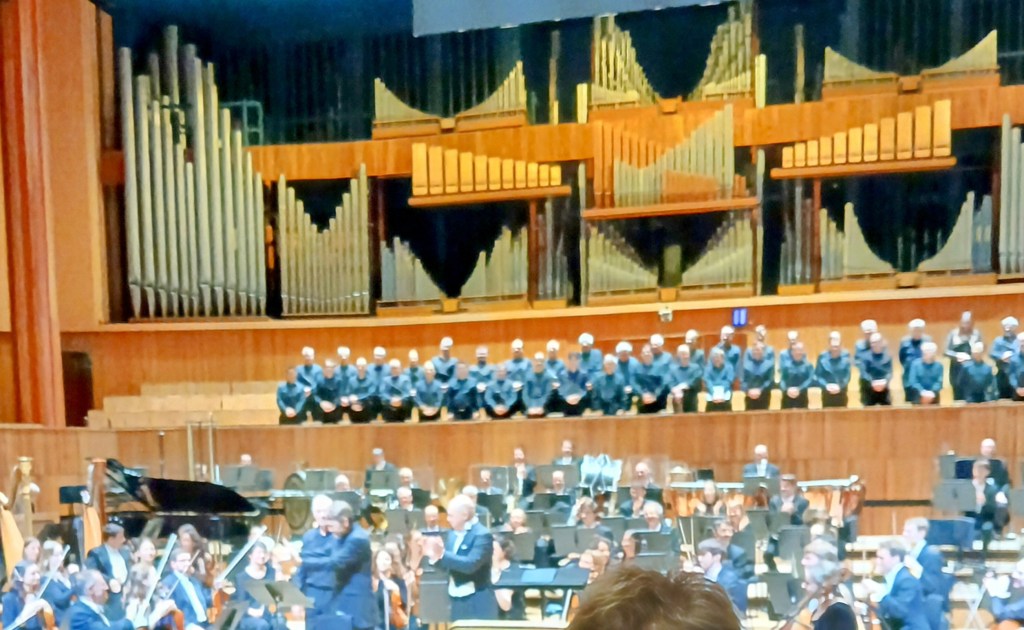
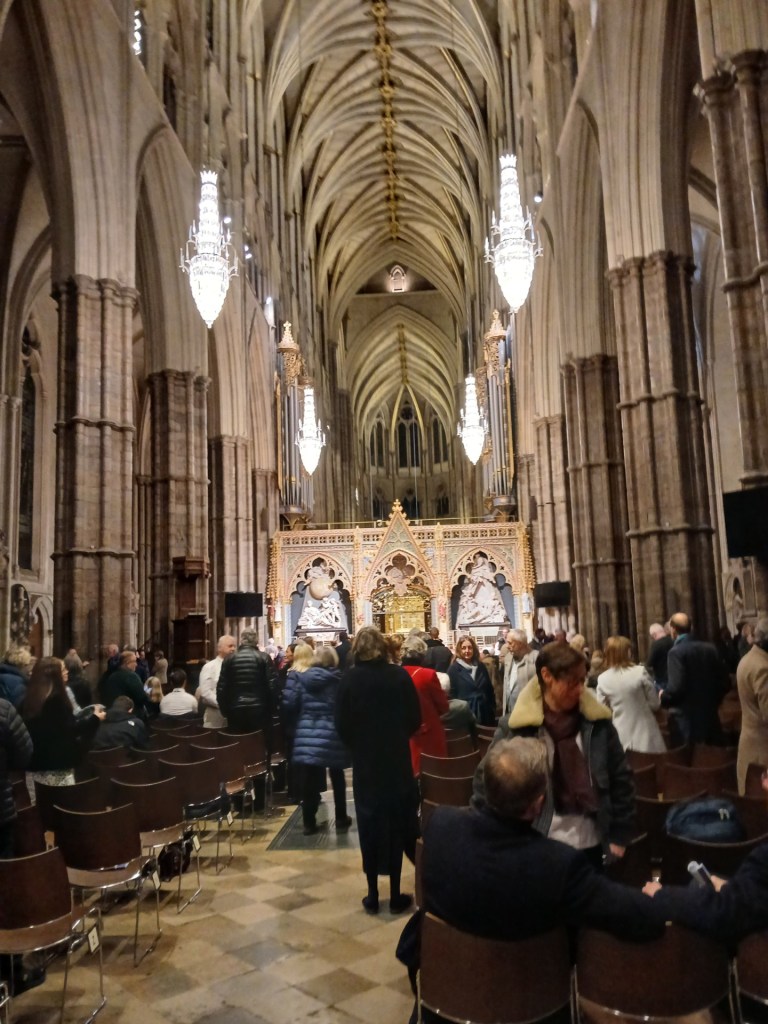
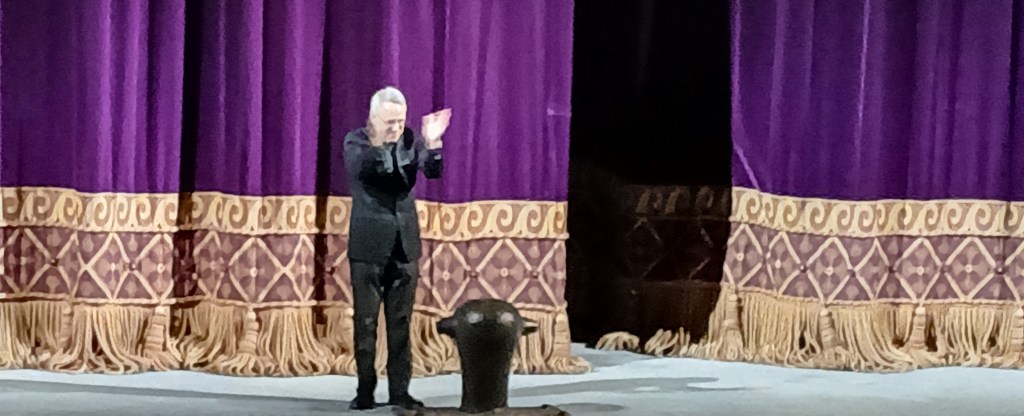
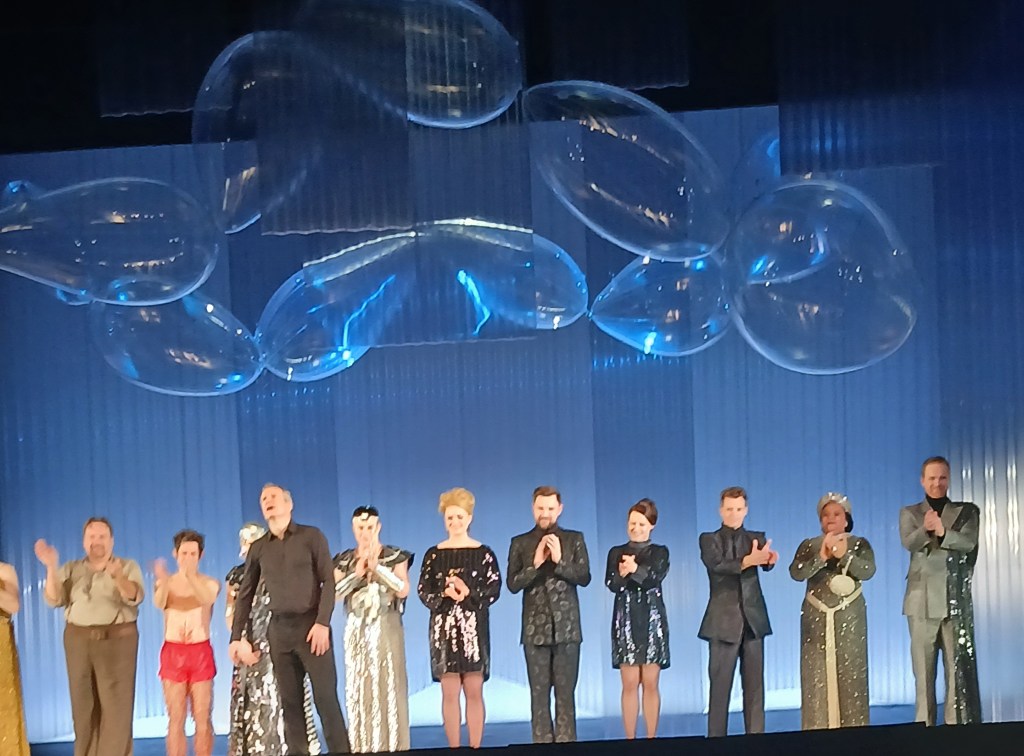
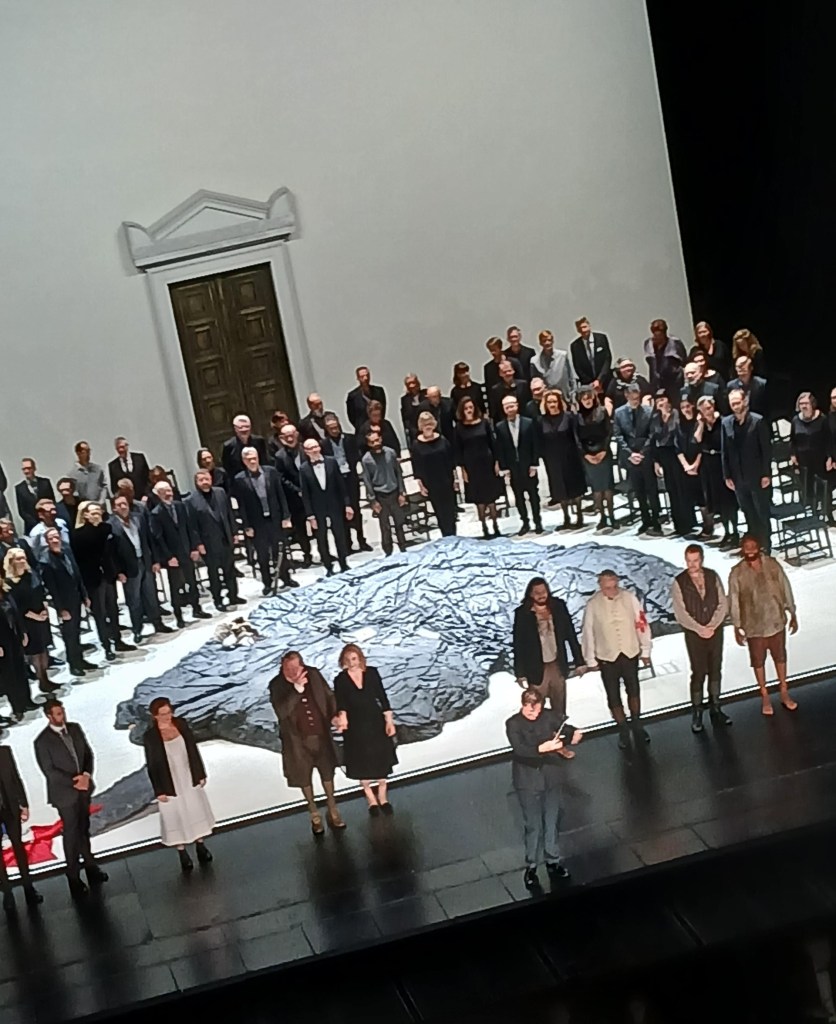
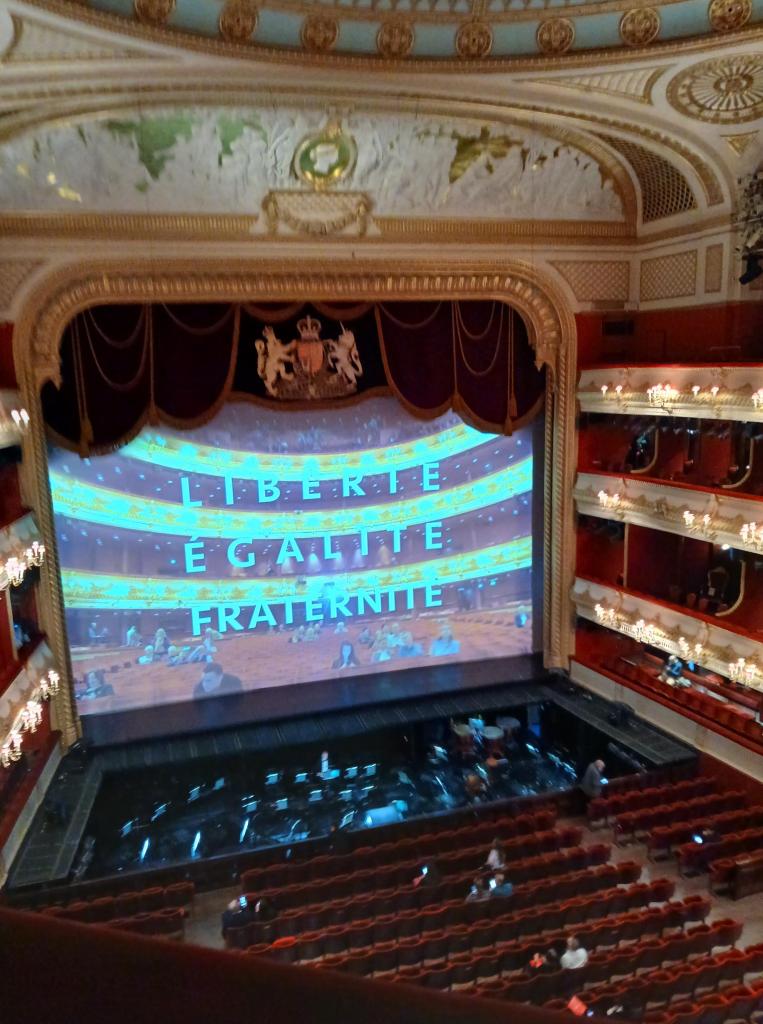
Britten, The Turn of the Screw. ENO London Coliseum, 11/10/24  

Director and Designer – Isabella Bywater; Lighting Designer – Paul Anderson; Ailish Tynan, Governess;  Miss Jessel, Eleanor Dennis; Peter Quint, Robert Murray. Holly Hylton, Flora; Nicolai Flutter, Miles;  Alan Oke, Prologue;  Gweneth Ann Rand, Mrs Grose. Conductor, Duncan Ward.

I have only seen one live performance of this work – a production for the Buxton Festival a while ago…12-13 years?  My memory of that is pretty misty now, though it was a gripping performance, I think.  I have a 2007 recording of a Glyndebourne production conducted by Ed Gardner.

I was very keen to see/hear this and how it worked on a big stage and large auditorium (though I was sitting in the front row of the stalls). Only the night before I went down to London for the show did I realise this was a new production – I had assumed it was a revival – and that I was attending the first night.

One of the arguments which ENO put forward two years ago to counter the Arts Council’s attack on their funding was the success they were having with attracting new, younger, audiences. It didn’t wash with ACE but I found at this performance it was still undeniably true – a completely different much younger audience for the most part to ROHCG’ ‘s and full of enthusiasm. But with the encouragement of that (precious) younger audience, there does come a responsibility – to make sure that what happens on stage is accessible and engaging so that people come back for more. There is good explanatory material on the ENO website, certainly – but not everyone will read it. As I got on the Tube afterwards at Leicester Square, I found myself sitting opposite two young women, who, I realised after a minute or two, had also been at the performance and were now desperately Googling to find out what it had all been about – ‘oh, so that’s who he was ‘, ‘ah, that’s what happened.’ They had clearly been baffled by the experience, and, as I got off the train at Russell Square, I said to them – ‘Don’t worry, I was as puzzled as you were by this production.’ They probably just thought I was being creepy, but that is what I did feel.

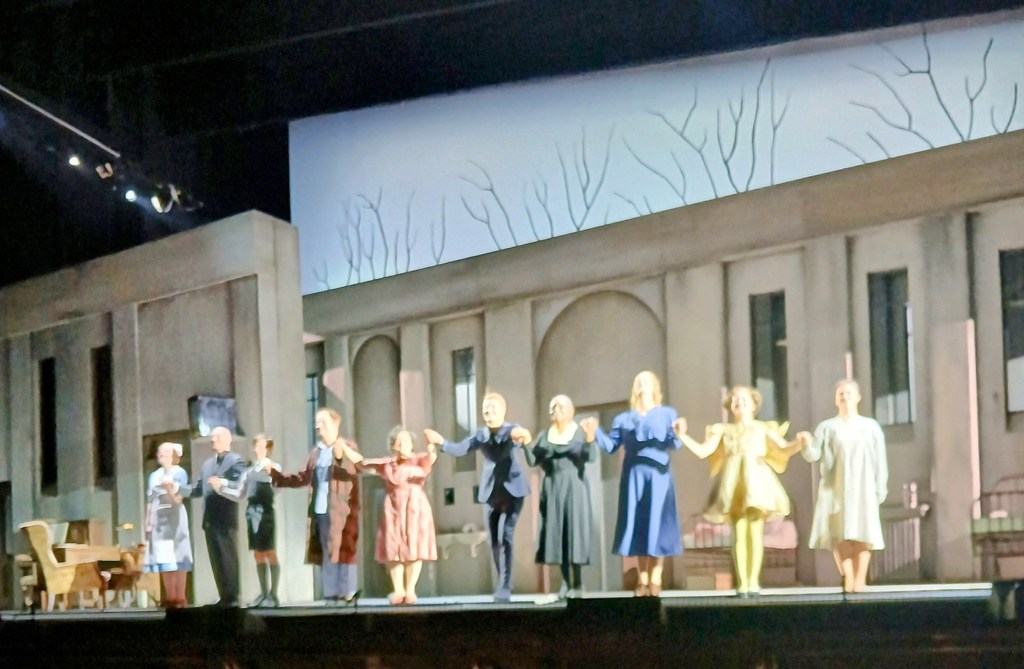
Maybe I should have bought a programme…. the director’s concept might have been clearer from that. I shall look forward to the reviews with interest to see what they make of it. The setting seemed to be a sanatorium, maybe a psychiatric hospital. The costumes looked 1920’s (I wondered briefly whether Quint and Mrs Jessell were meant to be Mr and Mrs Britten – this being the period of Britten’s childhood) but curiously there was a monitoring screen on the wall which looked 1960’s (thus maybe – the Prologue implies this – there is a gap of time between the events at Bly and the present) . The Prologue was narrated by someone coming in to the front desk of the hospital, maybe searching for an inmate. The ‘train’ narration by the Governess was given while kneeling on her bed and maybe therefore either she was mad when she went to Bly or has become so through her experiences there. Nurses in 1960’s uniform and maybe one or two patients drift across the set at points. There’s much use of video to suggest the park, grounds and interior of Bly which may also suggest the Governess is reflecting on the past. I wondered from some of their positions and costume whether Quint and Mrs Jessel were ‘really’ a doctor and nurse at the hospital who had been drawn into the Governess’ dreams/delusions/memories. But then Quint in the last scene is wearing a dressing gown as he attempts to wrest Miles away from the Governess…. Quint behaves controllingly and violently towards Miss Jessel in Act 2 – what time does that refer to? And are Miles and Flora just part of the past in this production or do they have any sort of reality in the hospital- likewise Mrs Grose? It was all, frankly, a bit of a muddle. Of course, in a more ‘traditional’ production, there would also be ambiguity about who Quint and Mrs Jessel are, but, overall, I felt this audience, at this time in ENO’s long history, would have been better served by a production which simply told the story well and left the work to be interpreted by the audience – it is one of those works which doesn’t benefit from a heavy directorial hand.

The scenery was the same throughout – two flats, one moveable, representing walls of the country house which shifted cleverly to different parts of the stage, and some furniture – two beds, a desk, a lampshade, and armchairs. Above the walls, but never fully revealed, are stark bare branches sticking up into the sky, maybe representing the sterility of the Governess’ incarceration – by contrast the (I think entirely) black and white videos are full of luxuriant foliage and beautiful interiors, again feeling like remembered images. I thought this was all very effective – and the sets, as you can see from the photo below, also have the effect of cutting off the back of this large stage and making it easier for the singers to project into the audience.

Within the constraints of this rather confusing production, there were some very effective portrayals by the singers. I haven’t come across Ailish Tynan before, though I’ve heard her name, and I thought she was very good indeed – she has a most beautiful voice in her upper register and was very effective in conveying the nervousness, the affection, the horror felt by her character. Her diction was clear. Miles and Flora were remarkably well sung and acted in what are very difficult roles for young people – Miles had just the right degree of stiffness without simply looking worried at being on stage (he needs to synchronise his piano playing a bit better though….) Robert Murray as Quint had the right degree of menace and his opening call to Miles was beautifully haunting. Mrs Grose was similarly very well sung by Gweneth Ann Rand. The small orchestra (I think there are 13 players) did all that was required of them, and Duncan Ward ensured they never drowned the singers.

There was much cheering and warm applause at the end, which I think was as much about general ENO supporting as anything else. I was pleased to see this production, and would love to see another more straightforward presentation of this deeply unsettling work, which, in these times much more than maybe at its first performances, does more than hint at sexual abuse, and deeply controlling behaviour, showing a glimpse of the worst of what human beings can be. Quint is of the same stock as Claggart, the baying crowd in Peter Grimes and the sinister, shadowy figures of Death in Venice pursuing Aschenbach – maybe also Oberon

Welsh National Opera – Puccini, Il Trittico: Cardiff 3/10/24

Cast: Dario Solari, Michele/Gianni Schicchi; Natalya Romaniw – Giorgetta | Sister Angelica; Haegee Lee – Young Lover | Sister Genovieffa | Lauretta;  Trystan Llŷr Griffiths – Young Lover | Rinuccio; Anne Mason – The Princess | Zita; Sioned Gwen Davies – The Abbess & La Ciesca; Mark Le BrocqIl –  Tinca | Gherardo; Wojtek GierlachIl – Talpa | Simone; Yvonne Howard – La Frugola | The Infirmary Sister; Andrés Presno Luigi;  Linda Richardson Nella; James Cleverton Marco; Benjamin Bevan Betto di Signa; Osian Wyn Bowen Song Seller; Fiona Harrison-Wolfe,  Midinette. Alexander Joel, Conductor; David McVicar, Director; Greg Eldridge. Associate and Revival Director; Charles Edwards, Set Designer; Hannah Clark, Costume Designer. Ben Pickersgill, Lighting Design

Apart from ’O mio babbino caro’ I have never heard a note of this music before, let alone ever seen the trilogy live in the theatre. This was a unique chance – I am sure I will never get the opportunity to see it again. So I very willingly set off on the four and a half hour journey from home to Cardiff by train. I guess a few years ago the staged performances of the three works would probably also have been on tour to the more accessible Birmingham or Oxford venues as well – but not since the Arts Council’s cut to WNO’s touring budget in England………….

The last time I was in Cardiff was also for an opera – 45 years ago, Reggie Goodall conducting Tristan with WNO to wild applause. The Cardiff Donald Gordon Theatre, part of the Welsh Millenium Centre and the WNO’s home now, is a magnificent theatre, seating 1900 and with excellent acoustics. Sadly, the embattled WNO, with funding cuts from both Welsh and English Arts Councils, did not have a full house for this performance – maybe 50% full. The orchestral players were wearing T shirts protesting against cuts and a walk out by the chorus had only narrowly been avoided the previous week. Nevertheless, the audience was noisily enthusiastic, particularly for the orchestra, and from the conversations I could hear around me some had travelled quite a distance to be there – Bristol, Bournemouth, and Reading.

I was reflecting during the evening that it is an extraordinary achievement for Puccini and his librettists  to have constructed 3 very different music dramas – each no more than an hour, each with a very different musical world, and each with its own special mood (from dark and gloomy to saccharine and sumptuous to vivacious). It’s a long evening, though – four hours with intervals – but I was never bored (except during the intervals, which were too long). There’s a curious link between the three very different plots – the death of a lover/son/family member – but there’s little that could be said to be musically connecting the pieces. The orchestration is wonderful – I could as easily just sit and listen to the orchestra in the pit as watch the stage and see the singers; this was Puccini’s last work before Turandot, and the colours of his three scores are remarkable.

The sets for the three were all different but straightforward and realistic – a Parisian canal, a convent and a sitting room. The photos below offer a reasonable view of them. For the first two works costumes were vaguely contemporary with the pieces’ genesis – 1910s – or maybe a bit later., 1920’s. For some unclear reason, Gianni Schicchi was set in the early 1970’s but this wasn’t a huge distraction. All three were extraordinarily detailed in terms of props – the convent had a faded black and white photo of a long-forgotten pope or cardinal for instance and felt exactly like the convent I used to live in (that story is for another time), while the Gianni Schicchi props included splendid 70’s lampshades, handbags, dresses and antique TV. McVicar’s (and the revival director’s) handling of people on stage was deft at all times, fully in line with the needs of verismo, and memorable.

Il Tabarro is the darkest of the three works – in what happens, in the music (generally slow moving but the work suddenly combusts at points with suppressed desire) and in how the set looked – a dark barge, a dimly-lit building nearby and a half-bridge. Natalya Romaniw was superb. She has a full warm voice, and an attractive stage presence – she knows how to handle herself on stage, and she got a great round of applause as a local girl-made-good from the audience.. Michele was sung by Dario Solari who was most impressive – a big sonorous dark baritone, and again good on stage. Luigi was maybe a little underpowered. Smaller parts were well taken with artists of the status of Mark Le Brocq performing.

Suor Angelica is probably the biggest hitter of the three. To say it’s ‘saccharine’ doesn’t quite do it full justice as a story  – mawkish, maybe? – but it is undoubtedly compelling, particularly from the arrival of the Aunt onwards, where the music opens up and becomes enthrallingly luscious. You know you shouldn’t….but really, best just to sit back and wallow in an enveloping flow of gorgeous music; the last 20 minutes or so are like an Italian Liebestod . Natalya Romaniw was again very impressive, giving it her all, with Senza Mamma being particularly fine.  On one occasion she didn’t quite handle a soft high note in the way I think she wanted to but her performance otherwise was stylish, moving and lovely – as well as grand in the final moments. There was a rare mis-step, I thought, from McVicar in the closing part of the final scene – the entrance of the small boy at the end (Angelica’s dead son) was somewhat flat and matter-of-fact. He should have come in clouds of glory and bright lights as the angelic chorus got going……..(as in a YouTube video of a Met production I looked at the following evening at home).

Gianni Schicchi was hugely enjoyable – great company ensemble working (including many of the WNO Chorus, with small parts), very funny and brilliantly thought through by McVicar. Again Dario Solari was very impressive – a big presence and a big voice, who was able to fool around in the scene where he is impersonating the dead Buoso.

Throughout the entire evening, the WNO orchestra played beautifully.

I was very glad I had seen this.

Halle Orchestra, Wong – Britten and Mahler: Bridgewater Hall, 26/9/24

Britten The Prince of the Pagodas: Suite arranged by Colin Matthews and Kahchun Wong; Mahler Symphony No 1 ‘Titan’; Kahchun Wong conductor, Halle Orchestra

Kahchun Wong is Singaporean, aged 38 and has been chief conductor of the Nuremberg Symphony Orchestra, the Japan Philharmonic, and now the Halle, as well as being principal guest conductor of the Dresden Philharmonic. He won the Gustav Mahler conducting competition in 2016. So, a young man, making his way in the world….. This was his debut as chief conductor with the Halle. There was scurrilous blogging, possibly from trolls, last year on the ‘Slipped Disc’ blog, when the 5-year appointment was announced – was the Halle panicking, with no replacement for Mark Elder in sight, and with Wong chosen after just one concert? He has only conducted a couple of concerts with the Halle since in the UK (though he has been on tour with them to Spain and has made a recording of the complete Britten ballet). So – this was in many ways a very important concert both for him and the Halle. The Lord Mayor of Manchester and various metropolitan mayors plus key sponsors were in attendance. This concert lived up to expectations!  

Kahchun Wong was interviewed before the concert and came over as modest, thoughtful, and knowledgeable. He spoke mainly about the Britten piece and his work with Colin Matthews to create a suite from the two-hour ballet. He had spent time at the Red House last year studying the original score, he said and he marvelled at the fluency of Britten’s invention – very few crossings out on the original score.

Mr Wong does not have a manic podium presence nor is he a deft stick wielder, particularly. He is in fact quite a calming figure before the orchestra, cueing in instruments clearly, with a precise beat. What he does seem to radiate is a lot of self-confidence and he clearly has the respect of the players. At the same time, he knows how to generate considerable excitement and energy within the orchestra at key moments – particularly in the Mahler – without excessive gestures, but by stretching out his arms, occasionally crouching for climaxes, and all with animation, smiles, and enthusiasm. I was pleased to see he’s maintained the split violins arrangement Sir Mark Elder had requested for the orchestra.

The Britten piece had some Mahlerian aspects -the fanfare for instance -and it is scored for a similarly sized orchestra to Mahler 1. It is also fascinating to note the gamelan-like sounds prefiguring the dances in Death on Venice. I don’t know the piece well, though I have the Knussen recording of the full ballet, but it seemed to me the orchestra played with energy and precision – some noticeably good oboe playing… . The Britten piece is fascinating to listen to but like all such suites – e.g. the Firebird – there are too many grand moments from all the goodies in too short a space of time – 30 minutes – so that it feels too rich and sweet, too much of a good thing sometimes, and with too many climaxes.

I’ve seen/heard many performances of Mahler 1 over the 58 years or so since I bought my Solti/LSO recording of the work in 1968. In recent times I have heard fine performances by Rattle/Berliners at the Proms in about 2010, and Pappano/Sta Cecilia Rome orchestra in 2018. I heard a performance I much disliked by Daniel Gatti in Leipzig last year. This performance by the Halle was exceptionally worthwhile, for the following reasons:

  • The balance between blocks of instruments was very well handled so that the sound was always clear. This was particularly the case in the first movement, where I have hardly ever heard so much of the woodwind detail
  • The structuring of the piece was well done – suppleness in the playing of phrases to allow each part of each movement to seem alive. Climatic moments were clear. The first statement of the triumphal ending tunes half way through the movement was quite clearly held back to emphasise the final triumph
  • Tempi were always well chosen, to allow savouring of the music but without becoming self-indulgent. The first three movements in fact were all slightly on the slow side, but this allowed for some expressive phrasing and a lilt to the folky elements
  • Some outstanding string playing – the cellos and basses digging in deeply at the beginning of the scherzo, and the violins sounding glorious in the finale’s big tune

Unlike the Gatti performance, nothing sounded manufactured. The music flowed inexorably and movingly. At the end, the Halle audience gave the performance a standing ovation – I’ve only ever seen that for Mark Elder before in Manchester, so that was a very good and absolutely justified sign of audience support for the new regime

Mahler in Prague

Tchaikovsky, Eugene Onegin. Dress Rehearsal, ROHCG; 20/9/24

Director, Ted Huffman; Set Designer, Hyemi Shin; Costume Designer, Astrid Klein; Lighting Designer, D. M. Wood. Conductor, Henrik Nánási. Eugene Onegin, Gordon Bintner; Tatyana, Kristina Mkhitaryan; Lensky, Liparit Avetisyan; Olga, Avery Amereau; Prince Gremin, Dmitry Belosselskiy (replaced by Brindley Sherrat); Madame Larina, Alison Kettlewell; Filipyevna, Rhonda Browne; Monsieur Triquet, Christophe Mortagne

In 1969 I went on a school trip to Russia and encountered the Soviet Union in all its ….well, remarkable presence. The Young Communists’ greeting party in Moscow, trips to Odessa, Yalta, Minsk, Kiev and Leningrad, a visit to the ballet…..the works…..I remember drinking in an Odessa bar with young Russians, my fellow school boys using German to talk to them (the Russians had served in East Germany). One of the things I took back with me from the trip, bought in a hard currency shop (and I’ve still got it in our sitting room) is a Melodiya recording of Eugene Onegin, my first encounter with the work. It has Vishnevskaya as Tatyana, and I played the harsh recording a lot, giving me a real understanding of the whiny Russian horns, the harsh trumpets and trombones, and the nasal oboe that were standard at the time in Russian orchestras.

I have only seen Onegin in two productions live on stage – I heard the work live first at Covent Garden in the Peter Hall production with Ileana Cotrubas and the Canadian singer Victor Braun, in the early 70’s, conducted, I think, by Solti, and then a fine performance in Vienna in 2015 with Netrebko, no less, as Tatyana, and Christopher Maltman as Onegin. I knew nothing about the work of the director of this new production at ROHCG (and indeed the same is true of most of the cast), but remembered with pleasure seeing the Stefan Herheim take on the Queen of Spades, brilliantly conducted by Pappano at ROHCG in 2019 on screen. So I hoped for something thought-provoking and intelligent, well-sung and played.

The production met or exceeded my expectations. Eugene Onegin is one of those operas which directors take liberties with at their peril – though you might have said the same of the Queen of Spades and look what Herheim made of that……. No doubt thinking of the requisite production longevity in an age of austerity, ROGCG managers, I am sure, breathed a sigh of relief when they saw what Ted Huffman and his team proposed to do with the opera, and they must have become positively enthusiastic when they realised that there were basically no sets – none of the court ballroom/country house sets and Pushkin-era props, but simply a blank open lightish floor and dark surrounds, as attached in the photo below. There was a raised long bench at the back which could act as a banqueting table or a low wall, and that, apart from some chairs and small tables, was that – some rather weird space age candelabras came down for the last scene, I should add, and M. Triquet had some balloons and balls for the party. Occasionally lights played on the backdrop, creating a an effect of clouds or mist.  The entire cast was clothed in what amounted to modern dress, apart from arguably the nanny. There were one or two slight production oddities – a ginger haired woman who helped Tatyana write her letter but who certainly wasn’t Olga; and someone who might have been M. Tricquet wandered round the stage in the second half to no particular point

 But essentially this was a very moving straightforward reading which I thought was excellent. The dark back and sides emphasised the claustrophobia of Tatyana’s country house, the night of letter writing and the darkness of the morning of the snowy duel (and there was snow…..). The direction team let the story unfold naturally, with the first scene’s Chekhov resemblances emphasised. A particular virtue of the production was the way chorus and dancers were handled – dancers and singers blended well, and there were some impressive stage pictures – eg the whirl of people in the country ball.

There are four problems to my mind about Eugene Onegin as a work, which this performance overcame to the extent any could. One is the awkward uneven length of the 7 scenes – you end up with a long first half or a long second, or two intervals – this production opted for the former (1,35 hours and 50 mins). The second is the irredeemably horrid nature of Onegin, who generates no sympathy whatsoever….. Gordon Bintner made the best possible case for this character Thirdly, things can seem to go a bit flat after the duel. It didn’t here because of the quality of singing by Onegin and Tatyana but was also due to the appearance of Brindley Sherratt (a sudden step-in from holiday for an ill Dmitry Belosselskiy) who sang his Gremin aria magnificently, with huge and convincing presence. The final problem, which Tchaikovsky himself recognised, is the episodic nature of the work, moving forward quickly with various different settings and times. I felt gripped throughout, though, by the quality of acting, singing and conducting.

Bintner, an up-and-coming Canadian had a beautiful burnished voice (though was he singing under the note at one or points?), big stage presence, good looking and effective actor. The opera is made or lost by the Tatyana, and  Kristina Mkhitaryan was very impressive indeed.  She’s a very commanding actor, she looks convincingly like a young woman, she has a powerful voice when needed, no Slavic wobble, and can sing most beautifully sotto voce. She was utterly convincing, and particularly outstanding in the last scene, in the dignity of her response to Onegin. Liparit Avetisyan as Lensky flung himself into the role as though it were Puccini and sang generously and well. I thought, of the rest of the cast, Alison Kettlewell as Mme Larina, and Filipyevna played by Rhonda Browne were particularly effective. I didn’t form a very positive view of Henrik Nanasi when he conducted the Flying Dutchman earlier in the year but the orchestra played magnificently for him today, all the climaxes well judged, strings warm and glowing and woodwind agile and plaintive. He kept things moving, which helps with tackling the episodic issue. The augmented chorus sounded very fine indeed, with an authentically Slavonic tinge.

 The heart of the work is the Letter Scene and if that doesn’t impact upon and move you, the performance is lost. I thought it was wonderfully – really, very movingly – sung and took me back to my 17 year old self listening to the Melodiya recording for the first time, terribly touched by it, and remembering all the things I’d seen in that Soviet Union visit.

Mozart, Marriage of Figaro: Live screening from ROHCG at Sheffield Odeon. 10/9/24

Director, David McVicar; Designer, Tanya Mccallin; Lighting Designer, Paule Constable; Figaro, Luca Micheletti; Susanna, Siobhan Stagg (replacing Ying Fang); Count Almaviva, Huw Montague Rendall; Countess Almaviva, Maria Bengtsson; Cherubino, Ginger Costa-Jackson; Bartolo, Peter Kálmán; Marcellina, Rebecca Evans; Don Basilio, Adrian Thompson; Antonio, Jeremy White; Don Curzio, Alasdair Elliott; Barbarina, Isabela Díaz. Conductor, Julia Jones

I saw this production live last year but of course seeing an opera on screen is a very different experience and, besides, the main cast members and the conductor were all different. I remember grumbling a year ago about the Regency setting, the over-monumental sets, and the lack of young UK singers. I won’t go over these again.

It must be very tough for singers, probably 99% of whom spend their time wholly with live audiences in the theatre, to have both to project to a large audience like ROHCG’s and on a large stage, and at the same time be filmed in close-up scrutiny, where every wandering eye or mistimed gesture can be a serious blemish on the whole show. It was a notable feature of this performance that all the singers, without exception, were comfortable and credible in both these dimensions (obviously I couldn’t judge myself how effectively the performance in the theatre went down, but there was certainly evidence of considerable audience enthusiasm during the performance and at curtain calls). The link between these two dimensions must be David McVicar, who the screening showed in rehearsal (impressive that he was doing it despite its being the show’s umpteenth revival) – he clearly works at great depth with these singing actors so that they are not only totally clear about they are thinking and feeling and doing, but know equally well what is happening to and inside the minds of. the other characters they are performing with. Very good personen-regie, in other words.

The three clear stand-out acting stars were Cherubino, the Count and Figaro. In acting terms, I have never seen a more convincing Cherubino than Ginger Costa-Jackson, who was the embodiment of an impetuous, pouting, wayward, awkward, annoying adolescent boy, and had the figure and the face for added credibility. The Count was a master of quizzical twitching eyebrows, stormy expressions, self-righteous indignation, and barely-tethered violence. Figaro was good at sardonic facial expressions, a sneering subtlety of manner towards the Count which was very effective. Ying Fang, the scheduled Susanna, was unfortunately ill for this performance so we heard instead the Susanna of the previous revival, Siobhan Stagg, who must have been panicking at points as to what exactly to do, but came over very well – calm, resourceful, very effective in her crossness with Figaro in Act 4. The Countess was maybe less of an effective presence on stage – she always seemed a little on edge (as well she might be – both in character and being filmed) and distracted. The smaller roles were all well acted – particularly Bartolo and Marcellina.

In terms of singing, this involved more decoration in arias than I have heard in other performances (eg in ‘Voi che sapete’), particularly by Figaro, Cherubino and the Count. The vocal honours went above all to Figaro and the Count, I thought. MichelettI, despite being apologised for as being under the weather, has a most beautiful dark voice, which was flexible and powerful. I would love to hear him as Don Giovanni. Rendall too has a voice clearly destined for great things – sonorous and commanding. Stagg, who must be on stage most of the time, was fresh-voiced till the end, and always with a warmth and generosity of tone. Having heard two months ago Tony Pappano coaching a singer through Susanna’s Act 4 aria ‘Deh, vieni, non tardar’, it was fascinating to see how much Stagg was instinctively using some of the actions and singing styles Pappano was recommending. Bengtsson and Costa-Jackson did not elide memories of many illustrious predecessors in these roles, but were never less than good to acceptable.  

Julia Jones is a British conductor who has come up through the German tradition of regional opera houses. I was expecting a fast and insensitive performance after reading some of the reviews of this revival, but, in fact, the orchestra played extremely well, and I wasn’t for the most part aware of speed as an issue. It was a crisp reading but slowed down when it needed to and the reconciliations of Figaro/Susanna and Count/Countess were both beautifully done. I do agree with one reviewer though that Dove Sono was taken at too fast a pace.  We were told in the screening that a fortepiano was being used for the recitatives – I realised I wasn’t sure whether that was now the norm or not……….

BBC Proms: Prom 62: Bavarian Radio Symphony Orchestra. Rattle, RAH, 6/9/24

Mahler, Symphony No. 6 in A minor. Bavarian Radio Symphony Orchestra, Sir Simon Rattle, conductor

A bit like my wish to step away from live Bruckner performances for a while, I resolved on the same course of action with Mahler after the Leipzig Mahler Festival last year, which ended, as it happens, with a very fine performance of Mahler 6 by Bychkov and the Czech Phil. However, I couldn’t resist this concert, and there’s the new Halle music director performing Nos 1 and 2 next season, and then Ed Gardner and the LPO doing Mahler 8 in Spring 2025…….. Anyway, definitely after Spring 2025, no more Mahler for a few years, with the possible exception of Das Lied von der Erde, which I have heard very little of live in recent years.

I was sitting in Choir East Row 1 two seats from the side stalls, an excellent position to hear the strings pretty full-on, and not be too blasted by the brass – though I was about 6 feet away from the hammer!  This wasn’t a generous concert offering, time-wise – when this team performed Mahler 6 in Berlin 3 nights earlier, they added a 30-minute first half of interesting pieces by Hindemith and Zemlinsky. But of course this work is often performed on its own nowadays (I remember Haitink offering a Mozart piano concerto beforehand in the 70’s………..). However Rattle did opt for the first movement repeat….Looking at the programme notes beforehand I saw with disappointment that Rattle chose to place the Andante before the Scherzo. I know all the historical arguments but still, emotionally, the heartache of the Andante surely should come only just before the tragic finale. However for once in this performance it didn’t seem to matter so much listening in the moment. Given that the andante first theme is a slowed down version of the Scherzo’s first theme, the relationship is close whichever way round they’re played, I began to feel.

I thought this was an outstanding performance, one of the best I have ever heard of this work. It wasn’t subtle; there were no beauty for beauty’s sake moments; it was passionate and raw, and intense. Putting the scherzo before the finale seemed simply to pile on the agony. There was quite a lot of flexibility in Rattle’s tempi, slowing down and speeding up, particularly in the first movement. I don’t know if that flexibility is sanctioned by the score but it seemed to work in this context – it was part of a passionate reading which of its essence needed to vary the pace. There were many memorable moments – the stillness of the mountain top, and the brief whispered chorale between the first and second subjects in the first movement, and the reprise of the Alma theme at its end; the climax of the slow movement; the piling on of more and more pressure in the finale, particularly after the hammer blows (no third one)., and the extraordinary climax just before the final (non) hammer blow where 4 sets of cymbals are crashed (something I’ve never noticed before). I don’t think I have ever heard an Albert Hall Prom audience more quiet and still throughout a long performance (though somebody behind me kicked my seat in fright or passion at the sound of the first hammer blow!). The ending was numbing but also cathartic, in the manner of tragedy.

The orchestral playing was quite something – surging, sweeping strings, utterly together and full and rich in sound; stunning horn, oboe, and trumpet solos, and the huge brass section (I counted 5 trumpets and I think the same number of trombones, as well as 8 horns) was outstanding in its depth and richness. I think it is remarkable that an orchestra can play with this degree of excellence and precision but at the same time convey such passion, agony, terror and anger.

This performance also gave me a sense of how remarkable this music is – I heard just over 10 days ago, a notable composer, Josef Suk, from Mahler’s period, original, thoughtful and engaging. But Mahler’s sound world is something completely different – where do these sounds come from, the screaming trumpets, the shrieking clarinets, the remarkable use of percussion? Wagner is really a very, very distant antecedent. You can plot a fairly straight path from Schubert to Bruckner, but Mahler almost seems to come from nowhere in this symphony’s sound world (apart from a few moments that echo Bruckner, whom he of course knew), and possibly Liszt. I think sometimes in my familiarity with these works over so many years I forget just how individual and strange this music is, and I am grateful to Rattle and the Bavarians for reminding me of its uniqueness and oddity.

After the Bruckner 4 the previous evening, I felt that maybe I was getting a little jaded about these great late Romantic works which I have known for getting on for nearly 60 years. But this Mahler 6 utterly engaged and moved me

BBC Proms: Prom 61: Bavarian Radio Symphony Orchestra, Rattle, RAH, – 5/9/24

Thomas Adès, Aquifer; Bruckner, Symphony No. 4 in E flat major, ‘Romantic’. Bavarian Radio Symphony Orchestra, Sir Simon Rattle, conductor

After 4 days I am still walking around with themes from Bruckner 5 in my ears after the magnificent Berlin performance, so it is a bit of an adjustment to suddenly move to Bruckner 4. Although really no-one can grumble (but I am), it is a pity that the BBC haven’t prompted the BRSO and Rattle to bring something a little less frequently heard than this symphony to the Proms – what about reprising the performances Rattle led with the BPO  12 years ago of the completed 9th Symphony (if it has to be Bruckner for the anniversary) – or the lesser known Symphonies nos 3 or 6? The BPO performed Bruckner 4 in 2022 at the Proms, and in addition Rattle conducted the work three years ago also with the LSO at the Barbican.  But I suppose these super-orchestras do what they do, and most likely are touring the same programme around Salzburg, Lucerne etc – so you get what the others get. Still, at least we had Ades as well……It’s a tough life being in a super-orchestra., though. I see that the BRSO and Rattle were performing Mahler 6 at the Berlin Musikfest on 3/9. Two nights later they’re in London.

Having got my grumbles off my chest, it was fascinating to hear the BRSO so soon after their cousins from Berlin, although inevitably coloured by the fact that i was in the Side Stalls for the Berlin Phil but in the low Choir for the BRSO. I’ve heard the BRSO band only three times before – a couple of Proms in 2019 under Yannick Nezet Seguin, and at the Leipzig Mahler Festival in 2023 when they played Mahler 7 (marvellously) under Daniel Harding. I was struck this evening by the beauty of the string tone, particularly the violas in the Bruckner. Their woodwind is of course excellent without quite the individuality of the BPO; horns are much in the same mode. (The woodwind were superb in their off-the-beat contributions in the Scherzo). Trumpets and trombones from where I was sitting were very resonantly together, perhaps smoother sounding than the BPO (with very similar resources – 3 trumpets, 3 trombones). There were a few orchestral blips with the BRSO which I don’t recall from the two BPO performances.

The Ades piece despite its name was no Vltava, but a dense piece for huge orchestra lasting 16 minutes and utilising the Mahler orchestral resources needed for the following evening. It had an ebb and flow to it, surging forwards and withdrawing, a vast landscape moving sometimes slowly, sometimes more like the Rite of Spring, including a very beautiful quiet passage for the woodwind. As ever with Ades, it was approachable and enveloping, quite Mahlerian in sound. It was commissioned by the BRSO for Rattle’s first season with them, and appropriately ends with a large rattle being whirled around by one of the harpists. It requires more time for me to understand its main themes and structure than one listening can provide. I shall listen to it again on BBC Sounds next week. Afterwards Rattle presented Ades with the Royal Philharmonic medal, which was notably ungracefully received – ‘ thank you’; ‘would you mind amplifying your speech a bit?’; ‘well, again, thank you’. Ades sounded a bit put out by the whole occasion…..

I facetiously described the Bruckner performance afterwards to a friend as ‘bright-eyed and bushy-tailed’ – a faultless extrovert rendition, which was fine, very similar to the LSO one 3 years ago, with quite fast speeds, but allowing time for warmth and affection. Predictably the Scherzo and Finale came off best. What was encouraging about this performance, I felt, was that with his new orchestra Rattle had not reverted to pulling around the score or making the music episodic because of a focus on beauty of sound, which was often in my experience a feature of his BPO performances. I thought that the first movement really didn’t follow Bruckner’s overall request to be ‘nicht zu schnell’ as well as ‘Bewegt’ – with motion. The tremolo strings at the beginning were nothing like as whispered as the sounds the BPO produce for the opening of the 5th and the first climax sounded rushed. To my mind, the faster a performance of Bruckner goes, the more one is aware of the repetitions, the slower the more opportunity there is for variation within the repetitions. Problematic also to my mind was the fast speed for the climax of the slow movement, and some of the tempi relationships in the finale. Features of the performance included some superb flute-playing, a wonderful first oboe, as I have said already a gloriously rich viola section, superbly growling basses and as you would expect an excellent first horn. The edition used was the Benjamin-Gunnar Cohrs one, which does have a few noticeable variations from the standard Haas/Nowak versions, and I think, a cut towards the end of the finale..

I felt a bit, and I think unfairly, unmoved by this performance, although it was very, very good. I think after this centenary year it’s time I gave Bruckner a break in the concert hall for a few years (though I am going to hear one of the completed Bruckner 9 versions in October conducted by the Halle Orchestra new music director Kachun Wong)

BBC Proms: Prom 56: Berliner Philharmoniker, Kirill Petrenko. RAH, 1/9/24

Bruckner, Motets: Os justi; Locus iste; Christus factus est; Symphony No. 5 in B flat major. BBC Singers, Owain Park, conductor. Berliner Philharmoniker, Kirill Petrenko, conductor

 After the magnificent Bruckner 5 from Thielemann and the Berlin Staatskapelle in Berlin last November, I wondered how I would feel about a very different sort of conductor interpreting this work….On the other hand, the Berlin Philharmonic is always worth listening to……. I was very interested to hear how Petrenko would tackle this piece – I’ve not heard him conduct other Bruckner works, and wouldn’t have thought it was immediately core territory for him, though he is of course a notable conductor of Wagner, Mahler and Strauss. Performances I have heard him conduct emphasise tight, brilliant playing, extreme clarity and pin-point accuracy, none of which sounds like the traditional ‘German’ approach to Bruckner (though Pierre Boulez once recorded a very interesting performance of Bruckner 8 with the VPO, which I’ve got as an MP3 stream). Apparently this is the first Bruckner he has conducted with the Berliners.

First we heard the BBC Singers, though. All three of the Bruckner Motets date from his later years in Vienna.I heard these Bruckner Motets at the Glasshouse Newcastle in March but the experience of hearing vastly fewer performers in the RAH cavern was very different and arguably nearer to Bruckner’s intention. This is not a mass Victorian singalong but something agonised and personal, The BBC Singers were superb, particularly the women, and it was a good idea to set the symphony in the frame of Bruckner’s avowedly religious music.

Oddly the programme booklet said nothing about the version of the symphony we were hearing except that it was the revised 1877-78 one. Though there are only very minor differences there are two versions of the Nowak one and the Benjamin-Gunnar Cohrs edition as well as the Haas one.

This was a hugely impressive performance of the 5th Symphony, and I guess it is a silly game to try and rank different performances of this calibre.  The highlights were:

  • The most coherent account of the Finale I have ever heard, in which all the different elements, often stopping and starting in ways which are difficult to hold in relation to each other, came together magnificently. Somehow the first appearance of the chorale theme was the most impressive I’ve experienced, and in contrast to it the following fugue, like the opening of the finale, sounded distraught, negative, even violent. When the chorale tune returned at the end, together with the first movement’s sweeping first main subject, it seemed to push away all the dross, the stops and starts, the negativity of the last movement, and became a hymn of praise, the Berlin Phil brass magnificent in their unison, carefully graded dynamics and sonority
  • It struck me that this is part of Petrenko’s wider ability for structuring the music so that a story is told, that episodes make sense following on one from another. The first movement in particular was very clearly structured and I never once felt lost within it
  • Petrenko’s ability to obtain remarkable clarity throughout in the orchestral sound was very apparent – enabling the inner voices to come through. This was particularly striking in the third movement with the woodwind, and throughout there were many details I have never heard before – an extraordinary little moment a few bars from the end of the finale with the flutes, for instance. Petrenko does seem to have the same sort of intense focus on detail that Carlos Kleiber is said to have had
  • There was a huge dynamic range throughout the performance – you can see Petrenko controlling this very clearly with his outstretched hands. The whispered opening to the work was quite wonderful
  • The BPO strings in the slow movement’s second themes were just glorious.

This was swifter than some interpretations I’ve heard – I thought about 70 minutes long. The swiftness seemed right in the first and last movements but maybe less so in the Adagio – nb that word. – where, at a very high level of execution indeed, the slow movement’s second theme, while gloriously played, was just slightly too fast. The Schubertian trudging oboe first theme, melancholy and forlorn, needs to be complemented by a real ray of hope and light that’s different enough to be properly contrasting, and to me part of that contrast is that that theme should be paced more slowly than Petrenko took it. It’s important to note that, though there were many moments of exquisite beauty, there was never any feeling of beauty for beauty’s sake, and there was always a clear sense of momentum and structure. Maybe, though, there were less moments of spiritual calm and repose than some interpreters bring to this music; but then again sometimes the clarity of Petrenko’s reading emphasised the neurotic, the disturbed, elements in Bruckner’s music, which is equally part of his sound-world and sometimes lost in more traditional readings.

But what a magnificent band the BPO is. They really do deserve the hype – they are the best – in precision, in ensemble, in the quality of soloists’ phrasing, in the richness of the strings and in the quality of the brass

Abbildung des Bruckner, Anton [1824-1896], Künstlerpostkartea

BBC Proms: Prom 55: Berliner Philharmoniker, Kirill Petrenko. RAH, 31/8/24

Schumann, Piano Concerto in A minor; Smetana, Má vlast. Víkingur Ólafsson, piano;  Berliner Philharmoniker, Kirill Petrenko, conductor

 I have never heard Víkingur Ólafsson play anything other than Bach and Mozart live, so I was looking forward to hearing what he did with the Schumann concerto. And I have never heard the whole of Ma Vlast before, let alone been to a live performance – in fact I only know the first two movements – Vysehrad and Vltava – well, and have, to my certain knowledge, only ever heard Vltava live. I may once have heard ‘From Bohemia’s Woods and Fields’ on Radio 3. ‘Sarka’, ‘Tabor’ and ‘Blanik’ are completely new to me. All this – plus the Berlin Phil and Petrenko – looked to be a very considerable treat as a concert.

Vltava I heard first when I was about 11 when my friend Ian in Hackney shared with me a vinyl EP he had of the work. I remember loving the fast dance bit in the middle of the work. The Schumann piano concerto by the early 80’s seemed to crop up at almost every London concert I went to. I had got very tired of it, and indeed, 40 years or more on, I can’t remember when thereafter I ever went to a live performance.

This was a glorious performance, for a number of reasons:

1, Vikingur Olafsson has the power to make you feel every note he plays is being freshly thought about. There were wonderful examples of this – the opening statement of the main theme on the piano, the dialogue of the piano with woodwind in the development section of the first movement, and the way the piano responded and played with the lower strings in the second theme of the slow movement. His playing also has a special intensity – you have to listen

2. This pianist has a lovely limpidity of tone – very elegant and thoughtful, not emoting and banging away – and the ability to make fine distinctions of volume in phrasing, as well as (of course) superb clarity technically. This was particularly evident in the finale

3. The superb playing of the Berlin Phil woodwind and horns – these were a constant delight, particularly oboe and clarinet in the development section of the first movement

4. The sense of sharp rhythmic impetus Petrenko and the orchestra gave to the music – skipping, biting string sounds particularly in the finale, and the end of the exposition of the first movement. Petrenko seemed a very supportive accompanist, often turning round to check speeds and timing with Olafsson

Olafsson seemed very keen on being at the Proms when he first appeared in 2021, and he spoke tonight of the extraordinary feeling of that concert, so soon after Covid, and the emphasis on community he feels the Proms has. As an encore he played Bach, one of life’s loners – a piece he recorded in his wonderful Bach transcription album, an adagio from an organ sonata BWV 528. The audience went wild

It is of course Smetana’s 200th anniversary this year. It seems in a sense a slightly odd piece of programming to have the Czech Philharmonic in London a few days earlier and not have them play Ma Vlast, and then have the Berlin Philharmonic a few days later with it on their programme – wouldn’t it have been better to give the Asrael Symphony to Petrenko and co (a much more general central-European sound, not specifically Czech)? Anyway………I guess maybe the point is to show Smetana’s universality…….

However, universality is not what it’s about – Ma Vlast is a foundational piece of Czech nationalism and national identity, and very specifically grounded in the landscape and history of Czechia. I found it difficult to relate to at first, as I listened to the whole of Ma Vlast for the first time, and wondered really what its narrative meant for me, a non-Czech listening 150 years after it was written. What I came to feel over the 75 minutes of the performance is that it was better to listen to it just as a piece of pure music, without any tone poem associations, and just enjoy the sheer melodic sweetness and inspiration and rhythmic bounce of much of the music. I was particularly taken by some of the pieces I know less well – Sarkar and From Bohemia’s Woods and Fields, the former having an exciting story about a Boudicca figure in Czech history who declares war on men – with fast moving music that was brilliantly played – and the latter, having more of a pictorial focus, with again exciting and memorable music. Vltava was faster than usual but with a terrific account from the Berlin Phil strings of the eddying flows of the river, and burbling from the woodwind. Tabor is rather heavy-going and tedious, with a repeated 4 note theme depicting Hussites getting very cross which gets on one’s nerves after a time but Blanik revives the good humour and provides an effective ending. There are Wagnerian tinges at times, but a lot of the music is surprisingly unrelated to say Brahms and Schubert. I guess the occasionally heard voice that is present in Ma Vlast is Liszt, without most of his bombast and note-spinning

The playing of the Berlin Phil was quite extraordinary and utterly impeccable – wonderful horn playing from Stefan Dohr, beautiful oboe playing from Jonathan Kelly, but above all it was the brilliance and tightness of the ensemble that impressed – the tripping dance music, the intensity, the tremendous climaxes, and the absolute precision (all of these present for instance in the final few minutes of From Bohemia’s Woods and Fields, and the grandeur and excitement of the last 5 minutes of Blanik). Throughout, Petrenko emphasised the dance element in the music, doing a waltz with himself on stage. But Petrenko is very far from being a podium show-off – his absolute and total commitment to the music, his complete belief in it, was palpable, and his unconditional focus on what the orchestra is doing was evident all through the concert.

BBC Proms: Prom 50 – Czech Philharmonic, Hrusa. RAH, 28/8/24

Vítězslava Kaprálová, Military Sinfonietta; Dvořák, Piano Concerto in G minor; Janáček Glagolitic Mass. Mao Fujita, piano; Corinne Winters, soprano; Bella Adamova, mezzo-soprano; David Butt Philip, tenor; Brindley Sherratt, bass – replaced b Pavel Švingr; Christian Schmitt, organ; The City of Prague Philharmonic Choir, Czech Philharmonic, Jakub Hrůša, conductor

I made a fairly late decision to go to this and managed to get a front row Chor seat just in front of the organ and behind the choir –  a rather spectacular seat for total immersion and a lot of noise in the Janacek piece, if less satisfactory for the Dvorak concerto.

As with the previous evening, the hall was packed out – there was a sense of real excitement in the air.

Vitezslava Kapralova (born Brno 1915- died Montpellier 1940) is a short-lived twentieth-century Czech composer, though completely unknown to me, and this Sinfonietta dates from 1936 – she apparently conducted the BBC Symphony Orchestra in it in 1938.  She is as you can see from the dates roughly a contemporary of Britten. Thinking about her, it is as though all we had of Britten’s musical output was limited to what he had composed up until the late 1930’s. It is clearly a tragedy that this composer died so young. The work is bright, clever – not unlike the Britten of the piano concerto, in fact – and held me totally throughout its ? 15 minute length. Who knows what she might have achieved had she lived even as long as Britten?

While I know the Glagolitic Mass very well, and have been to some very good performances of it by the Halle in recent years, the Dvorak Piano Concerto is not a work I know at all, really. I have the famous recording with Richter and Kleiber which I have played once or twice, but the piece has not lodged itself at all in my memory. I have to say that, encountering it in this performance, I was pleasantly surprised. Though it’s not a masterpiece, and goes on for too long and probably needs to be cut back by at least 10 minutes, this performance I found to be engaging for the most part, and indeed the main themes were much more memorable than I had recalled – the slow movement is really lovely. Mao Fujita gave the best possible account of it – even from my position in the Choir you could hear that his poetic and sensitive reading, never grand standing, and always focusing on making the phrasing of passages as beautiful as possible, was of high quality. The Czech Phil accompanied him beautifully too (incidentally this orchestra must have the last surviving tradition in its horn section of the old slightly whiney vibrato-heavy sound that all the Russian (and French) orchestras used to have 50 years ago).

The Glagolitic Mass was tremendous – as how could it not be when I was sitting 6 feet away from the organ and 3 feet away from the back of the heads of the male section of the choir plus maybe 12 feet from the timps. The City of Prague Philharmonic Choir made a tremendous noise, given that there were only maybe 80 of them and of course sounded utterly authentic. Hrusa got a real swing going in the orchestral passages, and the Czech Phil brass were particularly impressive – together with a very assertive timpani player (important in this work). I think this setting of the Mass is one of the best I know, and was particularly uplifting in this performance.  While Janacek himself was an agnostic, as a believer I find this work very sensitive to the Christian message, giving a radiant sense of the sacredness of creation to the words of the Mass. Hrusa didn’t go hell for leather with the rhythmic elements – there was a wonderful feeling of spaciousness, of the open evening sky, about the end of the Credo, for instance. One thing I noticed again and again, not only in the Janacek but also in the Dvorak the evening before, is that conductor and orchestra weren’t creating excitement by whipping up speed or accentuating the rhythms but giving the music the space to allow the orchestration and marked dynamics to do their work. It was impressive also to hear the Albert Hall organ put through its paces in the penultimate movement. The singers sounded, of course, with their backs to me , somewhat indistinct but as far as I could tell David Butt Phillip was dealing well with the challenging tenor role. Though no announcement was made, Brindley Sherratt definitely wasn’t singing the bass part as originally advertised…..The final minute or so was just tremendously exciting…….!