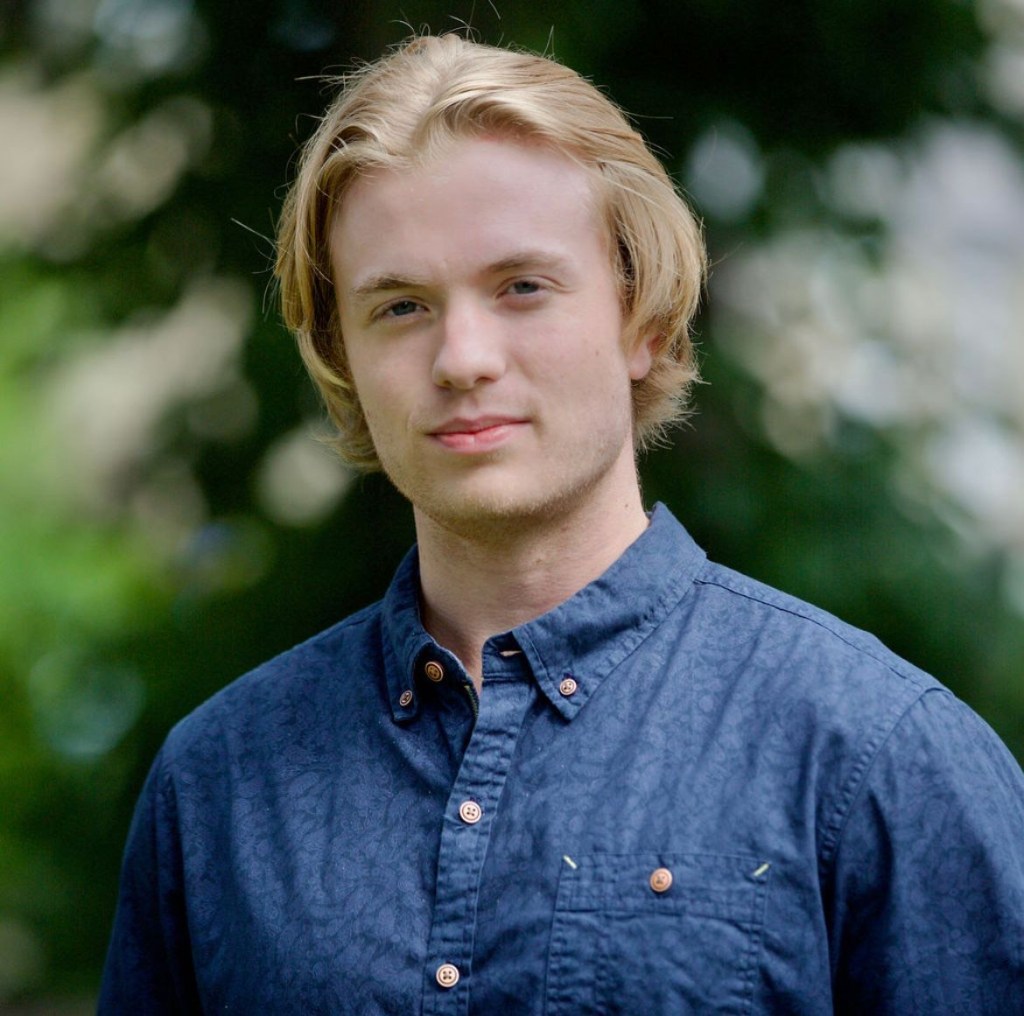
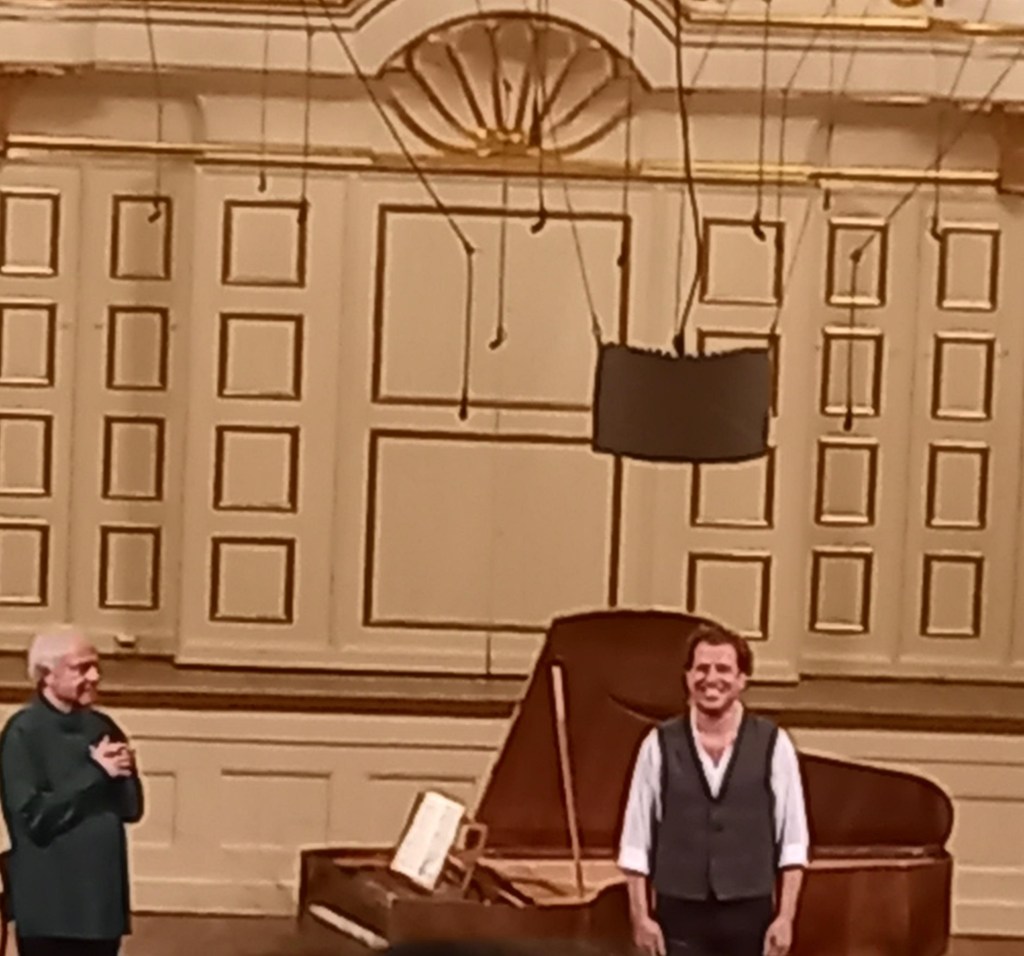
I went to a lunchtime concert today before the evening concert. The brief programme note indicated that Cristo Harijan is a “22 year old pianist who has just concluded his final year as an undergraduate studying with Murray Mclachlan at the Royal Northern College of Music, Cristo graduated with a first, receiving the outstanding mark of 94/100 for his final undergraduate recital’. The precise pieces played were
Bach / Busoni: Chaconne from the Partita 2 in D minor BWV 1004
Mompou, F:
Nocturne – Lentement modéré
Musica Callada:
3 – Placide
6 – Lento
13 – Tranquilo
16 – Calme
20 – Calme
27 – Lento molto
Liszt, F:
Transcendental Etudes S139:
4 – ‘Mazeppa’
11 – ‘Harmonies du soir’
12 – ‘Chasse neige’
The piece I liked most, because I know it best, was the Busoni arrangement of the Bach Chaconne. Mompou is a composer I had never heard of until very recently, when I saw that Stephen Hough was programming him. He was Spanish – early to mid twentieth century – and his music sounds a bit like Debussy, or Satie. It’s melancholy, atmospheric and easy on the ear, though maybe 7 pieces is a bit too much of a good thing for music that in a sense sounds much the same in each piece. I’m afraid I never have much time for Liszt, and the three pieces conformed to type – noisy, pedestrian thematically and immediately forgotten after hearing, with notes tumbling out this way and that. Mr Harijan sounded pretty impressive in his playing – though whether he was using too much pedal in the Bach or whether, like most churches, the acoustic properties of the space were just very resonant, I am not sure.
Dvořák, Cello Concerto in B minor; Josef Suk, Symphony No. 2, ‘Asrael’. Anastasia Kobekina, cello; Czech Philharmonic, Jakub Hrůša, conductor
Doomsters this year were saying that the Proms would last 6 weeks only and that the big foreign orchestras were no longer going to be affordable for the Proms. But, lo and behold, we have three of the top ten orchestras in the world visiting the Proms in the last three weeks, including the Czech Philharmonic, plus several major and very good second ranking visitors (Rotterdam, Orchestre de Paris) and numerous first rate specialist overseas bands (e.g. the Bach Collegium Japan, Il Pomo d’Oro) appearing during the season. There’s everything to indicate though that the resources which provide all this could be whisked away very quickly. We have to fight against that happening while just being very, very grateful the Proms continue to operate at the level they do.
Suk’s Asrael Symphony has only ever been performed once at the Proms before, by Libor Pešek and the Royal Liverpool Philharmonic Orchestra in 1991. I have never owned a recording of it until just recently, in preparation for this performance, and have never heard it live, so I was really keen to go to this concert. But first we had the Dvorak Cello Concerto as a (very welcome) warm-up……I really enjoyed this performance, above all because of the wonderful Czech Phil woodwind, and the way they made me listen afresh to the orchestral accompaniment to the soloist – there were times when it felt like I was hearing the piece as though restored to its original colours, and was hearing music I had never heard before. Very fine too was the way the orchestra always gave a lilt to the rhythms of the piece. And the yearning moments came across more intensely than I can recall from other performances (though I have to say I have heard many, including the legendary one in the 1968 Proms with Rostropovitch, Svetlanov and the USSR State Symphony Orchestra, amid protests in London and calls for the concert to be cancelled because of Russian tanks rolling into Prague that day). The soloist for this concert, Anastasia Kobekina, produced some beautiful phrasing but also could play the energetic passages with point and impact. The way the slow passage towards the end of the finale was played, quietly, passionately and building up to an immense climax, by soloist and orchestra, was outstanding. Ms Kobekina played something by her father with a member of the Czech Phil percussion section as an encore, a folky piece.
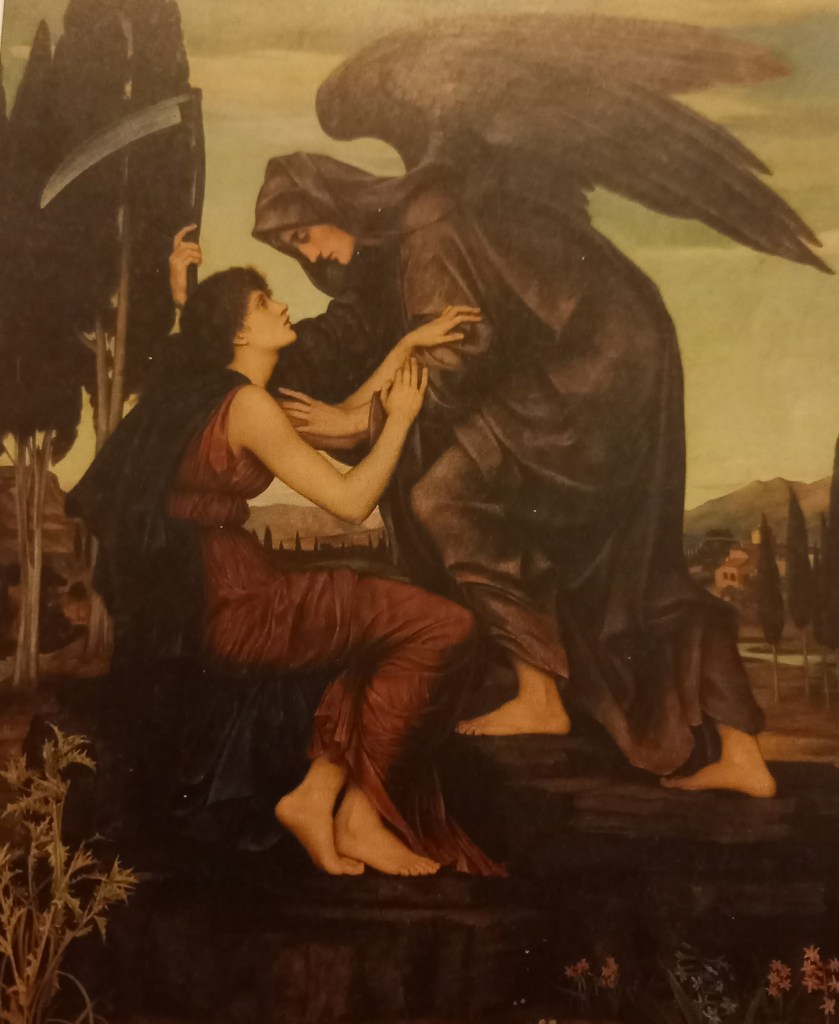
Suk’s work was completed in 1906 following the deaths first of his father-in-law (Dvorak), in 1904, and then of his wife. Asrael is the angel of death – in Islam the carrier of souls after death. The work is scored for a standard late Romantic orchestra- 4 horns but only double-woodwind, and 3 trumpets and trombones). It has 5 movements. There are a lot of influences clearly present in the work – the Wagner of Tristan and Parsifal, Mahler at times, Bruckner – but Suk does come across as having a voice of his own. There is a clear and fundamental death, or Asrael, motif that begins the work, and the way that motif gets transformed throughout the work, and it final appearance as the lovely chorale in the final 5 minutes, is something any listener new to the piece can enjoy. There are several themes from the work still reverberating in my head as I write this, always a good sign…..I did enjoy listening to the work but I also think it does at times seem episodic. The programme booklet tries to put a positive spin on it – the work ‘encompasses both angry denial, and the consolations of memory”. The first movement is ‘sombre’, the second full of ‘despairing sighs’, the third is full of ‘fevered imaginings;, the fourth represents ‘wistful recollections’ and the fifth is ‘defiant’. Well, yes, and there are at times moments that are exciting or beautiful, but also points at which things stop and start and seem to peter out or start off in a different direction. Maybe I need to listen to the work a few more times. I suspect if I had got to know this work as a teenager, and played it again and again in the way I got to know pieces as a teenager, I would love this piece. Certainly the orchestra played it sonorously and wonderfully – as good as one is ever likely to hear .
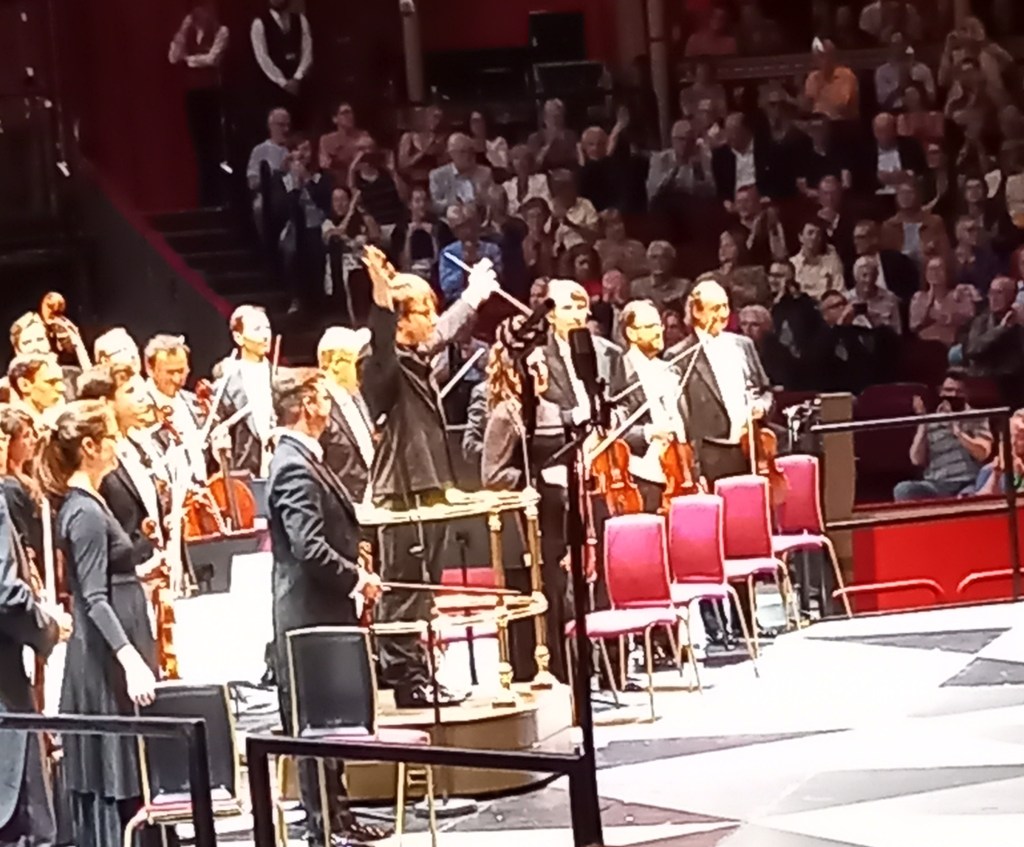
Given that Hrusa becomes Music Director of ROHCG next year, I was interested to see his conducting style close up. He gives large gestures – big swings of his stick – and has a very clear and energetic beat – it was also iunteresting to see, given his role in operas, how attentive he was to the soloist.
Tchaikovsky, Violin Concerto in D major op. 35; Shostakovich, Symphony No. 5 in D minor op. 47. Lisa Batiashvili Violin; Oslo Philharmonic; Klaus Mäkelä Conductor
…..So, the last concert of my 10 day trip to Bayreuth and Salzburg……….And here was Klaus with his ‘old’ orchestra, from the time when he only had one to deal with as chief conductor, as opposed to his future, where he is to be leading the Concertgebouw and Chicago Symphony Orchestras, ?as well as L’Orchestre de Paris. I heard him with this Oslo band two years ago at the Proms, when they were playing ‘Ein Heldenleben’ – that was an excellent performance. I wonder if this one in Salzburg was also originally meant to have Yuja Wang as the soloist – anyway they found someone almost equally starry in Lisa Batiashvili. I raised more than a quizzical eyebrow, in fact winced, at the price of this concert ticket for – what? 85 minutes plus a couple of encores, so I was expecting something special. I know Makela is being marketed as something special but I have seen him twice over the last two years…………………..
I remember that I must have acquired a recording of the Tchaikovsky concerto from when I was 11, but I have a particular memory of going to bed about 8pm one evening not long after that, and then being woken up by my parents about 9pm and asked if I wanted to listen to this concerto on TV – I think this was the performance by somebody called Mikhail Waiman with the Moscow Radio Symphony Orchestra conducted by Gennady Rozhdestvensky at the Proms. This would have been in August 1966, just before I turned 14. I think I might have seen live the same conductor and soloist perform the concerto in 1971 with what was then the Leningrad Philharmonic. Beyond that I can’t remember having been to many live performances of the work – though I must have been to some……..
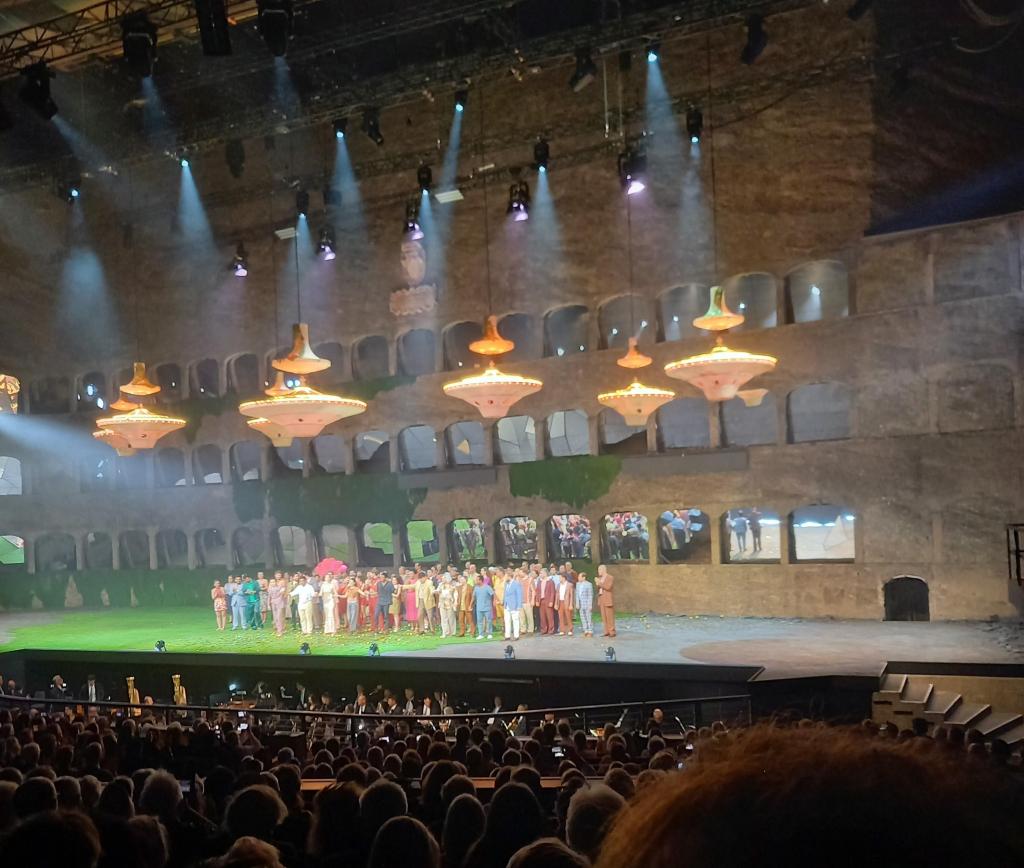
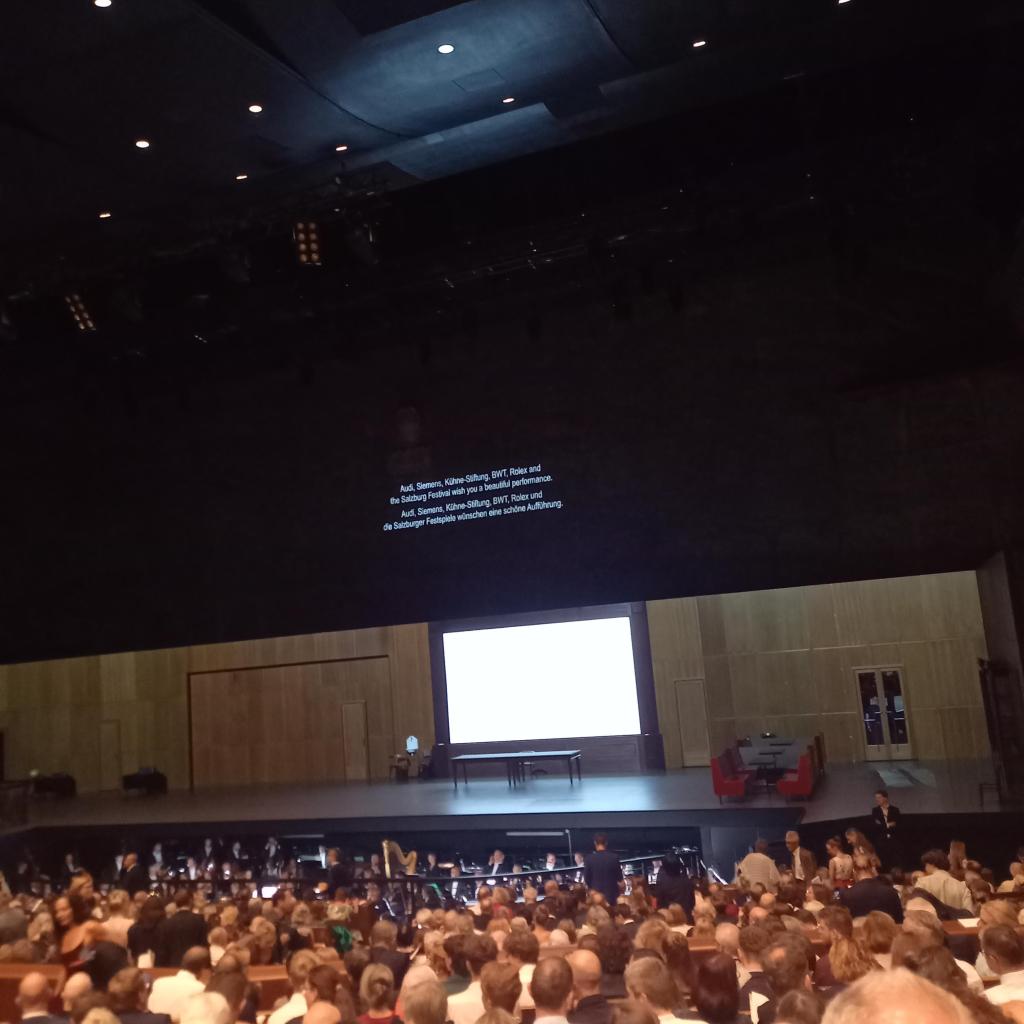
Bizarrely, though the orchestra pit was covered over and thus the stage extended towards the audience, for this performance the management had left the flying saucers over the orchestra from the previous night’s performance – they glowed red throughout the show. I was on the extreme left of the Felsenreitschule stage in Row 1 so sometimes sounds from the other end of the orchestra sounded softer than they might to someone sitting in the middle. I enjoyed the Tchaikovsky performance very much – it had dancing rhythms, and a real lilt to the melodies. When the climaxes came they were exciting and pointed, but often the orchestra was kept down to allow the soloist to shine through – she came across very clearly even from where I was sitting.. The soloist sounded technically superb and produced some totally secure melting high notes. Makela (a cellist) and Lisa Batiashvili did a little pizzicato duo as an encore.
I have heard many fine Shostakovich 5’s over the years, and this was another very, very good one. The two that have most lodged in my memory were both performances by Russian orchestras – Yuri Tenirkanov and the Leningrad Phil at the Proms in 1971, and another Russian orchestra (I think it might have been the Moscow Philharmonic) in 2001 in Sheffield, which almost blew the roof off the City Hall, so raucous and excitable was it. This Oslo performance was extremely well played – woodwind particularly – and climaxes were again very finely judged. The slow movement had rare intensity and the strings were thrilling when they throb with loud emotion towards the end of that movement. The end of the finale was done the Russian way – building up to an enormous climax very slowly like a fleet of Soviet tanks rumbling along. This is the first time the Oslo orchestra has been in Salzburg since 2000, when they came with their ex-boss Mariss Jansons, and they got a standing ovation from the Salzburg audience, which was thoroughly deserved
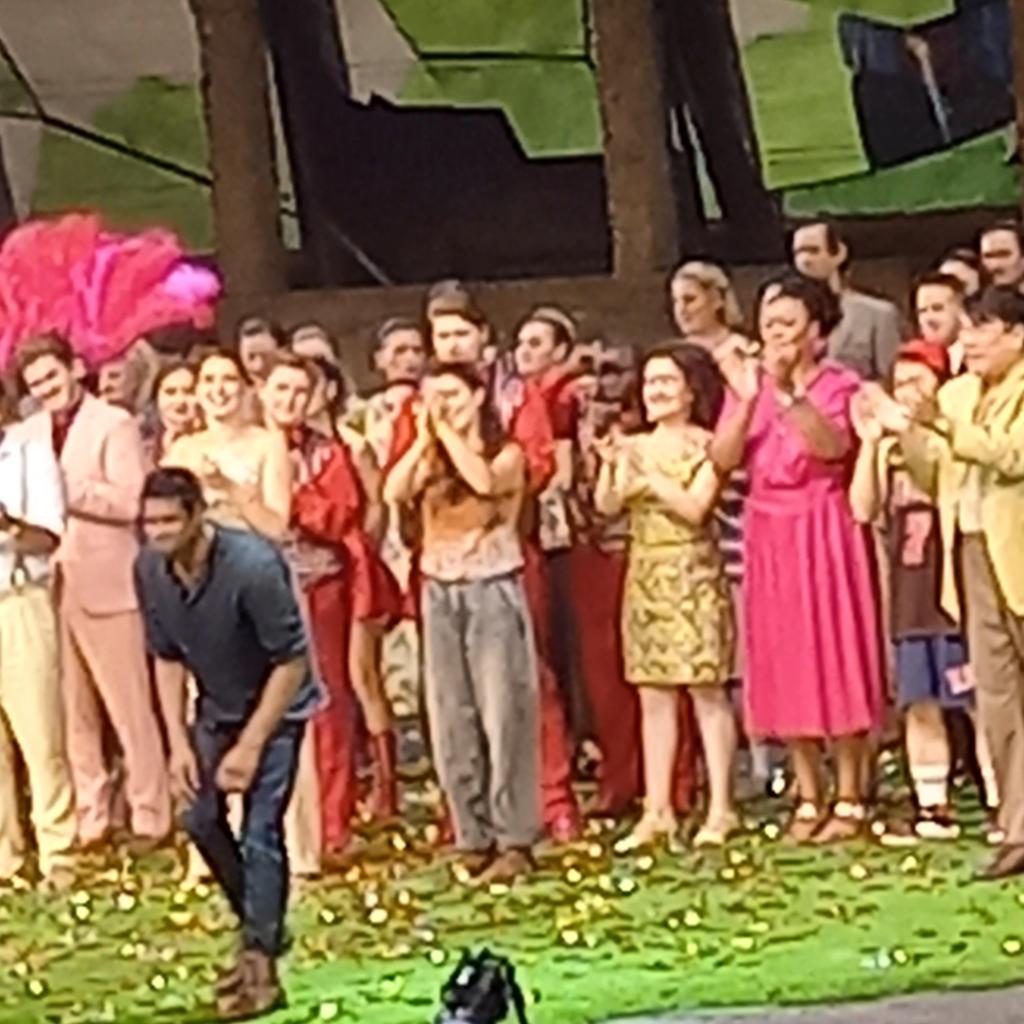
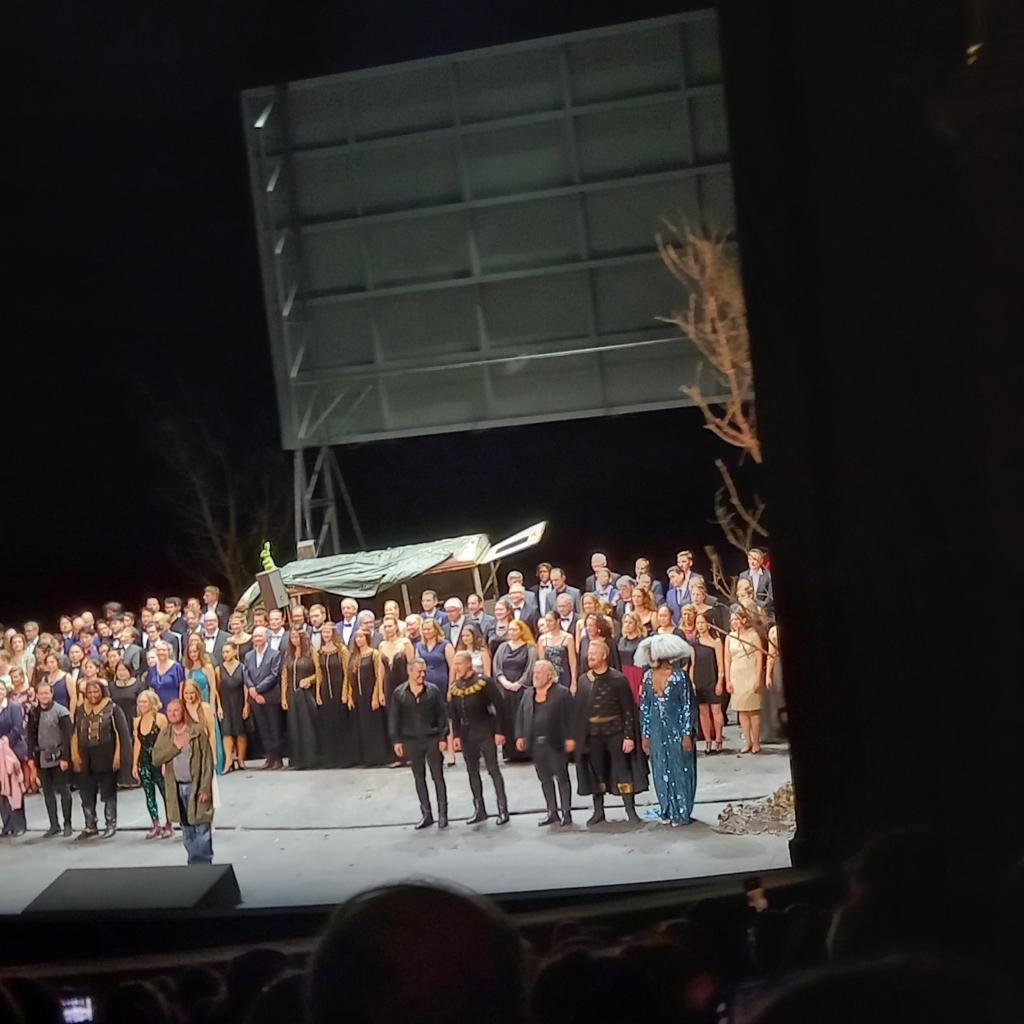
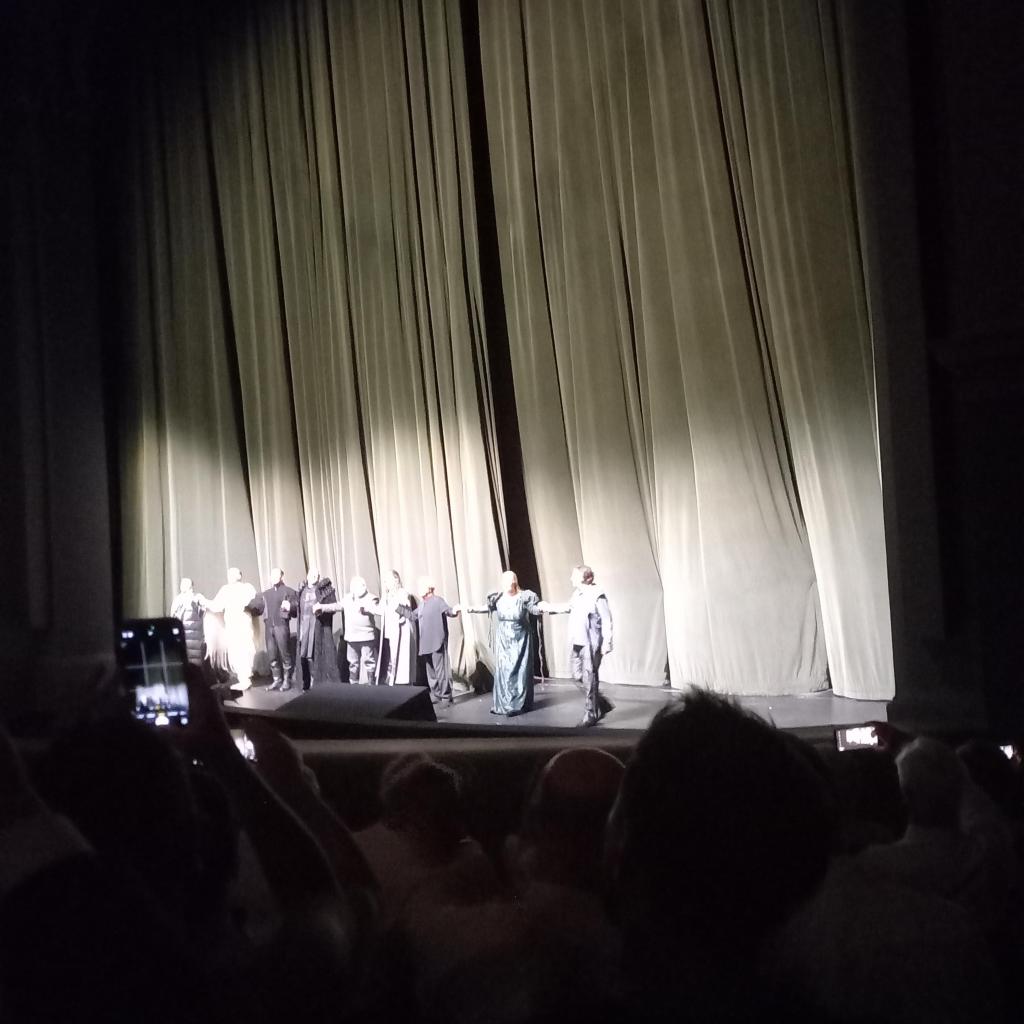
Timur Zangiev Conductor; Peter Sellars, Director; George Tsypin, Sets; Camille Assaf, Costumes; James F. Ingalls Lighting. Peixin Chen, The General; Asmik Grigorian, Polina; Sean Panikkar, Alexey Ivanovich; Violeta Urmana, the ‘Babulenka’ ; Juan Francisco Gatell, The Marquis ; Michael Arivony, Mr Astley; Nicole Chirka, Blanche; Zhengyi Bai, Prince Nilsky; Ilia Kazakov, Baron Wurmerhelm. Concert Association of the Vienna State Opera Chorus, Vienna Philharmonic I spent a pleasant few hours walking around the Residenz, and its Gallery and Museums, seeing the Modern Art Museum (a very good photography exhibition), and having a splendid beef goulash and bread dumpling lunch. Then, on to The Gambler. This was conceived far earlier in Prokofiev’s career than I had assumed – in its original form it was written and indeed planned to be put on stage before the Revolution, with Vsevolod Meyerhold, no less, engaged as the director. However with the Revolution there was much uncertainty about putting it on stage and so the first performance – with some revisions by Prokofiev – wasn’t until 1929 in Brussels It’s based on (another) Dostoyesvsky novel and is set in Roulettenburg, a fictional European spa resort in the 1860s. The young tutor Alexei has fallen in love with Polina, who is a ward of the General. The latter owes money to the Marquis, who is also as a rival to Alexei in being involved with Polina. The General hopes that his aunt, (and Polina’s grandmother) the Babulenka, will die, leaving him her money which will make him an attractive partner to the much younger Blanche; instead, the Babulenka turns up, very much alive, and loses everything in a wild gambling binge. After that everyone and everything starts to unravel……..So 6 main characters are involved…….. The Sellars production is again very effective in dealing with the peculiarities of the Felsenreitschule stage, which as I’ve said previously is very, very wide and has little depth. The stage has about 6 stylised roulette wheels which can move up and down, and have various flashing coloured lights emanating from them – a bit like space ships…..The walls of the stage have large fractured pieces of glass which can flash images back or distort them. Somone has also sploshed a lot of green paint asymmetrically across roughly centre stage. The work was played without an interval, lasting about 2hrs and 5 minutes As an opera, I wondered about it at first – maybe for the first 45 minutes or so. None of the characters come across as very sympathetic, and apart from Alexei are lightly sketched – the Marquis and the General are meant to be unlikeable and Polina isn’t given enough time at first for her character to be developed. Alexei is the fullest developed character but, again, he repels as much as anything else, making a lot of noise and sometimes arguing senselessly. I wondered why I should be bothered about what happens to them. Dramatically the work, I thought, begins to improve once the (assumed to be dying) Babulenka comes in – this scene and her mad behaviour at the roulette table is funny. The scene when Alexei as it were takes to the wheel to get the 50000 roubles to enable Polina to ‘throw in his face’ the offer of that sum the Marquis has made to her, as an attempt, as she sees it, to buy her, is dramatically compelling. And I did feel finally sorry by the end for Polina and the way everyone objectifies her and sees her in monetary terms. Musically, it’s not easy going – much less tuneful than say the Love of Three Oranges, still less War and Peace. Nevertheless I was beginning to recognise some of the character motifs by the end, never ever having heard a note of the work before. There’s actually less abrasiveness and thumping ostinato rhythms than I had assumed, though they are certainly there – particularly of course in the roulette-playing scenes. The cast was first class. Although she is a star name, Asmik Grigorian does not have that much to do in this piece, but when she was allowed to give full vent to her feelings, she did so very powerfully. She’s also a consummate actor, and very good at suggesting a grumpy slouchy teenager – and can still look the part. The show rests, though, on the energy of the person playing Alexei, and Sean Pannikar was excellent, dashing around the stage emoting and with a full bright tenor (he was of course Loge in ROHCG’s Rheingold last year). Violeta Urmana the veteran (well, over 60) Lithuanian soprano was magnificent as the Babulenka, and brought her still-present Wagnerian power (she’s sung Kundry, Brunnhilde and Isolde) to the role, shutting everyone else up. The General and the Marquis were sung and played well. The conductor was Timur Zangiev, who has been making a name for himself as a young up and coming Russian conductor – he’s recently conducted The Tale of Tsar Saltan at La Monnaie, Pique Dame and the Romeo and Juliet ballet at La Scala, Eugene Onegin at Munich etc etc. There’s been some grumbling in the Slipped Disc blog that he’s not had the Putin test applied to him, which to me seems to be almost on the same level as banning Tchaikovsky from Western halls. It’s one thing for fully-paid-up members of the Putin fan club to be blocked, but surely we shouldn’t be asking every Russian artist to make a statement that could have them imprisoned, exiled or their families threatened……? Was Furtwaengler banned before WW2 in the UK? – answer, no Here is the trailer – (The Player • Salzburg Festival 2024 (salzburgerfestspiele.at) to enable a further look at the sets. I think ultimately I am very pleased I have seen this work live, and particular in this Sellars production, but I am not sure I would be making a beeline for another production of the work any time soon. Peter Sellars came on stage at the end, a diminutive now rather paunchy figure with the trademark upstanding hair you can just make him out on the first photo below in blue near to the conductor and Asmik Grigorian
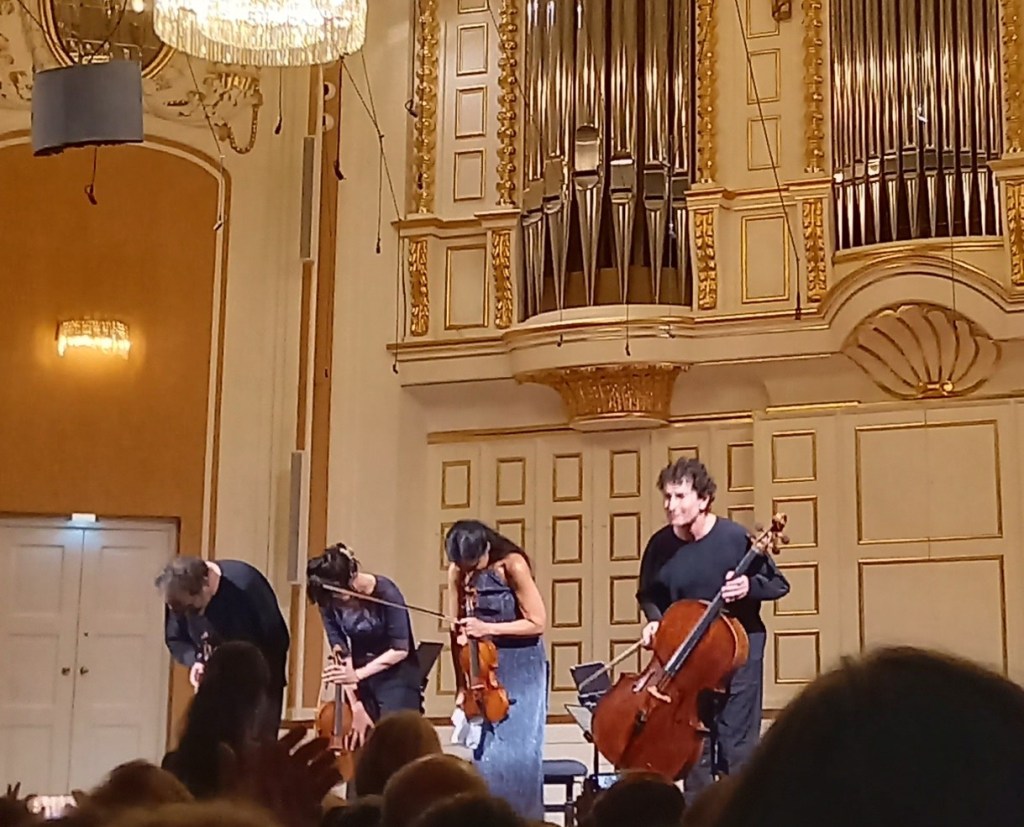
Schoenberg, String Quartet No 1 in D minor op. 7; Beethoven, String Quartet No. 14 in C-sharp minor op. 131. Belcea Quartet
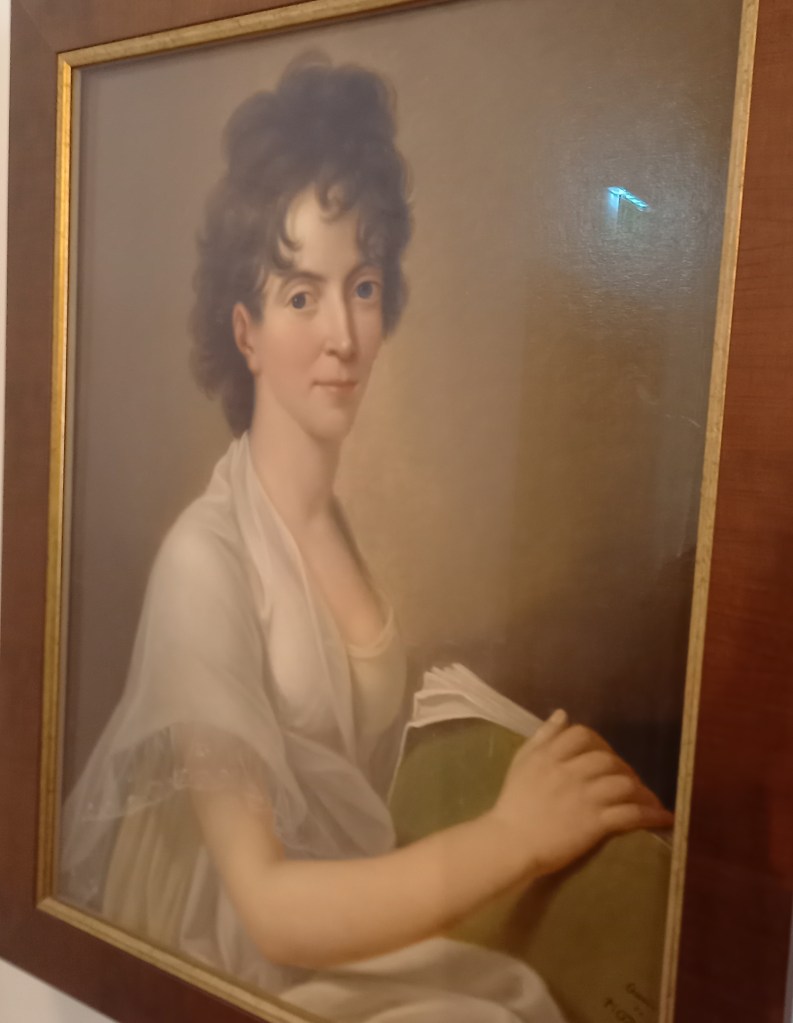
It’s been raining for most of the day and I still have two whole days after this one for touristy stuff before evening performances. So I wandered around and went only to the Cathedral – massive and ornate white and gold Rococo as you might expect – and Mozart’s birthplace, which is obviously a tourist trap of a major kind but doing its best to be serious for those interested. I was particularly struck by the large oil portrait of Constanze, dating to 1802, showing a very determined lady who managed Mozart’s posthumous reputation and documents very well – see photo below. And I had forgotten that her husband, von Nissen, eventually wrote the first biography of Mozart with all sorts of help from his wife. A pity that it doesn’t appear to be available in English currently.
And so on to Schoenberg and Beethoven – a very serious programme……….And I hadn’t realised that Schoenberg had actually written 4 quartets – I know the one with the voice, but this is the first time I have ever heard Op 7.
I should mention first something about Salzburg dress codes, or lack of them, incidentally. I was told beforehand that the Festival was much more formal than Bayreuth. In fact at the Weinberg opera there were a few DJ’s but a lot of the men were wearing dark suits. I was wearing suit trousers and an open necked white shirt and so were a few other other men, so there was some variety, thank goodness, and I didn’t feel conspicuous. But at this concert – inevitable perhaps given its content – anything was OK: there was a guy in tennis shirt and shorts, lots of short sleeve shirts, Hawaii shirts, a guy with a baseball hat and some in jeans. Good!!……………..Unfortunately the other inevitability of this concert was the curse of Schoenberg on the box office – the downstairs part of the Grosse Saal was full but the upstairs ‘Rang’ was empty. Nevertheless those who were there were very vocal in their appreciation.
The Schoenberg piece is one of his pre-atonal works, and in fact it has a very identifiable main theme at the beginning that is subject to umpteen transitions, variations and changes in the course of 40 minutes or so (I originally wrote slow – Freudian slip). I had read that it had 4 movements but got lost fairly on. It is an extraordinary piece – there are elements that sound like Mahler, others sounding like Brahms, there’s certainly some Viennese pop dance music, but all mixed up in a whirl of intersecting instruments that make it sound quite as dense as the Pelleas I heard 4 weeks ago at the Proms. I just couldn’t get the emotional narrative here, and yet I felt there probably was one – with a peaceful – or numb – ending.
The first movement of the Beethoven is almost as dense as the Schoenberg – it sounded startlingly modern in this reading – but what the Beethoven has is a clear – well, pick-upable – narrative trajectory: from sadness to humdrum daily routine, to (after a prelude) a core 4th movement that copes with suffering, moves us to a joyful 5th movement, and after a turn-around 6th movement prelude, ends in toughness, some grief but also resilience and hope. I thought the Belcea Quartet played it very well indeed – more characterful than Ensemble 360 in Sheffield – but I did think, from a quibbly point of view, that they took the 5th movement too fast, so that notes got elided.
So enthusiastic was the audience response that there was an encore – the wonderful 3rd movement – ‘Solo’ – of Britten’s 3rd Quartet, with what sounds like the flutterings of a soul released from earthly life
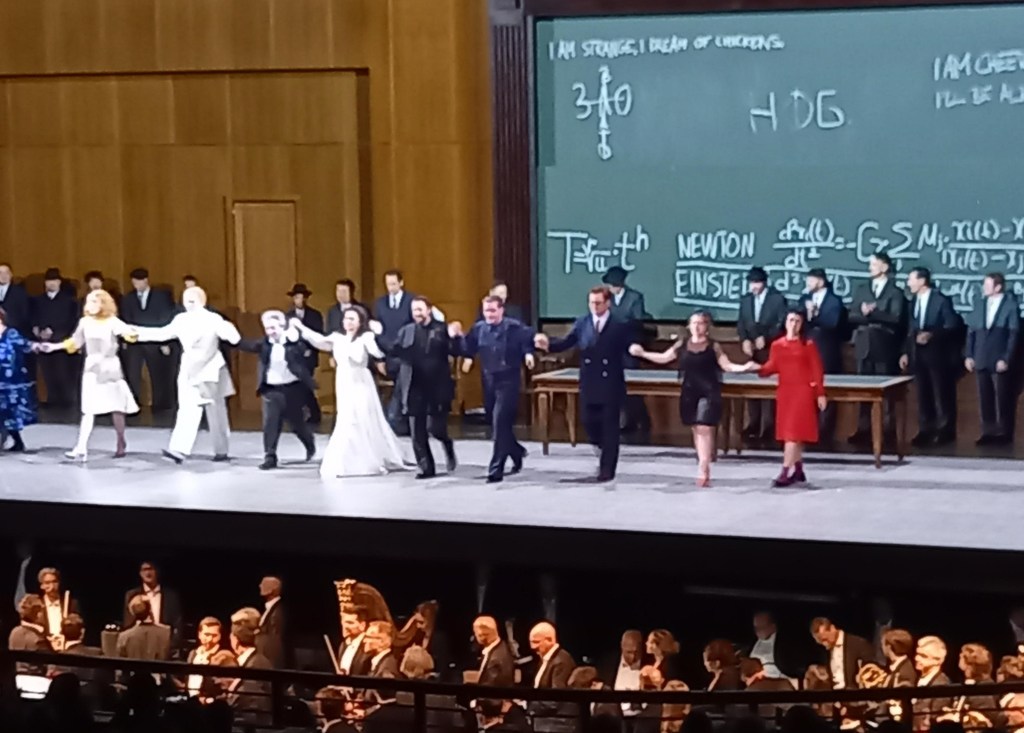
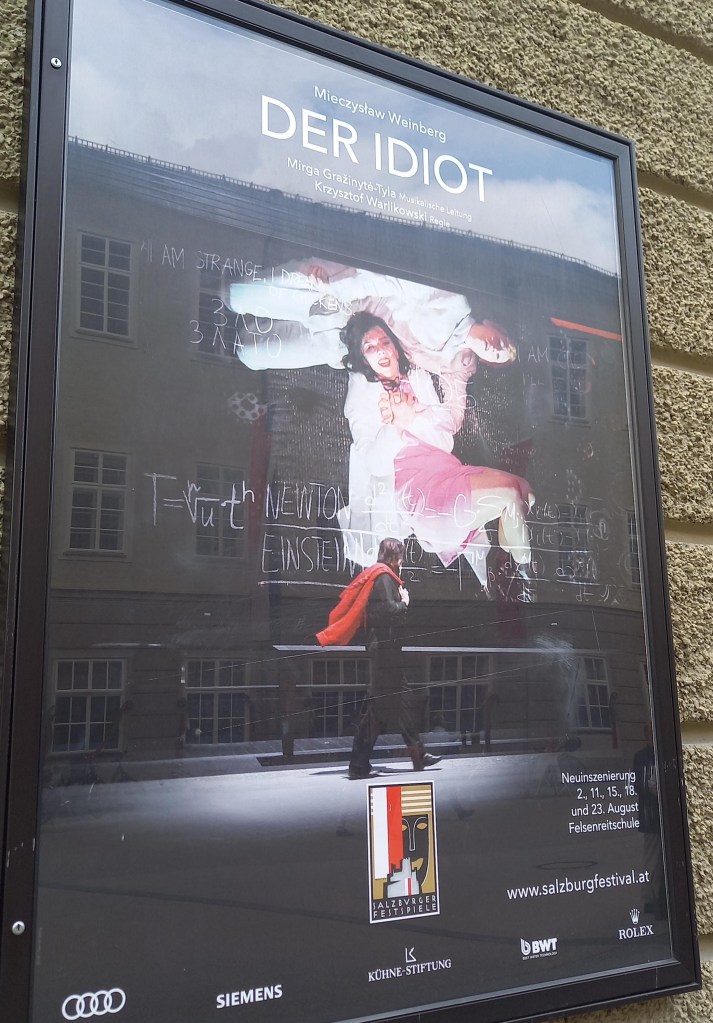
Oleg Ptashnikov, replacing Mirga Gražinytė-Tyla Conductor; Krzysztof Warlikowski Director; Małgorzata Szczęśniak Sets and Costumes; Felice Ross Lighting; Kamil Polak Video; Claude Bardouil Choreography. Bogdan Volkov, Prince Lev Nikolayevich Myshkin; Ausrine Stundyte, Nastasya Filippovna Barashkova ; Vladislav Sulimsky, Parfyon Semyonovich Rogozhin; Iurii Samoilov, Lukyan Timofeyevich Lebedev; Clive Bayley, Ivan Fyodorovich Yepanchin, general; Margarita Nekrasova. Yelizaveta Prokofyevna Yepanchina, his wife; Xenia Puskarz, Aglaya Ivanovna Yepanchina; Jessica Niles, Alexandra Ivanovna Yepanchina; Pavol Breslik; Gavrila (Ganya) Ardalionovich Ivolgin. Herren der Konzertvereinigung Wiener Staatsopernchor; Vienna Philharmonic
This is only the 3rd production in this work’s history, apparently, at least in the West, though web sources mention performances at the Bolshoi and Marinsky Theatres as well. There was also a reduced orchestra theatre performance in 1991 in Moscow while Weinberg was still alive but the first full premiere was not given until 2013 in Mannheim National Theatre under the musical direction of Thomas Sanderling. The Austrian premiere took place in April 2023 at the Theatre an der Wien in Vienna, and now we have this Salzburg production by Krzysztof Warlikowski and under the musical direction of Mirga Gražinytė-Tyla (though she was ill for this performance, and the conductor was her musical assistant in this production)
The story takes on only certain parts of the Dostoyevsky narrative and focuses on a quartet of four people – Prince Myshkin, who suffers from epilepsy, and is Christ-like; the dark-eyed beauty Nastasya, who Myshkin loves unreservedly. His love for her forces the upright Myshkin into a relationship with his rival for Nastasya, the rough Parfion Rogozhin, a rich merchant’s son. At the same time Myshkin is held in deep affection by Aglaya, the youngest daughter of the Yepanchins, but to whom he is unable to engage in real commitment. In Pavlovsk, Nastasya gives her seemingly irrevocable commitment to the prince, but flees to Petersburg and marries Rogozhin. In the end Rogozhin stabs Nastasya and kills her. Myshkin finds Roghozhin lying aside the dead Nastasya and strokes Rogozhin’s head.
Let me say first I felt thrilled to be at what was essentially the first ever major international set of performances of this major work, with singers like Volkov and Stundyte, and with the Vienna Philharmonic in tow – a remarkable evening. And I do think it IS a major work. The music doesn’t have arias (nor in a sense does Mussorgsky) but does have motifs. It has a huge range of expression and musical devices – ostinato rhythms, thunderous climaxes, tolling bells, lyrical moments, and some folk song. It doesn’t have hummable tunes on first hearing but it is very accessible. The most important points for me were that 1. It is absolutely gripping and immersive (on the much shorter Part 2 see below); 2, although Weinberg composed massive amounts of music for films and even children’s cartoons, this is not a film score with voices – it is a properly thought-through opera with voices and orchestra working together as equals. For the life of me I cannot understand why this is less of an important work than anything by Tippett, or Henze or others in the 2nd half of the 20th century. Very little of it sounds derivative. It has to be said it is a long evening – maybe 3 hours and 20 minutes of music, and could maybe do with a bit of judicious cutting in the 2nd half: I was left shattered by the first half, which was two hours, but the last hour has some domestic moments at the Yepanchins that dragged a bit, and maybe a bit less of Aglaya’s stress would also have helped. But this is for the future – on such an occasion this HAD to be performed complete. One wonders – and this might be part of the compulsiveness of the score – whether Weinberg unconsciously self-identified a bit with Myshkin; by all accounts he was an unworldly figure, who accepted even his temporary imprisonment in the late 1940’s with seemingly good grace, and remained eternally grateful to the Soviet Union and the Red Army for taking him in to the USSR when the Germans invaded Poland in 1939 (he was the only member of his Jewish Polish family left alive after the war)
There is a good deal of flummery and rather high-falutin’ gnomic talk in Warlikowski’s account of his production in the programme booklet, but for me the important points were that it involved brilliant stage craft, clear story-telling, utterly convincing personen-regie and clever updating. The production has to take account of the enormous width of the Felsenreitchule stage (I knew about the size of the Grosse Festspielhaus stage, built into the rock cliff, but this is just as enormous), and did this cleverly by having three acting areas across the stage, with some aspects of those areas being able to move from one area to another (like the train seats near the beginning). The setting is moved from Tsarist Russia to contemporary Putin era Moscow and St Petersburg, and this allows Rogozhin and his circle to be seen as oligarchs. But this is not overdone, and simply updates what is already there in the story. Despite its enormous size, the theatre is kind to voices so it was perfectly possible to hear the singers wherever they were positioned. The acting areas included a kind of bar area, extreme stage right, a bedroom / reception area associated with Nastasya, stage right. What was essentially the Yepanchins home, centre stage and slightly stage left, and a sort of waiting room/park area stage left. This is the trailer The Idiot • Salzburg Festival 2024 (salzburgerfestspiele.at) which gives a further idea of the sets. It will be interesting to see how Peter Sellars deals with this space on Tuesday. A curious aspect of the area just slightly stage left is a whiteboard with various equations on it – I think this is meant to suggest Myshkin’s otherness, and an inability to be as others are – for good or ill, but I could be wrong. This is really the only bit of Warlikowski’s production that I’d call gnomic.
Bogdan Volkov as Myshkin was an immensely impressive high tenor with the power to fill this huge auditorium yet able to convey the sadness and isolation of this unworldly figure; Ausrine Stundyte was outstanding (and of course back in January she was a very impressive Elektra with ROHCG) and dramatically compelling as Nastasya, while Vladislav Sulimsky was an ideal dark-sounding Russian-style bass as Rogozhin. Xenia Puskarz was very good as Aglaya, though maybe more differentiation between the sound of her and Stundyte’s voices might have been helpful – however that’s a casting issue, and nothing to do with the singing. Orchestra and chorus were wonderful
This was a great and inspiring evening. I have been exploring Weinberg’s symphonies and quartets for some time now, and to hear this opera is to offer exciting possibilities for further exploration. I really must go to ‘The Passenger’ somewhere soon – it can be quite frequently seen in Germany and Austria, according to Operabase
Mozart: Six German Dances K. 509; Sinfonia concertante in E-flat major K. 364; Divertimento for strings in F major K. 138; Symphony in D major, ’Paris’ K. 297. Clara-Jumi Kang, violin; Timothy Ridout, viola. Mozarteum Orchestra Salzburg, Andrew Manze Conductor
This was a nicely balanced programme with several work of Mozart’s earlier years (one a masterpiece – the Sinfonia Concertante) and the German Dances.
As far as I can work out, this orchestra is a subset of a larger Salzburg regional orchestra, and their strings have a traditional Austro-German sweetness and rich warmth of sound, Though I could be doing them disservice, nothing I could see or hear suggested in their Mozart guise this is a period instrument band, and I suspect they have probably been playing Mozart in much the same way for a very long time. The acoustic of the hall is quite a lively one – the sound is almost overwhelming when the trumpets, horns and timpani pile into the orchestral texture. I thought that Andrew Manze did very well to keep the textures of these works clear and not muddied, so you can hear the underlying shifts in harmony – helped by splitting the violins, and also to keep these works at speeds which makes them animated but without the gabble that that sometimes mean. I thought he did a very good job with an orchestra that probably seems them come and go all the time.
The Sinfonia Concertante, which is by far the best of these pieces, was particularly effective. The two soloists were obviously listening closely to each other and responding to each other’s intuitions. The slow movement in particular was treasurable
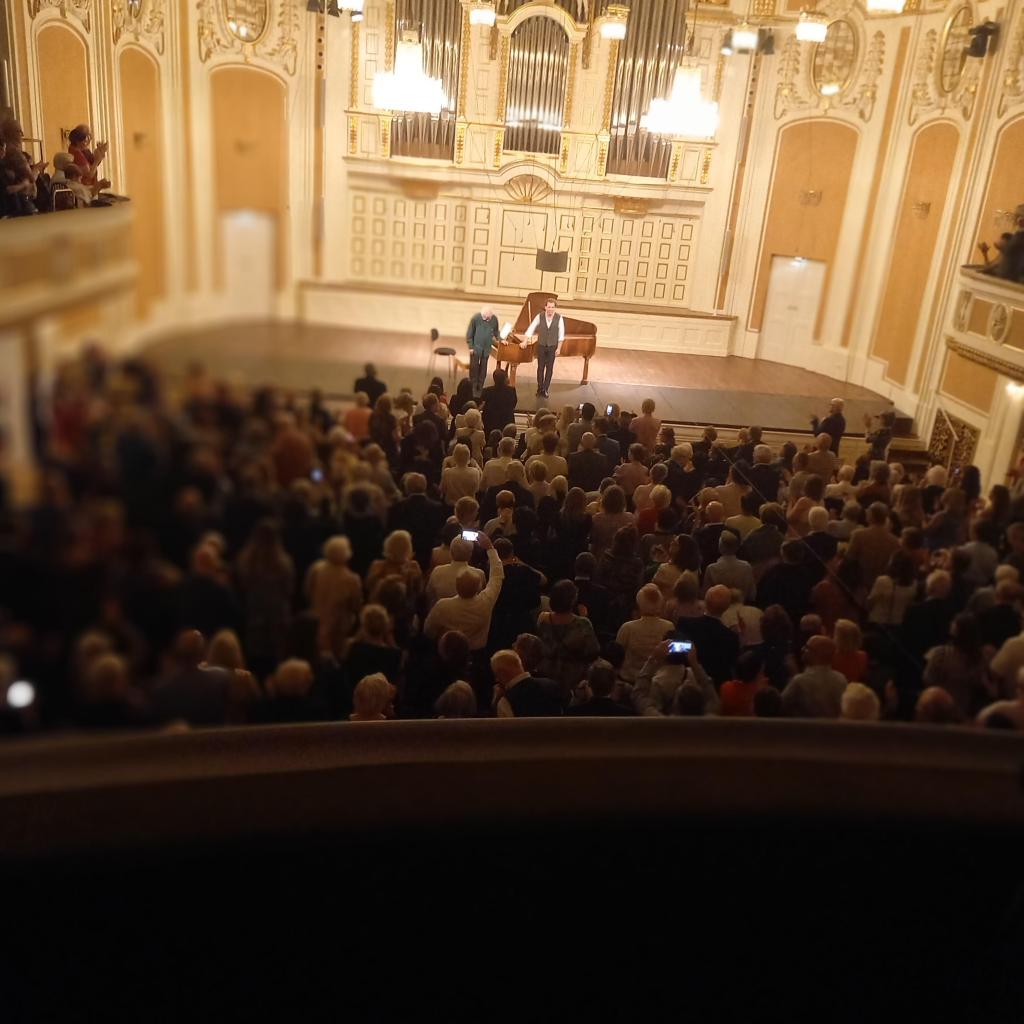
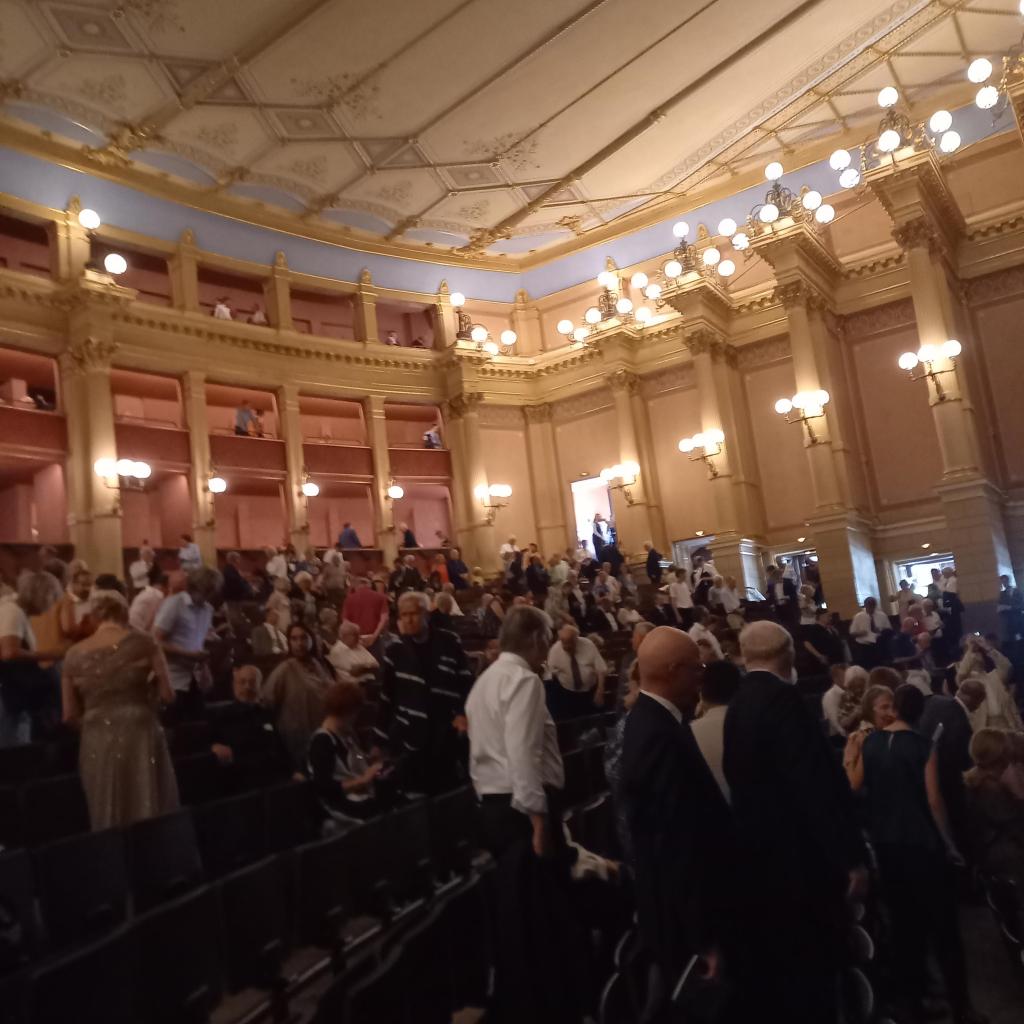
Schubert: Piano Sonata in G major D. 894; Die schöne Müllerin – Song cycle, D. 795. Julian Prégardien Tenor, András Schiff Pianoforte …..and so, on to Salzburg, neither the Festival nor indeed the city of which I have ever visited before, after the sadly usual rail chaos (train arriving late in Munich so missed my scheduled train, got another one which sat at the station until it was announced to have a defect….anyway I’m here) Andras Schiff, always one for spoken introductions, introduced his piano, which was an 1828 model from Vienna – ie made in the year of Schubert’s death and therefore having the sort of piano sound he would have been used to. That sound is much lighter and flexible, less clangy and allows for an extraordinary lightness of touch. Before getting down to playing D894 Schiff played two openers, both I think from Schubert’s repertoire of dance music, one of which featured a Hungarian tune (as Schiff pointed out). The excellent biography of Schubert by Lorraine Bodley I am reading at present describes how important dance music was both to his pocket -that was where a lot of his income came from – and his friendship group/social circle and I reflected during this excellent performance how much of Schubert’s other work derives from dance rhythms and styles. His piano sonatas also include elements from the improvisatory aspect of Schubert’s musical life – as I listened to D894 you could hear that move towards improvisation in how the music moved forwards. There was in Schiff’s performance an extraordinary delicacy which he / the piano created in the middle part of the slow movement and the whole of the third. Using the piano for this work doesn’t bring you grandeur in the first movement but it does give extra shade and colour to other parts – it was a very different experience to listening to Paul Lewis on a concert grand just over 6 weeks ago; this performance was lighter, more lilting. I loved it………………….. I know Die Schoene Mullerin fairly well as a work though I’ve not heard many live performances. Although I haven’t come across his name before Pregordien is clearly a major figure in the Austro-German musical world, inhabiting what one might call the ‘Peter Schreier repertory’ – Mozart tenors, Evangelists and lieder. That the performance was technically excellent goes without saying, and it was lovely to hear the work again. I have to say though that I found Pregordien’s approach a bit mannered, with exaggerated dynamics – at times only the front 3 rows could have heard exactly what he was singing. He also at times went into a falsetto voice I disliked. Interestingly, he was also adding a lot of grace notes to some of the songs which I didn’t recognise from my Fischer-Dieskau recording, whether this is historically informed performance practice or a new critical edition, I’m not sure. Curiously the haunting last song was almost jaunty in tempo. Still, these are minor quibbles The Stiftung Mozarteum Grosse Saal is a nice auditorium but very cramped to get in and out of – I wouldn’t like to be caught in the hall with the fire alarm sounding (or an urgent need for the loo for that matter)
Conductor, Nathalie Stutzmann; Director, Tobias Kratzer; Stage design, Rainer Sellmaier; Costumes, Rainer Sellmaier; Lighting, Reinhard Traub; Video, Manuel Braun. Landgraf Hermann, Günther Groissböck; Tannhäuser, Klaus Florian Vogt; Wolfram von Eschenbach, Markus Eiche; Walther von der Vogelweide, Siyabonga Maqungo; Elisabeth, Elisabeth Teige; Venus. Irene Roberts
This is one of those Bayreuth productions that has gone from being universally execrated on first appearance to being a loved and memorable production for many in the space of 5 years (how universally loved it is in Bayreuth was clear from the number of curtain calls – far more than for Tristan and Parsifal – and no boos). However from a distance, carping continues – a recent well-known commentator on Wagner giving a talk I heard was expostulating on the outrage of this production, as he saw it, committed on the work ‘Tannhauser’ and how it was full of black lesbians……(???!!! -sic) – of course, he hadn’t seen it
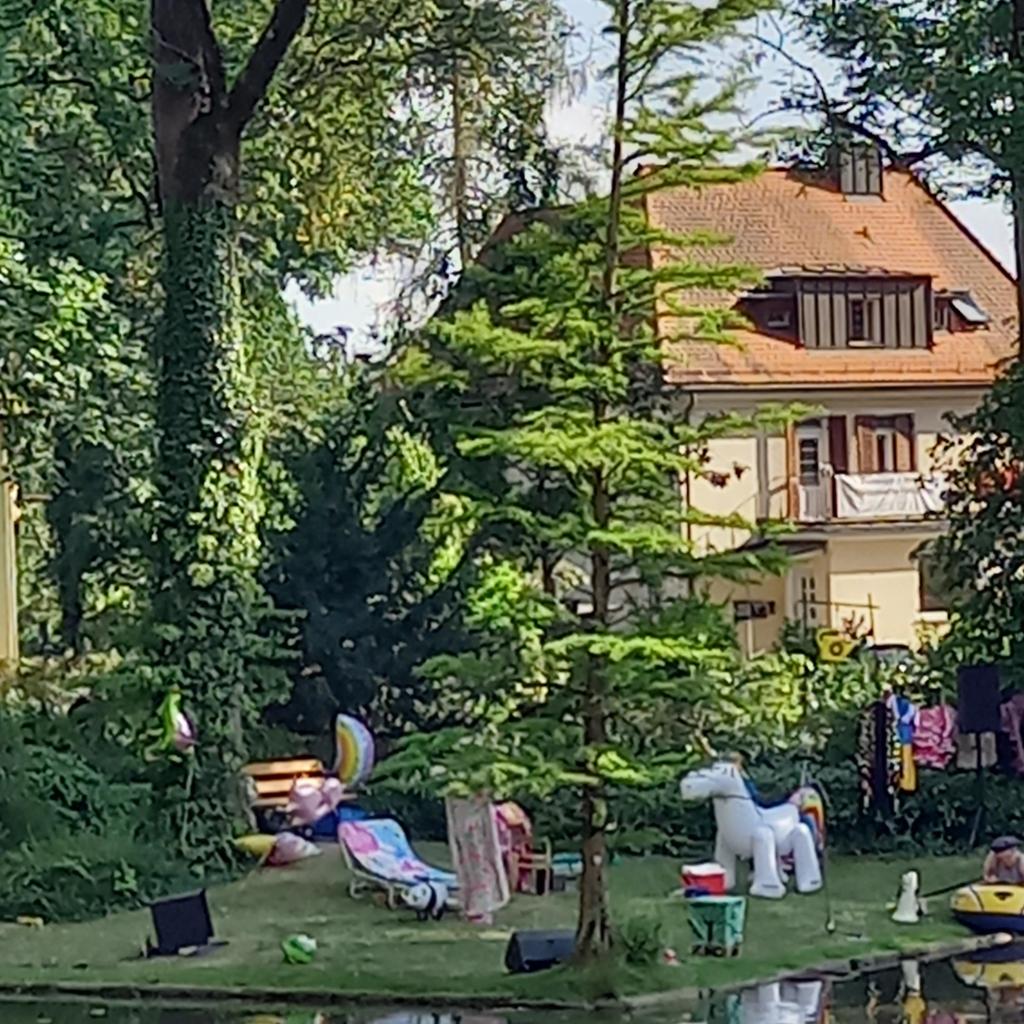
This was a very good but not one of the very best Wagner productions I have ever seen – it’s not completely up there with the Bayreuth Kosky Meistersinger from 7 years ago, for instance, or even that very fine Alden Lohengrin at ROHCG. I’ll explain why later, but the basic premise of the production is to replace the Wartburg / Venusberg dichotomy of the opera with one that involves the actual Bayreuth Festival performing the opera ‘Tannhauser’ on the one hand, and on the other a group of anarchic travelling players/musicians including Heinrich Tannhauser and Venus, Oskar, the small drum-wielding person from the novel The Tin Drum, and the black drag queen Le Gateau Chocolat, who together tour Germany in a camper van. Tannhauser is an out of work opera singer. The evening not only involves three acts of the opera but also an Act 1 interval cabaret show with Le Gateau Chocolat, Venus and Oscar down by the lake in the Festspielhaus Gardens, where LGC among other things sings Ol’ Man River and Dich Teurer Halle………….
The production uses the Dresden version of the score, I assume because it fits better with the video element that plays such an important part of the production. The first two acts are a triumph in terms of rethinking the opera. Half way though the overture we fly over the Wartburg in a video and as the Venusberg music starts we see a camper van speeding along an empty country road, with Heinrich dressed as a clown, Venus. Oscar and Le Gateau Chocolat . As the overture and Venusberg music continues, they stop at a Burger King and to siphon off ie steal some petrol from a garage. Accidentally they knock over a security guard while stealing the petrol. Heinricb is unsettled. When they stop in a kitsch rest area with elves around them to have their meal, to put on their Burger King paper crowns, and to put up some revolutionary posters quoting from Wagner’ essay on Revolution. (Free in willing, free in doing, free in enjoying), Heinrich decides to leave. He finds himself deposited near the Festspielhaus, in the gardens, and sees the pilgrims passing by (who are visitors to the Festspielhaus performance we are attending……!). He then meets (we are now into the opera proper) some of his old colleagues from the opera house and joins an upcoming very traditional production of Tannhauser. He also sees someone who is obviously his ex-girl friend who will be singing Elisabeth. She slaps his face!
In Act 2, we see at the beginning a video of what’s happening back stage as Elizabeth makes up and prepares to go on stage. Heinrich is late but eventually appears. During most of Act 2 the stage is split – the upper half is the video screen, the lower half the opera stage and 1950s style production, which we the audience are actually watching. As the crowd marches in on stage for the song contest we see via video Venus and Co slipping into the Festspielhaus, first of all to put up a poster as in the photo below and then to go backstage. Venus joins the female chorus, creating mayhem in the process. In the meantime there is brewing tension between Elizabeth’s other boyfriend, the singer playing Wolfram, and Heinrich. The opera proper and play within a play become impossibly confused….eventually Le Gateau Chocolat and Oscar start disrupting what’s going on on stage and we see a video of Katherina Wagner calling the police. All the disrupters ate arrested though not before LGC drapes a gay pride flag over the onstage harp.
So far so brilliant. The third act takes place in a junk yard where Oscar is seen making a solitary meal on his camper stove outside the now derelict looking camper van. LGC has left them and we see a huge billboard with his picture advertising expensive looking watches. Wolfram comes on looking for Heinrich, who has disappeared, and he ends up having sex with Elizabeth (who’s also out looking for Heinrich). The pilgrims passing by are essentially scavengers and go off holding various auto parts. Tannhauser comes on, a ragged dishevelled figure, totally an outsider, and does his Rome narration; Venus appears, and the rest of the opera carries on as normal. There is a gleam of hope at the end, to frame the final triumphant chorus about the Pope’s staff sprouting. Elizabeth and Heinrich are seen riding off into the sunset in a van – maybe a vision, maybe the reality, it’s not clear whether Elizabeth is dead or asleep at the end.
The problem with all this is that throughout the third act of course the original language and words of sin, expiation, grace, mercy, redemption , Rome, angels and Pope are being used. There is no connection between what is happening on stage and implied by the staging, and what the libretto is telling us. I guess this is yet another example of directors being unwilling to grapple with Wagner’s focus on these things. The contradictions perhaps bother.me less in Bayreuth than they would elsewhere because there are no surtitles and I have only a generalised understanding of what is being said. But there clearly is a gap. So this is in contrast to say the Kosky Meistrrsinger which is consistent and coherent from beginning to end. Act 3 here has to be comparatively a failure.
It’s been great to see probably the two foremost heldentenors globally in the three works I’ve seen in Bayreuth. Klaus Florian Vogt is singing Siegfried as well as Tannhauser. I find his voice well grounded, powerful and lyrical, though not everyone feels the same. He was up for every aspect of the role in this production and threw himself into it with Schager-like enthusiasm. Irene Roberts has to do a lot more than any other Venus in this role – fooling around in the second Act, appearing running round the lake in the cabaret as well as her slated moments in Acts 1 and 3 – she showed terrific energy as well as having a very good voice. Elizabeth, who in the nature of things even in this production is a bit wilty was very well sung by Elizabeth Teige, if not at the Davidsen level. Gunther Groissboeck was excellent as the Landgraf and Marcus Eiche (not a name I’ve come across before) was very good as Wolfram.
I have been sitting fairly far out to the right in the auditorium – seats 2, 5 and 7 in rows 7, 18 and 21. I have to say that there is a more balanced and warmer sound from the orchestra in the further-away tiers in the auditorium- row 18 sounded ideal, and Nathalie Stutzmann got the strings sounding glorious in the Act 3 prelude. She let the music flow naturally and wasn’t trying to make points – just allowing the orchestra be the best they can be. The Bayreuth chorus sounded wonderful throughout.
This probably has to be the highlight of my Bayreuth trip this year and I shall look forward to seeing (live for the first time though I did see it on TV during lockdown) Kratzer’s Fidelio at ROHCG in two months’ time. It also makes me realise I should like to see what happens in his Rhinegold in Munich next year.
One final thought – I seem to remember Gergiev conducted this when it was a new production in 2019 – the mind boggles as to what he made of it all……………….
Tristan is the Wagner work I have seen least in the last 7 years or so. I saw the last but one Katharina Wagner production at Bayreuth in 2017, conducted by Thielemann, which I thought was a good production, impressively conducted, with a quirky view of Marke – a domestic bully and abuser who takes Isolde back into his abusing household after the Liebestod – which is nonetheless given credence in various ways by the text and scenario (the Tristan was the late Stephen Gould and the Isolde Petra Lang). I saw a concert performance of the Glyndebourne production in 2021 at the Proms, and that’s it………There seems to have been an interim Tristan production for a couple of years at Bayreuth after the 2015 K. Wagner one – well-regarded – and now there’s this one, presumably with a run of 4-5 years. Reviews were mixed on the production in the press – enthusiastic about the musical aspect, less so about the production (inevitably, perhaps).
As I walked from my hotel up the ‘Green Hill’, the churches in Bayreuth were going bonkers, with multiple bongings for the Virgin Mary’s birthday. This jubilantly festal atmosphere was not replicated at the top of the hill – as I sat in a still stifling Festspielhaus, I found myself reminded of that late poem by Yeats, where he reviews some of the poetic themes he’s used in his life, and then writes:
Those masterful images because complete
Grew in pure mind but out of what began?
A mound of refuse or the sweepings of a street,
Old kettles, old bottles, and a broken can,
Old iron, old bones, old rags, that raving slut
Who keeps the till. Now that my ladder’s gone
I must lie down where all the ladders start
In the foul rag and bone shop of the heart. (‘Circus Animal’s Desertion’).
This production to me felt as though it was expounding the thought that all relationships fail before the accumulations in that ‘rag and bone shop of the heart’, and that we die alone, encumbered by our things and our memories, perhaps never having loved though we think we have. Several aspects of the production emphasised this point:
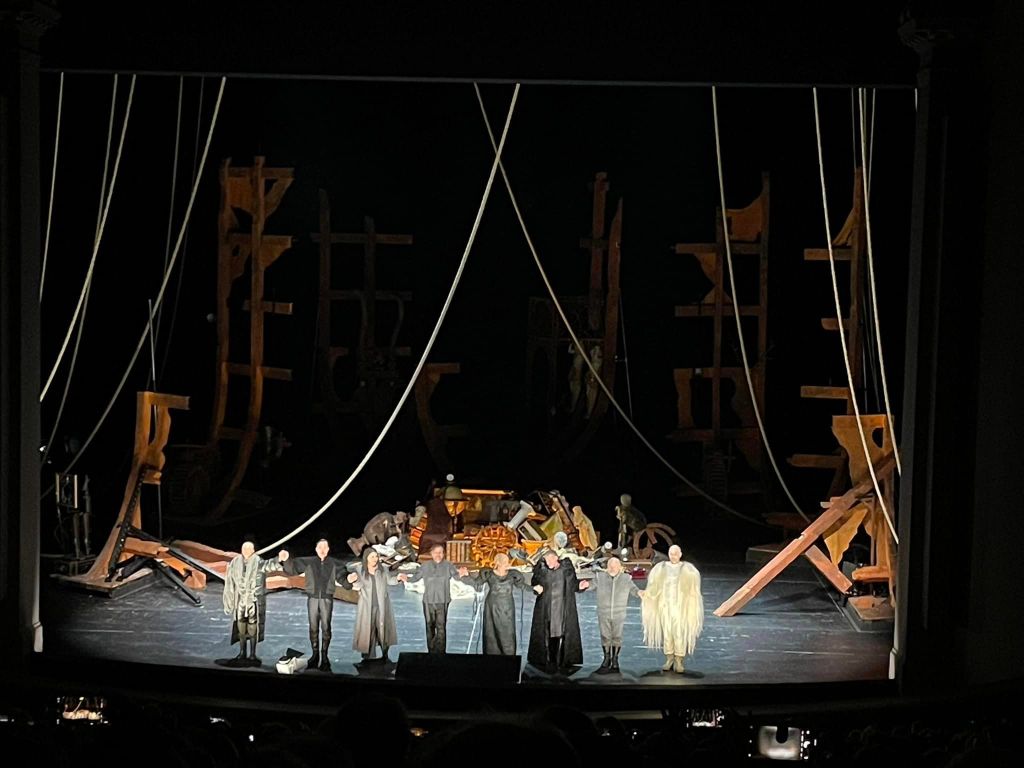
The sets for Acts 2 and 3 resemble giant junk yards. Act 2 is particular is everyone’s version of the ultimate attic nightmare – portraits, boxes, statues, crumpled bits of paper, broken bits of machinery everywhere. Act 3 seems more like an abandoned ship yard (which might make sense for Kareol), though I did wonder whether in fact many of the strewn-around items were actually giant parts of string instruments. Anyway both seem to represent an accumulation of things which somehow block the relationship between Tristan and Isolde.. And of course it is the past in their lives that both prompts and destroys the two lovers – Tristan’s ill-fated voyage to Ireland and Isolde’s meeting him there, knowing that he had killed her lover, Morold. And Tristan retreats into his past in going back to Kareol, and of course in being reluctant to re-encounter Isolde on the boat going back to Cornwall
In Act 1, Isolde is encumbered by an enormous dress which (apparently, though you wouldn’t know this without reading about it) has written on it words from the libretto, as though Isolde is programmed to repeat the tragedy she is clothed in. On occasion she tries to write on it, but, as far as I could see, does not succeed
Ropes are a feature of all 3 acts – in the first, I assumed they were just part of the suggestion of a ship, but in fact I think they may suggest routes out of the junk yards which the couple don’t take (the ladders of the Yeats’ poem)
Tristan and Isolde hardly touch throughout the work – perhaps briefly towards the end of the Act 2 love duet. Obviously there are practical reasons why opera singers can’t be too much wound around each other, but this production really emphasises the distance between the couple. And of course, while they sing about dying together, they actually do die alone in Wagner’s version of the story. Marke of course too is alone. Kurwenal doesn’t die in Act 3 but remains sadly alone on the sidelines to the end.
Curiously Tristan and Melot don’t fight either – Tristan is unwilling to touch another even in anger
There is no sense of elevation, of a different level of being, during the Liebestod, nor of any mystical reunion with Tristan, Isolde sings mainly on the floor, not differently lit to the rest of the stage, and at the end of the work she is just plain dead and alone, like the others
The theme of Night and Day is also prominent in the production – piercing spots lights range the audience and batteries of lights suddenly dazzle when Day makes its major appearances – the arrival in Cornwall, and Marke’s discovery of the lovers – while most of the opera is lit to be only sem-visible, particularly in Act 3, where the junk seems to be obscuring where the people on stage actually are. Again the darkness of unknowing seems to emphasise in this production separation, not union.
So, not exactly a bundle of joy and I found, perhaps in consequence, that I was unmoved at points I would normally have expected to be moved at. That’s an interesting contrast with Parsifal the previous evening – this Tristan was by far the better production (brilliantly executed, thoughtful, coherent) whereas Parsifal was, in retrospect, more than a bit muddled, but also far more moving. I found myself gripped with excitement by the Act 2 love duet in Tristan, which was wonderfully sung and played but I was only really moved by Brangaene’s two interventions, again emphasising aloneness and the danger of the illusion of unity. Or perhaps I was just too uncomfortable in the considerable heat within the Festspielhaus,,,,,,,,,,,,,,,
Musically this performance was very good indeed. Hats off to Schager for another powerful portrayal, and remaining fresh sounding even by the end of Act 3 – and being more musically varied and sensitive than most of the heldentenor breed. I hope Bayreuth have a view on who to replace him with when he finally decides he has had enough, but long may he continue………….Christa Mayer was excellent as Brangaene, a big voice but one also capable of subtlety. Gunther Groissböck, who was the subject of critical reviews after the first night, sounded ideally sonorous as King Marke, while Olafur Sigurdarson was among the best Kurwenals I have heard. About Camilla Nylund there have been various views, and who knows if she could really sustain the role so effectively in a less forgiving acoustic – however, while slightly shrill, and with an occasional wobble, she sang thoughtfully, was not over-powered by the orchestra and (though at times I kept hearing in my mind what other singers had done with certain phrases) gave a thoroughly musical account of the role.
I have been lucky with the Bayreuth Tristan conductors I have heard – Kleiber in 1974, Thielemann in 2017 and now Bychkov. The latter started the Act 1 prelude very slowly and beautifully, picking up in passion as it went along (though perhaps not with the intensity of the other two conductors). The performance seemed well paced, not hard driven, sensitive to the singers and with very effective dynamic control.
Frenetic cheering afterwards and not a boo in the house, unusually for Bayreuth (and welcome – given the history of intolerance in this place, booing always to me seems to have a particular edge and resonance)




 John's musical journey