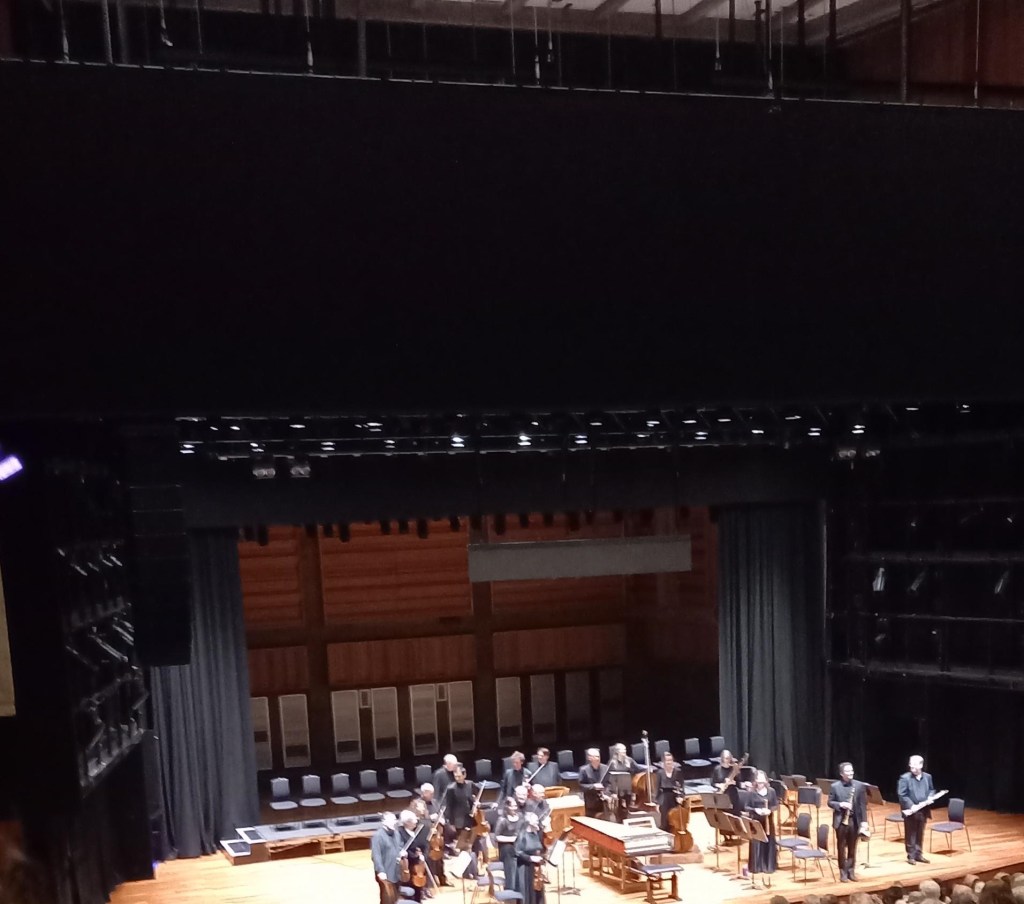
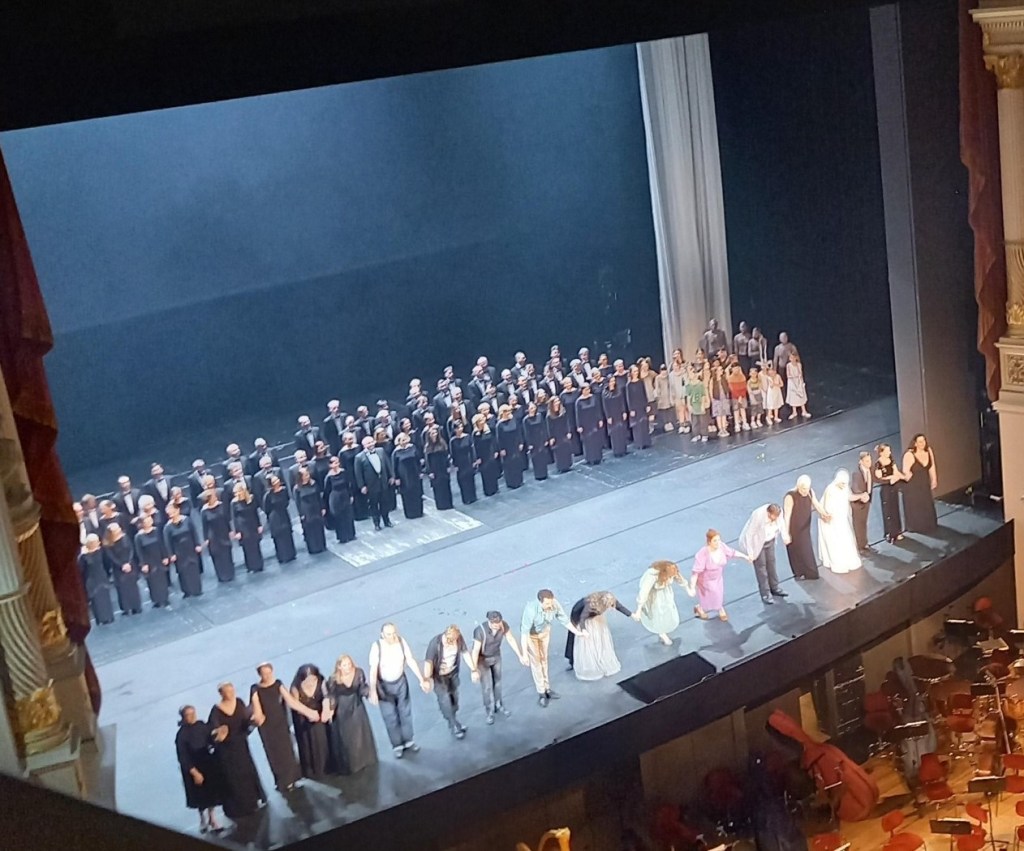
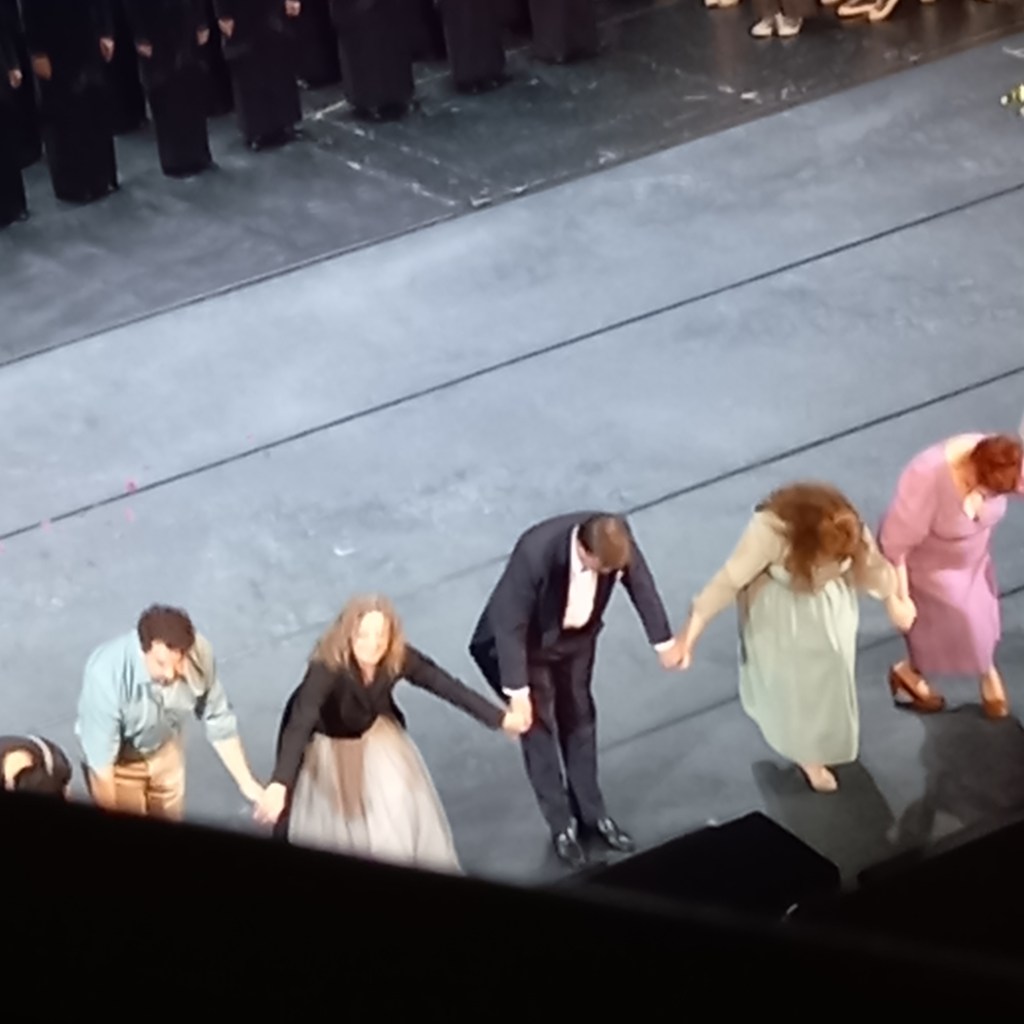
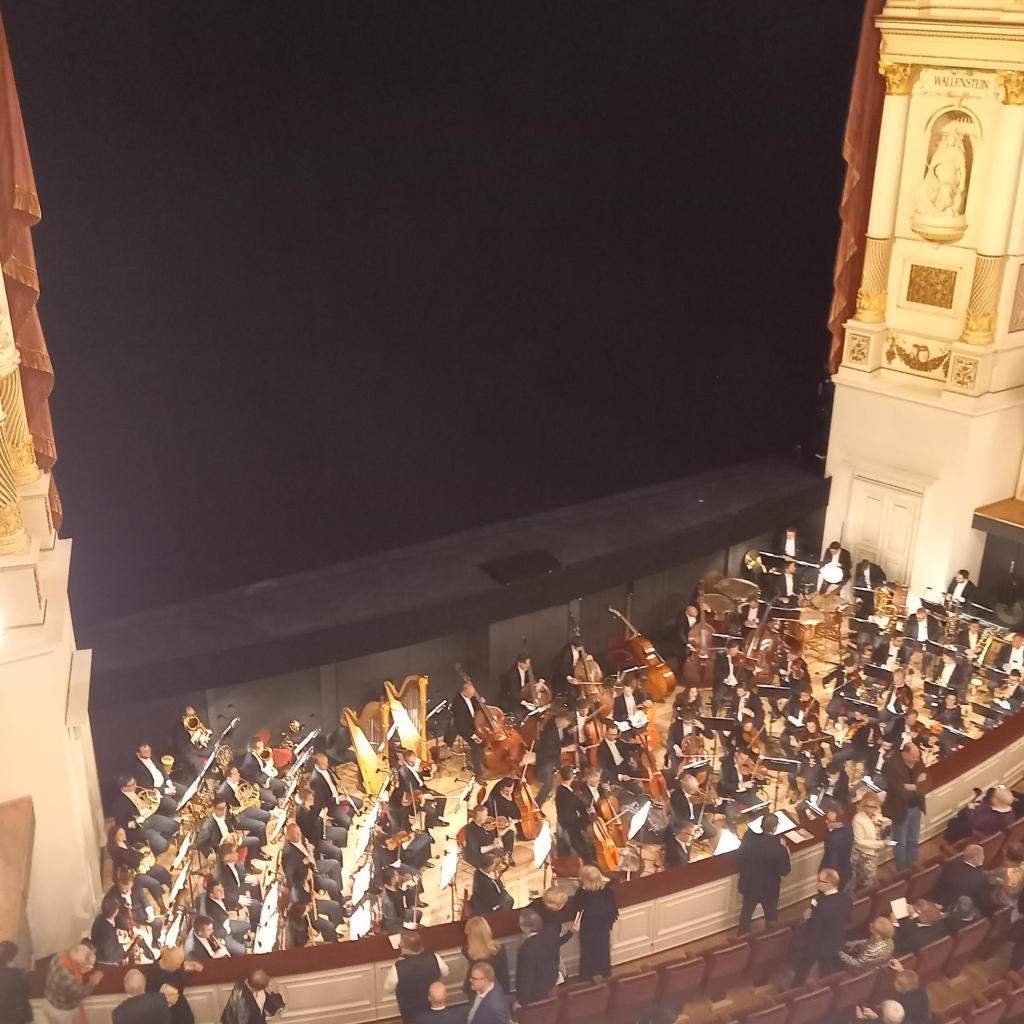
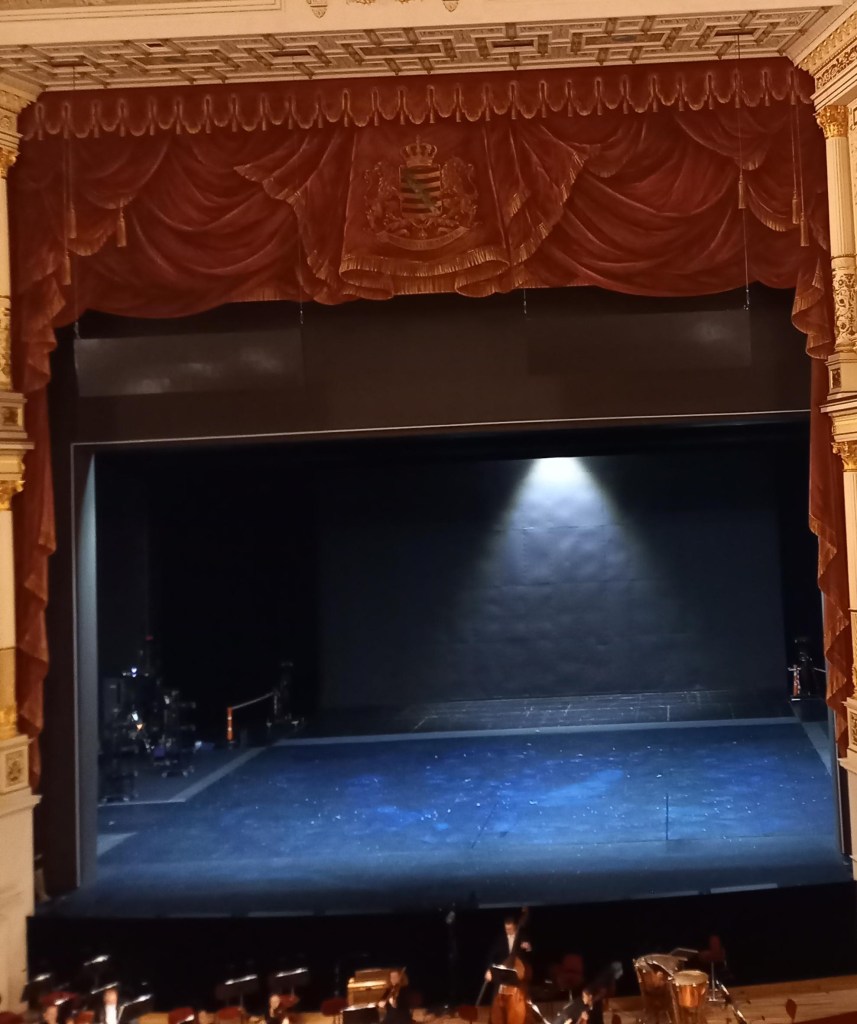
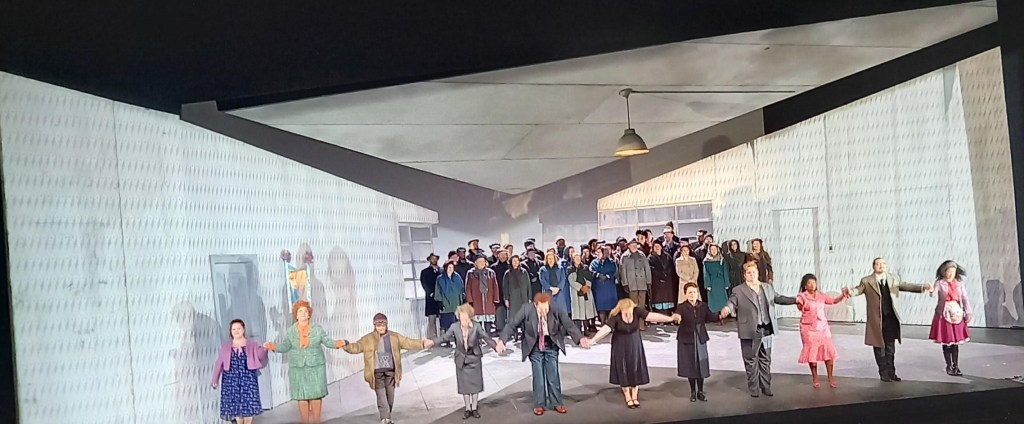
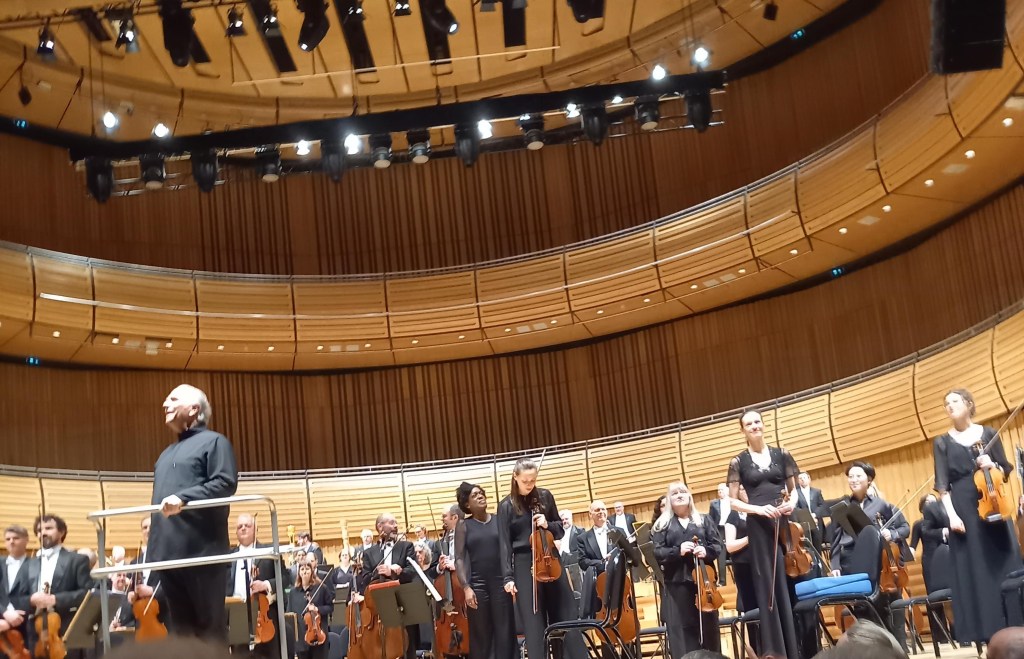
Halle Orchestra, Schuldt – R,Strauss/Brahms; Bridgewater Hall 15/2/24

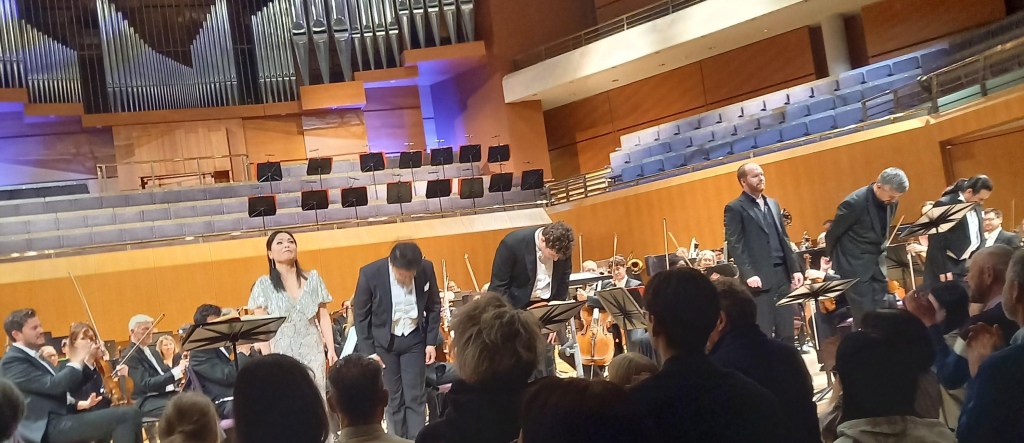
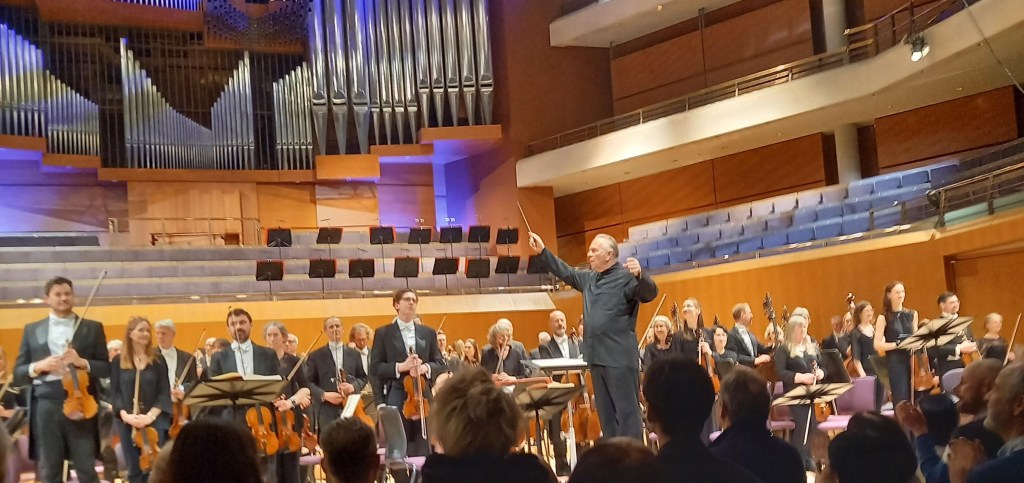
Clemens Schuldt conductor, Siobhan Stagg soprano, Markus Butter baritone. Hallé Choir;  Strauss Metamorphosen; Brahms Ein Deutsches Requiem

As I may have said somewhere else on this blog, the Brahms Requiem is one of the very few pieces of music I have actually sung in live performance, with St John’s College Music Society at Cambridge before an audience in the College Chapel in late 1971, in a choir where there were a few dozen sopranos and altos, a few more tenors and about 200 basses (I may be exaggerating but it did feel a bit like that – and of course reflects the – now completely bizarre – proportions of men and women at Cambridge in the early 70’s). So, definitely bottom-heavy but also a comfort for me as a performer, allowing me to skip the tricky bits and just mouth the words where necessary. But I can still sing along (in my head) with the bass part when I listen to the work. I have often wondered who was conducting and whether it was anyone who subsequently became well-known….

 I am casting my mind back as to whether I have ever heard this live as an audience member – I think I have done more than once, but the only performance I am sure I was at was, bizarrely, Pierre Boulez conducting it at the Proms in 1973, which I checked in the Proms Archives. That must have been an interesting one, but I have zero memory of it …………… I may have heard Rudolf Kempe conducting it at the RFH in the 70’s.

This was a stimulating programming combination – two great composers creating works which are to do with memory, both melancholy in nature, both celebrating the German culture of the past (in the case of the Requiem, Bach,  Handel, Luther and the Beethoven of the Missa Solemnis), and both reflecting in their mood the Lutheran Biblical texts used by Brahms reflecting on the transience of human existence– e.g.  “For all flesh is as grass, and the glory of man like flowers. The grass withers and the flower falls. Therefore be patient, dear brothers, for the coming of the Lord. (1 Peter and James), and “.Behold, my days are as a handbreadth before Thee, and my life is as nothing before Thee. Alas, as nothing are all men, but so sure the living. They are therefore like a shadow, and go about vainly in disquiet; they collect riches, and do not know who will receive them” (Psalm 39)

Clemens Schuldt is a new name to me but he clearly already has a substantial profile in Europe, East Asia and Canada and works in opera as well as concerts – he is making his debut this season with Opera North, conducting Mozart’s “Così fan tutte”.  I wondered about the need for a conductor in Metamorphosen – I have heard this work performed by chamber orchestras without one before. However I think Mr Schuldt’s presence did help to characterise the work effectively – the opening presentation of the key themes of the work sounded almost stunned, behind a veil, as though unable to contemplate the destruction of a culture. Climaxes were carefully graded so that it was clear where the emotional peaks were.  I sometimes find listening to this work that it is easy to lose track of what is happening, but this performance kept me focused throughout.

The Brahms is a wonderful work. It is years since I listened to it even at home and it was a huge pleasure to hear again all the glories it offers, particularly the luscious harmonies. The BBC once ran a radio programme where people described how, in all sorts of traumas, stages of grief and sadness, they received consolation from this work. Although there is triumphant Christian acclamation in it, the overall feel is one of a more secular comforting in loss.  This is emphasised by the two movements which begin and end the work – ‘Blessed are those who mourn’ and ‘Blessed are the dead’.

This Requiem is a very different beast to Verdi’s or Mozart’s – no hell fire or pleas for mercy here!. It  offers several tricky aspects which performers have to handle carefully – it is often slow but mustn’t become turgid; it has a rich dark texture but mustn’t sound muddy; it needs a big choral sound but also often needs rhythmic precision as well as the choral enveloping climaxes. I think this performance steered a very effective path through all these issues.

The chorus for the Brahms was large (I’d guess about ?160) and they made a wonderful sound  – rich, no frayed tenors or sopranos, and able to respond to the energy the conductor clearly required . The choral singing at the sudden fortissimo in the second movement of ‘Aber des Herrn Wort bleibet in Ewigkeit‘ was spine-tingling. The big fugues were also thrillingly done, I thought. Mr Schuldt seemed to me to get all the calls on tempi for the different movements just right – neither feeling too quick at any point or too slow – the Goldilocks effect, in fact. The beautiful 4th movement ‘ Wie lieblich sind deiner Wohnungen’ which can easily sound cloying was taken at a lilting speed which was very attractive. The way Schuldt encouraged both choir and orchestra to adopt a springy punchy approach to rhythm meant that the extended choral passages of movements 2, 3 and 6 never flagged. The two soloists were good – the baritone maybe sounding slightly constricted. The Halle produced a rich bass heavy sound, a velvet cushion, which could, with less judicious tempi, have been a bit stultifying, but which here fitted in with the overall approach

All in all it was wonderful to hear the Requiem live after so many years.

LSO, Stutzmann, Bruckner – Barbican, 11/2/24

Anton Bruckner Symphony No 9 (Ed Benjamin-Gunnar Cohrs); Te Deum (Ed Ernst Herttrich 2015). Performers – London Symphony Orchestra and Chorus, Nathalie Stutzmann, conductor; Lucy Crowe soprano; Anna Stéphany mezzo-soprano; Robin Tritschler tenor; Alexander Tsymbalyuk bass

I was hoping to have gone to a very interesting Halle concert before going down to London for this concert– a celebration of Steve Reich with Colin Currie, the percussionist, as conductor, and members of the Halle Orchestra – but sadly local trains were in a state of complete collapse and I was unable to get to it. So it’s almost two weeks since I have been to anything musical.

I have heard some fine performances live of Bruckner 9 by Haitink and Blomstedt. I am very pleased I found, after a lot of searching, a BBC SO orchestra recording of the work with Reggie Goodall conducting, which is a wonderful performance from the late ‘60’s. And I have a fine recording by Furtwangler. But I have often fretted about the issue of the missing 4th movement, and the curious reluctance of conductors and orchestras to play and promote the various scholarly completions of the work. Bruckner finished approximately 17 minutes of the last movement in full score, not just sketches, and there are several more minutes in sketch or piano form. The main problem is that the coda is missing so scholars must work out how this would sound, based upon the codas of, particularly, the 7th and the 8th symphonies – maybe also the 5th as well. Their conclusions are – from the versions I’ve heard – sometimes startlingly different. Nikolaus Harnoncourt once gave a lecture/concert of the Finale fragments that was recorded by RCA/BMG and can also be found on  https://www.youtube.com/watch?v=1fBJPhKezGc. This is a very interesting 35 mins or so which gives a very real sense of how much there is of a completed finale, and how different this is, for scholars, as a completion exercise, to something like Anthony Payne’s reconstruction of Elgar’s Third Symphony. Harnoncourt also makes the point that there may be pages of the manuscript score still extant, which lie hidden in someone’s attic, having been taken away by friends and enthusiasts after Bruckner died, as mementos….!  It seems strange to me – given that there are several completed versions by scholars (none of course accepted by the entirety of the Bruckner scholarly community, as the subject is a wonderful academic playground) – that we don’t hear performances of all four movements (perhaps with a pause before the finale to allow those who want to to leave). There are a range of completed versions  – eg the version on https://www.youtube.com/watch?v=gVoNyv5bfac  (Sébastien Letocart), as well as the DG Rattle/BPO recording worked on by a group of European scholars and released in 2012, and the version by William Carrigan, of which there is a recording, on the Chandos label, by Yoav Talmi conducting the Oslo Philharmonic, quite different at times to the Rattle version (and with a track of the original sketches as well as the Carrigan version of the 4th movement). There are others. Bruckner’s famous death-bed recommendation that the Te Deum be substituted for the ‘unfinished’ 4th movement of the 9th sounds very like some of the other things he agreed to under duress and doesn’t wholly make sense. The Te Deum dates from 10 years earlier and is a straightforward confident affair, very different from the darkness and angst of the 9th symphony.

Anyway, there we are…….a concert with the completed three movements of the symphony and the Te Deum. Natalie Stultzmann I haven’t heard before conducting live, though I enjoyed listening to a broadcast of her Tannhauser at Bayreuth last year, which was much – praised. I have just got tickets to hear her conduct Tannhauser at Bayreuth this year (along with the newish production of Parsifal and the new Tristan).

Stutzmann had a clear beat and was very much controlling her large forces (9 horns, 4 trumpets and trombones etc) effectively. There were clear distinctions between the different gradations of volume. This was certainly not the murky slow Bruckner of some but clearer and harsher. That’s not to say that where appropriate themes weren’t warmly shaped and phrased -eg the second subjects of the first and third movements or the second theme of the Trio. Nor was Stutzmann on the whole taking things too fast, though I did think that the Scherzo could have been more menacing with a slightly slower tempo. And there was real passion in the opening of the third movement – very Mahlerian…..What this performance gave me, through the clarity, through the very fine LSO playing, was a real sense of Bruckner’s precarious mental health while writing this work. A neighbour, who used to be a horn player in London orchestras in the 60s and 70s, was telling me about what he thought was the most chilling part of the work – the strange high trumpet note that sounds quietly over the reprise of the scherzo – he thought it was one of the most agonising moments in all music (and it was superbly realised in this performance). The sheer oddity,  the menace, the strangeness of the harmonies came over very clearly, particularly in the third movement which I thought was very finely shaped – everything led inexorably to that terrible climax. Interestingly the final tender string melody, which is normally shaped in a smoothly consoling way was phrased as a series of stabbing notes. Whether that was something to do with the textual edition used, or vibrato-less playing, I’m not sure, but it was a chillingly resigned end, like a clock ticking – in a sense making the need to hear the proper finale the more pressing. On that particular issue it is interesting how one or two melodies in the first three movements prefigure Bruckner’s wonderful chorale melody in the finale. 

Some people have said that the reason the finale was never finished was a failure of Bruckner’s imagination- that he no longer had it in him to write the great hymn of praise he envisaged. I have to say the version Rattle recorded- by the group of scholars which includes the late Benjamin-Gunnar Cohrs, who also edited the version of the three movements played by Stutzmann – is convincing to my mind even though the coda is perhaps too short.

Whatever the answer, the Te Deum isn’t it. The performance was fine – the beginning and end even thrilling  but this is a totally different sound world to the 9th symphony and offers no real resolution to the bleakness of that work.

All in all then I found this to be a fine performance. Using my now familiar three markers for Bruckner, this performance did Schubert and Wagner very well but missed some of the God element. I wonder why – unless I missed it- Stutzmann didn’t give the trumpet section a solo bow at the end – maybe they were a bit underpowered (unusually for the LSO). Or maybe she just forgot.

I’ll look forward to hearing Stutzmann conduct Tannhauser this summer. And onto the Big Bruckner Weekend at the beginning of March in Gateshead.

Danish String Quartet: Stoller Hall, Manchester – 29/1/24

Haydn String Quartet In G Minor, Op. 20 No. 3; Shostakovich String Quartet No. 7 In F Sharp Minor, Op. 108; Britten 3 Divertimenti For String Quartet; Danish Folk Music (‘Wood works’)

This was an interesting programme, though I am not sure an entire second half of Danish re-imagined folk music quite worked – to my mind it might have made more sense to cut out the Britten, have another Haydn or Shostakovich quartet, and intersperse what was played with the folk music. ANYWAY….it was an enjoyable evening. And with a full house…..I haven’t really come across this quartet before, though to give yourself as the name of the quartet the country you belong to implies some elevated status (or arrogance). They have been around for about 20 years, and were treated like rock stars by the RNCM/Cheetham’s students present (lots of whoops). And they were very good indeed!!

The Haydn was new to me – I don’t have a recording of any of the Op 20 quartets (and must get one). To quote Wikipedia, “the musicologist Cliff Eisen contextualizes the op. 20 quartets as follows: “Haydn’s quartets of the late 1760s and early 1770s [opp. 9, 17 and 20] are high points in the early history of the quartet. Characterized by a wide range of textures, frequent assymetries and theatrical gestures…these quartets established the genre’s four-movement form, its larger dimensions, and …its greater aesthetic pretensions and expressive range””.Here I was particularly struck by the slow movement and its long viola solo.  If you shut your eyes and just listened to the music without programme notes, it wouldn’t be, I felt, Haydn that came to mind but the Beethoven of the middle or even late quartets – astonishing music. The Danes played very beautifully throughout the work, but I did feel there was something like a lack of spring, vivacity – energy – in the playing of the Haydn; maybe a bit over-refined?

There were no such qualms with the Shostakovich (the shortest of the fifteen – only 13 minutes or so) – this was a really very good performance indeed, with masses of bite, the strings digging in deeply, and bitterly angry and powerful pizzicato from the strings at points in the first movement. Maybe the first and second violins swapping was something to do with this sudden increase in energy. At the same time the ghostly keening and the menace of the second movement was very well realised by the quartet, as was the violence and melancholy of the final movement.

The Britten dates from the early 1930’s so a very youthful work. Again, there was energy and vigour for what is a not inherently very interesting piece by comparison to the other two preceding it. I doubt if it could be better played.

As I have already indicated, the Wood Works folk music was pleasant enough – indeed some of it was really lovely, but really I would have preferred another quartet or the music presented in a different way!

Shostakovich/Prokofiev/Ades: BBC Philharmonic, Bridgewater Hall, 27/1/24

John Storgårds, conductor; Christian Tetzlaff violin. Prokofiev Cinderella, Suite No. 2, Op. 108, Thomas Adès Violin Concerto, ‘Concentric Paths’; Shostakovich Symphony No. 1 in F minor

This looked in prospect to be a fascinating programme: – a very competent conductor, a famous violinist, a Thomas Ades piece I hadn’t heard before, and a chance to get to grips, with the focus of a live performance, with the Shostakovich piece, which I have never quite got my head around. All this, plus some of the Cinderella music (I had previously heard Gergiev and the LSO performing the complete ballet at the Proms about 12 or 13 years ago)!

And indeed this was a very enjoyable concert of what was for me fairly or completely unknown music. I noticed Simon Webb,  head of BBC orchestras in the audience, looking a bit furtive, as well he might given the excoriating and maybe unfair criticism regularly hurled at him by Norman Lebrecht (BBC executive ‘owns mistake’ of killing ensembles – Slippedisc) and others. The hall was quite full, young, and appreciative – lots of University and RNCM / Cheethams students. Perhaps some had come to hear Christian Tetzlaff. The programming was a bit of a mystery – obviously Prokofiev and Shostakovich have connections, but the connection of either’s pieces with Ades was unclear. Perhaps the truth is that these are three works with quite awkward timings which just fitted together as a satisfying programme (which it was).

Cinderella was composed between 1940 and 1944, with Prokofiev breaking off in the middle to write his opera War and Peace. The premiere of Cinderella was in November, 1945, at the Bolshoi Theatre and the suites from the ballet were put together by the composer in 1946. It was very well played by the orchestra, with some particularly taut playing by the strings in the final Galop. Truth to tell, this Suite doesn’t really cover the well-known parts of the work (which presumably are in Suite 1) and while enjoyable I found my mind drifting at times. Also, given that these are excerpts which cover specific parts of the story, albeit in narrative order, there wasn’t really a feeling of progression or an inner musical narrative.

Concentric Paths is the subtitle of Adès’ concerto for violin and chamber orchestra.  It was premiered in 2005 and is in three movements, Rings, Paths and Rounds.  About 20 minutes long, I found it a gripping piece and must find a recording of it. I wished I’d listened to it beforehand on Youtube. Ades’ music somehow immediately gets to me – there’s always some sense of a narrative, of progression, of emotions which the music embodies. In the case of this work (and here I am following on from Tom Service’s programme notes) there’s perhaps a connection with the much more recent Dante ballet, or maybe the music of the spheres  – the first movement does seem to portray an ethereal sort of state, with very high solo violin sounds, while the second is a lot darker, more hellish, with stabbing chords. The third movement seems to offer a resolution of these states of mind. Tetzlaff’s strong, sweet playing was, I thought, remarkable, and he got (see photo below) a standing ovation from at least some members of the audience.

Perhaps because of the uncomfortably slightly short length of the Shostakovich symphony for a complete second half work, the orchestra played before it a short and simple but enjoyable Scherzo composed when the composer was only 17.  I was thrilled to be finding the Shostakovich symphony easier to follow than I have found listening to it on disc or on the radio – I have never heard it live before. It is a piece absolutely bursting with ideas, with sudden switches of mood and false starts by a prodigiously gifted young composer who wrote it as his end-of-Conservatoire show piece. Again, I must play my recording of it to understand it more. But I was very much taken with it, and it seems to demonstrate that time, not only of Shostakovich as a young man, but also of Russia’s intellectual ferment and experiment in the early 1920’swhen anything seemed possible, before the Soviet heavy hand got a grip. There are influences here certainly – of early Stravinsky and Prokofiev – but also it shows Shostakovich’s own developed voice coming through strongly.

Throughout the evening I was again impressed by John Storgard’s conducting – he is a very dependable figure on the podium

Tetzlaff leaving the stage with audience members giving standing ovation

R.Strauss, Elektra: ROHCG, 18/1/24

Conductor, Antonio Pappano; Elektra, Ausrine Stundyte; Chrysothemis, Sara Jakubiak; Klytämnestra, Karita Mattila; Orest, Łukasz Goliński; Ägisth, Charles Workman; Orest’s Companion, Michael Mofidian

This is the first time I have seen Elektra live in almost 50 years. I have not been to a performance of the work since 1977……and I definitely heard Birgit Nilsson sing the role. Quite when I did so is another matter – I might have been to the classic ROHCG performances of Elektra in 1972 with the (originally 1953) production involving Birgit Nilsson in the title role, Chrysothemis sung by Helga Dernesch and Clytemnestra by Regina Resnik, conducted by Georg Solti; I cannot imagine why I wouldn’t have gone to a 1977 run conducted by Carlos Kleiber, no less, with Birgit Nilsson and Gwyneth Jones, and, indeed, this may have been the one I went to – but if so I have zero memory of this. I am pretty sure I didn’t go to both the Solti and Kleiber performances. I am also confident I went to a performance conducted by Colin Davis in 1975, with Elektra sung by Danica Mastilovic, Chrysothemis by Berit Lindholm and Clytemnestra by Kerstin Meyer

This was a new production and was as fine an Elektra as I’ve ever heard, I think, and certainly an improvement on that old 1950s ROH production visually and dramatically. I hadn’t realised that the UK premiere was as early as 1910, with Sir Thomas Beecham conducting at the ROH, along with Strauss, who gave two performances.

The set – as is appropriate with Greek tragedy – adopted the principle of the unity of place: there was only the grey  outside wall of a big 19th century house, with large windows and a door at the back of stage left with a large staircase to look at throughout the opera. Lights came off and on in the house, which we saw through the windows, and people moved backwards and forwards in the corridor behind them, looking out at the courtyard in front of the wall where the action takes place. So all this effectively emphasises the inherent inside/outside dichotomy of the piece, and the closed-in feel of Klytemnestra and Aegisth’s life. There’s a sort of cellar entrance which Elektra goes in and out of, in the courtyard, not always with much perceived intention (is this the bath-house where Agamemnon was killed?). The costumes are difficult to place – possibly 1940s/50’s for most of the cast, though Orest looks 21st century (is that an idea of a future destroyer of a decadent group of people?). Really, there seemed to be no obvious reason for the specific placing of the story, but equally it didn’t particularly bother me and wasn’t a distraction. There were in fact no big directorial ideas, more a close focus on the personalities and interactions involved. That spareness too seemed appropriate to a Greek tragedy and it’s good not to be overblowing the grotesqueries inherent in the plot (there was a nervous titter from a few people when Klytemnestra screams as she dies, which reflects the fact that the audience was gripped by the plot, and helped to do this by the understatement of the production).

Elektra wore a black and white parlour maid-type dress, as did all the women on stage apart from Chrysothemis and Klytemnestra while the male minor parts wore dinner jackets or suits – Orest had long hair,  a jacket and tie. Chrysothemis had a 1950s flouncy pink dress and Klytemnestra a ball gown, jewellery and wrap. All the main characters on stage played their roles again in a somewhat understated way, which made one understand their predicaments more, and even feel for them – Klytemnestra, gripped by the horror of the past was not a wicked old witch; Chrysothemis’ search for a way out was moving, and all the main characters seemed tortured by a quest for love. All in all a production like this that doesn’t get in the way has solid virtues, the main one being that it gave a high quality cast the space to explore their roles.

In many ways the stars of a distinguished evening were Pappano and the orchestra. Through the various manifestations over the years of the Solti recording (vinyl, CD and MP3), I think I know this work well, but Pappano brought out countless orchestral details I’d never heard before – fluttering flutes, burbling clarinets, sounds of chamber music detail – particularly in the scene between Elektra and Chrysothemis. At the same time this wasn’t beauty for beauty’s sake, leading to a sapping of the work’s energy. Pappano’s reading was rhythmically taut and exciting but also lush (? maybe a little too much so, in the recognition scene which went very slowly after the initial frenzied orchestra – but it is the emotional heart of the work). The acoustics of the ROH do not lend themselves well to this kind of mammoth late-Romantic work, but all the main climaxes were appropriately noisy, with the last few bars truly stunning (and totally together)!

Ausrine Stundyte as Elektra was a last minute substitute for an indisposed Nina Stemme. Her voice is not a heavy Wagnerian one (and it is normally Wagner singers who take on this role). She can hit the high notes but not in a powerful Nilsson-like way. This conveys a sense of fragility. What she has is a voice of warmth and subtlety that, in some of the quieter moments outdid Nilsson in some of the beauty of her phrasing. This perhaps slighter voice goes well with a less than manic view of the role -Elektra here isn’t so demented and fixated, but more a tragic haunted figure – at the verge of total collapse at the end. Her attempts to dance were truly disturbing (though I thought her final collapse came a bit too soon, before the orchestra signifies it.) Sara Jakubiak was very impressive – in some ways a bigger voice than Ausrine Stundyte, and this vocal strength excellently conveyed the essence of the character, her sense of wanting to escape and live a real life. She had probably the best diction of the evening. Karita Mattila as Klytemnestra was also very impressive both in her acting (with no hamming) and in the warm lower register of her voice.

One slightly odd thing I found, listening intently to this work live, is that, 50 years ago, I found it impressively dissonant, abrasive and ‘modern’. Listening to it now, it feels very much like the other top drawer Strauss pieces, and I don’t really now see that there was a ‘path not taken’ in Strauss’ career. The path from Elektra to Rosenkavalier is entirely straightforward once you consider the very different subject matter of these two works……..But I am also impressed anew by the concision of the piece – how many themes have their origin in the three note Agamemnon theme which opens the work. Concision is not something you associate with Strauss in his later works. I guess in that concision does lie some link with the 2nd Viennese School………..

LSO, Rattle: Janacek, Jenufa. Barbican, 11/1/24

London Symphony Orchestra, Sir Simon Rattle conductor; Agneta Eichenholz, Jenůfa; Katarina Karnéus, Kostelnička; Aleš Briscein, Laca; Nicky Spence, Steva; Jan Martiník, Starek, the Foreman/Mayor; Carole Wilson, Grandmother Buryjovka; Claire Barnett-Jones, Barena/Herdswoman; Hanna Hipp, Rychtarka; Erika Baikoff, Jano; Evelin Novak, Karolka

This was a very fine performance which might perhaps have been a great one had Asmik Gregorian been available to take the part of Jenufa, as originally planned – unfortunately she had to cancel, maybe a fortnight before the performance (but I can’t really grumble – I heard her singing live at ROHCG in October 2021, and she was really excellent).

Jenufa is not a work I grew up with and I am still discovering its music. It’s earlier than the other operas and has a more ‘operatic’ feel in some ways…..an identifiable aria (to the Virgin Mary!), a love duet at the end: it’s less quirky than the other Janacek operas. But it has many of the same features – speech-inflected melodies, a driving sense of drama, and some folky music (though composed by Janacek himself from his knowledge of Moravian folk music.)

This was very much a concert performance, with music stands and no coordinated approach to dramatic interaction. Sitting as i was about 4 rows from the front, this was slightly more disconcerting than it would have been were I sitting further back. Some people – particularly Nicky Spence (who has been performing Steva for some years on stage) gave it the full Monty, with lots of movement, and facial expressions. The Mayor’s daughter, Evelin Novak, was also really throwing herself into the role. Katarina Karneus was very good at projecting the gloomy severe demeanour of the Kostelnicka and Erika Baikoff very lively as Jano. Others – notably Agneta Eichenholz as Jenufa – tended to keep their noses in the score  – Ms Eichenholz was pretty expressionless throughout and, except at the very end, didn’t really react to anyone else on stage. But, given that acting is not really part of the job description for such an event, I don’t think I can complain too much…..

Rattle and the LSO were superb – letting rip at the dramatic highlights, sustaining the tension in Act 2 and the violent ending of Act 1. There was a splendid bite to the folk music (aided by the excellent LSO Chorus), some excellent solos (e.g. by the leader, and first oboe) and some dramatic timpani thwacking. There was a glorious glow to the strings in the final 5 minutes and the cello section were outstanding throughout, I thought.

The cast was in general extremely good. Katarina Karneus (who sang one of the best Kundry’s I have ever heard 18 months ago with Opera North) was an outstanding Kostelnicka, able to convey through her voice and diction the full bitterness and horror of the role – her Wagnerian power was important in doing this, with some piercing top notes. Both Nicky Spence as Steva and Aleš Briscein as Laca were also strongly sung parts, with clear diction – the latter, a native Czech speaker, was particularly impressive with untiring stentorian energy (it sounds a difficult role to sing). The supporting roles were well taken. About Agneta Eichenholz as Jenufa I had a few questions in my mind – yes, it was well sung, a strong voice with little vibrato, but not really as fully characterised a rendition as it might have been. There wasn’t, I mean, the shading, the variation of tones and colours, that a great singer might have brought to the role. Maybe it was a little under-characterised, but hers was much more than a good-enough performance- she projected the vulnerability, the passivity of Jenufa very well, though very differently from what I remember of the more strident, assertive and energetic Gregorian.

Aleš Briscein and Agneta Eichenholz, with Katarina Karneus and Nicky Spence to the left

(Live Screening) Cineworld, Didsbury, Manchester: Verdi, Nabucco: Metropolitan Opera: 6/1/24

Conductor, Daniele Callegari; Abigaille, Liudmyla Monastyrska; Fenena, Maria Barakova; Ismaele, Seokjong Baek; Nabucco, George Gagnidze; Zaccaria, Dmitry Belosselskiy. Direction, Elijah Moshinsky.

Nabucco is one of those works I would probably never stir myself to see live (certainly haven’t done so hitherto…), and I needed a bit of internal debate and persuasion to go to a live screening of it from the Met in Manchester (the cinema which used to show the Met’s cinematic offerings in Sheffield is no longer doing so, so it’s much more of a trek). Luckily ROHCG screenings in Sheffield are continuing, and none of the other Met showings this season attract me (except maybe La Rondine, but I have just seen that live…….. )

Having been immersing myself in Jane Glover’s splendid book ‘Handel in London’ over the last week (a Christmas present) I casually wondered how Handel would have dealt with the subject of Nebuchadnezzar in an oratorio. One similarity surprisingly in both Handel’s oratorios and Nabucco is the extensive use of the chorus – the conductor reckoned at least half of the music was choral. I felt that maybe Handel was better served by creating the sound world of his later oratorios using the English cathedral choral tradition than Verdi was using the opera chorus traditions of the early 19th century Italian theatre….quite a difference really….

Anyway… when the overture began I realised I once had – probably still have –  a record of it which I must have last played about 45 years ago and that I remembered its tunes, all of which are used in the opera for arias or choruses.. That put me at my ease – my feeling about listening to and seeing Verdi is that it is a race between my enjoyment of the vocal pyrotechnics and the sheer energy of the music, on the one hand, as against my dismay at the ridiculousness of many of the plots and the mundaneness of much of the music, on the other, as to which gets the upper hand. With this opera the former just about triumphed over the latter, though only Nabucco and Abigaille have anything but cardboard cut-out parts, and several strands of narrative seem to have been forgotten about after their introduction (the relationship between Ismaele and Fenena, for instance). Overall I quite enjoyed seeing this – though I think once is enough….

My enjoyment was not helped by the production. The late Elijah Moshinsky I rated highly in the few ROHCG productions of his I saw. This one was very much reduced in impact by the massive revolving set – part temple of Baal, part Jerusalem temple, with lots of crags, steps and ledges for the chorus to perch on. This was problematic because:

  • It gave the chorus too little space to move around meaningfully in
  • It allowed far too much worry (at least in me) about whether anyone was going to stumble on the precipitous steps over a gown or scabbard
  • It confused, despite its intentions, the spaces which were ‘Hebrew’ and those which were ‘Babylonian’

It all seemed rather typical of the Met, and untypical of Moshinsky from the few shows of his I’ve seen. The costumes were also slightly curious - at least for the Hebrews: a sort of Afghan/Eastern Europe mix which looked odd – the Babylonian males were mainly in armour. All in all I wondered what sort of real input had been made by the anonymous individual who must have had a role as the revival director – there was too much semaphore acting and most of the time the singers seemed to do their own thing on stage, rather unimpressively.

The singing however carried the piece! The classiest voice was that of Maria Barakova, who sang most beautifully. I would love to hear her mezzo voice in a bigger role. Liudmyla Monastyrska had some occasional wayward moments, but this is a very difficult part and she has both the range for it (some very low notes as well as the high ones), and the power. She also has the ability to sing quietly to beautiful effect, with a lovely ‘white’ tone. And she looks the part of an imperious princess (not surprisingly she also sings Turandot), though her acting ability lurks just about over the acceptable side of hamming. I thought George Gagnidze also had a very good voice though his general demeanour remained much the same throughout – he never really conveyed the sense of a man either going mad or undergoing a religious conversion. Still, his voice sounded strong throughout. Seokjong Baek did what he could with the unrewarding part of Ismaele. Dmitry Belosselskiy was a disappointment as Zaccaria – his voice was simply too wobbly in his lower register and in general it sounded unfocused. The orchestra sounded idiomaticand energetic, and the chorus was very impressive indeed.

(Live screening, Showroom Sheffield) Berlin Philharmonic New Year’s Eve concert

Wagner, Tannhauser Overture and Venusberg Music; Die Walkure, Act1. Jonas Kaufmann, Siegmund; Vida Miknevičiūtė, Sieglinde; Hunding, Tobias Kehrer. Conductor, Kyrill Petrenko, Berlin Philharmonic Orchestra

For some time, Jonas Kaufmann’s voice has made me nervous. It seemed unsteady sometimes at the top and I have often heard a sense of struggle when I’ve listened to him in radio performances (II have never heard him live). He gave an interview recently where he explained he had finally managed to deal with a long running throat infection and to get his voice back to full health, and it certainly sounded as though he had achieved this with his performance of Siegmund in act 1 of Die Walkure at the screening, live, of the Berlin Philharmonic’s New Year’s Eve concert. His performance was thrilling, with excellent diction, and a real sense of poetry in his singing. The extended second ‘Walse’ seemed to be a triumphant statement of his return to vocal health. Vida Miknevičiūtė was a good though not exceptional Sieglinde who made less of the words than Kaufmann and didn’t show the same sensitivity to musical line and phrasing. Tobias Kehrer did all that was required of him as Hunding. The Berlin Phil and Kirill Petrenko gave an excellent reading of the Act 1 score – with outstanding oboe and clarinet playing and a real ratcheting up of tension and speed as the Act progressed. The last 5 minutes was one of the most exciting accounts of this music I can remember. The performance of the Tannhauser extracts was equally distinguished, though I wish Wagner had found a way of putting together the extended Venusberg music with the end of the overture……. Somehow the Venusberg music doesn’t really provide a sufficiently satisfying ending when just performed as an extension of the overture.

The one oddity about this live screening was the sound. Whether the work of the local cinema, or somebody involved in the Digital Concert Hall of the BPO, it seemed as though someone had set the sound at too high  a level, so that, where there were climaxes – eg the loudest rendition of the Pilgrim’s Chorus in the Tannhauser overture – the volume level got automatically cut back. Likewise some instruments seemed to be insufficiently cutting through the orchestra at times – I am sure this was the fault of the recording engineers rather than Petrenko and the orchestra. Anyway, this didn’t really detract from an excellent concert………….

Top ten live performances I went to in 2023

In no particular order:

1.            Die Tote Stadt, Korngold: ENO

2.            The Rhinegold, Wagner: ENO

3.            Rachmaninov’s Paganini Rhapsody plus Walton’s Belshazzar’s Feast: BBCSO, Makela, Wang, Proms

4.            Dialogues des Carmelites: Poulenc. Glyndebourne Festival Opera at the Proms, RAH

5.            Mahler 5: Concertgebouw Orchestra, Chung, Leipzig

6.            Midsummer Night’s Dream, Britten: Glyndebourne

7.            Bruckner 5, Thielemann – Berlin Staatskapelle

8.            Die Meistersinger, Wagner – Deutsche Oper Berlin

9.            Bach Goldberg Variations – Vikingur Olafsson, Liverpool

10.          Mahler 9 – Budapest Festival Orchestra, Fischer, Leipzig

It seems to me to have been an extraordinary year for excellent classical music and opera performances, in terms of what I have been able to get to (81 performances in all). I have come up with a ‘top ten’ for 2023, as above,  but it was very difficult to do this, and just look at what I have had to leave out – LSO/Rattle/Janacek’s Katya Kabanova; Czech PO/Bychkov  Mahler 6; Paul Lewis playing Schubert; Nelsons/Boston Symphony / Prokofiev 5; Berlioz, The Trojans at the Proms; Bayern SO/Jurowski  Strauss Alpine Symphony;  Handel’s Amadigi di Gaulla; Lise Davidsen in Don Carlo; the new ROHCG Rheingold; ROHCG Turandot; ROHCG Innocence; Elder/Halle – Elgar’s Dream Of Gerontius; Kurtag’s Endgame at the Proms; Peter Grimes ENO; Handel, Julius Caesar ETO; the LSO/Pappano Ades/Beethoven 7 concert; Lise Davidsen’s song recital in the Wigmore Hall, Scottish Opera’s Daphne (a full further 18 concerts/operas)

Hansel and Gretel, Humperdinck: ROHCG, 15/12/23 (Friends’ dress rehearsal)

 Conductor, Mark Wigglesworth; Hansel, Anna Stéphany; Gretel, Anna Devin; Peter, Darren Jeffery; Gertrud, Susan Bickley; Witch, Rosie Aldridge; Sandman, Isabela Díaz; Dew Fairy, Sarah Dufresne.  Director and Designer, Antony Mcdonald, Lighting Designer, Lucy Carter

I’ve never seen Hansel and Gretel live before. I first got to know the overture when i was 13 or so, and loved the opening horns playing music from the sleep sequence in Act 1. Even further back, when I was about 7, I was taught ‘country dance’ at primary school by a very witch-like lady called Miss Lankeston who had been a student of Cecil Sharp and who dressed in clothes that looked more like Edwardian than anything else. She taught us to dance and sing to the Act 1 duet – ‘with your hands you clap clap clap ‘ etc.

Nearer to the present, I remember reading about various famous productions over the years in the UK that have set out to portray , alongside the straightforward storytelling, some of the darker elements of this fairy tale, and I hoped that this production might offer other insights of that kind. The work has late 19th century stuff you can’t do too much about – the gender stereotypes (though it is Gretel who pushes the witch in the oven), and all the saccharine references to guardian angels – but it also touches on the impact of poverty, the cruelties of consumption, child abuse and cruelty, what makes for a sustaining life for a child and what doesn’t; there’s a lot directors can do with this work that doesn’t remove the happy ending, but does explore the dark of the darkness and indeed what the goodness consists of, in a way that makes it attractive and interesting to a wider demographic in the audience.

Sadly, this production was not really exploring any of these issues. The music was as uplifting and enjoyable as ever but dramatically this was not much more than a West End Christmas show, sadly – and indeed even at that level it seemed slightly skimped on occasion (though it was good to be hearing it in English).

The sets were very effective. There was a beautifully painted gauze curtain for the beginning which also could be lit in various ways to suggest different times of the day, and , of course, shone through to give sudden visions of Hansel and Gretel’s house (during the overture). When Act 1 begun and the gauze curtain rose, there was a suggestive backdrop of shadowy trees and a bright wooden hut. In the forest there are huge logs on the floor and the trees lit in different ways. The witch’s house is a crooked sinister building, with a knife stuck through its roof. It swivels round to show the inside of the kitchen (as in the photo below, where you can see the steps up to the cauldron, and the exploded cauldron after the witch has fallen in. The direst moment of the production was the dream sequence – there’s so much you could do here with video projections, but what we had here was a few dancers dressed as Little Red Riding Hood. The Big Bad Wolf and others flapping round the stage, with a twinkly fairy at hand to guard the children. Even as a family Christmas show, something more spectacular would have been possible, surely? The pitching of  the witch into the oven was handed well enough, and there was a rather splendid explosion which seemed to deposit a well-boiled witch into the front of the house. But overall the production didn’t seem to have a clear focus – it was neither a spectacularly conceived and executed Christmas show with lots of moments where you could ‘oooh’ and ‘aaaah’. Neither was it likely to be satisfying to an average opera-goer wanting to be challenged.

The score of Hansel and Gretel is lovely mixture of folk song-like melodies and the Wagnerian idiom, with Die Meistersinger certainly in evidence but also at times Parsifal (particularly in relation to the Sleep sequence); Fasolt and Fafner make an appearance in some of the Witch’s music. Mark Wiggleworth I thought gave a well-balanced reading of the score, keeping the music moving and with the rhythmic propulsion necessary for the folk tunes, but at the same time giving sufficient broadness to the evening prayer and the sleep sequence. I had the impression some of the singers were ‘marking’  – certainly Gretel, who was announced as having a cold, and maybe the Witch as well. All were good enough, none were really exceptional. One element that was very fine indeed musically was the children’s choir at the end, who sounded splendid

Otkrytoe Pismo Hamperdink Postcard-1910