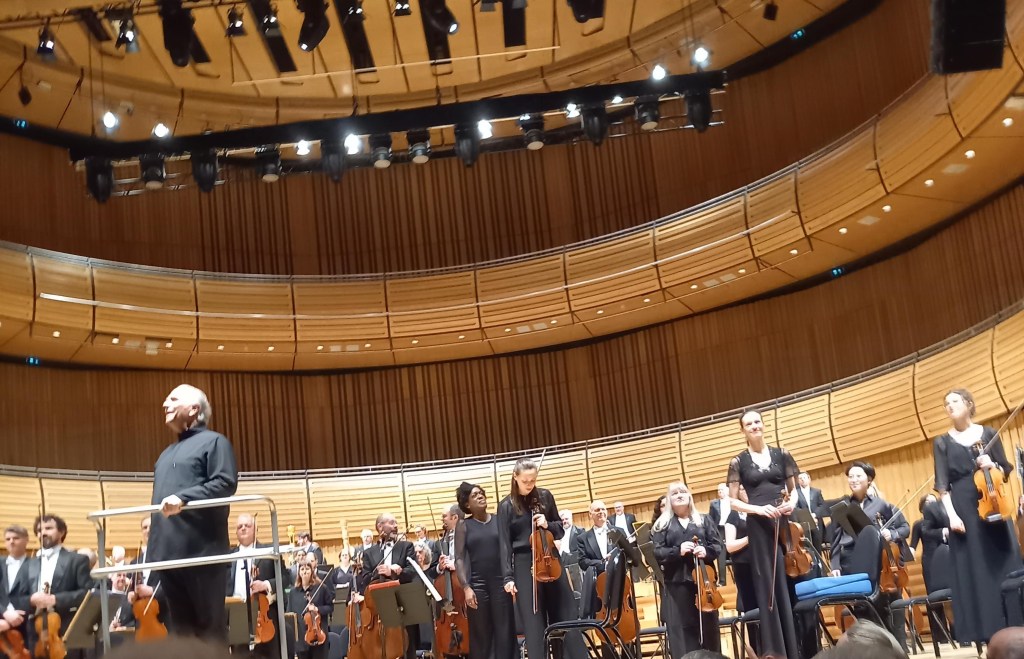
Bruckner Symphony no 8; Halle Orchestra, Mark Elder
As I have said elsewhere in this blog, I have been lucky to hear several very fine Bruckner 8s live over the years. This performance was the equal, at the very least, of nearly all of them, as I experienced it.
Astonishingly, this run of performances with the Halle is the first time Elder has ever conducted the work. I remember reading somewhere that he felt for a long time he had little to ‘say’ about the work that would warrant his conducting it – though back in 2011 he was saying in an interview that he thought it was one of his 5 favourite symphonies. It’s very difficult to express what I found so special about this performance but here are some thoughts:
1. Clarity of sound. It was interesting to see Sir Mark’s arrangement of the orchestra for the Bruckner 8. On an elevated level, there were 3 harps at the centre back, timpani next to them, horns, Wagner tubas and bass tuba to the left and trumpets and trombones to the right. The harps come into startling prominence as a consequence, in the second and third movements. Critically, the splitting of the violins opens a whole new sound world and I heard details of the string writing I’ve never heard before. Likewise, I noted several occasions when Elder was dampening the sound of brass and strings to allow the woodwind to shine through and I heard in general far more of the woodwind inner voices than is normally the case eg in the 2nd movement. The brass wings sounded both distinct from each other because of their raised and varied position when needed and were at the same time able make a gloriously homogenised sound when required. Another instance of clarity was at the very end of the work – the final Wagnerian blaze can sometimes seem a bit of a sonic soup but here the various strands were clearly audible.
2. Narrative. This is difficult to explain but Elder somehow conveys a real sense of the relationship between the different segments of the music as they veer between heaven and something approaching hell in this symphony – which means you feel you are following a deeply involving story. I have rarely felt so deeply the ‘heavenly’ vision of the start of the third movement and the tragic yearning of the second subject of that movement. The whole of the third movement had an arc of narrative I have rarely heard live before and which made it deeply absorbing
3. Shaping. Over the years the Halle and Elder in the late Romantic repertoire have developed an instinctive phrasing of the melodic material of these large works (Wagner, Mahler, Elgar etc) which gives them a sound that blooms and flourishes. The transitions involved in the melodic arcs are often beautifully handled – often a slight rallentando is used as players lean into a melody.
4. Affinity. There is something very special about the way Elder and the Halle have grown to understand each other. As you would expect Elder had an open score in front of him, and his conducting is not overly demonstrative, yet he was utterly in control (I heard one very minor early entry, from one of the first violins, throughout all 85 minutes or so)
5. Tempi. These to me sounded spot on – flexible, not mannered, not lumbering, nor too fast. Actually – listening again on the radio on Tuesday 5/3/24 (on I-Player for a month) to the Bridgewater Hall performance, a couple of days before Newcastle, I realised the tempi were in objective terms quite slow and measured. But they came across in Newcastle as exactly the right ones to be using, and didn’t at all drag.
I was pleased that Elder was using the Haas 1939 edition of the work. This allows a couple more minutes of music to be heard not in the Nowak edition
There was a huge ovation at the end – I heard from comments afterwards that this had been a very special occasion for many. All in all, my day at the big Bruckner Glasshouse weekend was really rewarding, even if it meant afterwards negotiating my way through the crowded Saturday night streets – Newcastle on a Saturday evening is quite something………!