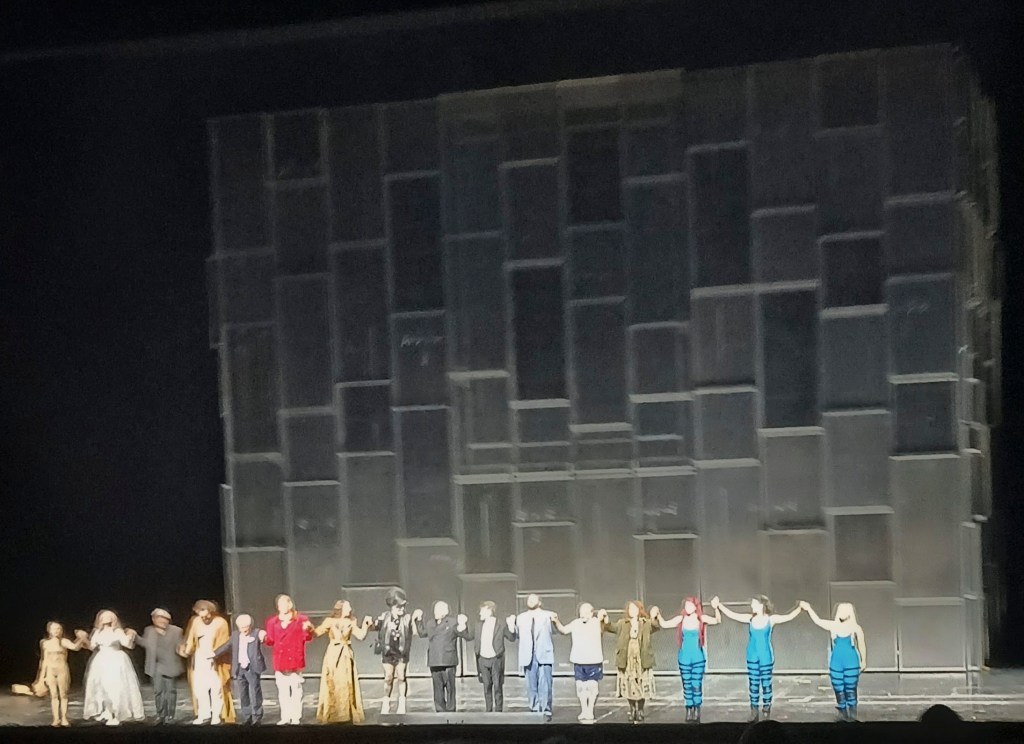
Calixto Bieito, Director; Rebecca Ringst, Set design; Ingo Krügler, Costume design; Michael Bauer, Lighting design; Video design, Sarah Derendinger. Conductor, Pablo Heras-Casado. Christopher Maltman, Wotan; Florent Mbia, Donner; Matthew Cairns, Froh; Simon O’Neill, Loge; Mika Kares, Fafner; Brian Mulligan, Alberich; Gerhard Siegel, Mime; Eve-Maud Hubeaux, Fricka; Eliza Boom, Freia; Kwangchul Youn, Fasolt; Marie-Nicole Lemieux, Erda; Margarita Polonskaya, Woglinde; Isabel Signoret, Wellgunde; Katharina Magiera, Flosshilde
So, here I am now in Paris, after a smooth Manchester to London / Eurostar journey. The streets around the hotel I normally stay in in Paris are much the same, despite a national strike yesterday and the prospect of more protests tomorrow – I did see a painted sign on a closed shop ‘Pouvoir pour les enfants’, but that was about it. My walk to the Opera from the hotel took in the usual crowds of young middle class professionals having a meal or a drink after work.
I got to the theatre about half an hour before curtain up and outside there was a huge young-people-singalong going on with someone beating a drum – the songs clearly stirring people up to positive action, and I caught the word ‘anti-fascisme’ a couple of times. I wondered whether it was aimed at the Opera Bastille, but I think the steep steps outside the Opera are just a place where young people hang out – I remember this from my previous visits.
The audience was clearly quite an international one – I knew that the Wagner Society of New York were there in numbers, but I heard English, Italian, Spanish and Dutch or Belgian voices as well. My seat is towards the back of the stalls – a bit recessed, but as there is quite a shallow pit, the orchestra comes across well.
I can’t remember a production where videos have played such an integral part of the set – the video display is constantly changing and is always there – perhaps occasionally distracting, but giving huge depth to what is happening on stage. Unlike the Bayreuth ‘AI’ Ring this summer, though, where projected images just took over, so critics said, at the expense of any clear direction to singers, this had much happening on stage that was insightful and interesting. The scenery was essentially as in the curtain call photo below – a big metal sheet with lots of uneven panels and with doors and a bridge included. It clanked occasionally but not really distractingly. The stage and the metal sheet could be raised up, so that for the Nibelheim scene we saw a set of workshops beneath the stage, split into sections. The videos may have been constantly changing and in motion but there are certain themes into which they can be grouped: endless running of numbers, grids and squares, electrical wiring, female robot dolls in close up, particularly faces, structures – horizontal and vertical lines, usually perpetually in motion; and for the opening, the Erda and the Rainbow bridge scenes some particular images I’ll discuss below. The videos are manically energetic, suggesting the over-arching madness of the modern world, the vast powers now at humanity’s disposal but which it can no longer, in fact, control. (as in the Bridle book).
The prelude begins, as it should, in total darkness – the opening video images are of 1950’s family house, a fine dining restaurant, middle class comfort. Suddenly the screen explodes into, I guess, modernity, and grids and numbers (I think) start scrolling, which they continue to do for most of the first scene. The Rhinemaidens are static throughout the first scene – Alberich, in a business suit, but looking as though he has a mid-life crisis on his hands, has a limp full size naked female doll which he drags on stage. It’s perhaps not very clear exactly what the Rhinemaidens are guarding as ‘the Rheingold’ – perhaps it is human creativity, intelligence, human ingenuity (though the continuinuingly repeated numbers may mean it’s crypto-currency), but there is definitely a ‘ring’, in this case a collar, which is there, already fashioned, with the Rhinemaidens, representing human control over nature. Alberich is aggressively sexual, pummelling the female doll, having sex with it, and he finally drags it off stage, laughing, with the ring/collar.
Wotan and Fricka are seated on a huge red couch wheeled on stage in Scene 2, Wotan in a cool black outfit, Fricka a more sexualised figure than she sometimes is. There is both violence and attraction in their relationship, which is much more nuanced than it sometimes is. Fricka also has a flirt with Fafner during the scene. Fasolt is dressed as a rather harassed businessman, Fafner has a Stetson and red cowboy outfit, while Loge is in drag with glittery short skirt, fishnet black stockings and high heels! The general feel is that the gods are emotionally uncaring, living for the moment, and driven by sex and power. As the descent to Nibelheim begins, we start to see AI human female dolls on screen, and in fact the Nibelungs’ underground workshops are now devoted to the creation of them – human passion perversely transformed by Alberich into something robotic and controlled. One robot has become fully alive, and is portrayed by a female dancer (the robot is called Gisela in the programme – is she to be the mother of Hagen?). When we go back up from the depths for Scene 4, there are some remarkable videos, giving great depth to what is happening on stage. When Erda appears, the videos suggest a sense of depth, of perspective, of a line stretching to infinity, and the endless action ceases, As Donner gets going with his thunder and the Rainbow Bridge music begins, this text appears on the video screens – “Le Dieu existe. C’est toi!!”. This is repeated hundreds of times, the wording getting smaller and smaller. A real drawbridge comes down from the metal set and Wotan and Fricka put on scrub-type lab costumes. This is all in line with a quote from Bieito which again comes from the Independent interview with him – “We are living in a moment where the gods, they don’t exist anymore — I’m talking about Western society. The human beings, they believe they are gods,” he said. “We are creating a machine ourselves. We are creating god.” At the ending, while Wotan and Fricka are ensconced in their Silicon Valley Valhalla lab, Fafner goes off with Freia, Ring collar round his neck. The final video image is of a baby’s face – probably AI – with the Ring collar (is this Hagen? Humanity’s future?).
The video imagery, as I have said, is intense and sometimes near-overwhelming, but always (and much more so than its use in, say, the most recent Bayreuth Parsifal) appropriate. What is excellent is that on top of it all, the characters on stage are always reacting to each other meaningfully. Sometimes, on the big Opera Bastille stage, it’s not always possible to pick up on everything that’s going on, and there’s a lot that’s quite subtle and would need repeated viewing to appreciate – but I thought in particular Scene 2 was very well-managed, each character individualised and not just waiting their turn on stage to sing. And the story is pretty clearly told, too, for newcomers, despite all that’s going on – there is a Ring, Wotan’s spear, a Tarnhelm, for instance, and something like a hoard, though it was difficult to see exactly what it looked like.
Musically, in terms of the conducting of Pablo Heras-Casado, this was not a heavy portentous reading, but quite fleet-footed and clear in sound – good for Scene 3 – though with grandeur when needed (the Rainbow Bridge was glorious). It took about two and a half hours – so not particularly fast – and the music-making always felt alert and tight (I counted one small orchestral false-entry). The outstanding singers for me were Maltman, O’Neill and Siegel. Christopher Maltman was as good a Wotan as he had been in London – a notably well-projected voice, an ability to sing lyrically and with better diction than most, and nasty in the same way as in the Kosky production. O’Neill’s performance was a bit of a tour de force – from someone whose career has been built on singing Tristan and Parsifal, this was an excellent piece of character singing and acting in a totally different role, with lots of drag queen twirls, and, again, clear diction. I thought Gerhard Siegel was as good a Mime as I have ever heard, though we’ll see how he does in Siegfried. Mika Kares was a powerfully resonant Fafner, boding well for his Hagen. Everyone else was sound, though the Rhinemaidens were a bit squally, as was Fricka at times (though her acting was excellent). Brian Mulligan as Alberich was excellent in his acting – his voice, in this theatre, sometimes sounded a bit under-powered.
It will be interesting to see how this Ring develops – Rhinegold is always the easiest to hang a concept on, the others less so. Here’s a trailer giving a sense of the production (with a different Wotan) https://www.operadeparis.fr/en/season-26-27/opera/das-rheingold – you have to scroll down to the ‘watch’ bit