(Written a couple of days before my trip to Paris). Although the ROHCG Kosky Ring is coming up in Autumn 2027, and I shall certainly be going to that, I couldn’t resist a week and a bit in Paris a year earlier to see the Bieito Ring, of which I have heard interesting things. The cast looked very strong, and I am lucky in having the time and money to do this.
A commentator on classical music issues I read somewhere recently said that there are four Ring cycles in various stages of emergence at present across the world which are of real significance in the ongoing history of staging this great work. One is the Kratzer/Jurowski production in Munich; the second is the Salzburg one getting underway with Serebrennikov and Petrenko; the third is the ROHCG one with Kosky and Pappano/Hrusa, and the fourth is this one in Paris with Bieito and Heras-Casado, the first one to reach the finishing line. The commentator went on to say that they had chosen these four because all of them have a good grip on narrative (ie a newcomer would understand what was going on) but also because they had significant things to say about how these works are important for us today. So……on to my first full Ring cycle in fully staged and full-orchestra form over a week to 10 days since 2022 (at Bayreuth; there was also the Regent Opera Ring, a 25-piece orchestra but fully staged, in 2025). This is only the 7th production of the Ring cycle I’ve heard in the intense 1 – 2 week time-span Wagner intended (ENO’s seen multiple times in the 70’s, Bayreuth x 2, ROHCG x 2, Regent Opera) in 56 years of going to Wagner music dramas. (I’m not counting the Opera North one in 2016 because it was not being fully staged).
Bieito was apparently commissioned by the Paris Opera to direct the Ring as long ago as 2015 and was in rehearsals for an April 2020 opening when COVID stopped everything for a year. The project was started afresh in December 2024 and Götterdämmerung premiered a few weeks ago, to mixed critical reaction.
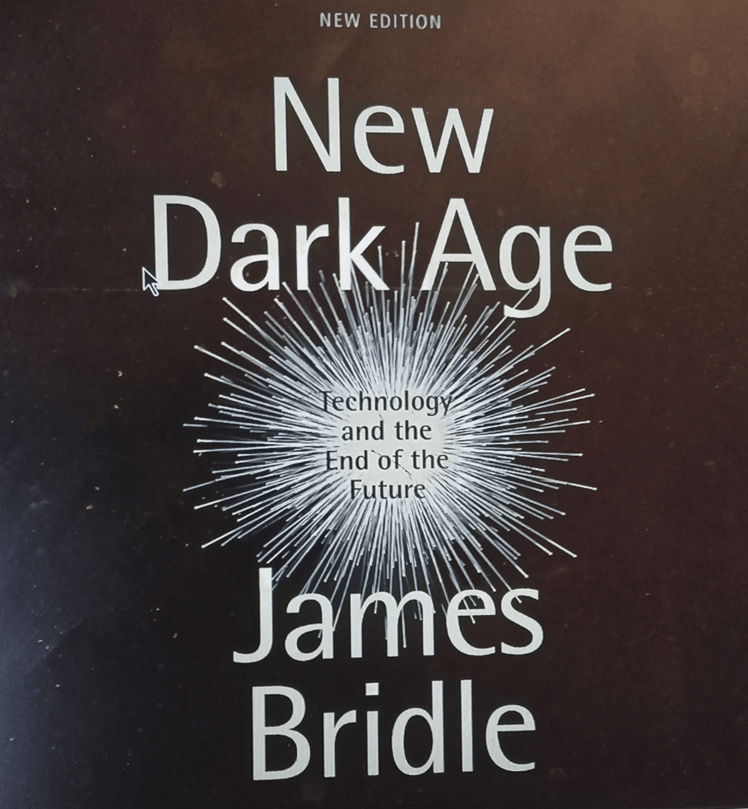
When Rheingold was first shown in 2025 the Independent reported an interview with Bieto, in which he said that he had been influenced in developing this production by James Bridle’s book “New Dark Age: Technology and the End of the Future.” By the sound of it there is undoubtedly a connection, indeed a close link. Bridle’s book is about, firstly, technology as a source of obscurity rather than enlightenment – increasing technological complexity has not produced greater understanding but rather opacity, surveillance, algorithmic power and social fragmentation. The Rheingold production, according to reviews, references cryptocurrency as the equivalent of gold, tangled masses of cables, television screens, and an AI-created humanoid figure. Bridle refers to invisible technological systems that govern modern life while remaining poorly understood. Wagner’s world of industrial exploitation in the 19th century (his famous reference in his last visit to London to that city looking like ‘his Nibelheim’) is replaced in this production, as I have read in reviews, by digital and networked power, echoing Bridle’s concerns about modern systems that are both omnipresent and obscure. Finally Bridle links computational culture to environmental crisis and climate catastrophe, and the reviews of this Ring seem to describe a landscape that’s post-apocalyptic and dystopian, depicting a world where nature has lost its bearings and civilization survives amidst ruins and debris. Bridle concludes that we need a new Dark Age, purging ourselves of our current obsession with data, in order to survive. He says in his book “Like climate change, the effects of technology are widespread across the globe and are already affecting every area of our lives. These effects are potentially catastrophic, and result from an inability to comprehend the turbulent and networked outputs of our own inventions. As such, they upset what we have naively come to expect as the natural order of things, and they require a radical rethinking of the ways in which we think the world”. But the other thrust of this book is that all is not lost: if we “really are capable of thinking in new ways, then we are also capable of rethinking the world, and thus understanding and living differently within it. And just as our current understanding of the world proceeds from our scientific discoveries, so our rethinking of it must emerge from and alongside our technological inventions, which are very real manifestations of the contested, complex, and contradictory state of the world itself. Our technologies are extensions of ourselves, codified in machines and infrastructures, in frameworks of knowledge and action; truly thought, they offer a model of a truer world. We have been conditioned to think of the darkness as a place of danger, even of death. But the darkness can also be a place of freedom and possibility, a place of equality. For many, what is discussed here will be obvious, because they have always lived in this darkness that seems so threatening to the privileged. We have much to learn about unknowing. Uncertainty can be productive, even sublime.”
At the point of writing this, I have no idea what the details of this production are, though I have seen some emerging reviews. Going back to that Independent review last year, the reviewer, Ronald Blum, wrote that the ‘AI machines developed in “Rheingold” will cause war in “Die Walküre,” nature will rebel in “Siegfried” and characters will gather in a Wagnerian-period living room as consciousness disappears into a black hole in “Götterdämmerung.” Well……let’s see…….Bieito apparently, we’re told, also visited moors near Haworth, home of the Brontë family, to find his mood for the Ring. What impact that will have on the production remains to be seen……………….
Of course, what’s been happening outside the Opera at Place de la Bastille and more widely Paris and across France over the last few weeks – rioting young people enraged at the lack of investment in education and poor prospects – is wholly relevant to the Ring. We’ll see whether any protests affect the performances – luckily my hotel is only 15 mins or so away from the Opera Bastille via back streets, so I don’t need to use the Metro. But I noted with foreboding that the Paris Opera performance of the Barber of Seville on Thursday 5/11 had been cancelled because of strikes.