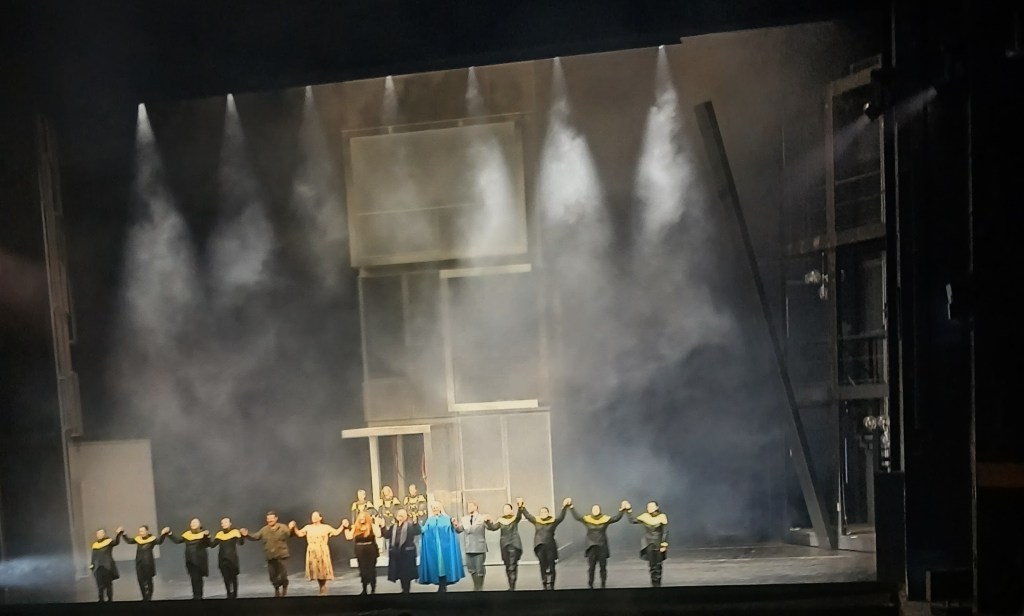
Production team as above. Conductor, Pablo Heras-Casado. Stanislas de Barbeyrac, Siegmund; Christopher Maltman, Wotan; Günther Groissböck, Hunding; Elza van den Heever, Sieglinde; Tamara Wilson, Brünnhilde; Eve-Maud Hubeaux, Fricka
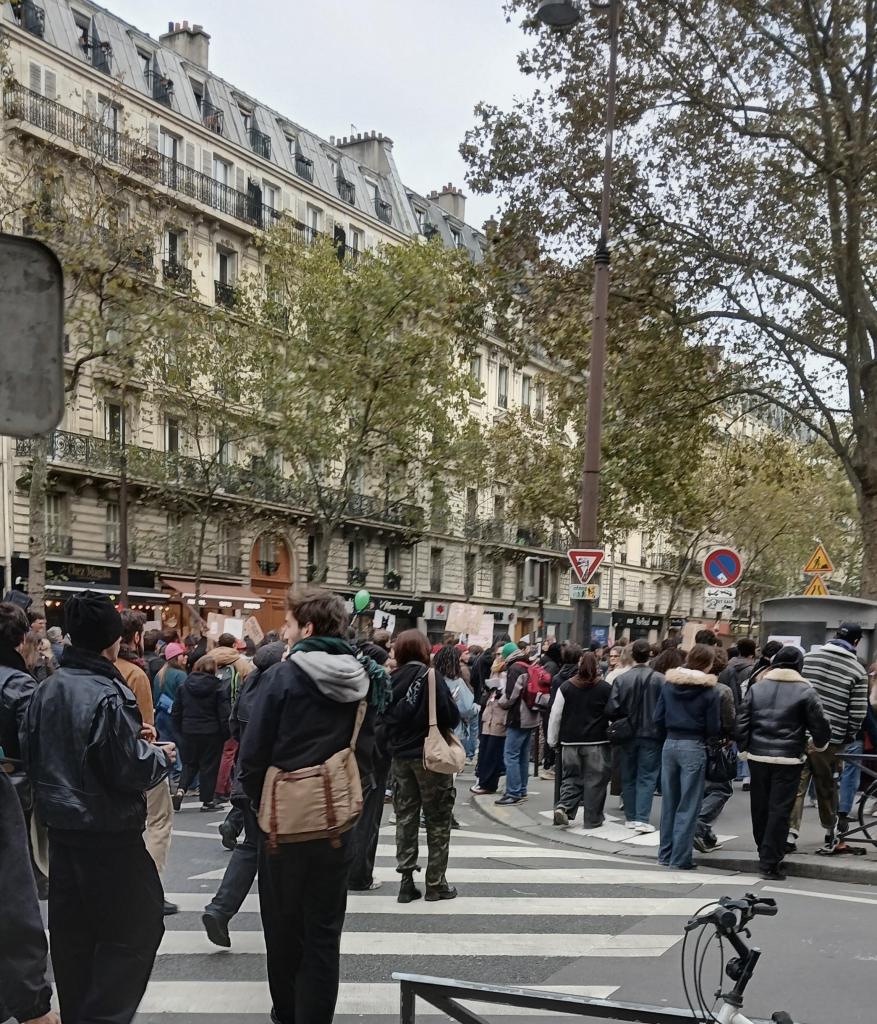
This performance I genuinely wondered about – would the Saturday protests allow it to go ahead? The Metro stations near me were all closed, so my planned trip to the newly restored Notre Dame Cathedral had to be postponed – I spent my morning wandering around the Pere Lachaise cemetery. When I walked back to my hotel hoping to have some lunch the police were closing roads and restaurants (I now saw that a number of them in my vicinity had had smashed front windows – particularly McDonalds (!)). There were lots of police sirens, and helicopters overhead, as the afternoon wore on…….Still, I reflected that the audience members filing in to the Opera Bastille for one of a run of Gotterdammerung performances a few weeks ago had to do so through lingering tear gas, so maybe things would be OK. The French, I said to myself, are used to these things. So…as you can see below, all was well and went ahead, I did though find myself seeing the march going past the front door of my hotel – see photo below. It was very peaceful – and with a lot of school children.
This was a performance which caught fire with Wotan’s scene with Brunnhilde in Act 2 and thereafter was very fine indeed. Curiously for the most part it did so through old fashioned stage action and fine singing, with elaborate video images having little to do with it, apart from the opening of the Ride of the Valkyries. It was almost as though the concrete stage demands set by Wagner, and the need to tell the story clearly with these complex people on stage, had in this ‘human’ work relegated the videos to simply an entertainment for the more spectacular bits. I had wondered a bit beforehand about whether this might happen. We’ll see how Siegfried goes.
Throughout there is an atmosphere of violence and a post-apocalypse setting. Siegmund arrives from his flight in gas mask and oxygen cylinder. Hunding attacks Sieglinde violently; so does Wotan to Brunnhilde in Act 2, and bodies are all over the place at the beginning of Act 3.
Act 1 opens with the same metal sheeting. This is how I described it for Rheingold, but in fact behind the front sheeting lies (or coverts into) a range of gantries, mid-way rooms and towers which get fully used in this music drama. The video imagery shows someone escaping from an industrial complex – multiple pictures of never-ending ladders going round and round in circles. There are also – I think, maybe this was only the later acts – images of war. Eventually the sheeting reveals a room half way up from the stage level which is Hunding’s hut, and Sigmund slumped to its right. Sieglinde picks up a pistol and points it at Siegmund when she first arrived – and indeed for the first 5 minutes is very hostile. Thereafter the act goes forward much as it does in other performances, dependent on the credibility of the acting and sense of relationship between the three characters, and helped by a video camera inside the room, which projects onto the set outside the room huge images of what is happening there. All three are in modern dress – Sieglinde looking slightly 50’s-60’s, Siegmund casual, and Hunding in a 3 piece suit, with a dead deer he brings in. Hunding is particularly interestingly portrayed – he is a man who is obsessive, constantly fiddling with his clothing, so tense he sleeps bolt upright, changes into his (Nazi?) army uniform half way through, and gets more and more agitated as the act progresses, seemingly knowing about Siegmund’s and Sieglinde’s love for each other. At the end he violently stabs the deer repeatedly. He remains in the upstairs room, while the two lovers creep down to stage level and their scenes after Hunding goes to bed are presented there. There is no door opening up to Spring (though some appropriate video colours), no sword in a tree or glimmers of it while Siegmund sits by the fire, but somehow a sword is produced at the end from the ground for ”Siegmund, heiss ich”. Videos scarcely feature once Siegmund is on his own and then joined by Sieglinde.
Act 2 prelude shows what a violent and war-like society this has become there is video’d thermal heat imagery in primary colours of dogs stalking and killing a deer, their fangs close up. When Wotan is seen on stage he is playing with a robo-dog, and the background of where he and Fricka have their argument is strewn with cables, as well as large red sofas. Again, there is a video camera embedded within the room, giving close-ups of Fricka and Wotan – at points Wotan appears to be playing to the cameras, winking and nodding to the audience. In Wotan’s scene with Brunnhilde as far as I recall there are no video images at all – at the most, some video camera work. As Siegmund and Sieglinde come on stage there are more images of fierce dogs. The interaction between Brunnhilde and Siegmund in the Todesverkundigung scene uses some of the different ‘rooms’ in the metal structure, including a top room like a recording studio where Brunnhilde begins her announcement of death to Siegmund. The different rooms open up for the fight between Siegmund and Hunding, so they can chase, under flashing video imagery, from space to space. Such a lot happens in less than a minute always at the end of Act 2 that it is often difficult in different productions to know what is going on. Here Wotan, I think, himself kills Siegmund. There is no evidence of a shattered sword, although one is later given to Sieglinde.
The wild dogs and their fangs return at the beginning of Act 3, together with a manic crowded canvas of maybe 20 video screens all different and constantly changing – most warlike, others grotesque. In Act 3 the metal sheet totally fragments – see photo below – into a square high tower and some outliers. The robo dog again starts the proceedings, looking straight at the audience and conjuring up a video image of an AI-generated blank faced audience . At the beginning all levels of the still integrated metal screen are used for the Valkyries to sing from, dressed in cyborg-type black uniforms, with green headlamps, including an extra 3 dancers who scale spectacularly down the walls. After that imagery ceases it is then just good old singing and acting on stage of the highest quality that’s present, with video imagery almost non-existent, apart from some sudden frazzles of interference when the emotional temperature of music and words demand it. It wasn’t quite clear why Wotan is so obsessed with the coloured stones (that’s how they looked to me – I see reviewers with better seats said gas masks) he’s placing round the stage, as Brunnhilde pleads for a fire round her rock. I thought maybe crystals, maybe some displacement activity, but it would make more sense for him to be putting down lights for the fire. In fact there is no video imagery at all for the magic fire – just dry ice, red lighting, and Brunnhilde imprisoned in that upper room. Wotan waltzes with himself off stage at the end – I am not sure this really worked or connected with the powerful emotion of the music.
This performance was moving and exciting because of some excellent singing and handling of stage interactions. Act 1 seemed fidgety and wilful at times in staging, and, good though Stanislas de Barbeyrac is, I found his singing this time a bit monochrome, and with less soft singing than the role really needs in Act 1 – although I should add that, as a local lad, he got a huge cheer at the end. I was delighted to hear Liza van der Heever in a staged role, having heard her at the Proms this year. Her diction was excellent, her pointing of words thoughtful – her voice is not as beautiful as some others in this role, but she was wholly convincing. Gunther Groessboeck sounded in much better voice than I have heard him recently, and his was a riveting account of Hunding. But somehow this was not – a personal view – a fully engaging rendition of Act 1. Maybe Heras-Casado set too fast a pace, maybe it was the awkwardness and business of some of the staging, when less would have meant more.
But somehow, from the moment Wotan started his monologue, I was transfixed. There was no extraneous business, just Wotan and Brunnhilde reacting to each other, diction clear, singing with sensitivity. I thought Maltman was absolutely outstanding throughout, and I have rarely heard Act 3 sung so well – it helped that Heras-Casado put the brakes on from the moment the Valkyries left, so that Maltman really had time to caress the words, pointing the meaning beautifully. I thought he was better than he had been at Covent Garden in 2025. And I was very agreeably surprised by Tamara Wilson, whom I have not heard (or even of) before this set of performances. Again, one could imagine a more beautiful voice, but she can ping the top notes, she can fine her voice down expressively, and I was very moved by both her Todesverkundigung singing and her pleas to Wotan, as well as by the physicality of her actions. There was such intelligence in her singing, and in her movements…! Bieito had clearly worked closely with the singers, as Kosky also had done, and this came out in how Brunnhilde and Wotan interacted – rather than the usual clinching embrace at the orchestral climax towards the end of Act 3, Brunnhilde started punching Wotan and screaming – this felt very moving. Fricka again acted well, but wasn’t distinguished in the same way, while the Valkyries were a varied lot, some much more impressive than others. From Act 2 onwards, Heras-Casado got the tempi, to my mind, just right, and the orchestra played with energy and power (and accuracy).
I thought everyone in the audience felt at the end this has been something rather special – there was a standing ovation, and lots of cheering, a feeling perhaps also encouraged by the unexpected gift from the Opera Bastille of ‘free’ fancy rolls and a glass of champagne for one of the intervals for each member of the audience!