The Hallé, ENO Chorus, Opera Rara. Paul Daniel Conductor; Alistair McGowan, narrator; Loïc Félix, Bababeck; Mathias Vidal, Saëb; François Piolino, Kaliboul’; Philippe Talbot, Xaïloum; Anne-Catherine Gillet, Maïma; Valerie Eickhoff, Balkis; Katia Ledoux, Périzade; Thibault de Damas, Le grand Mogol.
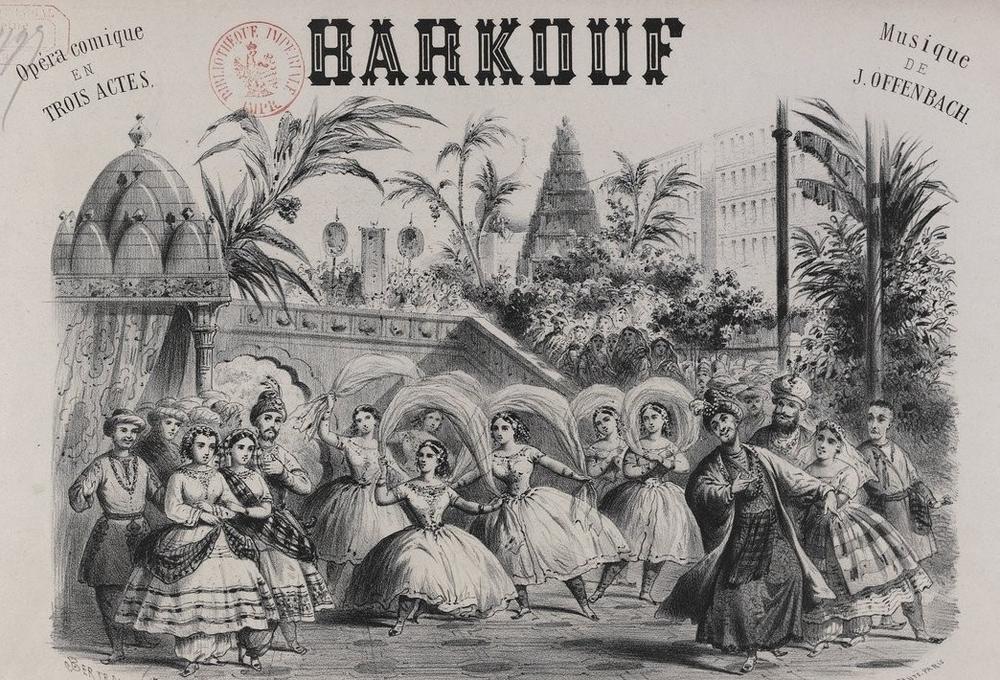
This is not a well-known work – as I suppose its appearance under the auspices of Opera Rara would indicate – and not one I’ve even heard of before. The Great Mogul of Lahore, the ‘ruler of all rulers, star of all stars’ appoints Barkouf, the dog, as the head of government to humiliate his rebellious people, in a country where, to quote the Bridgewater Hall blurb, “corruption runs wild, flattery is an art form and the only thing more dangerous than power are the incompetent politicians desperate to win it …The dog rallies the people and proves that even the unlikeliest hero can change history. …………….. Barkouf is a riotous romp through pomp, politics and power that is as relevant today as it was when it was first performed in 1860” (where after a few performances it was shut down, as being too critical of the 2nd Empire political establishment, and because of a whole series of mishaps with cast rivalry and illness). The story features a baddy, also Grand Vizier of Lahore – Bababeck – and a young woman who runs a fruit stall – Maïma. The Sultan appoints the dog he’s encountered as ruler of Lahore and Maima then realises that the dog is hers. She persuades Bababeck that only she can interpret what Bakouf is ‘saying’ and then issues some very liberal pronouncements in her interpretations, which shock Bababeck and his cronies. At the same time Bababeck is trying to marry off his annoying daughter to Saeb, through blackmailing his father – but Saeb is also Maima’s boyfriend. Barkouf’s woofs are translated by Maima to mean that he wants the marriage annulled, to the fury of Bababeck, who then, with his friends, plots a revolt but eventually is foiled by Maima – though Barkouf gets killed in the ensuing fight. All ends happily for Maima and Saeb
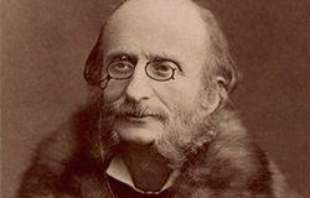
In a conversation between Flora Willson and Paul Daniel, the conductor, before the show, Paul mentioned that Offenbach had written about 130 musical stage works, including comic operas – of which only 4 or 5 are in the repertory. Many of the 130 musical stage works’ full scores have been lost and in the case of Barkouf a lot of detective work has been undertaken by Jean-Christophe Keck, rooting out manuscripts from members of the Offenbach family, and French and American libraries (M.Keck was actually part of the performance, playing the part of the dog Barkouf off stage with a terrific collection of doggy growls and snarls). There are apparently other Offenbach works M.Keck is working on.
Opera Rara I realised I didn’t know much about. They apparently receive no public funds and rely on private funding of approx £1 million a year to bring at least one or two unknown works to the public’s attention annually. Their primary focus is on producing a recording, as with this show, and then the live performance is the icing on the cake – so orchestra, chorus and soloists have just finished their recording in Halle St Peters after two weeks of intensive work. Opera Rara clearly has the funding to do things in style – hiring the Halle, hiring Paul Daniel (not only a very experienced opera conductor, but also with a lot of experience in France) and bringing together a really first-rate group of mainly French or Francophone singers, all with international experience.
Paul Daniel in his pre concert conversation talked about the superiority of Offenbach’s music to Gilbert and Sullivan, who are the nearest comparison that comes to mind (and Offenbach was in the UK for a couple of years at the time of the Franco-Prussian war, so connections could have been/?were made). Paul Daniel described G & S as ‘piano music’ transposed for the orchestra, rather 4 square and routine, whereas Offenbach is much more innovative (he was a keen student of Berlioz’s orchestration – Berlioz never learned the piano). Apart from that there’s a certain “zing” in Offenbach’s music, a fizz you never get with G&S. Of course ,Gilbert’s text is sometimes very funny – as a box office success Offenbach was paired with the most eminent librettist of the mid 19th century opera house, Scribe. There’s not much sparkle in the sung text – however for this performance Jeremy Sams (who else?) had prepared a narrative to replace the characters’ spoken exchanges. More on that below.
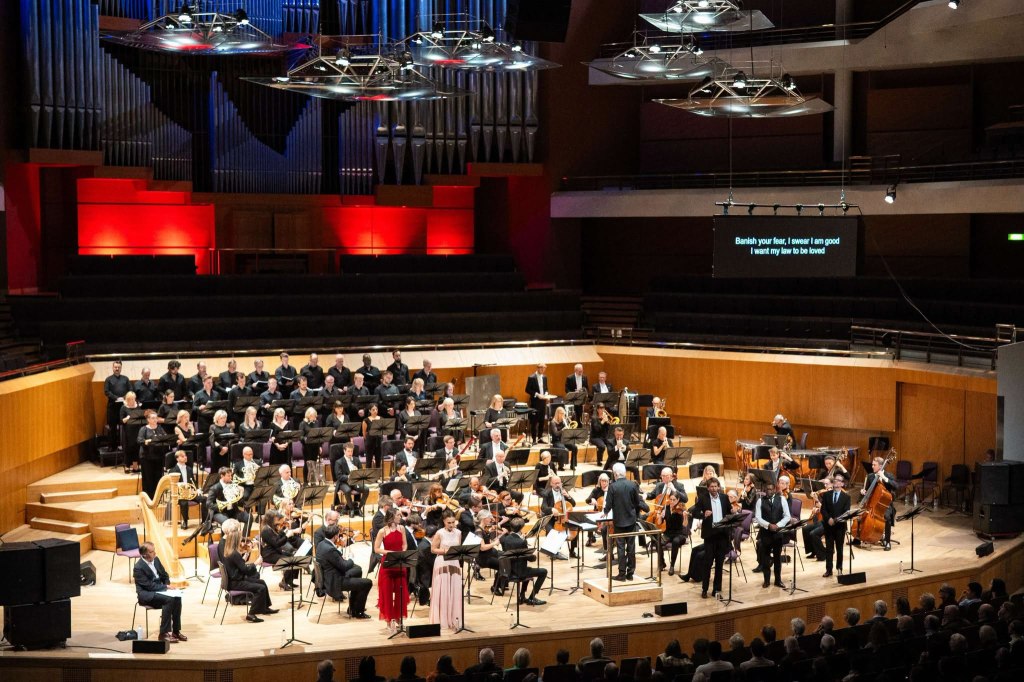
The singers were lined up behind music stands but – from my close-by position (Row B) – they were all engaging with each other, with even a very passionate kiss towards the end between Maima and Saeb. They were also all experts at this sort of music and had the ability to deal with staccato singing at speed, as well as shaping the more lyrical aspects beautifully, The people with the most to do – and absolutely able to make the most of it – were Anne-Catherine Gillet, as Maïma, and Loïc Félix, as Bababeck. Ms Gillet I fell in love with by the end of the first act – in movement, in singing, in pointed characterisation she was superb. Loic Felix has to project a suitably nasty manner and deal with the Offenbach equivalent of patter songs, and he did this brilliantly. All the other cast members were in their different ways equally capable but a special shout for Katia Ledoux, as Bababeck unmarried daughter, Périzade, a wonderful character actor. The Halle, reduced in numbers naturally (4 cellos for instance) were incisive and the ENO Chorus and RNCM singers all made the most of their parts. Paul Daniel presided over the whole thing with extreme economy of movement but total control. The one question I had was over the narrator, Alistair McGowan. He is apparently a stand-up comic as well as an actor, and a brilliant mimic (he did 8 of the political voices in Spitting Image some years ago). He read the actual narrative very well, with effective pointing, but kept putting on different voices for any quotes from Maima – Cockney, Welsh and something else. He was also given – for no particular reason unless it was simply to pad out a rather short second half – a stand-up comic slot at the beginning of the 3rd Act – lots of different accents and various Mancunian jokes, particularly about the current travails of Manchester City FC (I don’t know how that went down with those in the audience – the majority – from Manchester). I thought he was a bit too much of a good thing.
Anyway, a thoroughly enjoyable evening