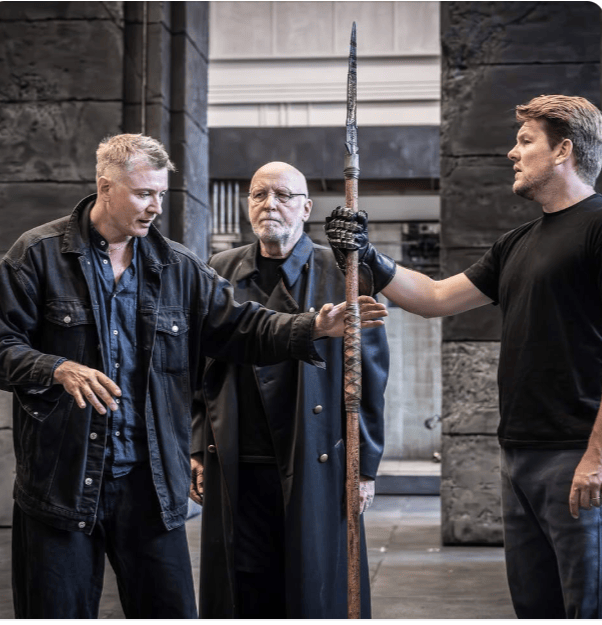
Director, Evgeny Titov; Set Designer, Etienne Pluss; Costume Designer, Esther Bialas; Lighting Designer, D. M. Wood; Video Designer, Christopher Ash. Conductor, Jakub Hrůša. Parsifal, Stanislas de Barbeyrac; Kundry, Ekaterina Gubanova; Christian Gerhaher, Amfortas; Christian Gerhaher; Gurnemanz, Andreas Bauer Kanabas (replacing Brindley Sherratt); Klingsor, Mark Stone; Titurel, James Platt
The ROHCG website announced that “This production contains nudity, blood, violence and self-harm.” To which, I suppose, one could reply – ‘and so does the Bible….’. My forebodings about this new production were fed by the ROH publicity – “This bold and dystopian staging gives a science-fiction twist to Wagner’s religious epic, which explores themes of power, gender and ideology” (NB no reference there to the exploration of religion or religious experience, which is the whole focus of the work); “Breathtaking lighting and a hallucinatory, dystopian set design bring Wagner’s all-consuming final opera to pulsating life in Evgeny Titov’s bold, dreamlike and disturbing debut production”. Oh dear……some preview photographs of sets suggested something indeed very different from woodland glades for Act 1. I read the headlines of an interview with the director Evgeny Titov which also did not get me enthused – ‘it’s an ugly, sexist piece’ he said, before the article disappeared behind the Times’ firewall (I agree that the Act 1 Grail community is a flawed one – that goes with the plot – and that sexism might well be part of those flaws, but it is precisely redemption from such flaws that Parsifal is offering). Media reviews of the first night were uniformly enthusiastic about the musical side and varied considerably in their enthusiasm or lack of it for the dramatic presentation – AN Wilson wrote a Substack piece calling it a ‘Catastrophe’ dramatically, others were much more positive, including Mark Berry’s Boulezian blog review, which I always pay particular attention to – however I only skimmed this; I’ll return to read in more detail after seeing the production. Anyway, I sat in the theatre, I hoped with an open mind, before curtain-up, for the best, and these are my thoughts after the event…………
Positives first:
- I was gripped and kept focused by what was happening on stage throughout the over-4 hours of this performance. Not for a minute did I find my mind wandering. That’s a huge credit to singers and director as indicated further below
- My memory doesn’t really go back to the details of what the 70’s/early 80’s productions of Parsifal were like, but in recent years I can’t recall a better acted production, and a better use of personenregie by the director, particularly in the second act. And that’s even with a jump-in for Gurnemanz, Brindley Sherratt being suddenly taken ill, who could not have had much time to work out in detail what he was meant to be doing on stage. All the characters were utterly believable, and there were many compelling touches – Kundry breast-feeding Parsifal; the naturalness of Kundry and Parsifal’s interactions later on in that act; the more than usually attentive and believable squires and pages attending Gurnemanz; the only time I have seen Flower-maidens (to give them their daft Victorian name that seems to have stuck with them) move in ways which weren’t faintly embarrassing, and who were, indeed, positively intimidating; the aggressive movement of the Grail knights in Act 3 towards Amfortas, and the latter tottering around the stage, a pathetic figure. I thought the way Kundry died during the Good Friday music was wonderfully done, and gave her character extra stature and enhanced agency – in some productions she just slinks out of view to die.
- Except for those elements I’ll touch on below, the directing of the singers was focused on telling the story, for long stretches in a straightforward compelling way, particularly in Act 2, but also in Act 1 Scene 1, and Act 3 Scene 1. Coupled with this there were, for the most part, some of the key stage props referred to (on the Grail, see below) in the text, which help newcomers to the story work out what’s going on – thus, there was a spear (for once, praise be!), there was a water bowl for washing feet etc, Parsifal appeared in black armour in that act (kind of…..) and with head covered; Kundry had a white baptismal dress. And all the characters looked credible – Kundry, Parsifal (even when mostly naked during Act 2), Amfortas, Klingsor; this again is helpful to those new to the work.
- Musically, this must be one of the best Parsifals I have seen. There were no weak links. In no particular order then: the choruses of the knights I have rarely heard sung so well and so sensitively – perhaps only equalled, but not surpassed, by Bayreuth’s, while their unseen counterparts, appropriately and sensitively distanced in some electronic way, sung beautifully; Stanislas de Barbeyrac’s Parsifal had no problems in hitting the top notes, or having the power for, say, his end of Act 2’s destruction of Klingsor’s castle, but he also sang his contributions to the Good Friday music most poetically; Christian Gerhaher’s Amfortas was astonishing in his diction, his shading of words, the way his voice could on occasion assume a kind of attenuated sound to convey his suffering – this must be the best account I have ever heard of this role; the Gurnemanz of Andreas Bauer Kanabas (replacing Brindley Sherratt) was deeply impressive – he has a huge voice which resonates far back into the Amphitheatre, and he used it very well – maybe Brindley Sherratt might have given more poetry to some moments, but this was imposing and just right for the role (touchingly he missed a line out just before the Act 1 Transformation Scene, but was completely unfazed by it – he got a huge cheer at the curtain calls); I have heard Ekaterina Gubanova’s Kundry in several different productions now but this was as good as I have ever heard her in the role, while the Klingsor, Mark Stone, did all that was required of him. This was Jakub Hrůša’s first ever set of performances of the work, and I found his reading very compelling indeed. If I were to sum up how it came across, I’d say ‘intense and flexibly compelling’. This was not a ‘slow’ or a ‘fast’ Parsifal but one where tempi were judged very well in relation to dramatic impact – on occasion in Act 2 fast, even violent, at other times among the slowest I’ve heard. But most of the time, one wasn’t feeling ‘slow’ or ‘fast’ tempi but just sensing ‘rightness’. There was great clarity at times in the orchestral playing – the often-quoted Debussy comment about the music being lit from underneath came to mind in the Prelude – but also energy, depth and passion where needed, and some remarkably intense string playing, particularly from the violas. This was an enormous personal achievement for Hrůša.
I’ll now describe sets and costumes, which were a mix of the appropriate and the mystifying. Colours throughout – for costumes and for sets – were black, white or grey – not a flash of other colours, except for the rather creepy ‘flower-maiden children’. The ‘woodland clearing’ of Act 1 Scene 1, and the similar setting, with meadows and flowers, in Act 3 Scene 1, had become a dark and gloomy set of dungeon-like rooms, with mildew stains and no evidence of recent attention or cleaning. Amfortas’ bath in the lake had become almost a torture chamber, again gloomy and stained. The Grail castle scenes were much the same – some large imposing pillars were moved on stage but essentially no change in atmosphere. In all these scenes there was evidence of an electronic surveillance system – picking up on Parsifal’s murder of the swan quickly. Act 2 is brighter and has a set of screens to stage left and a sort of office space for Klingsor – again there’s surveillance equipment. The images on the screen were, to me, mystifying – animated images at first from 600 years of Western art, mostly religious in focus, The spear and other religious artefacts seemed to be held in a mini-gallery of cases, so there is something here maybe about external possession of a religion rather than inner understandingand; there was also later 20 or more images of a face, grimacing, smiling, contorted – not recognisably any of the characters. I couldn’t work out what was intended by these. The idea of having the flower-maidens as robot – like, in grey tight-fitting metallic-looking trousers, is clever, appropriate and well-managed. What we have then is a gloomy dark dystopic Grail castle and surroundings, and a fiercely lit oppressive opposite in Klingsor’s castle
My concerns about the production were a lack of clarity on what, by the end, it all amounted to – what was it that was meant to have happened? The stage directions clearly indicate that the Grail community is made whole, ‘redeemed’, by the coming together again of Grail and Spear, and that Parsifal is ‘the redeemer’. Some have argued that Buddhism is a more important influence on the work than Christianity, and that Parsifal is a sort of Boddhisatva, who has reached enlightenment but remains on earth to help achieve others’ enlightenment (see the excellent Monsalvat website for much more along these lines). The two key elements that generated confusion, for me, anyway, were (1) where the Grail was in Acts 1 and 3 scenes’ 2, and (2) what is it that’s happening at the end of Act 3. The ‘Grail’ scenes as such have nothing in them that functions like a chalice, or glowing stone, that might traditionally represent the Grail. The Grail service involves the knights taking small cups to Amfortas’ body and drinking his blood from the wound. Essentially, they, led by Titurel, are torturing Amfortas, who wants only to die, and keeping him alive to feed on him. My assumption, from the way that he was lit, was that Amfortas himself is the Grail (this of course raises the question of what the Grail service looked like before Amfortas’ wound – but let’s not go there………). You could assume perhaps that Amfortas had become Christ on the cross, given the language used, but this only serves to complicate things more by the end. The other problem is about how the production ends. As Parsifal enters with the spear. the knights disappear, curiously, and the lighting becomes brighter – Amfortas and Parsifal are left alone on the stage. Amfortas motions to Parsifal to put the Spear over his wound, to heal him. Parsifal does this, does it again, and again, Amfortas continuing to encourage him. Suddenly Parsifal in a frenzy stabs him repeatedly, Amfortas dies, and Parsifal then crawls into a foetal position beneath Amfortas. It is very difficult to work out what is happening here. Both Amfortas and Kundry in different ways have escaped the wheel of suffering. But Parsifal despite his status as ‘redeemer’ still seems to be on that wheel at the end. Is the director trying to say that people are saved by God’s grace alone and no-one through purely human efforts can ‘redeem’ someone else or become a redeemer/ Or is it just that human life is irredeemably full of suffering. Whatever the intention, what we see on stage seemed to me to be in contradiction to what the music is saying – peace, fulfilment and reconciliation. Perhaps the director sees the final 5 minutes as celebrating Kundry and Amfortas’ escape from suffering? But what we see is a failed Parsifal before us.
To my mind, Amfortas as Grail, and the torture he is put to, is justifiable from text and music; Amfortas’ death is also justifiable – he spends most of his scenes in the opera asking for it. But the way Parsifal behaves at the end seems to me to be contradictory to the music – obviously music is not something you can put labels around, but I would challenge anyone to describe those last 5 minutes as despairing, troubled, or anxious music. So either the director is intentionally creating an ironic contrast (which may be what he intends) or he’s just got it wrong.
In a way I thought the Serebrennikov production I saw in April in Vienna had the more effective ending. But, until those last 5 minutes, I thought in many ways this Titov production was truer to the work, and more effective in bringing forth insights about it which I hadn’t thought of before. My forebodings by and large were unjustified, I’m glad to say………………….
I do think though there is a difficult balance that ROHCG has in commissioning directors to work on big pieces like this. It has two sets of people to keep happy – there are the old lags like me, who can place the production in the context of others they’ve seen, and be interested in different approaches; but there are others seeing it for the first time. What would they have made of it, and would they have come away about misconceptions about the work? Food for thought, anyway…………….
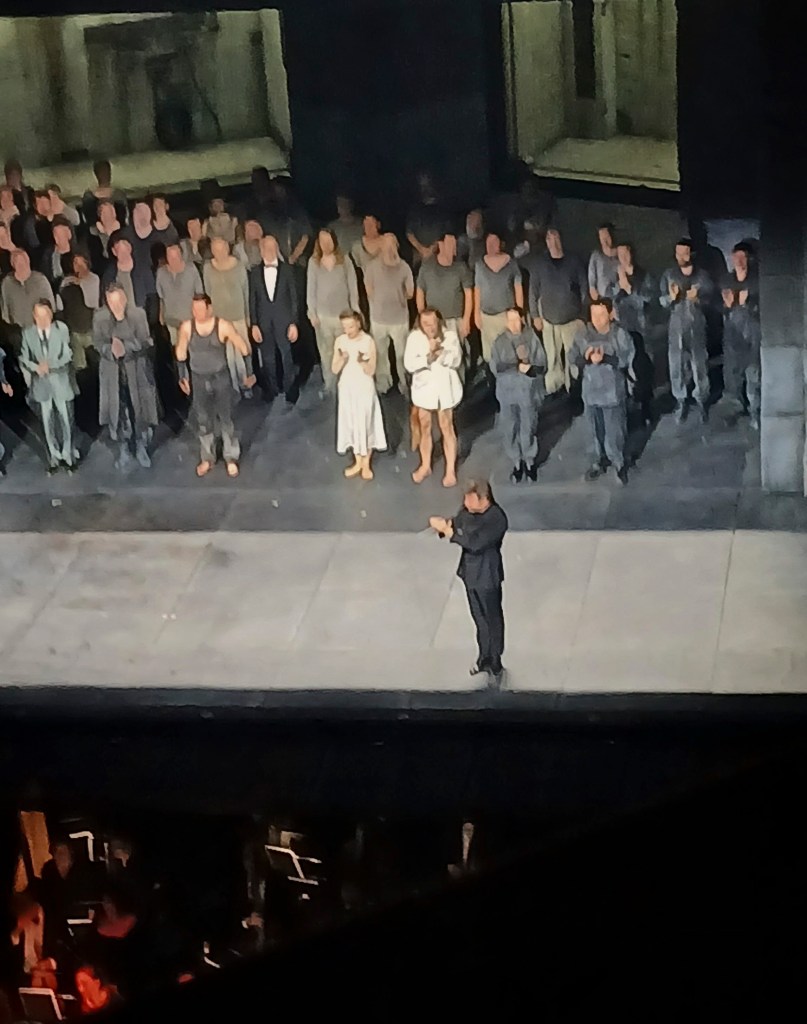
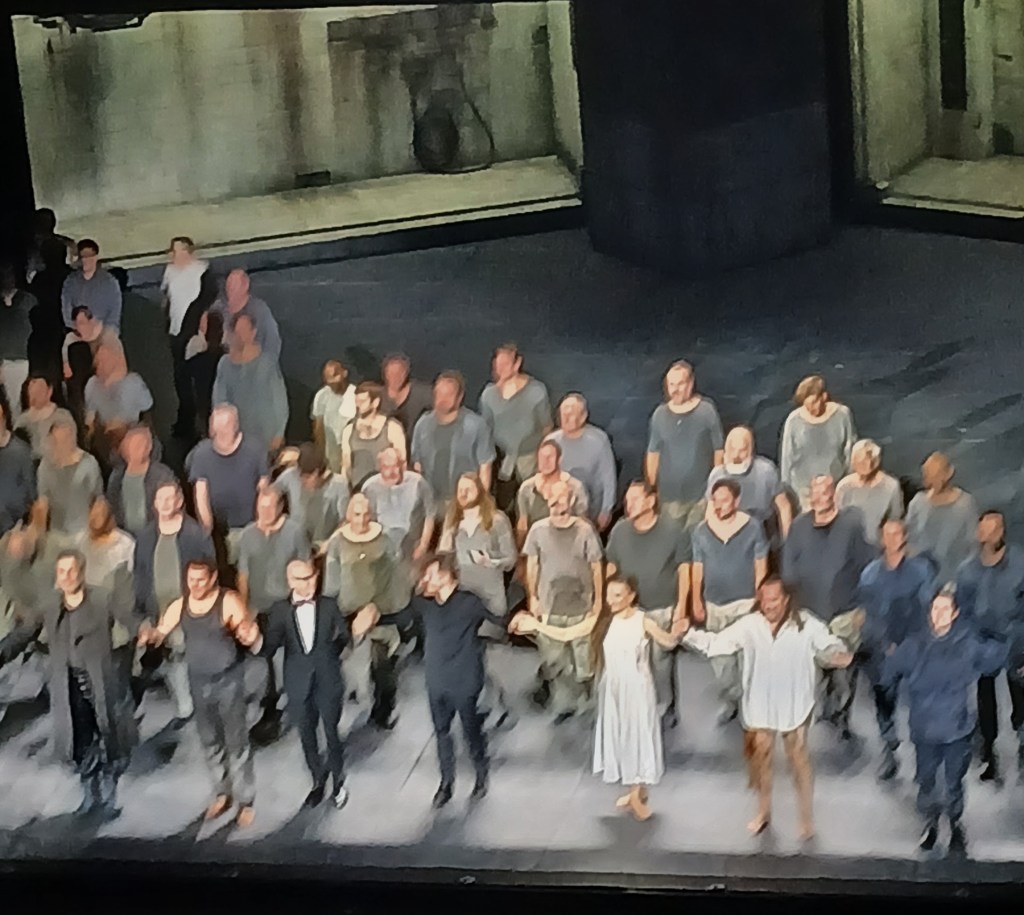
Rehearsal photos from ROHCG Facebook page