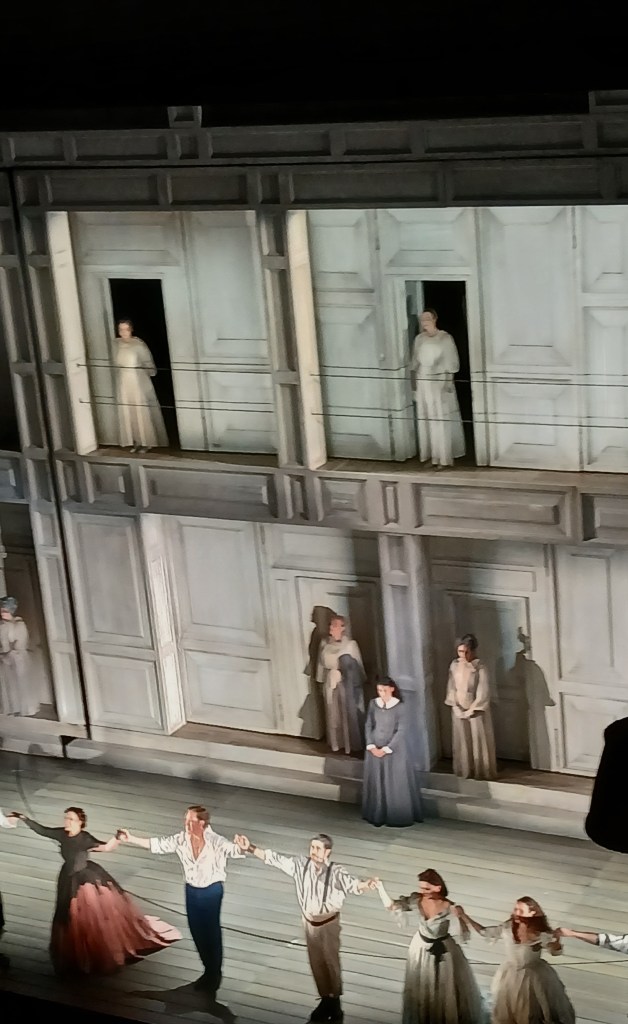
Conductor, Stefano Montanari. Gordon Bintner, Don Giovanni; Roberto Tagliavini, Leporello; Lydia Katarina, Donna Anna; Aigul Akhmetshina, Donna Elvira; Bogdan Volkov, Don Ottavio; Chelsea Zurflüh, Zerlina; Dingle Yandell, Masetto; Andreas Bauer Kanabas, The Commendatore. Director, Kasper Holten; Set Designer, Es Devlin; Costume Designer, Anja Vang Kragh; Lighting Designer, Bruno Poet
I last heard Stefano Montanari conduct last December at ROHCG, when he worked with the orchestra on an excellently played Ariodante, joining in with his violin on occasion. He was one reason why I wanted to hear this revival) the other being of course Aigul Akhmetshina as Donna Elvira. I last saw the production in 2021 – here is my blog write-up of it then – Don Giovanni, Mozart: ROHCG, 18/7/21 – John’s musical journey. I remembered this as a good production, and Don Giovanni is a work one can hear again and again. In addition, I have been reading (courtesy of Kindle’s bargain basement = £0.99p) a book called Mozart The Dramatist written by Brigid Brophy, first published in the 60’s and revised in 1988. It has many fascinating perspectives on Mozart* and the Enlightenment, not least on the male seducer as a type, in one way valued by the 18th century for their spear-heading of pleasure as an alternative goal to the 17th passion for the godly life, in another too easily getting out of hand and having to be reined in by the very supernatural religion the Enlightenment claimed to be against. To quote Brophy “Everyone knows (thanks to Tom Paine, who christened the enlightenment the Age of Reason) that the immediate duty of the emancipated Ego was to reason out its own moral judgments. However, as soon as reason was set free to act on behalf of the individual Ego, it began to accomplish another liberation even more fundamental to the character of the age: the emancipation of pleasure.” And ”Having nothing but love and the love of pleasure on which to found its hopes of social coherence, the enlightenment was particularly alert to the disruptive effects of those forces when people acted on them in personal relationships without first consulting either rationality or external constraint. The figure of whom its literature is most wary, and against whom the most stringent of its moralisings are directed, is the seducer.”It’s a short, though, odd step from Don Giovanni to the French Revolution
I found the production this time less satisfying than 5 years ago (perhaps, two months after the opening of the theatres after Covid, I was more generous and thankful). The various levels of staging, with lots of doors and superimposed images, means that it is always easy to see the singers, but all these split-up rooms and stairs allow you never to see the chorus, and makes many of the interactions between the characters have to happen at different level. This may well be deliberate, a presage of the total isolation which is hell for Don Giovanni at the end, showing a society where everyone is an isolated individual. But to me, it seems clear that Mozart and Da Ponte wanted the final scene – commenting on the justice of what has happened to the Don, and saying how we ought to behave – in place as a balance to the scene with the Commendatore (this production is unique among those I have seen in omitting it) and in the same way there should be some sense of a wider society behind the main characters, and a more open stage, at least at time, so that there is ‘another way’ beyond the total emancipation of pleasure. I also thought the handing of the Commendatore’s death is confused in staging – Donna Anna is clearly having fun with Don Giovanni (indeed she has another fling later on in the first act, I think) and the staging to me suggested she knows from the beginning he is the killer of her father – did she go into the house before the Commendatore’s killing? I don’t remember her doing so. Obviously she then has to pretend to Don Ottavio she doesn’t know at first who killed him– it all seems a bit clunky.
The other problem – to my surprise – was Stefano Montanari. In place of wielding a violin he conducted and played a centre-orchestra harpsichord for the recitatives. Many of his ad hoc harpsichord responses to the characters were really quite funny, and he occasionally added the harpsichord to the orchestral textures – doing then exactly what Mozart would have done in this work. But his speeds were in general too fast – gorgeous bits of interplay between strings and woodwind became smudged, notes were gabbled, harmonies submerged, and singers often rushed. This was really not good Mozart playing, and such a contrast to what I remember in 2021 when a German conductor called Constantin Trinks was conducting. Just very occasionally things were a bit more relaxed – Anna and Elivira’s last big arias were taken at a more measured speed, presumably to allow them to handle the coloratura, and these were then so much more enjoyable.
The men were the stronger element among the singers. Gordon Bintner was a first rate Giovanni – he has the looks, the energy, the ease on stage and a golden warm voice which sounded lovely in his serenade in Act 2. He also was very credible in suggesting the character’s violence and menace. Roberto Tagliavini was utterly convincing as Leporello, with a big voice, good projection of words (when not hassled by Montanari) and in particular an excellent ‘Catalogue’ aria. Bogdan Volkov (and admittedly Montanari was helpful here too in his arias) made Don Ottavio less of a bore than he sometimes is, and his voice was bigger than some in this part – his ‘Il mio tesoro’ was really enjoyable and with excellent coloratura runs (and must be a first for me to say that). Masetto and the Commendatore were both well done. None of the three female singers really offered outstanding performances, though none were in any way less than wholly adequate. Aigul Akhmetsshina as Elvira was passionate , she can act well, and she has a gorgeous voice but somehow she doesn’t sound quite right for Mozart – the voice is too big, the coloratura runs a bit approximate; Lydia Katarina as Anna and Chelsea Zurfluh as Zerlina had good stage presences, both looked their parts and were very credible, they did nothing wrong, but were simply not as good in their singing as, say, among contemporaries, Lucy Crowe (for Anna), let alone (in that role) the likes of Margaret Price – not as colourful, not as agile.
It was wonderful to hear the music again but I don’t think I’ll return to this production without some very special singers in prospect.
*A very interesting insight is the relationship between Dorabella and Fiordiligi in Cosi Fan Tutte, and the two Weber sisters who Mozart both courted