Maxime Pascal Conductor; Romeo Castellucci Director / Sets / Costumes / Lighting. Lauranne Oliva L’Ange; Philippe Sly Saint François; Sean Panikkar Le Lépreux ; Russell Braun Frère Léon; Léo Vermot-Desroches Frère Massée; Aaron-Casey Gould, Frère Élie ; Willard White, Frère Bernard
This was the main reason for my wanting to spend a few days in Salzburg this summer – the lure of seeing Messiaen’s huge (over 4 hours), rarely performed, opera was considerable to someone like me, who counts themselves as a Messiaen fan and always enjoys his music – and I will almost certainly never get the chance to see this again. I do have a recording at home but I have never played it all the way through until the day of the performance (I did have a go once at doing so when my partner was off on holiday, but got stuck about 2/3rds of the way through – however I did put my recording on at 7.45am the morning of the performance and listened to it till nearly 12, all the way through, in preparation). There is a video on YouTube from 1983, conducted by Seiji Ozawa, also, which I have dipped in to, at points. So I knew something of what I was going to, but have never engaged with the work fully in the way one does with a live performance.
Messages seen from reviews seemed to be a bit disturbing – that the director, Romeo Castellucci, rather than reinforcing the glory and transcendence of Francis’ life and Messiaen’s music, actively tried to disrupt these elements in his staging of the opera. So, as with Ariadne the previous evening I arrived with a certain amount of trepidation as well as excitement at hearing this work live for the first time. It’s interesting that, given the degree of directorial meddling in both, I was so annoyed by the Ariadne and so little bothered by this production of St Francis. Perhaps it comes down to the fact that, however much Castellucci has meddled with Messiaen’s concept (and I’ll come on to that below), the pace of his production, its largeness of scope, its ritual qualities, were appropriate to the work, even if what was being conveyed wasn’t always in line with Messiaen’s text and stage directions (and music).
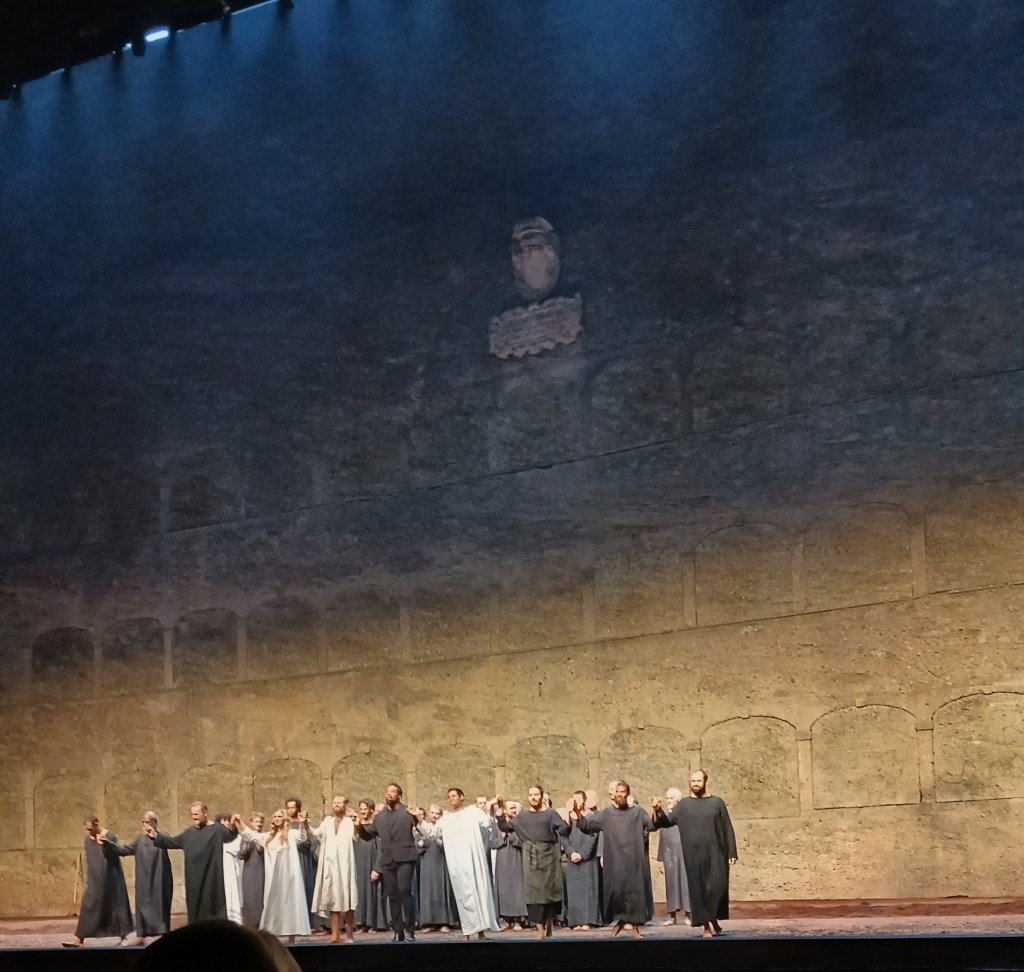
So…..the Felsenreitschule is of course a most peculiar stage, very high, and extremely wide. The production made use of several huge back drops – one of a stone wall, another of what appeared to be a city scape. There was also a neutral back drop on which white, red, yellow and various shades of blue lights shone at various points – very effectively in the Sermon to the Birds, and its predecessor, the Angel Musician.
The director’s approach seems almost to have been to undermine Messiaen’s vision of St Francis, as well as constructing a series of images that might have personal relevance to Castelluci but which were completely obscure to most of the audience. In terms of that process of undermining, the main issue for me was St Francis seemed to be portrayed as a neurotic, deliberately and perhaps with hubris pushing himself further than normal human bounds, to be deliberately self-abusive; he had a nervous tic (which seemed to disappear later on!) and seemed self-absorbed, not really relating to his brothers in any obvious way. But beyond that, why was there a separate white-gown-clad leper who did the singing alongside the skeletal figure whom Francis washed? Why were there two bread ovens brought in to bake bread (with the brothers putting the dough into the other (I suppose that has some sacramental relevance); why was Francis painting his legs blue (and the Angel, why was she painting her legs gold? Why were there dancers doing a decorous courtly dance at various points to the side of the stage; why (in particular) were birds falling out of the sky towards the end of the Sermon to the Birds (and why did a solitary peahen wander across the stage through the dead birds at the end of that scene)? Why was the wolf of Gubbio making a quick appearance despite no such scene in the score? Why was there no cross as indicated for the Stigmata scene in the stage directions, and why was it lit so dimly – just darkness and earth, not really complementing the radiance and joy in Messiaen’s music. Why, bizarrely, after the glorious closing chorus, did the conductor stop the applause to allow the tolling of bells to be heard and a herd (literally – 6 or 7 of them anyway) of sheep appear momentarily, only to have the curtains close on them. Why – at a different level – given the probably few French speakers in the audience were the German and English surtitles so often obscured by the lighting and colours used – I’d say for about 70% of the time. Some answers, it’s true, do appear in the interview with Castellucci given in the programme booklet (but one shouldn’t need that to understand what’s happening on stage). Castellucci believes that the Church airbrushed Francis after death, that Messiaen is responding to the official fideistic view of Francis, whereas the director feels the real Francis was coarser, more extreme, more radical. And on the dying birds (as I rather thought) that is a comment on the climate and biodiversity crisis – that many of the birds who Messiaen transcribed singing for are now rare or extinct.
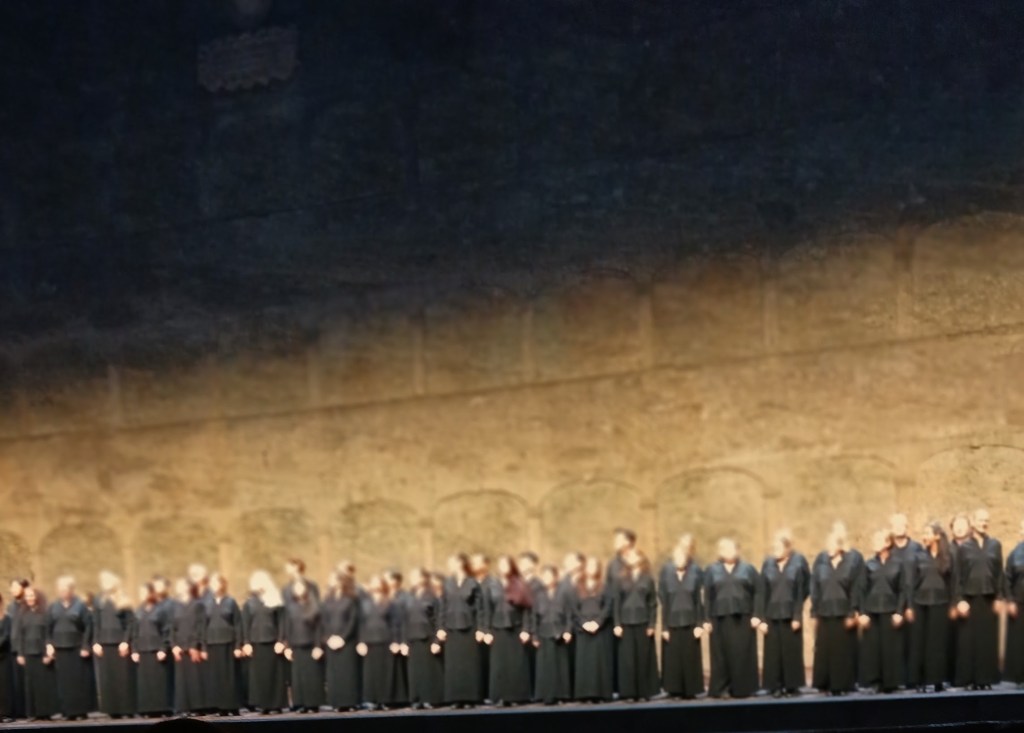
Perhaps the most important ‘why?’ of all is why, given all these sometimes obscure, sometimes annoying, elements will this undoubtedly be, when the reckoning comes, among my top 10 live performances of 2026. Principally, I think, because of the fascination, the beauty, the glory of Messiaen’s music, and the marvellous way it was rendered by the 120-strong Vienna Phil (pit crammed, and both side platforms packed with percussion instruments, including no less than 3 splendidly swirling ondes Martenot). Not only the orchestra – the augmented Staatsoper chorus (there must have been 100 of them) sounded glorious and indefatigable, always singing behind the backdrop. The way Maxime Pascal kept this altogether and everyone on their toes for 4 hours was beyond praise. And the music …….the joy at the end of the Leper Scene and his miraculous recovery, the beauty of the scene with the Angel where music is beatified as a way to God, the extraordinary ending – these are some of the greatest moments in opera, I think. I don’t think I ever lost focus once in the whole of the 4 hours, even when I had very little detailed sense of what people were actually singing (because of the lack of surtitles). Messiaen writes beautifully for the voice.
Few of the singers were names I had come across, apart from Sean Panikkar and of course Willard White. Were it not for the extensive resources (and presumably effective risk assessment processes) of the Festival there could have been a terminal disaster at the end of Act 1 – it was clear that Phillipe Sly, the Canadian baritone playing Francis, was having vocal problems in the first Act. At the beginning of Act 2, it was announced that he couldn’t continue vocally, but would carry on acting, with an understudy singing from the side of the stage. Because of the width of the stage, and the ritual slowness of the action, one could almost entirely forget that Sly was only acting. He was utterly convincing in Catellucci’s vision of Francis, and his understudy sang at least as effectively and beautifully as his principal (I’m sorry I didn’t catch his name). Sean Panikkar was powerful and resonant as the Leper, and the Angel, the young singer Lauranne Oliva, was surely someone with a bright future – a really warm, beautiful voice absolutely suited to the role. All the brothers were very strongly voiced.
I don’t think the work really needed two one-hour intervals (although I suppose that’s how Bayreuth does it) but luckily as I was with some friends this time passed quickly enough.
When Francis sings, towards the end, “Seigneur, Seigneur! Musique et Poesie m’ont conduit vers Toi; par image, par symbole, et par defaut de verite’ , obviously what Messiaen himself felt, I was very moved – this is how I sometimes experience the music and stage images I see.
Here is a trailer which, if you scroll down, will give you a further sense of how Castellucci approached the opera – Saint François d’Assise • Salzburg Festival 2026
 John's musical journey