Manfred Honeck Conductor, Ersan Mondtag Director / Sets / Costumes; Henning Streck Lighting; Luis August Krawen Video. Kate Lindsey The Composer ;Christina Nilsson (originally Elīna Garanča) The Prima Donna / Ariadne; Eric Cutler The Tenor / Bacchus; Ziyi Dai Zerbinetta; Johannes Silberschneider The Major-Domo; Christoph Pohl The Music Master ; Jonas Hacker The Dancing Master ; Leon Košavić Harlequin ; Michael Porter Scaramuccio; Lukas Enoch Lemcke Truffaldino; Theodore Browne Brighella; Jasmin Delfs Naiad; Anja Mittermülle Dryad; Marlene Metzger Echo; Vienna Philharmonic
This was the first time I have ever seen Ariadne auf Naxos live on stage. It never appeared in the UK in my teens and 20’s except at Glyndebourne– so unaffordable at that time for me to visit – and it’s not on so often even now in the UK. I was due to go to an Opera North performance 3-4 years ago but wasn’t able to, owing to a general rail strike. I saw it a couple of years ago in a Met screening with Lise Davidsen as Ariadne and, I think, Kate Lindsey as the Composer (or Samantha Hankey)
You would have thought that Ariadne auf Naxos is one of those works – like the Marriage of Figaro – fairly immune to too much director-meddling (18th century very specific social context). Oh well, I suppose I might have guessed, this being in the regie-theater zone of Austria/Germany, that the setting of this production of Ariadne would be a dystopian Mars 100 – 200 years in the future, where a bunch of rich humans have set themselves up to escape the disaster that Earth has become, and to which they bring in occasionally groups of humans, still stuck on Earth, to recreate the high culture for which they have built a Martian opera house. The director (apparently renowned for the political emphasis of his work) clearly intended, I assume, there to be some mirror here held to our present way of life – a decadent society looking in on itself from space, some comment on artistic patronage…….I thought in advance – oh dear, and wondered whether Elena Garanca, who was going to be the Prima Donna/Ariadne and had then withdrawn, had done so because of her unease with the director’s plans (she said that, having thoroughly reviewed the score and libretto, she did not feel able to empathise with the part). But that’s idle speculation on my part. More on the director’s views here – https://www.salzburgerfestspiele.at/en/p/ariadne-auf-naxos-2026#&gid=1&pid=1
Ariadne has a long history at Salzburg – from 1926, so a hundred years ago, when it was conducted by Clemens Krauss (for one performance by Strauss himself) and Lotte Lehmann was Salzburg’s first Ariadne. But, given the director’s introduction, I approached this with some trepidation…………and as it happens, rightly so…..
The Haus fur Mozart is the last of the Salzburg opera venues I am visiting for the first time. It is much better than the Prinzregententeater in Munich, where I saw Capriccio 4 years ago, in terms of sound and sightlines, and has a warm generous feel to its acoustics, even sitting where I was at the back of the stalls with a balcony overhang. The chamber ensemble culled from the Vienna Phil played marvellously – particularly good solo horn, oboe and clarinet – and made a noise in the lush ending of the Opera that sounded more like a full orchestra than the quite small number of players actually involved. Manfred Honeck seemed to guide them effectively and keep things on track – it helps that he used to play in the VPO and his brother was in the orchestra as concert-master…..
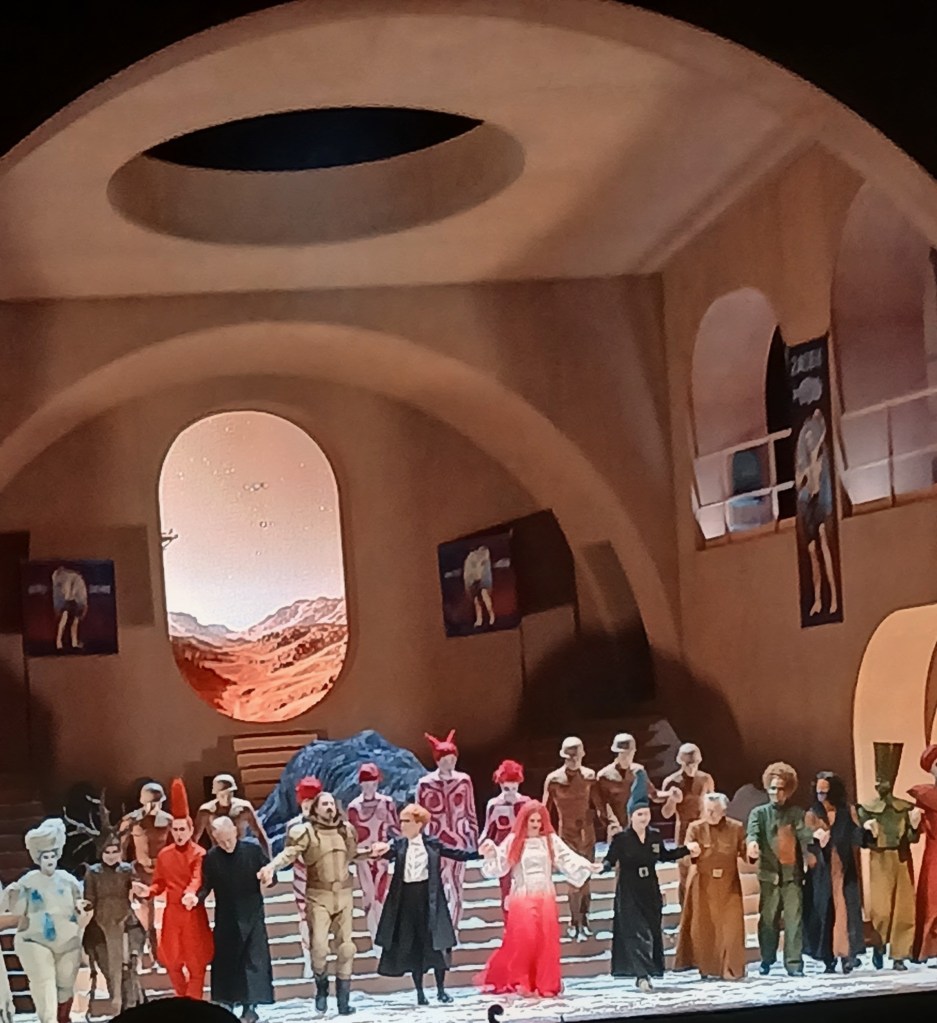
As you can see from the photo below, there was a quite effective room-like set, which was used for the Prologue and the Opera, with different levels and entrances. It also has a port hole, at the back, which gives you a bleak perspective of Mars. Through the port hole we can see spaceships arriving, leaving and flying by – very much space ships as might have been envisaged for Dan Dare or whoever in comics 50 years ago. Occasionally the spaceships seem to develop faces, as though they are god-like……..When the space ships are not zooming across the port hole, then the landscape outside can shift in tone and colour to help support the lighting and atmosphere of the interior of the ‘house’ , from cold star-lit nights to bright sunshine.
The Prologue, apart from showing the arrival of the spaceships presumably carrying the company of singers and actors, is fairly straightforward in how it is presented, and much is as it would be in a more conventional production, despite the oddity of some of the clothes – the music master in a monk-like cloak, a bright ginger wig for the dance master; none of the Zerbinetta crew are in conventional commedia dell’arte costumes. It is not clear at this point whether the Composer is male or female (Strauss and Hofmannsthal of course intended it to be a ‘trouser’ role) though at this point ‘she’ looks more female than male. However, I thought, at the interval, so far so good.
Things started to go badly wrong after the interval. While Naiad and Dryad were entirely conventionally dressed in long robes, Echo was in a ridiculous tubby furry costume and moving around on wires from the flies. Immediately 4 dancers emerge around the sleeping Ariadne, whose role seemed to be completely opaque to me – none of their movements seemed to have any clear relationship or commentary with what was going on on stage. The long scene with Zerbinetta centre-stage revealed that the Composer was indeed a woman – she shows her bra at one point – and Zerbinetta and she are clearly very attracted to each other. No problems with that, of course, but why – what’s it adding? Likewise, at one point in Zerbinetta’s song, a general orgiastic sex scene develops between everyone on stage – everyone in one form or another humping everyone else. Again, one’s seen it before, it can be effective, but in this case, why? When Bacchus appears, he does so in a space suit through the port hole and at the end he and Ariadne fly off in the space ship docked outside (and maybe – it’s unclear – get blown up…..).
I came away rather puzzled by what was happening here…….the Strauss/Hofmannsthal conception is obviously focused on how ‘high art’ makes it way in a context where patronage is provided in one way or another by people insensitive to its needs, and on what the relationship between ‘high’ and ‘low’ art is. The focus is more on the second than the first really, because, apart from the figure of the Major-Domo, there’s no one else on stage representing these rich, insensitive patrons. One could see ways of setting the opera in a contemporary context – budget-tightening cultural bureaucrats, plutocratic Salzburg audiences (given the number of large chauffeur driven black cars outside as I left) and so forth. But what the Martian setting adds is beyond me…….and what is meant when Bacchus and Ariadne fly off in the space ship is, again, completely obscure. I ended up completely confused as to what the director’s ‘message’ was. And – Heaven help us – I see Mr Mondtag is directing the new Parsifal at Bayreuth next year, for which I have a ticket……………..)
In terms of singing and acting this was generally strong. I was impressed by Christine Nilsson – a clear flexible ‘Strauss’ voice, some nice phrasing, good diction, power when needed, and an effective stage presence. Eric Cutler as Bacchus did what he had to do – for the most part accurately and powerfully, with a few off moments on top notes. Ziyi Dai was excellent as Zerbinetta, with the ability to act well in addition to pinging out the coloratura. I was also impressed by Christoph Pohl as the Music Master. On Kate Lindsey as the Composer, I was a bit conflicted – hers was a very intense, high energy performance and at low and middle ranges she sang beautifully. On high registers and at high volume she sometimes produced a very piercing harsh ‘white’ sound that I found quite difficult to listen to.
I am usually tolerant and often, I tell myself, perceptive with a new look at a familiar work. But this production, for me, was just confused dramatically, though very good musically. At least though, no boos at the end, though a number of people noisily stomped out during the second half
A trailer, giving some sense of the design and approach can be found on the link below if you scroll down:

