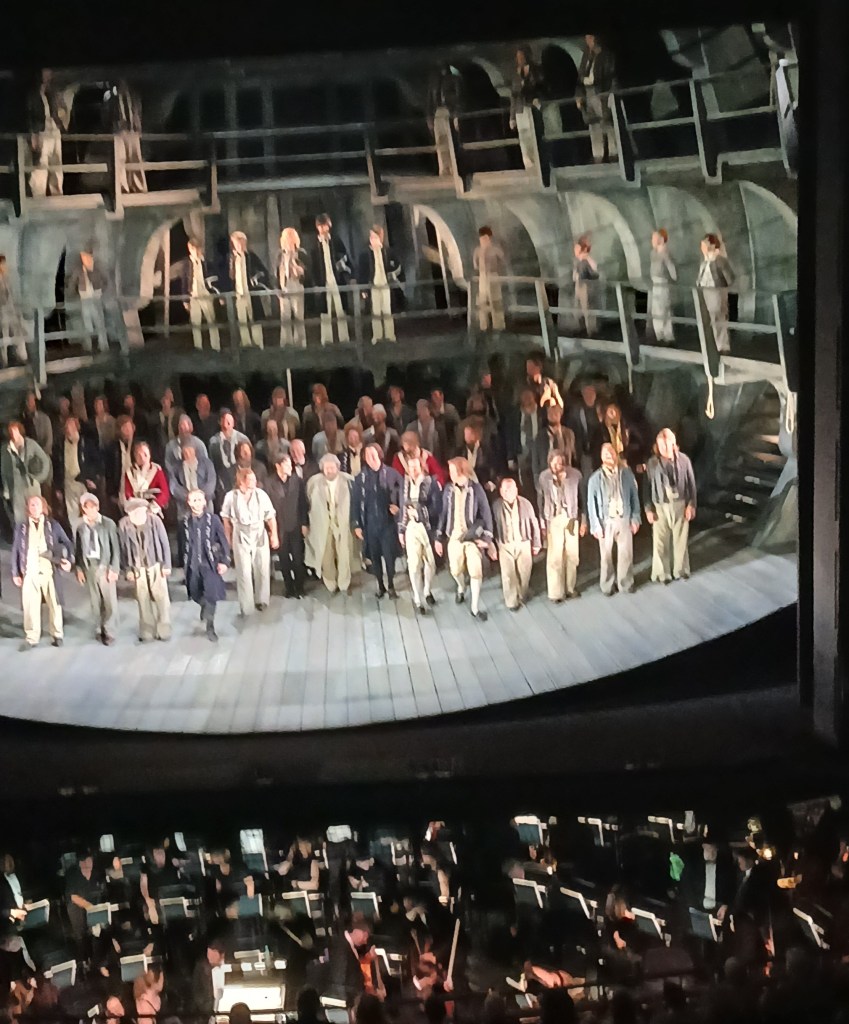
Conductor, Nicholas Carter; Director, Michael Grandage; Designer, Christopher Oram; Lighting Designer, Paule Constable. London Philharmonic Orchestra, and the Glyndebourne Chorus. Captain Vere, Allan Clayton; Billy Budd, Thomas Mole; John Claggart, Sam Carl; Mr Redburn, Dingle Yandell; Mr Flint, William Thomas; Lieutenant Ratcliffe, Daniel Okulitch; Red Whiskers, Alasdair Elliott; Donald, Samuel, Dale Johnson; Dansker, Clive Bayley
I got to know Billy Budd as a teenager, from a recording borrowed from New Cross Library in South London – I was thrilled above all by the battle scene…..In terms of live productions, I think this is the 3rd time I have heard and seen it live, though it is possible I saw a production in the 70’s (perhaps with Mackerras conducting and with Thomas Allen or Peter Glossop as Billy Budd, Richard Lewis as Vere) – but if so I have no memory of it: otherwise, once at ENO in about 2006; a performance at ROHCG with Toby Spence as Vere just before Covid lockdown, and now this one.
Despite the fact that Billy Budd is hardly an obvious Glyndebourne opera – hanging, sea battles, sadism and so forth hardly fits obviously with rose gardens, picnics, sunshine and country house lawns, nonetheless I thought this production was the best of those I can remember. Key to its success was the director’s making the story line very clear – I followed far more of the story closely than i can remember previously, and the lighting helped by not being too dark (though appropriately gloomy for the below deck scenes). The set was very effective – an oval concave deck shape, with two levels of gantries, ropes and rib-shaped planks. A lot of thought had been given to the props – guns, lamps, chests and so forth. There was a wall with windows which came down from the flies scenes in Vere’s study. The full stage served equally well for above and below deck scenes. Colours were typically muted, apart from Billy’s light blue and the Marines’ vivid red and white clothing.
One of the merits of the directorial clear story telling was that I appreciated much more clearly the Biblical references in the text, and the clear analogies of Billy Budd with Jesus at his crucifixion. I had never picked up before on the Christ-like comparisons Forster and Britten clearly make with Billy’s character and situation, nor on the fact that Vere follows at the end of the opera in singing Budd’s moving words and music about a better life that awaits them. The point of the opera had always seemed to me before about Claggart’s destruction of the innocent Budd, Vere’s inability to stop him, and the latter’s inability to rise above the letter of the law, unleashing the terrible conclusion. What came out more clearly here was that both Budd and Vere see a final end to evil and the triumph of the good, and that Vere’s great cry ‘What have I done?’ is in effect answered by a small unspoken voice which says ‘Whatever you have done can be forgiven”. In this reading, Claggart’s darkness didn’t have the same sense of subtlety and that was a pity – there was only threat. terror and cold fury in this character, which contrasted oddly with the more rounded and complex characters of Vere and Budd.
I was also struck afresh by the glory of the music. I have always loved the stirring battle [or not-battle] scene and the choral music for the seamen in the first act plus Vere’s beautiful monologues, but I had forgotten the loveliness of Budd’s two songs when he wakes from sleep and muses on his fate before his execution and some of the ways the orchestra is used – the remarkable chords before the scene with Billy in his cell in Act 2, which is both wonderfully simple and also moving, presaging the peace Billy finds in his heart as he faces the future. I was also very struck by the straightforwardness and clarity of Forster’s libretto. The careful tightrope walk needed between too much antiquated 18th century language and too much overdone sea salty naval language (‘avast, landlubbers’ etc) is very well kept to – the work feels passionate and urgent, but in a specific place and period
Billy Budd is very much a team opera – a large number of characters, a big chorus and orchestra. But the three major characters – Vere, Claggart and Budd – all have a major part to play in a successful performance of the work. The question mark in my mind beforehand was the credibility of Allan Clayton as Vere. Could this rather wild looking bearded man really play a character still so much associated with the creator of the role? At first, surrounded by his officers and men, Clayton did seem a slightly unlikely smallish and tubby Vere but he came into his own in the 2nd act, where, downstage, spot-lit, he was very moving in his reflections about Billy’s sentence and death, while his voice cut through and filled the theatre, and his wild demeanour made emotional sense. Sam Carl as Claggart was perhaps slightly over-the-top – but this was a directorial problem than inherent in Carl‘s performance. Wearing black, having a resonant voice and given no occasion to modify his fierce hatred of Billy, it was inevitable that at the end at his curtain call he should receive pantomime-style boos from part of the audience (a deplorable modern tendency in British opera audiences against those performing ‘bad’ characters, but understandable here). Thomas Mole as Billy had a beautifully glowing baritone voice, he was good at knowing when to stand still and not move manically around the stage, and gave a sense of Billy’s presence, his sensitivity and loving thoughtfulness for others. Among the many other members of the cast, Dansker played by Clive Bayley was a particularly strong performance. The chorus was very strong, filling the house easily with their big sound when they needed to, but also with a lovely quiet sound at times. The LPO was particularly snappy and tight in this performance (I am hearing them again at Monday’s Prom performing Strauss’ Alpine Symphony!) and their conductor Nicholas Carter, currently GMD at Stuttgart Opera, seemed very effective at handling the ebb and flow of the work – both the excitement of the battle scene and the quietness of Billy’s reflections