Bruckner. Symphony No. 5 In B Flat Major: Conductor, Christian Thieleman, Staatskapelle Berlin
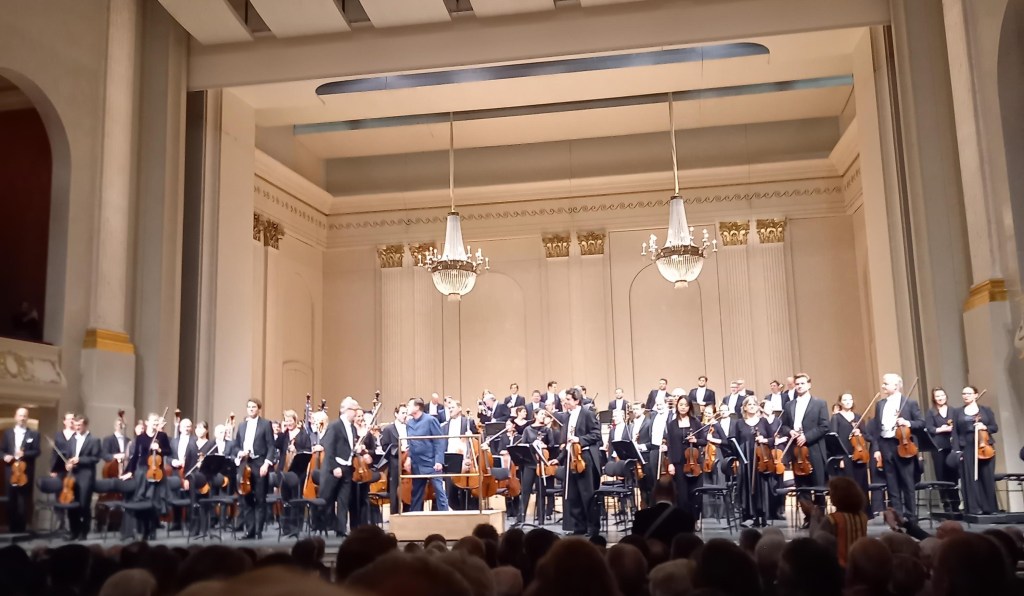
I heard the Berlin Staatskapelle play Bruckner at the Proms under Barenboim in 2016 (they played Nos 4 and 6 symphonies) and in the same year I heard Thielemann conduct No 3 at the Proms with his (then) Dresden orchestra. The Staatskapelle sounded superb in the Albert Hall, and returned with Barenboim in 2017 to play two Elgar concerts. I wondered how they would sound in this Opera House, which is not particularly designed for an orchestral concert sort of sound. I also wondered exactly where they would be playing…………as you can see from the photo below, they played on stage with the pit covered. The sound is bright, forward and from Row 13 extremely exciting! I was also wondering what other performances I’ve heard of this – not many…….I remember a BBC Philharmonic concert about 10 years ago – it might have been conducted by Simone Young. Other performances I am pretty sure I heard in the 70’s were conducted by Jascha Horenstein and Bernard Haitink. That’s about it……
But I have to say this absolutely thrilling performance was by far the best I’ve been to live – utterly memorable. I was completely gripped throughout (which doesn’t necessarily happen with me and this symphony listening at home – I find my mind can wander in the finale). There were several reasons for the excellence of this performance:
the absolutely glorious sound of the orchestra, particularly in this space – golden brass, characterful woodwinds, deep rich strings and a seriously noisy timpani player (the violins were, thank goodness, split, which definitely helps the texture in a piece like this).
the clear structure of the performance. Unlike say the 7th Symphony, where the emotional heart is in the slow movement climax, the 5th Symphony’s climactic point is in the last movement and at the very end, in the chorale which rides triumphantly over the rest of the orchestra in the brass. Any effective interpretation of this work needs to keep something in reserve for the ending. Thielemann and the orchestra delivered this in spades. You simply couldn’t believe the chorale could get any louder as it moved towards the final bars in the brass, with strings being urged by Thielemann to pile on the pressure with their runs – but it did!
Thielemann’s attention to the inner parts of each movement. This is perhaps based as much on observation as sound, but it is noteworthy how detailed Thielemann is in his cues to players, and how you can both see and hear how he is bringing out a range of colours behind the dominant melody at any moment.
each movement was beautifully characterised. A very quiet opening led to an extended exposition in the first movement which clearly differentiated the ? three different themes (which will come up again in the finale) and never sagged. The second theme of the slow movement was simply gorgeous and devastatingly moving, but fully integrated with the trudging first theme (clear link with the equivalent in Schubert 9) and the movement was beautifully shaped towards its melancholic and perhaps despairing climax. The third movement was glorious in its spaciousness and again I found myself listening to this more intently than I normally would
the speeds for each movement seemed exact right. Thielemann, from what I’ve heard of his work, is not a portentous lingerer, and, for instance, the speed of the slow movement’s second subject felt just right – not too slow, not too fast
Another aspect of going to a Thielemann concert is watching him conduct. I’ve already mentioned the detailed cues – he is also astonishingly energetic for someone who is after all in his 60s. It is an energy not intended for the audience but to convey dynamism to the orchestra – a form of showing commitment that demands commitment in return. It’s quite something to watch.
As I have said frequently in these pages, a great Bruckner performance puts together the lyricism of Schubert, the quiet, austere mysteries of the divine, and the blazing majesty of Wagner. I thought Thielemann and the Staatskapelle captured all these different dimensions in this performance
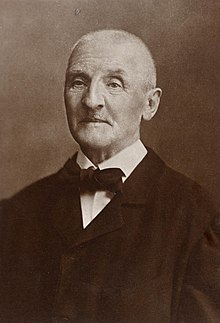
Abbildung des Bruckner, Anton [1824-1896], Künstlerpostkartea
Conductor, James Conlon; Director, Kasper Holten; Stage design, Costume design – Steffen Aarfing; Light design, Jesper Kongshaug. Cast – Heinrich, Ryan Speedo Green; Lohengrin, David Butt Philip; Elsa, Jennifer Davis; Telramund, Jordan Shanahan; Ortrud, Yulia Matochkina; Herald, Dean Murphy
After a morning at the Anglican Church in Berlin, where the familiarity of the liturgy was complemented by that of the seasonal request for more bottles for the Christmas tombola, I had lunch and then walked to the Opera House. This production is apparently some 11 years old, so a stable offer of the house, and the cast promised good things, I thought.
As it happened, 11 years meant ‘gone astray and people doing their own thing’. I mused to myself on the way back to my hotel why in so many ways the ROHCG David Alden production I saw last year was just such a better production. Part of the answer was that there was – 11 years on anyway – no driving concept in the Holten production such as there was with the Alden production (about the perils of saviour leadership). Partly also the sets didn’t really have any integral relationship with what was going on on stage (though they certainly didn’t impede the action). Again the action was a bit static and stylised (as I suppose is bound to be the case if you’re in a revival of an 11 year old production) – such a difference to the razor sharp attentiveness everyone had for everyone else’s doings on stage the previous evening. I was thinking during one of the intervals that I could conceive of a production where Lohengrin is a thoroughly fraudulent huckster, who dreams up the Grail story to make himself important and then is thoroughly found-out by Telramund and Ortrud. There were glimpses of ideas coming out at points – Lohengrin’s having to wear a pair of wings and then occasionally take them off may in fact play to the huckster idea (he does look a bit of a plonker in those wings); some clenched fist salutes from the good soldiers of Brabant may have something to do with the leadership idea but that’s never really taken any further. The production starts impressively – a landscape of dead bodies from a war, with a shooting star on the backdrop behind and relatives turning over the corpses searching for loved ones, with a shriek of recognition from a woman at the climax of the Prelude to Act 1 – but nothing follows on from this……….The end is (deliberately or just carelessly) ambiguous – Geoffrey could be appearing as a baby, as per stage directions, or could be a dead baby or something else. It was impossible to see which.
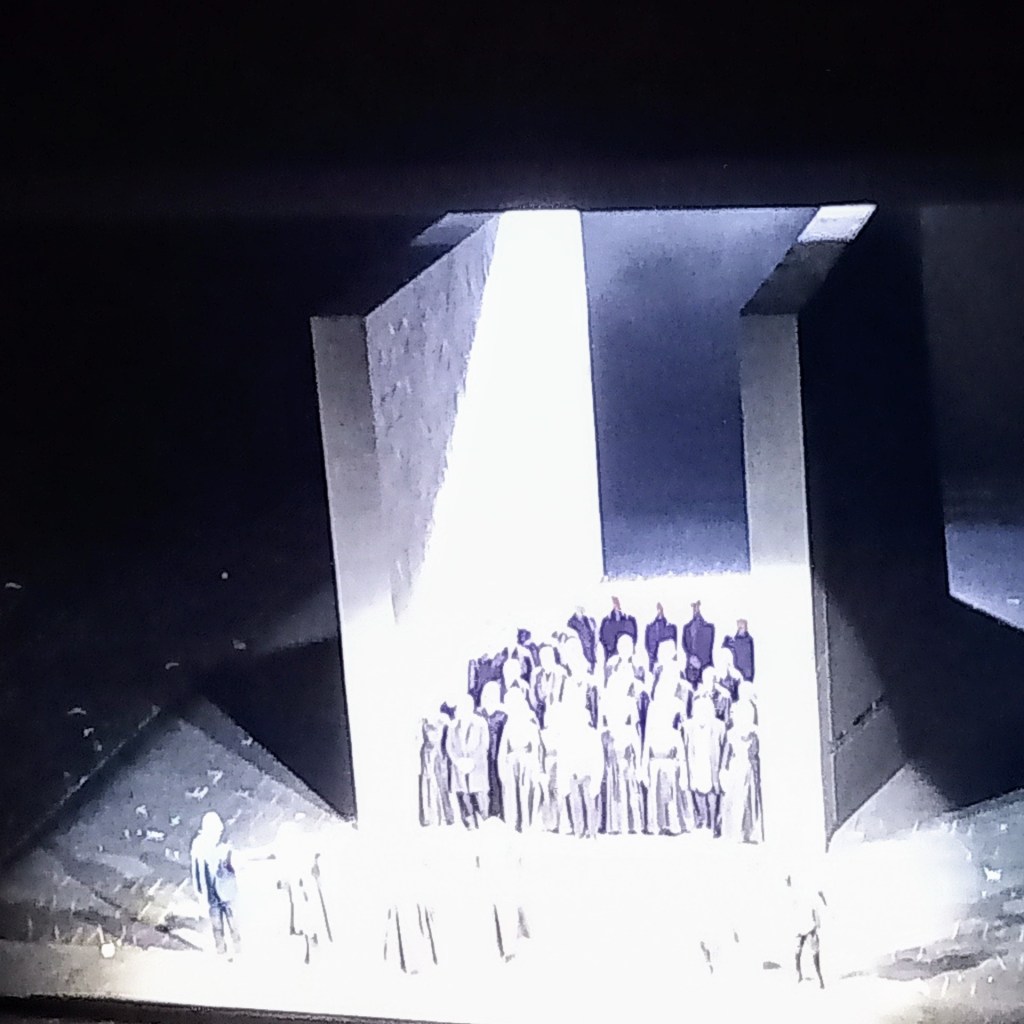
The stage is open and boxed round the edges for all three acts. Lit thin columns and a walkway are inserted for Act 2 for Telramund and Ortrud to lurk behind and for Elsa to walk on; there’s a curtain that’s drawn down towards the start of the processional scene at the end of Act 2 in the middle of the stage, and which also helps to close off the full stage during the intimate scene between Lohengrin and Elsa in Act 3. There is an Ypres WWI-stark blown-up trees backdrop for the last scene of Act 3, and, as you can see from the photo below, an impressive view of a Cathedral on a backdrop for the last 5 minutes of the Act 2 procession. There’s an impressive amount of lighting, smoke and things moving up and down at the back of the stage when Lohengrin first appears, but what could have been an interesting line for the production to take – how the divine breaks into modern life – was simply ticked off as a nice effect and otherwise ignored, though the projected swan comes back quite effectively at the end. Costumes are indeterminate – the chorus looks a mix of medieval, Napoleonic and 20th century, while the main cast is on the whole medieval.
Things aren’t helped by the detailed (or lack of it) personen-regie. King Henry just has to stand around looking regal, so he was OK, and the Herald likewise. The only person clearly acting in a dynamic way was Telramund, who captured the stage whenever he was around, but he didn’t really have anyone who responded meaningfully to his presence. Sad to say, Lohengrin was really pretty much of a lump, in terms of acting – he stood around trying to look solemn but seemingly asleep until it was his turn to sing, and occasionally just looking embarrassed at having those wings on him. Elsa does a lot with her voice but not much with her body and Ortrud resorts to semaphore too often.
Musically things were much better. James Conlon is a name I used to see a lot of in the UK but latterly he’s not done much there. Now in his mid 70’s, he conducted the orchestra very well and got a tight, bright performance from them – not much lingering on some of the gorgeous bits (after the Ortrud/Elsa scene in Act 2 for instance), but very exciting (with lots of offstage trumpets and drive at the beginning of Act 3 scene 2) at the points you need excitement. The augmented chorus sounded magnificent, and always more together under Conlon than they had been the previous evening. Ryan Speedo Green was excellent as the King, with a strong firm bass. Jordan Shanahan (who was Kilingsor in this year’s Bayreuth Festival) was, as I say, the star of the evening with a clear, well-projected voice with excellent diction. Yulia Matochinka was I suppose a standard Ortrud – rather in your face, noisy, not exactly subtle, and with a tendency to have a wide vibrato – who was good enough. I don’t think much of Jennifer Davies’ physical acting but she did an awful lot of effective acting in her singing, and seemed to get subtler and more nuanced as the evening went on. I was impressed. I’d like to cheer on David Butt Philip as one of our own but something seemed wrong about this performance. Partly, as said already, he just looked so uncomfortable on stage, but also his voice (and here I have to apologise for my lack of technical knowledge) is a rather dark, baritonal sort of tenor, and too much of his singing sounded a bit strained – you never felt at ease listening to it, and occasionally he struggled with one or two high notes. He certainly has the power and heft for the role, but his voice doesn’t convey easeful authority. It may be that this is (for a singer I have a lot of respect for) not a role he should carry on singing.
It should be said that some past reviews of this production in previous manifestations have said that, from their perspective, Lohengrin IS a huckster, and draws out prompt cards at the beginning to determine which story he should tell a gullible populace. They also say that in the production Elsa is seem to be in fact guilty of her brother’s death and brings in his corpse, All I can say is that none of this was evident to me………….
So, musically, enough to enjoy, but not a great evening………
Conductor, Ulf Schirmer. Director, Jossi Wieler; Stage designer. Torsten Köpf; Costume designer, Charlotte Pistorius; Light design, Olaf Freee. Cast – Hans Sachs, Johan Reuter; Veit Pogner, Albert Pesendorfer; Sixtus Beckmesser, Philipp Jekal; Fritz Kothner, Thomas Lehman, Walther von Stolzing, Magnus Vigilius; David, Ya-Chung Huang; Eva, Elena Tsallagova; Magdalena, Annika Schlicht; Nightwatchman, (recorded), Günther Groissböck
How lovely to hear this work again live after more than 6 years. I can’t see it being put on in UK for a while, so one probably has to travel to continental Europe to see it for the forseeable future, unless Glyndebourne revives its show. The last two productions I’ve seen of Meistersinger have been the excellent ENO revival of the WNO Richard Jones production in 2015, with Iain Paterson as Sachs, conducted by Ed Gardner, and the 2017 Kosky Bayreuth production with Michael Volle as Sachs, conducted by Phillipe Jordan. Meistersinger for obvious reasons has some very different resonances in Germany than it has anywhere else. The wonderful ending – the best I have seen of a straightforward production approach – of the Jones production had, as some readers may recall, the chorus gradually holding up pictures of all the great German composers, poets, novelists, thinkers and scientists, to celebrate the creativity and greatness of ‘holy German art’. I suspect you can’t now do that sort of thing in Germany – though Bayreuth did it for many years until the end of the Wolfgang Wagner era . You cannot, I suspect – I’m happy to be proved wrong – produce in Germany now an ending to Meistersinger which does what Wagner wanted it to be – a celebration of the energy and life-enhancing quality of great art (such as his!) . Kosky had a Nuremburg Trials theme in his 2017 production – essentially Wagner is allowed to be a great artist but condemned as a terrible person, and that artistry is allowed to manifest itself only in the music rather than in the operas themselves. As we shall see, there is a similar quirky ending with this production
Pre-reading on the web about this production, I found Deutsche Oper’s synopsis courtesy of the director in 2022, which went “In Dr. Pogner’s Private Conservatory. Pogner, the institute’s founder and director, is planning to transfer it into public ownership. His successor is to be chosen at a public singing exam the next day, Midsummer Day. The last stipulation of the retiring patriarch is that his successor agree to marry his daughter Eva, through whom he hopes to exercise a measure of control over the institute even after his departure. He doesn’t know that Eva is in a secret relationship with a music lecturer and therapist employed there, Hans Sachs”. Oh no, I thought – here we go………
In the event, for me, this was a first rate piece of music theatre. It will definitely be in my top ten for the year. The sets were basically the same in all 3 acts – although the last act added a stage with curtains. In each act there was a central acting area, usually with quite a few chairs, with wooden walls and doors which can represent houses or teachers’ rooms ( the first and third acts are clearly set in a music college, not unreasonably – this is a sing-schule – the apprentices appropriately enough dressed as music students and with scores in their arms.) The church scene at the beginning is interpreted as a group of teachers and music students listening to a performance. Walther and Eva are much less coy with each other than they would be in a conventional production and are passionate with each other right from the beginning of act 1. All are in contemporary dress. The director has fun with the students correlating some of the Meistersingers’ musical formulas with yogic positions. There are some indications of teacher abuse of students – wandering hands and inappropriate treatment. In Act 2, the usual town square scene is quite well represented by the doors and the space. Beckmesser comes on with a full grand piano when serenading Eva/Lena. Apprentices put out chairs and people come to listen to Beckmesser much as they do in Act 3. A wholly contemporary and utterly un-16th century Nuremburg setting raises a whole lot of staging issues – what to do about junkers and burghers? servants and mistresses?; cobblers and pinching shoes? patriarchal attitude to women? – which were on the whole either ignored or dealt with capably. A lot of the action just fell into place naturally and I was happy enough to be relaxed with most of the inconsequentialities. Perhaps the only thing that I find myself getting irritated by, thinking back, was the cobbler issue – the apprentices have to bring our a large bag of soft woolly multi-coloured shoes for Sachs to measure feet for (the same slipper types are used for the measurement of Eva’s feet in Act 3) but of course this allows no room for Sachs’ ‘marking’ – he has to tap on Beckmesser’s piano with a stick. The scene between Eva and Sachs in Act 2 is a lot more sexual in tone and action than normal, and there are hints of aggression from Sachs which we will come back to – there is clearly a MeToo# issue with Sachs and Eva. The action throughout is very carefully observed by the director – for instance, each apprentice has a specific role and personality. Kothner is bustly and pompous, David is a bit spaced out and not quite with it, Pogner is large and amiable. Walther is a good looking 30 plus with a scarf and Eva is small and bewitchingly sexy – both look good together and are lively, passionate characters. Hans Sachs is a cool bearded 50 year old, with his yoga mat under the linden tree, dressed in T shirt and in Act 2, shorts. Beckmesser is studious, thin and nerdy . I thought at first he was being portrayed as having a disability – which would have been problematic – but in fact I think he was just representing by a limp the poor shoes Sachs had given him.
So far so good. What is more controversial is how the second scene of Act 3 develops. In the riot scene at the end of Act 2, we see this kicked off by a group of people coming in from the back of the stage, moving forward with a rolling , jiving motion and gradually entangling with the seated burghers, with a sense of menace. After all the wonderful music and heightened emotions of the first scene of Act 3, played pretty straight, we suddenly see David, in the interval between the two scenes with the trumpets and drums thundering, desperately trying to get out of this large room with many doors – there is something unhealthy, restricting about this whole Nuremburg set-up. The various guild choruses come in as spectral figures writhing on the floor – they disappear when the burghers begin to come in to listen to the song competition. We begin to see a darker side to Sachs – he is seen actually prompting the ‘Wach Auf’ chorus, and revelling in his fame and the adulation of the crowd and the power he has achieved. Critically, when Walther says ‘no’ to becoming a Master, he and Eva begin to edge out of the room by a ramped passageway we suddenly see lit at front stage left – fleeing the restricted space to embrace their own lives as lovers and poets. As Sachs begins his peroration, in a way ‘Wahn’ becomes pervasive – the crowd begins to stir, to roll and jive, to raise hands as in a revivalist meeting (no, I didn’t see any Hitler salutes). Sachs has become a populist leader, the burghers maybe a group of AfD supporters. The remaining Meistersinger stand at the sidelines, not moving and looking concerned at the reaction of the burghers, shaking their heads with dismay.
Does the action in this production’s last scene properly relate to the impact of the music – to which the answer is……no! Is this last scene representing a credible reading of Sachs’ character? – no, it ignores all the humanity that Wagner clearly intended his character to represent; does it ignore Wagner’s stage directions? – yes. However, is it a compelling alternative reading that speaks to contemporary realities? – I believe yes, it is, though it’s sad that the warmth and beauty of the music are led to this conclusion
Musically, this was superb. Ulf Schirmer, who last year I heard conduct Parsifal in his last performance as GMD and Intendant after 11 years at Leipzig, conducted a slowish (4hrs 45 mins) but luminous and beautifully paced reading, The prelude to Act 3 was memorably played with burnished horns and dark cellos. Christopher Maltman in his recent Wagner Society Manchester talk spoke of the bel canto, legato singing of Wagner and what he called the vertically structured way of singing Wagner, giving more focus to text. Johan Reuter definitely came into the latter category – it wasn’t beautifully sung, as Norman Bailey’s account was in the famous 1970’s ENO production, but words were clear and emotion conveyed. Similarly Magnus Vigilius is no Alberto Remedios, but he had a strong and powerful voice that never failed and always thrilled when he opened up. Albert Pesendorfer – who I heard at Bayreuth last year, was a veritable incarnation of Pogner, with towering presence and a warm deep voice. Elena Tsallagova I heard as the Vixen in Munich last year – I thought her voice came across as bigger than I would have thought; again, maybe there was a lack of subtlety, but she led off the Quintet beautifully, and conveyed deep passion at her outburst to Sachs in Act 3. Philipp Jekal as Beckmesser did all that was required of him without ever falling into caricature. The Chorus were on great form, though there were a couple of moments when they were out of synch with each other and with the conductor.
All in all, a thought-provoking, theatrically and musically great evening
Photos courtesy of Deuteche Oper website, copyright: Thomas Aurin
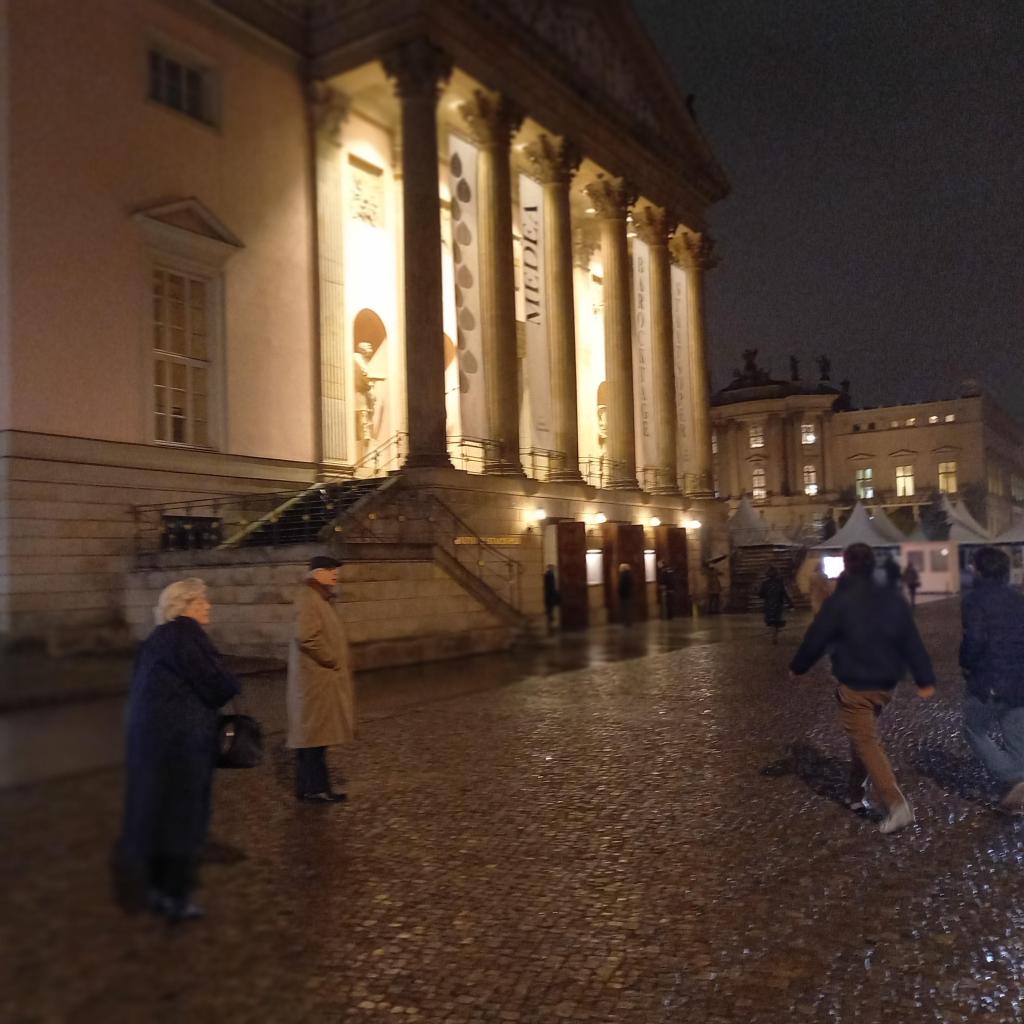
Conductor, Christophe Rousset; Production, Andrea Breth; Scenery, Martin Zehetgruber; Costumes, Carla Teti; Lighting, Olaf Freese. Cast – Médée, Marina Rebeka; Jason, Stanislas De Barbeyrac; Créon, Peter Schöne; Dircé, Maria Kokareva; Néris, Natalia Skrycka
This was part of a ‘Barocktage’ season at the Staatsoper which includes Simon Rattle conducting the Charpentier version of Medea as well as this and Mozart’s Mitridate, Re di Ponto’. As neither the Cherubini nor the Mozart are in any sense Baroque maybe the term means something different in German! And maybe the clue to that is that the orchestra playing this opera wasn’t the Staatskapelle, or its opera equivalent, but the Akademie fur Alte Musik, Berlin. They made a super sound – vital strings, a wonderfully plangent bassoon sound, hard timpani thwacks and a very impressive thunder sheet. The house acoustics suited their sound very well, although occasionally with a bit too much echo. The house was full, notably younger looking even than ROHCG, and enthusiastic.
Before going to this performance I had had one of my most dismal train journeys ever, from London to Berlin, which should have taken, including Eurostar check-in, about 14 hours, but in fact took 29 hours…….the Eurostar train was 2 hours late leaving London, because of a fatality on the line near Ashford; then, getting to Brussels, I discovered (DB hadn’t bothered to tell me) that there was a one day rail strike on DB, and only about 20% of the trains were running. I got as far as Cologne by 5.30pm and then discovered there were no trains to Berlin till the following morning…..so I had to get a small hotel room for the night in Colgne…..sigh………Anyway I didn’t miss any music – just a chance to wander round more of Berlin on Friday. So I was not necessarily at my critical best for this performance, after two 4-5am starts…………….
This was a bit of a mixed bag as a production, though the singing and playing were excellent – and of course (at least in my view) the work itself is not exactly a blazing masterpiece: in the right hands it can be gripping but is not exactly core repertoire. The Met production I saw screened 18 months or so ago was in costume contemporary with its performance (1797), and resonated with the violence of that extraordinary period. This one had some clear 21st century resonances, though not crudely stated. The basic set picture to me looked like a vaguely Near or Middle Eastern set of buildings – sandy-grey in colour, certainly with an air conditioner on the walls, and with lots of packing cases strewn around (Jason’s spoils which he’s brought to Creon). It felt a bit like a market place in Cairo. There was also a metal grid that moved up and down in one of the rooms to open up or close down vistas into the building beyond, familiar everywhere but particularly common in the Near and Middle East. What didn’t look particularly Middle-Eastern was a couple of large bull statues in the rooms. Above the walls level there are three or so large objects which could be giant air conditioning ducts, or could be parts of an overarching temple. Critically both her servant, and to a lesser extent Medea herself (who has to have a lot of her face seen for emotional impact) were dressed in conservative Muslim fashion – heads covered, long black clothing reaching to the floor. Was there some intent here to create the rage of the dispossessed, the colonised, even, dare one say, the Palestinians, against a dominant culture – Creon, Jason were all in Western clothes, though Dircé seemed to have a strange costume for her wedding that looked vaguely Renaissance or Ancient Egyptian. Was Medea meant to be some sort of Ancient Greek suicide bomber? Possibly, but if this was one of the references it was not overdone and often the production seemed content to tell the story – which of course at its heart is about the Jason-Medea relationship, and not really about anything broader. The set revolved, sometimes after, sometimes during, each scene so that we saw variants of the same set of buildings, with inter-connected doors, and this was effective in moving the action along. Very good use was made of a screen on one wall on which shadows could be projected to enhance the drama – most effectively when Medea moves towards her children at the beginning of the last act, intent on killing them. The director handled the inter-reaction of characters well (including a very painful grip from Medea on Jason’s groin!). What was least effective was the last 10 minutes or so of the work; although there was one spectacular effect – a person completely ablaze running across the stage as the fire begins to take hold – the fire, centred in three or four tanks, seemed less than overwhelming as a representation of the temple on fire. More importantly, with the general darkness of the stage, to enhance the impact of the fire, it became very difficult to know what was happening – what happened to the children, for instance? The last encounter between Medea and Jason seemed oddly stilted. Right at the close, as the curtain falls and Medea seems about to fall on her dagger, she suddenly steps in front of the curtains, hesitates and then is swept away. The production doesn’t really give much emphasis to the milk of human kindness – Creon is scheming and seems to have a headless body amongst the booty from Jason; the latter is seen kissing and touching up Dirce’s sister before the wedding; Dirce seems forced into the wedding by her father; Medea is crazed by the desire for revenge. Only Medea’s maid seems in any degree normal (and is she contemplating suicide at the end in this production?).
So this was a production, occasionally a bit opaque but always thought-provoking and interesting. It was exactly something someone used to contemporary theatre would feel at home with if coming to an opera for the first time.
I’d not come across any of the singers before. There were no weak links, but of course the whole work stands or falls by the quality of its Medea, and I thought Marina Rebeka did very well. She occasionally relapses into stock melodrama moves (hand, palm outwards, on forehead indicating horror) but her voice was strong and she put across Medea’s anguish as a mother very well. Maybe the sung text wasn’t as nuanced as much as it could be, but it was still a very credible performance, and she definitely looked the part. Everyone else by contrast is a bit of a cypher dramatically, but all sung well. Rightly, the maid Natalia Skrycka probably got the biggest ovation after Medea.
Galina Averina, Magda; Claire Lees, Lisette; Sébastien Guèze, Ruggero; Elgan Llŷr Thomas, Prunier; Philip Smith, Rambaldo; Pasquale Orchard, Yvette; Kathryn Sharpe, Bianca; Laura Kelly-Mcinroy, Suzy; Ross Mcinroy, Périchaud; Satriya Krisna, Gobin; Paul Gibson, Crébillon; Andrew Randall, Rabonnier. Kerem Hasan, Conductor; James Hurley, Director; Leslie Travers, Set Designer; Gabrielle Dalton, Costume Designer
It’s a strange experience going to listen to and see what was for me a completely unknown work by a famous composer in his prime – and be gradually introduced in the course of the evening to some wonderful music that I’d not known about. How could it have taken this long? For this was a first for me – indeed I am not sure how aware I was of this work until I knew that Opera North were putting it on. It’s not as though it’s from Puccini’s early years – it’s from the latter half of his working life, yet it never seems to have had great critical acclaim. Extraordinary when it’s such a popular composer (whose orchestration is always fascinating, despite some of the soppiness of his operas’ plots)…….This one seems to be loosely based on scenarios from Die Fledermaus and La Traviata, and, I believe, was originally conceived as an operetta with spoken dialogue – this then changed to being a through-composed work. It was originally to be premiered in Vienna but then got moved to France (1917) when, during the First World War, Italy and Austria found themselves on opposing sides.
This was in the event a big, very pleasant surprise for me. Puccini thought his brief was to get one over on Strauss and Rosenkavalier, according to one account I’ve read. Rosenkavalier is a very great work and I wouldn’t put the two at all on the same level but I enjoyed La Rondine enormously. It’s not a big hitter in the way Tosca or Turandot are, but, in its quieter way, has lots to offer. It has some really very fine Puccini big tunes (many of them with a waltz-like rhythm). It has a story that is realistic, properly verismo – most people can relate to it (high class courtesan and her maid go out on the town, the heroine Magda meets a great guy, she renounces her ‘protector’ and goes off with the newcomer. They live happily together in straitened circumstances but when Magda hears her bloke has got his parents’ permission to marry she feels she cannot present herself to them and her lover without telling all – she feels she isn’t worthy of him and them and finally goes off into some sort of new life – at least in this version; Puccini never completed it to his satisfaction and there are various nastier endings). There’s luscious Puccini scoring – not as complex as Turandot, but very redolent of La Fanciulla del West, perhaps, with some extraordinary sounds – rumbling double basses accompanying Magda at one point, for instance. It’s also a work that is less objectifying of women than some of Puccini’s operas – Magda has her point of view and remains herself throughout – she’s not really a victim. The big ‘club’ scene is lively and without cliches. “Bevo al tuo fresco sorriso” in Act 2 is a real ear-worming number….It’s a work I feel I immediately want to hear again and I am going to get a recording a.s.a.p. I cannot understand why this work remains in the doldrums while fairly dire operas like Manon and Werther get constant showings………..not to mention the lesser Verdi…….
The Opera North production was really very fine, and I felt director and designer did the best job possible for this work. The production was part of Opera North’s Green Season – ie recycling sets from old productions to save money! – and the first two acts used various moveable rectangular blocks and sets of steps to create a drawing room and a club. The blocks were pushed to the side for Act 3 to create a bedroom. Costumes were vaguely 1920’s (not sure why, really, but it didn’t matter) . What was most impressive about the production was the director’s handling of the interplay between the different characters – this was utterly believable, be it between the principals or among chorus members; one was utterly sucked into their world and made to believe it to be credible and real.
For this to happen of course, you need to have first class singing actors as principals. With one partial exception they were present. Galina Averina, a new name to me, was, I thought, wholly believable and she sang beautifully. The arrogant poet Prunier was very well charatcterised by Elgan Llŷr Thomas, and Claire Rees was an appropriately slightly dotty Lisette, Mada’s maid. Philip Smith, a lowering presence on stage, was very good as Rambaldo. I found Sébastien Guèze, who is clearly a very experienced singer from the programme notes about him, a bit unfocused at times in his acting as Ruggero, and his voice was sometimes quite ugly – relatively little of the legato and bel canto we might expect from a tenor singing this sort of repetoire. As a nice bonus a contemporary of my son and younger daughter at secondary school was in the supporting cast, singing a minor role as a member of Opera North chorus. The orchestral accompaniment under Kerem Hassan sounded totally idiomatic and coordination with the stage was handled well – I noted some beautiful oboe playing at one point
So…..a very good evening…….Was it just my imagination or was it the case that when one of the characters refers to various famous women of the past – Salome, Berenice – there’s one of the motifs from R.Strauss’ Salome suddenly quoted…… ?
Being a numbers person, to the point of tedium, I calculated that this was the 154th opera I’d been to see live. I have a list of about 130 I’d still like to see before I depart – top of the bucket list are Pfitzner’s Palestrina, R.Strauss’ Die ägyptische Helena, Monteverdi’s Coronation of Poppaea, Rienzi and Tippett’s King Priam! (another one, Strauss’ Daphne is coming up, and I am also seeing my first Rimsky-Korsakov opera, both in December)
Director, Oliver Mears; Set Designer, Simon Lima Holdsworth; Costume Designer, Ilona Karas; Lighting Designer, Fabiana Piccioli; Movement Director, Anna Morrissey; Conductor, Laurence Cummings. Cast – Jephtha, Allan Clayton; Iphis, Jennifer France; Storgè, Alice Coote; Hamor, Cameron Shahbazi; Zebul, Brindley Sherratt
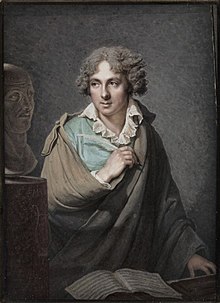
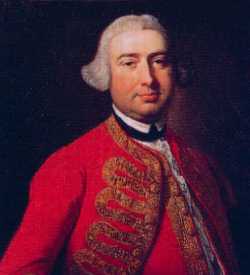
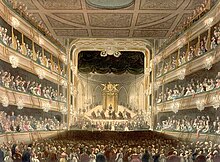
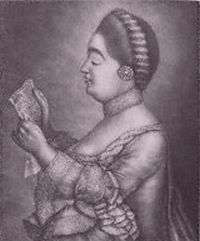
Jephtha is Handel’s last oratorio (1751). Whilst writing Jephtha, Handel was increasingly troubled by his gradual loss of sight, and in the autograph score, at the end of the chorus “How dark, O Lord, are thy decrees” in Act 2 he wrote “Reached here on 13 February 1751, unable to go on owing to weakening of the sight of my left eye”, Wikipedia tells us. The work was first performed appropriately enough at the Covent Garden Theatre on 26 February 1752, with the composer conducting, and with a cast that included John Beard as Jephtha and a diva of the opera stage, Giulia Frasi (see pictures below).
I had intended to go to a later performance but for various reasons couldn’t then make the booked date – luckily ROHCG has a relaxed approach to ticket exchange (at least for Friends) and so I swapped my original ticket for a dress rehearsal one mid-way back in the Amphitheatre – less of a drag for Baroque opera than it would be for Wagner or R.Strauss.
First, the positives. There was outstanding singing from Allan Clayton, Alice Coote and Jennifer France – although the announcement was unclear, Brindley Sherratt, singing Zebus, I think, was unwell and walked the role, with somebody singing from the wings. The knock-out number in this work is ‘Waft her, angels, to the skies’ an aria for Jephtha, which Clayton sang most beautifully and with almost no need for a ‘head voice.’ At the same time, he has a powerful voice too, able to go at full throttle but flexible enough to do the needed runs and grace notes, so his arias of victory and intention were also very impressive. Alice Coote was able to offer the arias of rage with impressive attack – you really felt quite scared for Jephtha as she spat out the notes – but she could also sing sweetly and softly in some of her earlier arias. Jennifer France had a lighter flexible voice seemingly ideally suited to Iphis, tightly controlled but warm as well as clear. The ineffectual Hamor was decently enough sung by Cameron Shahbazi, but there was not the same individuality there as with the two women and Jephtha (though maybe that’s just my prejudice against countertenors). There was also an impressive boy soprano as the Angel – this presumably is a nod to 18th century practice, but boy sopranos make me nervous – you always feel for them and are worried something will go wrong. I would be happier with a grown-up soprano, or countertenor.
The chorus – perhaps smaller than is ideal, presumably for reasons of economy– have a lot to do and sounded wonderful throughout, but particularly in their two big numbers at the end of the first and third acts. The orchestra too sounded idiomatic and lively – a tribute to the ROHCG’s band’s flexibility – it can’t be easy for the core players doing this one night and Rigoletto the next (I’d find it positively schizoid)
So – to the production. This was a production that’s difficult to summarise. In many ways one of the issues hovering around is that the work was never conceived as an operatic drama for the stage, and many of the scenes are quite static, made more so by the da capo arias, though there is more use of dramatic recitative here. Essentially there is a pretty simple plot for this opera, rather more drawn-out than it might have been – man invited to rescue his people from oppressors having been previously rejected y them; man succeeds but vows rashly to sacrifice to God the first living things he sees if he succeed; man does succeed and then his daughter is the first person he sees; his wife is understandably very angry with him; he is upset, his daughter is sweetly resigned and then an angel comes and sorts the situation out so that the daughter is allowed to live but has to be ‘dedicated to God’. It all makes for a long evening. Interestingly that last bit is not in the Bible – in ‘Judges 11’ she is allowed to wander for two months with her friends and then is executed – clearly too downbeat an ending for 18th century London, Handel and his collaborators thought
The basic set was a set of flexible tall blocks, black, grey, and white in colour, that moved around throughout the three acts and were generally serviceable and effective. When appropriately lit they could also be seen to have extracts of particularly ferocious Old Testament text on them – ‘Thus did he smite 20,000 Ammonites’, that kind of thing. A basic distinction was drawn at the beginning between the Israelites – dressed in dark clothes, vaguely Handmaidens’ Tale bonnets for the women – while their enslavers, the Ammonites, wore gaudy red and yellow colours and were seen dancing in the beginning of the first act. I thought immediately of 18th century non-conformists and London ‘society’. The Israelites continue in this dress throughout the work, while the Ammonites (having been duly smitten) disappear. There’s a clever use of the back stage screen in the chorus “How dark, O Lord, are thy decrees” when what is clearly some sort of picture of an eye is gradually eaten away from the centre by a black hole that gradually fills the whole screen, a reference to Handel’s incipient blindness as well as to the dark situation of the plot at that point. There was also a good and effective use of backlit shadows at certain points. I suppose the director’s big idea was to provide a commentary on the kind of religious psychosis that gets prophets vowing to sacrifice living things and puts Jephtha in the situation he gets into. The direction is relatively straightforward and credible / non-jarring, if static, until the last 5 minutes when Iphis, after her supposedly farewell scene with her lover, suddenly decides to break free from her imposed vows to religious isolation, and helped by three of the severe Israelite women undresses to a shift and runs off with her lover. In the final chorus the angel tears up a paper -? the Bible, 10 Commandments? – and at the same time Jephtha is seen under harsh lighting surrounded by walls, bound forever in religious orthodoxy and, indeed fanaticism and in agony. As the curtain falls, paper flutters down onto the stage and indeed from the top of the auditorium, again presumably symbolic of a new freedom found. I guess the director sees these last 5 minutes as a coup de theatre!
The problem with this is that there has been very little in what we have seen on stage hitherto that presages this final spurt to freedom. Up until this point, everything has been played straight, apart from one scene where Hamor is clearly frightened after the battle, but then launches into a confident aria. Not only are these last 5 minutes discordant with what has gone before, but they also don’t really fit Handel’s very fine last chorus, which is entirely positive in spirit, praising God for his mercies. It could only be heard as ironic if there had been a much greater build-up of the discordant elements. I don’t have any problem with the overall concept the director was trying to put across and I think it is a legitimate theme – it just hasn’t been done very well, i m h o. It would have worked better if for instance if the Ammonites had been nicer and the Israelites more obviously horrible to them (but that would have raised all sorts of issues in the current political context). It would be interesting to know if the events of the last month have had any effect on the production…..Or, again, when the chorus were singing the quote from Alexander Pope, ‘Whatever is IS RIGHT’, the chorus could have pointed towards the audience, with searchlights on them, or be ritually slaughtering some poor old Ammonites.
There is one oddity in the director’s conception I can’t explain – in fact Jephtha sees several Israelite women before meeting Iphis after his victory. Did I get that right….? It seems odd………..
So a great evening musically, not so great production-wise…….
Kerem Hasan conductor; Francesca Chiejina soprano: Wagner the Flying Dutchman – overture; Strauss Orchestral Songs (selection); Mozart Symphony No. 35 in D major, K385 ‘Haffner’; Strauss Munich: A Memorial Waltz ; Strauss Die Frau ohne Schatten – Symphonic Fantasy
I have seen Die Frau ohne Schatten twice – maybe in 1975/76 – at Covent Garden conducted by Solti, and have never been to a live performance again since that time, which is a great pity because it is a wonderful work. I have missed the various outings at ROHCG over the years and I kicked myself two times recently – once for missing the work in Munich last year and, possibly even more egregiously, in Vienna last month, the latter conducted by Thielemann and with an all-star cast. I. am continuing to look out for performances. So I seized on this concert as an option to hear at least some of the musical highlights live. ADDITION – In fact, having written this on the way home from the concert on Saturday I realised that the amazing website Opera Base could tell me if Die Frau ohne Schatten was on anywhere in Europe over the next year. And – praise be! – it’s on in Dresden with Thielemann in late March, I discovered the following day. I’ve booked my ticket!!!
The programming for this concert was odd – I guess Strauss and Mozart are linked (at least Strauss thought so) and I suppose Strauss was an early developer among 19th century composers, though not in the Mozart class. Wagner by contrast was self-taught and his progression towards greatness was relatively slow. The programming was also inefficient, requiring a huge orchestra for the second half Strauss, a small one for Mozart and a middling for Wagner, so lots of shuffling on and off stage
Kerem Hasan is a youngish conductor making a name for himself in Europe and the UK. I heard him conducting the Glyndebourne Touring Opera’s production of The Rake’s Progress very effectively a couple of years ago, and I see he is conducting Puccini’s ‘La Rondine’ I am going to on Friday.
This was in some ways quite an odd concert. Probably the most fully rounded performance of the evening was the Flying Dutchman overture. This took advantage of all the extra brass knocking around for the Frau one Schatten Symphonic Fantasy to have 6 horns and extra trumpets and trombones for the overture. They made a splendid sound and Hasan’s conception of the work was well shaped, with thrillingly climaxes. There were one or two small glitches in the orchestra but that just comes with live music
I realise I have seen Francesca Chiejina before, singing Freia in the Birmingham Opera Rhinegold (where she was very good). I’m really not very knowledgeable about Strauss songs and the 4 she sang weren’t known to me. I particularly enjoyed the last two – Ruhe Meine Seele and Befreit. The orchestral accompaniment sounded well-handled and not overpowering Ms Chiejina and there was some beautiful playing by horns and woodwind. Ms Chiejina’s voice isn’t huge and her handling of the words in each song was a bit generalised – as was her diction – but she floated some beautiful notes and I thought hers was a sound performance.
Things were a bit less clear after the interval…….I wasn’t too keen on the Mozart. Although the strings had been reduced the general sound was bottom-heavy and not ideally transparent – the details of harmonies didn’t come through. The fast movements were fierce and energetic but not poised, vivacious or elegant – really a bit clod-hopping at times. It’s strange the 1st and 2nd violins weren’t split.
The Strauss waltz was an occasional piece, written in 1939 for a film about Munich which was then scrapped – sounding much like Rosenkavalier but less tuneful.
The Symphonic Fantasy is a curiosity. Strauss wrote to a grandson in 1946 -“In the meantime, at the request of my new, very capable London publisher Boosey & Hawkes, I have put together an orchestral fantasia from the best parts of Die Frau ohne Schatten, which should make the work somewhat more popular in concert, since opera performances will probably remain impossible for some time to come. You see, one can still accomplish something worthwhile before one’s 82nd birthday if one has been diligent beforehand.” . The orchestra on stage at the BH was enormous, Wagnerian in size, and probably the size it would be in say Vienna for an opera performance – Straauss originally wrote it for a smaller orchestra more likely to be able to be got together in the immediate post war world. There was also an organ!! I enjoyed hugely the rendition of the interlude from Act 1 – one of the most gorgeous moments in all music – and the last 5 minutes of the opera belted out fff fff , as well as the beautiful trombone solo representing Barak’s Act 3 aria. But there were also a lot of wonderful moments in the opera which got left out – eg the lovely moment when the fountain starts to flow, and there wasn’t much of Keikobad. The piece is only 21 minutes long, so I wondered what anyone would make of the piece who didn’t know the opera – it didn’t seem to have a clear structure or flow. But, anyway – lovely to hear it, and the orchestra, again with some wobbles, sounded as though they were enjoying Strauss’ challenging writing
I have only heard this work once before live – with Andras Schiff about 6 years ago in Manchester – which was a very fine performance, though a long evening (he played Bach and Haydn in the first half, and the Goldberg Variations was the second half!). I know the work mainly through the 2nd Glenn Gould recording of it.
It is a curious fact that in North West England, there were no less than two appearances by classical music rock-stars this week, both playing the same work- the Goldberg Variations. Lang Lang was playing at the Bridgewater Hall on Monday 30th October; Vikingur Olafsson was playing the same piece in Liverpool two days later. I opted for Olafsson because I love some of the recordings he has made – the Bach transcriptions (which were a constant source of hope, consolation and enrichment during Covid lockdowns), the Rameau/Debussy disc and others, but I would like to have heard Lang Lang as well. Olafsson, like Lang Lang, has a definite brand, assiduously promoted by DG, for whom he records – the cool geeky presence, smart suits and blues and greys were all present at this performance. But none of that really mattered, when set alongside the combination of his technical brilliance and his insight into this music.
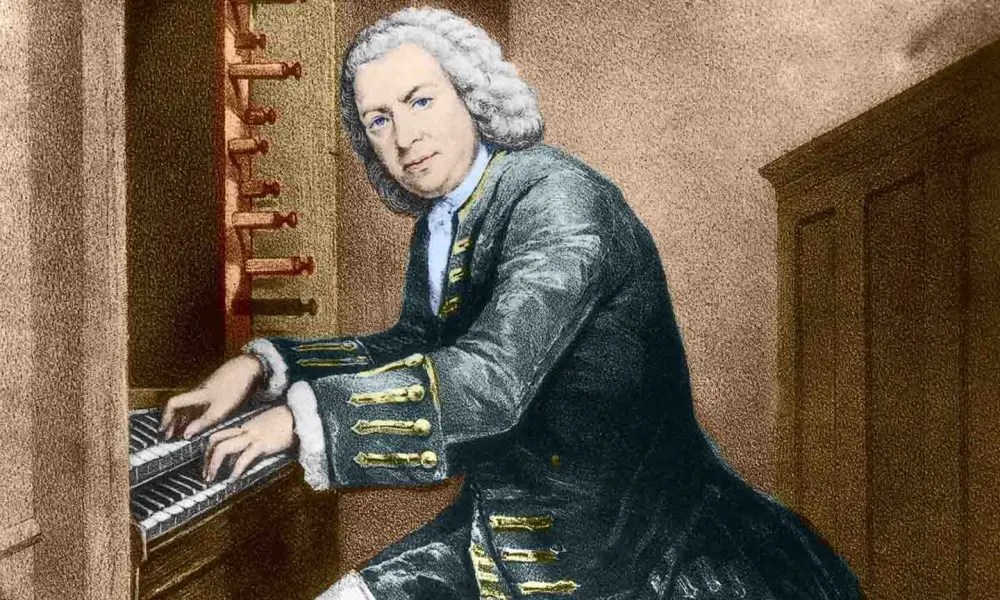
It struck me that, as a Christian, Bach would have believed that one of the properties of God would be His infinite creativity and abundance. He would also have believed that ‘The Kingdom of God is within you’ (Luke 17: 21 King James version). It’s therefore no surprise that in writing one of his longest and finest works, invention and abundance should be at the heart of what he has to say in his exploration. From the simple quiet statement – the still small voice of the Psalms , as it were – to the raging torrent of notes in some variations, this is Bach finding the infinite abundance of God within himself.
But there is also a journey here. The point at which this performance became truly special was in Variation 25, where the full horror of a fallen world seemed manifest in every disjointed and fractured note Olafsson wrung out of the piano. All the terrible things happening in Isael/Palestine and Ukraine/Russia at present seemed to hang over the music and the totally silent, seemingly mesmerised, audience. And then when Olafsson barnstormed into Variation 26 – and indeed onward to the ‘Quodlibet’ (Variation 30) – it sounded like the great chorus ‘Et Resurrexit’ from Bach’s B Minor Mass after the Crucifixus. The final articulation of the Goldberg aria, as Variation 30 slowed down gradually into it, was the achievement of a beautifully conveyed sense of final rest and repose. In fact there are two other variations (15 and 21, both in the minor key, ), and an introspective Variation 13 where there is this same sense of desolation, albeit not so sustained and countered in each case by a following variation of energy and brilliance, well-conveyed by Olafsson. There were many other fine moments though – beautiful phrasing of line throughout, crystal clear articulation (as in the rhythmically complex Variation 20) and a lovely way of giving the dance variations an extra spring. I was also impressed by his pacing of that introspective Variation 13. Speeds sometimes seemed quite fast – eg the ‘Quodlibet’ (faster than in his recording) – but always made sense in context
I was totally gripped for the whole 80 minutes or so – and I’ve bought the recording, as DG would want me to, that has come out alongside this year-long global tour of Olafsson’s where he is only playing the Goldbergs. There was huge enthusiasm from the audience and Olafsson clearly likes being in Liverpool – he said he was coming back next season, to much whooping and applause..
John Storgårds conductor; Tobias Feldmann violin: Sibelius Pohjola’s Daughter; Sofia Gubaidulina ‘In Tempus Praesens’ for violin and orchestra; Einojuhani Rautavaara Symphony No. 7, ‘Angel of Light’
This was a very stimulating and worthwhile evening. It was entitled ‘an evening of Finnish wonder’, which is a bit dismissive of the Gubaidulina piece, which comes from a very different tradition.
In a sense this was a traditional overture, concerto and symphony concert, with the Gubaidulina piece as the concerto, and with elements of spirituality connected with the second and third pieces.
It’s some time since I’ve been in the Bridgewater Hall (probably not since the Elgar oratorios in June) and after doses of the RAH and the Barbican, plus cavernous churches, it was wonderful to hear the clarity and warmth of the orchestral sound in the Bridgewater Hall. And the BBC Philharmonic sounded in very good form, particularly in the only work here I know at all well, the Sibelius. I thought the orchestra and Storgårds did wonderfully well in projecting the colours and drama of this music, with some very fine woodwind and horn playing and quite lush sounding strings.
The Gubaidulina piece is challenging but not inaccessible. I enjoyed it rather more than Offertorium which I heard a few years ago, another solo violin pitted against a big orchestra, as I recall. In this case it was a big orchestra without violins, with the other strings in full complement and a large brass and heavy percussion section, emphasising therefore the contrast between the sweetness and lightness of the solo violin and the darkness of the orchestra. The starkness and slowness of the piece sounded to me grounded in Russian Orthodoxy. The piece is about half an hour long and in an unbroken succession of contrasting episodes, the soloist and orchestra being pitted against one another – almost like an individual soul against some external force. The violin seems to lead at first with the full orchestra responding, successive climaxes being rounded off with a great gong crash, but about two thirds of the way through the violin sounds as though it is struggling against violence and there are some loud drum rhythms. There’s then an extended violin solo and you feel the orchestral response changing, culminating in an enormous major chord, sounding like some resolution of differences. The music then dies away. I found this to be an absorbing piece and I will try to listen to it again on I-Player – it’s not easy but I did find my attention held. Tobias Feldmann played I thought sensationally well.
I felt less positive about the Rautavaara piece, though I am a bit more familiar with it. If you were being cynical – perish the thought! – you could describe it as taking a dash of Sibelius, mixing in Mahler and Bruckner and ‘holy minimalism’ plus a bit of Hollywood film music, and coming up with something that is easy enough to listen to, but not gripping in the same way as the Gubaidulina piece. It is more static, less of a journey and too often the mood is a bit unvaried, though the 2nd movement has, as Rautavaara himself puts it in the programme notes, a “violent force”. Rautavaara clearly feels from his notes that this piece does represent a journey, but I have to say I didn’t feel it was a terribly gripping one.
Both works were well-received by a surprisingly full Bridgewater Hall, and excellently played by the BBC Phil (odd though that Storgårds didn’t split 1st and 2nd violins across the stage in the Rautavaara piece).
As an added bonus, there was a pre-performance half hour or so of songs given by the RNCM Songsters, a specially selected group of students at the RNCM – singers and pianists – who are passionate about, and excel in the performance of art song. This was in the foyer area. The songs were by Sibelius, Grieg, Delius, R.Strauss, Elgar and Quilter. I particularly enjoyed the performance by Siân Davies, a mezzo
Gemma Rosefield, cello: Bach, Cello Suite No.5 and Cello Suite No.6
I had been to one of the other two concerts covering the Bach Cello Suites but missed two of the suites out – probably 3 and 4. It was good to hear this performance of the 5th and 6th suites. Though I have a recording of them I wouldn’t say I play it that often, so it was a pleasure to hear these, not exactly as though they were new (I recognised some of the movements, particularly the Gavotte, from the 6th) but because I was never sure what was coming next……so one of the enjoyments in my listening to this performance was just of the fertility of invention of these works. They are very distinct in terms of their colours and feel: the 5th in C minor is dark and brooding, melancholy, abrupt and harsh on occasion, particularly in the Allemande, while the Sarabande is full of aching pain; the 6th is in D major, full of Bach’s dance tunes, and with a beautiful Sarabande as the 4th movement that is reflective, certainly, but with the contentment of things achieved rather than pain and losses felt, and things left undone. The soloist repeated it as an encore.
Ms Rosefield’s playing was always compelling, though occasionally sounding a bit scratchy and in need of maybe slower, more shaped, playing at times– certainly by comparison with the recording I’ve got, [played by someone I’ve never heard of, Victor Yoran]. The echo effects in the Prelude to the 6th suite were not very contrasted with the first articulations, I felt, for instance. But live performances are always preferable and I thoroughly enjoyed the hour spent in the Upper Chapel. The melody in the Prelude to the 6th suite will be ear-worming me all week………….

 John's musical journey