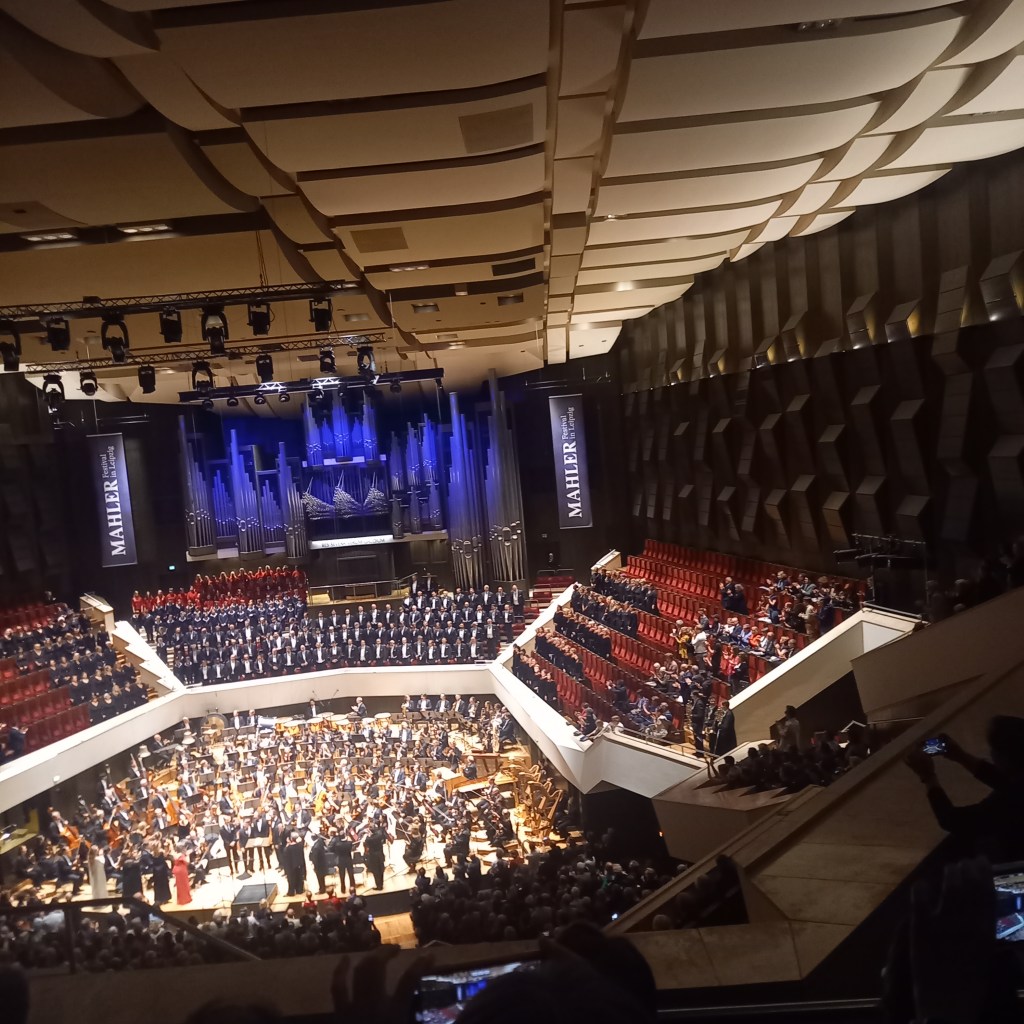
Halle Orchestra – conductor Sir Mark Elder; Sophie Bevan, soprano – The Angel Gabriel/The Blessed Virgin Mary; Alice Coote mezzo-soprano – Mary Magdalene; Ed Lyon tenor – John; Roderick Williams baritone – Jesus; David Stout bass baritone, Peter; Clive Bayley bass, Judas; 9 Apostles from the Royal Northern College of Music; Hallé Choir choral director Matthew Hamilton; London Philharmonic Choir artistic director Neville Creed
Although I’ve had a recording of this work for many years – the old Boult one (I remember hearing it on CD on a long coach trip from Kumasi to Accra with my staff c.2005 on my Walkman {!}) – I don’t think I really appreciated this work fully until I heard a wonderful live account of the work in 2012 in Manchester by essentially the same forces as I am now hearing in 2023. I sat in the front row of the stalls in 2012, and I had come back that morning from Dubai on a business trip – I had every reason to be falling asleep, but so fine was the performance, and so beautiful, the music, that I was totally attentive and completely overwhelmed by this work at the end – one of those moments you know you are going to treasure till the day you die. I subsequently bought the same forces’ CD of the work.
So, unless I organise myself at some point to go to the Three Choirs’ Festival, this is probably the last performance of this I will ever hear, given its infrequent appearances in the concert hall, and the fact that there are few other UK champions for it apart from Elder. Rattle maybe – he did the D o G memorably with the Vienna Phil once at the Proms, which I would have loved to go to, but was away for – but apart from Ed Gardner I don’t see anyone else out there among the younger generation of UK conductors as being likely champions (and Gardiner I suspect would probably see championing Tippet as more of a priority for championing). Having said that, I see Klaus Makela is conducting Walton’s Belshazzar’s Feast at the Proms, so maybe he can be persuaded of the riches of the English oratorio tradition…… And come to think of it Sakari Oramo has been a consistent champion of Elgar and the first performance of the Apostles at the Proms was given by Gennadi Rozhdestvensky in 1980……!!
A critic at the time of the Halle’s performance of this work at the Proms in 2012 described it as a ‘second-rate choral extravaganza’. I think that’s very unfair. For one thing, the text is concise (the critic describe it as gnomic but I suspect that may be because he doesn’t know his Bible. Elgar clearly does – and the words were selected by Elgar himself. While it is of course in King James or Revised Version wording, it is either from the basic Gospel narrative or passages from the Psalms, Proverbs and some of the Prophets plus Apocrypha, and it is brought together very concisely). The work is also well-structured – Part 1 focusing on Jesus’ ministry with Mary Magdalen as a central focus, and Part 2 on the Passion, Resurrection and Ascension, with Judas as a central point of focus . Although it is not dramatically as concise as Gerontius, certainly the Judas and Mary Magdalen passages are very striking. Musically there is some wonderful moments – the dawn sequence (apart from the embarrassing Orientalising bump and grind music of the Temple Singers), the beautiful setting of ‘Alleluia’ at points through the work, the wonderful choral writing – particularly the last 10 minutes of the work, and the musical material for Judas’ soliloquy. Words from Jesus and some of the other Apostles can drag a bit musically, I would say, but there is a mine of wonderful material in this work, and in overall terms it sounds much more Elgar’s own voice, with less use of Parsifal-like material (though of course leit motifs are a feature of both the Apostles and the Kingdom).
The Halle and LPO choirs sounded glorious, raising the roof in the final chorus. But they were also equally effective in the quiet passages – of which there are a lot in this work, and a challenge the combined choirs handled well. Alice Coote and Sophie Bevan had some lovely moments as Mary Magdalene and the Angel Gabriel, while Clive Bayley – despite some wobbles of voice occasionally, and maybe an over-operatic approach – was an impressive (and with very clear diction) Judas. The orchestra under Elder sounded wonderful – sensitively accompanying, thundering forth when required, and always with enough space to allow you to hear the inner voices of the score. I shall definitely be listening to the BBC R3 broadcast of this performance on June 28th
Again there were some extraneous noise issues, as with Gerontius. Either because of a malfunctioning air conditioning system or a malfunctioning microphone somewhere, there was a dreadful, distant hum audible in very quiet moments, somewhere above the left of the stage, in the first half (a lot of people could be heard complaining about it at the interval). Luckily this disappeared for the second half, but it was a pity the gentleman immediately to my left dropped a metal bottle of water on the floor during Judas‘ soliloquy, and Jesus seemed to have a mobile call for him from the stalls at some point in the second half. Oh well………..It will be interesting to see how the R3 broadcast deals with these problems


 John's musical journey