9. Pfitzner, Palestrina: Thielemann, Wiener Staatsoper
10. Mahler 6 – BRSO, Rattle, BBC Proms
As with 2023, there were a range of other concerts and operas which were almost equally as excellent, including: R. Strauss, Elektra – ROHCG/Pappano; Shostakovich 4 – LSO, Rattle; Death in Venice – WNO; Gotterdammerung – Jurowski, LPO; Jenufa – ENO; L’Olimpiade – ROHCG; Schubert piano sonatas D958/D959/D960 – Paul Lewis; Beethoven Op 131 quartet– Belcea Quartet; Janacek Glagolitic Mass’ – Czech Phil/Hrusa; Smetana, Ma Vlast/Schumann Piano Concerto – Petrenko/Olafsson, BPO; R. Strauss, Salome – Opera Bastille, Lise Davidsen; Puccini, La Rondine – LSO, Pappano; Weinberg, The Idiot – Salzburg Festival.
I feel very privileged to be able to attend all these wonderful musical events and feel very lucky to be living in a time which allows such (relatively) easy access to them
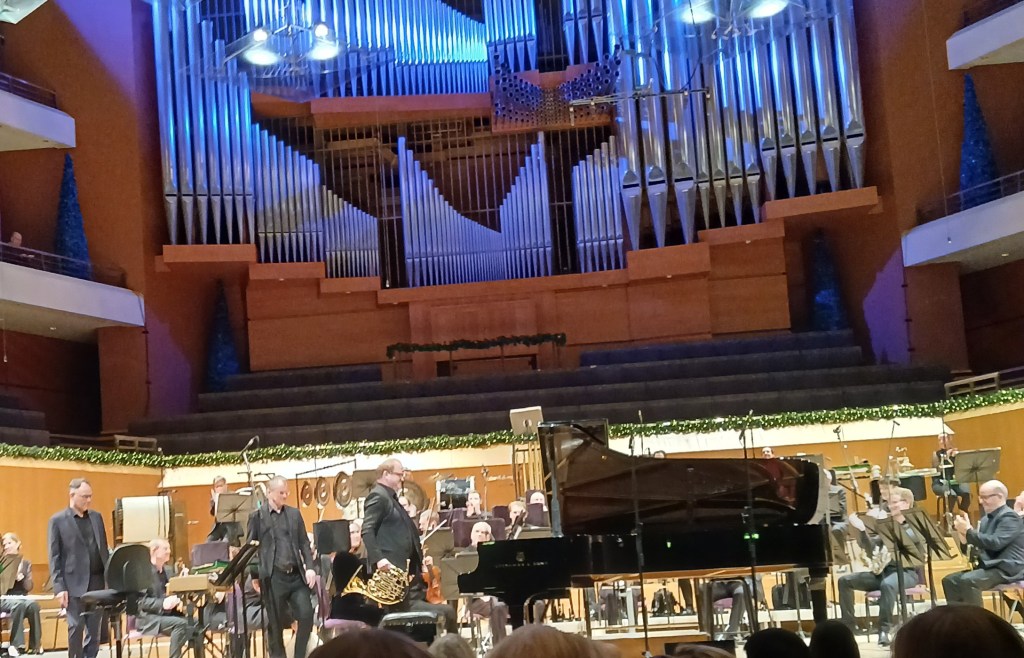
Messiaen Des canyons aux étoiles…Ludovic Morlot, conductor; Martin Owen, horn; Steven Osborne piano
Following on from Tuesday’s performance -of La Rondine, I was reflecting on how relatively few years there are between the writing of, say, Turandot and Messiaen’s ‘From the Canyons to the Stars’…no more than about 50 years. That is well within the span of my adult life yet they seem to inhabit totally different universes of sensibility. And yet there is maybe a hint of perfume and lushness to the Messiaen that Puccini might have understood even while other aspects of the work would perhaps have baffled him. In fact, we can compartmentalise composers too much – I was reading in a book about Elgar and the early recoding industry recently that he was very keen to hear more of Stravinsky’s music…..Anyway….it was quite a jump in two evenings from Puccini to Messiaen…..
I have heard this work a few times in a recording I’ve got and I remember some of the movements – the one about Aldebran and the last movement for instance. I was surprised and pleased to see that it had been scheduled by the BBC Phil (good old BBC) though a bit apprehensive about how I would feel listening to the whole 90 minutes of it rather than just selected highlights.
A decent number of people turned up to the performance – I had the impression from some overheard conversations that some had come from London to hear it, as after all it is rarely performed.
I had not really appreciated beforehand how individual the orchestral set up is – only a small number of strings, solo horn and the important solo piano (the work is almost like an enormous piano concerto), plus fore-grounded glockenspiel and xylorimba (the latter a new one on me), lots of heavy brass and significant numbers of woodwind and a battery of percussion, including the wonderful ‘geometer’ – like a wind machine but with pebbles inside. Messiaen of course based the work on his trips to the USA in the early 70’s and specifically to Utah, where he was hugely struck by the landscape,. which he described (as per the programme) as “the most mystical landscape” he had ever encountered, particularly the red-orange rock of Bryce Canyon. As someone who has slept overnight on the desert slopes of Mt Sinai, and seen the stars there more brilliantly than anywhere else in the world, I’ve had something of that same sense (I am sure less profoundly than Messiaen), from the experience, of the beauty and vastness of the universe and the unlikelihood of it all being a random collocation of atoms. It’s a work I have a sense of empathy with in its celebration of the natural and spiritual.
It’s an absorbing work and the 90 minutes seemed to flash by. The work was superbly performed by Steven Osborne on the piano, by Martin Owen on the horn (the ‘Appel interstellaire’ for solo horn was an astonishing piece of playing) and the glockenspiel and xylorimba soloists, together with the orchestra. The most enjoyable movements for me were 5. ’Cedar Breaks et le don de crainte’, 7. Bryce Canyon et les rochers rouge-orange, the beautiful 8. Les ressuscités et le chant de l’étoile Aldébaran and the final movement Zion Park et la cité céleste. If I am being honest some of the bird song movements were less than gripping, but, maybe, you need their sparseness and spikiness as a contrast to the awe, splendour and peace of the ‘spiritual’ music. As always with Messiaen (maybe Turangalila is more approachable than the other big pieces) it’s not easy music but I do find it very rewarding and, ultimately, moving. There’s a lovely quote from St Augustine I came across the other day which exactly fits how I felt about this work as I listened to it – “I feel that all the various emotions of the heart have rhythms proper to them in verse and song, whereby , by some mysterious affinity, they are made more alive” .
Concert performance – London Symphony Orchestra, Sir Antonio Pappano conductor; Carolina López Moreno, Magda; Serena Gamberoni, Lisette; Michael Fabiano, Ruggero; Paul Appleby, Prunier; Ashley Riches, Rambaldo; Sarah Dufresne, Yvette/Giorgette; Angela Schisano, Bianca/Gabriele; Marvic Monreal, Suzy/Lolette; London Symphony Chorus
Unusually for me, I had made a wrong judgement about seating in booking for this . I thought I was a few rows back from the platform but in the event I was in the front row about 5 feet away from the singers and the orchestra leader. I felt a bit awkward at times, but what I missed in being able to see the surtitles was more than made up by the feeling of being in the middle of a maelstrom of a performance. Because this was a very, very good performance indeed, within the limitations of the staged concert performance format – and this was one of the more minimalistic versions of the format, with serried ranks of music stands and little room to do anything on stage (it’s a big cast) than nod to each other and enter and exit.
It was disappointing to get an email about two weeks before the performance saying that the announced big star, Nadine Sierra, had had to drop out of the show (although she was singing at the re-opening of Notre Dame on 7th Dec – https://www.classicfm.com/discover-music/periods-genres/national-anthems/nadine-sierra-la-marseillaise-notre-dame/). Somebody called Carolina Lopez Moreno, I was told, was taking on the role of Magda – not a singer I’ve heard of before. In the event, she was fabulous. Tall, with an expressive face, she had a very well-centred voice, very secure-sounding, and hers was a big voice, too – her higher register was gleaming and clear, the top notes pinged out, sailing over the orchestra, and at the same time she had a warm lower register and could fine her voice down to expressively quiet phrasings when needed by the text and music. She sung sensitively when in duets with Ruggero, so that her voice didn’t overwhelm his. I thought she was quite a find as a dramatic soprano – she was brought up in Germany but doesn’t seem to be part of a company there; she’s sung in various Italian opera houses. She got a huge ovation from the (pretty knowledgeable, in terms of the conversations going on around me) audience. She was also the only person singing without a score, so could be much more bodily expressive and looking as though she was fully engaged with the role than others in the cast (even Fabbiano was using a score, which surprised me – I would have assumed a tenor of his experience would know the role.
The other stand-out for me was Peter Appleby, a Met regular, as Prunier, who although singing from the score, made a lot of effort to accompany a musical phrase with an appropriate gesture and point the words clearly, with excellent diction – his opening aria “Chi il Bel Sogno di Doretta” was excellent. Michael Fabiano has a fine Puccini tenor voice but, in this context, seemed a bit wooden in presence, particularly when confronted with such a vivid characterful performance of Magda. Sarah Dufresne had the right sort of sparkle and energy about her portrayals, as did Serena Gamberoni as Lisette. All the other parts were well cast and performed.
I just loved the music – so much of it is memorable, and so cleverly scored. It’s also concise, with no longueurs. It’s, in addition, a text that gives far more dignity to the heroine than most of the other Puccini operas – and she walks away at the end, sad but with head held high and in charge of her own destiny. The LSO, a lot of the players smiling to themselves and each other at some of Pappano’s huge ritardandos, played magnificently, with Pappano driving the score forward excitingly, but always with affection and warmth . The chorus also seemed to be enjoying themselves greatly as they belted out the big tune in the second act (and what an ear-wormer that is – Bevo al tuo fresco sorriso)
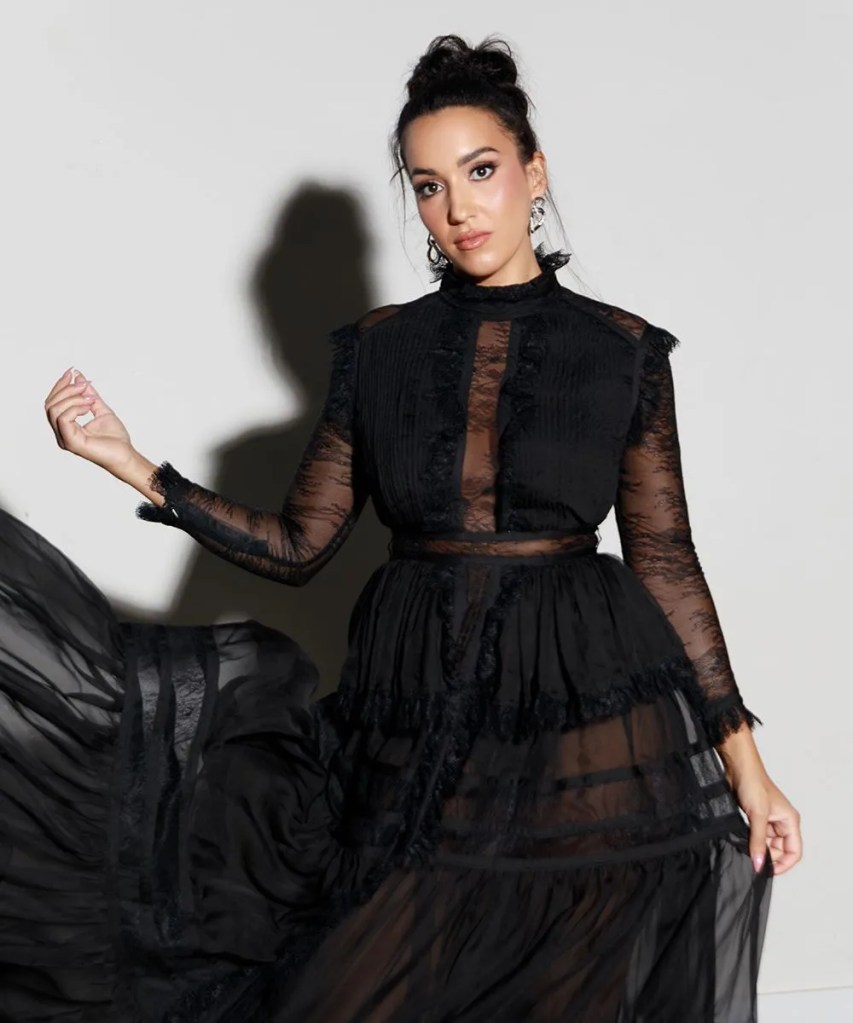
Uncredited picture from Ms Moreno’s website of her playing Magda in La Rondine
Stéphane Denève, Conductor; Rosa Feola, soprano; Singverein der Gesellschaft der Musikfreunde; Kate Lindsey, mezzo; Wiener Symphoniker. Programme included – Mass for Choir and Orchestra C major KV 167 “Trinity”, 2. Gloria, Mozart; Laudate Dominum, Mozart; German Dances KV 605, No. 3 C major “Sleigh Ride”, Mozart; ‘Ave Maria” for solo voice and organ, Saint-Saëns; ‘Carillon”, 3rd and 4th movement from “L’Arlésienne”, Suite No. 1 plus “Farandole”, 4th movement from “L’Arlésienne”, Suite No. 2, Bizet; “Les anges dans nos campagnes” for Choir in G major, Gevaert; “Marche des Rois” for Choir (Arrangement: Rosa Parker / Robert Shaw); “Adeste fideles”, Anonymous; Overture and “Abendsegen’ from the opera “Hansel and Gretel”, Humperdinck; “Ich harrete des Herrn”, Duet and choir from the choral symphony No. 2 in B-flat major op. 52 “Hymn of Praise”, Mendelssohn; “Bring a Torch, Jeannette Isabella” (Arrangement for Organ: Keith Chapman); Anonymous; “Adoration”, Florence Price; “In the bleak Midwinter” (Arrangement: Mack Wilberg); Gustav Holst; “Somewhere in my Memory” and “Merry Christmas, Merry Christmas” from “Home Alone” (1990), John Williams; “O du fröhliche” (Arr.: Matthias Spindler).
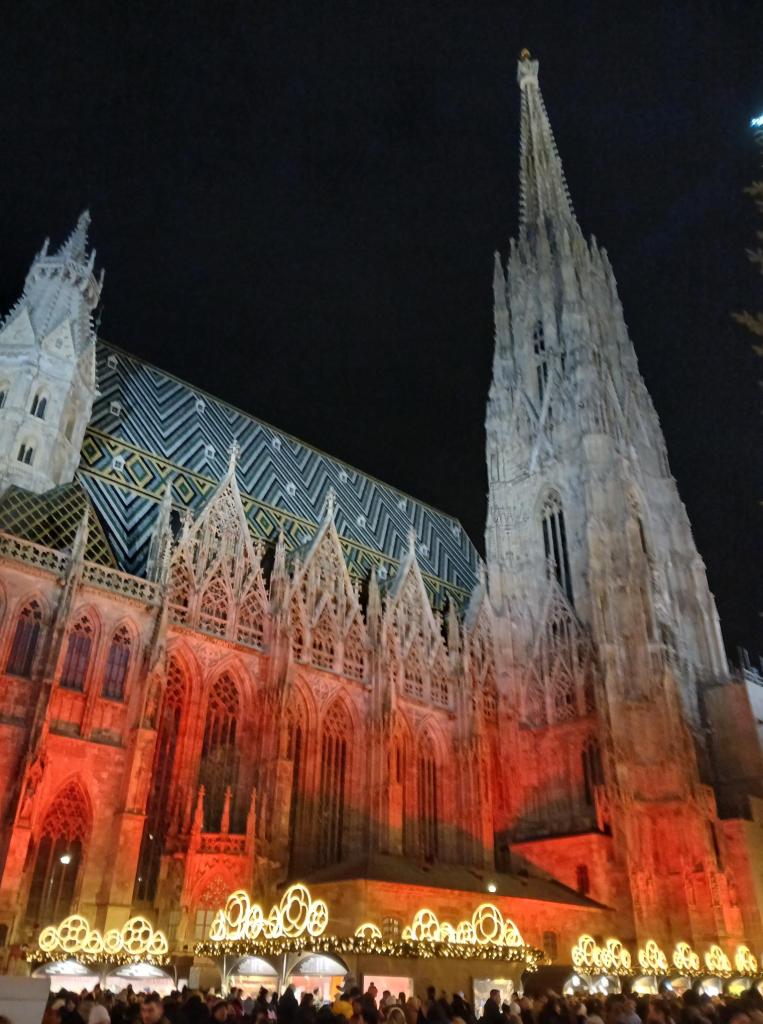
Well, for my third evening in Vienna – and it seemed a bit miserable to leave after only two – there were only two musical options happening that I could identify in advance to go to – one was West Side Story at the Volksoper, and the other was this, clearly a BIG Austrian event having a Christmas at King’s feel to it – televised, lots of people queuing. I suspect in fact I might have done better at the Volksoper but this, as they say, was what it was and delivered what it was meant to deliver – a series of festive, though not particularly Advent-ishly themed, short snippets of mostly easy-on-the-ear music. Highlights, though as usual the music in a big church always gets distorted, were the idiomatically played ‘Hansel and Gretel’ overture and Stephane Deneve really putting the orchestra through its paces in the Bizet Farandole, dangerously fast for such a congested space. Rosa Feola and Kate Lindsey are both distinguished opera singers and did well in their pieces, particularly the Hansel and Gretel duet. There was also some very effective and powerful organ playing in the piece arranged by Keith Chapman. That’s about it, really……My mind kept going back to ‘Tonight, tonight’……….as I listened to some of the more tedious pieces (there was a very irritatingly arranged version of ‘ In the bleak midwinter’ which managed to ruin Holst’s simple melody with chromatic overlays….)
My next trip overseas is in March to hear the Berlin Phil play Bartok. and three R. Strauss operas.
Pius IV, Günther Groissböck; Giovanni Morone, Michael Nagy; Bernardo Novagerio, Michael Laurenz; Cardinal Christoph Madruscht, Wolfgang Bankl; Carlo Borromeo, Wolfgang Koch; Palestrina, Michael Spyres; Ighino, Kathrin Zukowski; Silla, Patricia Nolz. Conductor, Christian Thielemann; Director, Herbert Wernicke; Design and Lighting, Herbert Wernicke
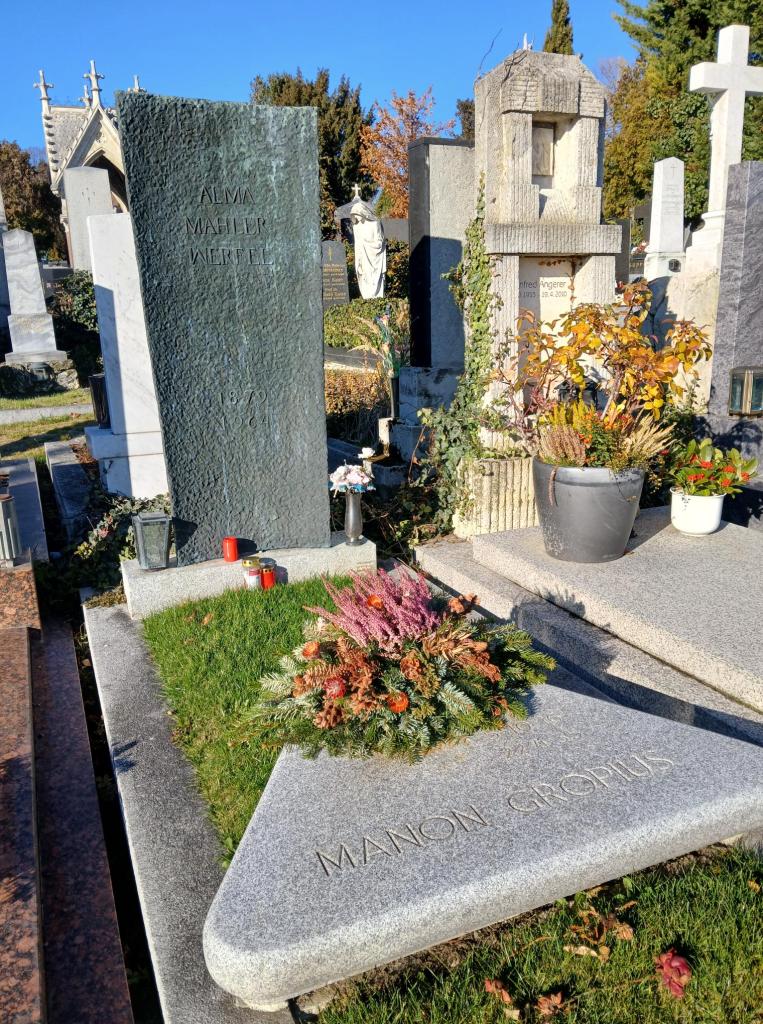
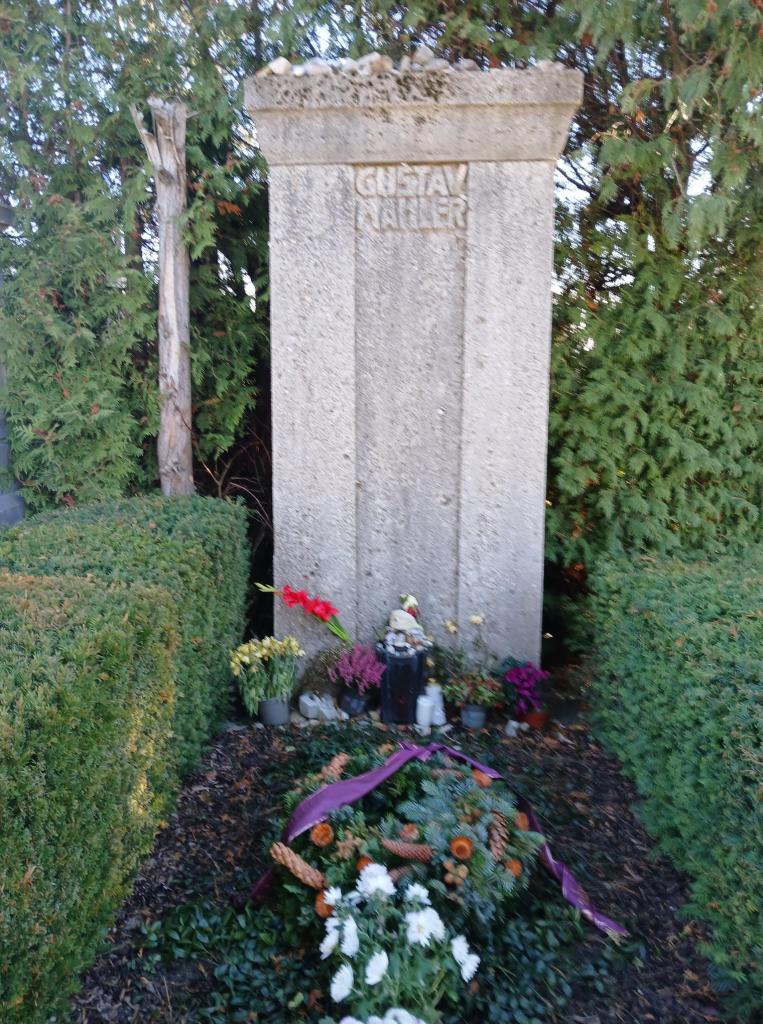
I spent the late morning and early afternoon in a bit of a pilgrimage to Grinzing Cemetery by U-line and bus to see Mahler’s grave (I had forgotten Alma and her daughter Manon – inspiration for Berg’s Violin Concerto when she died – are in a parallel plot about 50 yards away, and saw their graves too). The grave is surprisingly unshowy and not very imposing – just two words, Gustav Mahler, on the stone. It’s also not a very big plot; you get something of a sense of Mahler’s size from contemplating it. As you can see from the picture, there were lots of flowers
So….on to Palestrina……I have wanted to see and hear this work live for over 50 years. I can’t remember how I first got to hear it, but it must have been the Prelude which attracted me initially. It is rare to find the opera performed outside Germany and Austria – Covent Garden put it on with Thielemann conducting in 1997 and revived it in 2001. Andrew Clements wrote a very strongly negative review in the Guardian at the time, praising the quality of conducting and cast but giving it two stars overall for the work’s ‘schoolmasterly cadences and rambling, unfocussed melodic lines’ and Pfitzner’s own ‘bilious sense of injustice’ at seeing himself ‘passed over in favour of the new generation of modernists’. So there………….I can see what he means, and much Anglo-Saxon commentary on the work that I’ve seen dwells upon Pfitzner’s nationalism and his connections with fascism. But I think Clements is wrong……Although the student Silla does represent new tendencies in music, Palestrina is not an embittered man at odds with his age, and there is some disconnect in the argument from Clements here – Palestrina the composer is fully contemporary in his major work (despite one or two digs in the text at Silla for being a modernist) and his problem is not that he’s out of touch but that he is depressed and unable to write music after the death of his wife, and that the Church is undergoing a counter-reformation. The voices of the past and angels inspire him to write but it is contemporary music that he’s writing – albeit as the last link on a long chain, as the text puts it – and it’s the role of spontaneous inspiration in composition that’s emphasised; it’s the Council of Trent that wants to turn the clocks back by opting for Gregorian chants in future for church music, turning their back on polyphony for a purer Christian message. It’s true there is one reference to the ‘old’ music that he writes from one of the Cardinals, but, really, this is not an opera about old and new music – despite what I say about Die Meistersinger below – and in fact, despite the German far right views often associated with Pfitzner, ironically the opera is in part more about a powerful institution’s attempt to co-opt and overpower artistic inspiration than anything else.
The theme of Palestrina – artistic inspiration – has some connections with Die Meistersinger, and that work, and (musically) Parsifal, both seem unspoken presences in what we hear and see. There are apprentices, an older melancholy man who is a widower, and a riot in Act 2, plus a sad and serious Act 3 Prelude, for instance. Yet Pfitzner is his own man, really, and Palestrina doesn’t sound that much like Wagner or Richard Strauss. In particular, there is an inner light, a purity, a melancholy, about the best of the music, which Strauss could never have achieved
Never having seen the work in the theatre, and never having listened to it in one stretch, I was fascinated to see how it would come across live. The impact, I have to say, is a mixed one. I’ve always known this is a problematic work to stage. The problems are several: there’s the uneven timing of the three Acts – Act 1 an hour and 40 minutes, the second an hour and 15 minutes, and the third about half an hour. There’s also the problem that first and third acts have wonderful music, some of the loveliest I know, but the second is uninspired and about double the length it should be. Thirdly, in general, Pfitzner, who wrote his own libretto, had little of Strauss’ or Wagner’s sense for what makes for good drama on stage, and many of the scenes are too static. To make it work it needs a fresh production with lots of dramatic solutions creatively introduced to overcome the problems, and in particular, some of the many problems of the second act – e.g. as an example of what not to do, in this production all the cardinals look the same….. There is perhaps one effective idea in the 2nd act here, when in the closing moments police officers appear and shoot the rioters, another example of a domineering institution running amok. But this production was directed and designed by Herbert Wernicke who died over 20 years ago – therefore it’s obviously had several outings over the years and there was not much evidence of careful direction coming out of the presumably limited time for rehearsal. On the way home I fantasised about travelling back in time to meet Pfitzner in say 1914 and give the perspective of a 100 years into the future – ‘Herr Dr Pfitzner, the first and the third acts are wonderful but the second act is a disaster. Cut Act 2 to 30 mins, make it Act 2 Scene 1, and have another 30 minute scene with Palestrina in prison, and make the opera not only about how artistic inspiration comes about but how the State often tries to suppress artists it doesn’t like. That will also improve your reputation post-National Socialism’.
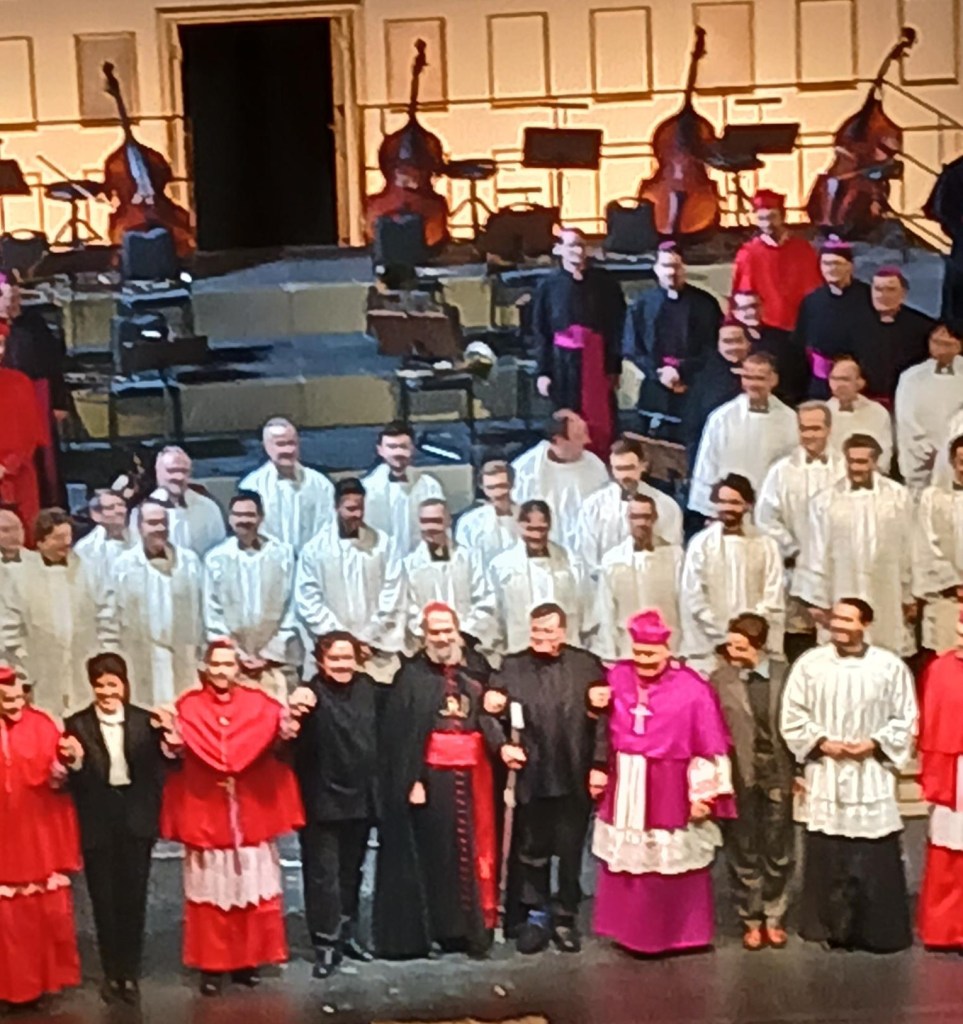
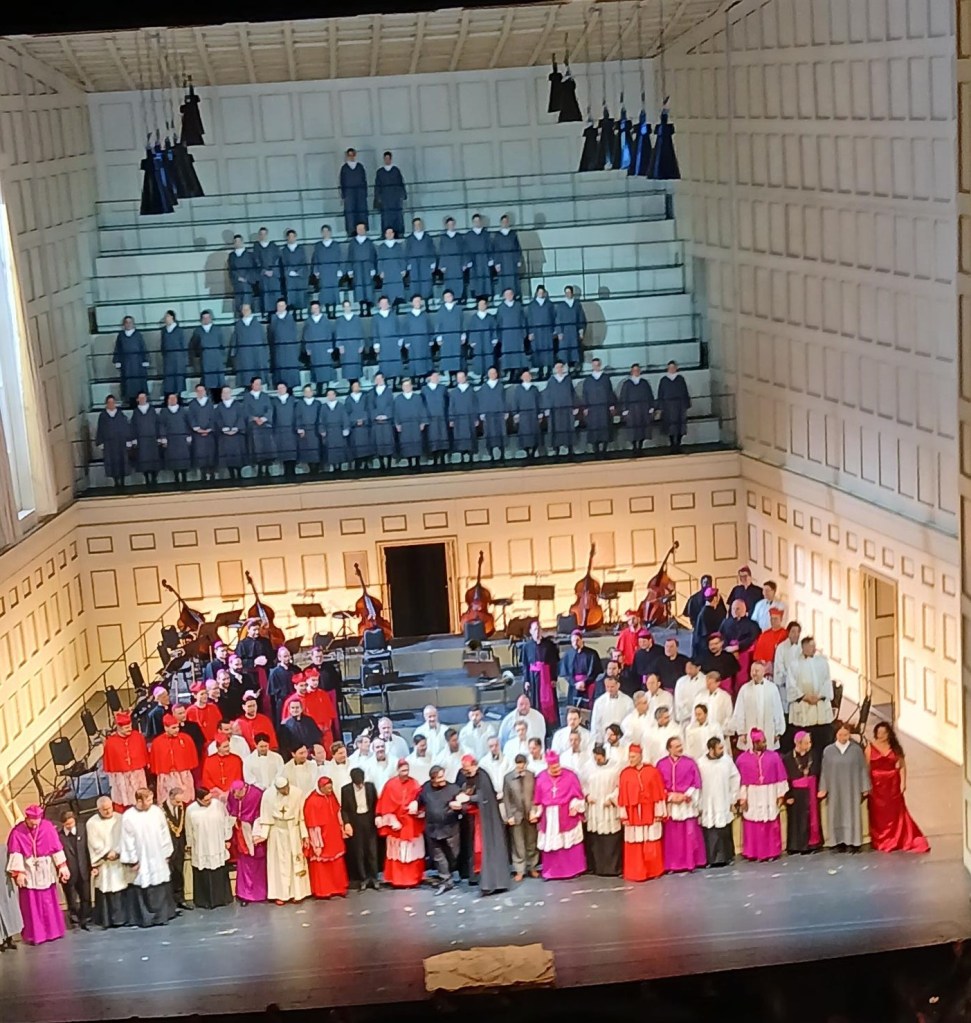
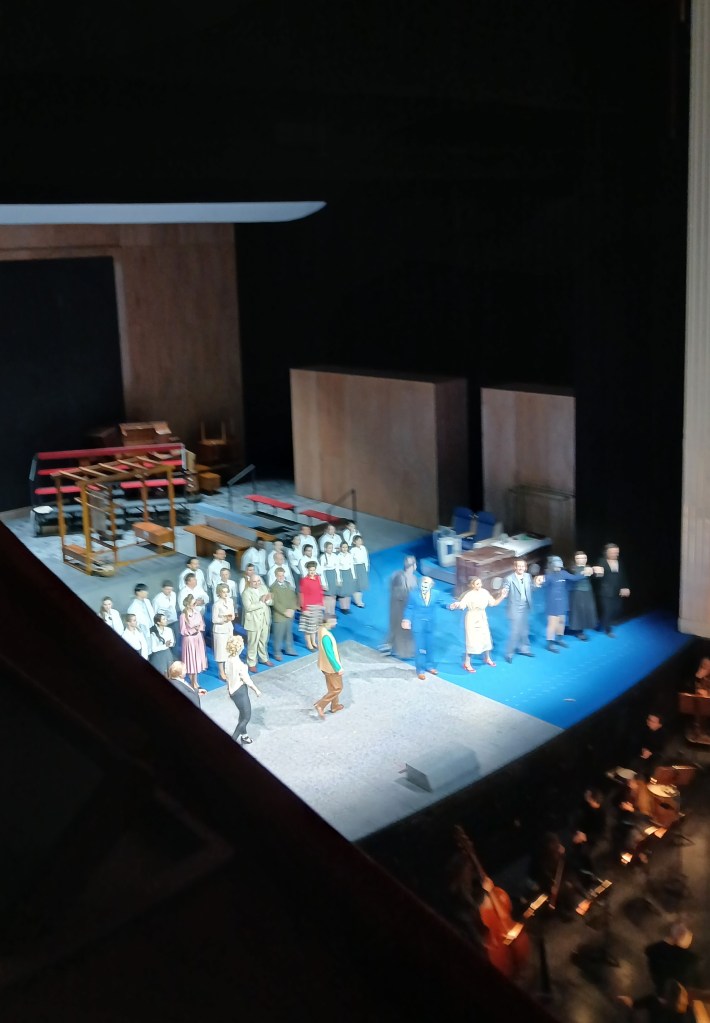
Anyway….he probably wouldn’t take my advice – he was apparently a terribly stubborn individual. The set for this production is as you can see from some of the photos below, a boxed large room, looking like a studio, church or concert hall, with tall panelled walls and an area at the back that looks like a large organ but which, in a real coup de theatre in the climax of the first act, becomes two opening panels as the heavenly voices begin their song of praise, revealing like the middle of a medieval altar four serried rows of choristers seemingly on top of each other. It’s a wonderful effect, and is used again in the 2nd act for members of the Council of Trent, as in the photo. Interestingly in all three acts abandoned string instruments lie around the set. Costumes seem to be vaguely of Pfitzner’s time for Palestrina, his family and clergy, and then chorister clothes for the masters and heavenly hosts.
Michael Spyres was excellent as Palestrina, with clear diction and an approach that relished the potential for beauty of phrasing in what he has to sing. He had to resort to a head voice for the very high note towards the end of Act 1, but, apart from that, his sounded to me a very fine reading. Ighino was warmly and touchingly sung by Kathrin Zukowski, and PatriciaNolz as Silla was suitably passionate, abrupt and impulsive. Wolfgang Koch was maybe slightly underpowered as Cardinal Borromeo, but gave a warm performance – maybe not quite fiery enough. Gunther Groissboeck – for once a current, rather than superannuated bass star of the past, in the role – did a fine cameo as Pope Pius IV, appearing from a stage box. The Vienna Philharmonic sounded utterly glorious in the pit – wonderful string playing in act 1, and some outstanding flute oboe and clarinet playing in Act 3. As in other opera performances I’ve heard him give, Thielemann (on crutches and seated while conducting because of an achilles tendon injury) controlled the orchestra tightly so that singers could always be heard, no mean feat in what is sometimes quite a dense score, and then lets the orchestra rip when it needs to – the end of Act 1 was thrilling. The (presumably augmented Staatsoper Chorus were on magnificent form.
The performances Thielemann gave at Covent Garden in the late 90’s of Palestrina elicited from the veteran critic of the time, Rodney Milnes, the comment that they were so excellent they almost made you think it was a great opera. It is undoubtedly seriously flawed, but it was wonderful to hear it, and the finest moments are indeed cherishable
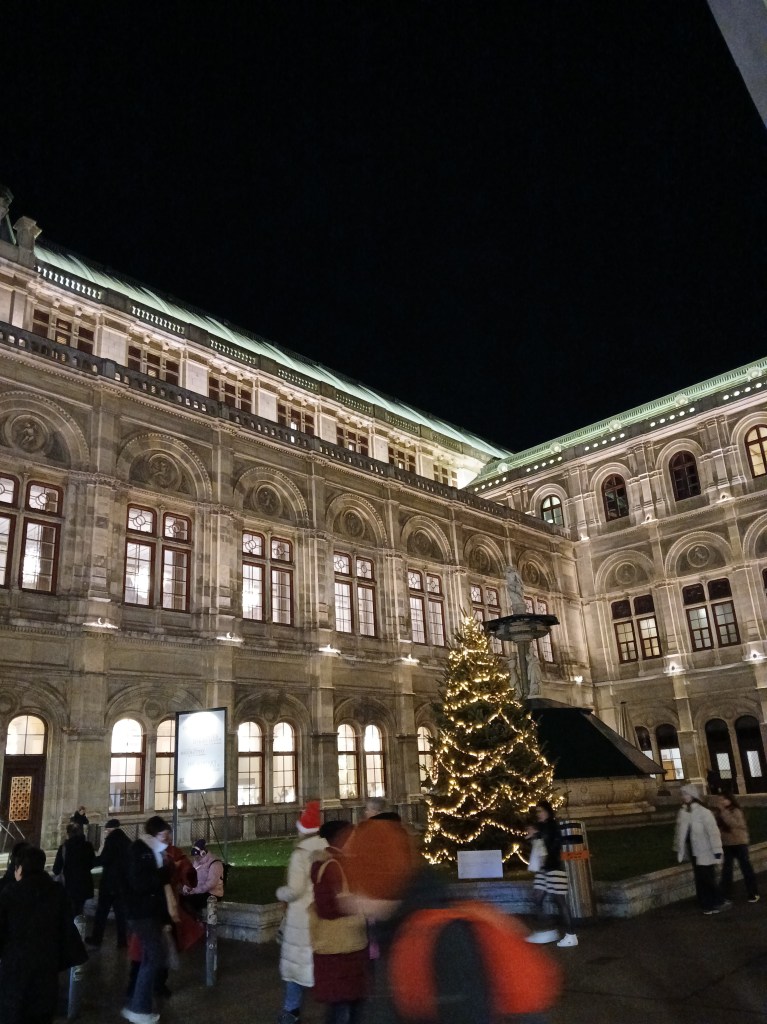
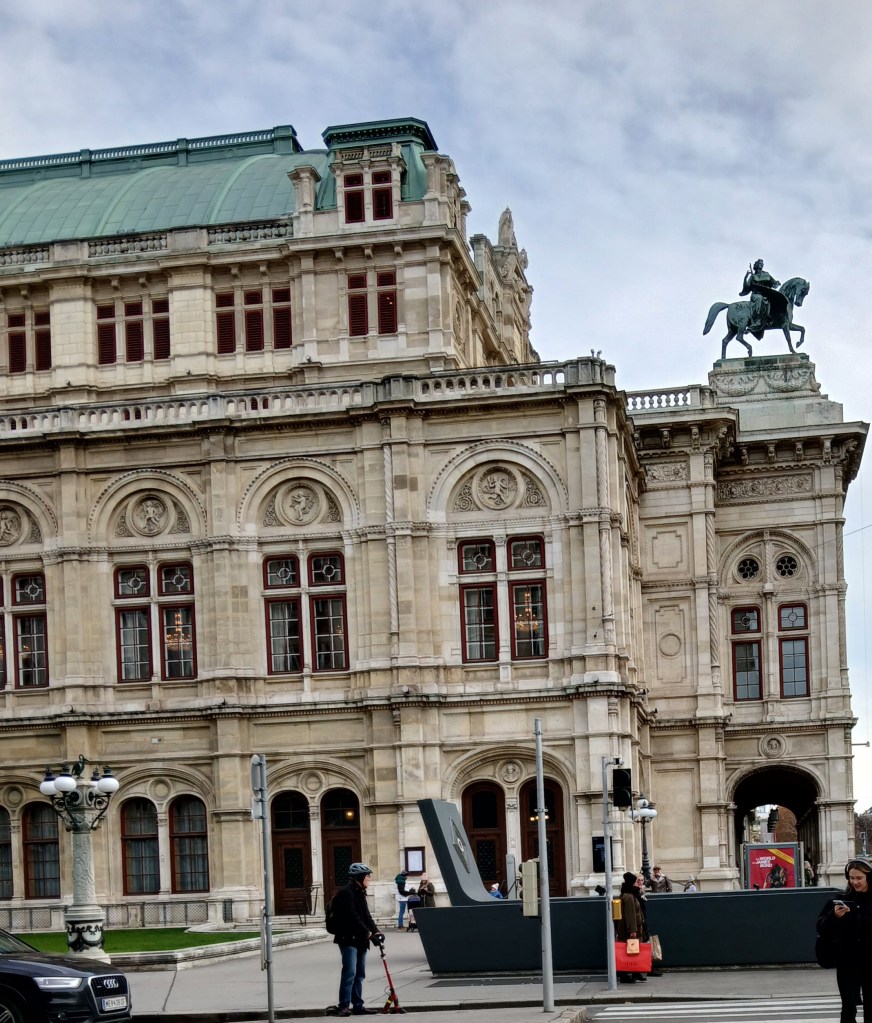
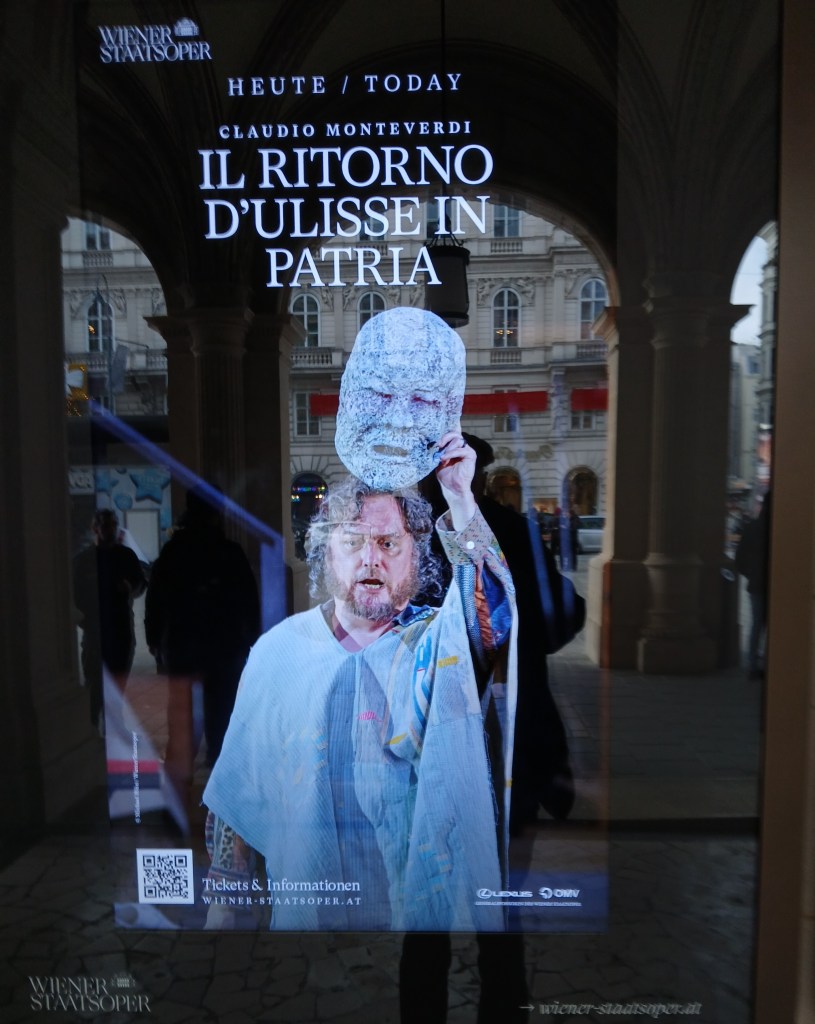
Ulisse, Georg Nigl; Penelope, Stephanie Maitland; Telemaco, Cyrille Dubois; Minerva, Isabel Signoret; Melanto / L’umana fragilità 3, Daria Sushkova; Nettuno / Antinoo / Il Tempo, Antonio Di Matteo; Pisandro / L’umana fragilità 4, Pavel Kolgatin; Iro / L’umana fragilità 2, Jörg Schneider; Ericlea / L’umana fragilità 1, Stephanie Houtzeel; Giove, Matthäus Schmidlechner. Orchestra, Concentus Musicus Wien; Conductor, Stefan Gottfried; Director, Jossi Wieler / Sergio Morabito; Designer, Anna Viebrock Following the Eurostar journey mentioned in the previous blog entry, I then enjoyed – and it all went very smoothly – a 12 hour journey from Paris to Vienna. After a walk into the centre of town the following day, I went to the Kunsthistorische Museum for a couple of hours, looking at the Brueghel collection (recommended by a friend, and it is very fine) and their very interesting Greek and Roman collection, particularly, and then on to the opera house This evening’s performance was a great and pleasant surprise. I have seen the Monteverdi opera once before, at an RNCM performance about 14 years ago. I don’t remember much about it, but I was left with the impression that it was full of declamatory recitative, stock cadences, and a not very compelling story (or rather a story told in a not very compelling way). I ‘d have much rather gone to see The Coronation of Poppaea, I felt, which I have never been to a live performance of – had it been on, however it wasn’t! – but as the point of my visit was to see ‘Palestrina’ the following evening, I was happy enough to hear and see Il Ritorno d’Ulisse again as the best thing to do that evening. But in the end my opinion of the piece was transformed, and became very much less grudging. The Vienna Philharmonic were replaced at this run of Monteverdi performances by the Concentus Musicus Wien, so the theorbos (3 of them), the natural trombones and all the other historically informed apparatus was on display. Suitors are said to have ‘ravaged and defiled’ the Ithacan palace since Odysseus’ departure and it certainly seems a dump in this production – ladders and scaffolding, a few unrelated chairs, some very basic tables and lots of chests move round on a revolving stage, along with, unaccountably, a large tennis umpire’s step ladder. A white screen drops down and is suspended above the action about a third of the way through, and on it are occasionally shown threatening images related to the gods’ power – when Jupiter’s powerful bird is mentioned there’s a picture of a bomber aircraft, at other times there are videos of clouds when the gods are referred to. The colours of set and costumes are predominantly contemporary furniture-like – browns, reds and blue – and only Penelope really stands out, in a brilliant white dress. The dress style is vaguely 1960s, to no particular point or effect as far as I could see, and the gods have bluish make up (certainly Jupiter and Minerva do, though Juno looks a bit like Dolly Parton in her younger years), and Neptune looked vaguely like a diver (though without the flippers which apparently featured in an Opera North production). In short, though not actively annoying, the set designs and costumes didn’t do much for me. My attention was gripped by three things -the quality of the acting and singing and the beauty and variety of the music. The latter first – I was stunned by the beauty of the music and that in fact there is much in the work that can only be really classed as an aria/duet etc. I loved the lush orchestration and the exotic sounds (obviously what it really sounded like in the 17th century is anyone’s guess, and no doubt Monteverdi, like Bach, would have worked with whatever resources he had available); there were many lovely moments (particularly a trio towards the end of the first half, and the final duet between Penelope and Odysseus) which were exquisite. I enjoyed the music in fact much more than I have the one or two performances of Orfeo I’ve been to over the years. Secondly, whatever the problems of the sets, the handling of people was very good – all were extremely convincing in their roles and reacted well to each other. The drama of Odysseus’ return seemed real. In a strange way, the intensity of the drama meant that humour could be brought into the scene where the suitors try to string Odysseus’ bow, and the comic character Iro was enabled to come across well, without distorting the story. Penelope in dark glasses was suitably remote, and Odysseus appropriately ardent. The gods were skittish, which is probably how Monteverdi and his librettist wanted them – Isabel Signoret particularly projected well as Minerva. The standout singer was the Austrian Georg Nigl as Odysseus – he had a strong, sweet voice that projected effortlessly into the auditorium, and he was very good at expressive phrasing, even in declamation. In fact, all the main male parts were strongly cast – the three suitors, and also Cyrille Dubois as Telemachus and Antonio di Matteo as Neptune were particular stand-outs. About some of the female parts I was less sure – Stephanie Houtzeel as Ericlea from where I was sitting (in a side box) sounded a bit underpowered. Stephanie Maitland (a Wiener Staatsoper young singer) has an unusual deep lower register which supported effectively her depression and her resistance to both the suitors and Odysseus. She seemed to me to be more focused on declamation than on lyrical phrasing – but maybe that’s just the nature of the role, and her contribution to the final duet was very moving. The Viennese early music specialist conductor Stefan Gottfried kept everything together and also directed from the keyboard. All in all, not only an enjoyable but a moving evening……..
Bach, Capriccio in B flat (Capriccio on the Departure of his Most Beloved Brother) BWV992; Beethoven, Piano Sonata No. 26 in E flat Op. 81a ‘Les Adieux’; Schumann, Geistervariationen WoO. 24; Prokofiev, Piano Sonata No. 7 in B flat Op. 83
This recital was entitled ‘Farewell‘ to give it a thematic link – a descriptive noun obvious enough as far as the Beethoven and Bach works are concerned. The Schumann Geistervariationen (Ghost Variations), or Theme and Variations in E-flat major for piano, WoO 24, was written in 1854, and is according to the recital programme the last piano work of Robert Schumann, as the piece was composed shortly before he was admitted into a hospital for the insane. It’s not immediately clear what the ‘farewell’ element is in Prokofiev’s Piano Sonata No. 7 in B♭ major, op. 83 (occasionally, again, according to the programme, called the “Stalingrad”). It’s the second of the three “War Sonatas”, composed in 1942. . Maybe it’s to be seen as a farewell to peace and stability……..
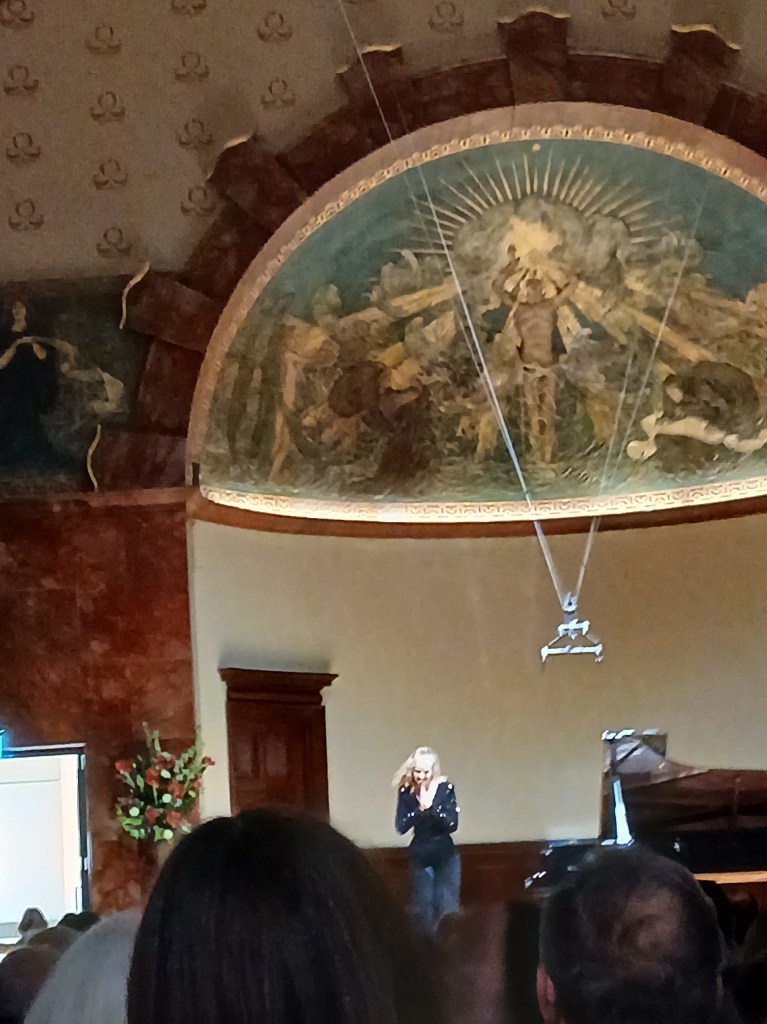
This was not a recital which would have normally justified the expense of a train ticket and a night in a hotel, but my travel to Vienna the following day meant I had to spend a night in London to catch an 0600 Eurostar train. This concert seemed a good way of spending an evening in London, of the options available. Elizabeth Brauss I think I’ve heard once before, playing Mozart with the Halle just after lockdown ended……I remember being impressed……And this was in the event a good concert to go to, with three pieces I hadn’t heard before, which is always a good thing
I was most struck by Ms Brauss’ playing in the Beethoven and Schumann. The Beethoven was confident, dramatic, at times withdrawn and mysterious. I found myself deeply led into Beethoven’s sound world and the pianist had the right muscular strength and clarity of sound I feel the.music needs. The Schumann was quite a find; a beautiful sad piece poetically played with a very fine decline into silence at the end which did seem to prefigure Schumann’s incarceration (though some idiot let forth the most enormous sneeze on the final chord…..). About the Bach I was less sure; it’s a lovely piece but sometimes the playing felt a little awkward in the production of some of the trills and clusters of notes -also not enough was made of the Baroque echo music, varying the repetitions, and I missed the distinctiveness, the varying,. of phrasing which Vikingur Olafsson provides in Bach piano arrangements. The Prokofiev is not a piece it’s easy to like – a lot of the music sounds quite arid, to my ear. But Ms Brauss stormed through it, and the third movement with its jazzy spikey syncopated rhythms is quite fun, while the edgy distracted slow movement also had me listening carefully. At the end of it I still had no idea of the work’s connection to the ‘farewell’ theme of the programme.
Ms Brauss’ encore was a return to the melancholy 19th century – possibly Brahms, possibly Schumann again….This was quite a short concert – barely more than 70 minutes of music, but, committed as I was to getting that Eurostar train the following morning, this didn’t bother me, and meant a needed early night…..
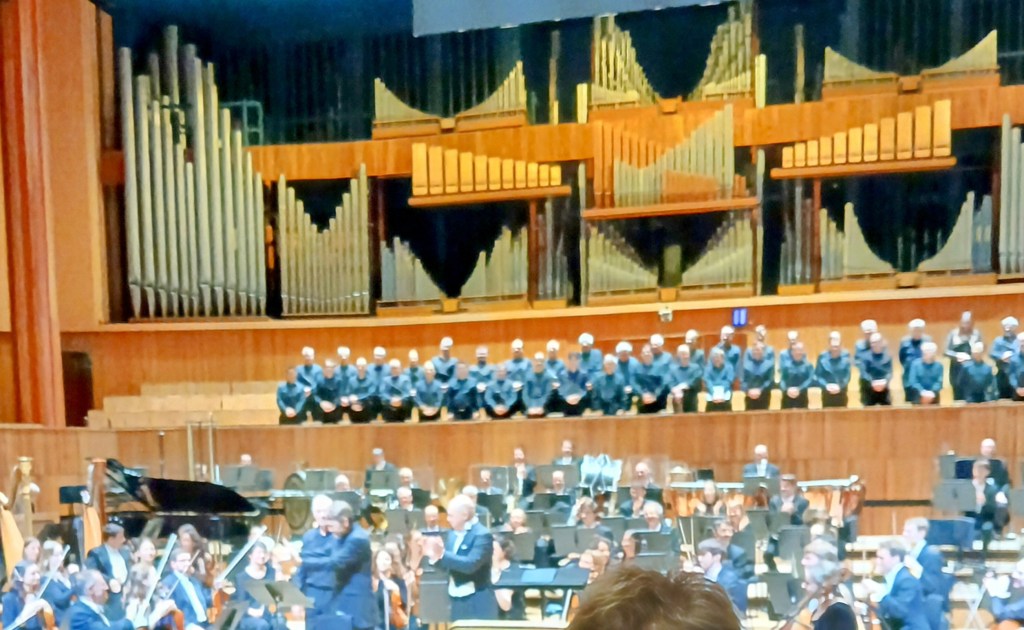
London Philharmonic Orchestra, Andrey Boreyko conductor; Gidon Kremer violin; Alexander Roslavets bass, narrator, London Philharmonic Choir. Schoenberg: A Survivor from Warsaw, Op.46; Weinberg: Violin Concerto in G minor, Op.67; Shostakovich: Symphony No.13 in B flat minor (Babi Yar) for bass, chorus & orchestra The background, in a sense, to this concert is the book by Jeremy Eichler, Time’s Echo, which looks at the Holocaust and World War Two, and the music related to it, and, in particular, studies in-depth the Schoenberg and Shostakovich pieces in this programme. It’s a book on music, war and memory which has been named History Book of the Year by The Sunday Times and hailed as “the outstanding music book of this and several years” by The Times Literary Supplement. Eichler is also currently the LPO Writer-in-Residence and so he was at hand to discuss the evening’s programme in a pre-concert talk (sadly to get to it I had to miss the evensong at Westminster Abbey I had intended to go to). Eichler’s thesis is that music offers a very special way of encapsulating memory, showing through its unique characteristics how feelings can be conveyed across hundreds of years. He was – allied to this – concerned that we should be asking not only how a piece of music works when we listen to it, but also why we should be listening to it. All of these pieces in the concert, he indicated, were ‘why’ pieces where that question is relevant and the answer based upon the memories they convey. I have never heard any of the pieces before live. I really only started listening to the Shostakovich piece when I knew this concert was coming up – I have never had an LP or CD of the work – though I do have an MP3 version, I’ve never got round to even listening to it before a month ago. I am not quite sure why – maybe just the fact that you need to be reading the text alongside listening to the music and I have only just found the text of the Yevtushenko poems on the internet. And the other pieces I have never heard at all, even in recordings. The Schoenberg piece is only 7 minutes but intensely dramatic, with a sprechstimme Narrator and a men’s chorus, the text being an imagined awakening of concentration camp prisoners who are being sent that day to the gas chambers. It is an atonal piece but of course that expressionist sound suits the subject matter very well, and the work culminates in the men’s chorus singing the Shema Yisrael, the Jewish creed, There is a final overpowering crunching chord to finish the piece (a bit underwhelming in this performance) ; the ‘creed’ was very well sung. Eichler’s book is very interesting on how this was one of the very first pieces of art to imagine the Holocaust after the war, and how it had an enormous impact on the Americans who first heard it as a result- it changed Schoenberg’s reputation in the US. Weinberg really was of course a ‘survivor from Warsaw’, so the linking of the two pieces is very clever. The Weinberg concerto, written in the early 60’s, represents a ‘memory’ of the Stalin era and its aftermath in the Soviet Union. There’s no obvious text or programme but the first movement seemed to me to have a feeling akin to a laboratory animal (violin) running around a maze repeatedly and unsuccessfully trying to escape. The fourth movement sounded like a call to collective, vaguely martial, action which the violin keeps evading with subdued responses and there’s an ambiguous conclusion. There’s also a beautiful slow movement and an mysterious 2nd movement. Though it doesn’t have the immediacy, intensity and individuality of the Shostakovich work which followed, it is an appealing piece and I can’t really understand why this concerto is not played as often as the Britten, Walton or Korngold violin concertos or indeed Prokofiev’s. Gidon Kremer has championed this work for many years and was a confident, sensitive soloist. He’s getting on a bit now and I thought at times his was a rather quiet voice, but he was never overwhelmed by the orchestra. There was some sort of drama before the last movement – maybe a bridge or some sort of peg on Kremer’s violin had broken – whatever…..It was quickly sorted out.
I was very impressed by the Shostakovich piece – this is a real find for me. It is certainly as fine as the 14th symphony, which I went to one of the first UK performances of in the early 1970’s and have loved ever since. The 13th Symphony is in 5 movements, with 5 Yevtushenko poems set, one for each movement. It is not really, or not only, a ‘Second World War’ work, which is how Eichler labels it. Of course the Babi Yar opening movement is certainly that, but the other poems are variants on memories of living in the Soviet Union in the Stalin era and beyond. The second and fourth movements reflect on aspects of the Great Terror -fear and sardonic humour – but with much contemporary relevance as well to the current Russian regime, startlingly so at times. The third is a tribute to the oppression and exploitation experienced by Russian women through successive political regimes. The fifth – a lovely piece of music with a real earworm of a tune – is, as I heard it, about the positive aspirations and creative potential the Soviet Union did support and encourage, as a sign of hope for the future (in the early 1960’s), despite warnings about careerists who go with the flow and perjure their own deepest beliefs for personal convenience and an easy life. I can’t imagine this work being better sung than by Alexander Roslavets, the bass, who conveyed in his singing of each text the appropriate emotions – anger, pity, sadness, warmth – very effectively. Andrey Boreyko, the conductor, encouraged the orchestra to provide all the bite, the wit and the quiet melancholic sweetness the music and text demanded. There was some excellent flute playing, bassoons and horns had fine moments too, the busy percussion section did everything required of them, and there was some great string playing. The audience was reasonably large but the RFH had closed the upper area – a pity there weren’t more people for what was a really inventive and thoughtful bit of programming, so refreshing after the endless Brahms 2’s and Mahler I’s – definitely one of my annual highlights this year…….
Choir of Westminster Abbey, Academy of Ancient Music; Andrew Nethsingha, conductor; Anna Dennis, soprano; Tristram Cooke, countertenor; Simon Wall, tenor; Jonathan Brown, bass.
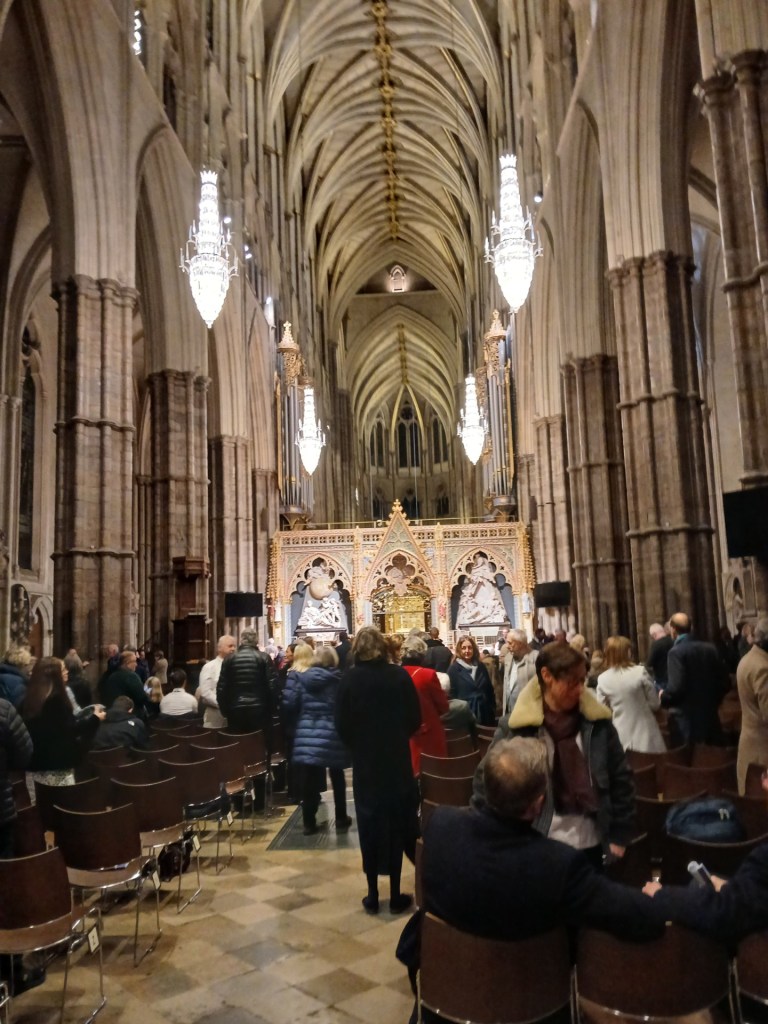
Going to this event was a matter of happenstance. I had hoped to be going to the L’Elisir D’Amore production at ENO but had wrongly written down the date of the show as 26/11 in my diary. In fact, it was happening on 27th when I had already booked another interesting concert – and hotel and transport were fixed for those two days. Of the options – this and Tosca at ROHCG, Birmingham Contemporary Music Group and a couple of other events – The Messiah seemed to be the most attractive, albeit in a restricted-view seat, particularly as I had had to miss the Halle Messiah I’d booked for last year, and it is ages since I heard it live (I think the last time I heard the whole piece was probably in the Anglican Cathedral in Cairo c.1985, but there was a splendid performance of extracts from a collection of church choirs in Accra, Ghana, all singing from memory and sounding glorious, particularly the basses, about 20 years ago) . The performance obviously was not heard in the most conducive of circumstances due to the last minute scramble – the best ticket I could get was on the left hand side of the nave, blocked by a pillar from seeing about 90% of the performers, and my hearing to some extent occluded by the pillar and of course in any case by the echo-y church acoustics playing havoc with the sound – and all that needs to be understood in comments following. Several things occurred to me listening to the work in full: • Its only near competitor in Handel’s works for the number of ‘hit’ tunes and memorable moments is Julius Caesar – almost every aria, every chorus, is a winner. It is really a glorious work to hear and must be a joy to sing • It’s also quite an odd work, which, despite the title, is nothing like a narrative of Jesus’ birth, death and resurrection. The different selected Biblical passages, apart from some of the Christmas story in Part 1 and bits of Revelations towards the end , are not notably related to each other and read like a series of texts for meditations and reflection on incarnation, suffering, resurrection and judgement rather than a story as such. The meditative nature of the text means that there is something to be said for the grand old Sargent-like ‘big’ Messiah performance style, moving at a stately pace and giving some more pace for musing, if not contemplation. This performance however was coming from a very different perspective – historically informed instruments and sounds, swift tempi, punchy rhythms. The snappy tooth-aching gut strings produced real energy in the choruses and gave some wonderful lightness to the music at points – the strings came through clearly shining in the shepherds scene, for instance, not swamped by voices – but performance as a whole did feel a bit rushed, with little time to think about the meaning of some of the chorus and recitative texts, .
All the singers apart from the soprano were members of the Abbey Choir – not a huge number of people. and of course this also meant that there was a preponderance of boys and no women. Using the Abbey Choir did seem to me to make the sound unbalanced at times – though there were only 8 tenors and basses and 4 adult altos, and about 25 boy trebles, the sound was adult-male heavy. Despite their number, the boys didn’t really have the cutting sound that adult female sopranos would have had, and the adult male voices, despite their numbers, tended to predominate in the choruses. Nevertheless, despite the above quibbles, there were many splendid moments. For me the highlights were: • ‘I know that my Redeemer liveth’ – impressive soprano singing • Another soprano aria – “Rejoice greatly, O daughter of Zion” • Counter-tenor aria – ‘He was despised and rejected’ • Bass aria – ‘Why do the nations’ • And of course the big choruses, complete with baroque drums and natural trumpets – ‘Hallelujah’ and ‘Worthy is the Lamb/Amen’ ….all of course experienced in the wonderful atmosphere of the Abbey.
I really must go to choral evensong at the Abbey tomorrow
Weston Hurt, Rigoletto; Yongzhao Yu, Duke of Mantua; Robyn Allegra Parton, Gilda; William Thomas, Sparafucile; Amy Holyland, Maddalena; David Kempster, Monterone. Richard Farnes,Conductor; Jonathan Miller, Director; Elaine Tyler-Hall, Revival Director; Patrick Robertson and Rosemary Vercoe, Designers; Ian Jackson-French, Revival Lighting Designer; Tommy Shaw, Choreographer
This is a very famous – and now elderly – production dating back to the 1980’s, which for whatever reason I have never seen before. Rigoletto has been one of the real rediscoveries for me in recent years, and I continue to find It a gripping work, saying a lot with relatively little means, and it is emotionally moving (at least when with the right singers), despite the familiarities of the tunes and some stock operatic scenes such as the heroine’s death, which can easily seem risible. I suppose in the intervening 40 years of this production we have become very much more used to directors resetting the context of an opera – I do remember when I saw ‘Rigoletto in 70’s it was most definitely set in a Renaissance court and you didn’t really expect it to be anywhere else (as for that matter it still was in 2022- at Covent Garden) and so the central impact of Miller’s staging has long since lost its sense of being a brilliantly clever idea. Nonetheless there are many aspects that are very well done – the production visually remains very appealing and impressive – the club where the ‘Duke’ of the local Mafia and his ‘court’ hang out looks splendidly and vulgarly opulent, the corner bar with the famous juke box is appropriately sleazy, and the windswept tenement blocks of ?New York look suitably gloomy. In the storm, pieces of scrap paper fly across the stage….. However sometimes on stage, after 40 years of revivals, things are perhaps less effective, and stock gestures take over – Gilda clasping her father’s knees imploring him not to take vengeance on the Duke, for instance; the deception of Rigoletto when the gang comes to abduct Gilda as a joke is oddly and ineffectively managed. Occasionally therefore there are moments where suspension of disbelief is not possible. The staging wasn’t helped by a Duke with – how to say? – less than sublime acting skills, who I suppose gave a reasonable impression of a hard-hearted Mafia boss but was not really able to give any insights into some of the subtleties of the character that text and music can provide. On the other hand the interactions between chorus members were handled well and were very effective.
What was really very good about this performance was the quality of two of the main protagonists, the strength of the supporting roles, the quality of the chorus and the ability of Richard Farnes as conductor to provide a first-rate accompaniment to the action.
I was completely bowled over by the quality of Robyn Allegra-Parton’s Gilda. She has a voice that can handle the coloratura aspects of the role with ease, has a beautiful edge to it that provides a lovely direct and penetrating sound (is the word squillo?) and she is able to produce some remarkably subtle quiet singing, as well as pinging out the top notes and having the capacity for intense control in duets and quartets. I have never heard of her before and she is most definitely someone to watch – she has real star quality vocally (she is credible on stage though I wouldn’t say her acting and stage presence are as remarkable as her voice – still less so her diction). Weston Hurt as Rigoletto was also very impressive; he has a well-grounded voice, a wide range, and a towering, big, stage presence. The latter doesn’t necessarily fit well with this role – at times he almost seemed too grand, too tragic a figure (and perhaps lacking the edgy elements of the role that come from his being an unpleasant fixer who is hated and feared by many, responsible ultimately for the death of Monterone) but Mr Hurt sang the role beautifully and I thought that overall, his performance was moving – and his diction was extremely good. Yongzhao Yu as the Duke got into his stride later on and he had some good moments in the final scenes, but generally he looked awkward on stage, his Italianate gulps were overdone and irritating and at times his voice seemed slightly too small for this theatre (at least as heard at the back of the stalls). Although of course many Italian speakers would feel the same about English singers performing in Italian, his English was also a distraction at times. David Kempster as Monterone, William Thomas as Sparafucile and Amy Holyland as Maddalena were all very good, each with terrific stage presence and fine voices. The chorus sounded excellent – incisive, together and disciplined, with a big sound that came across well. Richard Farnes’ and the orchestra’s account of the Prelude to the first act showed us the subtlety of his approach – a wide dynamic range, precision and some very-together playing throughout, bringing energy and pace to the story.
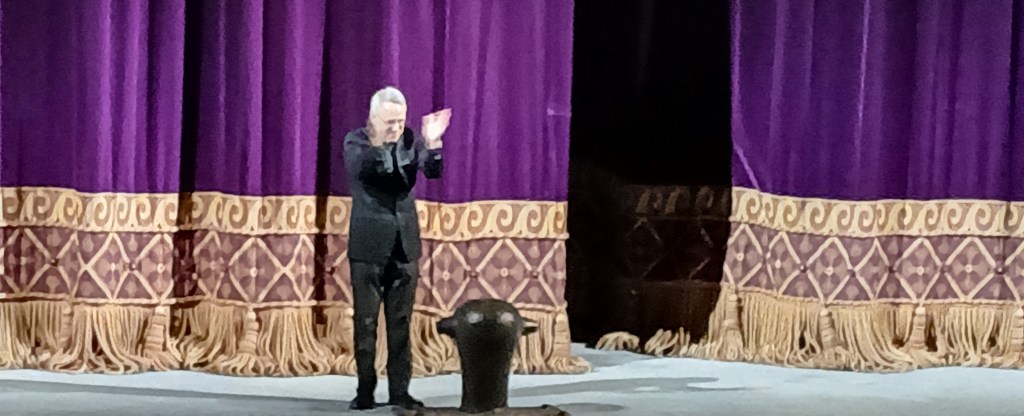
Farnes deservedly got a big cheer at the end. Wouldn’t it be good if he wanted to do more work with ENO in its new Manchester manifestation?




 John's musical journey