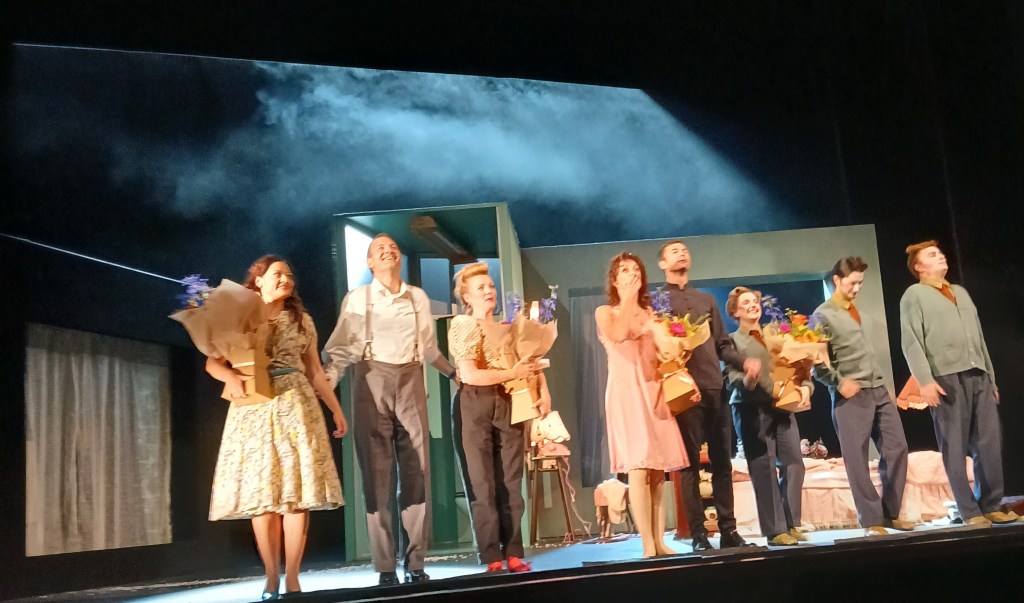
Bellini, The Capulets and the Montagues: English Touring Opera. Sheffield Lyceum, 4/4/25

Jessica Cale, Giulietta;   Samantha Price, Romeo; Brenton Spiteri, Tebaldo; Timothy Nelson  Capellio;  Eloise Lally, director; Peeter Harrison, lighting designer; Alphonse Cemin, conductor

My experience and knowledge of bel canto operas is slight – as I am sure I have said elsewhere in this blog the only Donizetti/Bellini opera I’ve heard is the former’s Maria Stuarda, until I saw Lucia last year. I’m well aware though of the respect Wagner held Bellini in, and I thought I’d go to this nearby performance in Sheffield given by ETO to see what I had been missing all these years.

Bellini wrote the work in a hurry after a previous flop, and used various arias from a previous opera to speed things along. It was an immediate critical success. The work is based on a story by an Italian writer Matteo Bandello rather than Shakespeare with a libretto by Felice Romani. Bellini’s opera focuses on the conflict between the two families and the lovers’ desperate search for love and escape. 

As with my experience of Lucia di Lammermuir last year I wasn’t completely convinced by my latest immersion in bel canto. I love the snappy fast numbers and the vivacious tunes, but get rather restless in the long slow, indeed languorous, arias. I like the displays of vocal athleticism, but find some of the musical tics – like the uniform approach to the codas of fast pieces of music – wearing.  Perhaps with an Oropesa, a Janet Baker, I would have been bewitched, But what I was very positive about was the excellence of this performance and production.

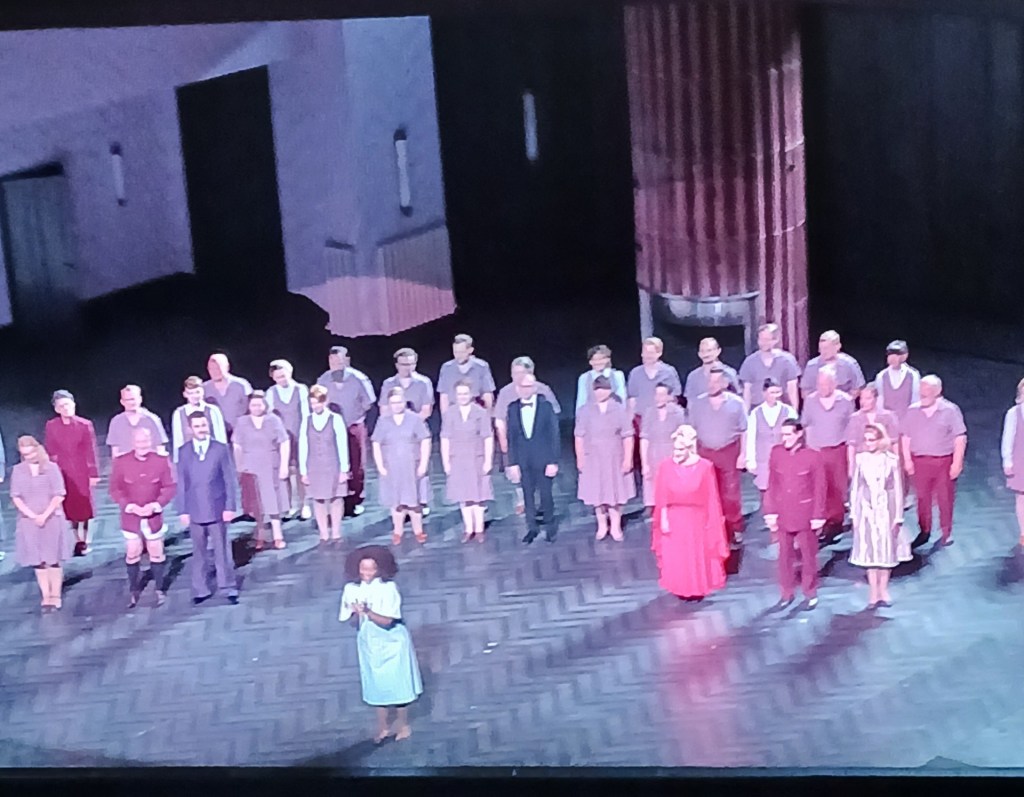
The setting was 1950s/1960s New York and Mafia gangs. Shades of Jonathan Miller, of course, but then Bernstein got there decades before…..Juliet’s Dad owns a coffee shop where she serves as a waitress and which is the headquarters of the Capuleti. Father Lawrence is a barista. Tebaldo, the newly appointed leader of the clan, is due to be married to Juliet.  Romeo disrupts the wedding and thereafter the story follows much on Shakespearean lines.

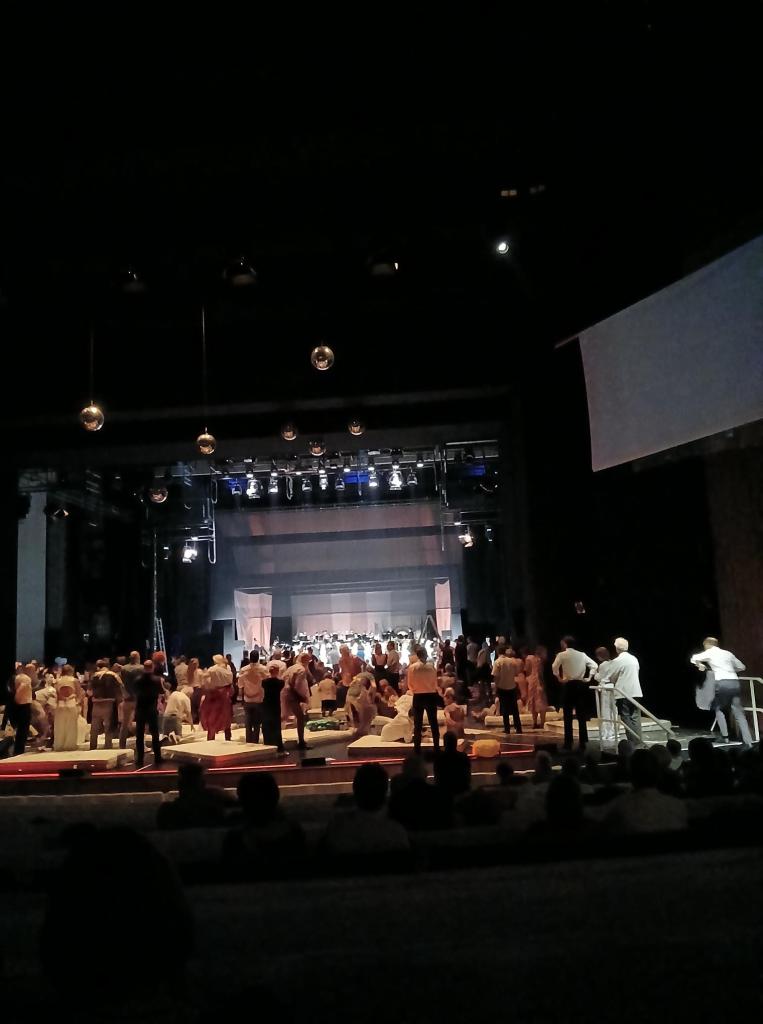
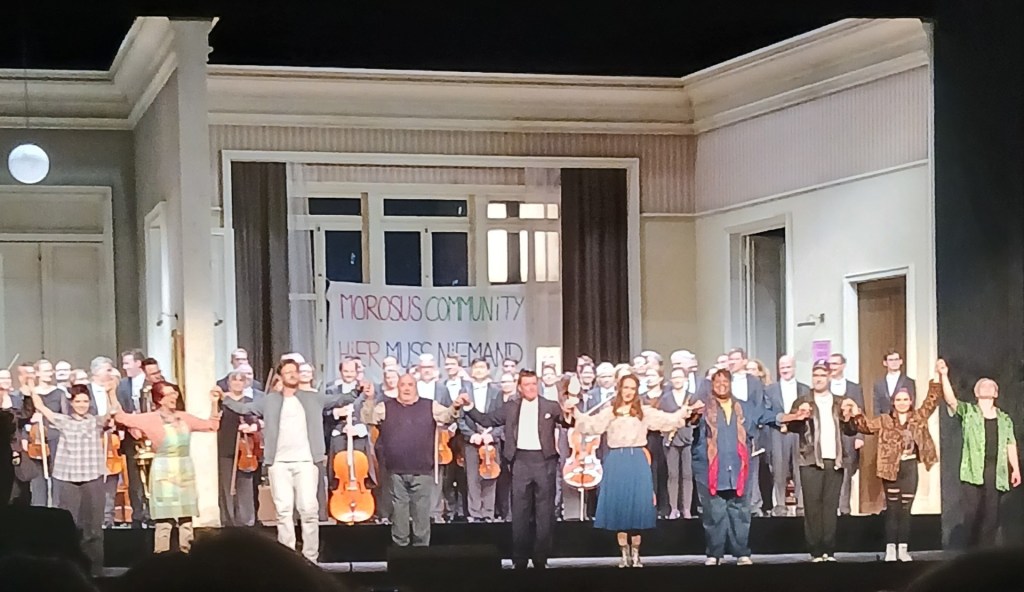
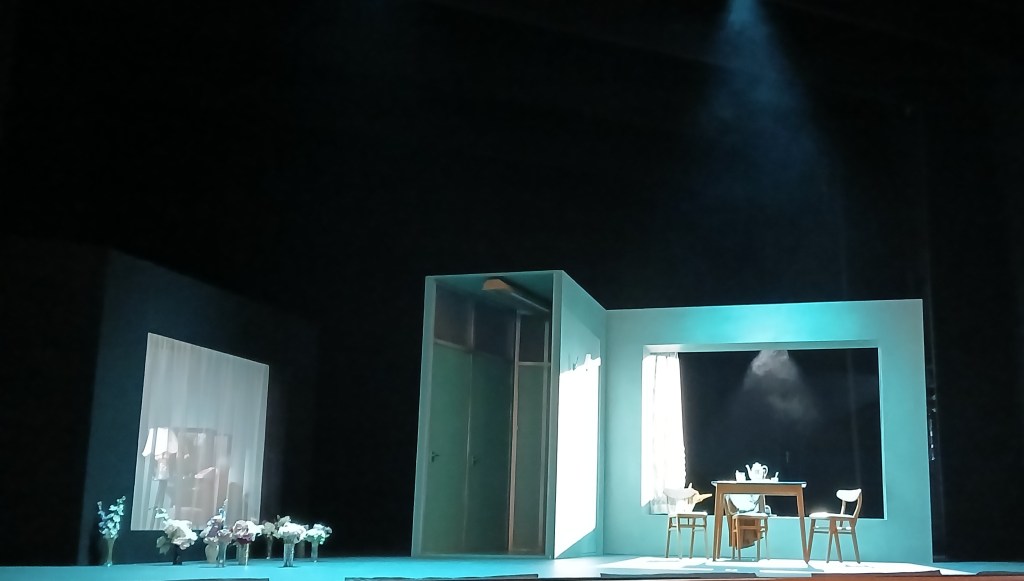
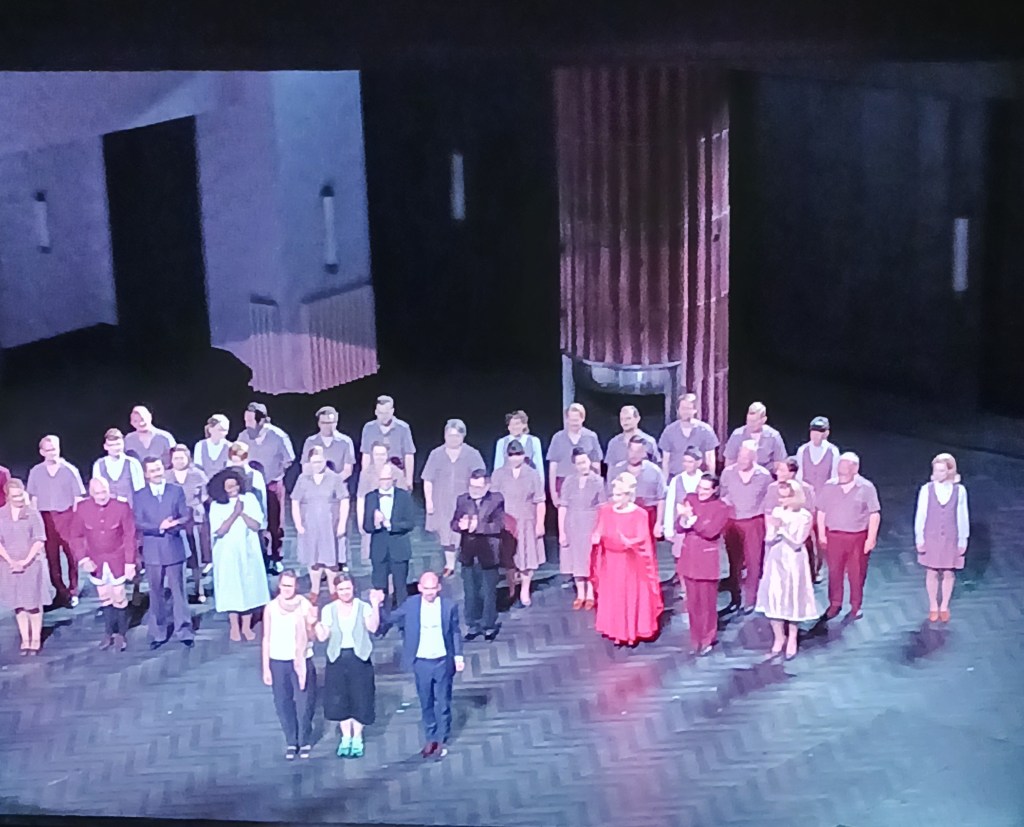
The sets – given the ETO’s need for economy and flexibility for different theatres round the country – were very impressive, and could have been part of a much bigger company’s offering. The first half was set inside the café – ultra-realistic with a 1950’s pay phone, all sorts of coffee equipment and roll-up blinds so that a bit more of the stage could be used, plus a large counter. The second half turned the counter into a tomb/catafalque, and the walls of the cafe turned inside out (see photo). The outside of the cafe looked as though there had been recent serious gang violence, with a hole blown in one of the walls. There was snow, and an impressive array of candles around Juliet’s catafalque. Interestingly, the lighting rig was clearly visible in both halves, somehow framing the story and contrasting with the realism of the sets. There was some excellent handling of fights, though once, at the end of the first half, a decision to take the fight action into slow motion (partly occasioned, I guess, by the lack of room on the set) teetered on the edge of a cliché. In general, the acting was very credible and kudos to the chorus for being such an impressive group of thugs (though given that there were only 8 of them occasionally it was difficult to identify who was a Montague and who a Capulet). Lorenzo had a particularly effective stage presence but all the cast members were entirely in character and believable.

The singing of the principals and the playing of the orchestra were excellent. The big orchestral solos in the arias for horn and clarinet plus solo cello were all very well performed, and the orchestral scamperings were precise and clear.  Jessica Cale’s Giulietta had both the agility of voice you need for this sort of music and the beauty of sound required for some of the big arias. Samantha Price was very convincing as Romeo and conveyed a credible sense of a good-looking and energetic hero, using her body effectively and giving a sense of forcefulness and robustness in her voice while at the same time presenting a beauty of tone and a good match with Giuletta’s voice in duets.   Brenton Spiteri’s Tebaldo (an excellent piece of casting) and Timothy Nelson’s sonorous Capellio were all first rate

Oh well – I see I Puritani is on at ROHCG with Oropesa next season while ETO is doing ‘L’Elisir D’Amore.’ I shall be there to see if I can get more enthused about this musical sub-genre……….

Britten, Owen Wingrave. RNCM, Manchester 1/4/25

Rory Macdonald, conductor; Orpha Phelan director

I am going to two operas I’ve never seen live before this week- indeed I’ve heard none of their music before, either…

Owen Wingrave of course was conceived as a TV opera, broadcast in 1971, Indifferently received and not very much staged since the 70s, though there have been two or three UK productions over the past 30 years, I wondered whether this RNCM production would be a revelation or confirm the seemingly general view that the work is not quite top-drawer Britten. 

I had several thoughts in hearing and seeing the work for the first time. It has some memorable musical moments –  Owen’s passionate praise of peace in the second half, and the haunting, melancholy Wingrave family ballad. The libretto by Myfanwy Piper is very fine, and I was gripped almost till the end by the story. Although the story is about pacificism (in the context of a military family) it is hard not to read it also as a metaphor for a young man coming out as gay, to the horror of his family –  Sir Phillip  even says at one point that Owen needs to be ‘straightened out’ – a direct quote from Henry James. Britten was apparently interested in using twelve tone serial techniques for this opera and it seemed to me (whether or not as a consequence) that musically the work lacked the richness, the variety and the power of its successor. Death in Venice.  This performance was in a reduced orchestration, and I wondered also whether the original orchestration might have helped here in giving a richer more complex sound.. I also felt that the ending (Owen’s death in the haunted room) comes too quickly and with too little build up. Finally, I felt that at times there was too much spoken dialogue where singing would have given more emotional resonance. But I’m glad I went and would love to see it in a fully professional production. It’s a powerful piece. it stays in the mind and I was never bored.

The set was naturalistic, showing the inside of an old rambling house, with the lighting producing many shadows – see photo below . Instead of the portraits of the Wingrave ancestors looking down, there were ghostly figures of soldiers (actors) from different 19th century wars, hovering, circling the living members of the family. Their movements provided on stage images to accompany the various orchestral interludes, with a particularly striking effect in the opening, where the soldiers emerged via a ladder from the trenches of ‘the pit’. In the first half Owen’s aunt and grandfather were given spectacular entrances via a raised platform and a dazzling spotlight. The cast members moved and reacted well – all looked natural, not hesitant.

There were two casts and I am afraid I have no idea which cast was ‘on’ the evening I went. The cast was excellent. The standouts were the four ladies, particularly Mrs Coyle and the aunt, who had excellent diction and a good stage presence. The men sometimes seemed a little more unconfident on stage but I thought Owen grew in credibility throughout the evening so that one felt more and more sympathy for his position. There was excellent (and a Pears-look/sound-alike) singing from Sir Philip. After a wobbly start the orchestra played well. As is always the case with the RNCM operas the audience was wonderfully responsive and there was much whooping afterwards, rightly so in this case

Ades/Stravinsky, Halle Orchestra. Bridgewater Hall, 27/3/25

Thomas Adès conductor, Ann Dennis mezzo-soprano, Hallé Choir:  Thomas Adès, Dawn: a chacony for orchestra at any distance; Thomas Adès, America: A Prophecy UK premiere; Saariaho, Oltra Mar; Stravinsky The Rite of Spring

This was a fascinating concert, with a near sell-out audience, an Adès piece new to me (and indeed part of it new to the UK) and only the second large-scale piece by Saarahio I’ve sat down to listen to, and in addition a major contemporary composer’s take on The Rite of Spring.

The curtain raiser was Ades’ Dawn, a piece I remember from the virtual 2020 Proms in the midst of the pandemic. The critics I remember at the time were a bit sniffy about it but I loved then and tonight the sonorities Adès created – the wonderful roar just before the end and the disconcertingly strange squeaky ending.  

I went to a pre- concert talk where Tom Adès gave his rationale for the coupling of his ‘America’ work and Saariaho’s ‘Oltra Mar’ as being one of guilt – that both were programmed for a New York Philharmonic concert for the Millennium with no less than 5 new works to perform. Rehearsals for the works were handled in alphabetical order and of the same length as for an ordinary concert. As he was an A and she an S his new work got much more rehearsal than hers and he had always felt guilty about that….

The Saariaho piece – La Mer in a sense – is in theory about the sea but covers a wide range of human experience – Love, Death, Arrival,, Departure, Time, Memory. The choir sings from three eclectic texts. The music is slow moving, much less varied than Adès’ work but also much richer and thematically more memorable than her opera ‘Innocence’. It has a haunting quality that I very much liked – particularly the section Le Temps. It’s slow-moving but mesmeric, and creates a very definite sound world for the work

Both with this work (and even more so with the Adès America work), it was a great pity there weren’t any of the set texts or summaries of them put into the concert programme. This was less problematic with the Saariaho piece – the sections have names and are relatively short, but it was a big problem with the larger Adès work, ‘America: a Prophecy’. This involves Mayan text, some text in English, and possibly Spanish material, essentially about the Conquistadores and their impact on traditional Mayan culture. But I cannot be more precise than this because the programme notes were so sparse. I only discovered half way through that the soprano was singing in English……The work – with only two movements and much less choral writing – had originally as above been premiered in 1999 and this was the UK first performance of its third movement, written recently. The music was, as ever with Adès, accessible but fractured, using a variety of musical traditions (including what sounded like some 16th century brass sounds), in this case sombre and compelling. The sense of desolation and loss in the work came across very clearly. The whole concert was being recorded by the Halle and I want to buy that CD when it comes out and listen to the work again. I found it moving and disquieting.

After the interval, the Rite of Spring….. We’d been informed in the pre- concert talk that Adès would be ‘going into the engine room of the score’ and approaching it afresh. To me, the bulk of what this might have meant was experienced through the increased audibility of some of the woodwind parts – there were extraordinary noises at points, and an increased clarity of sound in the quieter passages. The build up to the end of the first half was tremendous, though I felt some relaxation in tension in the second half. Adès is a slightly ungainly figure on the podium but very good in showing the orchestra (and the audience), in a very dense score, which voices he wants emphasised at any given moment. This was a faster more jagged reading than the two I heard Mark Elder give over the last 15 years (which emphasised more of the Russian folk tradition element) and very absorbing.

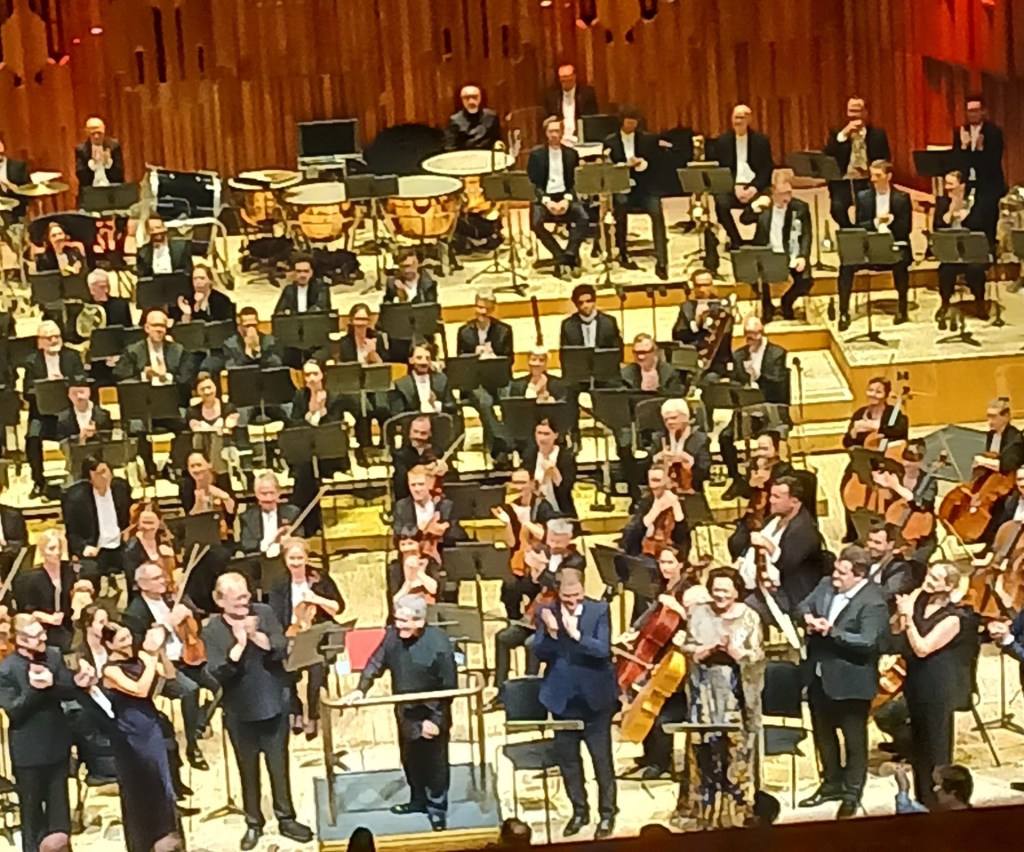
Tippett, Beethoven: Pappano, LSO. Barbican 23/3/25

Tippett A Child of Our Time; Beethoven Symphony No 9, Choral. London Symphony Orchestra, Sir Antonio Pappano conductor; Masabane Cecilia Rangwanasha soprano; J’Nai Bridges mezzo-soprano; Sean Pannikar tenor, Soloman Howard, bass

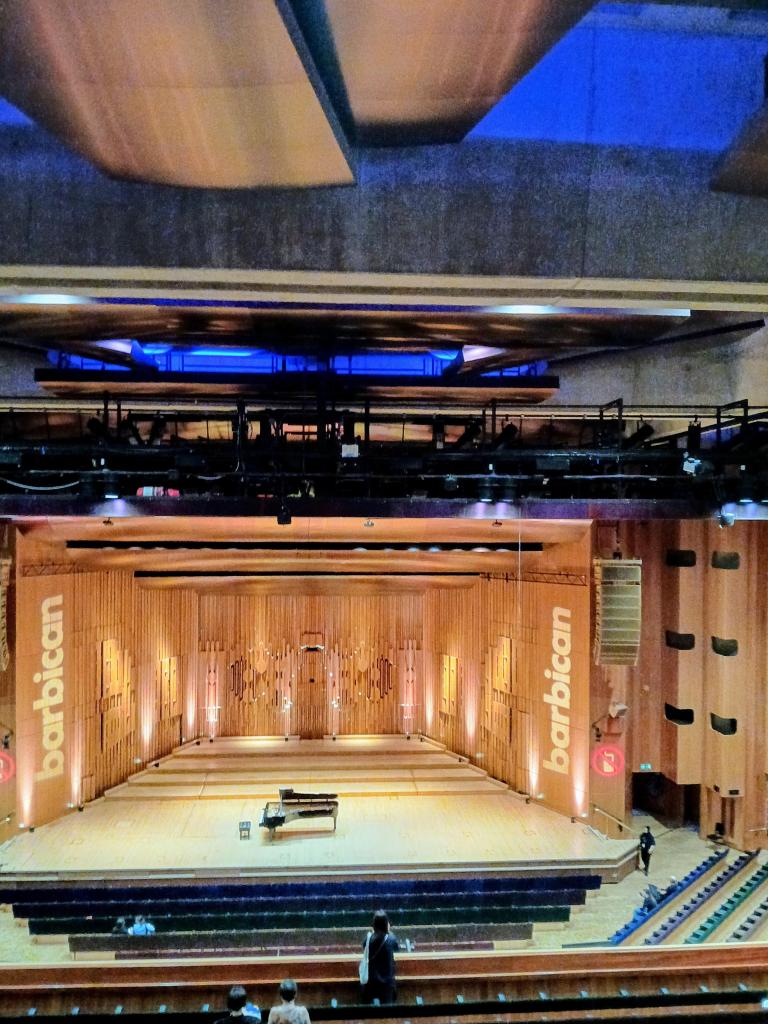
With the Barbican Hall completely sold out. this was an extremely generous programme, in terms of content and the demands on soloists, choir and orchestra – it can’t have been often in its performance history that A Child of Our Time is billed as a curtain-raiser. I remember hearing a number of performances of this work in the 70’s, including maybe one conducted by Tippett in 1979 but I have not heard it once live in the past say 25 years. It is wonderful music but the performance context has changed a lot since the 1930’s, and what once seemed a brilliant idea – African-American spirituals as a kind of contemporary quasi-Bach chorale – now can seem awkwardly like cultural appropriation (something I am sure Tippett was aware of in his later years). The LSO handled that problem for this performance  by having all four soloists with a non-white heritage – two African Americans, one South African and South Asian background.  That runs the risk in turn of looking like tokenism, so maybe this is just a problem we now have to accept with the work. Certainly the sight of 100 or so overwhelmingly white middle-class not-young people singing spirituals seems a bit questionable, in retrospect.   Nevertheless, this was a moving and enjoyable performance. Of particular distinction was Masabane Cecilia Rangwanasha‘s  high soprano circling beautifully above the choir singing ‘Steal Away to Jesus’, and the sonorous voice of Soloman Howard whenever he was singing (which makes me look forward to his Hunding at ROHCG in May with Pappano). The choir were particularly good in the fast, light spirituals – ‘Nobody knows the trouble I see’, for instance, and their contribution to the ‘general ensemble’ of ‘I would know my shadow and my light’ at the end was wonderful. All in all this was a very satisfying performance.

And so to Beethoven 9 after the interval. This has to be the best played performance of the work I have ever heard. The LSO were stunning throughout. Pappano used a big orchestra (5 horns, 8 double basses) but the overall impact was dynamic and light-footed – very different from the elephantine Berlin Philharmonic 10 days before, As an example of the crispness and sheer expertise of the playing the piccolo in the closing bars, taken at great speed, was absolutely accurate and clear in its notes. The timpani player – who has an important role in this work – was spot on every time with taut playing, and the strings, woodwind and brass were extraordinarily precise in the scherzo. The horn section – with many exposed passages to tackle which can often entail wobbles – were throughout confident and bright.

Altogether I enjoyed the first two movements very much. Often the way this work is written about (and sometimes performed) there’s a feeling that holy mysteries are being unveiled in the first movement There wasn’t much sense of mystery about the opening of this performance – what the whole movement did remind me of (it was taken at quite a pace) actually, in its sheer inventiveness and energy, was Haydn and the same is true of the second movement. It’s perhaps worth remembering that story about Beethoven being turned round by the contralto at the first performance to see the cheering audience – the fact is that they were cheering, that this wasn’t seen as ‘difficult’ music particularly, and Pappano’s performance heightened those connections with Haydn. The problem comes with the slow movement, which Pappano, in common with every other conductor I’ve ever heard live, conducted too fast (in my opinion). I reminded myself afterwards from the programme that this movement was described by Beethoven as ‘Adagio molto e cantabile’. The only conductors I’ve ever heard giving this a true ‘Adagio molto’ at the beginning are Furtwangler and Klemperer in recordings. And if you don’t do the adagio at the start as molto then you risk undermining some of the faster ‘cantabile’ passages later on, in the variations, by speeding them up in a way that damages their beauty. I am sounding a tad dogmatic about this, and there may be metronome markings in the score that justify Pappano’s (and others’) speeds, but I can only record what I felt. The last movement was very fine –  gloriously played and sung, and rapturously received by the audience. I have this slight feeling of let-down at every single Beethoven 9 I have ever heard…..I have a ticket for Kachun Wong’s performance of the work with the Halle, in May. It will be interesting to hear his take on the work…..I live in hope.

Brahms, Halle Orchestra. Bridgewater Hall, 20/3/24

Kahchun Wong conductor, Mariam Batsashvili piano: Ifukube Japanese Suite for Orchestra; Liszt Piano Concerto No.1; Brahms Symphony No.1
This was another very exciting and impressive concert from Kachun Wong and the Halle. The first three concerts I have heard him conducting this season were Mahler/Bruckner-based and I wondered how he would get on with more traditional classical fare like Brahms . Very well indeed is the answer – see below. The logic of putting these works together in the same programme was a bit hard to follow – the Halle announced it as a programme of 1sts. But , anyway, it is clear from some of Mr Wong’s programming this season that he is keen to promote East Asian composers, which is fair enough and very welcome. The Japanese composer Ifukube was featured this evening – apparently he’s written over 300 film scores. I had assumed something vaguely modernist but in fact this was very straightforward – broad dance-like music with strong drumming rhythms, and it fascinatingly both clearly derived from Japanese folk music yet did not in any way feel self-consciously orientalist. There was some extremely good flute playing and some wonderfully raspy brass.
Miriam Batsashvilli came on in jacket and trousers looking startlingly like a black-haired female version of Liszt (she has a similar profile). I have grumbled in the past in this blog about the meretricious Liszt concerto but this time I found myself just sitting back and enjoying it, going with the flow. Ms. Batsashvilli sounded a very impressive pianist, though she didn’t remove memories of Yuja Wang at the Proms 3 years ago performing this piece. She did a nice encore in the style of Offenbach, which was good fun.
The performance of the Brahms 1 was very impressive. I have not heard a better live one in a long time. It was serious, solid and sensitive, and it didn’t rely on flashy dynamism but seemed to grow organically. The disposition of the orchestra was interesting – split violins, 8 double basses at the back, 5 horns, and timpani to the side at a lower level. This created a rich deep sound – chords emerged from a deep bass. The first movement was taken relatively slowly so that the dotted note rhythms and angular punchy phrases made their full impact. The build up to the recapitulation in the first movement was tremendous in its power. The second movement was relatively fast and light but still very touching – the woodwind excelling themselves here and in the 3rd movement. The last movement was excellent – wonderful horn playing in their big tune, and a hugely impressive slow rendition of the big chorale tune at the end. There were many memorable moments in this movement – I particularly recall the moment towards the end when the horns play their big tune for the last time, where the music dies down slowly and movingly, which was very beautifully and lingeringly played, and the moment about 2 minutes further on when the orchestra slowly but inexorably picks up speed at the start of the coda, which was very exciting indeed. Throughout the Halle sounded wonderful. I really do think the Halle has made an excellent choice in Mr Wong – I hope he stays………….

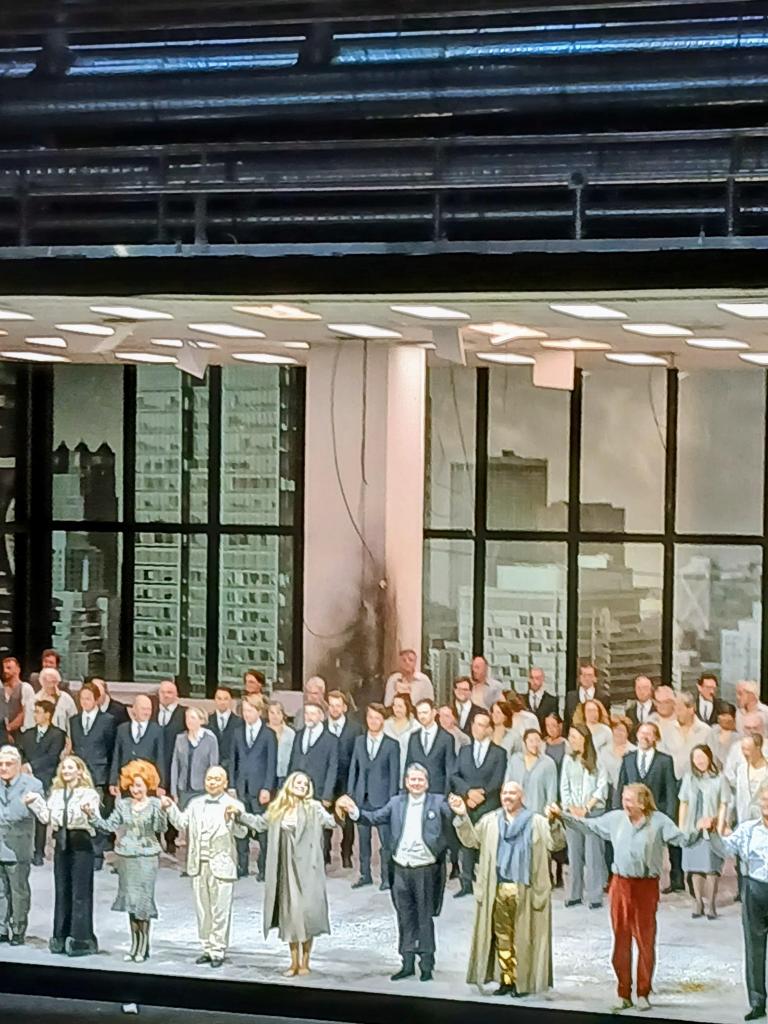
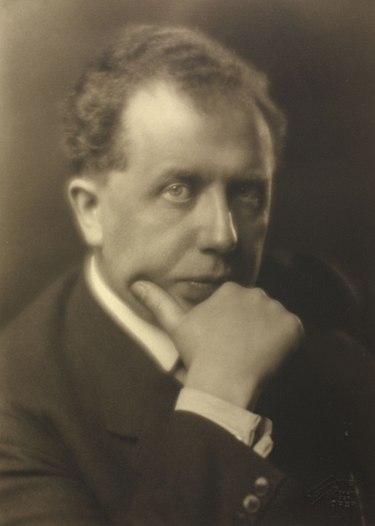
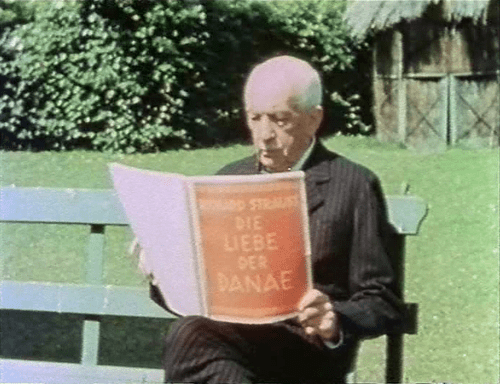
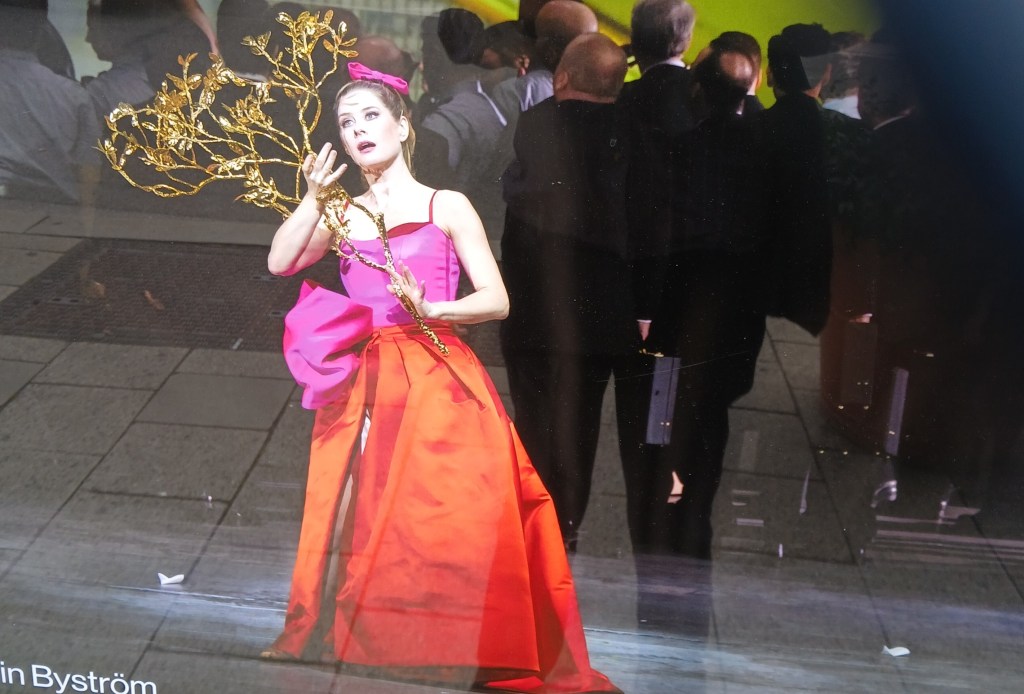
R.Strauss, Intermezzo. Deutsche Oper Berlin. 16/3/24

Conductor, Sir Donald Runnicles; Production, Tobias Kratzer; Stage, Costumes, Rainer Sellmaier; Lighting, Stefan Woinke; Court Kapellmeister Robert Storch, Philipp Jekal; Christine, his wife, Maria Bengtsson; Franzl, her little son, Elliott Woodruff; Anna, the chambermaid, Anna Schoeck; Baron Lummer, Thomas Blondelle; Kapellmeister Stroh, Clemens Bieber; Notary, Markus Brück; Notary’s wife, Nadine Secunde

I had a major panic about this performance the previous evening. I am becoming careless in my old age….. My ticket for Intermezzo I’d printed out on the other side of the one for Arabella – looking casually at the Intermezzo side I suddenly realised that I had booked for the performance 3 nights earlier, the day I went to the Berlin Phil concert. Somehow I had got the dates muddled up in my planning from about 6 months ago. I rushed to the box office, where I found that the Sunday performance had tickets available, that it started at 5pm (much more convenient, given I was getting an overnight train back to London ) and that this was a special ‘World Seniors Day – or something like that – which meant I was able to get a Euros 90 ticket for Euros 29!
I have never heard a note of this music before – I have not even got a recording of it. You have to wonder what sort of a compulsion there was in Strauss’ mind to want to write Intermezzo. It was obviously about him and his wife and would raise eyes brows on anyone coming across it in his legacy. His usual collaborator at the period it was written in the 1920s, Hofmannsthal, refused to touch it with a barge pole, and it must have caused many rows with Pauline. In addition, its story would seem to be ephemeral, and unlikely to be of interest after Strauss’ death. Yet somehow this slight comedy about the composer Storch and his difficult wife Christine, got written and perhaps surprisingly has remained part of the standard operatic repertory on stage ever since – even in the UK, Scottish Opera performed it in 2011 and one of the country house opera festivals – maybe Garsington – more recently. But it does seem to me to need special treatment – it doesn’t have the big moments, the melodic richness or the depths of Arabella, Ariadne etc, and it is quite a long piece for its content – with just one interval the evening still lasted over 3 hours. It must also be quite difficult to stage – lots of short scenes (maybe shades of the new art of the cinema here) and lots of musical interludes – in fact Strauss called it a comedy with musical interludes
So it needs a special production and at least one special singer to make it all work and feel worthwhile, and it got both in this production. Kratzer threw the works at it – he must have had a budget Covent Garden can only dream of – and he achieved sustained audience engagement, with frequent laughter. As far as I could see he was using the following tools in doing this:

  • a contemporary setting; no messing about with 20s costumes and Weimar Republic references
  • substantial use of video. As with his Arabella production, videos were shown with details of what was happening on stage at times. Video was also used for phone calls with people off stage – Storch in his car driving to the airport, Christine calling the Notary’s wife for the Baron to find accommodation for him. Cleverly. given Strauss’ emphasis on them, all the orchestral interludes were shown on a drop-down video screen (this also helped with quick changes of scenery, and obviously fits in with thr whole concept of the opera). There were variations here – once Storch was shown conducting the orchestra rather than Runnicles, aping his conducting mannerisms, and there was also, when Christine and Robert’s relationship was at its stormiest, a video of orchestral parts flying through the air. In addition, a 50s – maybe earlier- film of extracts from Der Rosenkavalier was shown when Christine is packing her bags to leave.
  • surprise props and settings – there’s a big taxi on stage at the beginning of the work, there’s an SUV and a small car shown on stage after colliding, and a very funny scene on an aircraft
  • other gags, most of which I’m beginning to forget. One nice touch is that the other conductor whose nearness of name to Storch causes almost the trouble -Stroh – is made to look astonishingly like Runnicles…..
  • some liberties with the text – e.g. Christine in this production very definitely has a full-on affair with the Baron
    The energy of the production was prodigious, and that same wave of energy affected the cast, all of whom dashed around the stage when required, particularly of course Robert and Christine. Philip Jekal was a new name to me but he had a strong warm voice. Thomas Blondelle, who only 2 nights earlier had sung Herod in Salome, portrayed the Baron as a offhand slightly cynical baseball-capped twenty-something lounging around the composer’s house and this was done brilliantly. But the opera stands or falls by the person singing and acting Christine, and Maria Bengtsson was astonishing – a beautiful silvery voice, absolutely a Strauss soprano sound, with some beautiful phrasing and a real luxuriating in the sound of the voice she had at her disposal. But she’s an amazing actor as well and rushed around the stage flirting, screaming, scheming, being tender/flippant, contradictory and quirky in just the way Strauss would have experienced Pauline. Sitting a few rows back from where I was for the other operas (Row 18), the orchestral sound was full and warm – Runnicles was clearly enjoying himself……
    I am not sure I would be rushing to see another production of Intermezzo – this production probably made the very best case for it ever and I am very pleased I saw it.
    Kratzer has also directed Die Frau ohne Schatten recently for Deutsche Oper….now that really would be worth looking out for…..
    And there’s his Ring of course developing in Munich….

R.Strauss, Arabella. Deutsche Oper Berlin. 15/3/25

Conductor, Sir Donald Runnicles; director, Tobias Kratzer; stage design and costumes, Rainer Sellmaier; lighting designer, Stefan Woinke; Graf Waldner, Albert Pesendorfer; Adelaide, Doris Soffel; Arabella, Jennifer Davis; Zdenka, Heidi Stober; Mandryka, Thomas Johannes Mayer; Matteo, Daniel O’Hearn; Graf Elemer, Thomas Cilluffo; Graf Dominik, Kyle Miller; Graf Lamoral; Gerard Farreras; Fiakermilli, Hye-Young Moon

I was surprised to learn from the programme that the first performance in Dresden of Arabella was as late as 1 July 1933.I had assumed it was a work of the 1920’s. The one ROHCG performance I can definitely recall hearing live was in 1973,with Silvio Varviso conducting and Arabella sung by Heather Harper, Zdenka by Elizabeth Robson. Matteo was Robert Tear and Mandryka was sung by someone called Raymond Wolansky. I may have gone also to a performance which featured Kiri Te Kanawa as Arabella, conducted by someone called Wolfgang Rennert a year or so later.

I have a wonderful recording of the work – a live performance from Munich, conducted by Keilberth, with Della Casa and Fischer-Dieskau – but have never ever really sat down to listen to it. I was staggered by the  beauty of the work and wondered how I had not listened to it more over the years, Anyway, this was the first live performance I had been to for nearly 50 years…..and it was very memorable indeed. This was a quite magical production that – and I have to say straightaway that I have no clear idea of how Kratzer did it (he of the Bayreuth Tannhauser and ROHCG Fidelio) – by the end it seemed to have the humanity, the wisdom, of the great Shakespearean comedies – and that is not what you’d normally expect from a bourgeois comedy set in 1860’s Vienna. Kratzer directed Act 1 as he did Fidelio, in hyper-realistic mode. The exact look of a mid 19th century hotel was captured and I am sure immense research was done to get the clothes and fittings absolutely right.  The stage was split into two, sometimes showing the family room on one side and on the other the hotel lobby. However occasionally a screen came down on one side and two video camera assistants filmed aspects of what was going on stage, hugely magnified onto the screens. For me the impact was to enhance the artificiality of this dressing up, which everyone understood was happening on stage and in a way that kept us to some extent at a distance from the characters’ emotions and feelings. Act 2 had the Brechtian trick of having the curtain open when we all filed back after the first interval, again enhancing artificiality. The Act 2 set was a large corridor with doors leading into a dance space where the ball was taking place, and it was in this act that remarkable things started to happen.  As Fiakermilli started singing in the midst of the ball, everyone was suddenly in 1930’s costumes (oh no, I thought – I know what’s coming, and they did – Nazi stormtroopers cleared the rabble, but did not make a re-appearance, though given the timing of the premiere, you could easily make a case for the insensitivity of Strauss and Hoffmansthal presenting such a work at that moment in history). However within another 10 minutes or so everyone was in modern costume and stayed that way until the end of the work. The third act was simply a black box, as in the photos below. There were though videos in huge detail on a large screen centre stage – one was of Zdenka in bed with Matteo, filmed in graphic detail (whether via AI or whatever) and another of a 19th century-style duel with pistols between Matteo and Mandryka, with Zdenka running to throw herself in between the two. All the videos were in black and white incidentally. This has had the effect of enhancing the reality of what was happening on stage – which was that individuals, dressed in modern clothes (though designer-led in black and white) were singing about commitment, love and forgiveness in an entirely natural and very moving way, speaking/singing as it were for all of us. All the trappings of opera and dressing up seemed to have fallen away, and left us with something very simple but deep.

I enjoyed this hugely. Musically, too, it was very good indeed, and there were no weak links.  Heidi Stober (who only a few weeks ago was at the Coliseum singing the role of Mary in the resurrected Thea Musgrave opera) was outstanding as Zdenka, hugely energetic, singing passionately and powerfully.  Albert Pesendorfer (another Bayreuth regular) was a sonorous Graf Waldner, while Doris Soffel (now 77, unbelievable) was a very amusing powerfully voiced Adelaide, whose amorous exploits Kratzer has a lot of fun with).  Thomas J. Mayer was an ideal Mandryka – dark-voiced, lively, passionate, good looking; very much the wild man of the woods. Matteo was sung well but looked very dumpy – this might have been deliberate on Kratzer’s part for reasons I can’t quite fathom. Jennifer Davis has a huge role to sing as Arabella and she sung it very well indeed – maybe perhaps without the shadings and creamy tones of a Schwarzkopf or a Janowitz, but by the middle of Act 2 one wasn’t really thinking in canary-fancying terms – she just had become Arabella, and was a wonderfully natural presence on stage. She seems to have gone from strength to strength in the years since I first saw her in ROHCG in 2019(?). I’ve never heard Donald Runnicles conduct anything before and this must be one of his last performances as music director of the Deutsche Oper. It was a beautifully played and paced performance, orchestrally – I had the feeling conducted quite slowly (it ended half an hour later than the scheduled time) but nothing seemed to drag.

I can’t wait for Kratzer’s take on Intermezzo tomorrow

 R.Strauss, Salome. Deutsche Oper Berlin. 14/3/25

Conductor, Keri-Lynn Wilson; director, Claus Guth; stage design and costumes, Muriel Gerstner; lighting designer, Olaf Freese. Herodes, Thomas Blondelle; Herodias, Evelyn Herlitzius; Salome, Olesya Golovneva; Jochanaan, Jordan Shanahan; Narraboth, Kieran Carrel

I was thinking before the show – should I have explored what else was on in Berlin in the evening? Did I want to see another Salome, after the excellent Lise Davidsen performance last year in Paris?  The answer in the event was that I thoroughly enjoyed this performance, particularly musically, though Claus Guth’s production was a bit gnomic, to say the least…..

I think part of the reason for my enjoyment is the concision of Salome, before Hoffmansthal got hold of Strauss (that’s not an original thought – it comes from George Harewood years ago) for it rarely meanders, and the drama keeps being piled on. Another reason is that the surtitles were much easier to read than in Paris, though in Berlin Joakanaan seemed much more versed in the King James Bible. And it is a wonderful sound picture that Strauss consistently delivers, full of colour and strange luscious sounds, but only rarely orientalist .

Claus Guth’s production dates from 2016. Other shows of his I’ve seen, like the ROHCG Jenufa,  have been fairly straightforward, if always imaginative, but this was something else……The basic design concept was of some sort of upmarket (mainly men’s) tailoring shop. There are rows of jackets with price tags in the upper platform of the stage, and some sort of counter selling accessories. Downstairs there are dressing rooms and some sofas and armchairs for people to relax into. There are many tailors’ dummies on the stage, often indistinguishable from real people. Herod and Herodias look and dress like comfortable upper-end business proprietors. Salome, mostly, has an Alice in Wonderland look, with an Alice head band (after the scene with Jokanaan) and longish dress. As far as I could make out, what seems to be happening is that Salome has suffered some sort of trauma, probably sexual abuse at the hand of Herod (and after all there are certainly allusions in the text to Herod lusting after his step-daughter). All the people around her are, as it were, just automatons, puppets whose movements and thoughts run along strictly limited lines – in fact at times all of Herod’s ‘court’ (or business associates) stagger jerkily around the stage with puppet-like or robotic movements. They can put on and take off emotions and beliefs like clothes, and are in effect like tailors’ dummies. There are are those who are manipulated and those few, like Herod and Herodias, who manipulate. Salome and (possibly?) Jokanaan alone do not behave in this way but are striving to be more human. Possibly…….One thing that does very affectingly express some of the creepiness of Herod is that there are in fact 6-7 Salome’s who join her at points in the action and run around the stage supporting her. They also feature in the way the Dance of the Seven Veils is presented – several of the little Salomes (they are all carefully graded in size) are accompanied by black masked puppeteers, who support them in their jerky puppet-like movements, and the real Salome too is captured and presented in this way – there seems to a clear link in the way Herod here behaves with sexual abuse. The head of Jokanaan is a tailor’s dummy head, ripped off by Salome.

All this is very well, but it does not entirely explain:

  • anything about what Jokanaan is about. Although he appears out of the ground almost naked at first, he soon somehow (I think my eyes were on the surtitles at the crucial moment) sprouts a suit and looks very similar to Herod. Is he in fact, in the way he suddenly pops up in the middle of a scene without your really noticing, a figment of Salome’s imagination. Certainly he doesn’t seem to get killed at the end (nor does Salome, who just walks away). Or has he too become a stuffed tailor’s dummy
  • why Salome is so obsessed with kissing the mouth of the tailor’s dummy

So all in all I wasn’t totally convinced, and I thought overall the Paris production was more convincing and better aligned what was happening on stage with words and music.

Olesya Golovneva is a new name on me, though she obviously from her website is having a very solid career in Germany, mainly in lyrical roles – Bellini, Donizetti and Verdi. She’s certainly not a big Wagner-type voice but she rode the orchestra well at critical moments, and you felt she was singing her heart out. Though not as beautifully or as subtly as Davidsen, she also phrased some of the lyrical moments of her role, and was a much better actor. Thomas Blondelle is another name I’ve not come across before but I found him to be very impressive as Herod – one of the best I’ve see, Evelyn Herlitzius – last heard by me as the Nurse in the Dresden Frau ohne Schatten  – was superb as Herodias, and Jordan Shanahan (whom I heard in Bayreuth as Klingsor last summer) was a fine Jokanaan (with a lighter voice than some). The orchestra sounded very fine from where I was sitting – row 13 in the stalls – and Keri-Lynn Wilson as far as I could tell was doing a fine job in keeping the music from being overly-dense, and not getting over-heated too early on (I mean a good sense of structure)

Bartok, Berlin Philharmonic: Berlin Philharmonie,13/3/25

Berliner Philharmoniker: Jakub Hrůša, conductor, Seong-Jin Cho, piano. Janáček: Fate, Suite;  Beethoven: Concerto for Piano and Orchestra No. 5 in E flat major op. 73; Bartók: Concerto for Orchestra Sz 116

This was my first visit to the Philharmoniie in Berlin, and it’s as spectacular and impressive a building as everyone has always told me it is – imposing, even beautiful, externally, and the different geometric shapes of the interior constantly surprise and delight you. Acoustically it’s magnificent, offering both clarity and warmth, a bright sound but not overbearing.

For me (although a lot of the pianist’s fans would disagree – they were there in large numbers) the undoubted highlight of the evening was the Bartok. If you have the world’s super-orchestra before you in a concert hall, the best on the planet, what better piece to hear them in than the Concerto, which is precisely designed to show off a virtuoso orchestra. This account just put every other performance I have ever heard of this work into the shade. Whether it was the whispering strings of the first movement, the togetherness and blaze of the brass in the last, the outstanding woodwind in the second and third movement, everything was just extraordinarily well-characterised. Hrusa helped too – as was the case with Jenufa at ROHCG recently, he has a natural feel for the music of central and eastern Europe and can really energise it and give the orchestra an urgent sense of propulsive rhythm. The piece is quirky, constantly going off in different directions and in less inspired hands can get a bit irritating. Here, I just felt I was being taken on a wonderful journey and enjoyed every moment as it passed by, without fussing too much about where it was all heading – I was totally absorbed.

The Janacek piece – an orchestral suite from the opera Osud, is a pot pourri of music from the opera, not necessarily in narrative order. I have heard the work (I think) but can’t remember anything about it. On the plus side, there are great melodies in it and the Czech conductor who put the suite together in the 50’s(astonishingly the work was not heard in its entirety until 1958, despite being composed 50 years earlier) builds up tension and excitement in the extracts chosen. The problem is that there are so many highlights involving tension and excitement that the work rather exhausts itself and ends abruptly, something not even Hrusa’s energetic conducting and this amazing orchestra could disguise.

I may well have been in a minority of one in the audience, but I have to say I didn’t really enjoy the Beethoven. There were several reasons for this. One was that in this hall with such lively sound, a super-orchestra like the Berlin Phil sounded quite aggressive in Beethoven, given the resources deployed – just too big, too loud and Hrusa’s energetic approach simply compounded the problem. Perhaps it is a consequence of age, but I want a performance of Beethoven which allows one to, as it were, reflect on the spaces between the notes, to have a sense that every phrase is precious and needs to be meditated upon. That may be asking for more than is realistic but I felt the soloist rushed too much in the opening and in much of the first movement. The second was also comparatively quick. The third movement was perhaps the best for all concerned and there were some lovely moments there. The sound the pianist produces is limpid and clear but sounds more suited to Chopin than Beethoven. I felt this was a less successful performance of ‘the Emperor’ than the one I heard at the Proms by the pianist’s compatriot,  Yunchan Lim. Seong-Jin Cho inevitably played an encore, which I couldn’t quite place – maybe French, maybe Russian  – which was worlds away from Beethoven in its driven mechanistic sounds (though maybe not worlds away from THIS Beethoven……)

Prokofiev, Budapest Festival Orchestra. Royal Festival Hall, 11/3/25

Budapest Festival Orchestra, Iván Fischer conductor; Igor Levit piano. Prokofiev: Overture on Hebrew Themes arr. for orchestra, Op.34a; Piano Concerto No.2; Prokofiev: Selection from Cinderella Suites

This was a concert I probably wouldn’t have gone to had I not been in London for the evening, prior to getting an early Eurostar train to, ultimately, Berlin [not even with one of Europe’s finest orchestras and an estimable conductor and soloist]. After a mad scramble to work out what to do following the discovery that King’s Cross Underground was closed off, I got to the concert with a few minutes to spare.

Prokofiev I always feel a little unenthusiastic about, somehow – I remember Norman Lebrecht describing a late-night argument with Gergiev about whether or not Shostakovich or Prokofiev was the finer composer. Gergiev argued passionately for Prokofiev – but I’m afraid I just can’t see it….somehow Shostakovich touches the heart again and again in a way Prokofiev just doesn’t.

The Overture on Hebrew Themes was originally scored for a chamber group and even when orchestrated uses a fairly small orchestra. It uses klezmer style music and has an important part for a solo clarinet, who here was foregrounded like a soloist. It was fun, but slight.

The piano concerto I thought I didn’t know at all – though in fact the memorable first melody I’ve definitely heard before. There’s a great deal of sound and fury and I wasn’t really sure where it was all going – this includes a massive piano cadenza which seemed to last half the first movement, Levitt raging up and down the keyboard…..the last movement had a folky tune – maybe connected with the first movement’s opening – which was appealingly simple after all the noise, and as a whole the last movement is perhaps a more traditional ‘piano concerto’ sound. But all in all this work and its emotional trajectory was opaque to me, though it’s clear the demands on the soloist are prodigious, and Levit was more than fully up to them. As an encore Levit played a piece of Schumann – perhaps from Kinderszenen – which was refreshingly spare and quiet after its predecessor, though some RFH overhead speakers gave some odd blurts of feedback at intervals.

Cinderella I know better, and I once heard a very memorable performance of the complete ballet by Gergiev and the LSO at the Proms. The lovely thing here was Fischer narrating the links between the 10 extracts played in splendidly accented avuncular English. There were some famous moments – the knitting stepsisters, the big waltz of the Prince and Cinderella, the moment when the clocks strike 12 and the final apotheosis – among the pieces chosen but also some less we’ll known ones (and sometimes mildly tedious). It didn’t seem the best selection from the work, on the whole.

Prokofiev wouldn’t, one might have thought, play to this orchestra’s considerable strengths – the big waltz in Cinderella for Prince and Cinderella was about the sole piece in which their gloriously rich string sound was displayed. But throughout I was impressed by the balance and precision of the playing – some incredibly clear and delicate flute playing, for instance, and I was particularly impressed by the sonority of the brass (some wonderful rasping sounds). The encore was the Gavotte from the Classical Symphony, which again highlighted the richness and warmth of the strings.

Although there have been lots of grumbles about the RFH’s acoustics, sitting in the balcony I thought – how much better than the Barbican….. The hall was maybe 70% full – surprisingly small given the eminence of the performers.