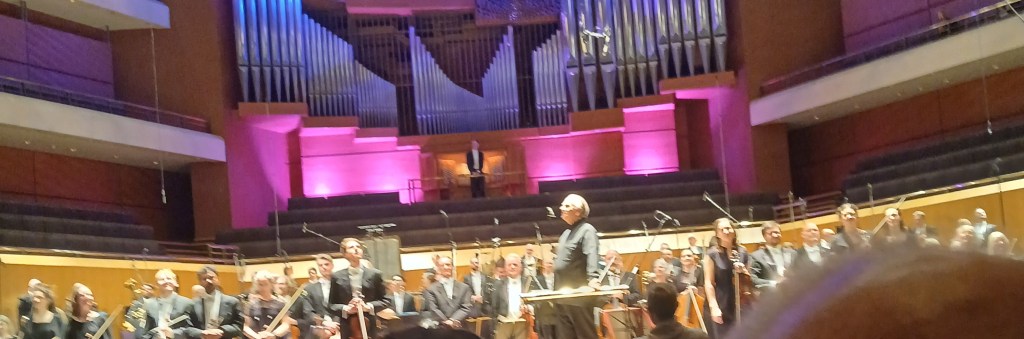
Mozart Flute Quartet in D K285; Beethoven Quintet for Piano and Wind Op.16; Elgar Piano Quintet Op.84
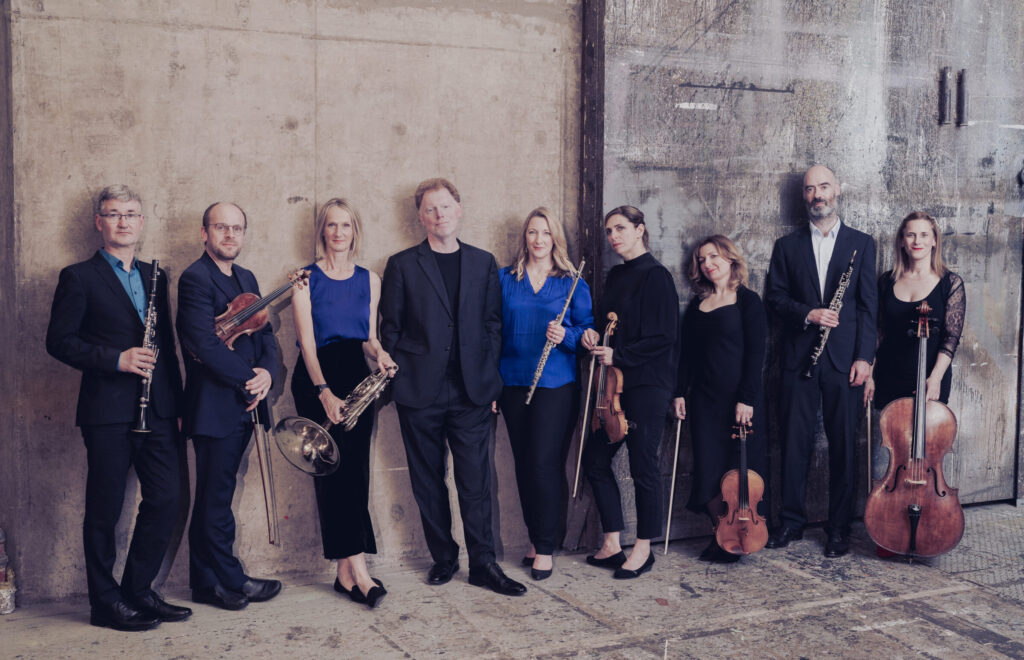
It’s a pity I have been to so little of the Ensemble 360 annual Chamber Music Festival – a lot of good things to go and see (20 concerts) but in the event this was only the second and last I’ve been able to make this year. In fact Ensemble 360 have been giving these May concerts for 20 years – this concert was an exact replica of the final concert of the first season.
The programming intention of this concert was not obvious, but maybe one idea was to offer two works of great composers in their youth, with another great composer’s near-to-last major mature composition. Obviously another point of connection is that there are two piano quintets, though of very different kinds.
The Mozart Flute Quartet was written over Christmas 1777 for Dutch surgeon and amateur flautist, Ferdinand De Jean, who commissioned some new pieces from him. There are three movements – Allegro, Adagio and Rondo. This Quartet was a delightful piece with a particularly bouncing last movement. The flute playing was very supple and at times outstandingly ethereal. I have to say this quartet sounded an odd combination of instruments – the flute has a high and bright sound; it sounds too divorced from the other string instruments, in a way. The two seemed only to be comfortably combined when the strings are plucking as in the rather beautiful slow movement.
The Beethoven work, again a work of a young composer in their 20s, also had three movements and was the product of his first few years in Vienna in the early 1790’s. Its obvious model, the programme note, pointed out, was the Mozart Piano Quintet . The Beethoven piece’s horn, oboe, bassoon and clarinet blend much better with the piano, and the work had the rhythmic energy of Beethoven’s later works, the third movement being particularly attractive. I was very struck by the cleverness of the wind writing, with each instrument being given its opportunity to shine, and also the way the horn writing did not cover the other instruments with its much greater volume (though that may also be to do with the quality of the horn player!)
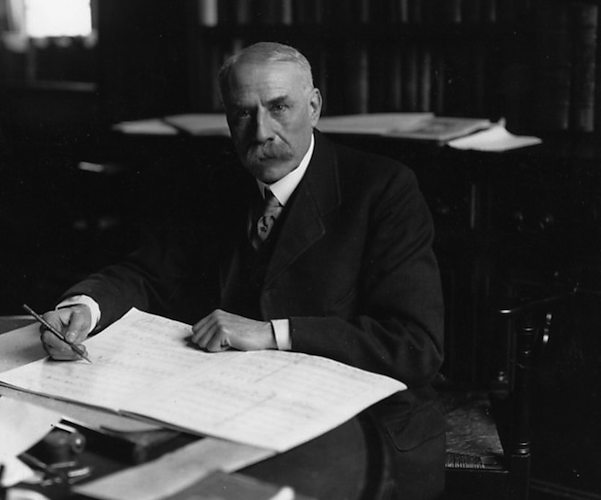
I have enthused about the Elgar work in this blog before – it is one of my favourite pieces of chamber music. Elgar wrote to its dedicatee, Ernest Newman, that ‘I want you to hear it. It is strange music I think, and I like it – but it’s ghostly stuff.’ (with reference to the first movement). I had the impression that this performance of the Elgar was more jagged, more fraught, than the Buxton Festival one a few years ago. The first movement sounded almost phantasmagorical, as the different themes flew in and out of attention, and with the world-weariness suddenly replaced by furious energy. At times I was also reminded of Mahler – just as Mahler transforms schmaltzy folk tunes and military band music, so Elgar transforms his often-Palm-Court salon music into something rich and strange. The slow movement was lovely, and the last movement generated the energy necessary to overcome the ghosts of the previous two movements. I hugely enjoyed this.
Ravel (arr. Farrington) Mother Goose Suite ; Farrenc Sextet; DURUFLÉ Prélude, récitatif et variations; Schumann Piano Quintet in E flat Op.44
This was a varied and interesting programme, with the best definitely last…..The Ravel piece I know from its full chamber orchestra version – here it had one each of strings, woodwind, horn and percussion, which amounted to the full complement of Ensemble 360 members. It’s a wistful lovely piece, based on fairy tales, both vivacious and pastoral, with a bit of chinoiserie thrown in for good measure. The Farrenc piece felt rather a dutiful acknowledgement – ok, I accept that canons are constructed by those with power, that in the past many gifted women composers were not able to have their works performed or simply felt too disheartened to write music., and that therefore there must be positive action to unearth and display their work. Farrenc in fact was acknowledged in her day to an extent so hers was work not completely ignored, at least during her lifetime. However for a piece to be revived it must be something that could take its place in a refreshed canon with justification, and this Farrenc piece, to me (and granted this is of course a personal reaction), was too conventional, too formulaic to achieve that status. It is sort of sub-Mendelssohn, sub-Schumann, but without real energy, drive and passion. Themes were attractive but the overall temperature was cool. The comparison with the Schumann quintet after the interview was stark
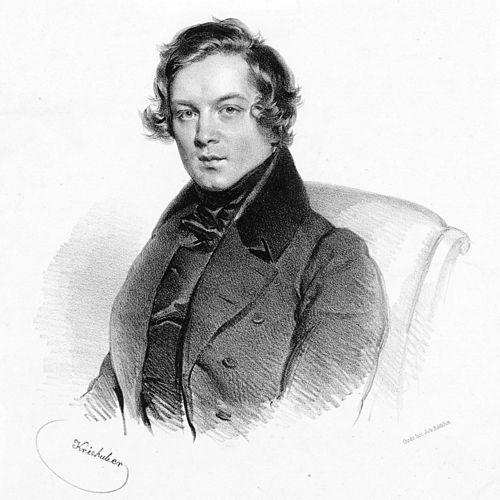
I liked the Durufle piece – wistful (flute, viola and piano), poised in a very French way and always interesting to listen to. The Schumann piece, as already intimated, is in a different league to the other music in this programme – passionate, driven, exciting, and with memorable melodic material, and with very little of the twitchy repetitions you sometimes get in Schumann’s music. The Ensemble 360 players seemed possessed – cutting, incisive string playing. Benjamin Nabarro’s and Gemma Rosenfield’s playing was particularly noteworthy, and Tim Horton as always was reliable – more than that, sensitive – on the piano. This was a memorable performance.
Conductor, Yannick Nézet-Séguin; Director, Claus Guth;Set Designer, Etienne Pluss; Ursula Kudrna; Costume Designer; Peter Mattei, Jokanaan; Gerhard Siegel, Herod; Michelle DeYoung, Herodias; Piotr Buszewski, Narraboth; Elza van den Heever, Salome
I had planned to go to an Ensemble 360 chamber music concert (Schubert and Janacek) on 17 May but discovered a week before that it started at 2pm and not, as I had thought, at 7pm – and I had to go to an important meeting at my church that wouldn’t finish with enough time to get me to the concert . I cast around for musical replacements and decided that the best option was the screened relay of the new Met Salome, again, as in Berlin in March, directed by Claus Guth. Although it means I will have been to three Salome performances in 2025 (there’s an LSO/Pappano concert performance in July, allegedly with Asmik Gregorian), I wanted to see this, given good reviews from New York-based critics. I’d read from a review that Guth was in this production as in the Berlin one using multiple Salomes (a reviewer called them Salomettes) of different ages during the Dance of the Seven Veils, and was suggesting, as before, child abuse as being a factor in the story of the opera.
The Sheffield Curzon was surprisingly full for this screening. I did wonder whether some had confused Strauss, R, with Strauss, J – if so they would have undoubtedly had a shock.
The demands behind a cinema showing of a live staged opera are formidable. Singing actors who would be utterly credible in the theatre live can sometimes seem on the screen to be over-acting or not quite looking as they should in the part – others whose performances might be dismissed live in the theatre as routine are shown to have unexpected subtlety and credibility. And it is difficult on film to reproduce the balance between orchestra and voices, so you get that sense in Strauss of voices soaring over a powerful orchestra at climatic moments.
In this performance the two who came off best were Herod and Herodias. Both looked utterly convincing close up, both sang wonderfully and they were totally in character 100% of the time. Jokanaan was not particularly well served by the movements the director had given him, and maybe he looked a bit too respectable and tidy close up. Salome in the theatre would have seemed utterly right, a first class performance, but you couldn’t escape the fact that in the cinema she did not look like an adolescent or even someone in their 20s, and as a result the impact of the performance. in the cinema, was diminished, and some of the intentional archness of her portrayal seemed odd, given that imbalance of age between character and singer.
Claus Guth said he was very influenced in this production by two Stanley Kubrick films – the Shining and another one I can’t remember. The set was 19th century Gothic horror, with all the servants and Herod in forms of evening dress. Herodias wore a ball gown. The set had three levels, dimly lit – an upper terrace where vaguely sinister, occasionally erotic, processions seemed to be taking place, often led by men wearing an over-sized goat’s head – this seemed to be something to do with the official religion of Herod’s court. There was a ground level ballroom, and then a lower stage which could be moved up, replacing the ballroom, and accessible via a steep set of stairs. In the lower level was both Jokanaan, and also the Salomettes, ghostly figures playing with dolls and rocking horses. Salome went to the bottom level for both the scene with Jokanaan and the final scene, where a spectacularly gruesome headless Jokanaan was sitting on a chair and his head lying on the floor. The reading of the ending was interesting – after Herod shouts out at the end ‘Kill that woman’ he falls to the ground with a heart attack, and Salome insouciantly walks off upstage. I suppose this emphasises the idea that in some way Salome is revenging herself on Herod. The connection with child abuse is obviously there in the text and an effective way of explaining why Salome is as she is. The Dance of the Seven Veils, again like Berlin using 7 different-aged Salomes, was more open in insinuating the abuse in the dancing, with a sinister goat head male dancer. It would have been (as Guth did in Berlin) better to leave it at that and have Salome played straight – just plain mad. Whether through Guth’s guidance, or the singer’s interpretation, Elza van den Heever made Salome a very arch figure, constantly trying as a character to be a wilful 18 year old and lacking any sense of maturity. Maybe that links with the abuse in some way, but the connection wasn’t obvious to me (at least) . Van den Heever did it very well – even in front of a merciless camera she was utterly in character – but the whole impression was to my mind a bit incoherent. In the theatre, again I emphasise, I would have been most struck by the remarkable singing Ms van den Heever offered us – beautiful phrasing, wonderful high soft top notes, every appearance of being able to sail over the orchestra at the big moments from what one could tell from the recording, and a stunning lower register as well. In the theatre I would also have been mightily impressed by Peter Mattei. I can’t remember hearing him in a performance before – his was a wonderfully noble warm voice, and his diction was excellent. He was in recent years by far the best Jokanaan I have heard, voice-wise
I was slightly disappointed by the orchestral contribution – the Met orchestra sounded magnificent but sometimes the reading seemed a bit sluggish and needing more bite in the most frenetic moments, as well as more grandeur in the big Jokanaan 6 note theme, when it blazes in the brass. I think on the whole, of the three staged Salomes I have seen in recent years, the Paris one with Lisa Davidsen and Mark Wigglesworth was the most effective.
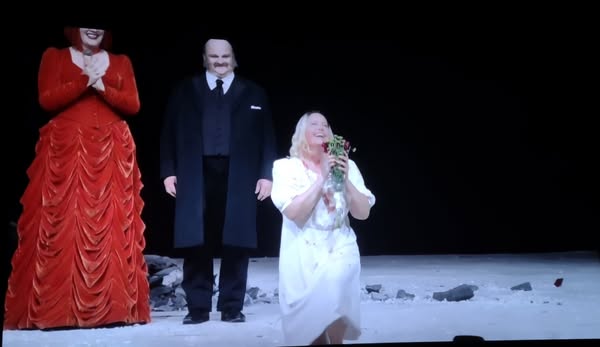
The Met ausdience went wild at the end, with a standing ovation, lots of flowers being thrown, and Ms van den Heever in tears. Given the notorious reputation of the Met as a bastion of staging conservatism, it was impressive to see the audience response to this, a classic bit of German regie-theater. Peter Gelb must be doing something right…………..
Halle Orchestra, Sir Mark Elder conductor. Huw Watkins, Concerto for Orchestra (world premiere); R. Strauss An Alpine Symphony
This was Mark Elder’s one concert with the Halle in this, the first year after he retired from being music director. It was billed as a big deal on Halle’s Facebook page – it also had a royal presence at the concert in the Duchess of Edinburgh (pause to work out which royal that is). And indeed the Alpine Symphony IS a big deal and requires one of the largest orchestras in the central canon of ‘classical music’. As for Huw Watkins, I have been to hear a couple of his works, but I don’t recall a particular style or approach to his compositions. Before the concert, in the auditorium. Sir Mark Elder, Huw Watkins and Tom McKinney were in conversation, listened to by a large audience (including me). Huw Watkins said in response to a question that he saw himself as a tonal composer in a 21st century context – which was different from being a tonal composer in a 19th century Romantic context. Influences on him included Janacek and Prokofiev. He flirted, he said, as Britten had, with other forms of musical expression Tom McKinney of the BBC asked why he did not attach programmes or give suggestions about the feelings and backgrounds to his works- he said, if I remember correctly, he didn’t want to dictate to audiences. He hoped, he said, not to bore audiences but to engage them.
Watkins’ new work, The Concerto for Orchestra, was in three movements – two quicker outer movements and an alternating slow fast ABACA structure. I found it to be indeed broadly tonal with an alert and memorable opening theme and the slow part of the second movement had a theme of great beauty. There were quite a few hints of Tippett, Vaughan Williams – a broad 20th century English tradition. Altogether as a work I enjoyed it and would want to hear it again. I did reflect afterwards that it was difficult to feel quite where the two outer movements were going – in both cases the music suddenly seemed to come to an end in mid flight.
Mark Elder in his remarks before the Alpine Symphony stressed that it represented a spiritual as well as a physical journey (somewhat contradictorily, the Halle had decided to have surtitles for the different stages of Strauss’ Alpine journey). Personally, I found this helpful – I have never quite worked out where some segments began and ended from record sleeves! It is a monster of a work and even the Bridgewater Hall had difficulties at times in coping with the orchestra at full belt without distortion. The orchestra played magnificently – the trumpet section particularly. I was also very struck by the unanimity of the woodwind choirs and the beauty of the first oboe’s and first horn’s playing, on or near the summit, as well as the glorious string sound in the closing sunset section. Elder’s approach to the work emphasised the vigour of the ascent – even the glorious sunrise theme was quite brisk – and the difficulties and perils of the descent, often taken quite slowly, particularly the lovely sunset sequence and the ‘vision’ just past the summit. I enjoyed this performance, but found the other live performance of the work I’ve heard – with Vladimir Jurowski and the Bavarian Staatsoper Orchestra at the Barbican about 18 months ago – more compelling. I am not sure why this was, given the fairly disastrous Barbican acoustics. Maybe the English approach is just a bit pragmatic……The performance received a warm reception from the audience
Antonio Pappano, conductor; Wotan, Christopher Maltman; Brünnhilde, Elisabet Strid; Sieglinde, Natalya Romaniw; Siegmund, Stanislas de Barbeyrac; Hunding, Soloman Howard; Fricka, Marina Prudenskaya; Helmwige, Maida Hundeling; Ortlinde, Katie Lowe; Gerhilde, Lee Bisset; Waltraute, Claire Barnett-Jones; Siegrune, Catherine Carby; Rossweisse, Alison Kettlewell; Grimgerde, Monika-Evelin Liiv; Schwertleite, Rhonda Browne. Director, Barrie Kosky; set designer, Rufus Didwiszus; costume designer, Victoria Behr; lighting designer, Alessandro Carletti
There had been very positive reviews of this production after the first night, so I was looking forward to this performance with great anticipation. Lise Davidsen was due to sing Sieglinde but she had cancelled some months earlier, being pregnant – happily, I’d heard her sing the role in 2022 at Bayreuth so was not unduly bothered by the cancellation. I was very interested to hear what the new Sieglinde, Natalya Romaniw and the Siegmund, Stanislas de Barbeyrac, would bring to the production, and fascinated to see how Christopher Maltman’s Wotan was developing.
I did find it, indeed, a remarkably good performance, one of the best I have ever seen. It was excellent mainly for two reasons – it was extremely dramatically effective and it was of high quality musically.
The staging was very physical – lots of grunts, shrieks, weeping, much running around, and violent at times. A lot of the action was very front of stage, singers foregrounding their reactions to each other. All the singers without exception were dramatically credible (polite for saying they looked the part) The visual picture was unrelentingly dark – blacks and greys predominating. In detail, then…….
Before Act 1 begins, the same naked Erda, portrayed as a very old naked lady, as previously seen in the Rheingold production, appears in silence, circles round the huge wide open stage and looks on as Siegmund comes on stage groaning and panting with exhaustion. A vaguely forest-like but nevertheless solid wall then comes down which delineates in the foreground the expanse of Hunding’s hut. The floor covering looks like stone slabs (and remains for all three acts). Costumes are contemporary – Siegmund wears a hoodie, Sieglinde in downmarket Primark-type clothes, and Hunding looks like a security officer or US cop. There is a sword on the wall which glistens in the darkness. As Spring cones in two doors in the wall open and Erda appears holding flowers for the couple. Erda again appears at the close of the first act – as Siegmund clasps the hilt of Nothung, the door is opened and Erda is holding the scabbard, releasing a (very long) Nothung into Siegmund’s hands.
In Act 2 we are in what looks like a deserted car park, again everything black and grey, with 5 or 6 big street lamps, and a large open space. The costumes here also is contemporary – Wotan with a suit, dark coat and a tie with (unlike Rhengold) now a beard, plus a proper spear, Brunnhilde is dressed in a kind of trench coat. Fricka arrives in a limo (for which Erda is the chauffeur) dressed to kill with sun glasses. The Todesverkundigung and final scene of Act 2 are played before remnants of the World Ash tree, also featuring in Rheingold, swathed in considerable amounts of dry ice. Erda comes in at points to listen to Brunnhilde, one time carrying a dummy which I think is meant to be one of the dead heroes the Valkyries carry, and which Siegmund smashes to pieces in his rejection of the Valhalla life Brunnhilde offers him. At the end the World Ash tree appears to be bleeding with horribly realistic red blood. The killing of Siegmund and despatch of Hunding were among the best stagings of this scene I have seen – Hunding fearlessly falling backwards in one movement off stage, and Brunnhilde utterly credible in her capture of Sieglinde.
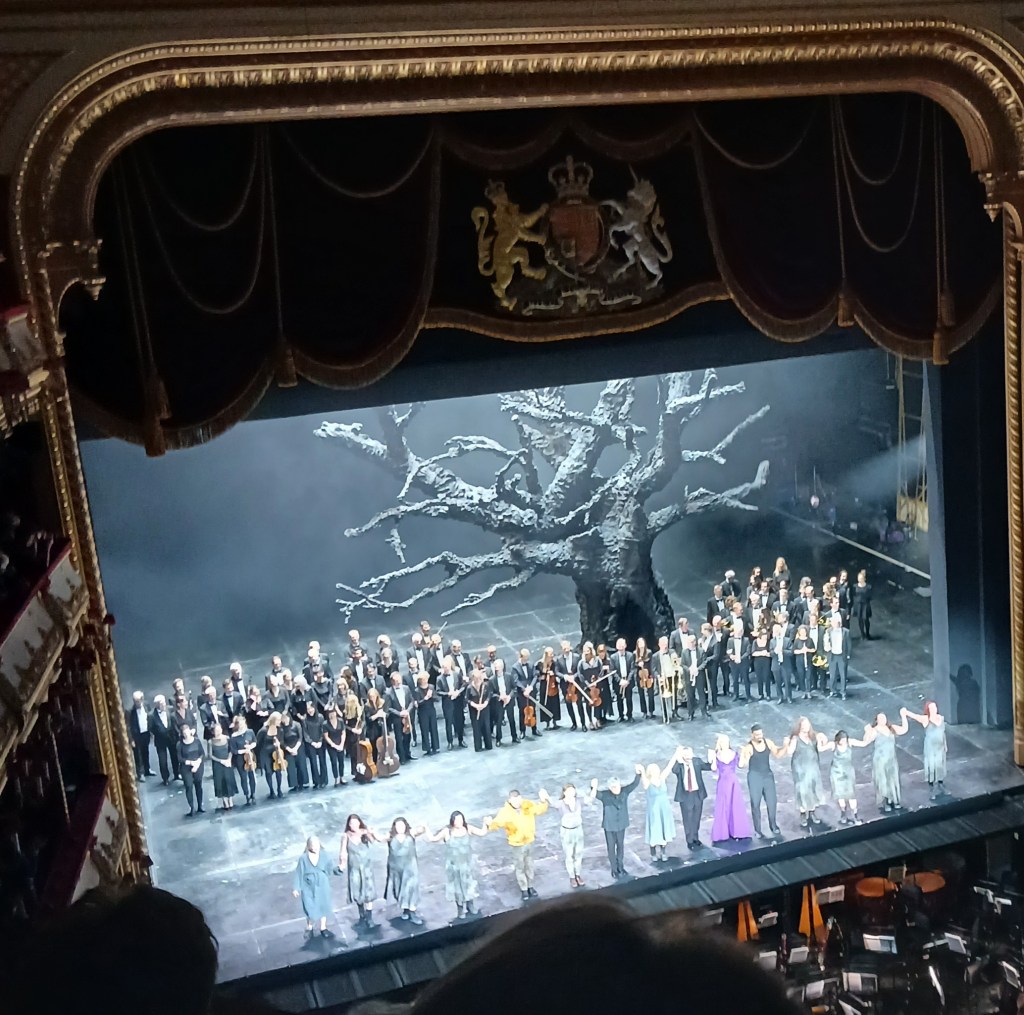
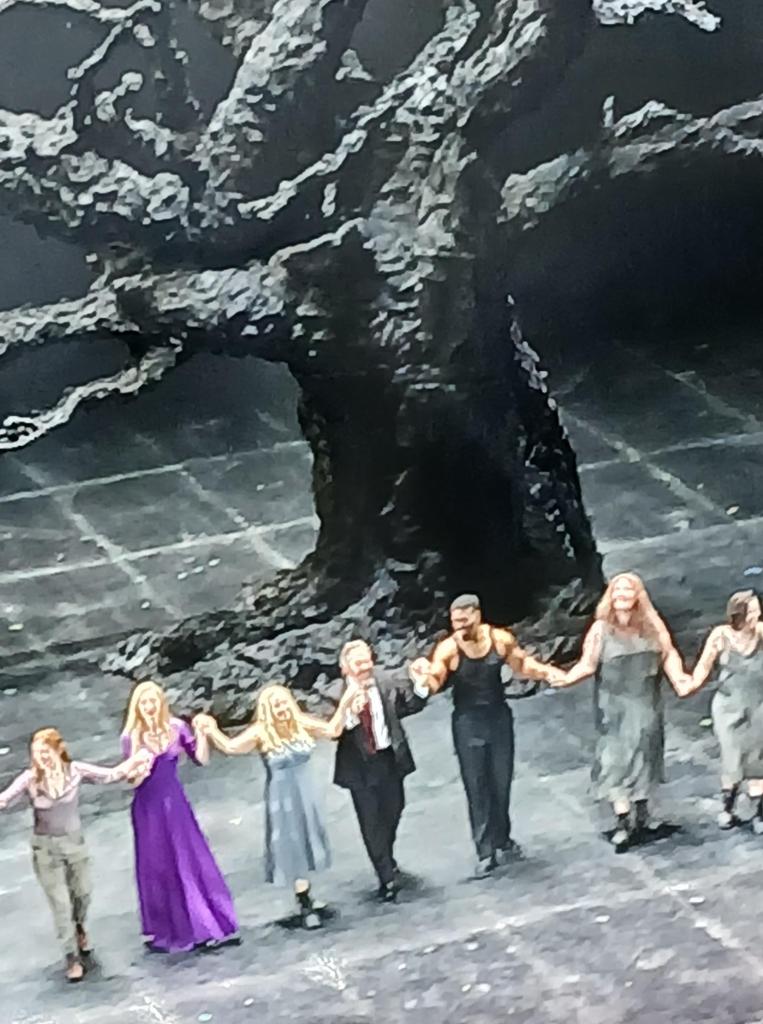
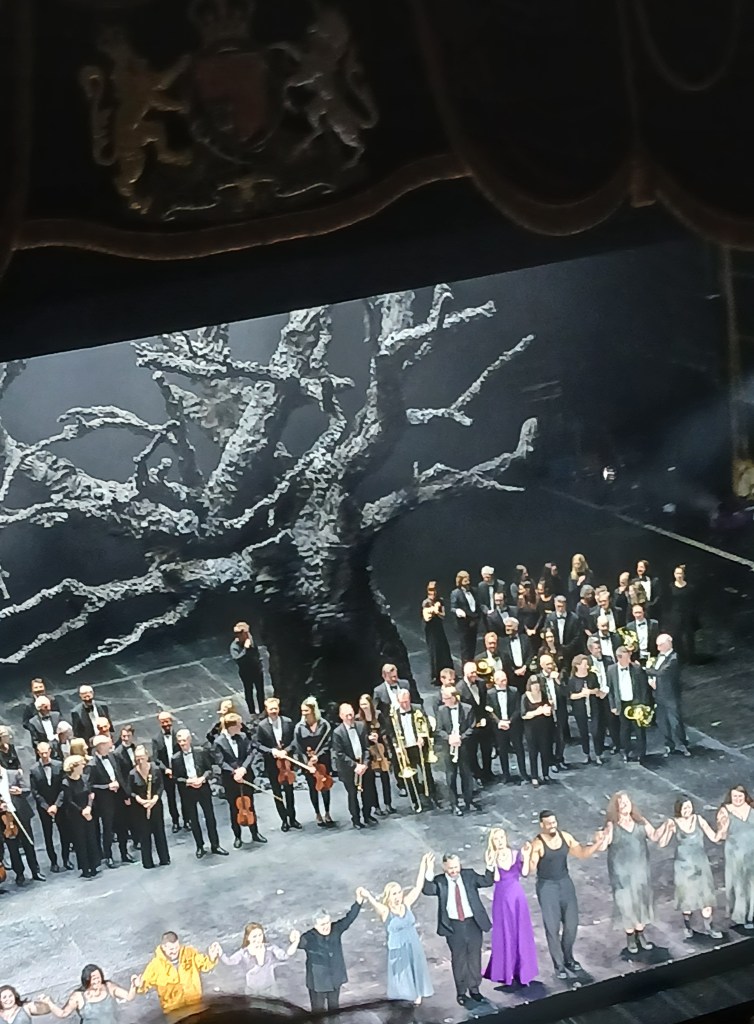
In Act 3, the whole vast Covent Garden stage is again open, and again in dull black/grey colours, with the exception of a big withered tree, this time upright, which may or may not be another part of the World Ash Tree, or maybe the lumps of wood on their side in Act 2 are NOT the World Ash Tree. Erda sits silently in the tree for most of the Act. The Valkyries and some helper-dancers trundle trailer-loads of heroes’ bodies around (much better than the silly Warner horse skeleton heads in the last ROHCG Ring) while they sing at the opening. Every detail of this act is clearly and beautifully played out on stage – I have never been so riveted by the final Wotan-Brunnhilde dialogue. At the end Brunnhilde walks into the heart of the tree and then it is spectacularly put on fire. Erda at the end walks behind Wotan as he slowly exits with the fire blazing (it’s interesting to note there is a bit of naughtiness with the surtitles at one point – when Brunnhilde refers to wanting a fire blazing round the ‘felsen’ – rock – the translation says ‘’tree’)
This account of the staging does lead to some questions. Given that Erda gave birth to the Valkyries, and she is seen as very old here on stage, my assumption is that she is reflecting in ‘old age’ on the whole sequence of events which led to whatever the eventual outcome of Gotterdammerung looks like. Yet at times she seems to have agency – eg with Nothung. Her role is still not very clear. And – if the tree in Act 3 is part of the World Ash Tree, is it the case then that Brunnnhilde’s bid for protection from ‘cowards’ and enabling Siegfried to be the one who passes through the flames contributes to the eventual ecological catastrophe that is waiting at the end of Gotterdammerung?
Musically this was very fine indeed. I don’t understand why I was less than impressed by Pappano’s conducting when I heard the previous Ring production in 2012. His reading of this work seems very fluid, speeding up and slowing down very naturally and not at all feeling piece-meal, but always serving the drama on stage, and incredibly exciting at times. The big climaxes of the three acts were thrilling, but also the orchestra gave us some beautiful playing in the quieter passages, particularly the earlier parts of the Brunnhilde/ Wotan scene in Act 3. Altogether the orchestra sounded wonderful and Pappano (and Wagner) know when to unleash the orchestra and when they need to be held back to ensure voices aren’t covered – there were really a very small number indeed of passages where voices sounded overwhelmed.
When I interviewed Christopher Maltman for the Manchester Wagner Society he talked about how he was very interested in blending the traditional German focus on words in Wagner singing and the expectation which Wagner himself had of a more legato style (which Maltman himself was more comfortable with). There were many moments in Act 3 where he was demonstrating both a legato line and a lieder singer’s care for the shaping of words. Some critics were a bit unenthused by his long narration in Act 2 but it held me throughout, and altogether I found his performance very fine indeed, and also very different from his arrogant Rheingold Wotan. I had had doubts about Elizabeth Strid beforehand – she had sung a not particularly impressive Senta at ROHCG about two years ago – but I found her very good indeed as Brunnhilde; one can’t help feeling that Pappano is something of a talent spotter and had heard potential in her voice. She looks the part, acted well and her voice, while not of the steely variety, can perfectly satisfactorily cut through the orchestra. Hers is also a warm rich voice and she did wonderful things in Act 3 with it (a most beautiful ppp with crescendo on a phrase). She also gave the most impressive trill I’ve ever heard from a Brunnhilde at the beginning of Act 2. Natalia Romaniw is more of a known quantity but even so I thought she was very good indeed – her final outburst in Act 3, giving thanks to Brunnhilde, riding over the orchestra, the intensity of her acting very compelling, and throughout an attention to words, with some lovely phrasing. Stanislas de Barbeyrac – another new name to me – was a baritonal but also very lyrical tenor, who yet had the heft (despite being apologised for, as having a ‘severe allergic reaction) for ‘Walse’ and the end of Act 1. At times his voice did indeed – as David Nice commented -sound like Alberto Remedios. And finally Soloman Howard was all you would want a Hunding to be – strong dark voice and a big presence (with a spectacular line in axe-wielding). The Valkyries were an aristocratic bunch…..
A shout of thanks too to the surtitles editor, for providing a full translation of the text as opposed to a generalised precis – Wagner deserves no less.
This has to be one of my top ten performances of the year, and I am definitely going to the cinema showing in 10 days time…………….And let’s hope I’m still on the planet for the rest of this Ring (and/or that the planet is in a condition to stage it)
Madeleine Dring: Prelude; Kenneth V Jones: Piano Sonata; Chopin: Piano Sonata no.3 in B minor
Madeleine Dring and Kenneth V Jones were both mid 20th century figures, the latter a film composer, a professor of composition at the RCM and, as it happens the pianist’s (herself a student at the RCM) great uncle. I liked the Dring piece, with subtle shifting harmonies and melancholy tone – not unlike Satie with a bit of Rachmaninov thrown in. The Jones piece was spikier – Prokofiev might be a possible analogy – but with, as the pianist said, a mesmerising and memorable slow movement. These two pieces were the highlight for me – I continue to have problems with Chopin, and the torrents of notes for the most part in the 3rd piano sonata did nothing for me. I did find the slow movement quite haunting, though. I found the pianist very proficient, even in the Chopin, which is clearly a difficult piece to play
London Symphony Orchestra, Sir Simon Rattle conductor. Peter Hoare, Brouček; Aleš Briscein Mazal/Blankytný/Petřík; Lucy Crowe, Málinka/Etherea/Kunka; Gyula Orendt , akristán/Lunobor/Domšík; Lukáš Zeman, Svatopluk/Würfl/Čaroskvoucí/RatsherrDoubravka Novotná, Číšníček/Wunderkind/Student; Arttu Kataja, Artist/Dohuslav/Vojta;Linard Vrielink, Skladatel/Harfoboj/Miroslav; Hanna Hipp, Kedruta. Tenebrae
This is a work I have never seen live before and I’ve never indeed had a recording of/ heard a note of the music. It has had an occasional appearance at the ENO and ‘country house opera houses’ over the last 50 years but in the UK is probably the least known of Janacek’s operas. I looked up Wikipedia as a first resort, which says that “The Excursions of Mr. Brouček to the Moon and to the 15th Century …….is …. based on two Svatopluk Čech novels”. “Brouček (translated as “Mr. Beetle” (literally little beetle) is a Philistine landlord in Prague who experiences a series of fantastic events as he is swept away (due in large part to excessive drinking) first to the Moon and then to 15th-century Prague, during the Hussite uprising against the Holy Roman Empire in 1420. In both excursions, Brouček encounters characters who are transformed versions of his earthly acquaintances. ………………… Janáček’s campaign, along with Čech’s, was against the pettiness of the bourgeoisie, specifically of Czechoslovakia. However, …….. [Mr Broucek’s]s shortcomings, failings, and ordinariness tend to be seen as qualities common to regular citizens of all lands”.
I went to this concert feeling slightly dutiful – almost a tick box exercise. It was far more than that, however. The first thing that struck me about the work is its accessibility and its warmth and varied melodic content. It is a lot easier to ‘get’ than say the ‘Makropoulos Case’, though it lacks the latter’s final radiant peroration, which several of Janacek’s operas have. There are Hussite battle hymns, bagpipes, waltzes, lullabies, a moon anthem, and some lovely lyrical themes for the moon aesthetes. There is a sunniness about the work, a positivity, which I haven’t heard in the same way in other Janacek operas.
One of the curiosities of the opera is that the original writer of the stories about Broucek is said to have focused on his crudeness and bourgeois narrow-mindedness, and Janacek seems to have seemed him in the same way. Yet, the music makes the moon artistic community feel rather precious, while Broucek in his manoeuvres to avoid being part of the Hussite army seems to be making a very appropriate response to the blood thirsty heavily nationalistic Hussite hymns. This makes the whole work easier to take for a modern audience.
A concert performance can’t give the full picture of a work of this kind, and there were various orchestral interludes where you wondered what was meant to be going on and what a director would do with them. Apart from Peter Hoare playing Broucek and his (by the end) 2 bottles of Czech lager next to him, and to a lesser extent the body language and movement of Lucy Crowe, no-one was really acting on the stage and that did mean at times, particularly in the moon sequences, and even with surtitles, it was difficult to know what exactly was happening. But overall the evening engaged me – there were even a few laughs – and made me want to see this in the theatre.
The LSO performed the work brilliantly, bringing out all the jaggedness of Janacek’s music but also at times its memorable and warm melodies (some lovely string playing). The brass, always important in Jancek, made a big impression in the 15th century, and the timpani had the right unyielding sound.
The stars of the show were Peter Hoare, with a clear, cutting tenor and a well-acted fusty manner that made him the personification of Broucek-ism; Lucy Crowe, whose voice and phrasing sounds more beautiful than ever, and Aleš Briscein, who had the perfect voice for those high powerful tenor roles which Janacek seems to specialise in writing for. I was also impressed by the bright voice of Doubravka Novotná. Tenebrae formed the very impressive chorus. Simon Rattle commanded all the forces with energy and love – I saw Tony Pappano in the audience taking a night off from conducting Walkuere at ROHCG and wondered how he enjoyed the event!
Sibelius Finlandia; Weill Four Walt Whitman Songs; Shostakovich Symphony No.7, ‘Leningrad’ (with film). Vasily Petrenko Conductor. Roderick Williams Baritone; Kirill Serebrennikov Art Director; Ilya Shaglov Video Artist. Royal Philharmonic Orchestra
I didn’t spot this concert as an upcoming event until a week before it happened. Vasily Petrenko is a conductor I always enjoy hearing but, somehow, I don’t always get news of the RPO’s programmes much in advance. The programming seemed very interesting – three different variants on patriotism (in Weill’s case of course a patriotism for his adopted country) – and it was fascinating in prospect, as part of the South Bank’s ‘Multitudes’ Festival, to consider what Serebrenniikov’s and his collaborator’s visual images might add to the already considerable impact (in my view – I am a fan of this work and not snooty about it) of the Leningrad Symphony (Serebrennokov is a dissident Russian film, theatre and opera director and designer, with the praised/loathed Vienna ‘Parsifal’ among his recent credits/demerits). I have to say my heart sunk when I read Serebrennikov’s video artist’s conception of what he intended to encapsulate in the four movements of the Shostakovich Symphony. 1. The Myth of Icarus; 2. The Illusion of Harmony and Memory of Flight: 3. The Depth of the Fall; 4. The Dichotomy of Progress. Oh dear……While the Symphony need not relate in one’s imagination just to the siege of Leningrad, the whole crux of the first movement is about something very nasty indeed invading the musical fabric, be it the ogre of Stalinism or the monstrous roll out of global capitalism, and its eventual expulsion at the end of the last movement. You can’t help feeling that it would be better if music led and fed the imagination rather than having someone else’ s imaginative responses delivered on a plate
Anyway….first the Sibelius and the Weill. Putting Sibelius together with the Leningrad Symphony is of course very much a loaded coupling – one piece of music calling out for freedom from Russia and another one calling out for freedom for Russia from the Nazis – and the Finnish, given that the latter joined the Germans in besieging Leningrad!. The RPO produced a cultured sound – splendidly rasping brass, sweet strings and a good forward thrust from Petrenko, with no screen images. The Weill piece seemed to have some half-hearted screen images – it wasn’t clear at first whether something had malfunctioned or whether the scratchy blips were meant to be commenting on the songs. I liked the Weill songs, written after Pearl Harbour, using Whitman’s Civil War poetry – slightly bluesy, slightly US folksy, just slightly Mahlerian at times (songs dealing with soldiers and death) and Roddy Williams sung them very well – mellifluously, great diction, voice sailing over the orchestra.
After a while I gave up on the screened images for the Shostakovich, and just shut my eyes. They just were not helpful and did nothing for me – a crudely delineated human Icarus figure, lots of vaguely mountainous views, lava flows, waves, fire, spheres – general screen-saver stuff etc etc. None of it spoke to me. The performance by the RPO and Petrenko was very fine, with a very wide dynamic range, and great care taken with the quieter passages to bring out individual musical lines. The first oboe was particularly fine. I was most impressed by the third movement- its passion, its glacial quietness, its delineation of sadness. At times it almost seemed too refined – maybe there should have been more vulgarity in the first movement’s climaxes – but the last few minutes of that movement were most beautifully and sensitively played. The last tumultuous 5 minutes of the whole work were tremendous….
Altogether this was a very distinguished performance, but one which I felt a bit distanced from, perhaps by the images. What exactly Serebrennikov had to do with it I am not sure, really – maybe the overall concept (which Petrenko put much more succinctly in his opening remarks as about ‘human resilience’, much more on the mark than all the stuff about Icarus…….
A question I asked myself at the end of these two Multitudes concerts were – have they introduced people to works they haven’t heard before, and would they listen to them again because of the multi-arts approach of the Festival? My impression was that people at the Mahler 8 concert were already quite well aware of that work and were treating the event as a conventional performance (underlined by the fact that the concert had sold out months earlier). The RPO audience was a bit different, and it could be that there were people there attracted by the approach who weren’t aware of the Shostakovich piece. Let’s hope they decide to explore further, if so
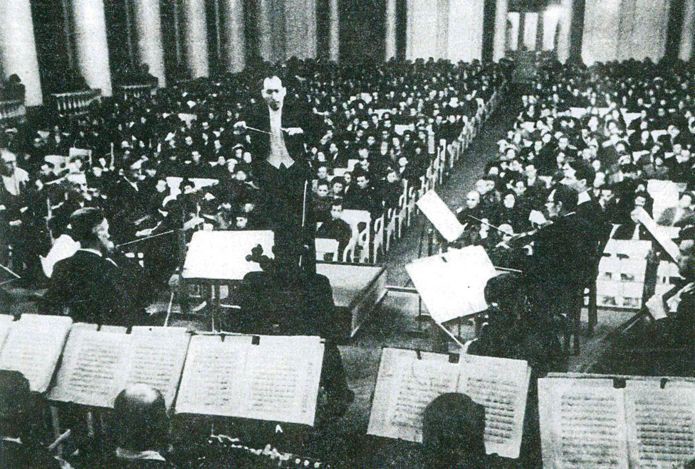
This is labelled as a photo of the first performance in Leningrad, with the siege still ongoing (but could it be the premiere, beyond the Urals?)
London Philharmonic Orchestra, Edward Gardner conductor. Sarah Wegener soprano, Magna Peccatrix; Emma Bell soprano, Una Poenitentium, Gretchen; Jennifer France soprano, Mater Gloriosa; Christine Rice mezzo-soprano, Mulier Samaritana; Jennifer Johnston mezzo-soprano, Maria Aegyptiaca; Andrew Staples tenor, Doctor Marianus, Tomasz Konieczny bass-baritone, Pater Ecstaticus; Derek Welton bass-baritone, Pater Profundus; London Philharmonic Choir; London Symphony Chorus; Tiffin Boys’ Choir.
This – and the RFH concert the following day – were both part of the ‘Multitudes’ Festival – to quote, “Leave your expectations at the door: this is orchestral music reimagined for all the senses by world-class orchestras, dancers, visual artists, poets and MCs”, in late April – early May. I hadn’t quite understood the significance of this when I bought the tickets a year ago. Hmmm……I don’t have a particularly set and negative view about the use of images in concerts – after all the whole of opera is built around such a combination of the musical and the visual. But I have not found – on the rare occasions when I have seen this done in the concert hall- that it has added much to the experience, and one time was definitely a distraction.
It’s over 3 weeks since I’ve been to a live musical event! I wondered if this is the first time that this work has been performed at the RFH? The Albert Hall is the obvious London venue, but in fact the last two performances I have seen live of this work have been in more conventionally – sized concert halls – Symphony Hall in Birmingham and the Leipzig Gewandhaus – and both have seemed more than adequate venues for the volume and scale of the work. I was interested to see also how the RFH’s much drier acoustic would work for this symphony. The concert was described as ‘staged’, as part of the above-mentioned Multitudes Festival – not something I have ever heard of or seen happening before – so I wondered too how that would come across………The staging was to be by “a creative team headed up by director Tom Morris, with video design by Tal Rosner and lighting by Ben Ormerod” (the latter I met years ago in Egypt trailing around with a Shakespeare group of actors). I thought, again, in prospect, that an excellent group of singers had been brought together for this performance – Derek Welton, who I interviewed for the Manchester Wagner Society in December last year; Andrew Staples, and Tomasz Konieczny, the current Bayreuth Wotan (who dropped out before the performance ), plus Emma Bell, Christine Rice and others.
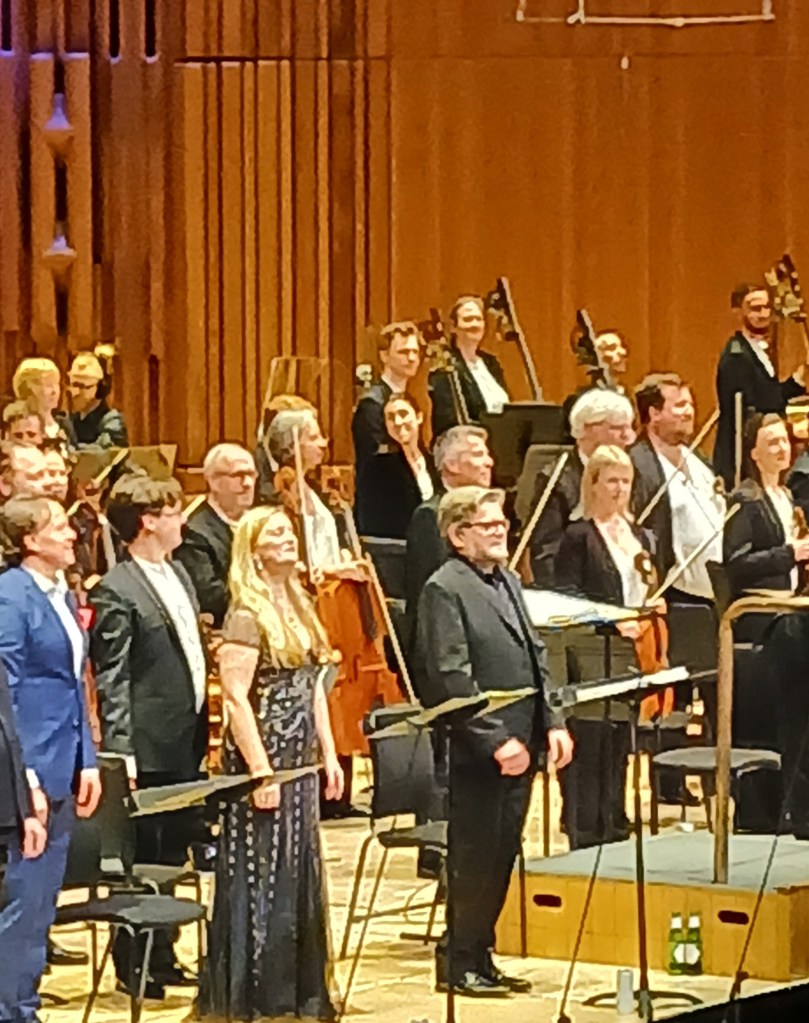
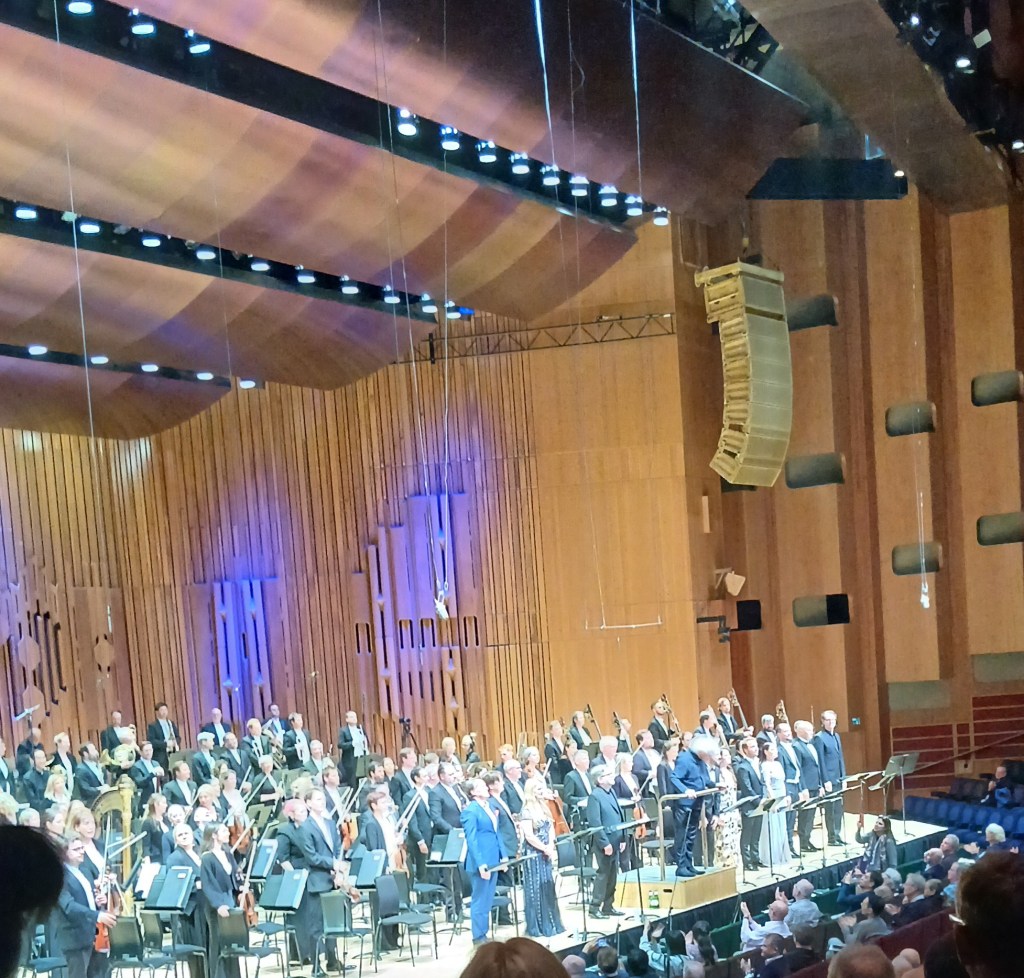
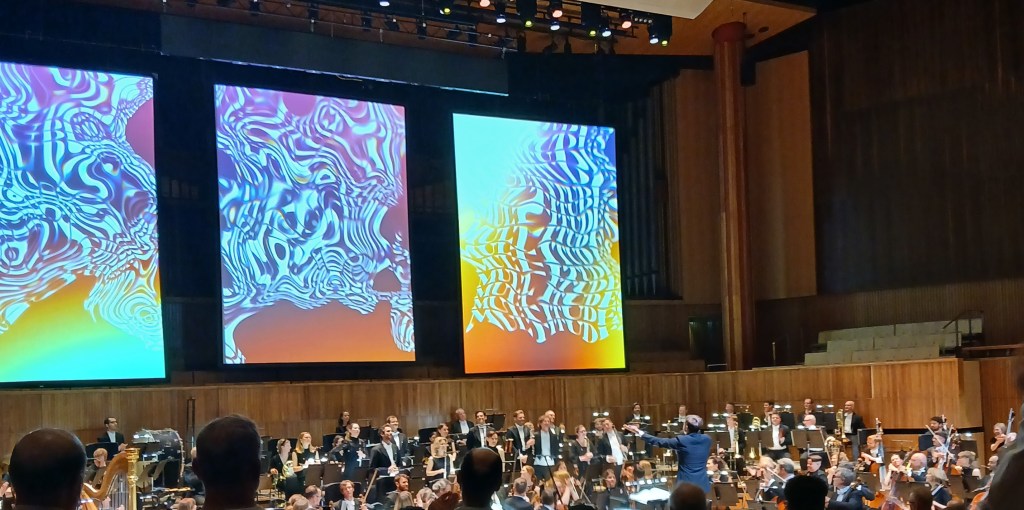
So how did all work out? I found this in its totality a very moving performance – I can’t honestly say I’ve heard a better one live. What was interesting was what made a difference to my feelings about the performance in the ‘Multitudes’ concept and what didn’t. There were two larger screens on either side of the RFH organ and one in the middle above the console. On these screens were projected (in addition to the words) a constantly evolving set of abstract images – spheres circling at the end of the two parts of the piece, raging fire for the Spirit in the first part, cold gloomy woods for the beginning of the Faust sequence, starry skies at points in the second part. Much was made in the orchestral introduction to Part 2 of a human face which I assumed to be Faust’s, which gradually dissolved in death. All of this was mildly interesting (and it’s certainly good to have surtitles, even if they were a bit selective – and so why not at least all the German in Part 2 – it is Goethe, after all) but didn’t really add that much to the musical performance. What was revelatory was the staging of Part 2. In Part 1 the soloists, at the back of the orchestra/in front of the choirs were static. But in Part 2 they came on and off stage in character, using spot-lit spaces within the orchestra, a platform in front of the orchestra and spaces in front of the choirs. The Mater Gloriosa appeared from right at the top of the organ loft. Very movingly Faust himself (ie the person in the video) came on stage and was then led out of the auditorium by Gretchen, as he followed her to enlightenment through the Ewig-Weibliche /Holy Spirit. Normally I am stuck in the audience trying to remember who is who, not being able to read the libretto in the programme properly and getting a bit fidgety at times in the various interactions. Here I was utterly gripped and for the first time understood who these characters realky are and how they are different from each other. Without scores for the second half, the singers were able to use their hands, their faces, act and show emotion with their whole body This staged aspect of the performance really did add a whole new dimension to my appreciation of this work.
Musically I thought this was very good indeed – what impressed me most about this performance was its immediacy, its vividness, and its careful grading of dynamics; the RFH acoustics did not seem at all to be a problem. The 3-D aural effect of the choirs from where I was sitting in the stalls was thrilling. The 2020 performance by Mirga and the CBSO I heard in Birmingham was, in retrospect, too hard-driven. The Leipzig performance with Andris Nelsons and the Gewandhaus orchestra in 2023 was very fine orchestrally, but the soloists and choirs were, I think, less impressive than here. Ed Gardner took a varied approach to tempi – the whole performance had a swing and a flow that felt natural. The final peroration of the work was very (and fittingly) slow (with some impressive gong clashes), the start of the first movement sprightly but not gabbled. The beginning of Part 2 again was slow but didn’t seem to drag. The choirs extended round either side of the stage and there must have been maybe 350 of them – the men were particularly impressive (the tenors sounding glorious in some of their exposed passages in Part 1). Perhaps the children’s choir didn’t quite cut through in the way Mahler envisaged. The LPO isn’t the Gewandhaus orchestra and lacks that central European richness of strings, but there was some marvellously secure brass playing (the high trumpet playing superb) and delicate woodwind in parts of Part 2 (where Gardiner brought out some inner voices I’d not heard before). As I’ve said above, the soloists were especially impressive – Emma Bell a very expressive Penitent/Gretchen, Andrew Staples a properly heroic tenor, and Derek Welton resonant and commanding. Sarah Wegener – not a name I know – was an extraordinarily powerful high soprano, cutting through the huge choral sound with ease in Part 1, while Jennifer France handled the high notes of the Mater Gloriosa beautifully.
So, all in all, the Multitudes concept worked for me in this concert. We’ll see what happens with Shostakovich 7 tomorrow.
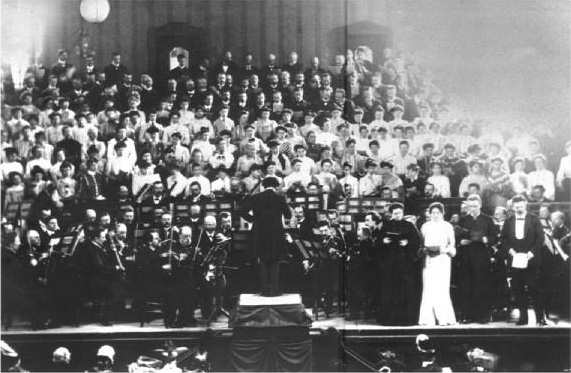
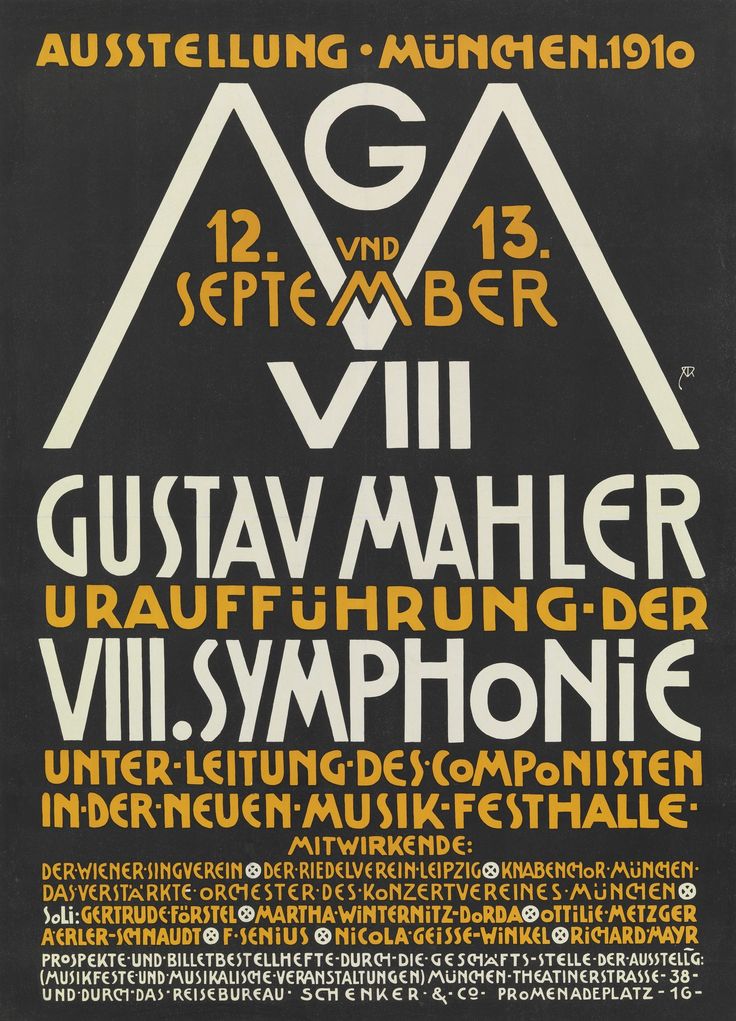
Unfortunately, I left my phone in the hotel so can’t show you the assembled forces in the RFH. Attached are two photos allegedly of a rehearsal before the first performance of the work in 1910 in Munich. The first looks more likely than the second – the first image has a clearer image of Mahler conducting which looks credible, and the line-up of soloists looks like Mahler 8. It could be a performance of Beethoven 9, of course. I love the poster image!!
My experience and knowledge of bel canto operas is slight – as I am sure I have said elsewhere in this blog the only Donizetti/Bellini opera I’ve heard is the former’s Maria Stuarda, until I saw Lucia last year. I’m well aware though of the respect Wagner held Bellini in, and I thought I’d go to this nearby performance in Sheffield given by ETO to see what I had been missing all these years.
Bellini wrote the work in a hurry after a previous flop, and used various arias from a previous opera to speed things along. It was an immediate critical success. The work is based on a story by an Italian writer Matteo Bandello rather than Shakespeare with a libretto by Felice Romani. Bellini’s opera focuses on the conflict between the two families and the lovers’ desperate search for love and escape.
As with my experience of Lucia di Lammermuir last year I wasn’t completely convinced by my latest immersion in bel canto. I love the snappy fast numbers and the vivacious tunes, but get rather restless in the long slow, indeed languorous, arias. I like the displays of vocal athleticism, but find some of the musical tics – like the uniform approach to the codas of fast pieces of music – wearing. Perhaps with an Oropesa, a Janet Baker, I would have been bewitched, But what I was very positive about was the excellence of this performance and production.
The setting was 1950s/1960s New York and Mafia gangs. Shades of Jonathan Miller, of course, but then Bernstein got there decades before…..Juliet’s Dad owns a coffee shop where she serves as a waitress and which is the headquarters of the Capuleti. Father Lawrence is a barista. Tebaldo, the newly appointed leader of the clan, is due to be married to Juliet. Romeo disrupts the wedding and thereafter the story follows much on Shakespearean lines.
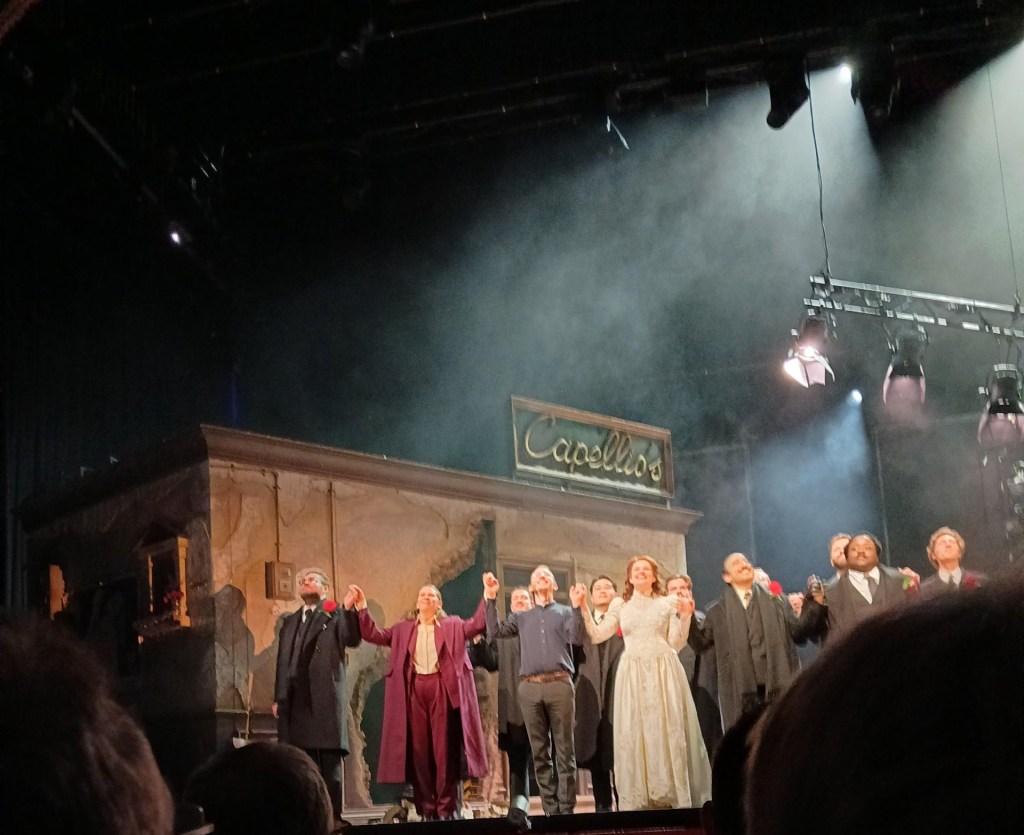
The sets – given the ETO’s need for economy and flexibility for different theatres round the country – were very impressive, and could have been part of a much bigger company’s offering. The first half was set inside the café – ultra-realistic with a 1950’s pay phone, all sorts of coffee equipment and roll-up blinds so that a bit more of the stage could be used, plus a large counter. The second half turned the counter into a tomb/catafalque, and the walls of the cafe turned inside out (see photo). The outside of the cafe looked as though there had been recent serious gang violence, with a hole blown in one of the walls. There was snow, and an impressive array of candles around Juliet’s catafalque. Interestingly, the lighting rig was clearly visible in both halves, somehow framing the story and contrasting with the realism of the sets. There was some excellent handling of fights, though once, at the end of the first half, a decision to take the fight action into slow motion (partly occasioned, I guess, by the lack of room on the set) teetered on the edge of a cliché. In general, the acting was very credible and kudos to the chorus for being such an impressive group of thugs (though given that there were only 8 of them occasionally it was difficult to identify who was a Montague and who a Capulet). Lorenzo had a particularly effective stage presence but all the cast members were entirely in character and believable.
The singing of the principals and the playing of the orchestra were excellent. The big orchestral solos in the arias for horn and clarinet plus solo cello were all very well performed, and the orchestral scamperings were precise and clear. Jessica Cale’s Giulietta had both the agility of voice you need for this sort of music and the beauty of sound required for some of the big arias. Samantha Price was very convincing as Romeo and conveyed a credible sense of a good-looking and energetic hero, using her body effectively and giving a sense of forcefulness and robustness in her voice while at the same time presenting a beauty of tone and a good match with Giuletta’s voice in duets. Brenton Spiteri’s Tebaldo (an excellent piece of casting) and Timothy Nelson’s sonorous Capellio were all first rate
Oh well – I see I Puritani is on at ROHCG with Oropesa next season while ETO is doing ‘L’Elisir D’Amore.’ I shall be there to see if I can get more enthused about this musical sub-genre……….