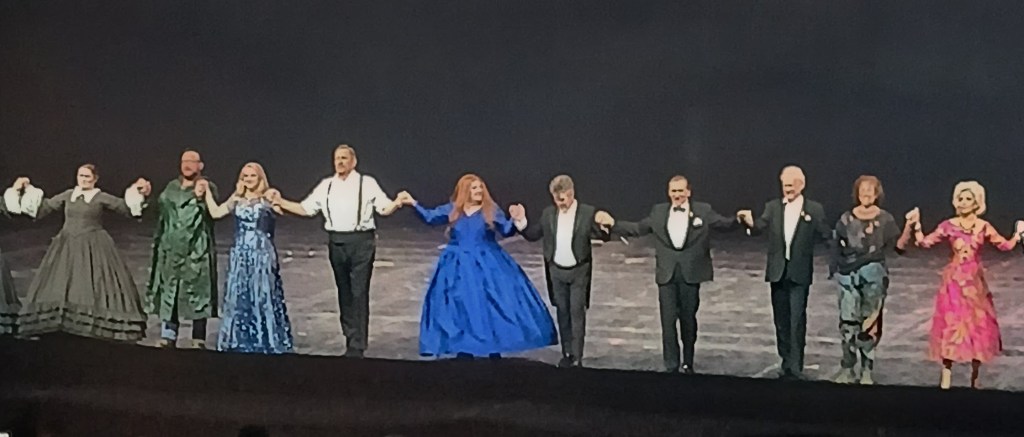
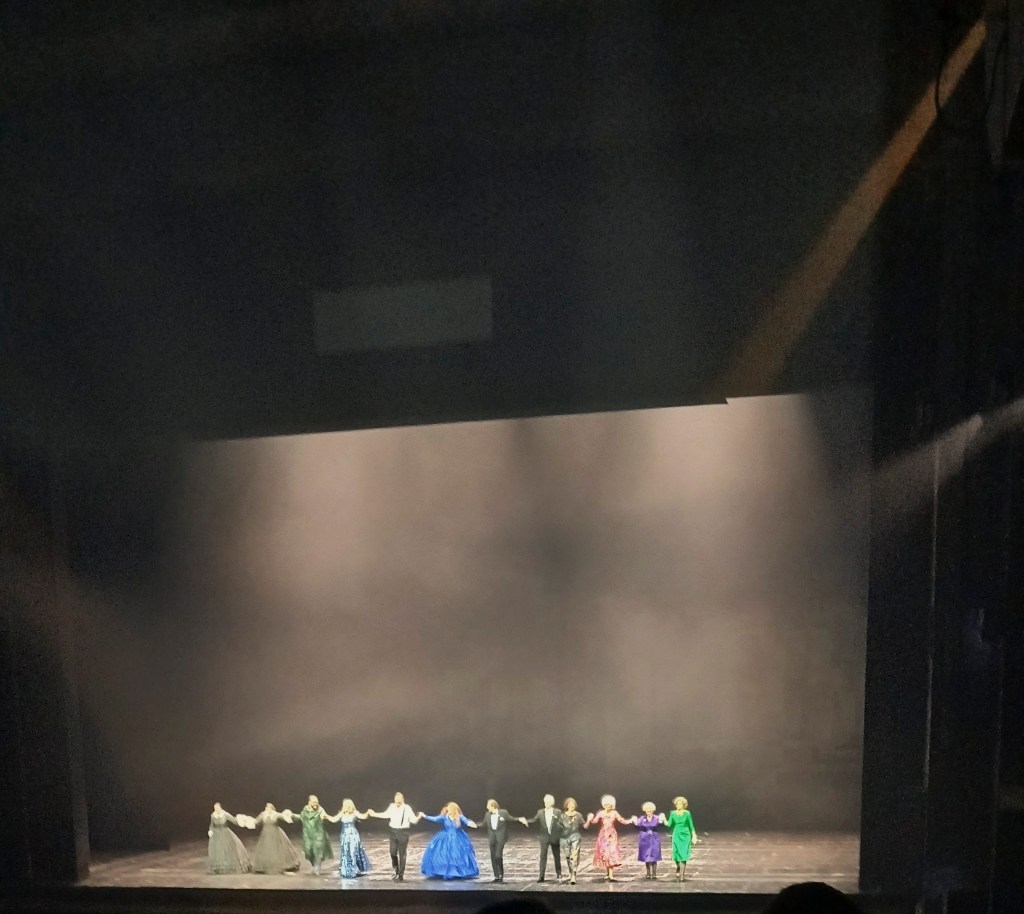
Production team as above. Conductor, Pablo Heras-Casado. Andreas Schager, Siegfried; Tamara Wilson, Brunnhilde; Brian Mulligan, Alberich; Gutrune, Sinead Campbell Wallace; Gunther, Johannes Marton Kraenzle; Mika Kares, Hagen; Margarita Polonskaya, Woglinde; Isabel Signoret, Wellgunde; Katharina Magiera, Flosshilde; Eve-Maud Hubeaux, Waltraute; Aude Extremo, First Norn; Marie-Andrée Bouchard-Lesieur, Second Norn; Sinead Campbell Wallace, Third Norn
This will be both a review of this performance and also my thoughts on the whole Bieito Ring. Some of the reviews of the run of performances of the new Gotterdammerung seen earlier in October suggested that Bieito had almost given up trying to do personenregie with his singers. I can’t understand this accusation – everything seemed to me to be thoroughly worked through in this rendition. One might not understand or like everything going on but there was no doubt in my mind that a lot of thought had been given to what we were seeing on stage.
The Norn scene was relatively fast and well paced by Heras-Casado. The Norns were dressed in early Victorian costume and centre stage was a large black loom. I guess the point was that the industrial revolution and the Norns themselves are part of history – what we’re experiencing now is something very different. The 3 Norns’ singing was all excellent (one of them, Sinead Campbell-Wallace, doubled as Gutrune). Rather than just a bit of rope breaking into pieces, the entire loom spinning system collapsed, with the Norns having quite a task to remove all the tangled-up wires before the two lovers come on stage. Altogether this was one of the best Norns’ scenes I have encountered in live performance. The Siegfried/Brunnhilde ‘duet’ was fairly conventionally staged, although Grane again makes an appearance as a hobby-horse. The loom has been turned on the revolving stage so that it becomes a cave entrance for the two lovers to come out of. The departure of Siegfried is curious – he goes slowly and sadly with a bucket containing the sword and Tarnhelm (I think). Perhaps this is indicative of some sort of premonition of his fate, or perhaps just a damaged personality through his childhood. As we come to the Gibichung Hall, the video projections begin – we are in a vast room with a big smart table and a huge window at the back where you can see clouds floating by – very much a tech bro sort of mansion, brilliantly envisioned and lit. Siegfried seems much livelier. Much of the scene is conventionally handled, though exactly when the potion is taken, I found a bit unclear. The video screen changes as the position takes effect to a hunting scene, light brown in colour, and then a darker mushrooming brown as the plot for Siegfried to capture Brunnhilde for Gunther emerges. Gutrune is usually portrayed as a wimpish figure – here she behaves increasingly oddly as the plot gets underway and the potion takes effect on Siegfried – one reading is that she gets, I think, very drunk and vomits during Hagen’s watch (the latter maybe a typical Bieito touch). The long table, on its revolving platform gradually moves out of sight and is replaced by the cave we left Brunnhilde in. The Waltraute scene is another key moment without any video imagery – Waltraute seems to be suffering from some sort of palsy, and her outfit is in tatters. I thought this scene was wonderfully done. The appearance of Siegfried as Gunther was the most credible, I’ve ever seen – Schager was very good at making his voice become like Gunther – while Brunnhilde was very effective in her visceral anger at and rejection of ‘Gunther’.
With the beginning of act 2, with Hagen asleep, we’re back with the table, now at right angles, and a video display for scene between Hagen and Alberich, of what at first seems a large hall, maybe later more like a church, shimmering in a dizzying way that makes it seem unreal. For the wedding hall we seem to be back with the huge metal sheet across the stage, with indistinct images which look like gates. The table is now used as a centre of the wedding scene with the vassals, Hagen standing on it to attract their attention. The rest of the act is well – though fairly conventionally directed – Brünnhilde’s scorn and Gunther’s weakness both well portrayed. Gutrune again behaves in a rather odd way, swanning around in a very queenly manner at the beginning of the scene. Something that may have been there in other scenes but which I only noticed during this act was that the action was being portrayed upside down on the nearer two proscenium arches – is this about showing how the world has become upside down. The closing part of the full wedding scene and then the ensuing ‘revenge’ ‘trio’ were as well staged as I have ever seen them, again fairly conventionally but extremely closely observed. This ‘trio’ scene had a huge projection of a nasty-looking red chandelier, shaking like it has a bunch of snakes within it.
In act 3, we are back in the land of big data. While the Rhinemaidens set the table for dinner, and talk to Siegfried, there are manic projections on the back screen – seemingly more than a hundred small screens all with something happening on them. Similar less manic and slightly larger-screened projections continue when Siegfried gives his narration. It is a fascinating and effective feature of the narration scene that everyone is there for it – the Norns, the Rhinemaidens, even Brunnhilde for a time. The projections, coloured for the beginning of the narration, turn black and white when Siegfried dies and then there is a sort of black whirlpool effect during the funeral march. Siegfried is on the table, dead, until the Immolation scene. Gutrune’s reactions to Siegfried’s death when she is told are well handled but it is unclear – there is no raising of the hand as far as I could see – how Hagen is prevented from grabbing the ring. The immolation scene is done with just a spotlight on Brunnhilde, who has assumed the blue dress we first saw her in in Walkuere, and who has similarly her Grane hobby horse. The end doesn’t quite work. After her last notes, Brunnhilde begins to spin slowly off stage with Grane (poor woman, I felt for Ms Wilson – this must be difficult without falling over). What I think Bieito and the lighting designer wanted as she disappears is total darkness – no projections of Valhalla in flames or the Rhine over-flowing, since that would resemble the past of Valhalla). All we can see is a small yellow light as Brunnhilde whirls away, which seems to come nearer, to begin to mean something, but then suddenly disappears, We are (or should be) left in darkness. This of course refers back to Bridle’s dark new age, the need to consciously welcome a ‘dark’ future. Unfortunately, because of orchestra lights, because of remaining smoke, it wasn’t quite dark enough.
The audience clearly felt cheated by the way the ending was handled, and, after tumultuous cheers for the musicians, when Bieito and his production team came on stage for the curtain calls, there were lots of books and shouts of anger. A pity the tetralogy had to finish in such a sour way.
There were no weak links in an outstanding cast. Tamara Wilson gave a more nuanced, thoughtful, account of the Immolation Scene than I have ever heard before. Her voice may not have the power of Lise Davidsen, and it is not an inherently beautiful instrument, but she can act in a visceral physical way, and every phrase is thought through, is projected with meaning, and musically sensitive. Andreas Schager, as he is wont to do, dodged and shouted through a few top notes, but was always a magnetic stage personality, and just is the best Siegfried I have heard (apart from Alberto Remedios of course). Sinead Campbell-Wallace was a big-voiced Gutrune, sung with clarity and sensitivity. Mika Kares, as Hagen was impressively domineering with a rock-steady bass voice, and knows how to use stillness to enhance stage presence. Johannes Marton Kraenzle is a firm and – to the extent the role allows – authoritative figure as Gunther, clearly portraying the character’s weakness and singing with energy when needed; Eve-Maude Hubeaux as Waltraute was one of the most effective portrayals I have seen and heard – hearing her and Ms Wilson together was like going to a masterclass in clear diction and thoughtful phrasing. The Rhinemaidens sounded much better than they did in Rheingold – much steadier of voice and mellifluous. The chorus was well-drilled and totally together. Alberich again was a murkily lit and uncharismatic figure. Heras-Casado continued his brisk way with some scenes (the Funeral March was a tad too brisk for my taste), together with considerable slowing down for some of the sensitive and most beautiful highlights – here the Waltraute scene, particularly, and also much of the Immolation scene as well. Again, the orchestra played superbly – all the big moments resplendent.
All in all, I thought this Gotterdammerung was the best staging and best sung of the four in Paris, with Walkuere as a close second
What then did I make of the whole Paris Ring interpretation and experience?
- Overarching interpretation: Yesterday morning globally was a classic example of how technology is fast spinning out of our control – to go back to the theme of Bridle’s book. There was a global outage on Microsoft Outlook and Teams, affecting millions of customers (including at 9am in Paris yesterday, me). The Guardian reported that “the world has quickly become accustomed to online services being available 24/7. Given software is no longer solely downloaded to individual PCs but is also stored on a server owned by a company, outages like this will happen. Most of the time they’re brief, but sometimes they’re not……. There are so many different pieces of the puzzle keeping services online – but the effects of one of those services going down is much greater than it ever has been.” The choice of the themes of the Bridle book as a Ring for the contemporary world was wholly justified by this production, and at this higher level, there was consistency from start to finish (or at any rate as much consistency as there is in the Ring as a whole in Wagner’s conception)
- Musically, very fine: there were very few weak links. One could think of different singers who might do individual roles more effectively, and also different ways of realising the tetralogy as a conductor, but in the real world this is about as good as it is likely to get
- Sets/videos/lighting, outstanding: almost all the settings for the different operas were visually stunning, and were consistent with the overarching interpretation. It was at one with that overarching theme that the production team never got trapped into using the powerful video imagery for the show-biz special effects – the Magic Fire, the ending of Gotterdammerung, The absence of ‘total darkness’ at the end was about the one failure in this whole Ring in this area
- Personenregie, and handling of the specifics of each scene, variable: there were times when standard approaches were taken, and also times where an innovative approach provided special insight or seemed particularly effective. But there were other times when actions and presentation seemed mystifying. Perhaps it is just that we were being asked to use our imagination. And that is something too little asked of us in opera productions. That I think is a more likely reason than the response that goes ‘oh well, it’s all this post-modern stuff’ – the latter approach doesn’t really believe that works of art have ‘meaning’, which this production most definitely did. Some might quote Jean-Luc Godard talking about film, applied to opera. ‘Any (opera production) which tells a story is putting itself at the disposal of the ruling class’. But this production was most definitely telling a story, and did it well, in the bigger scheme of things
.I am very glad I saw this, and will be looking forward to talking about it further, with others who may have been following the live streaming next week, at the Wagner Society Manchester talk on Monday 14 December at 7pm via Zoom. If you are reading this, are not a Society member and would like to attend, please contact susi.wagnersocietymanchester@gmail.com