David Bates, Conductor; Lyndsey Turner, Director; Soutra Gilmour, Designer [set & costumes] Tim Mitchell, Designer [lighting]. Christine Rice, Iphigénie; Jacques Imbrailo, Oreste; Nick Pritchard, Pylad; Morgan Pearse, Thoas; Olivia Rose Tringham, First Priestess; Ava Dodd, A Greek Woman; Robert Winslade Anderson, Scythian Priest
This was an absorbing, even engrossing, evening, and a bit of a change, even a relief, from Bieito-style Wagner. There was the sense of a full house, and an atmosphere, a buzz, in the Coliseum I haven’t felt for a while – it felt like ENO 40-50 years ago, There was a straightforward but always (with perhaps one exception) thoughtful staging, the set design was utilitarian but absolutely appropriate for a work related to the theatre of ancient Greece, and all the singing was of a high standard.
Though I sort of knew how it would sound, having heard Orpheus and Eurydice several times, I was unprepared for the variety of the music – the slow contemplative arias for Iphigenie, the choruses, the wonderful Scythian music with tambourines and cymbals, the opening storm, and the urgent dramatic arias for Oreste and Pylad. From a historical perspective it was fascinating to see how quickly aria could be intersected by a chorus and then start up again, how aria could quickly switch to recitative – very different from say one of the less inspired Handel operas 35 or so years earlier, and its sometimes a bit relentless offer of one da capo aria after another. Despite the variations in Gluck’s music, it has a clear glow, a quiet melancholy, that I find very appealing,
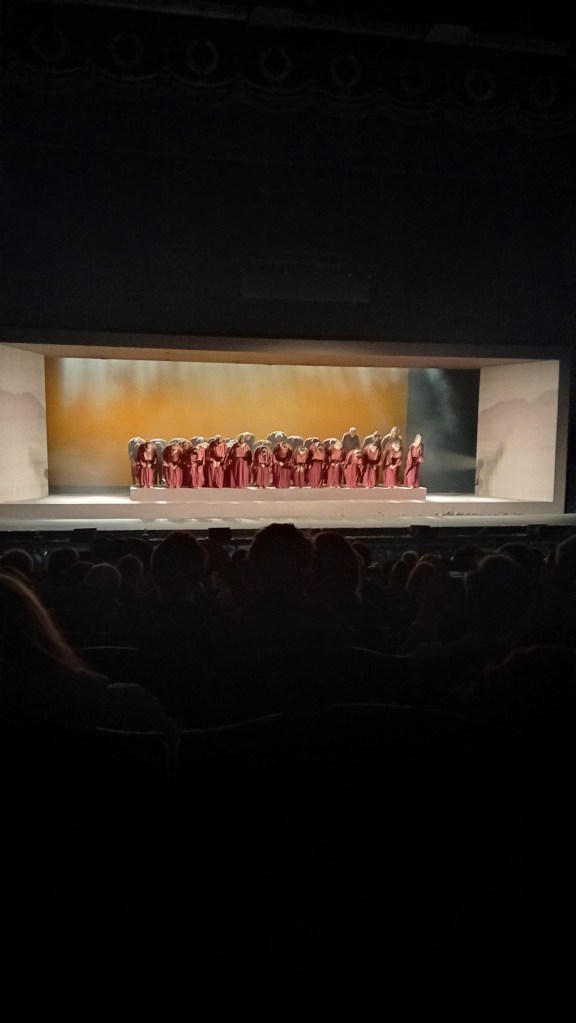
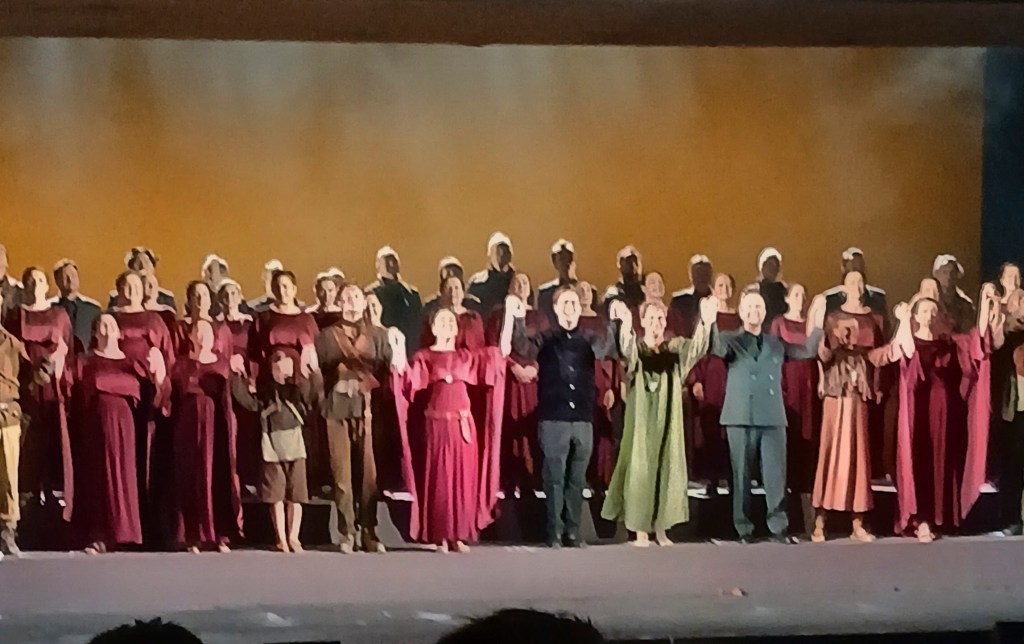
The set was simple – see the first photo below – and appropriate to a Greek tragedy; only a few props, a box like set with a very low ceiling and a raised area. Clearly a cheap set, but absolutely right for the work. What you don’t want in this work is any funny business in the staging in the Bieito mode, nor was there any, with one exception. All the characters on stage behaved simply and naturally and had been well-directed. Iphigene was, as she should be, slow of movement and had the necessary dignity of a princess and a priestess. The chorus of priestesses – who I suppose could have been handled in a ritualised way – in this production had been well guided in how to interact with each other, to give the impression of a set of individuals working together, and there were no false notes in how they presented themselves. The three main male roles were all believable, though Thoas is a bit of a carboard cut-out villain for whom not much could be done to make the character fully live. The idea of having an adolescent girl and a younger boy occasionally moving in and out of the action, clearly representing the childhood versions of Iphigene and Oreste, was a good one, but quite why the two of them appeared, with the boy (treble) singing to represent the dea ex machina Diana was a bit unclear. But we were on the home straight by then and it didn’t really matter.
Christine Rice was a wonderful Iphigene – some beautiful soft singing and always utterly in command of her voice. Jacques Imbrailo was remarkably good as Oreste – I don’t think I’ve heard him in better voice, and Nick Pritchard was his equal. All the smaller parts were well taken.
There had been a lot of comment is media reviews – and comments on them – about the appropriateness of singing this in French at ENO. Some thought it an obvious step – many singers would be unwilling to learn such a rarely played work (unjustly so) and French is less easy to translate into sung English than some other languages. Others thought that this was the death knell of ENO – once you removed singing in English as a USP, what was the point of ENO – but then again others commented that the point of singing in English lapsed on the introduction of surtitles. My only comment on this debate would be that if you are going to sing it in French, at least make it identifiable as French – what I was hearing could as easily be Urdu as French.
I’’d love to see other Gluck operas -Alceste, Armide, Iphigeneia at Aulis at the least, not to mention any of the other 20 or so he composed. I must check with Operabase what other Gluck operas are on in Europe next year