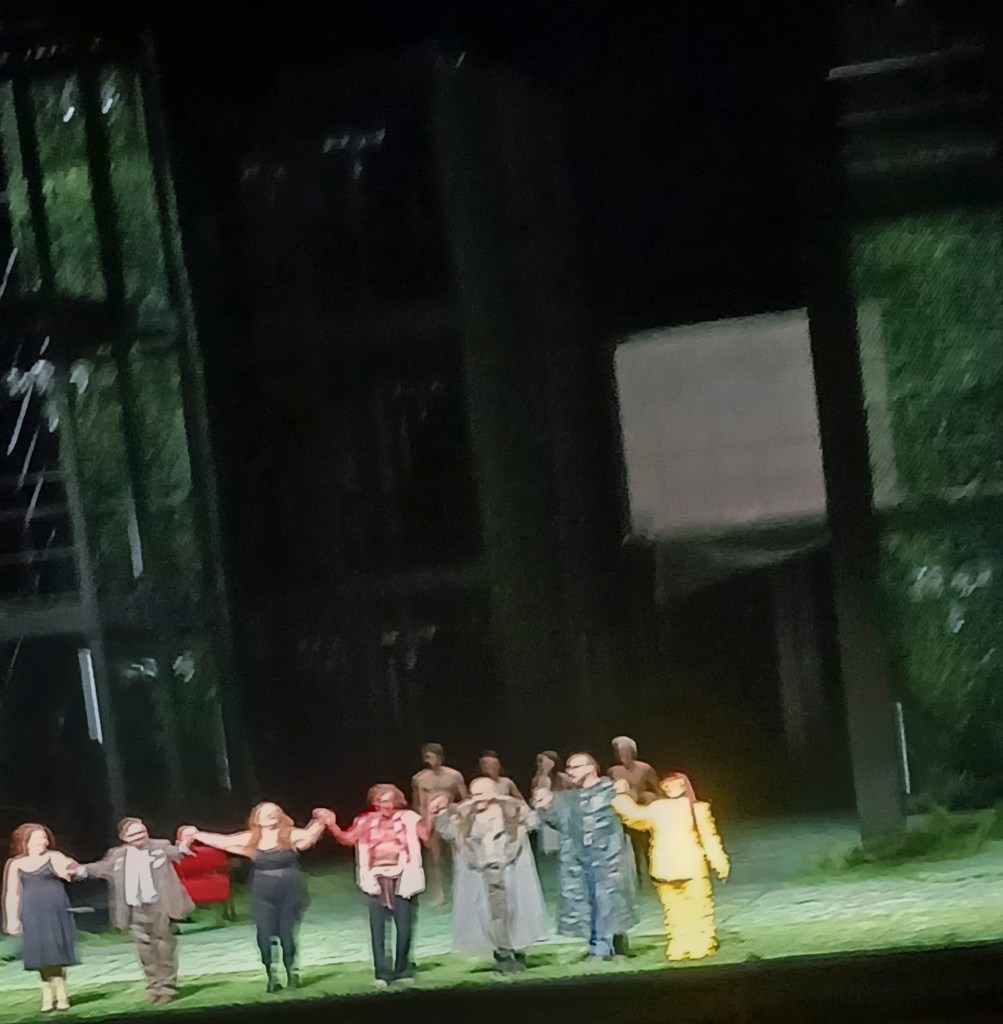
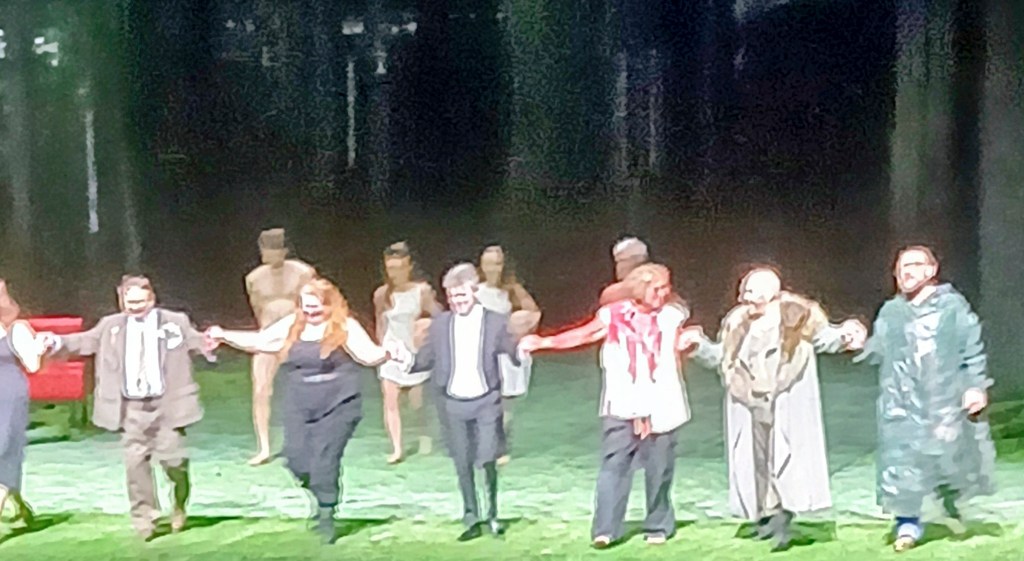
Production team as above. Conductor, Pablo Heras-Casado. Christopher Maltman, Wotan; Andreas Schager, Siegfried; Tamara Wilson, Brunnhilde; Brian Mulligan, Alberich; Mika Kares, Fafner; Gerhard Siegel, Mime; Ilanah Lobel-Torres, Woodbird; Marie-Nicole Lemieux, Erda;
Yesterday morning, I visited the Palais Garnier, Paris’ other main opera house, built in 1870 – a monstrous building crowded with visitors, vulgar, garish, and doing nothing at all for the image of opera as anything to do with contemporary life and ordinary people – and saw the Wagner exhibition put on there – some interesting images from past productions at the Opera Paris. From there I went to see the restored Notre Dame Cathedral – a wonderful building (though Westminster Abbey is better). And then, after a splendid lunch of lamb kidneys a la forestiere, and a quiet afternoon to the Manchester Wagner Society’s Zoom talk on Wagner and Film – very interesting and well-researched. Today, after a morning meeting with Derbyshire County Council officials via Teams about schools’ stuff, I walked around the locality my hotel is in for a bit and then…. on to Siegfried.
The set for Act 1, and to a slightly lesser extent Act 2, is very striking (one of the best Ring sets I’ve ever seen). There are lots of trees, with many branches and leaves, enhanced by video projections, rustling in a slight breeze – it is indeed a forest environment. Except that.…. these are mutant trees, upside down, hanging from the flies, growing horizontally, a lovely but polluted perverse world. The old metal structure seen in the Valkyrie is just occasionally visible through the trees. Mysterious figures – robots – occasionally are glimpsed staggering through the trees, looking sick. The lighting is dim, and it is very difficult to see from a distance what Siegfried and to an extent Mime are up to most of their times on stage in the first act. Siegfried is contemporarily dressed, while Mime has clearly come up in the world – he is now wearing a (not very well-fitting suit, and a tie. Instead of a bear, Siegfried comes on with a bit of old metal – which he fiddles with; he investigates what I assume is Sieglinde’s suitcase and wraps himself up in what might be her dress. During the forging scene, it is particularly difficult to see what is happening (I suspect the answer is – ‘not a lot’; there’s no forge or hammer. He rubs bits if sword together at the beginning of the forging scene, he rummages around in the suitcase. Those watching the live streaming might get a better idea. It’s also unclear what his emotional state is by the end of the forging scene- his movements get slower and slower; he spends more time on his knees and gives a loud groan of anguish at one point. Is he overburdened by the loss of his mother and farther. Is he upset by taking up a weapon of war, as a child of nature? Does he foresee his end, with a heavy heart? It’s impossible to say. The Wanderer/Mime scene is conventionally done. The forest stirs and gets agitated at points -the climax of the acene with Wotan and Mime’s fearful vision, for instance.
In Act 2 there is again much that’s not that clear. There are still the upturned trees but they are sparser – I guess to make way for the dragon to appear. We see Zombie dancers in the trees. Eventually Alberich enters with a very ill female robot, who is obviously pregnant, and who gives birth and then? disappears/dies? Alberich carefully wraps up the baby and seems to want to look after it – is this Hagen? Again, Wotan pirouettes away after seeing Alberich. The lighting remains very dim not only for this Alberich/Wotan scene but for the rest of the act, and what Siegfried is doing in the aftermath of Fafner’s death is unclear. The Forest Murmurs scene is traditionally done, and the trees do indeed almost murmur though there is lightning of the dark green textures. The dragon is impressively done – a human face mask on some sort of crane structure, with, curiously, Fafner standing beside it – all with a backlit lighting and smoke (though the smoke doesn’t help visibility). This is one of the best dragons I have seen him. Siegfried is again acting in a disturbed fashion in the aftermath of Fafner’s death. The woodbird is off stage, but appears towards the end flying through the air beckoning Siegfried forward.
In the third act we are still with a few of the upside-down trees but with the tower, and Brunnhilde’s top room, clearly visible. There are again a few robots making a brief appearance during the prelude. We see a white table set out for tea and Wotan and Erda at first sit down to chat, the latter having been summoned by Wotan, but things quickly become violent – as they obviously do quite often in this production, and Wotan pushes Erda on to the floor during his statement of Wotan’s will. Curiously I don’t recall any particular video images during the last glorious 5 minutes of this important scene. When Wotan and Siegfried meet, again Siegfried behaves in a distracted and disturbed way, at one point spinning the white table round, at others with his head in his hands. Wotan rolls on the floor at the end of this encounter, cowering from Siegfried, who instead of breaking the spear takes it (though we don’t see it again in this opera, unless it is being used right at the end for the last 5 minutes of the final scene for Brunnhlde and Siegfried to hold onto). At the edge of the stage Erda watches this scene and does a little dance as Wotan is overcome, before disappearing. Rather than going off into the magic fire (there is none, not even red lights), and blowing his horn. Siegfried has to clear away bits and pieces of the set to create the foreground of the final scene – I suppose a Brechtian alienation thing, but why isn’t clear. I couldn’t understand at all what was happening in the few minutes before the awakening – round about ‘Das ist kein Mann’. – the silhouette of Brunnhilde is clearly visible at the top of the tower through semi-transparent plastic sheeting (a brilliant image and with huge fairy tale resonance, of course) but instead of going up to the tower, Siegfried at first is poking and prodding something at ground level. Eventually Siegfried does go up the tower, smashes the plastic screening to create an opening, kisses Brunnhilde and the final 25 mins or so get underway – first of all the two only partially visible (from the waist upwards) in the tower and then down at ground level from when Brunnhilde is looking for Grane. Again, Siegfried (and Brunnhilde) do the Brechtian thing of clearing the plastic sheeting away before they descend. The act ends conventionally – both singers singing out to the audience and each holding one end of spear/sword? embracing as the curtain falls.
There was a lot that was pretty obscure about this Siegfried. What held it together was a combination of, as in the Valkyrie, the singers being allowed to get on with it and not be over-directed, at some of the key moments (Wotan/Erda, and Siegfried/Brunnhilde), an astonishing set, and some really fine singing. On the first point, Heras-Casado produced again a gear change from brisk to slow for these, which helped hugely with, say, Brunnhilde’s ‘Ewig war ich’. By contrast the poor Woodbird was really struggling at the speed the conductor set for her songs. Andreas Schager was his usual generous and untiring self, being lyrical at points, but also banging out the top notes with huge volume, sounding much the same at the end as he did 5 hours earlier. His acting was very subdued compared to the Kosky production, which clearly indicates Bieito worked with him a lot, though to what end I couldn’t really make out. Maltman sang the scene with Erda in commanding but also poetic voice (he was ill when I saw the Kosky production live, so it was a great pleasure to hear him sing this). Again, Tamara Wilson was both sensitive and powerful in her singing – she’s very impressive. Gerhard Siegel was a good ‘character tenor’’s reading of Mime, though at points he over-did the yelping sprechstimme, I thought. Again, I thought Brian Mulligan was an OK, but not particularly characterful/colourful, Alberich. The orchestra was on strikingly good form – no slips in the difficult high violin playing on Brunnhilde’s ‘rock’, and climaxes were carefully graded (particularly noticeable during Siegfried’s ascent to the ‘rock’).
It will be fascinating to see how Bieito handles the final part of the tetralogy…………