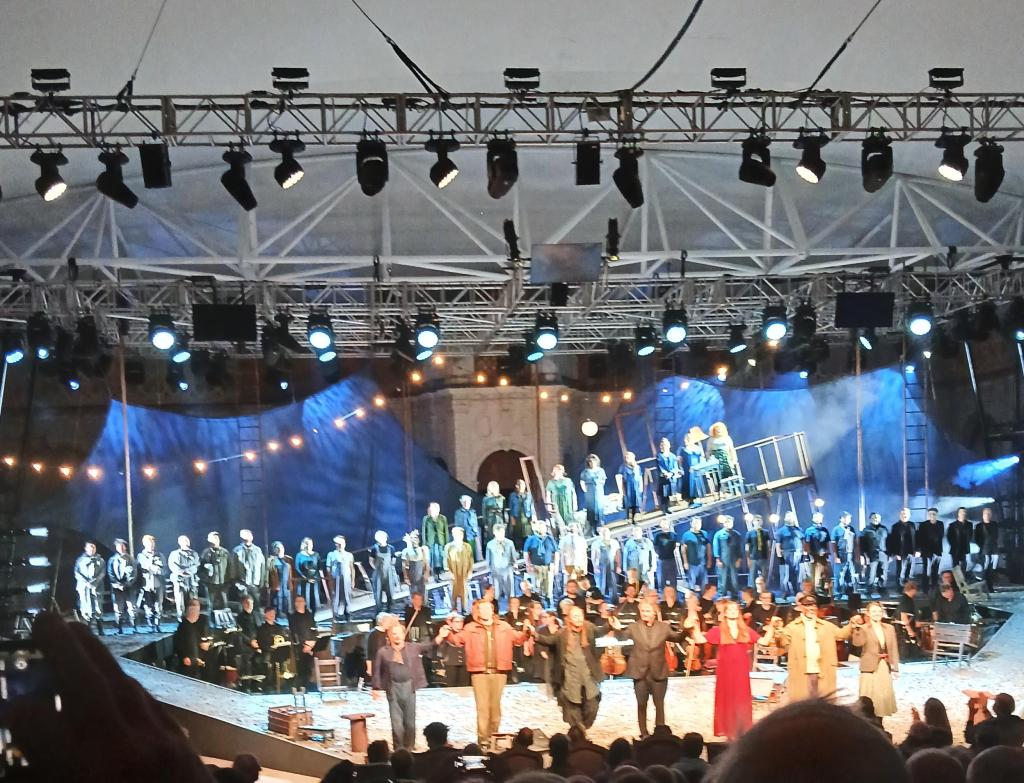
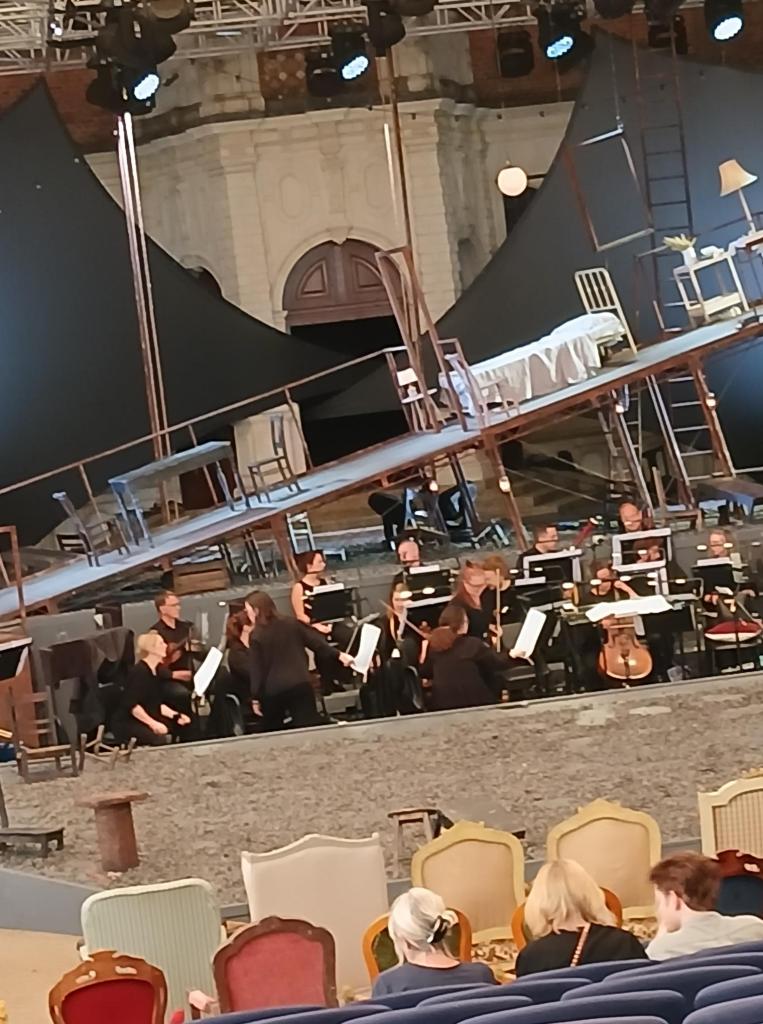
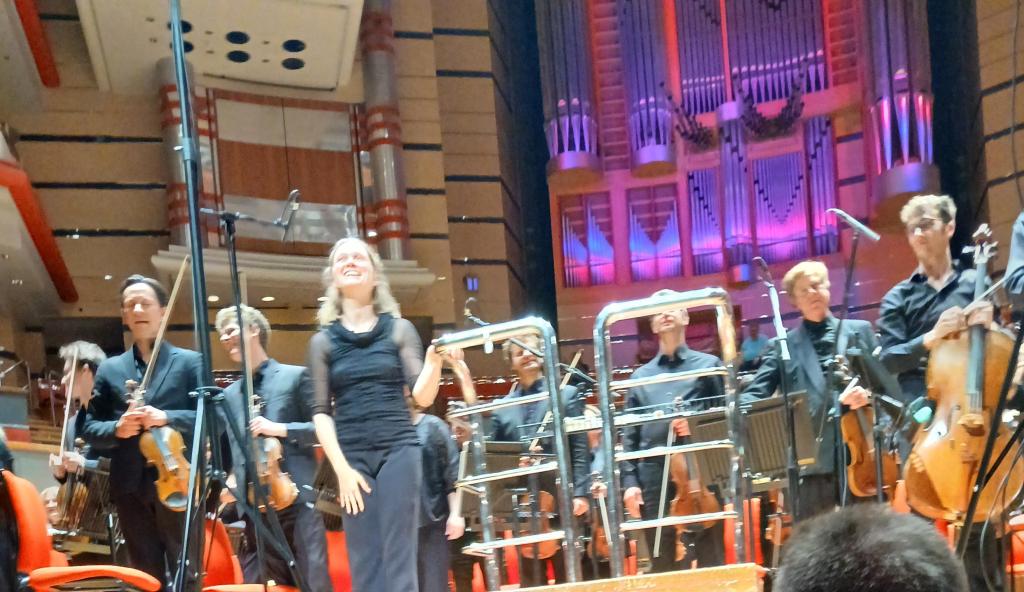
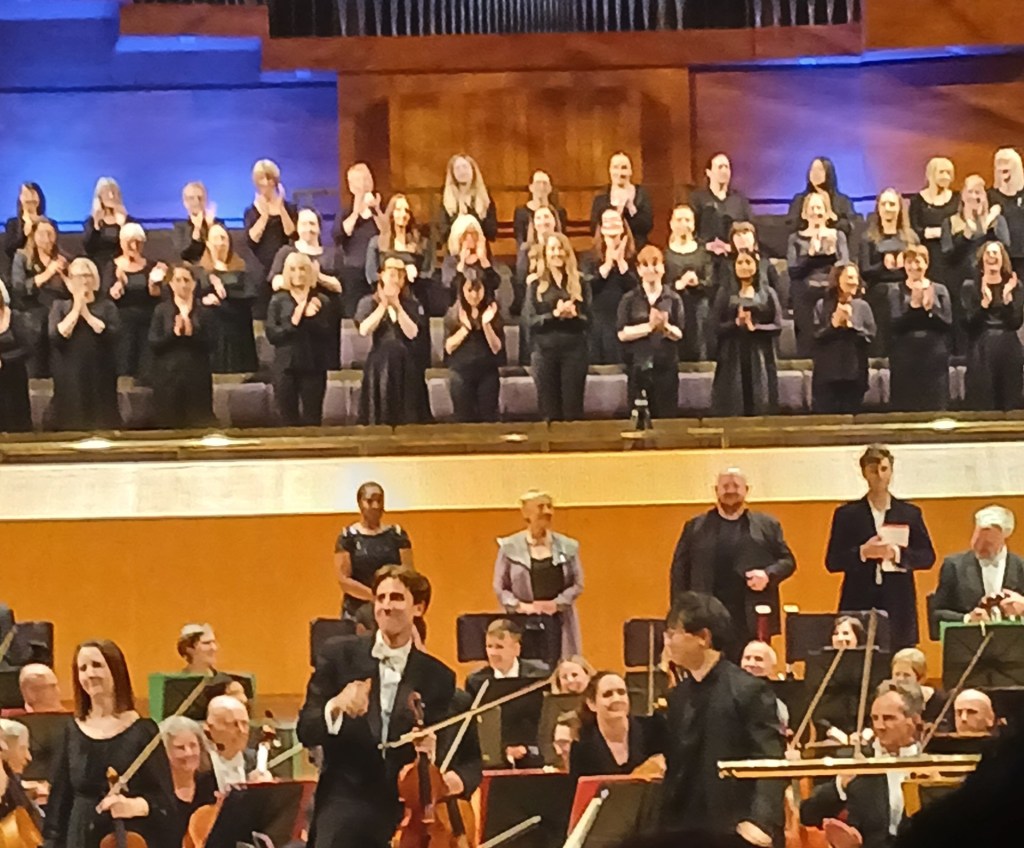
Berliner Philharmoniker: Jakub Hrůša, conductor, Seong-Jin Cho, piano. Janáček: Fate, Suite; Beethoven: Concerto for Piano and Orchestra No. 5 in E flat major op. 73; Bartók: Concerto for Orchestra Sz 116
This was my first visit to the Philharmoniie in Berlin, and it’s as spectacular and impressive a building as everyone has always told me it is – imposing, even beautiful, externally, and the different geometric shapes of the interior constantly surprise and delight you. Acoustically it’s magnificent, offering both clarity and warmth, a bright sound but not overbearing.
For me (although a lot of the pianist’s fans would disagree – they were there in large numbers) the undoubted highlight of the evening was the Bartok. If you have the world’s super-orchestra before you in a concert hall, the best on the planet, what better piece to hear them in than the Concerto, which is precisely designed to show off a virtuoso orchestra. This account just put every other performance I have ever heard of this work into the shade. Whether it was the whispering strings of the first movement, the togetherness and blaze of the brass in the last, the outstanding woodwind in the second and third movement, everything was just extraordinarily well-characterised. Hrusa helped too – as was the case with Jenufa at ROHCG recently, he has a natural feel for the music of central and eastern Europe and can really energise it and give the orchestra an urgent sense of propulsive rhythm. The piece is quirky, constantly going off in different directions and in less inspired hands can get a bit irritating. Here, I just felt I was being taken on a wonderful journey and enjoyed every moment as it passed by, without fussing too much about where it was all heading – I was totally absorbed.
The Janacek piece – an orchestral suite from the opera Osud, is a pot pourri of music from the opera, not necessarily in narrative order. I have heard the work (I think) but can’t remember anything about it. On the plus side, there are great melodies in it and the Czech conductor who put the suite together in the 50’s(astonishingly the work was not heard in its entirety until 1958, despite being composed 50 years earlier) builds up tension and excitement in the extracts chosen. The problem is that there are so many highlights involving tension and excitement that the work rather exhausts itself and ends abruptly, something not even Hrusa’s energetic conducting and this amazing orchestra could disguise.
I may well have been in a minority of one in the audience, but I have to say I didn’t really enjoy the Beethoven. There were several reasons for this. One was that in this hall with such lively sound, a super-orchestra like the Berlin Phil sounded quite aggressive in Beethoven, given the resources deployed – just too big, too loud and Hrusa’s energetic approach simply compounded the problem. Perhaps it is a consequence of age, but I want a performance of Beethoven which allows one to, as it were, reflect on the spaces between the notes, to have a sense that every phrase is precious and needs to be meditated upon. That may be asking for more than is realistic but I felt the soloist rushed too much in the opening and in much of the first movement. The second was also comparatively quick. The third movement was perhaps the best for all concerned and there were some lovely moments there. The sound the pianist produces is limpid and clear but sounds more suited to Chopin than Beethoven. I felt this was a less successful performance of ‘the Emperor’ than the one I heard at the Proms by the pianist’s compatriot, Yunchan Lim. Seong-Jin Cho inevitably played an encore, which I couldn’t quite place – maybe French, maybe Russian – which was worlds away from Beethoven in its driven mechanistic sounds (though maybe not worlds away from THIS Beethoven……)
Budapest Festival Orchestra, Iván Fischer conductor; Igor Levit piano. Prokofiev: Overture on Hebrew Themes arr. for orchestra, Op.34a; Piano Concerto No.2; Prokofiev: Selection from Cinderella Suites
This was a concert I probably wouldn’t have gone to had I not been in London for the evening, prior to getting an early Eurostar train to, ultimately, Berlin [not even with one of Europe’s finest orchestras and an estimable conductor and soloist]. After a mad scramble to work out what to do following the discovery that King’s Cross Underground was closed off, I got to the concert with a few minutes to spare.
Prokofiev I always feel a little unenthusiastic about, somehow – I remember Norman Lebrecht describing a late-night argument with Gergiev about whether or not Shostakovich or Prokofiev was the finer composer. Gergiev argued passionately for Prokofiev – but I’m afraid I just can’t see it….somehow Shostakovich touches the heart again and again in a way Prokofiev just doesn’t.
The Overture on Hebrew Themes was originally scored for a chamber group and even when orchestrated uses a fairly small orchestra. It uses klezmer style music and has an important part for a solo clarinet, who here was foregrounded like a soloist. It was fun, but slight.
The piano concerto I thought I didn’t know at all – though in fact the memorable first melody I’ve definitely heard before. There’s a great deal of sound and fury and I wasn’t really sure where it was all going – this includes a massive piano cadenza which seemed to last half the first movement, Levitt raging up and down the keyboard…..the last movement had a folky tune – maybe connected with the first movement’s opening – which was appealingly simple after all the noise, and as a whole the last movement is perhaps a more traditional ‘piano concerto’ sound. But all in all this work and its emotional trajectory was opaque to me, though it’s clear the demands on the soloist are prodigious, and Levit was more than fully up to them. As an encore Levit played a piece of Schumann – perhaps from Kinderszenen – which was refreshingly spare and quiet after its predecessor, though some RFH overhead speakers gave some odd blurts of feedback at intervals.
Cinderella I know better, and I once heard a very memorable performance of the complete ballet by Gergiev and the LSO at the Proms. The lovely thing here was Fischer narrating the links between the 10 extracts played in splendidly accented avuncular English. There were some famous moments – the knitting stepsisters, the big waltz of the Prince and Cinderella, the moment when the clocks strike 12 and the final apotheosis – among the pieces chosen but also some less we’ll known ones (and sometimes mildly tedious). It didn’t seem the best selection from the work, on the whole.
Prokofiev wouldn’t, one might have thought, play to this orchestra’s considerable strengths – the big waltz in Cinderella for Prince and Cinderella was about the sole piece in which their gloriously rich string sound was displayed. But throughout I was impressed by the balance and precision of the playing – some incredibly clear and delicate flute playing, for instance, and I was particularly impressed by the sonority of the brass (some wonderful rasping sounds). The encore was the Gavotte from the Classical Symphony, which again highlighted the richness and warmth of the strings.
Although there have been lots of grumbles about the RFH’s acoustics, sitting in the balcony I thought – how much better than the Barbican….. The hall was maybe 70% full – surprisingly small given the eminence of the performers.
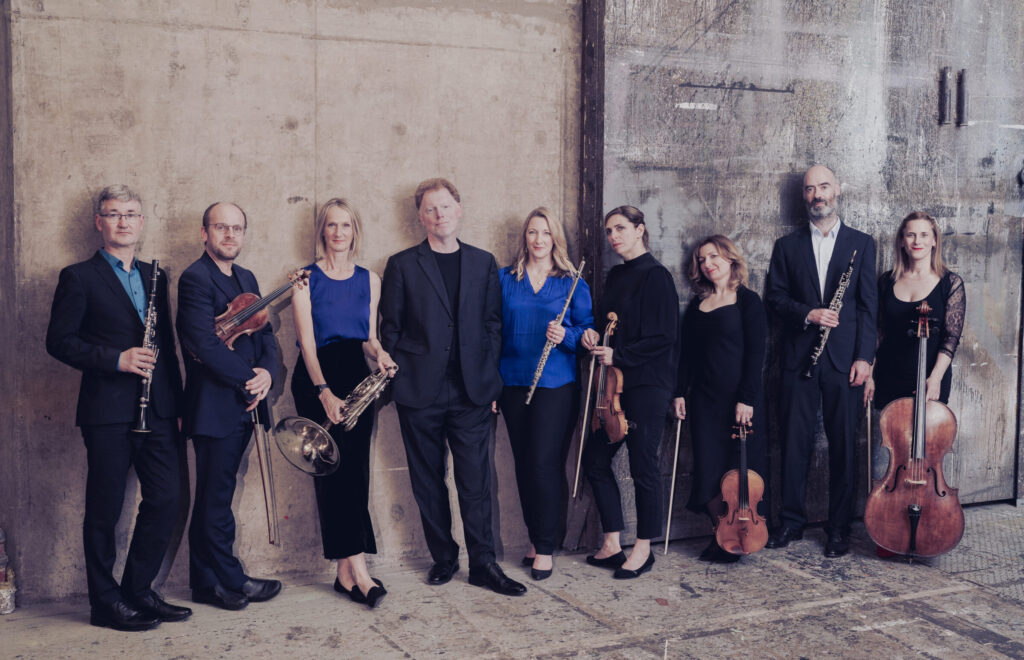
This was a short concert which was part of a whole set of concerts and symposia on Shostakovich’s chamber music over the weekend in Sheffield – sadly this was the only event I could actually make…..My knowledge of which Shostakovich Quartet is which is sometimes a bit vague – the only one I know as a number that I can immediately remember themes and movements from is no 8. Otherwise sometimes I recognise them and sometimes I don’t. As soon as no 10 began, I realised I had heard it several times before. It has a melancholy ruminating first movement, a ferocious scherzo, a most beautiful slow movement, and a final movement, which is based on an Armenian lively folk song that can appear both jolly and sinister, relaxed and militarised, and which draws to a ghostly end, repeating themes from the first and slow movements. It’s a product of the 1960s, not a happy time for Shostakovich, who was in declining health, not helped by excessive consumption of cigarettes and vodka. Ensemble 360 played it magnificently, really digging in to the strings in the scherzo and with a lovely warm tone in the slow movement.
No 12 I am not sure I have ever consciously sat down and listened to before, so I’m more impressionistic in my comments here. I liked the first movement, which seemed to move forward in long melancholy waves, surging and withdrawing. and apparently based on an atonal theme that sort of resolves itself at the end of its twelve notes.. the fast second movement was spikier and tougher, also more difficult to keep track of, than the 10th equivalent. There was an extraordinarily violent solo violin pizzicato passage towards the end. The final section like the 10th is bitter-sweet and insouciant,
I think these are the most impressive performances I’ve heard from the string quartet part of Ensemble 360 -I wish I could have heard more of the weekend……….
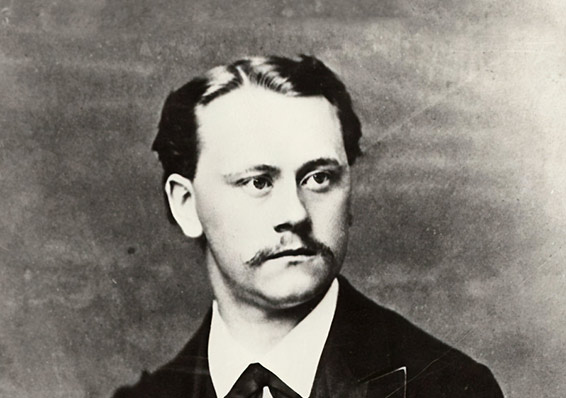
A photo below of Shostakovich partying in happier times….
Norn 1: Ingeborg Børch; Norn 2: Mae Heydorn; Norn 3: Jillian Finnamore; Siegfried: Peter Furlong; Brünnhilde: Catharine Woodward; Hagen: Simon Wilding; Gunther: Andrew Mayor; Gutrune: Justine Viani; Alberich: Oliver Gibbs; Woglinde: Jillian Finnamore; Wellgunde: Elizabeth Findon; Flosshilde: Mae Heydorn; Waltraute: Catherine Backhouse; Ben Woodward: Music Director and Conductor; Caroline Staunton: Director; CJ Heaver: Producer
Three days of sitting in close proximity to a lot of people snuffling and sneezing has produced the inevitable consequence of my beginning to do the same. Despite not feeling at my best I travelled down to London for this with high expectations – which were in very large part met. In fact I totally forgot about my cold for five and a half hours, and indeed the time spent in York Hall felt nothing like that long, so absorbing was the action.
The Prelude and the first scene of Act 1 both take place within the same curtained space as the last scene of ‘Siegfried’. The Norns are appropriately black-costumed and mysterious, Mae Haydorn a particularly rich-voiced and impressive 2nd Norn (and Rhinemaiden). After the Dawn Music, Brunnhilde was still in her brilliant white bridal dress that she had worn at the end of Siegfried (though it was not the dress she went to sleep in at the end of Walkuere – oh well, that may be asking too much), which she wears throughout Gotterdammerung, while Siegfried was out of his straitjacket and into a normal white T shirt. The curtained space seems to indicate possibly a place of safety, possibly a place of imprisonment or stagnation – it’s not clear. Siegfried seemed to have another psychotic episode immediately after saying goodbye to Brunnhilde, and arrives at the Gibichung Hall in hoodie and the ‘Slayer’ T shirt he wore in Siegfried. He seems in moody adolescent form. The Gibichung Hall has a ‘curated’ exhibition of Walsung artefacts – the dummy Sieglinde caressed in Walkuere, the fire extinguisher Hunding kills Siegmund with, and Mime’s pots and pans. At a slightly later point Gutrune wears the same dress as Sieglinde of blue-ish grey colour. Siegfried scarcely needs a potion to fall for Gutrune (oddly one is prepared but never swallowed, as, in reverse, is also the case in Act 3), again suggesting his sense of disturbance. Gutrune is much feistier than is normally the case, pushing both her brother and Siegfried around physically at points. The Waltraute scene was very effective – Waltraute in the same costume she wore in Walkuere, and Brunnhilde caressing Siegfried’s strait-jacket at the beginning, with flickering lighting when she arrives. The sometimes either confusing or embarrassing scene with Gunther/Siegfried and Brunnhilde was very well handled. Various masked black clad threatening figures appeared (making use of the choristers I think), one of whom was Gunther, while Siegfried sung his lines from the wings.
In Act 2, there’s a novel ending to the Alberich/Hagen scene opening the Act, where Hagen actually kills his father (with the fire extinguisher). The Vassals scene is excitingly staged – it seems quite a relief to suddenly have all these extra people on the stage, and in this case they turn up in silly party hats and blowing whistles. The tensions between Gutrune, Gunther, Siegfried, Brunnhilde and Hagen are well-managed and never at all feel ‘operatic’ (Shaw’s big criticism of this work). There’s a striking twist at the end of the Act where Hagen and Brunnhilde seem to develop a thing for each other and grope passionately – exciting theatre, though I am not wholly sure what the point of it was, except to emphasise Brunnhilde’s passionate nature, and her contempt for Gunther.
Somehow in this production, and I am not quite sure how this was done, the Rhinemaidens in Act 3 seemed to have greater seriousness and prominence than in many productions I’ve seen – the encounter with Siegfried assumed its proper apocalyptic significance. The Rhinemaidens brought Siegfried’s teddy bear along as a sweetener (though there is in fact a reference in the text to the animal he was hunting). As elsewhere in this production, if a spear was mentioned in the text, there was a spear on stage, in this case hanging down from the ceiling ready for Hagen to grab to kill Siegfried. Gutrune, again, seemed a much gutsier figure than normal in her recriminations against Hagen. I guess it was in the last half hour or so that some of the limitations of this very special production were particularly apparent – the volume in Funeral March, particularly from the lone trumpet who was clearly getting tired, was just not enough, and at the end, although there was smoke and red flames, there was little of lighting that showed the green or blue of the enveloping Rhine, or the birth of a new world. There was a surprisingly comic moment when Hagen comes on at the end – like a pantomime villain, he is shoved by the Rhinemaidens (who also quite rightly appear to take possession of the Ring) into a pit on stage.
The audience for this was subtly different to other nights – more people coming who were new to this particular set of performances and were at Gotterdammerung because it was a new production. I saw Anthony Negus and his wife Carmen Jakobi in the bar during the interval, and it would be interesting to get their take on some of the singers new to them appearing this evening – maybe and hopefully some could be used for the Grange Park Ring Negus is conducting from 2026 – 2029……The singing and acting of the main characters were without exception excellent. Peter Furlong was every inch the troubled teenager, with a range of expressions demonstrating his bewilderment or frustrations with the adult world he found himself in. His diction was clear, his singing always memorable, with lots of shading. Catharine Woodward as Brunnhilde was once again authoritative, grand, prodigious of volume and attack, constantly in character and with some sensitive phrasing. Simon Wilding’s Hagen was extraordinarily good – he really commanded the stage whenever he was on it, acting with a rare, malevolent intensity. If his voice could deal with a larger house, he is a Hagen any major opera house would be glad to host. Gunther was generously voiced but also radiated indecision and fatuity. Justine Viani as Gutrune showed both acting talent and a lovely well controlled voice. All the Norns and Rhinemaidens not mentioned hitherto, as well as the chorus, were very good.
All in all I am so glad I saw this ‘Ring’. Perhaps Die Walkuere was the performance I responded to most, but it was all very well worthwhile seeing, and I do hope there were talent-spotters from major artist agencies or opera houses in York Hall over these two cycles who will give some of these singers a chance to excel on bigger stages. I was again sitting a few seats away from Loge and other company members – they were obviously going on to an after-party. I hope they enjoyed themselves……
Siegfried: Peter Furlong; Mime: Holden Madagame; Wanderer: Ralf Lukas; Fafner: Craig Lemont Walters; Alberich: Oliver Gibbs; Woodbird: Corinne Hart; Brünnhilde: Catharine Woodward; Erda: Mae Heydorn; Ben Woodward: Music Director and Conductor; Caroline Staunton: Director; CJ Heaver: Producer . Siegfried: Peter Furlong; Mime: Holden Madagame; Wanderer: Ralf Lukas; Fafner: Craig Lemont Walters; Alberich: Oliver Gibbs; Woodbird: Corinne Hart; Brünnhilde: Catharine Woodward; Erda: Mae Heydorn; Ben Woodward: Music Director and Conductor; Caroline Staunton: Director; CJ Heaver: Producer
I had to dash quickly back to the Peak District for a meeting on Wednesday late afternoon and then back down to London and York Hall from midday on Thursday. I was feeling a bit tired by the time I got to the hall but was immensely refreshed and stimulated by this performance. I have seen 6 performances of Siegfried in the last 15 years in concert or staged form – Halle, ROHCG, Opera North, LPO, Longborough and Bayreuth. (I have no desire to see the Schwarz Bayreuth production again live, but would love to go to a live performance of the Herheim Ring in Berlin and the Milan/Munich ones now developing. In the meantime, Bethnal Green……). Although I did find the Bayreuth performance provided some thrilling singing, and of course the orchestral playing was wonderful, in many ways, taken as an overall experience, the Regents Opera performance was as good if not better than any of those mentioned above.
As I went into the hall I heard one person saying to a friend – ‘Well, Ring productions are always a bit wacky – but then you’d probably think an utterly traditional production was a bit odd too”. True enough, but this comment was interestingly prescient, in that this ‘Siegfried ‘did create more thought-provoking and startling images and reflection than its two predecessors had. I have I think finally got my head around the director’s art concept – this is that an art gallery, a space where art objects are displayed, should be a place of transformation – people are changed by their engagement with the art objects and in a sense the objects are changed by the perceptions of them by observers. In that sense an art gallery stands as an effective metaphor for the sort of personal transformations that happens to (some) characters in the Ring – Wotan, Brunnhilde and Siegfried certainly. It underlies the energy of the Rhinemaidens in Scene 1 of Rheingold, and its perversion can be seen in Valhalla, a place which is against change of any kind.
In the Regents Opera production, Act 1 of Siegfried is set on a fairly bare stage. There’s an armchair and a faulty lamp at one end, and a pit where Mime makes his poisonous soup and Siegfried does his forging. Wotan as Wanderer appears in the guise of an electrician to mend the faulty lamp……Siegfried carries a teddy bear around with him. The forging scene was fairly realistic – there was a process of shaving the sword into small fragments, and beating the metal, plus red sparks flying onto the ceiling of the hall, and an actual sword at the end of it all – though the anvil was I think an art in-joke; it looked like Marcel DuChamps’ porcelain urinal. But it was split at the end of the act…..
Act 2 was very obviously an art gallery setting – in fact the Woodbird in this production was a gallery owner?/hostess?, offering drinks and nibbles, and guiding guests. There were some plinths but also some video screens around the stage, able to show magic fire when the Woodbird refers to this, but also various art images eg of decaying fruit. At the end of the gallery was a red box behind which Fafner lurked. Fafner was effectively presented as a human, with a long spangly golden cloak who, together with lurching slow movements, looked convincingly dragon-like. However what happened to him was less easy to explain – in the Forest Murmurs Siegfried had become more and more disturbed in his behaviour, crouching in foetal position on the ground. To an extent I have never seen in any other production, he seems a tragic figure, unable to shake off the inheritance of having no parents and a difficult childhood. He’s very unlike the New Man as Wagner originally conceived him. As Siegfried kills Fafner, and the latter lays dying, by a very effective theatrical sleight of hand, Fafner suddenly becomes Sieglinde, with her blue dress and a black wig, and then, further, ends up as a baby in a nappy. I’m assuming that killing Fafner suddenly sparks terrible memories of his tragic past in Siegfried. The transformations to Sieglinde and the baby I also found very disturbing, in ways I’m not clear about. The brief scene where Siegfried goes into the cave to find the hoard is oddly handled – Alberich and Mime appear with top hats and sticks doing a vaudeville act…..This suits the character of the music and what they’re saying quite well, but dramatically it’s at odds with everything else in the production – a curious directorial choice.
The first part of Act 3 is an open space, and the Wotan/Erda and Wotan/Siegfried scenes are conventionally, though also effectively, handled. Fascinatingly though, as Siegfried begins to go into the Magic Fire, he is led off stage by two gentlemen in white costumes who look very much like mental health paramedicals. And when he is returned on stage to meet Brunnhilde, he is also in white but with a strange shirt and far too long sleeves that looks something like a strait-jacket. Surprisingly, and in a way unlike other aspects of the production so far, where an object mentioned is an object seen on stage, there is no Nothung and no ring in evidence. In the meantime, during the Fire music, the stage has been transformed into a box with white curtains, and drapes inside, again white. Brunnhilde, also in white, is standing in a corner. The rest of the Act was well, but less controversially, staged, with both characters utterly convincing, and the impact of hearing such thrilling singing close up was overwhelming. There was also an effectively handled move by Siegfried before ‘Das is kein mann’ to prevent the usual laughter. So – an interesting staging, and it will be fascinating to see what happens in Gotterdammerung given Siegfried’s clearly very damaged personality.
Musically the singing and acting were mostly at a high level. Peter Furlong as Siegfried was apologised for at the beginning as singing despite a heavy cold. Notices around the lobby assured us a stand-in was available if needed. In the event he sounded in very good voice throughout (though with the occasional cough when he wasn’t singing) and coping with the impossibilities of this role far better than many of the Siegfried’s I’ve seen over the years. He handled the top notes with ease and amazingly showed little sign of flagging even right at the end, alongside a fresh Brunnhilde. Although obviously in a smaller space than a conventional performance, he really didn’t sound very different from Andreas Schager in this hall, though maybe the latter pays more attention to the lyrical aspects of the role and as a native speaker can project the words more easily – but Furlong sounded to be at that sort of level. As indicated Furlong successfully made Siegfried a more sympathetic and troubled figure than he often appears. Ralf Lukas was quite outstanding as the Wanderer, with, again, detailed attention to text and nuance of musical phrasing (it’s no surprise he studied with Fischer-Dieskau) and a wonderfully noble voice. Catharine Woodward acted very well and her voice was thrilling, top Cs pinged out effortlessly and trills managed better than many. Alberich , as in Rheingold, was forcefully sung and acted – again, something of the East End wide boy about him – while the Woodbird was sung clearly and beautifully. Mae Heydorn was an excellent richly voiced Erda . Holden Madagame’s Mime offered some impressively intense acting but most of the role was delivered in a kind of sprech stimme and there was very little heft to the voice. The pacing of the music drama by Ben Woodward was less manic than in Walkure, and the gradual ratcheting up of tension in Act 1 was particularly well managed. The indefatigable orchestra played extremely well. The one real oddity of the reorchestration is the inability to find a sound that catches anything like the malevolent Fafner sounds of tubas (Wagner and ordinary) in the full orchestra preludes of Acts 1 and 2; the organ/synthesiser sound was far too quiet and timid.
Nerdish readers may note a compendium of Brunnhilde final top C’s in Siegfried here – https://www.youtube.com/watch?v=2NGm9l3BnkY&t=111s. I have to say Catharine Woodward was up there with the best of them………
Siegmund: Brian Smith Walters; Sieglinde: Justine Viani; Hunding: Gerrit Paul Groen; Wotan: Ralf Lukas; Fricka: Ingeborg Børch; Brünnhilde: Catharine Woodward; Gerhilde: Charlotte Richardson; Helmwige: Shannon Roberts; Ortlinde: Ella de Jongh; Waltraute: Catherine Backhouse; Schwertleite: Gráinne Gillis; Siegrune: Magdalen Ashman; Grimgerde: Grace Maria Wain; Rossweisse: Caroline Carragher; Ben Woodward: Music Director and Conductor; Caroline Staunton: Director; CJ Heaver: Producer
And so – on with the Ring, and back from the expansiveness of Covent Garden to York Hall …………..and from one form of excellence to another, very different, kind……..This performance for me took flight fairly early on in the first act and never touched the ground again thereafter. There were several reasons for this: Ben Woodward paced the work very well – at quite a fast speed (particularly in Act 1) but the music never sounded hurried or pushed in a way that would narrow its expressive potential; there were some excellent experienced singers who knew how to draw the best out of their voices in the main roles, and, finally, a production which continues to be quirky but is always clear in signposting what is happening on stage and allowing singers to work up their own positions on the characters they are portraying. Under Woodward’s direction, the orchestra sounded supercharged, and there was some wonderfully expressive and exciting playing. The issues I had on Sunday about the orchestra sounding subdued seemed to disappear this evening. And, among many other players, hats off to the wonderfully expressive oboe of Philip Howarth (I should have mentioned on Sunday the composition of the orchestra – 6 violins, 3 violas, 2 cellos, 1 double bass (with an extra one for Gotterdammerung Act 3), 1 each of flute, oboe, clarinet and bassoon, interestingly 5 horns, then 1 trumpet, 1 trombone and 1 synthesiser. It is remarkable how full-bodied the sound seemed tonight at the big moments in Act 3.)
The set for Act 1 was almost devoid of plinths but has a fridge with bottles of mead inside, a fire extinguisher, a toaster, and a column with a sword hilt peering out at the top. There is a tailor’s dummy, which Sieglinde caresses and which I assume is a substitute for her lost brother. For Act 2, we were back with the plinths of Rheingold, and small objects were placed on them by Brunnhilde; Hunding places his killer fire-extinguisher on one before being struck down by Wotan. In Act 3 the white blocks were rearranged to create a small rock face for Brunnhilde to lie down on. The Valkyries come on carrying famous paintings – the Mona Lisa, Caspar David Friedrich’s “Wanderer above a sea of fog’, and others. These are all destroyed by Wotan, who punches holes in them when he comes in in fury in Act 3, and he also writes ‘Entartate” (Degenerate) on sticky tape he puts round Brunnhilde. I still haven’t got my head around the whole ‘art’ concept , but there are some articles by the director in the programme which may enlighten me. However, whatever concepts there are in the director’s vision, she is also extremely good, clearly, at letting each character develop in the singer’s imagination, and the fact that no singer looked awkward on stage or at a loss is a tribute to her skills. Costumes for the 6 principals were much better coordinated than in Rheingold – in particular Wotan and Fricka had black/grey shalwar khameezes with a scarf that complemented each other. Sieglinde, Siegmund and Hunding had variants of blue., with Siegmund in contrasting red as well plus combat trousers. Brunnhilde had a costume of black leggings and long shirt plus a wrap which emphasised her girlishness, The Valkyries were a riot of colour, which sort of worked.
All 6 principal singers were first rate. as singing actors. Each of them had seemingly internalised a view of their character, and had ‘become’ it. They acted without self-consciousness and with ease – a credit to the director’s approach. Justine Viani had not stood out particularly as one of the Rheinmaidens but as Sieglinde she was outstanding. She had a wonderful creamy tone to her voice and offered far more shading than many of the other singers, caressing the music at times. Her ‘Du bist der Lenz’ was gorgeous and her cry of thanks in Act 3 for deliverance was sensational. Gerrit Paul Groen was a huge-voiced Hunding and a deep bass, commanding on stage. I liked Brian Smith Walters as Siegmund- he doesn’t have a beautiful voice and occasionally a slight vibrato troubled me, but he had a baritonal quality that is good for Siegmund’s role and he can hit all the high notes with ease. It was no surprise to read he had many of the major Wagner roles for tenor in his repertory. Though it’s a show-off moment, his ‘Walse’ in Act 1 had real intensity and emotion as well as being long and loud! Ralf Lukas again impressed as Wotan – a contained and reflective presence, every word counted and was conveyed in clarity and with pointing. His voice cracked once or twice before the end on high notes, but this was easily forgiven. Catherine Woodward was apologised for as getting over a cold, and once or twice that was evident on low notes. But she has a bright and gleaming, big, voice, dealing with the high notes easily, and able to shade it effectively in the tender moments with Wotan and Siegmund/Sieglinde. She was very convincing in conveying a girlishness and liveliness to Brunnhilde’s character on stage that will doubtless contrast effectively with the maturity of her Gotterdammerung role. Finally while Ingeborg Borch as Fricka in Rheingold was good but here in Walkure she was very effective indeed., commanding and generously voiced as well as utterly convincing in her anger and contempt for Wotan. The Valkyries were a somewhat motley crew in appearance but they all sang and acted well, and were credible.
All in all, I found this an inspiring evening that was on a different level to the preceding Rheingold, and which was roundly cheered by a full house (including Loge, sitting three seats away from me)
Director, Richard Jones; Set designer, Miriam Buether; Costume designer, Nicky Gillibrand; Lighting designer, Lucy Carter; Edward Gardner, conductor. Cast – Christian, Allan Clayton; Michael, Stéphane Degout; Helge, Gerald Finley; Else, Rosie Aldridge; Helena, Natalya Romaniw; Helmut. Thomas Oliemans; Grandma, Susan Bickley; Mette, Philippa Boyle; Gbatokai, Peter Brathwaite; Linda, Marta Fontanals-Simmons; Chef, Aled Hall; Lars, Julian Hubbard; Pia, Clare Presland; Grandpa, John Tomlinson; Christine, Ailish Tynan
I have listened to very little of Turnage’s work – much less than I have for instance to Ades’. I have a recording of a large-scale orchestral work called Speranza, by the LSO, which I’ve found interesting and attractive but have had no encounter with his operas or other pieces. This set of first performances of Turnage’s new opera has a cast of many of the great and excellent of British singers, a very good conductor and director, and has received astonishingly positive reviews. So I went along to see this with a sense of anticipation rather than the usual feeling of dutifulness that attending new works normally involves. That sense of anticipation was shared, clearly, by many others in the audience- there was a real buzz to the pre-show conversation that you don’t often hear, a buzz strengthened by the distribution throughout the auditorium of invitation cards in Danish to Helge’s 60th birthday party, and a gaudy decoration plus a picture of Helge above the proscenium arch of the stage..
The work is relatively short – an hour and forty minutes – and without an interval. But it is one of the most intense experiences I have had in opera in a long while. The story is unsparingly grim – as mentioned, it’s Helge’s 60th birthday, and his three surviving children and spouses/partners/grandchildren all turn up with a cluster of other relatives (including Grandpa and Grandma) for a celebratory dinner in a big hotel. His other child, Linda, killed herself recently in the same hotel everyone is staying in. As his opening speech, requetyed by the toast master, , Christian recounts Helge raping his children and Helge’s wife Else being complicit in this. He continues to try to make the guests confront the truth about Helge. Not believing him, Michael – his brother – and others lock him in the wine cellar to silence him. Michael leads the guests in a song insulting Helena’s boyfriend, Gbatokai. Helena then reads aloud to the guests a letter found in the dead Linda’s room which again alludes to Helge raping the children, and that she can’t live any longer with her memories. There is consternation, and Helge has to hide in the kitchen. Michael finds him and beats him up, seemingly leaving him for dead. Guests continue to party next door while Christian thinks about his dead sister., who appears before him The coda next morning has guests arriving for breakfast, greeting each other and Helge and his wife enter – no-one alludes to the event of the previous evening and at the end Christian is left alone on stage in a slumped heap.
This is truly an opera – not a play with music –and the alternating moods of the music and the varied forms of singing are essential to understanding what is going on. It is one of the most impressive new operas I have ever seen on its first run. There is quite a lot of Britten about it (the ‘good morning’ chorus, the orchestral interludes – themselves reflecting Wozzeck – and the sense at the end that nothing has changed as the Village/the family goes about its business, for instance) but not in any way that is derivative – just in a way that is similarly accessible, dramatically acute and very, very moving. The musical styles are varied – there is a rumbunctious conga, some beautifully moving quiet moments for Helena and the dead Linda, passionately sad music for the last interlude as a picture of 4 children grows ever larger on a screen, some comic choruses (the one about salmon v lobster soup and the Hellos /Good mornings), some slurring jazzy moments. There is a whole world of music here. If there is one moment I cherish from tonight’s memories it is of the dead Linda singing before the last prelude the words of Julian of Norwich – ‘all shall be well and all shall be well and all manner of things shall be well’. I was in tears.
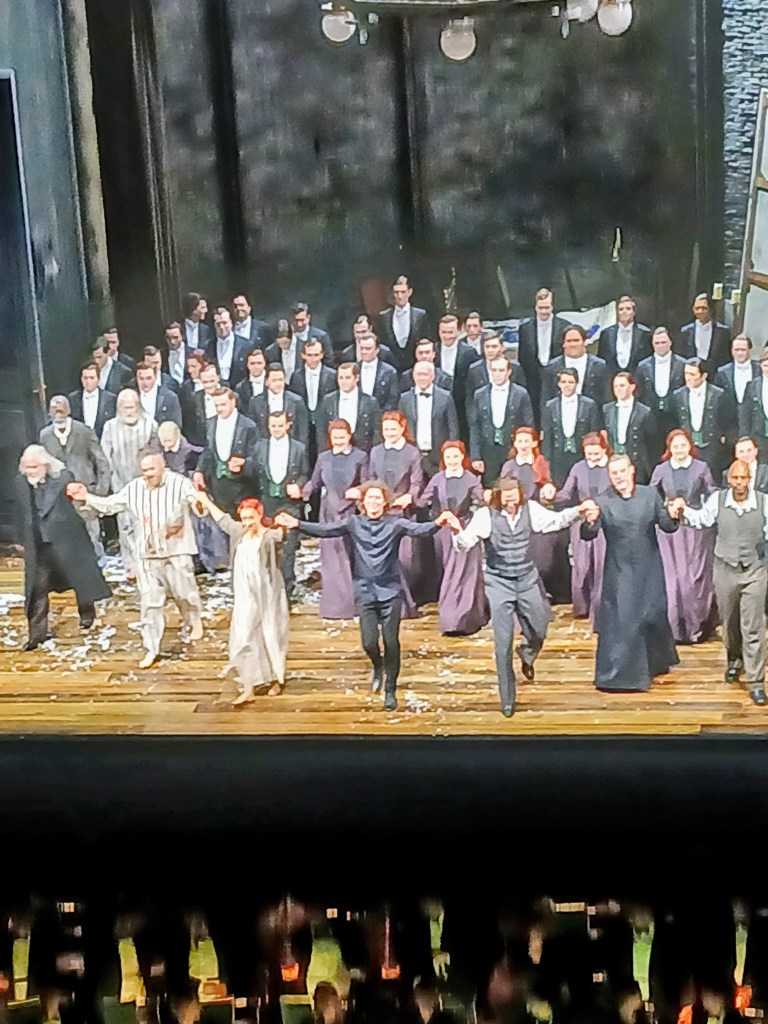
The production was very effective in moving a large chorus and a very large cast deftly around the stage. The chorus of family members was well characterised so that each seemed an individual, and there was little that looked artificial in the way they moved. The hotel reception area as in the photo doubled as the main dining area for speeches; there was then via dropped screens a split stage area appearing for scenes with individual characters and groupings . Richard Jones I always find to be effective but this must be one of his best shows.
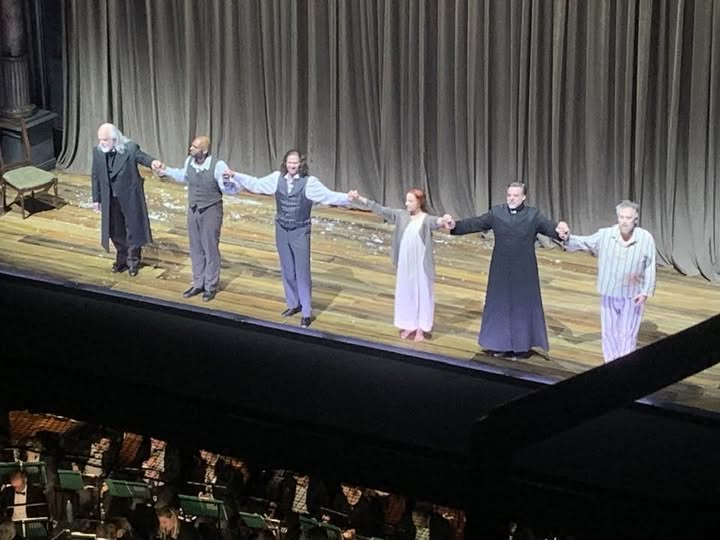
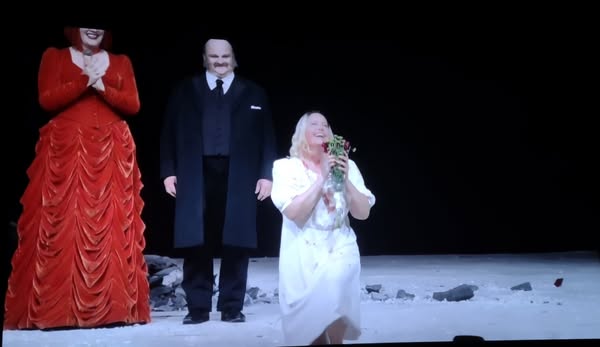
The super-star cast were all splendid – Allan Clayton excelling as Christian, Natalia Romaniw outstanding as Helena, Gerard Finlay smooth as Helge, Stéphane Degout a strong stage presence as Michael and John Tomlinson having the time of his life as Grandpa. And Ed Gardiner kept the orchestra taut and thrilling. This must be one of the very finest new operas of the last 25 years. It will surely have multiple productions in Europe and the US. I was very happy to see Turnage appear on stage at the end (see photo, with his trademark silly hat), hugely cheered by the packed) audience. I was amused to read that a few critics felt the music was too easy-on-the-ear and insufficiently ‘gritty’. What planet do these guys live on?
Woglinde: Jillian Finnamore; Wellgunde: Justine Viani; Flosshilde: Mae Heydorn; Alberich: Oliver Gibbs;Wotan: Ralf Lukas; Fricka: Ingeborg Børch; Loge: James Schouten; Donner: Andrew Mayor; Freia: Charlotte Richardson; Froh: Calvin Lee; Mime: Holden Madagame; Fasolt: Henry Grant Kerswell; Fafner: Craig Lemont Walters; Erda: Mae Heydorn; Ben Woodward: Music Director and Conductor; Caroline Staunton: Director; CJ Heaver: Producer
I have seen an in-the-round Rheingold once before, in July 2021 in Birmingham, Graham Vick’s posthumous production (see my blog on page 30), which was a powerful staging with a very focused ‘concept’ -a plutocratic Wotan and the Nibelungs as Deliveroo drivers. It had, I recall, an outstanding Loge and the CBSO in splendid form.
The two stand-out experiences for me about this performance were, as in Birmingham, the closeness of audience and stage, and the excellent performances of some of the singers. The fact that I was in Row D in the stalls meant I was able to see the slightest acting nuances of the singers, and I felt totally wrapped up in the immediacy of the drama. The time seemed to fly past. This to me is the most important experience of this production so far and allows one to forgive a range of things that don’t quite work or were off-piste for one reason or another. I was able to see and engage fully with Wotan’s agonised deliberations before giving back the Ring, be overwhelmed by the cleverness of Loge’s account of his travelling around the world searching for a substitute for Freia, and closely experience the smugness of Wotan at the beginning of Scene 2.
The following were absorbing singer/actors on the stage:
Pre-eminently Loge, one of the best portrayals I’ve seen, witty, mocking and biting, sharp, quick in movement. James Schouten was a real stand-out, and he has a powerful flexible voice as well as excellent stage presence.
Ralf Lukas’ was an introspective portrayal of Wotan which might have seemed under-powered in a bigger theatre but which was, close -up, intelligent and thought-through, finely sung, with excellent diction. He made you watch Wotan’s every movement, and every movement had a purpose
Henry Grant Kerswell was I think the best acted Fasolt I’ve ever seen, and his resonant and powerful voice suited the character well
Mae Heydorn has a beautiful voice and her Flosshilde and Erde were both very impressive – a really sonorous contralto
Oliver Gibbs as Alberich – his voice was apologised for – he was getting over a cold – but seemed nonetheless to sing strongly and sensitively, He was an excellent actor, with some boxing flourishes to honour the performing space, and gave a sense of both the evil and the vulnerability of Alberich
No-one else among the singers was less than good – all gave convincing accounts of their roles.
The production was on the whole very good at telling the story, and although not realistically done, it was perfectly clear what was happening when, for example, Alberich became dragon and toad. There was a spear and a ring – not to be taken for granted nowadays(!! Imaginative use was made of gold foil to cover Freia in Scene 4, as another example. Effective use was made of lighting at points like the covering of Freia and the appearance of the Rhinegold. The one thing in terms of people-handling which to me was problematic was the end of Scene 4, where most of the gods and Loge seemed to wander off in a desultory fashion, leaving Wotan to muse on his next steps. This just looked muddled and at odds with the music and stage directions.
There were some things I had a few issues with, but which should be seen in the context of the all I’ve said above. These were:
Design concept. The basic set-in-the-round was a series of plinths with, in Scene 1, sculptures and models on them. The Rhinegold seemed to be one of these models. The plinths (one review said they looked vaguely Speer like) were variously used also as benches, but on at least (I think) some of these boxes the sculptures remained throughout the performance, and Mime was handling with one of them in Scene 3 (significantly perhaps when he’s singing about how the Nibelungs used to create for their own pleasure). There’s something possibly here about how the ‘purity’ and joy of an original artistic image can be taken over and perverted by self-interested interpreters, how arts can be used for political ends but what exactly this has to do with Rhinegold is none too clear (although it’s something highly relevant to Wagner’s works -as such). We shall see how this develops. I was also not clear why Alberich should have ‘Gesamtkunstwerk’ tattooed on his back……
Costumes, although everyone understands there’s not funding for elaborate coordination, seemed a bit all over the place. Froh wore a clown’s suit, Donner a light blue suit, Wotan an ‘arty’-looking combination of cloak and scarf. The general effect was a bit messy, like costuming in our village pantomime where everyone is encouraged to bring along a costume relevant to their character without always thought as to the visual consequences.
The sound of the orchestra; obviously an orchestra of 23 or so is not going to sound like an orchestra of 90/100, and everyone understands there are going to be points when things just sound a little odd. And the reduction seemed, to an amateur like me , very clever and thought through – maybe 95% of the time I wasn’t aware of the reduction, and I also heard details sometimes – for instance in the accompaniment to the Rhinemaidens singing at the end – which I have never heard before. But I did wonder about the positioning of the orchestra – from where I sat, stalls right, it sounded distant at times even in the loudest moments. I wondered about whether placing the orchestra more centrally rather than at one end would have helped increase the volume -also whether it should have just subtly been amplified a bit at points, given the glorious sound close up of the voices, which could easily have coped with that..
Occasionally there were a few orchestral glitches, but I was impressed by the energy of the string playing and the indefatigable brass and woodwind. I also thought Ben Woodward had a real sense of the structure of the piece that allowed it to flow naturally – sometimes quite fast in Scenes 3 and 4. Yes, it’s a different experience from what the Kosky/Pappano Walkuere will be in May at ROHCG, and there is no real substitute for a Wagner orchestra at full-strength and ablaze. But this Regents Opera production is remarkably clear in pointing to the emotional and dramatic truths of Rheingold, and the parallels with what is happening in the world now are more pertinent than they have ever been. This seemed to me so much more emotionally powerful than a concert performance even with a full orchestra and famous singers.
As various commentators have pointed out, Regents Opera should now be regarded as an opera company full stop, not a ‘fringe’ one, albeit a small company requiring some radical changes to be made in order to stage the Ring live before an audience. But The Ring is The Ring is The Ring and it is a remarkable achievement. York Hall in Bethnal Green, a legendary venue for British boxing, was chosen last year as the performance space, and The Ring is being performed there, in the round, twice, in an intimate and close-up experience for audiences, with many seats no further than 5 rows from the action on stage. The Regents’ Ring is uncut and with a full cast but with a very reduced orchestra. The adaptation of Wagner’s enormous 90+ orchestra for The Ring down to a group of 23 musicians must have been a huge task, requiring, I am sure, hundreds of hours of detailed work by Ben Woodward, the conductor, in arranging it, and incredible stamina from the 23 musicians in performing it.
This is therefore the kind of event it is very difficult to be impartial about in a review. As part of the Manchester Wagner Society, I interviewed both Ben Woodward (conductor) and Catherine Woodward (Brunnhilde) in Autumn 2024 on their forthcoming Ring. The whole cycle has been presented without any Arts Council money and has cost approx. £600,000 to put on. In a time of economic stagnation, and unwillingness to fund opera from public sources, the sort of energy the Woodwards and everyone else involved in this production has shown is astonishing and a remarkable exemplar to those struggling for the survival of this art form and these great works. Some may think this is the thin end of the wedge – an adaptation for a small orchestra will encourage the surviving publicly-funded opera companies to assume that private sector initiative can fill the gap they can no longer fund (there is a Grange Park Ring Cycle planned to kick off in 2026 under Antony Negus) ……..but then it is up to us as voters and members of political parties to make the case for public sector funding of great art, as in the original Keynesian vision, and to support the bridging of gaps in public appreciation of works such as The Ring through making them available and (relatively) affordable
The York Hall is a remarkable building – a leisure centre nowadays but, as above, a boxing venue also, with Tower Hamlets proudly emblazoned over the entrance and a series of rather murky decidedly functional areas leading to a large bar area and then to the auditorium – see below for photos of inside and outside
This is only the 7th Ring cycle I have seen – in the sense of experiencing all 4 music dramas in a short period of time – Bayreuth 1972, ENO 1973 and 1977, ROHCG 2012, Opera North 2016, and Bayreuth 2022. There is something about hearing these pieces in close proximity to one another that makes for a very special experience
Ainārs Rubiķis, Conductor; Joe Hill-Gibbins, Director; Johannes Schütz, Set Designer; Astrid Klein,Costume Designer; Matthew Richardson, Lighting Designer.Cast: Mary Bevan,Susanna; David Ireland, Figaro; Neal Davies, Dr Bartolo; Rebecca Evans, Marcellina; Hanna Hipp, Cherubino; Hubert Francis, Don Basilio / Don Curzio; Nardus Williams, Countess Almaviva; Cody Quattlebaum, Count Almaviva; Trevor Eliot Bowes, Antonio; Ava Dodd, Barbarina
This was one of the best and most joyous productions and performances I have seen of The Marriage of Figaro. I have to say straight away that this impact can’t be entirely dissociated from the fact that I was at the show with my younger daughter who was listening to and seeing Figaro for the first time. Inevitably therefore you see and hear it through their eyes and ears as well as your own, and when it’s well received the reaction becomes your own too. It’s also true that I haven’t seen that many productions of the work – the ENO 70’s one with Mackerras, the ROHCG one in the 70’s directed by Peter Hall, the new-ish ROHCG McVicar one, Opera North just before lockdown and that’s probably about it (maybe also a Proms performance of a Glyndebourne production). But, even so, this production by Joe Hill-Gibbons had great virtues – the plot and actions were very clear, it was very funny in parts, the serious and moving aspects were well-handled and hearing it in English, you realise, does give it a different dimension – not least because the surtitles then have to follow exactly what is being said on stage, rather than give a rough approximation in translation, often leaving quite important details out. I understood tonight several aspects of the plot which had escaped me for years listening to it in Italian live and on disc, even with surtitles and translations. Musically, it was also very fine – after a scrambled overture, ridiculously fast, which had me fearing the worst, the conductor, Ainārs Rubiķis was very flexible in his approach to the score – some numbers were even on the slow side. The clarity of the filigree of instruments playing in the scene where Susanna and the Countess are dressing up Cherubino is always a touchstone for me as to how the conductor handles the score, and Rubiķis passed with flying colours. Many other passages had the right lilt or bounce; I felt the Goldilocks approach to Mozart in evidence – not too fast, not too slow – with, for example, a beautiful account of the forgiveness of the Countess for the Count, which featured positively lush playing by the strings, glistening with appropriately Mozartian emotion. The orchestra got the biggest cheer of the evening, and the woodwind in particular played beautifully.
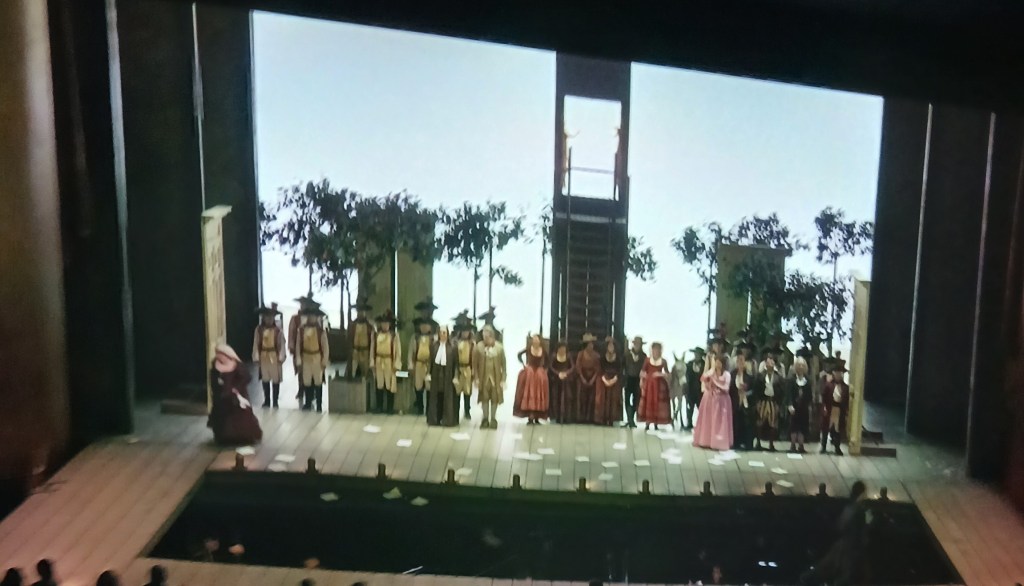
The design aspect of the production polarised the critics. Essentially what you have here is a white wall with four doors, which is on a powered platform that can take the wall up quite high above the stage, giving space underneath for various characters (for instance Susanna in Act 2 when she’s hearing the Count trying to get into the room with Cherubino inside, or for Cherubino to do his garden jump onto a trampoline). The wall can also be pushed back, to give an open space for performance in front of it – useful particularly in Act 4. But there are no pieces of furniture and scarcely any props. The wall can obviously be lit in different ways which reduces the starkness at times, but it is pretty bleak. The four doors are of course ideal for the comings and goings of characters in the plot and were often used to very amusing effect. Given the harshness and lack of clutter, I was intrigued about how the director and designer would handle the Act 4 subterfuge and impersonations – in fact, with Figaro lying downstage looking out at the audience, and a certain measure of dim lighting, it’s convincing. I did miss the bed covers or armchair which normally hides Cherubino in Act 1, though – having Cherubino hide behind the door didn’t always seem convincing. Another aspect of the way people were handled on stage was to have them use a jerky robotic-like movement at times, combined with freezing in positions at the end of a scene or aria. I’m not sure what that was about – some connection with commedia dell’arte came to mind but it didn’t seem to add much. Costumes were modern-ish, with one exception, though not quite contemporary, apart from the Count’s man bun – maybe 1970’s? The exception was Cherubino, who was dressed in vivid colours and shorts, with owlish glassed and ginger hair – the getup made him a figure of fun and in a way less human than the others, – and it left Cherubino looking pretty unmasculine right from the beginning. Jeremy Sams’ translation deserves a glowing mention – funny, pithy, managing rhymes for many of the arias, it had almost none of the toe-curling operatic English you used to see so much of on surtitles or as performed at the Coliseum. The one thing that really was a pity in the production was – perhaps unintentionally (and the ENO is not alone in this) – getting an audience laugh when the Count asks for forgiveness in Act 4.
There were no weak links in the cast, though as in other performances recently my auditory memory sometimes hears great figures of the past singing these roles as their successors perform. An interesting issue was that, musically, there was no vocal decoration in the big numbers – maybe it was thought to be too ‘operatic’ for an audience which did, as ENO would have hoped, have lots of people coming to the work new. Nardus Williams, tall, regal, was an excellent Countess – Dove Sono perhaps sung with more colour and deftness of touch than Porgi Amor – and she was also a good actor and team player who didn’t stand apart from the madcap stuff going on on stage. Mary Bevan was, as Susanna always is, in control at the centre of the madness and her big aria in Act 4 was beautifully delivered. Some critics were not that impressed by Cody Quattlebaum (great name!) as the Count but I found him impressive – a warm voice, agile acting and striking the right balance between being very unpleasant while not becoming a caricature. Hanna Hipp acted very well, and while her voice doesn’t have the creamy tone you ideally need for the role, or the ability to sing softly with great beauty, her performance was thoroughly satisfactory. Rebecca Evans made much more than usual of Marcellina -this was in its own way a star performance. About David Ireland as Figaro I felt more conflicted – he has a big, energetic stage presence, a resonant voice and excellent diction – but he just sounded, well, angry all the time – there was insufficient variation of tone, I think I mean………
Anyway, an excellent evening….now, onto the Regents Opera Ring next week.