La Clemenza di Tito ROHCG 23/5/21

So – it finally happened! After 14 and a half months, yesterday I was at a full scale opera again , at Covent Garden. The last time I heard an opera, or indeed an orchestra, was the Marriage of Figaro, given by Opera North on 14 March 2020 at the Salford Lowry Theatre……..Since then – in September and October 2020 – four string quartet concerts, two song recitals and a solo violin performance…..only……

I thought the performance of La Clemenza di Tito I went to on Sunday May 23 at the Royal Opera House was tremendous. Mark Wigglesworth kept the music moving and lively, yet always with enough space to appreciate the inner voices in the orchestra. It was wonderful to hear an orchestra again, and the seats we were in – front row of Amphitheatre – offered really good sound, with a nice thwack from the timpani when needed. The voices, after months of tinny laptop sound, seemed extraordinarily loud and – well – real.

But above all the production by Richard Jones kept me constantly engaged and watching what was going on on stage. The production was set in what looked like Fascist Italy – possibly Titus as a Mussolini-type. I haven’t seen Clemenza since the famous ROHCG performances in the mid-70s’s with Colin Davis, Janet Baker, Lucia Popp, Yvonne Minton and Frederica von Stade. Despite all these stars, I found it a dreadful; bore – I kept looking for the wit and vitality of the Magic Flute, or Cosi Fan Tutte, and not finding it. In a classical traditional production (John Copley, I think) that 70’s production seemed to emphasise the rigidities of opera seria. I think I understood that the music by itself was often beautiful, and had many of the numbers been found within Don Giovanni or Marriage of Figaro they would be well-loved showpieces of the repertoire, but the plot and context wholly undermined the work. Richard Jones and his designer produced a context that emphasised the cramped and boxed nature of the life the leading characters were living, and the ridiculousness of the classical forms / the anger lying hidden behind the facades – there were some very sinister figures in hoodies who appeared from time to time. The senators following Titus looked like fascist or communist small-town politicians, while Titus himself seemed gradually to exchange genuine compassion and pity for an exalted view of himself that, at the end, had him running round the stage in gleeful celebration of his own compassion, while the rest of his retinue suddenly drew their knives, the reality of power behind the façade of the ‘good’ Emperor. The other characters were carefully drawn, their emotions real and understandable. Sextus and Servilia seemed to be working class people – footballer and pasta shop girl – elevated by the whims of Titus to be a friend/a potential bride of the Emperor. Vitellia was also understandable, her bitterness and anger clearly expressed

But all this would have been rather besides the point if the singing had been indifferent. But it wasn’t – though the stand out star was Emily D’Angelo as Sestus, all the singers without exception were never less than good, and both Nicole Chevalier as Vitellia and Edgaras Montvidas were particularly impressive.

A really tremendous performance, then…… Fingers crossed there will be others over the next few months – I am going to Don Giovanni in July.

Ready, steady, and ??go…..

After months of hibernation, I have booked a whole range of concerts and operas to see in May, June, July and August. We’ll see how much of this actually happens. I’m – in theory – ready to spring into action as below, and plan to go to:

ROHCG – La Clemenza di Tito

Halle Orchestra – 4 concerts and a rehearsal

LSO – concert Yuja playing Rachmaninov PC 2 and MTT conducting Beethoven 5

Opera North-Fidelio

Thomas Ades 50th Birthday – Barbican

Bach weekend – King’s Place

Mirga conducting CBSO in Weinberg

ROHCG Don Giovanni

Plus masses of Buxton Festival stuff. including Handel’s Acis and Galatea, Northern Chamber Orchestra (a fine concert with Schoenberg’s Verklaerte Nacht and R Strauss’ Metamorphosen) and a new musical piece called Brunnhilde’s Dream with Sir John Tomlinson)

ENO Tosca in August

And Holland Park Opera – Cunning Little Vixen, and Hansel and Gretel

Plus, possibly, the Proms…Goodness!!

I’m poised…but will it happen?

We shall see – and I shall report……

Sir Adrian Boult and Wagner

At the Manchester Wagner Society we had a great talk last week about Sir Adrian Boult and ‘what might have been’ if he had been given the chance to conduct more Wagner. The talk was given by Adrian Brown, a student of Sir Adrian’s, a finalist in the von Karajan conducting competition and a very experienced conductor, mainly of orchestras in the London area.

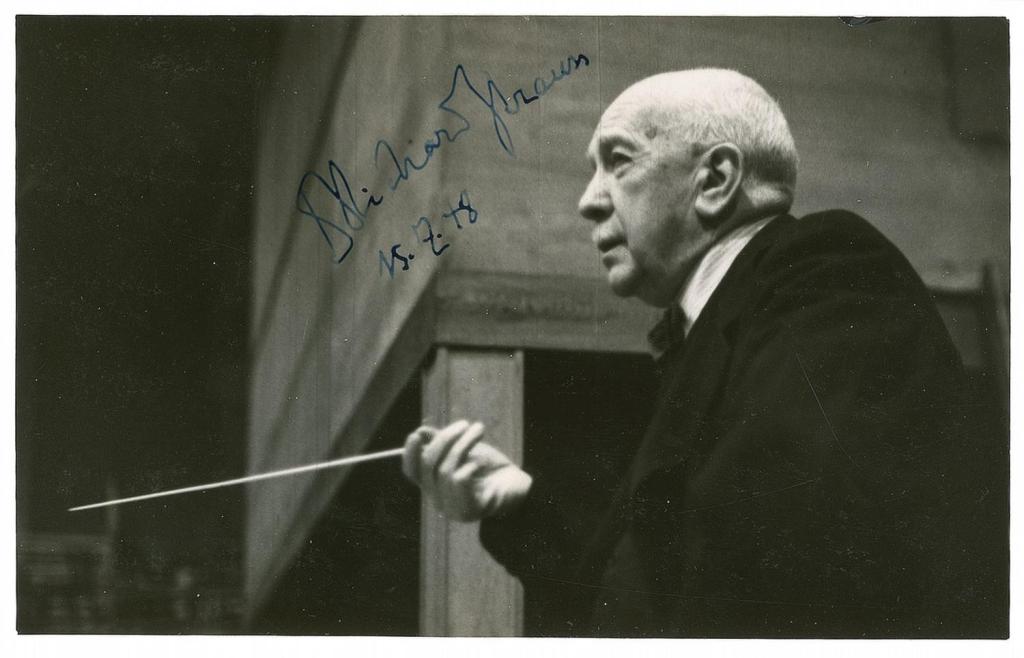
I guess this is in part a generational thing. If you were say under about 58, or not living in the UK, you would have been unlikely to have seen Sir Adrian conduct ‘live’ – his last live performances were I think in about 1978 at the age of 89! – and you would probably know him principally for his many recordings of 20th century English music. For those older than that, you might have seen his imperturbable calm presence on the rostrum, flicking his long baton at the orchestra, and extracting extraordinary performances of, yes, Elgar, and Vaughan Williams, but also Brahms and Schubert and other Romantics. His background was impressive – as a young man, he was at the first performance of Elgar 1 in Manchester, he conducted the first credible performance of Elgar 2, he gave the first performance of many of Vaughan Williams’s works, and he observed and learned from Nikisch and others before the First World War, who themselves in their youth had received directly from Brahms, Schumann or Tchaikovsky instructions on how particular works should ‘go’. He was still passing, Adrian Brown said, information to British orchestras on how Schumann wanted a particular passage of his 4th symphony to be phrased in the mid-1970’s! However, I had no idea Boult had ever had much of a history with Wagner. But he had! Adrian Brown explained that he had conducted a number of staged Wagner performances in the mid/late 1920’s and early 1930’s, mainly of Valkyrie and Parsifal. Beyond that, he had visited Bayreuth a number of times before the First World War, and had decided views on the quality of the productions there. “Boult came in, reeking of Horlicks,” was Beecham’s dismissal of his notoriously abstemious colleague but the Tristan Prelude Adrian wanted us to play was full of passion and energy. It seems sad – though Boult might have been bound by his BBC contract, and of course by the circumstances of WW2, not to get much involved in non-BBC opera from the early 30’s to his ‘retirement’ at the age of 60 from the BBC – and extraordinary that he was never asked to take on a full Wagner performance between 1949 and 1978, nearly 30 years of conducting life beyond retirement. Even with Reggie Goodall waiting in the wings, was there really going to be more fire and life to a Wagner Ring cycle from Karl Rankl or Kubelik in the early 50’s at Covent Garden than from Boult? It seems an inexplicable mistake by both ROHCG and ENO.

But there we are – apart from the EMI recordings of Wagnerian bits and pieces that we dipped into, there are no extant Boult recordings of Wagner. Adrian Brown’s talk showed us clearly that we had all lost as a result

Goldberg Variations

I listened the other day to the Wigmore Hall live stream of the Bach Goldberg Variations played by Pavel Kolesnikov  (271) Pavel Kolesnikov – At Wigmore Hall – YouTube

I find this an endlessly absorbing work. I am not qualified to comment on Kolesnikov’s pianistic competence but it seems to me a fine performance. I love the work because:

  • Its original theme, unlike that of some variations, is memorable
  • Its structure is very clear – a Canon every 3 variations and a still centre in variation 15, half way through
  • for the most part, it is possible for me as a lay person to be able to relate each variation with the original theme and work out how it ‘varies’ from it
  • I love the underlying melancholy of this work, like so much of Bach’s output. Yes, I know there are gigues, gavottes and whatever, but there is a quiet sadness at the heart of this work which I find deeply appealing
  • Above all I love the 30th variation – ‘Quodlibet’ – and the transition to the repeat of the original theme
See the source image

The recording I’ve got on MP3 is the 1981 Glenn Gould version – very good but with a lot of groaning and muttering thrown in…………..

The only time I’ve heard this live was a performance by Andras Schiff in about 2018 at the Bridgewater Hall. Very memorable, although also a very long concert, and I almost missed my train!………

Das Rheingold – Melbourne Digital Concert Hall February 2021

I laid out a not inexpensive but thoroughly worthwhile £19 or so on a digital link to the Melbourne Opera recent performance of Das Rheingold which they were streaming for a few days – I had been interested to see it as a result of emailed conversations on Manchester Wagner Society business with its conductor and his wife.

I really enjoyed this – I don’t always focus as much as I should on streamed opera on a small computer screen, but I found this very absorbing. Somehow the excitement of a huge challenge for a relatively small company, who’d not tackled the Ring previously, conveyed itself in the performance and made this a very absorbing and indeed moving experience.

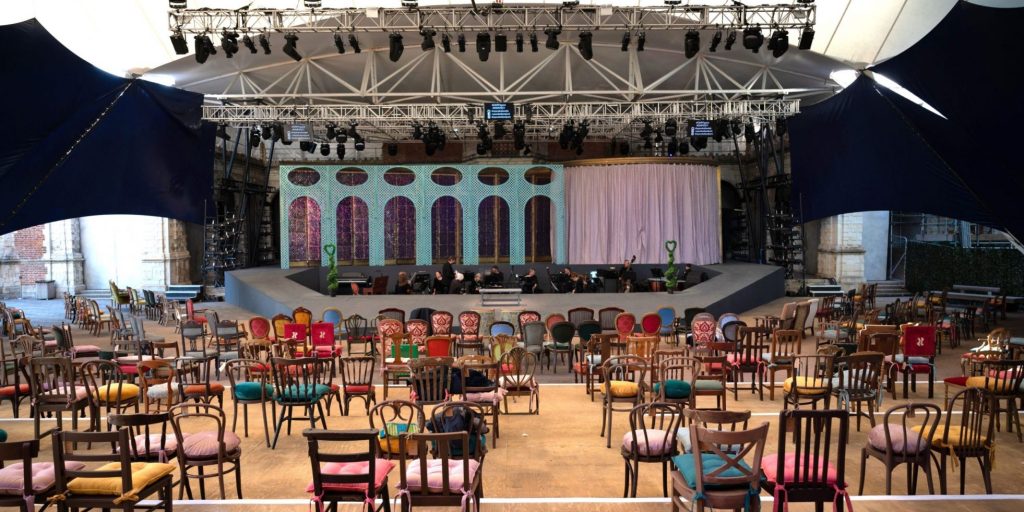
The sets and lighting I thought were good – see picture above- particularly for the Valhalla scenes – the Rainbow Bridge ending looked genuinely impressive. I was less convinced by the Rhinemaidens’ luminous swings and the extra floaters – again, see picture – but they weren’t disastrous or detracting. There didn’t really seem to be any Rheingold in the first scene, which felt a little odd. The work of the director on the interaction of characters was less impressive, I thought – there was too much of eyes-to-the-front and semaphoring. I liked the costumes – Russian giants, glitzy minor gods and goddesses, particularly

There were some good singing actors, particularly the Loge (a gift of a role if you’ve the right temperament – James Egglestone had). Simon Meadowes as Alberich had a powerfully projected and sensitively sung approach, and I was also struck by Lee Abrahmsen as Freia. The Mime seemed to be forcing his voice quite a lot. Eddie Muliaumaseali was a bit of a cipher as Wotan, and seemed to get drowned by the orchestra occasionally – I didn’t really get much sense of what Wotam was about from him . I thought the orchestra and the conducting were excellent – it was quite a fast moving performance that fitted the straightforward narrative-focused style of the production very well. On the recording the snarling brass and timpani came across particularly well!! Perhaps there were a few moments of orchestral uncertainty occasionally, but the whole musical approach had an impressive sweep.

I felt I would much rather have listened to this than Radio 3’s re-run of the ROHJCG Rheingold from the Ring cycle in 2018

Celibidache’s Bruckner 5

I spent an hour and a half (!) yesterday with a Youtube video of Sergiu Celibidache and the Munich Philharmonic performing Bruckner 5 in 1985. (260) Anton Bruckner Symphony No 5 in B-flat Major – Sergiu Celibidache, MPO, 1985 – YouTube

This is a VERY slow performance, a full 9 minutes longer than Abbado, also on Youtube, who is himself no speedster in the Bruckner stakes. But for the most part I thought it worked extraordinarily well. The visual image of Ceibidache conducting from memory and keeping a very close eye on what the orchestra’s doing is matched by the sense of concentration in the sound of the orchestra which makes you hang on every note in at least the first three movements, and relish the – not always heard – combinations of instruments at the slow speeds chosen. The slow movement big theme at 27.30 is quite overwhelming, in its string phrasing and clarity, and is as moving as I have ever heard at the speed Celibidache chooses. My usual approach re Bruckner is to say ‘the slower, the better’, but I am not quite sure that quite fits the needs of the last movement of the 5th Symphony, which, in Celibidache’s approach, does fall apart a bit. I lost concentration at several points during the fugal doodling, but the ending is very fine. Certainly this is better than any live performance I’ve ever heard, and maybe is as good as it gets in what is a not wholly convincing finale.

I hadn’t quite worked out who Celibidache was, I’m afraid to say., until I looked him up. I got mixed up with the other distinguished Romanian conductor Constantin Silvestri, who had a long period in Bournemouth………Celibidache by contrast, clearly a very able man, a composer, and a mathematician as well as a conductor, was chief conductor of the Berlin Philharmonic after the war, before Furtwangler was de-Nazified and took back the reins, and subsequently spent periods of time as chief conductor in Stockholm and Paris before ending his days as the chief conductor in Munich. He was into Buddhism and spiritual practices – maybe Bruckner spoke particularly directly to him as a result.

Anyway, recommended!

Rattle Schubert 9 – LSO, January 2021

This was broadcast on Radio 3 at the end of January – I think it’s also on Youtube. The I-Player link is BBC Radio 3 – Radio 3 in Concert, To the memory of an angel. I was interested to hear this as, had the pandemic allowed, I was supposed to see this concert at the Barbican on 7 January at 3.30pm. In the event I cut out the Berg Violin Concerto, interesting and moving work though this is, and just listened to the Schubert.

It’s years since I listened attentively to Schubert 9. I bought the LSO/Josef Krips recording when I was about 13, and remember in the 1970’s wonderful live performances (on several occasions) by Sir Adrian Boult (who, I’ve just discovered can also be found on Youtube conducting the work – (263) Franz Schubert “Symphony No 9” Sir Adrian Boult – YouTube), and also a memorable concert with the LSO and Karl Bohm, his first concert in London c1971 since …?before the war/ever? I remember the grandeur of the ending of the first movement in Bohm’s reading, making it sound like Bruckner (my brother who was at the same concert – Mozart 29, Strauss Don Juan and the Schubert – compared Bohm’s reading favourably to Bruno Walter’s recording from the 1950’s), and I seem also, thinking back, to recollect the spring and the bounce of rhythms which Boult’s slightly slow pacing generated. I also remember some intensive listening maybe a little later in the 80’s to a Furtwangler performance on record but in terms of live performances since the 70’s I don’t think I’ve ever heard it again and sat all the way through it.

This of course was a recording but it felt ‘live’ – I suppose partly because, without the pandemic, it would have been so and I would have gone to it, and also partly because it felt very ‘live’ in several senses of the word as a performance. It was recorded in LSO St Lukes, and, while occasionally there were some smudges, these seemed to make it more of a live occasion. I guess because of the acoustic of St Lukes, the woodwind sounded very forward, the strings quite backward (that may also be because there were less of them than usual). I found lots of interpretative nuances in the performance and things to enjoy – particularly a real Viennese swing in the waltzy bits of the third movement . The first movement prelude started off very fast and I wondered whether that was right, but Rattle and the LSO persuaded me it was fine, and the transition to the first movement proper worked well. I was blown away by the second melody of the slow movement – beautifully played, and it took me back to when i played my Krips/LSO record in 1967 and reflected, as I listened to that movement, on the school journey I had just been on to France (Grenoble), on how liberating that had felt and how dismal it felt coming back to Hackney! Right at the end Rattle and the LSO were sprightly, and didn’t give the full weight a Furtwangler would have done to the Don Giovanni / Commendatore 4 knocks on the door – but after all, this is still a young man’s work, for goodness sake, and the LSO brought out all the energy, bite, passion and nuance you could want. I really enjoyed this!

Picture of Karl Bohm below for the memory.

Rienzi

Remarkably I have never seen or heard a note of Wagner’s Rienzi beyond the overture. While it’s not too much of a disgrace for a Wagnerian in the UK to say they’ve never seen a live performance, it is available to watch on Youtube, and on Friday I decided to take the plunge – 51 years after I saw my first Wagner opera – and,  empowered by lockdown, actually watch Rienzi, albeit in a heavily cut production. Here is the link   (242) Wagner – Rienzi (Pinchas Steinberg) – YouTube. This was a 2018 Toulouse Opera production. I have to say it is difficult to say exactly why – other than Der Meister’s say-so – Rienzi isn’t performed at Bayreuth and at the same time The Flying Dutchman and Tannhauser are. There are definite very clear stylistic connections between the three operas, and to be frank I would still prefer to watch early Wagner than early Verdi. With a suitably paced and well performed performance, as this was, it seems, without being a masterpiece, a very watchable and listenable work. I recommend it, and have to say I quite enjoyed it. But I may be in the minority – other critical comments through the ages have included (apart from von Bulow’s jibe about it being ‘Meyerbeer’s best opera’), ‘Meyerbeer’s worst opera’ (Charles Rosen), ‘an attack of musical measles’ (Ernest Newman), though apparently Mahler reckoned it ‘ the greatest musical drama ever composed’ (hmmm). Cosima Wagner recorded Wagner’s own comments in her diary for 20 June 1871: “Rienzi is very repugnant to me, but they should at least recognize the fire in it; I was a music director and I wrote a grand opera; the fact that it was this same music director who gave them some hard nuts to crack – that’s what should astonish them”

Next stop – Das Liebesverbot, also on Youtube

Gerald Finzi

I have been catching up on parts of my MP3 collection that I bought a while ago and haven’t really listened to much. Amng them are some collections of music by Gerald Finzi. His large scale works – Clarinet Concerto and Cello Concerto – I know fairly well and I really like them – melancholy, introspective, obviously first half of the 20th century English, but an individual voice that sounds different to the more robust Vaughan Williams. I have particularly enjoyed listening now though to this below, which is an excellent collection of

Introit: The Music of Gerald Finzi

smaller pieces – Finzi seems to have had a habit of starting works and not finishing them off, so that the piece entitled ‘Eclogue’ on this collection is actually the slow movement of a not-completed piano concerto, and ‘Introit’, another piece which is the surviving movement of a violin concerto dropped from any list of opuses.

I’ve also been listening to ‘Dies Natalis’ – which I enjoyed – and ‘Intimations of Mortality’, which I haven’t really got into yet. All his music is worth exploring – an individual and interesting voice…….. (which sounds patronising but is my gut reaction)

For your reading list 1

One of the books I got for Christmas was ‘Wagnerism’ by Alex Ross – Wagnerism: Art and Politics in the Shadow of Music: Amazon.co.uk: Ross, Alex: 9780007319053: Books

I am now about 75% of the way through it – it is a fascinating, if exhausting, read. Essentially it is a history of European culture from the 1880’s to the 1930’s, and the omnipresence of Wagner’s influence in almost all aspects of that culture – Conrad, Virginia Woolf, TS Eliot, Joyce, Mann  – you name them, they have a place in Ross’s book. Occasionally it begins to be a bit list-like and repetitive, and its structure is very much of the “…and then…..and then….and then….” variety. But every reader will discover things they didn’t know – I am still boggling (and maybe Ross is being playful here) over the provenance of the French processed cheese brand – “Le Vache Qui Rit”, which apparently was an ironic French 1st World War nod to the German habit of naming their military defences with Wagnerian terms – Siegfried line, etc. “Le Vache Quit Rit, Valkyrie, geddit? Hmmm, not sure……

Anyway., a thoroughly recommended read for all Wagnerians