This was the shock-horror headline being put out by Normal Lebrecht’s Slipped Disc website this morning. Although Norman enjoys his shock and horror, I am sure his informant is correct. There are several and local reasons for this – Covid, rail strikes, heat wave, cost of living and also (big contributor in my view) the reduction in tourists. But I think there is a more general problem. Since the 1960’s the classical music ‘industry’ has allowed itself to take on more and more of the attributes of the wider culture of consumption and economic growth that we all live in. There are simply more concerts, more opera performances, more chamber music recitals than ever before, and more musicians coming, highly trained, out of the music colleges and universities. The industry, as in any other market, has diversified – more ‘country house’ opera, a whole range of resurrected music from Baroque opera to medieval plainchant, for instance. It has created new attractions – the ‘star’ conductors and soloists. But I think we are now at saturation point. There are simply too many professional orchestras in the UK, and they are playing insufficiently diversified programmes. There are too many Mahler 1’s, Tchaikovsky 4’s etc. The nudge of Covid has brought calamity to the industry because people are having to think about and justify why they are going to particular concerts. Yes, I will go to the operas I love, performed to a level I know to be high, and I will go to the LSO’s concerts and those given by ‘star’ conductors and soloists I admire – eg Vasily Petrenko, or Mitsuko Uchida. I go to something between 60 and 80 musical events a year so I think I am relatively uncritical in my affections. But why on earth should I plod into a provincial city on a wet Wednesday evening to hear an unknown conductor perform a Brahms symphony with an orchestra who can be inspired but can also lapse into routine with an indifferent conductor. I am just not music-starved enough to bother
So…..I fear the answer is probably as it is in the wider economy. Forego instant gratification, and having everything available. Reduce consumption, so that you really value what you listen to. And accept that the number of orchestras etc will have to reduce. Naomi Klein, in her book “This changes everything’ reckoned that we would have to go back to the 1960’s to have a sustainable lifestyle –and I am old enough to remember this was a perfectly enjoyable way of living. So should we do the same with classical music – ENO back in Sadler’s Wells, some provincial touring, more UK artists? And combine this with a massive attempt to bring in new audiences, without which the whole enterprise is doomed anyway
Conductor, Lothar Koenigs; Production, David Marton; Set Design, Christian Friedländer; Costume Design, Pola Kardum; Lighting, Henning Streck. Die Gräfin, Diana Damrau; Der Graf, Michael Nagy; Flamand, Pavol Breslik; Olivier, Vito Priante; La Roche, Kristinn Sigmundsson; Die Schauspielerin Clairon, Tanja Ariane Baumgartner; Monsieur Taupe, Toby Spence
I have never heard Capriccio live and I thought this looked like a good cast, headed by Diana Damrau and with our own Toby Spence taking the role of the prompter. It’s a 50 min trek from my hotel to the Prinzregententheater so I arrived, on this very hot day, rather sweaty and uncomfortable. I was thinking that here in Munich I am only 600 miles or so by road from the Ukrainian border, or 1000 miles from Kyiv, and everywhere in Europe at present there is evidence of increasing climate change. The other works I have seen and heard during my trip to Munich and Leipzig have addressed important aspects of the human condition, and created new perspectives on them. By contrast the subject matter of Capriccio – do words or music matter more in opera – does not, really, address those fundamental human concerns. You might say it’s inherently trivial……..plus it’s not, as a work for the theatre, in the same league as the great Hofmannsthal operas: it’s got too many words, people talk/sing too much and there’s not enough action. The cleverness of this production is that, by setting it in the 1930’s, and having – see below – some definite Nazi references – it does ask questions about the piece that wouldn’t normally get asked
The set was essentially a vertical cut-through section of a theatre – half a stage, half a set of stalls and half a surrounding set of walls. The Countess and Count move between a box on one of the walls, the auditorium and the stage. The stage also provides space for some of the conversations between Flamand, Olivier, the Countess, Count and others. The auditorium walls maybe look as though they have seen better days. In addition to the unfolding of the various love efforts by Flamand and Oliver, and the overall plot, there is something else happening in the stage auditorium. M. Taupe, the prompter, is dressed in a long faun mackintosh, and wears glasses; he is writing constantly in his note book. At first we see him inspecting and measuring a ballerina, then he’s doing the same with a couple of the ballerinas (see picture – here more obviously measuring noses) and some other people, and after this inspection they are sent out of the theatre as outcasts, marched off by M. Taupe. He tries from the prompt box to listen in on the conversations of the Count and Countess. During the final glorious soliloquy by the Countess, surely one of the most beautiful 15 minutes in all music, he is lurking in the shadows of some potted plants. And on the final chord, the lights are suddenly switched on in the ‘stage’ auditorium and we see 10 men, identically dressed to M. Taupe, in all the boxes looking on threateningly. In her final soliloquy, the Countess is addressing someone who I think is one of the ballerinas who was sent off by M. Taupe, an older, weakened, saddened, maybe grieving woman. Finally also, as the Countess sings her soliloquy there is a lady (I may have been imagining this, but I don’t think so) in one of the boxes being served coffee who repeatedly takes it in a way that, by means of light and shadow, creates a fair sideways view of Adolf Hitler. So, there is clearly a commentary here which connects this work with the difficult issue of Strauss and the Third Reich, and the timing of the first performance – 1943. It relates the work to the removal of Jewish artists and performers from German culture after 1933, and Strauss’ role in that for a time as the President of the Reichskammer for music (till, to be fair, he was sacked by Goebbels for not whole-heartedly following the Nazi line).
In many ways this was the finest of all the performances I have seen in the last 8 days in Germany. Not a weak link in the cast, intelligent direction and immaculate performances. Unfortunately I can’t say how much more resonance and reinforcing connection there was between the text and the 1930’s/NSDAP slant which this approach was proposing, because the combination of lighting on stage, the fact I was in the penultimate back row and maybe small typescript meant that I couldn’t read the surtitles which – as always with the Bayerische Oper – are in German and English. Obviously I have listened to the work on record and I know the outline of the plot but it meant that I probably missed a lot of the interplay the director intended between what was being sung and his view of the work. So I wasn’t really clear at the time how the NSDAP angle changed the meaning and emotional impact of the Countess’ final soliloquy, or the whole words/music debate. I think I remember the Countess kissing the Jewish older ballerina at the end…….The beauty of the last 15 minutes found its objective correlative on stage not in the plight of the countess, torn between two lovers and words v.music, but in the plight of the Jewish artists and performers who were thrown out of work after 1933 and the terrible fate of many of them , in which Strauss, even with his Jewish daughter in law, who he did his best to protect, was to some extent complicit. But were we being invited to consider the Countess as a cosseted irrelevant aesthete or someone coming to full understanding of what was going on around her? I’m not aure, and maybe that’s as much left hanging in the air as the words/music debate. As a footnote, having had a quick look at the words, I have since realised that the final scene involves the Countess talking to herself in the mirror in the libretto – ‘Do you want to be consumed between two fires? You mirrored image of Madeleine in love – can you advise me, can you help me find the ending for the mirror. Is there one that is not trivial?’, so the Director has cleverly used this idea to have the Countess talk to the Jewish artist (unless it is really Madeleine as an old woman – but I don’t think so, given the two pictures of the lady below – one having her nose measured, one with the Countess). And there is justification in the text for the characterisation of M. Taupe – ‘I am the invisible ruler of a magical world……….Only when I sit in my prompt box does the great wheel of the theatre begin to turn.”
I had forgotten how much gorgeous music there is in this work, and so much of it was toe-curlingly luscious and beautiful that I kept giving myself hugs of pleasure, metaphorically. The orchestra – another part of which was at the same time performing The Nose by Shostakovitch at the National Theatre – played magnificently; there was a stunning horn solo marking the beginning of the Countess’ final 15 minutes. Lothar Koenigs, the conductor, is a name I had heard of as a conductor, though I couldn’t remember where or when – a brief Google reminded me that from 2009 to 2016 he was Music Director at Welsh National Opera.
Diana Damrau was simply stunning. I am amazed that her website said this was her debut in the role – she is an absolute natural for the Countess. Effortlessly beautiful tone, stunning soft singing, lovely silky line, all the projection you could want – this was a simply amazing performance. But all the male principals were strong – though oddly the whole business of the rivalry between Flamand and Olivier seemed to get less and less important as the work went on, and M. Taupe’s monitoring of everyone became more obvious.
The audience cheered and stamped wildly at the end and there were even cheers for the director and his team, an unusual event in the land of regie-theater
I was so focused on going to Parsifal, which I booked first, about a year ago, that I didn’t really look very closely at what else was going on in Munich this July. Had I foregone Parsifal, I could have made a slightly later trip and seen Capriccio, Der Rosenkavalier, Die Schweigsame Frau and Die Frau ohne Schatten, as well as the Cunning Little Vixen. Oh well, another time…..But first another ambition has to be met – to go to the Salzburg Festival!……….That’s for next year or the year after (I am also going to a Mahler Festival in Leipzig in May 2023 covering all the symphonies including Das Lied von der Erde!)
Christian Gerhaher, Anna Lucia Richter, Pianist Ammiel Bushakevitz: Wolf, Italienische liederbuche.
My planning for this Munich trip was done a long time ago and at one point I wasn’t going to the Sunday performance of Capriccio. Hence I ended up not planning in advance anything to do on the Friday and Saturday evenings. On the spur of the moment I took a cheap seat at the Nationaltheater for another aspect of the Munich Opera Festival, their series of song recitals. Christian Gerhaher, and Anna Lucia Richter were singing Wolf’s Italienische liederbuche.
Wolf has completely passed me by – I have never really listened to his work except a few snippets which I decided 40 years ago I didn’t like. This was the first time I have ever really heard and focused on Wolf’s music. As there were no translations and surtitles for the most part I had no idea what the two singers were singing about, but I was very impressed by a number of the songs – haunting, lyrical, having a quiet beauty that made me want to listen to them again. The two singers sounded wonderful, particularly Gerhaher in the quieter lyrical passages.
This was rather a revelatory evening….! I’m buying a recording – working out whether it is one that Gerhaher made 10 years ago or Janet Baker……
Conductor, Ulf Schirmer (with the Gewandhaus Orchestra), Director and Designer, Roland Aeschlimann; Costumes, Susanne Raschi; Lighting, Lukas Kaltenbäck. Kundry, Elena Pankratova; Amfortas, Mathias Hausmann; Titurel, Randall Jakobsh; Gurnemanz, Rene Pape; Parsifal, Andreas Schager; Klingsor, Falk Struckmann
I booked this a long time ago, during one lockdown or other, when being able to go to Wagner again seemed a distant dream……The cast looked distinguished – Elena Pankratova and Andreas Schager were both in the 2017 Bayreuth Parsifal I went to, and Rene Pape is a well-known bass (though disgracing himself recently by a disparaging tweet about the Met’s gay pride celebrations, which he claims happened when he was drunk – in advance I hoped he was sober for this performance).
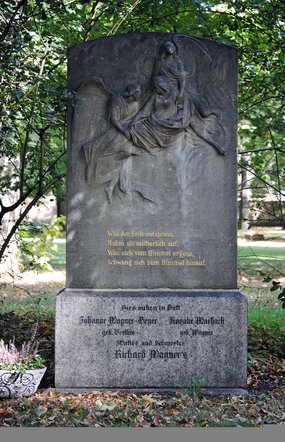
I spent the morning of the performance looking round Leipzig including going to a fascinating (though only in German, but still I got the gist, and the images were nearly all new to me) exhibition organised by the Wagner Society of Leipzig about Wagner’s childhood and up until his early 20’s. It included a portrait I’d never seen before of Wagner in his early 20’s, and also of his ? brother? cousin, Adolf, who looked extraordinarily like him, and his (rather beautiful, though no doubt a bit idealised in portrait), two sisters (? or cousins?) who as far as I could make out were both either on the stage or a musician. I hadn’t realised his mother lived until 1848, so would have seen her son make his way in the world and be kapellmeister in Dresden (and was spared the disgrace of seeing him flee for his life after the 1849 revolution). I also hadn’t appreciated that not only his father but also his step-father died when he was quite young
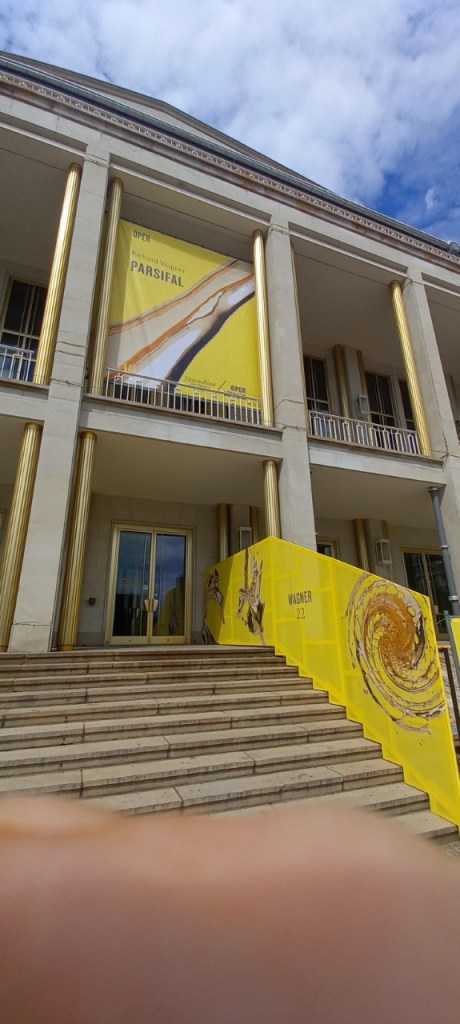
Anyway, to the performance……… The opera house in Leipzig is a fine GDR creation (photo below), very much less over-bearing and more welcoming than the huge Nationaltheater in Munich. The house was completely full.
This was not one of those Wagner productions which seek to completely retell the story (the Berlin one set in a prison, and a recent Vienna one as well, I think) and was, with a few quirks, actually fairly traditional (it dates from 2006) and even on a few occasions seemed to refer back to Wieland Wagner’s Bayreuth production – for instance there is a backdrop of tree shapes in Act 1 Scene 1 which reminded me of that production, as well as Gurnemanz and the Knights /pages in that scene also looking Wieland-esque in long coats. The unchanging element in the set was a front gauze curtain which allowed some effective images but did make things murky and fuzzy at times, together with some very selective lighting on characters on the stage – particularly Klingsor, whose face was more or less completely blurred. There seemed to be writing on the steps at the front of the stage that was, maybe intentionally, undecipherable. The gauze curtain was underlit in blue for Acts 1 and 3 (though Act 3 Scene 1 was without the writing, and the writing, I think, disappeared during Act 3 scene 2). I had no clue what this writing was but somebody told me it’s actually a register of Grail knight. If so it plays no part in the action. The blue colour is still there in Act 2 but there are shifts towards slightly more emphasis on yellows and reds. There is move to green and blue in Act 3 scene 1 and then back to blue for the final scene. The stage is fairly bare but in the Grail temple there’s no chalice as such but an enormous circular flower-patterned window which, when Amfortas sends a signal with some sort of magic mirror (almost like an ipad!), opens up to reveal a kind of whirling conical shaped vortex constantly changing colours in Act 1, appearing at the furthest-away point of which is a pattern of red and white (maybe a few more colours) changing shapes. In Act 3, the vortex doesn’t whirl and instead there’s a much larger hologram not unlike a diamond – maybe a dodecahedron – possibly a reference back the medieval legends where the Grail is a magic stone. In Act 2, there is the same whirling vortex, but without the image at its centre – presumably as a kind of parallel to the temple – and on stage left high up is a suspended enormous spear, pointing downwards. For once the climax of Act 2 has a spear doing something,…. it moves upwards towards Parsifal. The knights in Act 1 scene 2 seem distant, (it’s not easy to see their faces) and almost automatons, with huge shields. It’s almost shocking when they move to close in on Amfortas in Act 3 scene 2 and threaten him. The most wayward part of the production is that at the beginning of Act 3 Scene 1 you see in addition to a withered tree a clump of about 50 shapes under white shrouds. During the Good Friday music Kundry gradually unwraps them – I thought at first, with a cringe of horror, that they were meant to be ‘new buds’ of some kind but realised afterwards that actually they are all in Buddha imagery. The sight of Kundry messing around with these shrouds is very distracting during some of Wagner’s most glorious music. On the other hand, the best part of the production is the handling of the end, which, as the vortex remains calm and the dodecahedron floats, has Amfortas and Kundry facing each other in redeemed love, with a solitary Parsifal almost within the vortex. This is a beautiful way of depicting on stage what is happening in the music. Parsifal has an odd costume in Acts 1 and 2 – a bit like a Pakistani peasant with baggy shalwar trousers. Kundry had a very unflattering dress, which she should have put her foot down about – Ms Pankratova looked much more seductive in the hammam in the Bayreuth production.
On the whole, then, though there seemed to be a lot of ideas that never got anywhere or completely added up, this production allowed the music to speak for itself and didn’t seriously seek to compromise its impact with its interjections, while only fitfully enhancing that impact.
Acting-wise, presumably there was relatively little time for rehearsal – the singers looked as though they’d been mainly left to their own devices. Parsifal had a jaunty approach to the role in Act 1 which he probably carries from production to production, though I seem to remember him looking more directed at Bayreuth. In Act 2, Mr Schager tended to go over-the-top in his actions and over-emote – for my taste, anyway. Ms Pankratova resorted to semaphore. Rene Pape was the singer who had best taken on board the old adage that most opera singers simply move around too much and that the most important thing is being still, and only moving when you have to…..
Music-wise it was a very much more distinguished story. For starters the orchestra of the Leipzig Opera is actually the Gewandhaus Orchestra, so this almost automatically elevates the musical quality – you’re listening to one of the great orchestras of the world….. I was sitting on the fairly extreme right-hand side of the auditorium so the sound for me was a bit unbalanced in favour of the brass, but that was my fault for leaving booking too late, not the orchestra’s. There was some magical woodwind, string and horn playing and, as in my reviews of the Gewandhaus Orchestra at the Barbican in May, just that sense of utter security that you get from a great orchestra, a willingness to play out fully and with confidence. Ulf Schirmer is leaving the Leipzig Intendant post after 11 years and this was his last performance – he took a measured approach – I think about 5-10 mins slower than Richard Farnes – but nothing dragged or felt too quick. There were three outstanding performers on stage. I have never heard Rene Pape live before. He may have unpleasant opinions, but his was the finest-sung Gurnemanz I’ve ever heard live– a beautiful and powerful voice, plenty of colour and variation, great diction. I thought this was in the Hotter league. Good though Toby Spence was in the Opera North performances, Andreas Schager showed what a real heldentenor can do with the part – a ringing powerful voice, and sensitivity in musically projecting the changing understanding of Parsifal on stage. His ‘Amfortas – die Wunde’ in Act 2 was quite extraordinarily powerfully sung. And Elena Pankratova was as good as Katerina Karneus of the ON concert performance in the sensitivity of her singing. However both the Klingsor and the Amfortas were also very good – just not in the same category of excellence. This was a luxury cast.
In the real world, this was probably about as good as it gets, currently, with live staged Parsifal performances. I enjoyed it hugely and was very moved, as I always am, by the profundity and greatness of this work
Conductor, Edward Gardner; Production, Stefan Herheim; Set Design, Silke Bauer; Costume Design, Esther Bialas; Lighting, Michael Bauer. Peter Grimes, Stuart Skelton; Ellen Orford, Rachel Willis-Sørensen; Balstrode, Iain Paterson; Auntie, Claudia Mahnke; Swallow, Brindley Sherratt; Mrs. Sedley, Jennifer Johnston; Ned Keene, Andrew Hamilton
It’s ages since I last saw Peter Grimes live on stage – I was asking myself the question of exactly when just before curtain-up, and thought maybe not since the ROHCG Vickers/Davis/Elijah Moshinsky production in the 70’s. That seems ridiculous – maybe sometime in the early 00’s with ENO? At any rate the only stage images I have aurally and visually are Vickers’ voice and the pebble beach set from that ROHCG production. I was disappointed to have missed the highly-praised ROHCG performance I’d booked to see in March because of Covid, and so was particularly excited to see that this was a production directed by Stefan Herheim, from whom I’ve seen interesting and good work, and with a good cast of stalwarts – Stuart Skelton, Iain Paterson, and indeed Brindley Sherratt, fresh from Gurnemanz (see below), as well as Ed Gardiner.
This was a very fine production and performance. The basic set is a barrel-vaulted building looking not unlike some of the older village halls in places near where I live. It opens up at the back to have a further performing space with a backdrop on which can be projected images of the sea, shoals of fish, a burning sun – there are other images as well, often with a blue theme (whereas the hall itself is brownish) . The hall is used as the main performance space so that it serves as Grimes’ hut from which the boy climbs out and falls, the church service, the pub, the Act 3 party and more. All this works very well. The ‘building’ helps the singers’ voices and makes the chorus more menacing (in fact the sound was near to eardrum-bursting levels at points) – in general terms it also conveys that sense of the confinement of village life which is a fertile breeding ground for resentment and rumour. There is little sense of the wideness of the sea and its infinite horizons – the sea is only there as a place of work and the action of the opera in this production scarcely takes it into account. There is a massive amount of work for the chorus to do, and for the director to get them to do, in the opera, as well as in the latter case handling the movements of the minor characters as well. I thought this was well done – no sense of uncomfortable blocks of people, as in Les Troyens, hanging around but, rather, feeling that everyone was a character, and knew what they were doing, and this makes the coming together of the mob more terrifying. Thus the director ensures the story is told well. Herheim gives prominence to the boy as a symbolic figure– dressed in white, and obviously conveying that sense of innocence, and the tragedy of its loss, which is a theme also in Billy Budd, the Turn of the Screw, and in a slightly different way Death in Venice. But this was not overdone or out of place – that could be said of the whole of the production: it was fully in conformity with music and text, and in no way strained that relationship (again, unlike Les Troyens!). Maybe the two occasions when the house lights came on as the chorus sung at us, seeking Grimes, and obviously implicating us in the vilification and persecution of Grimes, were a bit cliched – personally, I didn’t mind.
I do find this a very moving and remarkable work. It is both of its time, and universal. It is clearly in part the reaction of a gay man to the public vilification and criminalising of being gay, but goes beyond that to any sort of persecution of one group of people by another. It raises – tangentially – uncomfortable thoughts for me about my visit – I have dreamed for over 50 years of coming to the Munich Opera Festival. What if I had been born in 1868 rather than 1952. If again I had waited 50 years to have come to this Festival in 1938, focusing on and celebrating the performances by Furtwangler, Richard Strauss at this very opera house, how aware would I have been of the completely unacceptable political regime that lay behind it, and the persecution of Jews which was gathering pace. Would I have ignored that in the pursuit of great performances? I hope not, but it is part of the power of this work that it raises those sorts of questions in my mind.
However, a fine performance depends on the singers and musicians. All the minor roles were very well done – one of them, Ned Keene, was sung by an understudy, Andrew Hamilton, who had only been told today that the original performer for the role had Covid (he got a big cheer). The stand-out for me were:
Iain Paterson as Bulstrode (another Wotan and Sachs!) who sang authoritatively and resonantly (reminding me of Norman Bailey in the classic Moshinsky production) and who came across sympathetically, without overdoing the old sea-dog angle.
Rachel Willis-Sørensen as Ellen Orford, who was a revelation to me. I have always thought of Ellen as a bit of a wet blanket (poor Heather Harper may have had something to do with this) but this performer had a stunning voice (she has the Marschallin in her repertory) and made Ellen a far more real and passionate character than I had previously realised.
Stuart Skelton, I am afraid, these days, makes me nervous. After his disastrous Prize Song at the Last Night of the Proms last year, I feel uncomfortable whenever he sings a high note. To be fair, he gave us much beautiful quiet singing, in what was, for Britten, Pears’ special register, and some really powerful top notes as well, but also some cracked and tentative ones. I never really got much sense of a characterisation of Grimes from his performance either; he just looks like a big bloke wandering around the stage – and it seems now as though he moves around with some difficulty, which doesn’t really help. To be fair to him, Grimes is a pretty ambiguous character, which makes characterisation difficult, reflecting some of the conflicting impulses of his creator – an outsider who would be much happier in a city (as Bulstrode says at one point) but who decides to live close to his roots (as Grimes says) in precisely the sort of place where people would look askance at him. Vickers managed to create a characterisation of the rolet by extreme means, focusing throughout on the madness and intensity. I’d love to have seen how Pears performed the role – obviously I have the recording, which emphasises the introspective aspects of it, but I wonder how he conveyed that, how he looked and felt, on stage……
Ed Gardiner got a great performance from the orchestra – a very nuanced performance with climaxes carefully graded, and much fine playing. The chorus was superb, and really incisive in their approach..
The audience was very positive about the performance and cheered enthusiastically – it was good to see a reasonable proportion, again, of youngish people. I assume most of them were German and most of them were therefore following the German surtitles. Diction was pretty good amongst the cast but when I did look up to the English surtitles, I found a lot of the Montague Slater libretto toe-curlingly outdated, which might put a youngish UK audience off. Reginald Goodall, who conducted the first performance of Peter Grimes, is supposed to have said something like “I do think Ben is too twee and parochial. He should have had at least partially a European education – that would have knocked the tweeness out of him”
Anyway, a great evening……I have one more evening at the National Theatre, a lieder abend on Friday evening. Other than that there’s the Prinzregententheater on Sunday for Capriccio, and of course Leipzig for Parsifal on Thursday
Conductor, Robert Jindra; Production; Barrie Kosky; Set Design, Michael Levine; Costume Design, Victoria Behr; Lighting, Franck Evin. Forester, Wolfgang Koch; Forester’s Wife, Lindsay Ammann; The Schoolmaster, Jonas Hacker; The Priest, Martin Snell; Haraschta, Milan Siljanov, Pasek, Caspar Singh; The Vixen, Elena Tsallagova; Fox, Angela Brower.
As I think I have mentioned before in this blog, I have seen a number of excellent, very different, productions of this work over the past 5 years – at Glyndebourne, Holland Park, ENO and at the Barbican (semi-staged by Peter Sellars). I was excited to see this production on offer in Munich because of Barrie Kosky as director., When originally first performed in this production earlier this year, Mirga was conducting but she is now, or is about to be, a new mum, so though she was originally scheduled to conduct, Robert Jindra took over relatively late on. The cast looked good, including Wolfgang Koch (a Wotan, Sachs and Barak) as the Forester and some of the ‘company’ singers who were also in Les Troyens.
I was intrigued to see whether the audience numbers and type would be different for this production from Les Troyens the previous evening. Whereas the Trojans audience was a (bit) sparser and older, the Janacek was both fuller and younger – I guess much like London where Covent Garden attracts more young people than you’d ever see at Opera North or WNO
Anyway, to the performance…..and, after the previous evening’s directoral vagaries, this was a masterclass in how a director should shape and lead a production with a clear overarching vision. The vision in this case was about mortality, which made it a darker reading of the piece than I’ve seen elsewhere – the Glyndebourne version in particular was full of greens and yellow and golds. This Munich production was for the most part held within a background of darkness. The opening shows a huge black stage, with a funeral service being held. We see the grave being dug, and the Forester is one of the mourners. And the ending of the opera too has the Forester, after the radiant celebration of nature, walking off to the back of that great black stage as light fails. But the rest of the opera has as its basic set, in front of that darkness, a series of curtains, ropes and banners which have a reflective metallic glint – they can be forests, stars, snowy, spring-like – which produces some wonderful effects. Within, therefore, that mortality, there is wonderful energy and beauty and life. The climax of that sense of energy is the uproarious wedding scene, where we don’t – as per other productions – see festive animals having a good time, but lots of human legs and arms bouncing around in obviously sexually suggestive ways. It’s very funny, and entirely in accord with the music and the intent of the work, and concludes with three huge firework bangs which sends showers of silver sparks all over the stage. The disadvantage of the set is that it can’t easily be used to represent human housing. The other major directoral decision here is to get away from any partial or full animal representation but have the animals as normally human. That’s the first time I’ve seen this done and it takes a bit of getting used to, but I thought it worked well. Both humans and animals seem to pop up from holes in the ground and the only difference between them is in the former’s lighter colours. Curiously, the decision to do this seemed in this production to diminish the sexual tension between the Vixen and the Forester, which was much more prominent in all the other productions I’ve seen., and minimises the sense of strangeness and inappropriateness of the young Vixen inside the human house Here the relationship seems cooler, and there is more of an emphasis on the freedom the Vixen wants for herself. The production in some way perhaps foregrounds the animals more and minimises the human doings, which is perhaps a fault but if it is so it is entirely within the scope and meaning of text and music. So this production was funny – the hen sequence was the best I’ve seen – and beautiful, and at the end I was very moved indeed. I did wonder – though it’s not a problem I had – how this production would appear to someone to whom the work was new. You’d have to be very clued up to work out to whom the Vixen was talking in the Forester’s house (the dog) or that it was a badger who found himself summarily evicted from his home. A very good thing, though, was that the work was played without a break – director’s vision coming before profits at the bar…….
This is one of those works that requires a company spirit, and members, and Munich still seems to have such a company – whether that’s so contractually I’m not sure, but there were small parts taken by singers who had sung in Les Troyens, as I’ve said. The Staatsoper youth choral group need a special mention! Altogether it felt like a company effort. The stand out performances were by:
the Vixen, Elena Tsallagova, who was energetic, sung beautifully in the love scene and had a huge stage presence (all she needs to do now is cartwheels as per Alagna);
the Fox, played by Angela Brower which was very well done – she is a big presence with a big voice and is clearly going places
and the Forester, with Wolfgang Koch projecting a sadness and weariness worthy of Hans Sachs.
So I thought this was a marvellous and, despite the sadness, an uplifting performance, and maybe a more clear-headed approach – without fake pantheism – is all for the best with this great work. If I had one further cavil it would be that the orchestra – sounding so wonderful last night in Les Troyens -seemed less comfortable in this music. It was almost as though, when the music moves into lyrical, occasionally almost Straussian, territory, they knew what they had to do and the strings soared; at other times they sounded a bit uneasy with some of the cross-rhythms and asperities of the score, which I remember Rattle doing so well with the LSO about 3 years ago
But all in all, though the recent ENO production runs it a close second, probably the finest I have seen of this wonderful work, and as with the Kosky Meistersinger at Bayreuth I so admired, the detail of the crafting of the production is awe-inspiring
POST SCRIPT: because I had planned nothing for the following Saturday (16/7) I bought a cheap ‘stehplatz’ in the third ‘range’ for this same production. I think I did the orchestra a disservice in the above – they played wonderfully. on the Saturday The sound even standing at the back, and the sightlines, in this position in this house are much preferable to standing at Covent Garden. The performance was also being relayed to a big screen and speakers outside in the square where there was a large audience under the (free) ‘Opera for All’ scheme. I got the extra thrill, coming out from the performance through the main foyer, of seeing the cast close up returning back from being cheered by the crowds outside – they all seemed fired up and elated, as they should have been!
Conductor, Daniele Rustioni; Production , Christophe Honoré; Set Design, Katrin Lea Tag; Costume Design , Olivier Bériot; Lighting, Dominique Bruguière. Cassandre, Jennifer Holloway; Hecuba, Emily Sierra; Ascagne, Eve-Maud Hubeaux; Didon, Ekaterina Semenchuk; Anna, Lindsay Ammann; Priam , Martin Snell; Enée, Gregory Kunde; Panthée, Sam Carl
The first of my five musical events in Munich, having travelled all day by train the day before (London – Brussels – Frankfurt – Munich) – the only stressful part of my journey being from the Hbf in Munich to the hotel, where I confused north and south and went round in circles for half an hour……..Back to hard copy maps, I think……Google Maps doesn’t challenge your assumptions.
I have never seen Les Troyens before and it has always been on my list of top operatic things to see (as well as seeing Pfitzner’s ‘Palestrina’, and another chance to see ‘Die Frau ohne Schatten’ before I die). In fact, I have actually sung in an extract from this work conducted by Colin Davis (ahem) – the Proms’ Last Night in 1970 featured the chorus of welcome to Dido as a concert item and the Prommers were invited to sing along, with a rehearsal. I had heard dire things about this Munich production, including a corruscating review in the Financial Times which gave it one star, so I approached this performance with a fair degree of trepidation, though the cast is a good one and the reviews were generally positive about was going on musically.
Les Troyens is undoubtedly a flawed work – as is usually the case when something never really becomes part of the central repertory. There are too many static scenes, and it requires a huge cast and a big orchestra – it’s not an easy work to stage at all. But there is wonderful music in it, particularly the choral material, some of the big arias and the orchestral set-pieces, and it’s well worth an occasional hearing, although a concert performance might be equally effective – however, as it’s taken me 50 years to get to see this piece, and the chances are I don’t have another 50 years at my disposal, this is probably my only shot at it and I was very happy to see a staged version.
The Troy part I thought was well done – the basic set looking like a war scene with a picture of the sea suspended at the back. There is a sense of a doomed society about to expire – men in evening dress in the chorus, a vanishing civilisation totally unable to cope with the threatening Greeks. Everything is in a cold black white or brown. The horse never appears as such in Berlioz’s libretto , but the director decided to bring on a huge neon light saying ‘Das Pferd’ [the horse] which took a bit of getting used to but is probably preferable to having a massive wooden horse on stage. Gregory Kunde has a relatively brief appearance as Aeneas in Part 1 and sounded very impressive – not a big voice but able to project with lots of ‘ping’ and great top notes, plus immaculate French. Jennifer Holloway’s voice I didn’t find particularly agreeable to listen to but arguably Cassandra is a bit unrelenting anyway. The ghost of Hector made a brief but memorable appearance. Throughout, Honore in the first part did as much as could reasonably be expected to create interesting stage pictures – particularly the scene with flowers where the women entreat Cybele, and the final scene, with menacing Greeks breaking through the women about to die with Cassandra. The prophecy of the wonderful founding of Rome made a great impact at the end dramatically as well as musically.
So I moved on to Carthage not really understanding what the fuss had all been about, but the director’s view of Part 2a of the work, in Carthage, was – ummmm – more of a challenge. The set was clear – a walled enclosure but again with an image of the sea in the background. At one end of the spectrum of experience in this part 2a, there was some of the finest singing in duet I have heard for a very long time in “nuits d’ivresse’ from Aeneas and Dido, and also some stunning playing from the orchestra in the Royal Hunt and Storm. While it is certainly true that there is a LOT of music without singing you have to do something with as a director in this work – the ballets, as well as the hunt – nonetheless a clear sense of what the director wanted to get across in these scenes failed to come through. Part 2a started with a bunch of naked – fully so, as far as I could see – men lounging on the beach. OK, that might set up a narrative about Carthaginians being lotus-eaters, which is certainly there in the text – Trojan sailors complain about leaving Carthage saying they are having a very nice time, thank you, and the girls are great – but why was the director just focusing on young men? We hardly saw the Trojans at all en masse (they were off stage singing their chorus in praise of Dido, which seemed odd)– and when they did appear occasionally, they also were in evening dress – so my theory about Part 1 doesn’t hold! The Royal Hunt and Storm and the ballets were, except the last of the ballets, accompanied by videos of variants of what looked like – I have to say it – soft gay porn. Again, if we have to have soft porn, OK, but why not a bit of diversity,? Anything we see on stage must have some dramatic relevance whatever orientation it is…..This really didn’t seem to have much connection with the text, unless the suggestion is that Carthaginians were particularly into being gay, and therefore particularly reprehensible lotus eaters, but that is obviously objectionable. Maybe the point of the videos were that the Carthaginians were totally inward-looking – and the very last of the videos was actually a video of a singer on stage being filmed by a guy with a camera – but, again, where were the women (to be fair there did seem to be one woman who was an onlooker in what looked like something of a male orgy – but why?)? Clothing in Part 2 was all over the place – the Trojans seemed to be in vaguely peasant attire (Aeneas in a peculiarly unbecoming set of baggy shorts) while the Carthaginians were in modern – mainly beach-type – dress. Both Dido and Anna had short skirts and long legs – was there something going on about sexuality – but if so what was supposed to be being said and why? A howl of boos accompanied the closing of the curtains for Part 2a from some members of the audience.
Part 2b seemed to suggest the director had just given up – most was ‘stand-and-deliver’ staging for Dido, Anna and Aeneas, and they just seemed to be doing standard operatic semaphore (while singing sensationally). There was little sense that the director had worked intensively with the singers on their reactions to each other. When the chorus did come on stage they just stood in blocks and delivered – there seemed to be no direction of them.
OK, epater les bourgeois and all that, but it did seem as though the director had made a bit of a mess of the Carthage scenes – I simply couldn’t make out how what was being seen on stage fitted together. There are so many interesting slants you could take on this work – imperialism, the standard neo-classical love-and-duty angle, the differences between the Trojan and Carthaginian cultures, nationalism and populism, militarism, even refugees – that it was disappointing the production was so incoherent. But, as I say, the singing was sensational – Ekaterina Semenchuk quite dazzling with her beauty of sound, and flexibility of voice and tone. Gregory Kunde went from strength to strength. The other huge positive was the orchestra and chorus – stunning playing, and very good singing from what, by ROHCG standards, seemed a slightly under-sized chorus – and I thought Daniele Rustioni’s conducting was excellent – alive to all the nuances of the music, constantly alert….. He is apparently a Pappano protege and one of the front-runners for the ROHCG musical director role once Pappano leaves. The only singer I wasn’t taken with was Anna (Lindsay Ammann) whose voice seemed rough and not well-controlled
So, I saw what the Financial Times meant, but all in all I was very, very happy to have finally heard this piece live on stage, despite some of the occasional daftness of regie-theater on show, and a lot of the singing was wonderful.
DIRECTOR – Damiano Michieletto; REVIVAL DIRECTOR, Noa Naamat; SET DESIGNER, Paolo Fantin; COSTUME DESIGNER Carla Teti, LIGHTING DESIGNER, Alessandro Carletti; CONDUCTOR, Antonio Pappano Turridu – SeokJong Baek; Nedda and Santuzza – Aleksandra Kurzak ; Canio – Roberto Alagna; Alfio, Dimitri Platanias; Lola, Aigul Akhmetshina; Mamma Lucia. Elena Zilio; Tonio, Dimitri Platanias; Silvio, Mattia Olivieri; Beppe, Egor Zhuravskii
These are again two works I have been very snobbish about in the past and as far as I can remember I have never seen them live before . I do recall that Rita Hunter once sang Santuzza in the 70’s but I have no memory of going to the ENO to see her, I probably wouldn’t have booked this time, except that I had an evening spare in London before getting a very very early Eurostar train the following morning, and I thought it would be good to see Jonas Kaufmann in a role, plus Ermonela Jaho is a superb singing actor. As luck would have it both were indisposed and couldn’t make it, but we got some excellent replacements instead, as you’ll read below. Coming to these two works supposedly for the first time, I quickly realised how much particularly of ‘Cav’ I already knew – umpteen recital recordings of the Easter hymn, the Intermezzo, and various big arias have just got lodged in my memory over the years. ‘Cav’, in many ways is the more striking work – it has ‘big tunes’ galore, and an action-packed and clear story, whereas I Pagliacci doesn’t have quite the same level of heightened melodic invention, and I found myself getting a bit confused as to who was who in the ‘play within a play’ sequence, and who precisely Beppe is. The production I thought was well done. In both cases the setting is the late 1940’s in a Sicilian village and this works well – Alfio comes back from the war with a splendid 40’s car, the costumes and sentiment feels right for this period. There are attempts made to link the two works – posters are going up for I Pagliacci near Mamma Lucia’s bakery in ‘Cav’, and Mamma Lucia seems to make a re-appearance in ‘Pag’. The sets in both works are revolving realistic designs for parts of the village and this works well, particularly in ‘Pag’ so that we can alternate between the village stage and the dressing rooms. The only slightly out of the way part of the production is that it starts in the Prelude of ‘Cav’ with Turridu’s murder and then tells the story of how we got to that point. The sheer energy of these two works requires first rate singers who can project their character well to an audience in a relatively short period of time. The standout star of both was Aleksandra Kurzak, who is at the peak of her career and can do everything she wants to do with her voice – passionate, quiet, smooth and lustrous, violent, she can do it all in a refined and totally controlled way, with little vibrato and total clarity. Her two tenor leads were quite a contrast – the Canio was Roberto Alagna (her husband) who offered a master class in style – he is in almost the twilight zone of his career and he can no longer belt out the top notes as he once could, but what he does is affecting, beautifully sung, with pointed, clear diction and representing the absolute essence of the tradition of Italian 19th century opera (he also managed to do a cartwheel at one point!). His ‘Cav’ equivalent, SeokJong Baek as Turridu, was ardent and full-on, very different in style and approach but suiting perhaps the intensity of ‘Cav’ better, just as the subtleties of ‘Pag’ are very well-matched to Alagna’s abilities to what he can now deliver so effectively. The other person singing in both operas was Dimitri Platanias as Alfio and Tonio, and he was very good at delivering menace and threat. Lola in ‘Cav’ was sung very well – a beautiful warm, rich mezzo voice – by Aigul Akhmetshina, a young Russian singer. Antionio Pappano kept the orchestra fizzing and full of energy.
Much against my better judgement ans my expectations, a really enjoyable evening…………
Haydn – String Quartet in G minor Op. 20 No. 4; Brahms – Piano Quintet in F minor Op. 34
This was a great concert. The Brahms was magnificently done with energy and passion. The third and first movements had a magnificent sweep, and the second a quiet thoughtfulness. The last – complex, jumpy, moody, an unrelenting outburst of intensity – was also very powerful. More than I usually do, I learned a lot by keeping my eyes open and looking at the interchange between the four players, particularly the way the first violin lifted herself up from the chair whenever she was playing something particularly passionate or lyrical and the way the 1st and 2nd violins worked together. I have heard this work but must listen to it again soon – it’s much more special than I had remembered. The Haydn too was very well played and enjoyable – like its partner the previous evening, it’s a product of his Sturm und Drang period, and is, again, quirky. It opens softly with some enigmatic phrases, followed by a violent outburst and follows up during the movement with unexpected pauses and a false recapitulation – altogether a difficult movement to ‘read’ emotionally. The slow movement is a rather sad theme and variations, touchingly done and the minuet is “alla zingarese” (in Gypsy style). The final Presto continues “scherzando” (jokingly) with “Gypsy” elements and with surprising harmonic and rhythmic twists, before disappearing suddenly in a whisper. All was brilliantly realised by the Quartet
Haydn – String Quartet in G minor Op. 20 No. 3; Shostakovich – String Quartet No. 1 in C Op. 49’; Mendelssohn – String Quartet No. 3 in D Op. 44 No. 1
I had had an excellent afternoon walking for 3 hours on the South Downs near Lewes with an old friend, and this concert was the perfect end to the day, a really well played and well thought through string quartet concert. The emotional trajectory in the choice of pieces was clear – from very unsettled and quite odd Haydn through the seemingly and superficially graceful ease of the Shostakovitch, with a lot going on under the surface, to the genuinely sunny Mendelssohn. The stand out performance was the Mendelssohn – this quartet is becoming another London bus and I had heard it only two weeks earlier at the Stoller Hall. This was a much, much better played performance – the first violin offering both more sweetness and variation of expression but also with more fire and energy when needed, and all 4 players were producing a much more varied sound – in terms of tone and dynamics – than the Manchester one. There was a big difference! The Haydn was very strange – coming from his Sturm und Drang period, it had none of the ‘gentility’ and charm/wit you might associate with Haydn, The finale came to an abrupt halt that was inconclusive rather than jokey, the first movement stopped and started, went off in unexpected directions and unsettled me. The Shostakovitch seemed elegantly played – but with edge and real propulsive energy in the finale.
I am looking forward to their Haydn and Brahms tomorrow lunchtime – this sounds like a very strong group of players