Gustav Mahler, Symphony No 7 in E Minor; Berliner Philharmoniker, Kirill Petrenko, conductor
As I walked past the front of the Albert Hall towards the Arena standing queue area for this sold-out Prom, I was amazed to see a gaunt, tall, balding and now stooping figure who has been a constant presence at the RAH for the last 50 years, whenever I have been to a sold-out Prom. He’s their regular black market ticket seller, and he must have some official tolerance from the RAH, so ubiquitous is he. I would have thought by now he would have retired – he always seems to have looked the same…..but there he was, a reassuring presence in a fast changing world…..
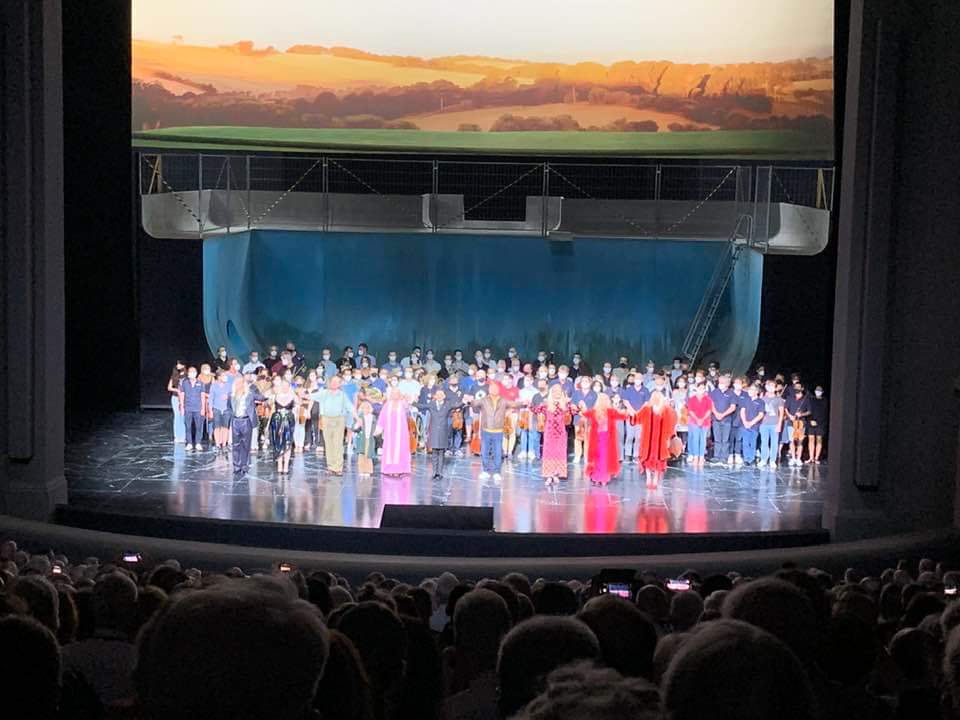
The concert once again affirmed my belief that the Arena standing area is the only part of the RAH where orchestras sound at their best. The Berlin Phil sounded fabulous – warm, full strings, brilliant brass, exquisite woodwind and a highly impressive timpanist, amongst others. The whole orchestra seemed to be listening to each other responsively, and there was a joyful sense of music making together – almost chamber-music like – that I think must be part of what Petrenko creates as a working atmosphere with this band.
Petrenko has, apparently, got a broken toe – which didn’t seem to need a stool or footrest, and he bounced around on the stage as I imagine he normally does. It’s a pity – presumably on doctor’s advice to ease up, he has been replaced for the second BPO concert by Daniel Harding and the programme changed from Shostakovich 10 to Bruckner 4 – that’s a pity; I was looking forward to Petrenko’s Shostakovich, and Bruckner 4 received a magnificent performance from Rattle and the LSO last year
It is only 6 years since the BPO played the same work under Rattle, at the Proms (which I was at) and indeed only 4 years since Petrenko conducted Mahler 7 with his Bavarian State Opera Orchestra at the Barbican (which I didn’t go to). I was asking myself as I listened what the differences were between the two performances I’ve been at. Both were very, very good. If I have to characterise Petrenko’s version it was a quest not so much for beauty of sound as for exquisite clarity – layer on layer of inner parts revealed in a way I don’t remember with Rattle, but exquisite not in a sense of beauty for beauty’s sake but somehow uncovering further aspects of what Mahler wanted to say. Particularly in the second, third and fourth movements there were sounds of burbling woodwind or snarling brass I just don’t think I’ve heard before. The other things that made Petrenko different for me were (1) the driven rhythmic approach to the outer movements, which worked well, and didn’t sound forced, and (2) the tightness of Petrenko’s conducting – there’s no leaning into phrases here, but pointed, compressed lyricism. Petrenko has a wonderful style as a conductor – physical, acknowledging every motion of the music with his body (but never to excess) and signalling everything to the orchestra through his gestures. That glint in his eyes and the huge attention to detail reminded me a bit of videos of Carlos Kleiber at work.
There was a standing ovation at the end from the majority of the audience.
Siegfried, Stephen Gould; Gunther, Michael Kupfer-Radecky; Alberich, Olafur Sigurdarson; Hagen, Albert Dohmen; Brünnhilde, Iréne Theorin; Gutrune, Elisabeth Teige; Waltraute, Christa Mayer; 1. Norn, Okka von der Damerau; 2. Norn, Stéphanie Müther; 3. Norn, Kelly God; Woglinde, Lea-ann Dunbar; Wellgunde, Stephanie Houtzeel; Flosshilde, Katie Stevenson. Valentin Schwarz (director), Andrea Cozzi (designs), Andy Besuch (costumes), Konrad Kuhn (dramaturgy). Reinhard Traub (lighting), Luis August Krawen (video), Bayreuth Festival Chorus and Orchestra, Cornelius Meister (conductor So….onto Gotterdammerung. I will put forward a few views first on where I am in my assessment of this production, and will make any changes after I’ve seen Gotterdammerung. My assessments will be based on the following criteria, as I mentioned in my Rhinegold review
1.The quality of the concept (if there is one) and relevance to the opera (s)
2.Consistency in the implementation of the concept
3.How that concept relates to what the words and music are telling you
4.The insights which the approach brings to the work(s)
5.The quality of singing, conducting, acting and orchestral playing.
and I have added a 6th – the quality of the set design and the appearance of the production
On 1 – Schwarz himself says “The fact that the “Ring” in Bayreuth is performed in its entirety within just one week gives us the opportunity to show a family epic in a four-part series format and to follow these characters in their circumstances and omissions through the course of time. Where are you from? Where are you going?…”; “I want to tell a story about today’s people, today’s figures, today’s problems – and not about gods, dwarves, giants and dragons.” In another interview he talks about this being the ‘Netflix’ approach. The problem is that The Ring is inherently bursting with meaning – meaning is what Wagner intended it to have, even if he was in two or minds as to what, and so Schwarz’s concept sounds weak, though plain story-telling of course as such must be a virtue. There is a theory of theatre which is reflected in one of the essays in the programme book which is an approach that the theatre should reflect the disorder and lack of logic in the world we live in – ‘coherent incoherence’. This does seem relevant to this production.
On 2, the problem is that, having indicated that plain story–telling is what he plans to be doing, Schwarz starts importing a lot of action/signs that immediately disrupt that and suggest ‘meanings’ (the Rhinegold being a child, the pyramids, the various other children who pop up etc). I saw a Facebook post from a French guy attending Ring III saying that he was convinced it was all about the quest for eternal youth in a world of decay and death. This makes some sense but (a) is not what Schwarz said he was doing (b) is not followed through in any coherent way. People perhaps are attempting to find ‘meaning’ when maybe it is just not there. Of course, ‘coherent incoherence’ (or the other way round) might be an explanation, but then themes move in and out of view which suggests that this approach isn’t followed consistently either – at times some of the themes seem more systematically treated…… at other times less so. There are themes you can discern if you go with the flow – the abuse of children in conflict and by power; violence against women; flashy consumerism; even climate change. But it never really comes together. Quite often too in this production the plain story-telling seems to be deliberately obscured – e.g. there doesn’t seem to be any real reason why it should be Wotan rather than Siegmund who fathers Siegfried). Unless these issues are cleared up in Gotterdammerung…….
On 3, most of the time there is a fair degree of coherent relationship between action, words and music, even if it’s not conventional – it doesn’t really matter that there’s no dragon or bear. But there are certain symbolic things – spear and sword are the obvious ones – which can’t be air-brushed away in the manner Schwarz suggests. I wasn’t too bothered by the plastic surgery Valkyries or Mime’s anvil-less forging scene. On 4, there are some insights – I have new perspectives on Fricka for instance, I think the way Siegfried is played is also effective, and different in the degree of thuggishness involved.
On 5, the singing so far has been of the highest quality – quite outstanding; the cast has acted well; for the most part the orchestra has played well, though not achieving the sort of sounds I heard in 2017 under e.g Thielemann. The conducting has been reasonable but not inspired (but there is the benefit of doubt to be given, granted the circumstances of 3 weeks’ notice)
On 6, too, as often in Bayreuth, the sets are stunning to look at ,
So……onto the Prologue and Act 1. The curtains open on a child’s bedroom – the same one as the fantasy one in Act 1 of Walkure. Brunnhilde is putting the chid to bed. The Norns come in as the child dreams, I think (though oddly there seem to be 4 Norns, rather than 3 – maybe one is the child in the dream. Similar Norn like figures also were around in the bedroom in Walkure. When Siegfried and Brunnhilde meet in the room after dawn breaks it is clear this is their child – though whether she is also the child who was led away by Erda in Rhinegold isn’t clear – and also that they are not getting on very well (this is how I read it anyway) and Siegfried goes off in a huff. The Gibichung Hall is another plush apartment with lots of staff and plenty of bottles of champagne – white seats and various bits of modern art. Gutrune looks like a sleek oligarch’s daughter and she’s certainly not ‘wet” in the way she’s portrayed in many productions. Gunther is as he should be unreliable and passive – he is also, in this production, just rather strange…very hyper-active, and exaggerated in his movements. He also sported at least in the first performance a T- shirt with ‘who the fuck is Grane’ written on it? I was too far away to see whether this was still around for Ring III….Hagen is slobby and into middle age, still wearing his trademark yellow T-shirt. Because the Tarnhelm and magic potions are, well, magic, and therefore against the concept, clearly Mr Schwarz has to arrange something to enable to Siegfried to win Brunnhilde for Gunther as his wife. His decision is to indicate that Siegfried is so fed up with Brunnhilde that he immediately falls for Gutrune (who is indeed very easy to fall in love with) without any magic potion. Grane is very disturbed by the whole Brunnhilde/Siegfried relationship collapse and tries to restrain Siegfried – he has the offered potion from Gutrune poured over his head. We see later that the Gibichungs have killed Grane and chopped him up – he is wheeled in on a bloody trolley during Hagen’s Watch. Back in the child’s bedroom Brunnhilde meets Waltraute ‘normally’ and the scene where Siegfried is disguised as Gunther, which is usually difficult to bring off, was no more or less messy than other productions – in this one both Gunther and Siegfried appear but with Siegfried out of sight singing for Gunther. The abduction of Brunnhilde is nasty – but, then, that’s what it is. Throughout the scene with Brunnhilde the child is present and she is taken with Brunnhilde to the Gibichung Hall. A lot of booing accompanied the curtain coming down at the end of the act – though for the production, not singers.
Act 2 was better. The first thing we see is a punch bag which Hagen is working out with. He hides behind the punch bag when Alberich appears and answers from the same position. The set remains essentially remains a white box throughout the act, but opens up effectively at the back with mist and darkness as Hagen’s vassals come on stage. Apart from the fact that the vassals have red Viking-type face masks – but, hey, why not?- the rest of the Act is conventionally handled within the white box and the singers just do their thing. The child is present for part of the wedding scene and there are some indications she can be identified with the Ring
Act 3 was, frankly, dire. The setting was the same throughout – a cross section of an empty cracked and ruined swimming pool. Obviously this connects with the swimming pool of the Rhinegold and here represents a certain sort of futility and pointlessness to everything, I suppose. I have seen an argument from one critic indicating that the empty pool represents the impact of climate change, brought about by trashy consumerism represented by the Gods and Gibichungs – but this should have been woven into the fabric of the 4 evenings in other ways. The swimming pool has a higher level where vassals, Gutrune and Gunther gather and from where Brunnhilde starts her immolation scene and then there’s the bottom of the pool where Siegfried and Hagen are. The child is with Siegfried when he dies but disappears half way through the immolation scene and is, I think, killed. What is quite shocking, given the vividness and splendour of the music, is that more or less nothing happens on stage (apart from Gunther’s death) until the end of the opera, essentially. There is no movement of Siegfried’s corpse anywhere- it stays at the bottom of the swimming pool; Hagen dumps the severed head of Grane in a plastic bag halfway through the Immolation scene. Brunnhilde collapses on top of Siegfried. Hagen’s “Back from the Ring” is meaningless as there is no ring of any sort around. As Valhalla goes up in flames columns of strip lights appear on the back drop – what this might mean is entirely unclear. Finally, in a way that seems more of a gesture than anything else, the foetal image of the twins appears again. All this seemed a dire abrogation of directorial responsibility when the music intimates so much.
The singing and playing was another matter, happily. The cast was uniformly very good indeed. In advance, one wondered about Irene Theorin’s capacity now to take on this enormous role, but I found her to be very impressive, even if unflatteringly dressed and not really looking like the redemptive figure she’s meant to be (but which Mr Schwarz is denying) – some of the audience had it in for her during the curtain calls, which I thought was sad. On this subject see https://slippedisc.com/2022/08/at-bayreuth-brunnhilde-gives-one-finger-to-the-booing-audience/ .Stephen Gould was similarly impressive and strong voiced – though he ducked a few of the top notes – and I was as impressed by his Siegfried as I was by his Tristan 5 years ago. Hagen, Gunther and Gutrune all sang well. The orchestra sounded glorious throughout as did the Chorus. The audience interestingly seemed to have decided Cornelius Meister was doing a good job – no booing for him, unlike the first run of this production. There were still a few of his trademark lurches and lunges but all in all I felt he had conducted the work well.
All the judgements I made above before this performance stand – indeed are intensified. At the heart of the problem is a weak concept which is then further pushed off the rails by any number of ideas which start off well and then trail off. I have no idea what has happened – was there not enough time to think it all through (but it can’t be this, given that the production has been pushed back). Is it the ‘coherent incoherence’ deconstructionist ploy against ‘big narratives’. Possibly, but the impression given is simply one of incompetence. But I have a further sense that in retrospect the production does have a haunting quality – there is an underlying theme, not treated systematically, of not only the quest for wealth, power, and money, but also of the human urge for survival, to seek permanent youth, for regeneration, inheritance, renewal, perpetuation, innocence perhaps, in a world where on the contrary everything eventually ceases to exist or gets corroded, ages, corrupts, degenerates, or dies. Climate change is part of this overarching vision
Anyway, it is still a marvellous experience to hear this work where it was first performed in its entirety, and with its wrap-around mystique. The singing and eventually the orchestra were glorious. A pity about the production…as it stands, but it would be very interesting to see how it has developed in three years’ time in 2025 and to see how many second thoughts there have been…..And of course 2026 is the new 150th anniversary Ring.
Siegfried, Andreas Schager; Mime, Arnold Bezuyen; Der Wanderer, Tomasz Konieczny; Alberich, Olafur Sigurdarson; Fafner, Wilhelm Schwinghammer; Erda, Okka von der Damerau; Brünnhilde,Daniela Köhler; Waldvogel, Alexandra Steiner. Valentin Schwarz (director), Andrea Cozzi (designs), Andy Besuch (costumes), Konrad Kuhn (dramaturgy). Reinhard Traub (lighting), Luis August Krawen (video), Bayreuth Festival Orchestra, Cornelius Meister (conductor)
The weather has got cooler in the last few days in Bayreuth – indeed there was some rain during both Walkure and yesterday the Hollander performances. Temperatures obviously in the Festspeilhaus have also gone down (except raised temperatures among those getting crosser and crosser with this production!) Certainly my 40-minute walk there has been a much pleasanter experience.
I continue to be intrigued by the audience. Internationally, Brits and Americans predominate, though there are also quite a few French and a few Chinese. What’s interesting from the conversations overheard among the English speakers is that not everybody is terribly knowledgeable about these operas – some are, but others are clearly experiencing The Ring for the first time. And there are also some young people ie teenagers here with their parents. What sort of experience they are having I’d love to know…. Anyway, onwards with Siegfried
Act 1 started off fairly conventionally as most productions go. We were in a battered old? house or maybe series of shacks – maybe it is the same house as Hinding’s – but if so, why?. As the lights get brighter it begins to look weirder….There is a cheap happy birthday glittery sign over the door and we are back in Mime’s slightly dubious schoolroom, though without the transparent white box and this time his pupils seem to be puppets of various sizes as well as a kind of Punch and Judy box in to which he occasionally disappears – maybe all this may be something to do with Siegfrieds birthday). Siegfried appears seemingly drunk and seems way past Mime’s coercive schooling – like the young Hagen in Rhinegold he has masses of energy not bring productively used and which turns into destructiveness. He eventually goes off with the largest of the puppets. There must be something here around distorted childhoods – which Siegfried certainly has, but where this idea is going isn’t clear. The Wanderer scene is handled fairy conventionally – Wotan is in the same suit he wore for Walkure. The Forging scene again roused storms of bòos at the end but I thought this was undeserved. A sword of sorts seemed to appear- I couldn’t quite see how…hidden within Mime’s walking stick, maybe. The forging doesn’t take place as such, but instead Siegfried embarks on a manic orgy of destruction, decapitation and quartering all the puppets and the furniture in time to the forging song. From the final splitting of the anvil moment which here involves Siegfried about to run Mine through with his sword and then missing and collapsing on top of him, we assume that he is still drunk. Most of this I thought was quite clever and well done, but I still am baffled by the childhood sub-theme
Act 2 is set in a big living room somewhere – it is unclear where but its Fafner’s residence and he has a troop of carers. Wotan and Alberich have their exchange and we don’t realise till the end of that scene that there is an elderly gentleman sitting with his back to the Idience.in a bed/wheelchair. This is Fafner, accompanied by the “Rhinegold’ the now older young Hagen. You also notice that there is another glowing pyramid on a table nearby. Siegfried and Mime come in and sit downstage on a sofa set. Wotan and Alberich sit in the opposite corner. The Wood bird is one of the waitresses, and Siegfried (who continues to be someone with considerable appetite in various respects- when he’s not drinking he’s scoffing pot noodles) starts flirting with her when she comes to him upset after her employer ie Fafner makes sexual advances to her. This seems a mistake – isn’t Brunnhilde meant to be the first woman he’s come across? Fafner when woken seems to have a stroke after being pushed by Siegfried out of his chair but it maybe that young Hagen is also involved in killing him. Siegfried encourages young Hagen to come with him and Mime potters around to see what else Fafner has in a cupboard. He comes back with several toy horses, which seem to make periodic appearances in the operas so far without explanation (they appear in Valhalla and with the dream young family in Act.1 as well as Mimes house) – what their significance is I have no idea. Mime is killed by Siegfried with the sword from his walking stick, and then suffocated with a cushion which Young Hagen enthusiastically joins in with. The act ends with the Woodbird, leading both Siegfried and Young Hagen away.
Act 3 has the same set as Walkure Act 2, but somehow looking more dilapidated (it also seems to have sprouted – but maybe I just hadn’t noticed it yet a large metallic-looking pyramid stage right). Erda looks as though she’s leaving the place and appears with the child she took away in Rhinegold, and the girl leaves when she does – Wotan now has the hat he should have had in Act 1 but he leaves it around – it is later taken up by Brunnhilde. When Siegfried comes along with the young Hagen, Wotan is found curiously sloped in the same invalid chair/bed Fafner was in. Young Hagen somehow leaves Siegfried at some point as the encounter with Brunnhilde begins. There is a coup de theatre when Brunnhilde comes in masked from her deep hibernation – this is well done. The final scene is – not that it needs much enlivening – added to by quite sensible actions for Siegfried to show his fear and his distraction at being faced by Brunnhilde – several times he has to be restrained from running away by Grane: he also brings out what I think is a comfort blanket which Mime gave him for his birthday (might be wrong about that). Act 3 was really powerful, I found – principally because it consists of three big set pieces with glorious music and the director doesn’t provide too much distraction.
Andreas Schager was simply astonishing. He throws himself wholeheartedly around the stage, he’s tireless in playing a violent young man, full of inner demons and vocally he sounds as fresh at the end as he does at the beginning. I’ve never heard anyone sing and act this role better live except for Alberto Remedios. Schager lacks a certain lyricism, but he tries harder at this than most I’ve heard. A genuine helden-tenor, then. I have also been very impressed by Tomasz Konieczny. He was another last minute replacement (the role was originally to be sung by Gunther Groessboeck (in fact even more originally by Ian Paterson), then by John Lundgren and he then pulled out a few weeks before the first night). His voice is large, with a lot of attention to varying tones and volumes, and with very good diction (he also managed to injure himself on a collapsing chair in the first cycle Walkure). Arnold Bezuyen was tireless and very effective as Mime – one of the best I’ve seen. I’m not quite sure why the management wanted two Brunnhilde’s for this Ring – were they trialling Daniela Köhler? Anyway, she was very good at hitting the high notes and acting the role as Brunnhilde transitions from being a goddess – whether she’d stay the course for Walkure or Gotterdammerung who knows. Olafur Sigurdarson continues to impress as Alberich. And – praise be – the orchestra sounded much better than for the first two nights (though there was a bit of a disaster when the first horn missed their cue and the first few notes of the first appearance of the Siegfried motif in the first act)– there was some beautiful woodwind playing, the strings sounded glorious, and Meister didn’t do so many of his sudden lurches – though there was a disconcerting sudden surge forward for the closing duet, which however Kohler and Schager coped with admirably. On the whole, despite some of the annoying direction issues, this was the most enjoyable and the best played and sung of the three Ring operas I’ve heard in this cycle. And the singing continues to be without any reservations first class. The grumblers were saying 10 years ago that Bayreuth could no longer attract the really first class singers. That’s certainly not the case this year
Conductor, Oksana Lyniv; Director, Dmitri Tcherniakov; Stage design, Dmitri Tcherniakov; Costumes, Elena Zaytseva; Lighting, Gleb Filshtinsk; Dramaturgy; Tatiana Werestchagina: Daland, Georg Zeppenfeld; Senta, Elisabeth Teige; Erik, Eric Cutler; Mary, Nadine Weissmann; Der Steuermann, Attilio Glaser; Der Holländer, Thomas J. Mayer, Bayreuth Festival Chorus and Orchestra
I reviewed this earlier in the year, in late March while sitting at home with Covid, having very much enjoyed the video made of last year’s new production. It’s now revived for 2022 but with Asmik Gregorian replaced by Elizabeth Teige (Ms Gregorian is currently apparently singing sensationally in Salburg) and John Lundgren, who was scheduled to reprise his performance, replaced by Tomas J Mayer after he called off through ill health. I hadn’t originally seen this was on in one of the ‘spare’ Ring days -I was able to book on line a (not very good) 3rd row aeat at the back of the Loge – as it happened the first seat in the first row was unoccupied as the lights dimmed so the attendant was happy for me to sit there, and it made a big difference to the visuals and probably sound too
Seeing it live in the Festspielhaus, I was less than impressed by Tcherniakov’s concept of the local man returning to his grim port town to take revenge on the society that killed his mother, who had an affair with Daland and then killed herself when she was rejected. While the concept of Senta’s obsession remains basically untouched, and Daland can be as greedy and horrible as he is seen to be in any conventional production, the concept of the Dutchman as revenger does not really make much sense of what the Dutchman sometimes has to say – e.g “ My doom is eternal!……..Never shall I find the redemption I seek on land! ……..Death never comes! This is the dread sentence of damnation. I ask thee, blessed angel from heaven who won for me the terms for my absolution: was I the unhappy butt of thy mockery when thou didst show me the way of release? Vain hope! Dread, empty delusion! Constant faith on earth is a thing of the past” . For many people this kind of language does not relate to their experience and is pretty meaningless. Surely the need is for the director is to ask – OK, so what would words like redemption, eternity, hell, faith etc mean in a modern context. The trappings of the sea and ghost ships aren’t particularly important, as Tcherniakov’s concept shows, to getting at the work’s inner meaning but he doesn’t reinterpret the essential problem of the Dutchman as anything other than revenge. There is also within the piece something about the Outsider – the artist as Outsider but maybe anyone as outsider. The riot in Act 3 Scene 1 may relate to this a bit in Tcherniakov’s work, as may the shooting of the Dutchman by Mary (though exactly why this happens is totally unclear ) but it’s not really built upon.
So, really, yet another piece of muddled directoral thinking redeemed (that word again) by some magnificent performances. Elisabeth Teige was a stunning Senta – a thrilling big voice and able to convey the same sort of edgy teenager-iness as Ms Gregorian. Tomas J Mayer, not someone I’ve come across before, was an excellent Dutchman, with much less barking and more mellifluous singing than you’d get with some (he is also a Wotan in various houses’ Ring cycles). It’s also noteworthy that he took over only 3 weeks before the first performance from John Lundgren, who cancelled all performances in this summer’s Bayreuth Festival ‘due to the severity of personal problems. Georg Zeppenfeld was as good as he’s been in everything else I have seen him do live. The wonderful Chorus sounded as good as ever – and they have a lot to do in this opera. And Oksana Lyniv made the orchestra fizz and boil in a way that it just hasn’t with this year’s Ring (so far). The pictures below are in the main of last year’s performances
Fricka – Christa Mayer; Siegmund – Klaus Florian Vogt; Hunding – Georg Zeppenfeld; Wotan – Tomasz Konieczny; Sieglinde – Lise Davidsen; Brünnhilde – Iréne Theorin; Valentin Schwarz (director), Andrea Cozzi (designs), Andy Besuch (costumes), Konrad Kuhn (dramaturgy). Reinhard Traub (lighting), Luis August Krawen (video), Bayreuth Festival Orchestra, Cornelius Meister (conductor
There was a good example in this production of Walküre where taking a new look at The Ring and doing something unconventional really works, and offers new insights. Wotan’s Farewell from ‘Der Augen leuchtendes Paar’ onwards becomes in this production Wotan singing in a monologue on an increasingly empty stage mainly expressing his misery at the mess he’s made of things. Brunnhilde has gone off (I’ll say more about that exit later on) and, for the Magic Fire Music, Fricka comes on to attempt a reunion, with a candle-lit tray of drinks. While it is true that Wotan still has to sing about his spear point, the clink of the spear on the ground is made by the sound of glasses when Fricka offers her glass to Wotam=n. Wotan takes not much notice of Fricka, she realises she’s failed and she goes sadly off stage to the sound of the long string melody and the brass and glockenspiels and woodwind. Clearly some people hated it and there was a fair amount of booing at the end, but it struck me as a clever way of showing us new insights into the characters and their motivations. Another good idea was having Hunding come as a suppliant to Fricka in Act 2 and being a very low class figure in this posh house
I was also thinking as I walked up the Green Hill about our current expectations of Wagner productions. We no longer expect to see Fricka’s rams or Grane (though we do see a kind of Grane in this production). We don’t expect to see Valkyries flying through the sky or even only rarely a dragon in his cave, or a toad pop up. So to what extent are we justified in our criticism of things being ignored or changed in this production?To me there’s a difference between those objects which have symbolic experience and meaning and those which don’t. A dragon does not, a sword or a spear do – but I will have to think more about this
Act 1’s Hunding house is a very rough looking place with lots of scrap metal, failing electricals and lumps of concrete all over the place. In the Prelude, Hunding, wearing a cheap suit and a tie, is trying to fix the fuse box when the curtain goes up. We immediately see that Sieglinde is already pregnant – this is presumably by Wotan. who tries to assault her later (if Hunding, this would be for me a production step too far in going off at a tangent, given the importance of Siegfried’s genealogy). The set continues unchanged until the door bangs and spring comes in. New scenery comes down from the flies creating a kind of ideal young family home with plenty of toys, bright colours and two young children playing. This again I thought was a good insight into perhaps the two’s unrealistic hopes. After Sieglinde’s ‘Du bist der Lenz’ we go back to the ramshackle house. The glowing pyramid makes a reappearance when Siegmund sees Nothung in the fire (which wasn’t there) – there was a sudden glowing light from something Sieglinde is holding in her bedroom and when opened by Siegmund contains a revolver. So Nothung is a pistol, not a sword….. This remains consistent until Siegmund dies, though how badly it was damaged isn’t clear and how the forging in Siegfried will be handled is currently a bit of a mystery. The staging of Act 1 is pretty director-proof in consisting of three individuals in a tense but clear relationship with each other. The person regie was fairly standard but still very moving
Act 2 is another part of Valhalla. Apparently, Freya’s funeral is taking place though there is no indication from on stage that this is who the coffin contains. The set remains the same throughout the Act. We meet Brunnhilde who has leather trousers and long blonde hair, and we also meet Grane who is a kind of personal servant much given to taking selfies – he helps a lot with Sieglinde’s baby (I’ll come on to that). Act 2 handling of characters on stage has some interesting touches e.g Brunnhilde is much more nervous than usual in the Todesverkundigung scene and Wotan and Fricka are hovering around in the background at first. She’s touchingly excited to be disobeying Wotan. Shockingly Wotan tries to sexually assault Sieglinde at one point – he stops I think when the fight between Hunding and Sieglinde starts. The person to person handling was done, I think, quite well by the director
Act 3 opens hilariously in a upmarket plastic surgery clinic – the Valkyries are all having plastic surgery and there are various comic moments that work rather well. This also paves the way for how Brunnhilde’s banishment by Wotan is handled – she is given a surgical coat by Grane and led off into the depths of the clinic to undergo some sort of suspended animation process. In this production by the time she comes on with Brunnhilde Sieglinde has actually had the baby and he arrives in a blanket carried by Grane. I don’t have a problem with this (it has always seemed rather daft to me that Brunnhilde should have to tell Sieglinde she’s going to have a baby – surely she should know……)
Musically, things continued to be of a very high standard (mostly). To start with the most positive , Act 1 must be the best sung I’ve ever heard in live performance. Klaus Florian Vogt’s and Lise Davidsen’s spring songs to each other were beautifully sung with very clear diction and pointing of words, and some lovely phrasing. Vogt also has the heft for the big scenes and moments – his ‘Walse’ was strong but also not overdone. Vogt’s singing in the Todesverkundigung scene was also very beautiful. Lise Davidsen heard live is quite something – her voice is massive but also beautifully controlled. Her ‘Oh hehrstes Wunder’ in Act 3 was one of the most amazing sounds I’ve ever heard in the opera house. Iréne Theorin received quite a lot of criticism in the first cycle and she must be nearing the end of her time when she can realistically sing this role – she’s apparently been singing it for 17 years – but she sounded in bright and clear voice – high notes pinged, a warm central register; she sounded very good indeed. Georg Zeppenfeld was as usual a magnificently voiced figure as Hunding. Christa Mayer was very good as Fricka too. Tomasz Konieczny has a lighter voice than one might expect as Wotan, but he worked very hard to point words and achieved a great deal of variation in tone – some of his Farewell was sung barely above a whisper; I thought he was unusually effective and certainly had no trouble in commanding the stage when needed. He had understandable problems though with some of Cornelius Meister’s exaggerated rallentandos in Act 3 – after a fairly smooth and well handled Acts 1 and 2, Meister seemed to throw caution to the winds in Act 3 and introduced some rather heavily-done gear changes to point up a particular motif or climax that seemed unnecessarily heavy (and clearly caught Wotan out a couple of times . It seems unfair to be criticising someone who only stepped in to the role 3 weeks before the first night, when the slated conductor dropped out – whether through illness, ‘artistic disagreement’, or what, who knows..) but I have to tell it as it is, and some of the orchestra seemed to get caught out at times too. At the end there were huge cheers for Davidsen and Vogt and Zeepenfeld, considerable appreciation for Konieczny and Meyer and some boos as well as cheers for Meister
So…..high quality singing, a so-so conductor and a production which varies from the brilliant to the annoying. A day’s gap now before Siegfried……
Wotan – Egils Silins; Donner – Raimund Nolte; Froh – Attilio Glaser; Loge – Daniel Kirch; Fricka – Christa Mayer; Freia – Elisabeth Teige; Erda – Okka von der Damerau; Alberich – Olafur Sigurdarson; Mime – Arnold Bezuyen; Fasolt – Jens-Erik Aasbø; Fafner – Wilhelm Schwinghammer; Woglinde – Lea-ann Dunbar; Wellgunde – Stephanie Houtzeel; Flosshilde – Katie Stevenson. Valentin Schwarz (director), Andrea Cozzi (designs), Andy Besuch (costumes), Konrad Kuhn (dramaturgy). Reinhard Traub (lighting), Luis August Krawen (video), Bayreuth Festival Orchestra, Cornelius Meister (conductor)
This is the fourth time I’ve been to Bayreuth (1972, 1974, 2017 and now), and the second time I’m seeing The Ring here. As is to be expected on what has long been described in quasi-religious terms as a pilgrimage, my journey on 24/8 from London was fairly arduous, made more so by DB engineering works and a track-side fire. I finally got to my guest-house at 1030pm, after 15 hours by 5 trains and 1 bus, and going round in circles via Google-Maps in Bayreuth. I spent the morning of the next day remembering my bearings in the town – I am very usefully based near Wahnfried and Richard Wagner Strasse on this trip – and then walked up the hill to the Festspielhaus for a 6pm Rhinegold
Because I have to give a talk about this production to the Wagner Society in Manchester, I have been a bit more assiduous than I would otherwise have been about reading reviews of this new production, and preparing myself also by listening to the explanatory podcasts now on the Bayreuth Festival website. As readers may well have noticed, this new production has not exactly brought out fanfares of praise from reviewers – the blogs and newspaper articles I have seen have run from the ‘quite an interesting idea but rather muddled’ kind of approach to hysterical invective about ‘regie-theater’ gone mad.
A few points it’s maybe worth making before we start. The Ring of the Nibelung is one of the great pinnacles of western high art. As such, you’d really only expect for there to be many different ways of interpreting its story. Just because an interpretation is unusual, you shouldn’t just reject it out of hand. Instead, you might use criteria like:
consistency in the implementation of the concept
how that concept relates to what the words and music are telling you
the insights which the approach brings to the work
also, you’d want to think about the quality of singing conducting acting and orchestral player.
So these are 4 criteria I’ll be basing my views of this Ring production on
Obviously I have now seen only one of the four operas so these are some tentative notes which I might expand or disown as the cycle proceeds.
You forget – or you do if like me you have only been to Bayreuth a few times – how magnificently large the Bayreuth stage is and the depth of resources it has for huge visual impact – whatever the merits of the production, with the right designer you can be assured of spectacle! We certainly got that here. I also needed to be reminded both of the wonderful acoustic, and the kind things it does to singers performing this music, and also of the quality of singers Bayreuth can draw on, who, moreover have been working together for a number of months on this production, and this really shows in the quality of the interactions they have with one another. This was an outstanding cast, I thought.
The basic concept of the production is the history of an extended family, gripped by the need for power and money, and a fondness for lavish display. The spectacular Valhalla set for Scenes 2 and 4 works on three different levels, with a very fancy drawing room for the gods, and a garage space for Fasolt and Fafner to drive in with their big SUV. The latter is one of the various moments where a bit of undercutting humour on Wagner’s sometimes rather loud and pompous music works rather well. The best example of the latter is Donner, a golf enthusiast, who tries to hit the giants with his club earlier on and uses his club again in the calling forth of thunder and lightning, with a little putt as the thunder rolls. Erda makes various appearances in Scene 2 and earlier in Scene 4 as, clearly, a girl friend of Wotan, which she undoubtedly is in the text, as the future mother of Brunnhilde. This is all good and creative stuff. Part of the extended family history is the fact that Alberich and Wotan are twins (again, perfectly justifiable from the text) and the Prelude is accompanied by beautiful images of foetal twins with an underlying message about the human capacity for good and evil which lies within both of them.
The main issue that is harder to get one’s head round is the concept of the Rhinegold being a child, and how this then plays out. Scene 1 is visualised as a swimming pool, presumably on Wotan’s estate, with the Rhinemaidens as nannies and a group of children playing in the pool and around the edges. Alberich’s increasingly desperate conversations with the Rhinemaidens is well-handled and the fact that they can splash him and push him face first into the water is a clever way of showing how humiliated he is. The concept of a child having the potential for good and evil also makes sense – and of course in many ways this is similar to how gold is seen. The Rhinemaidens’ lament at the end of the work is for the fact that there is no return to the innocence of childhood. But the concept of child-gold does bring with it a clear question – so what is Alberich renouncing and what is he taking on at the end of Scene 1? I assume he is renouncing love based on mutuality and respect and taking on the control of children to shape his future (which of course is what Wotan is also doing). Where I lost the plot a bit Is in Scene 3 and the early part of Scene 4. Here, instead of the usual miserable dwarves, we had a group of little girls, identically uniformed and obediently scribbling away, and looked after by a somewhat dubious and possibly pederastic Mime, within an airtight box. The stolen ‘Rhinegold’ little boy is engaged in being violent and disruptive towards them, and we begin to see that he is the young Hagen.
Four points relating to questions I had in my mind as I watched this:
I suppose the little girls are another example of people – in this case Mime acting as Alberich’s agent – controlling others’ potentiality. OK,….
But, why does one little girl come up to Valhalla in Scene 4 to ‘cover’ Freia (she is taken away by Erda after her warning to Wotan, and wouldn’t it have been better if all the little girls came up from Nibelheim?
… why also would Wotan go down into Nibelungs’ kingdom to take possession of a nasty little boy – and why would Fasolt and Fafner want him? Is the idea that he is still a human being of infinite potential, and therefore ‘treasurable’. Or that he is just the sort of criminal mind in the making they need. I sort of get those two options, but remain baffled by the point above
As several commentators have mentioned there’s also the odd glowing pyramid towards the end of Scene 4, which the Gods are very keen on. I didn’t think this was much of a deal – just the Gods indulging in a bit of New Age-ism as another way of trying to control the future
One of the writers in the programme book says that, because there are inconsistencies in Wagner;’s Ring, it’s OK for the director to create some more (I paraphrase)! I am not sure about this philosophically, but, all in all, though occasionally baffled, there was a lot more right than wrong about this production so far. I think my main concern is that, as a non-German speaker, although I have a reasonably good knowledge of the German text and what it means, it’s not detailed – I can’t feel viscerally what it means when a giant says ‘there’s a ring on your finger’ when a little school-girl is standing before Wotan. That is a limitation which will inevitably colour all my comments.
Musically, this was very, very good. There were really no weak links among the singers – the stand-outs were three excellent Rhinemaidens, a truly outstanding Alberich in Olafur Sigurdarson, and an excellent (dodgy lawyer) Loge in Daniel Kirch, But Egils Silins was also very fine as Wotan, utterly commanding the stage when he sang. A really great cast. I was slightly less impressed by Cornelius Meister, the late replacement conductor. Some of the music sounded a bit gabbled at a fastish pace (2 hours 20 mins), with some over-obvious gear changes. The orchestra sounded glorious for the most part, with a few bumpy bits when coordination went a bit askew (unusually for this orchestra, in my experience).
One gentleman shouted out something angrily during the performance, and there were a few boo’s as the curtain came down but also then an enormous cheer and stamping of feet from the audience as the cast took their curtain calls. There were a few boos for the conductor (unfair given that he stepped in at the last minute)
Anton Webern, Passacaglia, Op. 1; Six Pieces for Orchestra, Op. 6 (revised version, 1928); Claude Debussy, Ariettes oubliées arr. Brett Dean; Johannes Brahms, Symphony No. 2 in D major: Siobhan Stagg, soprano; Australian World Orchestra, Zubin Mehta, conductor
This was a very enjoyable concert. I only went to it because I had an evening to spare in London before setting off for Bayreuth the following day, but I am really glad to have gone.
The ‘Australian World Orchestra’ is a new one on me and a slightly daft name – but it has apparently been a going concern for at least 10 years. It is a collection of Australian musicians from all over the world coming together for ad hoc tours in the summer, and a pretty impressive bunch they are – many of the main German orchestras (Leipzig, Munich, Koln etc), the LA Phil, the Chicago Symphony, San Franciscom LSO/LPO/Philharmonia/BBC Symphony and leading Australian orchestras are represented among the players. They’re a big orchestra and this was their first UK tour – they sounded very fine, with a warm string tone, some beautiful woodwind and horn playing, and together a real ’heft ‘and weight of orchestral sound that sounded particularly fine in the Brahms.
I guess I must have seen Mehta conduct in concerts over the years, perhaps with the Israel Philharmonic, but the last memorable live event that I went to which I know he conducted was the famous production of La Fanciulla del West at ROHCG in 1979, with Domingo. I would not have been particularly excited in advance by the prospect of his conducting Brahms, but this concert proved me wrong!! He now looks very frail –he is after all in his mid-80’s – and has a Haitink-like black walking stick and a seat at the podium, which he moves very slowly towards from the wings. But once seated he is fully in control and with few gestures gives the orchestra all the signals and impetus they need
The two Webern pieces sounded very well done. I have never forgotten Simon Rattle’s grouping about 10 years ago in a BPO Prom of the Webern 6 pieces alongside comparable works by Schoenberg and Berg with the request that we listen to these works ‘as though to a Mahler symphony’. And that is of course exactly the world they inhabit, albeit with an increasing abstraction that is sometimes seemingly far removed from Mahler’s intensely personal writing, and at other times seem simply an expressionist extension of it. I must listen to these beautiful works more often and get to know them as well as I might say a Mahler symphony.
The middle of the evening sagged a bit. Brett Dean’s arrangements of some early Debussy songs with words by Verlaine (and Brett Dean was one of the viola players in the orchestra [ex-BPO]) were slightly nondescript and uninteresting. They were well sung but one wondered what the point was.
But the Brahms was tremendous. This was an old man’s Brahms, much like the one I heard Haitink conduct in the Barbican in 2017 or what I remember of Boult’s performances of this work- serene, autumnal, full of a gentle melancholy. By this I mean that tempi were steady – even sometimes a bit slow – but allowing both a spacious unfolding of the main themes and a reflective approach to the many passages of transition from key to key, major to minor, so that you really felt you were falling into an unfolding of the piece rather than being driven through it. The first movement was beautifully textured, with many individual voices you don’t always here, and the finale was one of the most exciting I’ve heard, with a fine gradation of dynamics so that the blare of trumpets and trombones at the end sounded really quite cathartic. The steady tempi made for precise rhythmic thrust and articulation which added to the excitement. Throughout Mehta with small gestures showed just which orchestra sections he wanted to hear highlighted and his accentuated beat at moments of high drama unleashed forceful propulsive motion in the orchestra, which sounded thoroughly Central European and idiomatic
The encore was the first Dvorak Slavonic Dance and – as he is also a showman among other things – Mehta conducted standing up, clearly enjoying himself. I am sure the orchestra would have been happy enough to do a second encore but it did seem a bit rough on Mr Mehta……….
Bartók The Miraculous Mandarin – suite; Prokofiev Piano Concerto No. 3 in C major; Hannah Eisendle Heliosis (UK premiere); Dvořák Symphony No. 7 in D minor: Benjamin Grosvenor, piano; Vienna Radio Symphony Orchestra, Marin Alsop, conductor
I went to this concert primarily because I’d never heard the Vienna RSO live before, as far as I can recall, and because the programme looked attractive ….and substantial, at a time when some concerts, not only at the Proms but RFH and elsewhere, only offer 60-70 minutes of music. This offered over 90, with a probable encore as well……It shouldn’t be a major factor, but somehow sometimes is. Having said that, I have had some fairly routine experiences listening to Benjamin Grosvenor and Marin Alsop in the past, so that was slightly tempering my expectations.
The hall was again very full – Choir, Side Stalls, Arena and Circle completely so, with a few spare seats in the central stalls, reflecting, as I have said before, the high pricing of this area by BBC/RAH. And all this was on a rail strike day!
Again, I found it difficult to comment on the quality of the orchestra from the first row of the Albert Hall Choir seats. There was some tight rhythmic playing in the Bartok, but sometimes inexact splurging in the Dvorak of some string passages. There was some beautiful woodwind playing in the Prokofiev and Dvorak, and some wonderfully soft horn playing in the Dvorak, but the strings sometimes didn’t seem to have enough weight in some of the more passionate passages in the Dvorak – and indeed it was a smaller string section than some – certainly in comparison to the Oslo band (6 rather than 8 doubles basses, 8 rather than 10 cellos etc). All in all, I thought they sounded similar in standard to the regional BBC orchestras – but I must listen to the broadcast and see if hearing them from the right perspective makes a difference.
Rather to my surprise, the work I enjoyed the most was the Prokofiev. Though I have a recording, I don’t play it that often, and I was absolutely gripped by the three very different movements – by the fertility of the musical ideas and by that strange melancholy feel you get in so much of Prokofiev, of wistful music from distant pre-revolutionary ballrooms, of a better time now passed. Benjamin Grosvenor played it very well, and, while appropriately hammering where needed, was also very good at phrasing the quieter elements in the score. There was an encore from Mr Grosvenor– appropriately given the 33C heat in London today) Ravel’s Jeux d’eau.
I also enjoyed the new piece by Hannah Eisendle, which was great fun – full of John Adams-like rhythms and sounding sometimes like something akin to minimalism, but more quirky and unpredictable than this infers, and with a careful blend of quiet and extremely loud elements in the score. The orchestra played it very well indeed, and very tightly, something which I think Marin Alsop is very good at achieving in the orchestras she works with.
The Bartok I always have a bit of a problem with – clearly it’s a seminal piece in all sorts of ways, but (a bit like my reaction to Tapiola, which was written roundabout the same time – maybe a couple of years earlier) I always find myself getting lost in trying to follow the story – which I know – in the orchestral sequences. It always ends at a point where I think the magician is still being killed, and I am always surprised at the abrupt finish! It sounded well in this performance but again without the rich underpinning of strong string sound in some of the more-rhythmic passages.
The Dvorak was lovely, though I always have an issue with these works. I hear them as essentially an assembly of glorious folky tunes, worked up and developed a bit, it’s true, but none of Dvorak’s symphonies seem very symphonic in any normal use of the word, and in the 7th in particular I find the frequent references to Wagner (eg Walkuere Act 3) and Brahms 1 first movement a bit irritating. But the 7th is great fun, and much of this was gloriously played. I happily swallowed my reservations for the duration – but Dvorak symphonies would be fairly low down on my extended Desert Island wish list (whereas Rusalka I rate much higher)
There were two encores – a contemporary (I think) Cats polka, with lots of feline noises from strings, brass and percussion, and the Thunder and Lightning polka – both very well done
Jean Sibelius, Tapiola; Franz Liszt, Piano Concerto No. 1 in E flat major’ Richard Strauss, Ein Heldenleben: Yuja Wang, piano; Oslo Philharmonic Orchestra, Klaus Mäkelä – conductor
Despite Norman Lebrecht’s lurid warnings (and I don’t deny his underlying thesis about the diminishing market for classical music) the Proms seems to be doing pretty well in terms of audiences as the season progresses – the last 3-4 concerts have been, as I understand it, pretty well-attended, and this Friday concert with the Oslo PO was absolutely jam-packed, with a full arena, circle and stalls. Part of that no doubt was the Yuja Wang factor – however, almost nobody left at the interval so the audience was clearly there for other reasons as well. It really felt as though pre-pandemic times had returned….
One of those other reasons might have been the much-hyped young Finnish conductor, Klaus Mäkelä. I was in a Choir seat near to the organ which is good for watching the conductor and his interaction with the orchestra, though imperfect for orchestral balance, with the horns immediately in front of me (all 8 in Ein Heldenleben) and the timps and percussion to my left. Thus I can’t really comment on Mäkelä’s competence in getting the orchestra to hear itself and to balance the different blocks of instruments effectively, but it’s obvious that he is a lively (indeed charismatic) presence on the rostrum – a very clear and elegant beat, acute attention to what the orchestra is doing, and a kind of rhythmic propulsion in his movements which supports and encourages similar energy in the orchestra. The latter were clearly enjoying playing for him and appreciated his presence very fully at the end.
Another reason for a large audience turning out might have been the Oslo Philharmonic, which has had a distinguished roster of chief conductors over the years – Blomstedt, Previn, Jansons, Vasily Petrenko and now Mäkelä. Though not in the Leipzig Gewandhaus class, they have a warm and polished sound, with a particularly good horn section and very solid brass – the woodwind on the whole didn’t seem to shine to the same extent in this concert. It was impossible to judge the string sound from where I was sitting, but my impression was – very good indeed!. Sitting close-up, I was aware of one or two orchestral mis-steps during the evening, but nothing very alarming or problematic, and totally understandable on a hot evening and in the middle of an extensive European tour.
‘Tapiola’ is a piece I tend to respect rather than warm to. This performance seemed to be very effective in conveying the brooding sense of the dark masses of Scandinavian forest, with very clear textures, though, as in other performances I’ve heard, I get a bit lost in trying to get my head round the piece’s structure. The violas in particular played beautifully at points (I point them out because they were to the right of the conductor so came across very clearly to me from my vantage point).
The Liszt concerto I always find an annoying and vacuous piece. But I have a lot of time for Yuja Wang, and she did her best with the concerto – though people can sometimes be a little sniffy about her, and make vaguely racist comments about ‘all-technique-and-no-heart’ etc, I have to say I find her playing not only (to the best of my understanding) technically extraordinary but also full of delicacy and contrast. I tend to think of the Liszt concertos as galumphing and strident rather than delicate, but Yuja brings out more of that latter quality than anyone else I’ve heard, and with some beautiful exchanges with some of the solo or near solo instrumentalists in the piece eg the clarinet. She almost made me like the piece. Should I mention….? (yes, I will) …….she was also wearing a stunning sparkly pink extremely short dress and extremely high heels…….(sorry). She gave two encores – some sort of variations or piano fantasias based on themes from Carmen and Gluck’s Dance of the Blessed Spirits. I have no idea who wrote the Gluck piece – conceivably it was by Liszt or perhaps Busoni; the Carmen was by Vladimir Horowitz, and they were both brilliantly and tastefully done. I think Yuja Wang is a remarkable artist – one of the finest pianists we have at present, from my admittedly non-technical knowledge.
The word I want to use for the Heldenleben performance is …exciting. It was a really thrilling performance. It didn’t have the exquisite sounds, or the ‘inwardness’ of the last 10 minutes or so or the orchestral clarity of the Gewandhaus performance I reviewed in May, but it was just tremendously gripping in all the big moments, and Mäkelä managed to keep up the tension even during the wandering violin ‘Pauline’ passages – aided by an outstanding leader of the orchestra and some very good orchestral soloists e.g. the horn. The battle scene made an enormous racket and the return of the opening theme was truly viscerally thrilling, while the ending, with its echo of the opening of Also Sprach Zarathustra, was spine-tingling. The music never seemed raucous or over-blown, which it can do in the wrong hands.
All in all, a very enjoyable concert. The orchestra did a lively encore which was vaguely familiar – I thought it was maybe a Hungarian dance by Brahms, but apparently it was the ‘Ritter Pazmann’ csardas by John Strauss II – quite why the Hungarian theme I’m not sure…. All in all, the Oslo Philharmonic thoroughly deserves its nomination for the Gramophone magazine Orchestra of the Year Award.
Doreen Carwithen, Bishop Rock; Grace Williams, Sea Sketches; Ralph Vaughan Williams, A Sea Symphony (Symphony No. 1): Elizabeth Llewellyn, soprano; Jacques Imbrailo, baritone; BBC Symphony Chorus, BBC National Chorus of Wales, BBC National Orchestra of Wales; Andrew Manze, conductor My first Prom of the year….! After Norman Lebrecht’s dire warnings about ticket sales, I was wondering what the audience size would be for this concert. I had got down from the Peak District on a rail strike day to London by walking an hour and a quarter from my village to a bus stop and then getting a bus to Sheffield, after that taking one of the six trains running to London that day. I also forgot this was a 7pm start so I arrived at the hall 10 mins before the start somewhat breathless and concerned, but came in to a surprisingly full space – not sold out by any means but feeling comfortably full in the stalls. Only the high up circle looked a little bare. Promenaders were also less than might have been the case before the pandemic – whether because of the online-only standing tickets or Covid-induced fear of a sweaty close-together space, who knows…. I think also that, between the BBC and the RAH, they have over-priced many of the seats, being at Barbican/RFH levels when the peculiarities of the RAH acoustics should really necessitate some reduction in price.
There was a good buzz around in the audience, recognising that the Sea Symphony doesn’t come round too often in concert halls. Indeed, it’s yet another one of those ‘first in 50 years’ events for me…I have never heard Vaughan Williams’ Sea Symphony live before. It was, I suspect, thought deeply unfashionable by the Proms programmers of the 60s and 70s when I was at my most intense phase of Promenading, and has only been performed at the Proms a few times since the 1980’s.
Anyway, lovely to be back for a full-on Prom for the first time (given the complications last year) since 2019.
There were two works in the short first half. Sea Sketches by Grace Williams was easy enough listening and with careful contrasting to keep my attention, but not really very memorable. The only movement that stays in my mind 12 hours later is the one about lighthouse sirens. The first work in the programme, though, by Doreen Carwithen called ‘Bishop Rock’ was much more arresting – demonstrating a very clear melodic gift, sparkling orchestration, a really exciting short work, and though Walton-esque in some ways the piece still felt original. The composer was clearly talented – she apparently gave up composing though after 20 years once she married the composer William Alwyn, which is rather sad.
The Sea Symphony is a work I don’t know that well. Listening at home, I’ve always found my concentration dropping off after the magnificent first movement. it was a real thrill to be able to follow the whole work, all the words and in particular experience the beauty of the last movement. I found that that actually (dearly though I love them) this work is much less fusty and late Victorian in sound than the Elgar oratorios – it is constantly providing the unexpected in harmony and instrumentation, and the choral writing sounds in many ways more complex – while the opening is simply magical in the way the chorus mimics the sound of the receding wave. There’s much less of Wagner and Brahmsian influences in the VW work than there is in Elgar too – it has a real sense of sparkling originality, from a young man with plenty to say. Of course, the symphony also has many resonances with RVW’s folk song collecting, particularly in the form that found its way into the English Hymnal (several passages in the work eg the third movement closely resemble some of VW’s best hymns). I find Whitman’s poetry a bit wearisome, to say the least, and it is to the music’s credit that it doesn’t show the words up as the portentous waffle they can sometimes feel like when read
Andrew Manze led a performance of great energy and rhythmic propulsion. The opening was, yes, grand, the RAH organ pounding away, but also quite crisp and fast moving. The whole of the first movement went very well, choral and soloists’ diction being very clear at all times. The different episodes of the last movement hung together well ( the beautiful description of the earth hanging in space was particularly moving given the biodiversity loss and climate crisis we are experiencing). Manze was also very good at making the quieter parts intensely introspective and inward. Altogether, this performance made the work ‘add up’ for me in a way it never has before.
The massed choruses – there must have been 300 choristers – sounded wonderful. As usual you really have to stand in the arena to get the best sound – my side stalls seats, about level with the conductor, meant that some of the sounds were washing over to my left – but the choruses still sounded magnificent (though there were one or two moments of scrambling, when VW asks the chorus to sing a great many words fast and in unison – ‘A pennant universal’ was a bit of a mess). Elizabeth Llewellyn is a favourite singer of mine and she sounded glorious – poised soft high notes yet with the power to (as it were) sail over the orchestra (her ending of the first movement was quite spectacular). Jacques Imbrailo seemed rather as though he was having vocal difficulties in the first movement ( his voice cracked at one point) and he seemed to be prefixing some of his entries with an Italianate sob – maybe the movement was just too noisy for his voice) but he sounded much better thereafter, singing beautifully with Ms Llewellyn in the final movement). The orchestra I found it a bit difficult to assess, given my seating position. From where I was the strings sounded underpowered and thin, but I think this was an RAH issue. There were some distinguished wind contributions, particularly the first horn.
Altogether a great evening……. I am so glad I made the effort, despite all the travel hassles. I see Norman Lebrecht is now, following on from his previous Jeremiad, forecasting a general collapse of BBC orchestras, and a radical merging of other Arts Council funded ones, over the next few years – see https://slippedisc.com/2022/07/this-summers-proms-will-be-the-last-as-weve-known-them/ . I think he’s right, in fact – so, as the man says, best to enjoy it while we can. I’m going to 6 more Proms this season. Likewise, the gas crisis in Germany makes it imperative to get to as many events there as I can before things get very difficult.