Cal McCrystal, Director; takis, designer; Les Dennis, Sir Joseph Porter; Elgan Llŷr Thomas, Ralph; Alexandra Oomens, Josephine; Hilary Summers, Buttercup; Chris Hopkins, conductor.
It constantly amazes me that anyone in this age should want to go and see Gilbert and Sullivan. The satire for the most part is feeble, the send-up of opera now wearing very thin after nearly 150 years, the class assumptions only really of historical interest, daft plots and attitudes to women which are often completely at odds with the modern age (though this production managed to trump that by making a running joke about dementia….). Yet the theatre seemed decently full (particularly after a long run) and there were lots of youngish people, not just the G&S addicts mouthing all the words remembered from amateur dramatics in their youth in Dorking – people seemed to be enjoying it. I didn’t, but perhaps I’m in a minority. Yet surely there are better funnier examples of light music worth staging to be unearthed from somewhere…….
This production was slick, clever, with lots of gags, some relatively crude double-entendres, plenty of colour and some good dance routines. All the singers were never less than competent, though some of their West Country accents came and went a bit. Les Dennis, without operatic training, did his famous patter song well but his lack of ability to really project his voice showed – some of the verbal exchanges sounded a bit strained, I thought. The ENO Chorus was outstanding in joining in with the various dance and movement routines – there was also some excellent tap-dancing!
So – a good show but personally one I could have done without
Suk – Fantastic Scherzo; Rachmaninov – Piano Concerto No.4; Dukas -The Sorcerer’s Apprentice; Janácek – Sinfonietta: Halle Orchestra, Sir Mark Elder, conductor and Boris Giltburg, piano
This was a really excellent concert. This was, from my perspective, because:
The programming was clever – two works from the mid-1920’s, two ‘late’ works (Rachmaninov and Janacek), two stand-along scherzo-like works; two works in G (Suk and Rachmaninov)
I knew really well the Sinfonietta and the Dukas (or thought I did) and the Suk and the Rachmaninov were pretty well unknown to me
The works chosen brought out the best in those performing
The hall was very full, as it should have been for such a great concert
The scherzo by Suk had a lovely tune at the heart of it, and was very approachable, but I thought it went on too long – there was a lot of repetition, really, and I lost focus occasionally. But it was beautifully played by the Halle, particularly by the woodwind.
The Rachmaninov was a riveting performance – I really need to get to know this work better. It dates from the earlier part of Rachmaninov’s exile and you can hear occasional Gershwin-y phrases and harmonies, and motor rhythms that might come from his US experiences and travel. It begins with a broad sweeping sound that seems like the ending of some of Rachmaninov’s previous pre-1917 works, and becomes steadily darker and more complex, more angular and biting, more severe, and concentrated. Giltburg’s performance seemed extraordinarily good – sensitive, flexible, spectacular where needed. As an encore, Giltburg played Rachmaninov’s Etude-Tableaux Op.39 No.2 in A Minor, which, though pre-Revolutionary, was equally questing and strange (indeed until the BBC the next day put the title on its website I thought he might have been playing Scriabin) and in fact both Rachmaninov works are heavily chromatic in the way Scriabin is
The Dukas I am afraid is too associated, for me, with Mickey Mouse to make much of an impact….The Janacek Sinfonietta though was extraordinary. I thought I knew this piece well, but realised (after Sir Mark’s pre-concert talk) that I had quite missed what this work was meant to be about…a celebration of Czech nationalism, and in particular the end of German domination which was particularly unfortunate in Brno during the First World War, with accusations of torture. It has a universal appeal through its contrasts of light and darkness, I guess, and what was special about this performance was the bite and clarity of the performance. The 13 extra brass players needed (in addition to the 12-13 in the orchestra proper) were placed in the Choir seats, so their music projected magnificently into the hall. But also I think Sir Mark took some of the music more slowly than other performances I’ve heard and this allowed a greater clarity and bite to the overall sound, and also a much greater dynamic range . The Halle woodwind and brass were magnificent. Undoubtedly the best performance I have heard live of this marvellous piece.
Fantasia – Matteis; O Mirium – Ruta Vitkauskaite; Elsewhere – Finnis;Sarabande in D Minor – Bach; Tinge – Michael Gordon; Outshifts (3 Movements) – Emily Hall; Curved Form – Alex Groves; LAD – Julia Wolfe: Rakhi Singh- Solo Violin Recital
This was a somewhat different concert to the type I’d normally attend, but also quite odd in terms of audience composition. Rakhi Singh is not a name I’ve come across before but she is music director for Manchester Collective, which I’ve heard of and which did a very good concert at the Proms earlier this year.
She performed wired up to a big loudspeaker/audio system that, in addition to amplifying her sound, and picking up the harmonies and resonances from it, could also, for some numbers, provide a backing electronic track, and with two technicians in tow.
There were two ‘conventional’ Baroque works, the Matteis piece and the Bach. The Matteis was interesting – he was the earliest notable Italian Baroque violinist in London and a composer of significant popularity in his time, though he had been utterly forgotten until the later 20th century. His work showed the same sort of desire to experiment with the sorts of sounds a violin can make as some of the contemporary works in the programme. The Bach piece was soulful, contemplative and well-played, though I wish Ms Singh had switched off the amplifier and just played both these pieces acoustically.
Other than these, the two best pieces were, I thought, by Ruta Vitkauskaite and Emily Hall. The name and background of the first of these pieces was not explained but its violin work and backing electronic track was very attractive and absorbing to listen to – I had heard another of her pieces a few weeks earlier at a MITR concert. The background to Hall’s piece was explained – something to do with the space between countryside and cities. I had no idea how the music related to this idea, but again I liked its ruminative and thoughtful movement. There were two pieces that were more like musical/electronic doodling – the Finnis and the Groves, both making use of the ability to mix/amplify sounds and of the violin’s ability to make odd sounds when played in unusual ways. I found these a bit of a waste of time, after a first few absorbed minutes. The other two pieces were noisy, more folk/rock based and both great fun – the Gordon and the Wolfe, particularly the latter, where the violin was attempting to emulate the sound of 9 bagpipes…..
The audience was odd – maybe 100 or so, but nearly all foreign students from the University. I wonder if someone had told them to go……they weren’t music students, they said (when Ms Singh asked) – engineering, digital media, all sorts. …….They seemed to be a bit bemused, and indeed we had to be instructed by Ms Singh to clap a bit more at the end of the performance than we had at the end of the first half, otherwise ‘I’ll feel a bit of a lemon’, she said. We did rouse ourselves sufficiently to be quite enthused by the bagpipes’ piece, though not enough for a return to the stage by Ms Singh.
I’m glad I went to this – always good to go to something out of the ordinary……..
Howell, Lamia; R. Strauss, Four Last Songs; R. Strauss, Serenade; Mozart Symphony No.41, ‘Jupiter’: Halle Orchestra – Christian Reif, conductor; Natalya Romaniw, soprano
This was interesting programming – both the Strauss Serenade and the Howell piece were written when their composers were precociously young – 17 and 20 respectively – and of course Mozart was a child prodigy; the 4 Last Songs are completely at the end, and Mozart’s last symphony, nearly at the end of each composer’s prodigious output; the Howell piece sounded very Straussian; and, of course, R.Strauss revered Mozart and the period he represented all his life.
Sadly the Howell piece – though remarkably confident in its orchestration and taking its cue from Debussy and R.Strauss – was not really that interesting. The Halle produced some gorgeous sounds but the piece isn’t really that attractive melodically, and, though following a clear story-line, didn’t really engage (at least) me as a listener. It would be nice to declare it a neglected masterpiece, but it isn’t, unfortunately. The other youthful piece, the Strauss Serenade, is a much more interesting and effective piece – it’s for wind instruments, and is clearly built on a Mozartian model, with some very enjoyable melodies. It was extremely well played by members of the Halle wind section.
The highlight of the evening was Natalya Romaniw singing the Four Last Songs. I thought this was world-class singing and it’s surprising (unless it’s her own choice) that she has done so little work outside the UK (Houston and France, looking at her website). I wondered at first in the early part of the first song, ‘Spring’, whether she would be able to offer enough variation and light and shade. In the other three songs she delivered that in spades – some wonderfully soft and sensitive singing, some thrilling full-blast notes, scrupulous attention to the text and altogether an overwhelmingly radiant voice. I was very moved by this performance. The Halle played very well and there was some outstanding horn playing. I don’t think I’ve ever heard a finer performance live of the last song. ‘Im Abendrot’.
The Mozart was more problematic. OK, I know the heading of the 1st movement of the Jupiter is ‘allegro vivace’, but In Christian Reif’s account it was more like ‘allegro maniacale.! The first movement was ridiculously fast, apart from an odd quirk at the beginning whereby the opening chords had an overlong pause before the soft string reply began (the Halle seeming to be caught out the first time it happened, with a ragged entry). To be fair, by contrast, I thought the finale was well-managed – a steady speed, and a very effective handling of dynamics, as well as bringing clarity of the inner parts in the orchestra (it DOES all sound much better when slower!). The inner movements were also quite well done. Also, Reif did the outer movement repeats – always a plus point! Mr Reif is a young German conductor who is currently working with the San Francisco orchestra. His work on Lamia and the 4 Last Songs shows he’s clearly talented
Director, John Cox; Designer, David Hockney; Conductor, Kerem Hasan; Anne Trulove, Nardus Williams; Tom Rakewell, Frederick Jones; Nick Shadow, Sam Carl; Mother Goose, Fiona Kimm; Baba The Turk, Rosie Aldridge
My eyes almost popped out of my head a few months ago when I saw that Glyndebourne were touring their venerable production of the Rake’s Progress round the country this Autumn. I caught up with it in Milton Keynes. I first remember reading about this production in Opera magazine in 1975, and I think I remember also going to hear it in concert form at Glyndebourne’s annual outing to the Proms around that time. The production – directed originally by John Cox with sets designed by David Hockney – is of course legendary and it was a huge privilege to be able to see it, albeit 46 years on……..Also, astonishingly, John Cox had come back 46 years after the first performances to rehearse the company for this Glyndebourne tour.
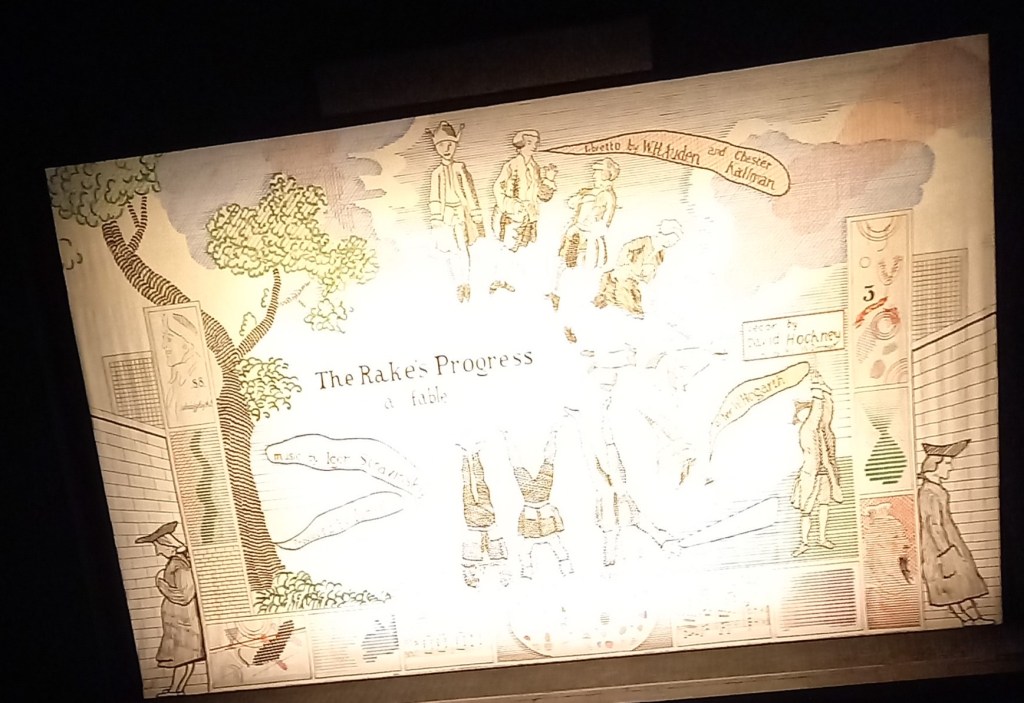
Hockney’s sets are built and designed around the Hogarth engravings, and created so as to seem as though drawn/painted in great detail, with small criss-cross, wavey lines. There are many memorable images – the front cloth (inadequately photo’d below), Bedlam, the churchyard, the opening scene in Anne’s house and the wonderful decorations and paintings in Tom’s London town-house…… The props designed for the auction by Hockney are wonderful too – the drawing-like Great Auk, for instance…..I guess the one drawback of letting a famous painter loose in the theatre is that there’s an awful lot of set-changing and clunky 3-4 minute waits. There’s no use of a core set which adapts for different acts in this production! But there is a real sense of the Hogarth engravings somehow coming alive before your eyes which is very remarkable to see and hear, an effect heightened by clever costume designs and make-up. John Cox’s direction of the singers makes the most of the jokes without becoming crude, and always is at one with the music.
Although I heard another concert performance of the work in 2018 (LPO, Jurowski) this was the first stage performance I have seen of this work. I was bowled over by the wit and wisdom of the text, particularly the religious undertones that were important both to Stravinsky and Auden. And I hugely enjoyed the music too in all its cleverness and sparkle and melancholy (has there been more haunting song written in the last 100 years than Anne’s lullaby for Tom in the churchyard?).
Of the singers, the standout performance was Nardus Williams as Anne. Though she’s not got a big voice, she projected well and produced some wonderfully soft singing and phrasing. Maybe the role doesn’t need a strong actor, but she was good at being still and having a calm presence, which is what the role requires. Sam Carl as Nick Shadow was strong, pointing the text well and having a lowering stage presence. He has some funny lines and delivered them well. Frederick Jones as Tom Rakewell was maybe slightly bland, with less of a nuanced approach to song and text, but maybe that’s ok with this character. Rosie Aldridge went hell for leather with Baba the Turk, as one has to, I guess (not a role for subtlety).
Keřem Hassan conducted, effectively, as far as I could tell. The MK Theatre has a dry forward acoustic and sometimes the orchestra seemed to be playing too loudly (eg the discordant woodwind in Anne’s lullaby. Whether that’s something Mr Hassan could have done something about I’m not sure
A great evening……and one which the audience much enjoyed too (and the house was pretty full)
In between La Traviata at Covent Garden and The Rakes Progress in Milton Keynes I went to a surprisingly enjoyable lunchtime recital at St Olave’s church near Fenchurch St station. This was given by young Colombian coloratura soprano Meliza Metzger. accompanied by Michelle Chow. There were arias by Mozart, Rossini and Donizetti, and two of Adele’s arias from Die Fledermaus. Michelle played extracts from two Scarlatti sonatas.
Though its difficult to know how her voice would sound in a big opera house Ms Metzger projected splendidly in this church context. She dealt with the coloratura runs accurately and confidently and hit the high notes with panache rather than timidity. She projected the text well. Maybe there could have been a bit more variation to phrasing at times and – with Adele – a bit more characterisation (I would be happy to be proved wrong , but it sounded to me as though she was less comfortable singing in German as opposed to Italian). But it was thoroughly enjoyable to hear her in these pieces. And I enjoyed the Scarlatti too – there’s so much music to hear that I know next to nothing about. I have one CD of Scarlatti sonatas – there must be 100’s of them!
Anyway, this was a thoroughly worthwhile hour of listening to unfamiliar music.
Director, Richard Eyre, Designer, Bob Crowley; Conductor, Antonello Manacorda; Violetta, Lisette Oropesa; Alfredo, Liparit Avetisyan; Germont, Christian Gerhaher
This was the first ‘live’ Traviata I’ve been to since the one at Covent Garden in the 70’s when Ileana Cotrubas was Violetta in a new production, though I did see a film of the current ROHCG production ‘live’ in 2019 (see blog around early 2019).
The sets and production are at the service of the music and drama, and, in a good sense, don’t get in the way, with period, glamorous costumes and a required bit of spectacle in the gambling/ballet scene. The only set I would question would be the one for the last Act, where Violetta’s bedroom simply looks too big, and a more confined space would have aided the sense of illness and oppression (it was also in this act that there was a rare technical glitch, with the lights coming on to represent sunshine before the blinds were open!)
I always, as I have said elsewhere, always been a bit disdainful of Traviata, as being sentimental and full of too much ‘oompah’ music and trite tunes. This is silly, I know……however I felt particularly stupid as I listened to Antonello Manacordo’s reading of the score, which was taut, exciting, beautiful when it needed to be, and very well phrased. The ROHCG orchestra sounded excellent. There was one point – I can’t remember whether in the gambling scene or the last act – when Manacordo almost made the coming together of Alfredo and Violetta sound like Tristan, such was the intensity of the playing!!
This work depends crucially on the ability of the singer playing Violetta to be a credible actor, to project a whole range of emotions, characterising aspects of the role through her voice in two hours and 10 minutes of almost constant on-stage presence, and to have the vocal ability, stamina and technique to deal with the coloratura elements of the role. I wasn’t originally going to go to Traviata at all but as soon as I heard Lisette Oropesa as Gilda in Rigoletto (see blog) I raced to the ROHCG website and bought just about the last decent ticket in the Amphitheatre, foregoing an evening of Shostakovitch string quartets at Milton Court. Lisa Oropesa was – no other language will do – stunning as Violetta. She has a totally confident technique which allows her to produce stunning top notes (as in Sempre Libre), coloratura runs, and an immense variation of volume, vocal colour and tone. Her intrinsic vocal sound is beautiful – a sort of smoky sound, if that makes sense. She projects the words well and acts very convincingly. This is one of the finest, all-round, operatic performances I have ever seen – the sort of performance that gives some confident backing to my feeling that, at its best, there’s no other art form that can beat opera
Liparit Avetisyan as Alfredo had also been in Rigoletto with Oropesa earlier in the season. I was much more impressed with him here than in the former work. Though he is a bit stolid on stage and doesn’t particularly project much of anything (possibly a fault in Verdi’s characterisation?) he offered us some sensitive soft singing – altogether more varied than when he was the Duke of Mantua. There’s been a lot of critical discussion about Christian Gerhaher’s Germont, with some feeling he produced singing that was unidiomatic, and ‘choppy’, un-legato-like. For, me this was simply his representing the pent-up fury of an elderly gentleman seeing his ambitions for his family collapsing around him, and I thought it worked well – his singing of some phrases was very lovely.
All in all – much to my surprise – a great evening!!
Britten, Ireland and others: settings of poetry by Thomas Hardy; Finzi: Song cycle: Before and After Summer: Roderick Williams, baritone, Christopher Glynn, piano; also for a few songs Gareth Brynmor John, part of the ‘Momentum: Our Future, Now’ initiative
I wondered why there was such assiduous queuing going on for this event – people started queuing for the doors to open a quarter of an hour beforehand….my answer came as the lights went down. For a song recital, even one entirely in English, it’s always good to be able to see the words on the programme – however at the Crucible Studio only the first few rows have sufficient light for you to be able to do that! Sure enough, all the early queuers I’d noticed had indeed grabbed the ‘limelight ‘ spots.
The Crucible Studio is really a wonderful place to experience a song recital – you’re so near to the singers, and they really (at least these singers) seem to like that sense of closeness (though the closeness might have issues associated with it in these pandemic-infested times, but nobody seemed that bothered about the issue). It was a pity not to be able to read the words in the programme as none of the songs were known to me apart from those from Britten’s ‘Winter Words’ cycle. Roderick Williams (who gave an excellent introduction to the songs) was outstanding – the shadings he could give to his voice, the clarity of his enunciation and (something you only see close-up) the projection of personality (or acting, if you like) were all really first – class. His colleague Gareth Brynmor John if anything had a more beautiful-sounding voice but wasn’t able to match Williams’ shadings and projection. The second half was entirely taken up with the Finzi cycle ‘Before and After Summer’. I like Finzi in short doses but maybe 40 minutes of him is a bit much – though very sensitive to the words, the music is just a little too much the same…..On the whole, I enjoyed the first half more. Still, while an hour and a half of uncompromising Hardy gloom in prospect was uninviting – it’s to the credit of a varied set of composers and to the two singers that it felt neither unvarying nor depressing
Mendelssohn A Midsummer Night’s Dream: Scherzo, Nocturne, Intermezzo, Wedding March;Ryan Wigglesworth Piano Concerto; Schumann Symphony No.2. Ryan Wigglesworth conductor,Marc-André Hamelin piano, Halle Orchestra
This was my first time in Sheffield City Hall for, I think, almost two years……I was struck again by its very dead acoustic; in the space after a loud orchestral chord instead of appealing reverberations there’s a sound like a football bouncing off a formica table. Apparently people have been talking about its unsatisfactory acoustics since the 1930’s but no-one seems to have come up with a solution…..
For some reason I had chosen to sit in the front row of the stalls – this means that you’re up, close and personal with the violins but everything else seems to be happening at a distance over your head. In that unsatisfactory position and acoustic, the Halle still sounded very good indeed – violins in particular really together and sharp (as in ensemble, not tuning . I counted just one slight early entry from a single violin in the piano concerto, but otherwise they sounded razor-edged)
The Mendelssohn MSND extracts were very enjoyable – it’s a long time since I have heard this music. I was struck by the similarities between some of the music and early Wagner – Mendelssohn, Schumann and Wagner were all born within 4 years of each other, all were around in Leipzig during a similar period, yet there is little I heard this evening that connects Wagner with Schumann, while with Mendelssohn there are many similar turns of phrase and melodic cells. Interesting…..
The Wigglesworth piano concerto was a hard nut to crack, for me anyway, and I can’t say I enjoyed it as much as some other contemporary works I’ve heard recently. My understanding wasn’t helped by the fact that seemingly City Hall had given up on issuing programmes, so I was unable to know in advance the structure of the piece or get any advance notice of particular aspects of it. The piano concerto is in 4 movements, and I enjoyed the third one (Notturno) best – into a strange arid and disturbed landscape of meandering strings, the piano brings at (I think two) points a simple melody – I thought it might be Chopin but apparently it’s a Polish folk tune – which is very touching, and gives a sense of incredible loneliness and desolation. I also got on with the first movement reasonably well, where the strings seemed to have a set of Mahler or maybe Berg-like themes to play while the piano wandered through this density with a cool calm set of reflections. The scherzo and the final fugue made little impact on me, I’m afraid.
For some reason, while I have known the 1st, 3rd and 4th symphonies of Schumann since I was a teenager (with vinyl recordings by Furtwangler and Solti) I never listened to the 2nd symphony to the same extent, so it is only more recently I have come to appreciate it. While commentators often talk about the symphony being linked to the recovery of Schumann from serious illness and his relationship with Clara Wieck, to me it always sounds as though it is linked to the mental illness he suffered from – now thought to have been a combination of bipolar disorder and perhaps mercury poisoning which led to “manic” and “depressive” periods. The scherzo 2nd movement, with its obsessive repetitive rhythms, is, to me, pretty manic, and the slow movement is then a wonderful reaction to it – not dangerously exalted, but a deeply felt reflection. The final movement then does sound genuinely like an overcoming of illness, and is very moving in its energy and joy. I thought the Halle’s performance was very good – maybe not with the sweep and grandeur that a Berlin Philharmonic could bring, but with precision and energy. Wigglesworth, like Mark Elder, splits the violins across the stage, and this led somehow to a lot more energy in the orchestral sound in the outer movements, while giving a real bloom to the reflections of the slow movement and its wonderful melodies. Maybe there wasn’t quite the fullness of some performances in the first and last movements but still – an excellent rendering of this work………..
Obviously, 92 is a good and very advanced age to get to, and so, in a sense, it wasn’t very surprising to hear that Bernard Haitink had died, on Friday. But it is still sad to see another part of my teenage years of coming to classical music – and always thereafter –passing away, after Solti, Abbado, Kleiber and others. He was perhaps the last of that stellar group of conductors brought into prominence particularly by the recording industry from the 1960’s to the 1990’s .
I saw him conduct mainly in the 1970’s and then more recently from about 2008 onwards (in between I was working overseas or with family responsibilities, so my concert-going was much more selective). I remember his Mahler 2 at the RFH and many Proms – Mahler 1, 2 ,3 , 5 , 6, and 9; Bruckner 2, 5, 8 and 9, as well as Tchaikovsky, Britten, Dvorak and many others from the 70’s. More recently I heard a Mahler 9 with the LSO in about 2009, a Bruckner 9 with the VPO in about 2012, an astonishing Mahler 3 with the LSO in 2016, and then several concerts in the 2017-19 period: a wonderfully relaxed Brahms 2 with the LSO in 2017, a Schumann 2 with Gustav Mahler Chamber Orchestra in 2018 and a Mahler 4 with the LSO finally in 2019. The one time I heard him conduct Wagner was ‘Siegfried’ in 1990 at ROHCG, with Rene Kollo as Siegfried – a fine performance, I remember.
I think my biggest disappointment is never to have heard him in the opera house apart from that one Wagner performance. I missed his entire tenure at Glyndebourne and the rest of his time at Covent Garden.
I think I probably took him a bit for granted when I was younger. Only in the last 15 years did I fully appreciate the way he could create a special aura over a piece, so that its structure was clearly expounded, and the performance seemed absolutely ‘right’; and at the same time he encouraged the players to a pitch of intensity in a performance I have rarely heard in the concert hall, and with only a modicum of expressive gestures. What I noticed, sitting in a RAH Choir seat for that memorable Mahler 3 in 2016 , was the power of the cue-in glances he gave to members of the orchestra as they played – both encouraging and vigilant. That performance, though slow by the clock (105 mins, someone said) was utterly transfixing – the music of the first movement flowed unselfconsciously; the great chasm of the third movement, when the scurrying of the animals seems to suddenly die away and you’re left with a sense of the immensity of the universe, was shocking; Sarah Connolly in the 4th movement was unbearably moving in the Nietzsche song, and the final movement just grew and grew in waves of sound that were overwhelming at the end. That performance was a great tribute to Haitink’s art. On the other hand, I’m ashamed to say that, while my South Bank Centre account assures me that I went to – or at least bought – tickets for – a concert in September 2009 consisting of Haydn’s Clock Symphony and Bruckner 7, with the Chicago Symphony, I have absolutely no memory of this event. I wonder why this is?…..maybe Haitink was sometimes too easily taken for granted and it is only now he’s gone that we shall realise what we are missing.
I hope the BBC will repeat the splendid documentary they made of his life soon
 John's musical journey