Gustav Mahler Youth Orchestra, Daniele Gatti, Conductor.Gustav Mahler: Adagio from Symphony No 10; Symphony No 1
I spent the earlier part of the day at Wittenberg – or rather Lutherstadt Wittenberg. I went to the Lutherhaus, and the Schloss church, where Luther is buried. The museum at the Lutherhaus is very fine and thoroughly informative – Luther’s house is in fact his old monastery which he, his household and his students/academic and domestic staff took over after the early 1520s with the agreement of the local ruler.
The evening’s concert encompassed both the beginning and the end of Mahler’s symphonic oeuvre – an interesting piece of programming. This was, however, as I suspected it would be, not a great evening – though let’s be clear I’m judging this by the very highest standards (as is of course appropriate for a Festival). I’ve mentioned Gatti’s Mahler before (see review of Mahler 5 four days ago …..seems a life time…!). Both the Mahler 1 this evening, and the Mahler 4 some years ago had the same characteristics I associate with Gatti’s conducting – exaggerated tempi, arbitrarily slowing down or speeding up, and emphasis on beauty of sound for its own sake. The Mahler 1 started ridiculously slowly in the beginning of the first movement and the latter ended ridiculously fast; there was an extraordinary slow down the second time the second main theme occurred in the finale; the ending was raucous; and so forth. This performance annoyed me a great deal. The adagio of Mahler 10 was better but was not as intense as the CBSO one on Sunday.
In addition, while the orchestra plays very very well, and clearly has some very talented young players, there were sometimes problems at moments of transition, when there was a less than total unanimity of ensemble – which I guess is due to their not playing together as a permanent ensemble and some hesitancy as to how one section joins in with another (or it might have been Gatti’s beat – though he seemed to be giving very clear directions to the young players………..)
This was the sort of evening where you think that maybe there’s too much Mahler being played, and that conductors get to feel they can only make an impact on their audience if they exaggerate their approach to the work or do something unusual. I hadn’t appreciated until reading the programme notes for the concert that in 2024 Gatti takes over from Thielemann in Dresden. That, sadly is somewhere I’ll probably be avoiding for the next few years then, though I could imagine he’s an excellent opera conductor
Budapest Festival Orchestra, Iván Fischer conductor: Gustav Mahler — Symphony No. 9
I spent an agreeable 3 hours going to some Leipzig museums – first of all the contemporary history forum, which is about the history of the DDR (and very informative, with all signs in condensed form in English) and then, at the Town Museum, the exhibition ‘The Music City Leipzig under National Socialism – Clef and Swastika), where printed English guides were available; this too had a range of fascinating exhibits outlining those who left Germany in 1933, those who lost their jobs but had no option but to stay in Leipzig, those who carried on but lay low to the extent they could, and those who actively collaborated (including Richard Strauss at first). The other name I’d come across before was Hermann Abendroth, who’d initially been dismissed from a post in 1933 ‘because he employed too many Jewish artists’, but subsequently got a job with the Opera House. He had to join NSADP in 1937, but was quick to be de-Nazified after the war
So…..Mahler 9 with the Budapest orchestra, whose performance had received some rave reviews in London when they were visiting there last week. Expectations were high and were more than met by this performance, which must be just about the best of the 9th I’ve ever heard live (here we go again into my list of superlatives, but I can only tell it as it is).
Mahler 9 is both impassioned and resigned, about whatever we think it is about – one’s own mortality, the serious business of trying to live life honourably, whatever. There are some clues as to how Mahler felt about it himself – the reference to Kindertotenlieder right at the end of the last movement, and to Beethoven’s Les Adieux sonata, and there is even, Stephen Johnson told us before the concert, some evidence from recent research that ‘Abide with me’ was the hymn that Mahler heard being sung at the fireman’s funeral in New York that produced the muffled drum stroke for the 10th, and which so sounds like the first few notes of the Adagio’s main melody. However, as again Johnson pointed out, this symphony more than most is surrounded by myths, and it’s important to remember that it is not a ‘farewell to life’, given that it was written long before Mahler’s last illness, and he had many months of energetic programmes in New York to conduct in, and the passion for life is just as important as the fear of or resignation to death in the work. However though the break-through moments which some of the other symphonies possess appear, they fail in this symphony. The most obvious one is the slow part towards the end of the third movement – the melody is too saccharine, and fails to take off, becoming merely sad, and mocked by the orchestra – the extraordinary clarinet passage which mocks the tune, for instance. I also detected somewhere – can’t remember where, maybe the first movement – that there is a flute solo which sounds extraordinarily like the flute solo. in the finale of the 2nd symphony but which here fades into nothingness, rather than a choral hymn to resurrection. One interesting thing I didn’t know – again from Johnson – is that ‘ewig’ and the same two note sequence represented by that word features in the ending of the 8th, obviously the end of Das Lied vin der Erde and also – the two notes – at the beginning of the 9th Symphony.
In performing this work well, I guess you need to have a first class orchestra, and a conductor who gets the right balance between passion and resignation, so that the work neither becomes overly-manic and fidgety or too slack and slow (Wagner’s conducting theories again about melos and tempi). The orchestra sounded magnificent – somehow a darker sound to the massed strings than some I’ve heard this week, and with very fine section leads – in particular horn, trumpet, flute, oboe and clarinet. However they didn’t have – or weren’t encouraged to have – that slightly show-off sense of beauty for its own sake that one can sometimes get from other front-rank orchestras – everything fitted into a vision of the work. The orchestra was placed with double basses along the back of the stage, violins split, cellos to the left, which all seemed to make the string sound richer in texture. The first movement was quite phenomenal – taken at a relatively quite fast past, it gripped me in a way I’ve never heard live before – the opening theme achingly beautiful, the climaxes enormous and frightening, the sadness at the end of it almost overwhelming. The sheer volume of the climaxes was quite extraordinary. The second movement was also quite fast, but still clod-hopping and rough enough in feel, and still allowing for sufficient room to be able to speed up in the manic bits. The third movement on the other hand was slower and the steady tempo allowed all notes to be heard and a clear rhythmic pulse established, the contrapuntal detail to be audible, and a manic speed-up at the end to be achieved without a scrabble – all while being played with accuracy and venom. As a result the movement sounded grimmer than it sometimes does more bitter and it never degenerated into just being an orchestral showpiece. The last movement was extraordinarily fine, with again not that slow a basic tempo. This emphasised the passion for life in this movement as well as the tragedy of the great climaxes. The strings digging in to their unaccompanied 4 note passage in the last of the climaxes was a sound so intense it was almost unbearable to listen to. Equally the strings slowly dying away at the end were very memorable.
Justifiably this performance got the loudest cheers and most people on their feet of any performance so far this Festival. Half way through the Festival it’s this performance and the Concertgebouw’s No 5 that have been the stand-outs.
Bavarian Radio Symphony Orchestra, Daniel Harding: Gustav Mahler – Symphony No 7
I spent the earlier part of the day in Eisenach, about an hour’s train ride from Leipzig, the birthplace of Bach with a fine Bach Museum, rather better than its cramped Leipzig equivalent, and including an hourly concert for 20 minutes of extracts from Bach’s keyboard music played on a domestic organ, a clavichord, a spinet and a harpsichord . By 5pm I was back in Leipzig at an English language talk by Anna Stoll-Knecht (Locarno) on Mahler and Wagner (it being Wagner’s birthday), with particular reference to conducting Wagner in Leipzig. One thing I hadn’t appreciated is that Cosima and Mahler collaborated closely on finding and training singers for Wagner roles and were in regular touch with each other from the early 1890’s to mid 1900’s, until she abandoned Mahler because of her indignation at the innovative Roller sets in Vienna. We were also played a brief extract from Karl Muck’s 1928 recording of Parsifal as the next best thing to hearing Mahler conduct – I used to have that recording in vinyl, and was reminded how good it was I took immediate steps to get a digital version this morning. The speaker focused on Wagner’s theories on conducting – that the key things are getting the melodic line clear, getting then the tempo right, and ensuring that transitions from one tempo to another are gradual and not lurching. Mahler’s early reviews suggested he hadn’t taken that advice yet when he was conducting in Leipzig – there are references to ‘jerkiness’, over-excitability etc
And so to Mahler 7…… Stephen Johnson made the – I thought quite helpful – comment in his talk before the concert started that (quoting Abbado) we shouldn’t be trying to make sense of this work; we should just enjoy its very different moments, its wonderful instrumentation, the thematic material. It’s in a way Mahler’s most mindful symphony. I think you can be a little bit bolder than that, personally, and that the comments in programmes notes that you find talking about the work as an evocation of ‘night’, is fair enough. There is a certain sort of darkness about the first 4 movements that I can relate to this (and, according to Johnson, Mahler is said to have announced loudly to an orchestra when he was rehearsing the work, when he got to the finale, “And now…….this is DAY!’ I followed that mindful advice, though, and found it helpful. If you take that view about mindfulness, however, almost automatically you’re going to prefer the clinical precision, the remarkable focus on detail that the Berlin Phil and Petrenko offered at the Proms last September, as I reviewed here at the time. Harding’s reading, with another great orchestra (now of course Rattle’s) did not have that degree of forensic detail and exquisite moments. What it did have was bundles of energy. With my mindful hat on, and not bothering overmuch about what the symphony is ‘about’, I loved particularly the finale, which gripped me more than any other live performance has done, and which was brilliantly played by the orchestra. But sometimes I felt that Harding was trying too much to emphasise certain points, to make things in a sense ‘meaningful’ . But there were superb solos by almost every section principal, and the orchestra was wonderful. The performance got a big ovation from the audience (though not on the scale of the Concertgebouw’s 5th on Saturday. Interestingly, having a drink afterwards with someone I’d met on Friday’s guided tour, afterwards, we overheard two blokes at the next table talking about Mahler and Wagner. They stopped to have a chat when they left and one of them turned out to the (excellent) conductor Mark Wigglesworth, who agreed that the 5 movement don’t fit together very well – they seem to come from different symphonies, he said
City of Birmingham Symphony Orchestra, conductor Robert Trevino : Gustav Mahler — Symphony No. 10 (arrangement by Deryck Cooke)
Mirga Gražinytė-Tyla was meant to be the conductor for this concert but she pulled out a week before the event – as she had been conducting in Rome a few days earlier on May 13 and was due to be conducting this in Birmingham around the same time, I’m not quite sure what was happening with her programming…..I’d not heard of the replacement but he is apparently a frequent visitor to Leipzig. It’s a pity not have heard Mirga conduct this work – I usually find her concerts inspirational.
I came to this concert with some trepidation. I can see why the CBSO were invited to the Festival – Nelsons used to be their chief conductor, Mirga was his successor, they have had a succession of winners as conductors that has given them a lot of kudos (Rattle, Oramo, Nelsons himself, Mirga) – but it’s still a bit of a leap from the three orchestras we’ve had so far to the CBSO. How would they fare?
The answer is….very well indeed. The CBSO is not the Concertgebouw, and no British orchestra in my experience (and I am happy to be told otherwise) apart from arguably the LSO has the kind of weight and thickness of string sound that the best central European orchestras have (and the Concertgebouw) – though the Halle are pretty stylish string-wise. But there were virtuoso performances from (particularly) the first trumpet (and his back-up in those searing long trumpet notes), and the first flute, and in general excellent tight ensemble. What the CBSO strings did have is a sort of acerbic lightness that goes very well with the sound world of this symphony. I was touched to hear someone next to me (I think – my German is minimal) say to his neighbour ‘They play like a German orchestra’. High praise indeed!!
I got to know this work through the first recording of the Cooke performing version – the Philadelphia/Ormandy recording. That was of Cooke 1, but in fact Deryck Cooke revised it another two times. It was interesting to hear some of the (minor but audible) changes he made, adding more texture and depth to the orchestral sound
It is very easy to read Mahler’s life a little too smoothly into his works. As Stephen Johnson (who’s giving an English language lecture before each symphony in the Gewandhaus) mentioned, the enormous dissonant crash with the high trumpet in the first movement was added at a fairly late stage in Mahler’s development of the score, so it’s reasonable to assume that it is a response to the news of Alma’s infidelity in the Spring. But this work was being developed alongside the enormous triumph of the first performance of the 8th Symphony in the summer of 1910 in Munich, which established Mahler publicly as an eminent composer who was also a conductor, rather than vice-versa. Though he obviously knew of his heart problems, he had no idea at that point that he was going to be dead within a year. So while there is clearly an emotional journey in this work, it is not necessarily about a dying man, and may have (pure conjecture of course) more to do with his continuing grief for the death of his eldest daughter, and Alma’s adultery.
The symphony’s structure is much harder to ascertain than the first 7 symphonies, and it comes as no surprise that, according to Donald Mitchell, there is evidence that Mahler had some uncertainty about the order of the 5 movements as he developed the work. Essentially, we have a first movement that moves between consolation and bleakness, a second that is quite jolly, the deadly serious Purgatorio, the violent 4th movement and a final movement that brings back consolation to the fore. It is more difficult for a conductor and orchestra, therefore, to take us on a journey through this work which makes emotional sense than, say, the 5th Symphony. The best thing about this performance was that the journey was clear and made sense. Key elements were:
The shattering climax of the first movement, which was brilliantly done, and overpowering in volume (the trumpet and high strings were extraordinary)
The clarity and rhythmic impulse of the second movement
The depth of the sudden upswelling of emotion half-way through the Purgatorio movement, which is, if not a break out moment to something ‘other’, then certainly the turning point of the work, where it’s recognised that the status quo, the continual grind, self-conscious jollity can’t continue, and that grim reality has to be faced and hopefully overcome
The jagged edges of the 4th movement – though there were moments when the conductor I thought went too fast and, though the CBSO kept up with him, some clarity was lost in terms of note-value
The beautiful way in which the consoling song of the last movement unfolded, and the passionate climax and upswelling at the end
So, all in all, a performance I appreciated very much of a work I haven’t heard very often live in the concert hall in the full performing version. One thing I noticed which I hadn’t before is the occasional influence of Parsifal on the score – Mahler didn’t, I think, conduct Parsifal in New York, taking the ban on complete performances outside Bayreuth seriously, but he did conduct extracts in New York and Germany. The opening of the first movement is very similar to the Act 3 Prelude, and at the end of the first movement there is a passage very similar to the closing bars of the Prelude to Act 1, as the curtain rises
What would have happened if Mahler had lived another 20 years – how might his work have developed? Stephen Johnson’s view was that the 10th symphony performing version suggests some very tentative answers – that he wouldn’t have tipped over into total atonality but, rather as Britten and Shostakovich did, used atonality within a fundamentally tonal perspective. But beyond that – who can say; how would WW1 have affected him? Would he have gone back to an impoverished and much reduced Vienna? Would he have been interned in the US? Sadly, we shall never know……..
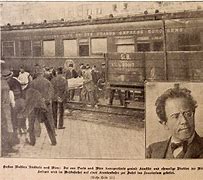
Mahler being carried off the train on his last journey, arriving in Vienna and reported by newspapers
Organist: Michael Schönheit: Johann Sebastian Bach — Fantasia and Fugue in G minor BWV 542 (in the version by Karl Straube); Franz Schmidt — Chorale Prelude “Nun danket alle Gott”; Max Reger — Introduction and Passacaglia in D minor WoO IV/6; Franz Schmidt — Lento – Interlude I from the oratorio “The Book with Seven Seals”; Franz Schmidt — Vivace ma non troppo – Interlude II from the oratorio “The Book with Seven Seals”; Franz Schmidt — Allegro molto moderato – from the oratorio “The Book with Seven Seals”; Franz Schmidt — Prelude and Fugue in D major (“Hallelujah”); Max Reger — Fantasia and Fugue on B-A-C-H op. 46
After a pleasant hour and a half at the Fine Arts Museum, I went along to St Thomas’ Church. This was a very great deal of noisy dense organ music and I realised for music of this period on this instrument it would have been much easier to hear it and understand what was going on in the Gewandhaus hall as opposed to the (inevitably) very resonant and muddy acoustic of a church. The Bach arrangement by a former cantor of the 30’s and 40’s in St Thomas’ Church was monstrous in its pomp and solemnity, whether Wilhelmine or National Socialist I’m not sure. The Regier pieces were much as I imagined they would be – dense, academic and difficult to listen to. The most attractive pieces were by Franz Schmidt, perhaps because they had a narrative backgrpund – and the apocalyptic suits the sound of the organ. I must give the Book of the 7 Seals and some of the symphonies another try – I do have the recordings.
Royal Concertgebouw Orchestra, Myung-Whun Chung Conductor: Gustav Mahler — Symphony No. 5
It’s nearly two years since I last heard this work live – a moving occasion at the Proms in 2021 when a scratch orchestra of all the freelance musicians who had been out of work for the past 18 months, because of Covid, had conducted by Mark Wigglesworth – an occasion , with a huge albeit distanced orchestra that just wouldn’t have been imaginable 8 months earlier. The last time I heard the Concertgebouw orchestra was about, oh, 6 or 7 years ago at the Proms – before Daniel Gatti was sacked. I think I’ve written somewhere else here that I was left, after the Concertgebouw Mahler 4 which Gatti conducted then, asking myself why an orchestra which had played so beautifully had given such an ultimately unmoving performance. None of those qualms here…….Although I seem to be reaching for superlatives in these reviews rather often, I simply cannot recall a more moving, life-affirming or memorable live performance of Mahler 5, and that includes Haitink, Rattle, and Honeck from the past. No, it didn’t match the famous Mahler 5 that Bernstein and the VPO gave in 1987 at the Proms (which I heard a broadcast of by the BBC during the 2020 lockdown but was away overseas for at the time) but in terms of what I’ve heard live, this was the best! And, like after my last experience with the Concertgebouw, I’m asking myself – why? These are some thoughts:
I think a lot of it had to do with the conductor, Myung-Whun Chung. He gave purpose and direction to the whole performance – often quite boldy; he was not afraid to slow down or speed up, sometimes quite dramatically, to make a point, to relish a moment, to support the overall architecture. He was also quite clear as to the direction of the symphony – the pivotal point (the last one of this kind in Mahler’s symphonies), another of those break-through moments, is the first appearance of the chorale theme which comes back at the end of the finale, in the second movement. This was taken very slowly, building up to a huge climax that was quite overwhelming. His handling of the Adagietto was slow – someone who I was talking to afterwards, looking surreptitiously at his watch, made it 11 minutes, not far short of Lenny’s 13 – but beautifully shaped, with an utterly memorable climax – I’ll long remember the lower strings digging in for their lives at that point. Whatever his choice of tempi, they seemed right in the greater scheme of things, and as a result I was wholly focused throughout – I can remember times when I’ve lost focus a bit with the repetitions and false endings in the 2nd and 3rd movements. In his conducting style it was crystal clear what he wanted, with emphatic lunges to make a point, As a result of all this, the finale seemed utterly joyous and again I was transfixed throughout – the chorale tune’s re-appearance again, enormously slow, was quite wonderful. The final point to make was that Mr Chung (if that’s the right name to use) was very good at helping the orchestra to achieve an effective balance, so that inner voices could be heard, and there were many moments when a clarinet or bassoon burbled unexpectedly, and voices popped up which were new to me.
I guess, aided in the performance by the acoustics of the hall, the other factor was simply the quality of the playing, in all departments. The first trumpet, the horn section, woodwind principals were all magnificent. And somehow – one of those things that sometimes happen in live concerts – the whole became much more than the sum of its parts, a vast breathing organism, with immense power. The adagietto started as a whisper, the last movement ended fff fff. The Concertgebouw PR machine sometimes quotes a critics’ survey a few years ago which rated it ‘the best orchestra in the world’. They were certainly at that level last night.
I’m happy to report that I wasn’t alone in my reaction to this performance. Most of the audience was on its feet at the end, and those I spoke to afterwards – a group of people I’d met on the guided tour on Friday – had similar reactions…………….
Frank-Michael Erben violin, Anton Jivaev viola, Valentino Worlitzsch cello, Yulianna Avdeeva piano: Gustav Mahler — Quartet for Piano, Violin, Viola and Cello in A minor; Alfred Schnittke — Quartet for Piano, Violin, Viola and Cello in A minor; Johannes Brahms — Quartet No. 1 for piano, violin, viola and cello in G minor op. 25
The Mahler Quartet is a – dare one say it – fairly anodyne work, only about 11 minutes in length, sounding vaguely Brahms (and Mahler did know Brahms and there are accounts of the two going out for walks together. So anodyne was it that I drifted off to sleep after about 8 minutes and then woke up to some fairly frantic violin screechings, which was a short piece by Schnittke entitled ‘nach einem Fragment von Gustav Mahler;, which as far as I could make out from the German-only programme was a discarded piano piece. I can’t say I had my head round this. The major work then was the Brahms, which I found I really didn’t know at all but much enjoyed, and have it on again as I am writing this on my computer. The Quartet players seemed to enjoy it hugely and so I did I. I realise that I know the 2nd Quartet for Piano and Strings reasonably well, the others not at all. I must give Brahms’ chamber music a concentrated listen when I get back home
Before going to this afternoon concert I had spent about an hour in the Mendelssohn house Museum. As our guide yesterday said, it is indeed a model of what a music-based museum should look like, and had many interesting exhibits – including a special section on Fanny, Mendelssohn’s sister. Beautifully presented, there is enough English summaries to know what you’re seeing. There is also an interesting extract from a book by a music critic about the history of music, writing in the 1930’s about Mendelssohn, fully and enthusiastically endorsing the Nazi line – ‘Un-German’ etc. There is then an updated music history book from the SAME author in the 1970’s. The obviously anti-Semitic lines have been removed but there is still the fundamental Wagner-based anti-Semitic trope that Mendelssohn could not write ‘music of the soul’, and was fundamentally un-serious.
Munich Philharmonic, Tugan Sokhiev conductor, Christiane Karg soprano, Ekaterina Gubanova alto, Andreas Schager tenor: Gustav Mahler — Symphony No. 4 in G major; Gustav Mahler — Das Lied von der Erde
Before the evening concert, I did a couple of things:
I went on a 2hr 45min guided tour entitled ‘Mahler and Leipzig’ – this was not so much about Mahler as, after all, he was only in Leipzig for two years, but our guide (English-speaking tour, about 15 people) was hugely knowledgeable about other aspects of Leipzig’s musical history. We didn’t dwell much on Bach but there was a lot about Artur Nikisch, Mendelssohn etc. A large number of composers have passed through Leipzig, including Janacek and Grieg. She highly recommended the Mendelssohn house, which I must get to. She also was very interesting about the role Kurt Masur, with his various government contacts, had in ensuring that peace protests in 1989/1990 were met with no violence by the DDR authorities
I went to a 6pm musical service at the Thomaskirche, essentially a form of Choral Evensong, with Bach Motets BWV 226,228 and 229, as well as a 16th century setting of the Nunc Dimittis (but no Magnificat) all sung alas not by the Boys Choir but by the very good Saxon Youth Choir
When I bought my tickets, in October 2021, the evening concert was due to be conducted by Valery Gergiev. He however was dismissed as conductor of the Munich Phil after Russia’s invasion of Ukraine, as a known Putin supporter, and Sokhiev was the replacement. The latter – I’ve not seen him conduct before – is an Ossetian Russian, one of the last students of Ilya Musin at the St. Petersburg Conservatory, who from 2014 to 2022 was Music Director and Chief Conductor of the Bolshoi Theatre in Moscow , and Music Director in Toulouse. In 2022 he resigned from both posts, feeling he had to leave both due to ‘current events’, and wishing to be even-handed.
This was a substantial concert – by far the heftiest of those I’m going to, and I have to say I was flagging emotionally by the time we got to Das Lied von der Erde, as maybe you’ll see below.
I thought the Munich Philharmonic sounded every bit as good as the Gewandhaus orchestra and of course both works give players more chance to shine as woodwind and brass individuals than Mahler 2 does. I also marvelled at the clarity, warmth and simply the volume generated within the hall, seated 4 rows from the very back. Given that the hall was a GDR product, and access to Western technology available at the time limited, it is even more a tribute to the quality of DDR architects, and sound engineers of the time that they got it so right.
I thought the Mahler 4 performance was quite outstanding. My view was perhaps coloured by reading somewhere recently a remark by Mahler I hadn’t come across before, that the so-called sleigh bells at the beginning of the work (which we automatically associate with Christmas via Lieutenant Kije) are in fact representing the bells on a jester’s hat; also, Mahler’s remark to Alma along the lines of ‘I can’t be happy if there is one person in the world suffering’. This symphony seems to me to be a lot about how suffering and darkness enters our lives at every stage, and that any resolution of life’s seeming futility into something making sense and being meaningful is complex, and we are left with an ambiguous ending. Perhaps in this work, these thoughts are refracted through the mind of a child, but the work lets us know that even there we find darkness as well as light.
Sokhiev and the orchestra were I thought extremely effective in bringing out the work’s ambiguities. This was done partly through extraordinary clarity in the orchestral sound, so that the glints, the undercurrents of disturbance and disagreement from brass, woodwind or strings are heard very clearly. It was also done through judgements on tempi – thus the first theme of the slow movement was perhaps faster than usual, less contemplative, expressing therefore more a simple joy in life, while the contrasting sad, slower than usual, sections of that movement seemed darker and gloomier than normally played, subverting that joy. As in the Mahler 2 dynamic contrasts were well handled too – but also ambiguous. Mahler 4, unlike the 2nd, 3rd and 5th symphonies has two ‘break-through’ moments – the point at which we sense something ‘other’, something more than the life we lead. In this performance though, the quiet string musings before the 2nd of those moments, the uproar of the ‘opening of heaven’ in the third movement, were not as quiet as they sometimes are and that seemed to make the uproar more knowing and the aftermath more saccharine. Likewise the sudden welling up in the 2nd trio of the scherzo seemed too loud, too self-conscious, for this to be a true realisation of sudden joy, and the following muted sniping trumpets were more telling.. Somehow, right at the end of the 4th movement, the harp sounded louder than usual, making it more like a tolling funeral bell than a quiet sinking into paradise. In all these sorts of ways, and many more, I found this a very telling subtle performance, emphasising the ambiguities in this work more strongly than I’ve ever heard before. I can’t honestly remember hearing a better one.
After this, I didn’t the emotional or mental energy to appreciate the performance of Das Lied von der Erde quite as I should have done. I think also, my sitting right at the back of the hall did make the voices, as opposed to the instruments, sound a bit distant. Again, I though Sokhiev and the orchestra were working wonders with the music – the funeral march in the last movement was magnificently bleak, the 2nd autumnal song was slower than usual and all the better for it, with wonderfully wispy strings; also – a small point, but one that I often wince at – the mandolin was kept under control when the singer in the last movement begins to sing ’Ewig’.
But obviously a performance of this work has to stand or fall by the singers. Ekaterina Gubanova and Andreas Schager are both opera stars whose work I have much enjoyed at performances over the last year. Schager obviously, as the current go-to Siegfried, has the vocal heft for his first and third songs – he was, though, unable to give pointing and delicacy to the 2nd of his songs, about the artists on the lake, Gubanova had somehow too generalised a voice – her diction wasn’t clear, the sound of her voice was lovely but she didn’t point words and phrases enough. I may be wrong about two people who I have great respect for as singers but somehow they didn’t really seem to me to be suited for these songs – you somehow need singers who can project the words and situation more clearly. In the case of the alto role, my gold standard is Janet Baker, who I heard live several times. This simply wasn’t in that league. So measured by any normal standards, this was a very good performance, but by Festival standards maybe slightly disappointing.
As a final thought, I wonder if they might have done this differently in terms of programming. The Festival organisers could for example have cut out Das Klagende Lied, for instance, later on in order to give DLVDE its own top billing………………..
Mahler Symphony No 2 in C minor: Gewandhaus Orchestra, MDR Radio Choir, Andris Nelsons conductor, Ying Fang soprano, Gerhild Romberger mezzo-soprano
Well, here I am in Leipzig with 11 days of concerts and talks all focused on Mahler (and some of his contemporaries). I am intending to have side trips to Eisenach (the Bach House there), and Erfurt and Wittenberg for the Luther connections as well, but for the main, this is a Mahler-focused two weeks, which I am much looking forward to.
Having collected a battery of tickets from the Gewandhaus box office and a Festival Pass, my first stop was to go to a talk on Bach and Mahler by Dr Peter Wollny, the Director of the Bach-Archiv (actually there was a brief even earlier stop as I misjudged the timing, got to the Archiv half an hour early and so then spent 20 minutes in the Thomaskirche being royally entertained by a rehearsal for an evening performance of Haydn’s Creation by the Saxon Youth Symphony Orchestra, with the famous ‘And then there was light’ passage). Mr Wollny’s talk was very interesting, The Archiv had recently bought from a private collector the complete Bach edition owned by Mahler (59 volumes, with Maher’s edition of the Matthew Passion missing – they are still looking for it), published from the 1850’s to 1890’s., as part of its research interest in the reception of Bach’s music in the 19th and early 20th centuries. 5 of these volumes had annotations in Mahler’s hand. They relate to a series of ‘Historical Music’ subscription concerts Mahler had given in New York (at a time, whether in the US or Europe, when Bach’s music was still very unfamiliar), and his annotations for the performances he gave. What he essentially offered was a Bach version of a late Romantic ‘Bach Symphony’ – 4 movements chosen from different Suites to represent a trajectory similar to a Beethoven symphony – slow introduction and Allegro first movement, Scherzo second movement, slow movement and fast final movement. Mahler’s annotations show that he was aware that the earlier view from Mendelssohn’s time, that one just played the printed notes on the page, was wrong, and that decoration was needed. Interestingly, though, there was no thought from Mahler of giving the performer more freedom to do this – the decorations / dynamics were meticulously laid out (in the same way as they are in his symphonic scores). Was he aware of the contrast between the imposition of his own views on Bach – mixing up Suites – and the micro-managed instructions for his own symphonies? – seemingly not (though it’s not clear whether he actually followed his own instructions when conducting his works, and certainly his pupil conductors all had wildly different views of how the symphonies went), It was moving to see three of these volumes on display, and realise that similar volumes would have been studied during Mahler’s summer composing retreats (Alma Mahler mentions he only ever played Bach in his composing hut), particularly the impact (in terms of Bach’s counterpoint) on the composing of the 5th Symphony.
….and then on to Mahler 2………..I have heard many fine Mahler 2’s over the years – Klemperer, Haitink, Boulez etc. This was up there with the best of them. The seats I’ve taken for this Festival tend to be at the top of the Gewandhaus hall – at Festival prices, and with 11 concerts to pay for, that was more or less inevitable. The sound though in the hall is extraordinarily good – resonant yet clear, and, from where I was sitting, all-encompassing at the loudest moments (which you need with Mahler), Compared to say sitting in the uppermost area of the Barbican it is an altogether superb acoustic.
I thought Nelsons’ conducting was excellent – it wasn’t in any way ‘showy’, it didn’t draw attention to itself – the tempi seemed right and considered throughout; there was little that was extreme (but that didn’t mean it was boring!) and it was in the best sense a modest performance – meaning not that it was undramatic – it absolutely was! – but rather that orchestra and conductor were felt to be entirely at the service of the music. The whole of the finale – which at least until the climax of the march can seem excessively episodic – sounded as though it had a clear forward drive. I liked too the way Nelsons handled the dynamics – the loud was really loud, the quiet whispered.
What must people have thought of this work in the 1890’s? – it’s quite unlike anything that could easily be heard at that point. Even 130 years later, the violent hammering of the climax of the first movement is jarring – and it seemed so again at this performance, even after my familiarity of over 50 years with this music. Adorno says “Mahler charges tonality with an expression it is no longer constituted to bear”. That strain was very clear in this performance, and the combination of orchestra and conductor’s approach to the music emphasised the screeching woodwind and the violence of the percussion and timpani. It is remarkable how Mahler uses music to prompt questions about ourselves, and the way we live our lives – really very little music does that so directly. The performers made the ‘shriek’ in the final part of the 3rd movement a very powerful statement that things ought to be better than the life we too often have
As before when I’ve heard the Gewandhaus Orchestra, the playing was truly remarkable – lovely flute playing at tha pivotal point in the finale, beautiful horn, oboe and clarinet playing, and some of the most emphatic timpani playing I’ve ever heard, together with the gorgeous phrasing of the strings – the thunder of the lower strings in the opening was memorable. The chorus was excellent and I really liked the contralto’s voice – warm and with many different colours; she offered us a memorable Urlicht
Inevitably there were a few niggles – the most important of which was that the soprano didn’t really emerge quietly and subliminally from the chorus in her first entry but came in with far too emphatic an entry. The brass had one or two fluffs to contend with – but these things happen…….But altogether this was an exciting, truthful and memorable performance
Bach The Art Of Fugue, Contrapunctus 14; Beethoven Septet; Brahms Piano Quintet in F minor
The programme for this afternoon concert was slightly re-arranged, so that the Bach was followed by the Brahms and with the Beethoven then in the 2nd half, Unfortunately, it was really the Brahms I had come to hear, and as I was off to Leipzig the following day, I am afraid I gave the Beethoven a miss and sloped off after the Brahms, during the interval.
The pianist was Kathryn Stott, who is a ‘guest artist’ of the Music in the Round chamber music festival of concerts this week, all of which except for this concert I shall miss. The Brahms was a very invigorating performance and it sounded to me very fine – it is a bit of a sensory over-kill when you are seated literally 4 feet from the piano, downstairs in the Crucible and so the music washed over me in a series of undulating crashing waves. I was never bored, but would find it difficult to be objective…………………….

 John's musical journey