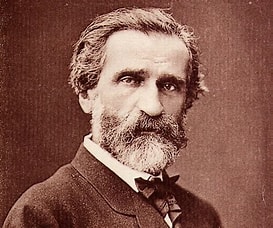
Verdi – Messa da Requiem; Sir Mark Elder conductor; Natalyia Romaniw, soprano; Alice Coote, mezzo-soprano; Thomas Atkins, tenor; James Platt, bass; Hallé Choir and Orchestra
Yet another work I’ve known since I was a teenager but haven’t heard live since the 1970s. I can’t remember who performed it or exactly when I last went to a live performance – I have a feeling it might have been 1972 at the Proms with Jessye Norman in the soprano role. For some reason the lending library recording boxed set I got to know this work from as a teenager didn’t have the LP side with the Libera Me final section of the Requiem on it. This final movement always comes as something of a surprise to me when I listen to it!
I know this work very well (apart from the Libera me) and it has one of the most perfect moments in music I know of in the Sanctus – the brief Hosanna section with the chorus, But I do have a problem with this work – or at any rate how it is often performed (and as it was performed this evening). Verdi’s Requiem concerns the most fundamental questions you can ask yourself, whether from a secular or religious perspective – what have I made of my life? Am I with the sheep or the goats? What will be remembered of me? What lasting good have I done for other people? The only ways of setting these words to music are those which communicate the solemnity, the drama and the tragedy/triumph of those big questions. I always find myself querying those who grumble about the over- operatic stance of the work – since opera as a medium is ideally placed to capture the emotions relating to these issues. It can be serious, comic, tragic, triumphant, with the audience intimately caught up with the drama. The problem with many performances of the Requiem, I think, is that, while things are fine when the choir is singing, or the orchestra given free-rein – the opening of the Dies Irae always sounds to me to be akin to the storm which opens Otello. – issues come with the soloists. The style and the very large role they have to play would indicate that they should treat their roles with dramatic bite and intensity. Unfortunately, both the nature of the words – ancient, Latin, religious – and the context means that often the soloists sing in a rather unengaged generalised manner and this was true of three of the soloists at this performance. The one person who really gave us the sense of a human being asking the questions I’ve outlined, and facing the reality of judgement, was Alice Coote who gave a deeply committed and powerful account with very effective projection of many of the words. She really gave us the sense of a human being struggling with their fate – her snarled “Quem patronum rogaturus, cum vix justus sit securus” was terrifying. The others were very good but didn’t project anything like the same intensity. James Platt was sonorous, Thomas Atkins (not a name I’ve come across before) had a very good ‘Italianate ‘ tenor voice. Natalyia Romaniw was more than very good – she floated beautiful high long-breathed notes, her silvery voice was a pleasure to listen to but she didn’t really make much of the text, and her head sometimes seemed buried in the score – she wasn’t treating the work as a dramatic event, whereas Alice Coote’s eyes were constantly and intensely on the audience.
The Bridgewater Hall was pretty full for this performance. The line-up of soloists, as I say, was impressive and the Halle Choir large and capable. The Halle Orchestra sounded splendid – I noted some beautiful bassoon playing and a sumptuous string sound. My only criticism was that the offstage trumpets sounded a bit too distant and ethereal. So, this for me had many aspects of a very good performance but not, I think, a great one.
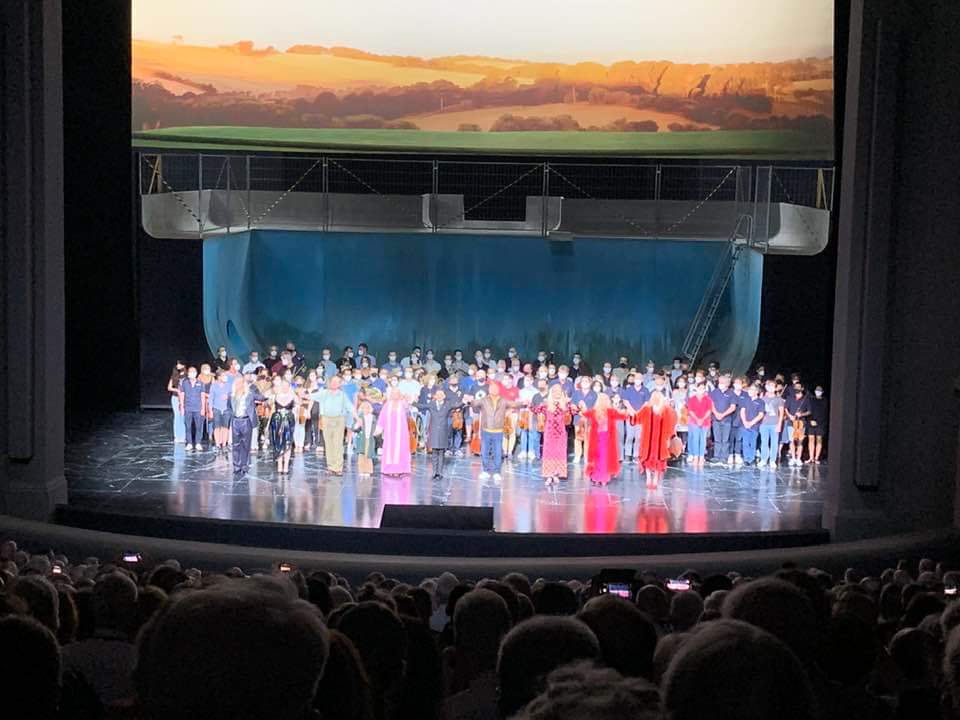
Production, David Mcvicar; Set Designer, David Mcvicar; Costume Designer, Doey Lüthi; Lighting Designer, Paule Constable. Conductor, Carlo Rizzi. Cast: Medea, Sondra Radvanovsky; Glauce, Janai Brugger; Neris, Ekaterina Gubanova; Giasone, Matthew Polenzani; Creonte, Michele Pertusi
As far as I am aware I have never heard a note of Cherubini’s music. I even had to look his dates up – though I found I was broadly right in my surmise that he was late Classical/early Romantic (1760 – 1842). I must have come across his name when reading Berlioz’s Memoirs long ago too, since he features in them as a disagreeable, stick-in-the-mud Conservatoire head in Paris (where he spent the majority of his life) at loggerheads with Berlioz. He seems to have been around in Paris during the Revolution and managed to both have aristocratic patrons in the 1780’s, and be supported by Napoleon at a later date. So, obviously politically astute….He was also apparently much admired by Beethoven.
I was, therefore, looking forward to this screening, and, indeed, it was an absorbing evening. Medea really is a transitional work – more fluid and less formulaic than Gluck, but still with some classical structures and turns of phrase. As one of the Met presenters said Cherubini was born into the age of Mozart and Haydn and died in the age of Verdi and Wagner. The music could sometimes have come straight from Don Giovanni but at other times it is straining forward into Fidelio, Bellini and even beyond to early Wagner. It is rarely performed (though was a vehicle for Callas). The reason for that becomes obvious when you hear the work – it’s the demands the work makes on the title role. The range required of the person singing Medea is extraordinary – from full dramatic soprano top notes to the low notes you’d expect from a mezzo. This plus the fact that Medea is much the biggest role in the work means that, as the conductor said in an interval interview, unless you have a great Medea, don’t even contemplate putting on this work.
There are different ways in which this work could be presented by a director: go for classical Greek, maybe a modern drama on a tug-of-war between divorcing parents over the rights to see and care for their children – or set it at the time and place it was written, revolutionary France. The costumes in this production looked vaguely 1790s – was the intention that Medea was in revolt against the ancien regime (there were a few wigged figures around).? If this was the intention, it wasn’t really carried through in any further coherent detail. The basic set was three sides of the crumbling brick walls of Corinth, their gates here massive, tarnished gilt doors. with another inner space within this. A mirror set above that inner area gave some interesting effects in Act 3, particularly, but didn’t really seem to have any intrinsic connection with the drama. The curtain sometimes separating the outer layer of set from the inner seemed to flap about inconsequentially and open and shut, particularly in Act 3, more than was probably sensible. The fire seemed to be already raging at the beginning of Act 3 – I didn’t really understand why this was so. In short, it looked all in all like a typical Met set – chunky, pleasing on the eye but not in the end doing very much and could have been much pared back
I’ve never heard the various Callas recordings, so have no idea how she compares, but Sondra Radvanovsky seemed to me to fulfil all the requirements of the role, certainly vocally; she was stunning in the heights and depths. Maybe her acting strayed a little bit towards the melodramatic – but then, the whole role is framed in that way, so one can hardly criticise her for that. Fundamentally it was an amazing performance. Her helper, Neris, was warmly sung by Ekaterina Gubanova, and Matthew Polenzani made the most out of the not very pleasant character of Giasone. Glauce, Jason’s new wife., was the one slight disappointment – stolid on stage, with little acting above the crude, and acceptable but not overwhelming singing. The orchestra under Carlo Rizzi played vigorously and eloquently.
James Macmillan, Larghetto for orchestra (2017); Gerald Finzi, Clarinet Concerto, Vaughan Williams, Symphony No 3 (Pastoral); Brigantes Orchestra – conductor Quentin Clare; clarinet, Emma Johnson; soprano, Laurie Ashworth
I was at this event as a Welcomer at Sheffield Cathedral, one of the various voluntary things I do. My attention had to be a little less than 100% on the music – you’re never quite sure who will wander through the door of the Cathedral during a concert: drunks, completely paralytic football fans as a subset of these, and in this case Chinese and other students and tourists thinking the cathedral was open, and also bunches of young people looking for another event which had been postponed to the following evening….And I was on door duty…..
Nevertheless I did enjoy this concert and thought it quite brave of the orchestra to attempt this in Sheffield, which has fairly conservative musical tastes. A ‘modern’ piece by Macmillan, a mid 20th century composer I suspect few in the audience will have had much knowledge of , and Vaughan Williams …..
As The Brigantes website has it, “The original Brigantes were a Celtic people; a collection of tribes ruled by Queen Cartimandua in 1st Century Northern England. They populated what is now Yorkshire. The Brigantes were both tribal and cultured, enjoying theatre and music……..The Brigantes Orchestra encapsulates location, culture, unity and the idea that an orchestra is, roughly speaking, a tribe of musicians.” They are in fact as they describe themselves ‘Sheffield’s professional symphony orchestra’ and have a good local following, although this programme, attracting about 160 people, was half their usual audience number.
I normally approach orchestral music in cathedrals with wariness – often the bath tub reverberations are just too much to deal with. But Sheffield Cathedral is well-suited to orchestras and the sound is surprisingly clear. The Brigantes orchestra isn’t that big, but it sounded very fine in this context.
The first two of these three pieces, if I’m being honest, have a tendency to go on for too long. I was dealing with latecomers for part of the Macmillan, but was astonished at how many times I thought the piece was coming to an end, only to find the orchestra had surged onwards. I found this piece a bit too bland. The Finzi piece I know a little, and Emma Johnson was an excellent soloist. It has a beautiful slow movement and a jolly tune in the finale. It feels – at any rate compared to VW – a little four-square, a little dull in its orchestration, but it is still an affecting and interesting piece. The Vaughan Williams, though, inhabits a different sound world, a different level of individuality and effectiveness, and the orchestration, particularly in this acoustic, sounded magical. Though I sometimes find it difficult to find my way in this piece, the sonorities sound wonderful and both the solo trumpet player and soprano soloist were impressive. The orchestra sounded as though this piece was more of a challenge for them than the other ones, and there were a couple of moments which were a bit untogether, but in the main the orchestra sounded full-bodied and very impressive in this context.
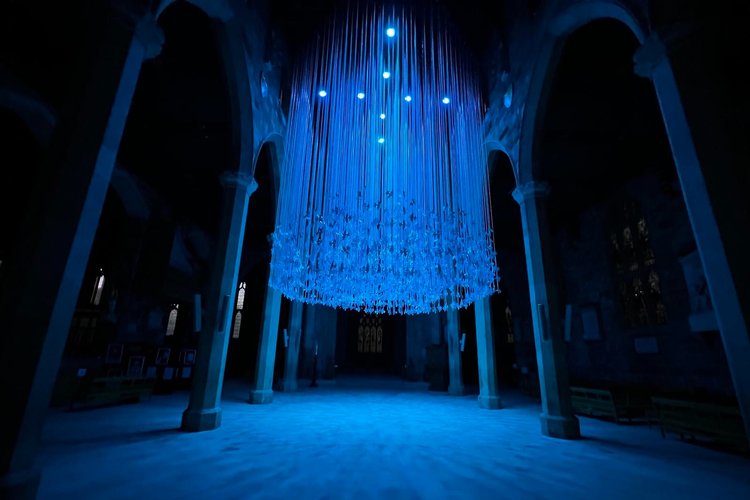
The whole programme represented a series of reflections on peace and the impact of war, and those attending could look, as they listened, at the very impressive “large-scale installation, created by Peter Walker and composer David Harper, which ….features several thousand paper doves suspended above the nave of the Cathedral. Schools across Sheffield and South Yorkshire have contributed, as have community groups, wellbeing groups, and the general public, by decorating the doves that form the artwork with messages of peace, love, and hope – creating a unique piece that reflects the thoughts and feelings of local people from all faiths, ages, and backgrounds.” (Cathedral web site – picture below)
Leo Hussain, Conductor; Christof Loy, Director; Christian Schmidt, Designer; Olaf Winter, Lighting Designer. CAST: Sinéad Campbell-Wallace, Floria Tosca; Adam Smith,Mario Cavaradossi; Roland Wood, Baron Scarpia; Msimelelo Mbali, Cesare Angelotti; Lucia Lucas, A Sacristan; John Findon, Spoletta
This was an extremely enjoyable and impressive performance, with singers who in the main I’d never heard of before…….It’s a production that’s been around for a few years in other European opera houses but this was its first outing at the ENO. I was sitting in what I think must be the best value seats for opera in London – the front of the Balcony, where you get the full blaze of the orchestra and at the same time you are nearer to the singers than you would be at Covent Garden in a similar Amphitheatre position . Behind me was an elderly Italian gentleman clearly a little bemused by the audience’s lack of responsiveness after the big arias (he carried on shouting ‘bravi’ solo, nonetheless, and said to me how good he thought the performance was). The house was pretty full and at the end it gave a very rousing and enthusiastic response to the artists. All in all, the evening made me feel more positive about ENO’s future – and in addition you could hear how the singers were giving what they were singing new edge, colour and meaning because they were singing in English.
The production had a simple set for first two acts – two walls, one with a large window, and a floor of black and white squares. This functioned very well as both the church and Scarpia’s dining room and office. The last act offered a small room where Cavaradossi was being held and then the top of the fortress tower – with a wall for Tosca to throw herself off (and she does, more convincingly than in most productions I’ve seen). The interaction between the characters was extremely well handled by director and artists and made for a gripping piece of theatre – for instance the way Scarpia came menacingly close up to Tosca during Visse d’ arte, groping her. Visually too the whites and blacks of the sets were offset by the vividness of costumes. There were some oddities – costumes were partly in modern dress, partly early 19th century and partly 18th century. Quite what that was about I am not sure – at points in each act a set of painted drapes appeared as well. I guess there was some point being made about characters being knowingly part of a self-conscious piece of theatre (Tosca does indeed commend Cavaradossi for being an excellent actor in handling, as she sees it, the execution) but these points – the drapes and the costumes – while not being coherent were also not really getting in the way of the action either.
The three main parts were tremendously well-sung. I have never heard of Adam Smith before but his voice is strong, well-grounded – infinitely better than the Radames at ROH the previous evening – capable of subtlety as well and when needed truly stentorian (his cry of ‘Vittoria’ seemed to go on for ever!). He also looks good and moves easily on stage. He was probably the best of the three – but Sinéad Campbell-Wallace was also very effective. She doesn’t have – at least on this occasion – the ability to float notes quietly, as I remember Angela Georghiou doing last year at ROH, but she has a lovely warm voice, which can also achieve dramatic intensity, and again she is utterly convincing on stage. Roland Wood didn’t overdo things and, again, has a beautiful-sounding voice, which adds a dimension to his portrayal of Scarpia.
The ENO orchestra was on great form, and Leo Hussain (again not a name I’ve come across though he’s clearly been around for a while and has numerous European and US opera productions to his name) had clearly energised them
Director, Robert Carsen; Set Designer, Miriam Buether; Costume Designer Annemarie Woods; Lighting Designer, Robert Carsen And Peter Van Praet. Conductor, Antonio Pappano; Aida, Elena Stikhina; Radames, Francesco Meli; Amneris, Agnieszka Rehlis; Amonasro, Ludovic Tézier; Ramfis, Soloman Howard. Orchestra of the Royal Opera House and Royal Opera Chorus
In my snobbish and silly way, I’ve never really had much time for Aida – it is something like 35 years since I last saw it live. I actually went to see it in Egypt outside the Pyramids (there is an open-air stage area there which has hosted many illustrious performers, such as the rock band Police) in 1987 – I think it was the Palermo or possibly the Naples Opera company, with a host of camels and so forth, all the cast in entirely Ancient Egyptian garb looking rather small within the looming massive sets (and of course with the Pyramids there too). My employer was trying to bring out the National Theatre production of Shakespeare’s Antony and Cleopatra, with Judi Dench and Anthony Hopkins to the same venue (in the end sadly scuppered by a NT stagehands strike) and I was asked to go along to get to understand how a large scale European production could be put on at this open-air venue. I managed to wangle quite an expensive seat, and I also remember saying I ought to see it twice so got a seat for the Luxor performance they were giving as well (and maybe a dress-rehearsal). I must have seen one production at ENO or ROHCG before the Egypt one – was there a Rita Hunter Aida with Mackerras? – but I have no detailed memory of one. It’s I guess a tribute to the staying power of the work that having not heard a note for 35 years except for one live broadcast I remember listening to once in Pakistan, I remember so much of the music.
I had a ticket for the dress rehearsal of this new production, which I couldn’t make because of my coughing fits (see below), so I was pleased to catch up with it via this screening.
The production I thought was very fine indeed. It took the essence of the work – war, captivity, national rivalries, patriotism and loyalty, two women vying for the same man and translated Egypt into a modern militaristic state, with a supreme leader and what looks like a tricky first lady…..Amneris.. The basic set was a kind of concrete bunker. The chorus were soldiers and the Triumphal March consisted of soldiers lifting up and removing the coffins of their fallen comrades under a large portrait of a ‘Dear Leader’ which was at the back of the stage in several scenes – a portrait of the Korean singer who played Pharoah. Admittedly the production seemed to be a close relative of the ROH Lohengrin – a similar preoccupation with flags, reds, blacks and greys, and the sense of an oppressive state. The ending of the second act with videos of modern warfare was devastating. Other scenes were set in a parade ground with raised stands for the spectators, a memorial to fallen soldiers with names on the back walls and, powerfully the tomb in the final scene was an armaments store, with rocket heads – making the Priestess’ final words “peace’ very powerful. I don’t think there were any missteps in the sets and the director’s concept. Maybe it was overegging it a bit, making the work seem more profound than it really is – but it was just so much better than yet another attempt trying to recreate Ancient Egypt. And although I assume it was conceived before Feb 2022, the resonance with the current state of the world is only too obvious
The stand out star for me was Amneris – Agnieszka Rehlis – who combined a very considerable stage presence with a warm rich voice. She threw herself into the role and was utterly convincing in her malice and desperation, as well as her recognition of the power she had as Pharaoh’s daughter. , Elena Stikhina as Aida was less compelling dramatically but had a beautiful voice that produced some lovely floated high notes, sensitively varied phrasing as well as the dramatic top notes at high volume the role demands. Radames was a bit of a disappointment – Francesco Meli had little stage presence, wandering around the stage to little effect. It was difficult two see why two very attractive women were throwing themselves at him. He also had some vocal difficulties with the higher range of the role and resorted to falsetto at points. Pappano conducted with his normal vigour and empathy with the orchestra
Conductor Marc Albrecht, Director Christof Loy, Sets Johannes Leiacker, Costumes Barbara Drosihn, Light Olaf Winter. Cast: Heliane Sara Jakubiak, The ruler, her husband Josef Wagner, The stranger Brian Jagde, The messenger Okka von der Damerau, The doorman Derek Welton, The blind judge Burkhard Ulrich, The young man Gideon Poppe, Chorus and Orchestra of the Deutsche Oper Berlin
I haven’t been to any musical events with a live audience since the Berlin Phil concert on 4th September, first because of a bad cold, which gave me paroxysms of coughing for a few weeks – quite inappropriate for concert-going….. And then, given that my domestic partner was going on a much-looked-forward-to walking holiday in Greece, I decided not to go to any big audience events until after she left, to ensure I didn’t give her Covid, with domestic consequences too distressing to think about. So 6th October was to be first live event I’d been at for over 4 weeks – I had a ticket booked for a Halle concert (Elder conducting yet another Heldenleben but also Pavel Kolesnikov playing Rachmaninov’s 3rd piano concerto). However, because of the ripples of the train strikes of 5th and 8th December, there was neither a train home from Manchester to my village after the concert nor a train to Buxton from which I could have got a taxi, and our shared car wasn’t available. So I decided to take an evening out to get to hear Das Wunder der Heliane by Korngold in a streamed recording from 2018 by the Deutsche Oper, at home.
I had never heard a note of this work before and, I have to say I was rather more impressed by it than I thought I would be. It’s a glorious late Romantic mash up of Richard Strauss, Mahler, Puccini and a few others. I found it more attractive than what I’ve heard of Strauss’ late operas between Arabella and Capriccio (maybe Daphne is an exception to that broad statement), with washes of colour, gorgeous harmonies, and glittering polytonal hues. Perhaps its sound world is a bit dense and monotonous after a while and maybe there is a lack of variation which would prevent it being seen as a masterpiece – there are not many distinctive melodies (though the aria “Ich ging zu ihm (“I went to him”) is very fine/. But all in all it still feels to be a gripping stage piece. Korngold was 30 when it was first performed but after 1933 it fell into a void, and has only recently begun to be occasionally performed in the 21st century – though much less so than The Dead City, which has two new productions planned in the UK between 2022 and 2023. It’s quite a long opera – maybe 2 hours and 40 minutes and occasionally I thought it would have worked better if it was 30 minutes or so shorter.
In essence it’s a fairy tale, a story of love, hatred and redemption of an almost Wagnerian kind, which (most of this is courtesy of Wikipedia) revolves around the Ruler, who is a cold despot incapable of love, his forlorn wife Heliane, who is loveless, a Dionysian Stranger with a message of love and joy, and a people in the Ruler’s kingdom waiting for a redeeming miracle. The Ruler suffers because he is unable to win the love of his wife Heliane. Since he is unhappy, he will not tolerate his subjects living in happiness. The Stranger had recently arrived in the land and was bringing the people joy; as a result, he is arrested and sentenced to death. The story concerns the love of Heliane for the Stranger when she meets him the night before his execution, the rage of her husband, and her protestations of innocence (though she is in love with the Stranger there is no sexual contact – though she does bare herself before him). Eventually the Stranger commits suicide and the enraged Ruler says she will only be judged innocent if she can make the Stranger rise from the dead. Eventually of course she does that, the Stranger offers a blessing to the people and banishes the ruler whose power is broken. The Stranger takes Heliane in his arms. ‘United in their love they rise to heaven’ says Wikipedia
The production offered a single set for the three acts, a slightly 20’s art-deco large function room with wooden panels and daylight coming through windows in the ceiling. The costumes too were sort-of 20’s, predominantly in dark brownish/blackish colours with the exception of Heliane, for the most part in white and the Stranger in a grey suit. Movement and interaction between the characters seemed natural and unforced. The director staged the ending – which could be a nightmare to get right – very effectively: slowly everyone except Heliane and the Stranger falls to the floor, as though asleep, and they both walk out of the room into a new life – I guess justifying the one set approach, so that its constrictions can be felt to have been thrown off at the end.
I thought Sara Jakubiak as Heliane was terrific. She’s not someone I’d heard of before, but she had the voice, the looks and the ability to be convincing in close-up in her acting that made her a really powerful exponent of the role. Brian Jagde as the Stranger was strong-voiced, if a bit unrelenting (but that maybe how it’s written) but, for someone who’s meant to be charismatic, a bit stolid and unmoving. We didn’t really get a glimpse of any manic zeal. Josef Wagner was I though very convincing as the Ruler. The glimpses we saw of Marc Albrecht seemed to indicate he was enjoying himself hugely
Alfred Schnittke, Viola Concerto; Anton Bruckner, Symphony No 4 in E flat major ‘Romantic’: Tabea Zimmermann, viola, Berliner Philharmoniker, Daniel Harding, conductor
While it is true that a broken toe can hurt like hell, and needs time to heal, it’s unclear why Petrenko’s toe permitted him to conduct Mahler 7 but not the originally scheduled Shostakovitch 10, which would have been much more interesting to hear than Harding’s Bruckner, particularly when Rattle had given such a good account of this work at the Barbican last year. I am sure Petrenko’s Shostakovich 10 would have been an amazing performance……….But there we go – you don’t easily give up on the BPO playing Bruckner, whoever is conducting……This was an inevitably rather disparate concert in terms of programming: Shostakovich and Schnittke would have gone well together – Bruckner and Schnittke on the whole don’t.
The Schnittke piece perhaps overstayed its welcome by abut 5 minutes or so – I found it hard to get a grip on the structure and the second movement seemed to me to go on for too long. But it is an interesting and effective piece, which moves from mourning to Shostakovich-style mockery and pastiche to something … I am not quite sure what; some sort of resolution……. The programme notes spoke about the use of a Russian Orthodox chant but I am afraid I failed to spot this. I liked the use of popular music – less strident than Shostakovich – and the gentler quieter spirit this concerto displayed compared to the great Shostakovich cello and violin concertos
The Bruckner symphony was of course very good indeed – that goes without saying. Personally, using my always useful criteria for Bruckner – a really effective Bruckner performance should have elements of Schubert, Wagner and God – this performance had plenty of Schubert – some absolutely stunning playing by horns, woodwind and strings, really emphasising the lyrical elements of this piece – but very little of God (i.e. a sense of the transcendent) and not much Wagner (a sense of overpowering passion). It tended towards the vice of emphasising orchestral beauty for its own sake, completely different from the driving vision Petrenko gave to the same orchestra in Mahler 7, with, in the Bruckner, almost exaggerated pianissimos and woodwind sounds that were on the one hand astonishing (in the scherzo, say) but on the other hand just slightly suggesting ‘look what we can do……’. – self-consciously virtuosic, if you like. On the positive side, there was a very careful gradation of volume, so that the fff passages really were that…………It was odd that the BPO had reduced the number of players for this performance – there seemed to be only 6 double-basses and 4 horns, but, of course, being the BPO, the sound they produced was akin to what most orchestras would need double the number to produce. Daniel Harding seemed on the whole to let the orchestra play without too much interference, and then with a bit of steering where necessary – very different from the intensity and control of Petrenko.
It can’t be said that this was a disappointment – we are talking about a very high level indeed of orchestral execution – but this was not a performance for the ages
Beethoven Piano Sonatas Op 109, 100, and 111; Andras Schiff, piano
A lovely morning offering from Andras Schiff. The RAH was packed – there must have been 10 times a standard Wigmore Hall audience in there!
Schiff began with 2 unannounced Bach pieces; I remember in his very readable and recommendable autobiographical notes that he said he began his musical work-outs every day with Bach as a kind of mental clearing-out, or thought-sanitising before practising, and that was presumably the intention here. The pieces I knew but couldn’t place- maybe from the Well Tempered Klavier?
The performance of the Beethoven sonatas was the best I’ve heard live. Sometimes when I’ve listened to these works in concert, there’s so much going on that the textures seem a little muddy. Here there was a wonderful clarity, with the left hand often floating over the top of the turbulence. There was also the very real sense of line in the way the slow movements were played and the clarity with which you could hear the ‘theme’ amid the ‘variations’ where this was he movement form. And the delicacy of phrasing was very noticeable at time – the tiny holding back at points of a note.
Gustav Mahler, Symphony No 7 in E Minor; Berliner Philharmoniker, Kirill Petrenko, conductor
As I walked past the front of the Albert Hall towards the Arena standing queue area for this sold-out Prom, I was amazed to see a gaunt, tall, balding and now stooping figure who has been a constant presence at the RAH for the last 50 years, whenever I have been to a sold-out Prom. He’s their regular black market ticket seller, and he must have some official tolerance from the RAH, so ubiquitous is he. I would have thought by now he would have retired – he always seems to have looked the same…..but there he was, a reassuring presence in a fast changing world…..
The concert once again affirmed my belief that the Arena standing area is the only part of the RAH where orchestras sound at their best. The Berlin Phil sounded fabulous – warm, full strings, brilliant brass, exquisite woodwind and a highly impressive timpanist, amongst others. The whole orchestra seemed to be listening to each other responsively, and there was a joyful sense of music making together – almost chamber-music like – that I think must be part of what Petrenko creates as a working atmosphere with this band.
Petrenko has, apparently, got a broken toe – which didn’t seem to need a stool or footrest, and he bounced around on the stage as I imagine he normally does. It’s a pity – presumably on doctor’s advice to ease up, he has been replaced for the second BPO concert by Daniel Harding and the programme changed from Shostakovich 10 to Bruckner 4 – that’s a pity; I was looking forward to Petrenko’s Shostakovich, and Bruckner 4 received a magnificent performance from Rattle and the LSO last year
It is only 6 years since the BPO played the same work under Rattle, at the Proms (which I was at) and indeed only 4 years since Petrenko conducted Mahler 7 with his Bavarian State Opera Orchestra at the Barbican (which I didn’t go to). I was asking myself as I listened what the differences were between the two performances I’ve been at. Both were very, very good. If I have to characterise Petrenko’s version it was a quest not so much for beauty of sound as for exquisite clarity – layer on layer of inner parts revealed in a way I don’t remember with Rattle, but exquisite not in a sense of beauty for beauty’s sake but somehow uncovering further aspects of what Mahler wanted to say. Particularly in the second, third and fourth movements there were sounds of burbling woodwind or snarling brass I just don’t think I’ve heard before. The other things that made Petrenko different for me were (1) the driven rhythmic approach to the outer movements, which worked well, and didn’t sound forced, and (2) the tightness of Petrenko’s conducting – there’s no leaning into phrases here, but pointed, compressed lyricism. Petrenko has a wonderful style as a conductor – physical, acknowledging every motion of the music with his body (but never to excess) and signalling everything to the orchestra through his gestures. That glint in his eyes and the huge attention to detail reminded me a bit of videos of Carlos Kleiber at work.
There was a standing ovation at the end from the majority of the audience.
Siegfried, Stephen Gould; Gunther, Michael Kupfer-Radecky; Alberich, Olafur Sigurdarson; Hagen, Albert Dohmen; Brünnhilde, Iréne Theorin; Gutrune, Elisabeth Teige; Waltraute, Christa Mayer; 1. Norn, Okka von der Damerau; 2. Norn, Stéphanie Müther; 3. Norn, Kelly God; Woglinde, Lea-ann Dunbar; Wellgunde, Stephanie Houtzeel; Flosshilde, Katie Stevenson. Valentin Schwarz (director), Andrea Cozzi (designs), Andy Besuch (costumes), Konrad Kuhn (dramaturgy). Reinhard Traub (lighting), Luis August Krawen (video), Bayreuth Festival Chorus and Orchestra, Cornelius Meister (conductor So….onto Gotterdammerung. I will put forward a few views first on where I am in my assessment of this production, and will make any changes after I’ve seen Gotterdammerung. My assessments will be based on the following criteria, as I mentioned in my Rhinegold review
1.The quality of the concept (if there is one) and relevance to the opera (s)
2.Consistency in the implementation of the concept
3.How that concept relates to what the words and music are telling you
4.The insights which the approach brings to the work(s)
5.The quality of singing, conducting, acting and orchestral playing.
and I have added a 6th – the quality of the set design and the appearance of the production
On 1 – Schwarz himself says “The fact that the “Ring” in Bayreuth is performed in its entirety within just one week gives us the opportunity to show a family epic in a four-part series format and to follow these characters in their circumstances and omissions through the course of time. Where are you from? Where are you going?…”; “I want to tell a story about today’s people, today’s figures, today’s problems – and not about gods, dwarves, giants and dragons.” In another interview he talks about this being the ‘Netflix’ approach. The problem is that The Ring is inherently bursting with meaning – meaning is what Wagner intended it to have, even if he was in two or minds as to what, and so Schwarz’s concept sounds weak, though plain story-telling of course as such must be a virtue. There is a theory of theatre which is reflected in one of the essays in the programme book which is an approach that the theatre should reflect the disorder and lack of logic in the world we live in – ‘coherent incoherence’. This does seem relevant to this production.
On 2, the problem is that, having indicated that plain story–telling is what he plans to be doing, Schwarz starts importing a lot of action/signs that immediately disrupt that and suggest ‘meanings’ (the Rhinegold being a child, the pyramids, the various other children who pop up etc). I saw a Facebook post from a French guy attending Ring III saying that he was convinced it was all about the quest for eternal youth in a world of decay and death. This makes some sense but (a) is not what Schwarz said he was doing (b) is not followed through in any coherent way. People perhaps are attempting to find ‘meaning’ when maybe it is just not there. Of course, ‘coherent incoherence’ (or the other way round) might be an explanation, but then themes move in and out of view which suggests that this approach isn’t followed consistently either – at times some of the themes seem more systematically treated…… at other times less so. There are themes you can discern if you go with the flow – the abuse of children in conflict and by power; violence against women; flashy consumerism; even climate change. But it never really comes together. Quite often too in this production the plain story-telling seems to be deliberately obscured – e.g. there doesn’t seem to be any real reason why it should be Wotan rather than Siegmund who fathers Siegfried). Unless these issues are cleared up in Gotterdammerung…….
On 3, most of the time there is a fair degree of coherent relationship between action, words and music, even if it’s not conventional – it doesn’t really matter that there’s no dragon or bear. But there are certain symbolic things – spear and sword are the obvious ones – which can’t be air-brushed away in the manner Schwarz suggests. I wasn’t too bothered by the plastic surgery Valkyries or Mime’s anvil-less forging scene. On 4, there are some insights – I have new perspectives on Fricka for instance, I think the way Siegfried is played is also effective, and different in the degree of thuggishness involved.
On 5, the singing so far has been of the highest quality – quite outstanding; the cast has acted well; for the most part the orchestra has played well, though not achieving the sort of sounds I heard in 2017 under e.g Thielemann. The conducting has been reasonable but not inspired (but there is the benefit of doubt to be given, granted the circumstances of 3 weeks’ notice)
On 6, too, as often in Bayreuth, the sets are stunning to look at ,
So……onto the Prologue and Act 1. The curtains open on a child’s bedroom – the same one as the fantasy one in Act 1 of Walkure. Brunnhilde is putting the chid to bed. The Norns come in as the child dreams, I think (though oddly there seem to be 4 Norns, rather than 3 – maybe one is the child in the dream. Similar Norn like figures also were around in the bedroom in Walkure. When Siegfried and Brunnhilde meet in the room after dawn breaks it is clear this is their child – though whether she is also the child who was led away by Erda in Rhinegold isn’t clear – and also that they are not getting on very well (this is how I read it anyway) and Siegfried goes off in a huff. The Gibichung Hall is another plush apartment with lots of staff and plenty of bottles of champagne – white seats and various bits of modern art. Gutrune looks like a sleek oligarch’s daughter and she’s certainly not ‘wet” in the way she’s portrayed in many productions. Gunther is as he should be unreliable and passive – he is also, in this production, just rather strange…very hyper-active, and exaggerated in his movements. He also sported at least in the first performance a T- shirt with ‘who the fuck is Grane’ written on it? I was too far away to see whether this was still around for Ring III….Hagen is slobby and into middle age, still wearing his trademark yellow T-shirt. Because the Tarnhelm and magic potions are, well, magic, and therefore against the concept, clearly Mr Schwarz has to arrange something to enable to Siegfried to win Brunnhilde for Gunther as his wife. His decision is to indicate that Siegfried is so fed up with Brunnhilde that he immediately falls for Gutrune (who is indeed very easy to fall in love with) without any magic potion. Grane is very disturbed by the whole Brunnhilde/Siegfried relationship collapse and tries to restrain Siegfried – he has the offered potion from Gutrune poured over his head. We see later that the Gibichungs have killed Grane and chopped him up – he is wheeled in on a bloody trolley during Hagen’s Watch. Back in the child’s bedroom Brunnhilde meets Waltraute ‘normally’ and the scene where Siegfried is disguised as Gunther, which is usually difficult to bring off, was no more or less messy than other productions – in this one both Gunther and Siegfried appear but with Siegfried out of sight singing for Gunther. The abduction of Brunnhilde is nasty – but, then, that’s what it is. Throughout the scene with Brunnhilde the child is present and she is taken with Brunnhilde to the Gibichung Hall. A lot of booing accompanied the curtain coming down at the end of the act – though for the production, not singers.
Act 2 was better. The first thing we see is a punch bag which Hagen is working out with. He hides behind the punch bag when Alberich appears and answers from the same position. The set remains essentially remains a white box throughout the act, but opens up effectively at the back with mist and darkness as Hagen’s vassals come on stage. Apart from the fact that the vassals have red Viking-type face masks – but, hey, why not?- the rest of the Act is conventionally handled within the white box and the singers just do their thing. The child is present for part of the wedding scene and there are some indications she can be identified with the Ring
Act 3 was, frankly, dire. The setting was the same throughout – a cross section of an empty cracked and ruined swimming pool. Obviously this connects with the swimming pool of the Rhinegold and here represents a certain sort of futility and pointlessness to everything, I suppose. I have seen an argument from one critic indicating that the empty pool represents the impact of climate change, brought about by trashy consumerism represented by the Gods and Gibichungs – but this should have been woven into the fabric of the 4 evenings in other ways. The swimming pool has a higher level where vassals, Gutrune and Gunther gather and from where Brunnhilde starts her immolation scene and then there’s the bottom of the pool where Siegfried and Hagen are. The child is with Siegfried when he dies but disappears half way through the immolation scene and is, I think, killed. What is quite shocking, given the vividness and splendour of the music, is that more or less nothing happens on stage (apart from Gunther’s death) until the end of the opera, essentially. There is no movement of Siegfried’s corpse anywhere- it stays at the bottom of the swimming pool; Hagen dumps the severed head of Grane in a plastic bag halfway through the Immolation scene. Brunnhilde collapses on top of Siegfried. Hagen’s “Back from the Ring” is meaningless as there is no ring of any sort around. As Valhalla goes up in flames columns of strip lights appear on the back drop – what this might mean is entirely unclear. Finally, in a way that seems more of a gesture than anything else, the foetal image of the twins appears again. All this seemed a dire abrogation of directorial responsibility when the music intimates so much.
The singing and playing was another matter, happily. The cast was uniformly very good indeed. In advance, one wondered about Irene Theorin’s capacity now to take on this enormous role, but I found her to be very impressive, even if unflatteringly dressed and not really looking like the redemptive figure she’s meant to be (but which Mr Schwarz is denying) – some of the audience had it in for her during the curtain calls, which I thought was sad. On this subject see https://slippedisc.com/2022/08/at-bayreuth-brunnhilde-gives-one-finger-to-the-booing-audience/ .Stephen Gould was similarly impressive and strong voiced – though he ducked a few of the top notes – and I was as impressed by his Siegfried as I was by his Tristan 5 years ago. Hagen, Gunther and Gutrune all sang well. The orchestra sounded glorious throughout as did the Chorus. The audience interestingly seemed to have decided Cornelius Meister was doing a good job – no booing for him, unlike the first run of this production. There were still a few of his trademark lurches and lunges but all in all I felt he had conducted the work well.
All the judgements I made above before this performance stand – indeed are intensified. At the heart of the problem is a weak concept which is then further pushed off the rails by any number of ideas which start off well and then trail off. I have no idea what has happened – was there not enough time to think it all through (but it can’t be this, given that the production has been pushed back). Is it the ‘coherent incoherence’ deconstructionist ploy against ‘big narratives’. Possibly, but the impression given is simply one of incompetence. But I have a further sense that in retrospect the production does have a haunting quality – there is an underlying theme, not treated systematically, of not only the quest for wealth, power, and money, but also of the human urge for survival, to seek permanent youth, for regeneration, inheritance, renewal, perpetuation, innocence perhaps, in a world where on the contrary everything eventually ceases to exist or gets corroded, ages, corrupts, degenerates, or dies. Climate change is part of this overarching vision
Anyway, it is still a marvellous experience to hear this work where it was first performed in its entirety, and with its wrap-around mystique. The singing and eventually the orchestra were glorious. A pity about the production…as it stands, but it would be very interesting to see how it has developed in three years’ time in 2025 and to see how many second thoughts there have been…..And of course 2026 is the new 150th anniversary Ring.
 John's musical journey