Live concert and opera highlights I have been to in 2025

It’s been another extraordinary year for high quality classical music performances I’ve attended. These are my top ten performance highlights, in no particular order:

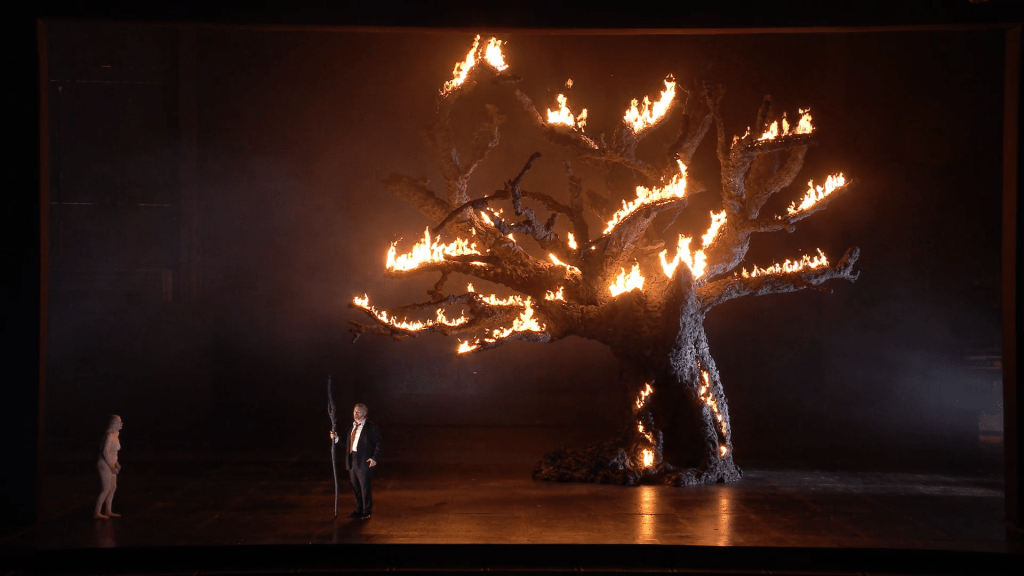
1.           Mahler Symphony No 2: Wong, Halle, Bridgewater Hall

2.           R.Strauss, Arabella:  Runnicles, Deutsche Oper Berlin

3.           Wagner, Die Walkure: Pappano,. ROHCG

4.           R.Strauss, Die Liebe der Danae: Bayern Staatsoper, Schager/Bystrom/Maltman

5.           Mozart, String Quintets K515/516: Takacs Quartet, Wigmore Hall

6.           Puccini, Suor Angelica, Pappano, LSO, RAH Proms

7.           Turnage, Festen: Gardner,  ROHCG

8.           Adams, Harmonium:  Adams, Halle, Bridgewater Hall

9.           Strauss, Salome, Grigorian, Pappano,  LSO, Barbican

10.         Mozart, The Marriage of Figaro, ENO

It was difficult to choose these ten. There were so many others I could have chosen – a powerful Brahms 4 with Rattle, and LSO, in January along with Janacek’s Jenufa at ROHCG conducted by Hrusa. I loved the Beethoven 9 the Halle performed with their talented chief conductor Kahchun Wong in February, along with the excellent Regents Opera performance of Walkure in Bethnal Green. March saw some superb performances – the Bartok Concerto for Orchestra, with the Berlin Phil and Hrusa, alongside Strauss’ Intermezzo, at the Deutsche Oper Berlin. It was very good indeed to hear another live Mahler 8 after 5 years, conducted by Ed Gardner with the LPO in April.  There were a number of excellent Handel opera productions, notably Semele, at ROHCG and Partenope, at ENO and a jagged exciting Sibelius 2, with the Leipzig GO, and Andris Nelsons, at the Proms, while Anna Netrebko was unforgettable in December’s Turandot, and there was an excellent performance of Die Schweigsame Frau in Berlin, with Thielemann conducting, in July

Turandot, Puccini – ROHCG – 18/12/25

Director, Andrei Șerban; Designer, Sally Jacobs; Lighting designer, F. Mitchell Dana; Conductor, Daniel Oren. Cast: Princess Turandot, Anna Netrebko; Calaf, Yusif Eyvazov; Liù, Masabane Cecilia Rangwanasha; Timur, Rafał Siwek; Ping, Simone Del Savio; Pang, Emmanuel Fonoti-Fuimaono; Pong, James Kryshak; Emperor Altoum, Raúl Giménez; Mandarin, Ossian Huskinson

I spent my day in London partly at my laptop, partly doing some shopping, before going to Choral Evensong (some very fine Palestrina) at St Paul’s Cathedral and then on to Covent Garden for Turandot. I’ve seen this production once before, in 2017. It is one of Covent Garden’s most venerable ones – at least 40 years ago – but it still looks very good., and much less silly than the equally venerable Met Zeffirelli offering I saw on screen a few years ago. I thought at that time that I had probably had enough of live Turandot performances for the foreseeable future, but I reckoned without the return of Anna Netrebko to the Covent Garden stage. I have heard her only once live before – as Tatiana in Eugene Onegin in Vienna in 2015 – and I was fascinated to see how she would perform Turandot and whether her voice was right for the role.

I realised that apart from possibly in the 70s (did I see Nilsson in this role? – I seem to remember the Cecil Beaton sets but think it was probably Amy Shuard in 1973), I have only seen Turandot live that once, in 2017. And I also realised that, while I know the famous parts of the music from recordings, I don’t know the details of the plot and what the characters are doing in any detail. I found this performance gripping throughout until after the death of Liu. It may be 40 years old but it is a tremendous show, with its dancers, masks, carts and chariots, red ribbons flying down, huge cut-off heads,  the emperor coming down from Heaven, the floating moon and the towering sets. It is never over the top in the Met manner and the masks, the emphasis on the blood and cruelty, made the setting sinister, not just a tawdry bit of early 20th century Orientalism. The agony of the Chinese people under the terrible regime of Turandot is emphasised – I had never really picked up on the desperate choruses before. Although I suppose cultural appropriation is involved, the production seemed less disrespectful than the Met one. In fact, at the end of the 2nd act, I was in a state of high excitement – this must really be, I thought, one of the best things I’ve been to this year. However, as I guess in every production of Turandot, you cannot hide the fact that what happens after .the death of Liu in Act 3 – which was where in completed full score Puccini left the work when he died – is a bit of a mess, musically and dramatically. The Wikipedia article on Turandot suggests there is still Mahler 10/Elgar 3 type work to be done on Puccini’s sketches, beyond what Alfano reconstructed; there are also bits Alfano did complete which Toscanini (?) cut and aren’t always heard in modern performances. Whatever further work might be done, the ending is dramatically unconvincing and musically seems to tread water. Perhaps the fault lies with the librettists – I think Puccini was on the 4th version of the text when he died, but he had spent months trying to wrestle with the issue of how Turandot changes from ice-princess to a more normal human being. Perhaps it should have been Turandot who dies and not Liu……? Until the death of Liu, I was constantly amazed by the colour of the score and how attuned it was to the work of Puccini’s contemporaries – there’s flecks of Debussy, Stravinsky and Mahler to be heard, but all recast into something immediately recognisable as Puccini. After the death of Liu I found my enthusiasm flagging and felt increasingly disengaged.

Anna Netrebko was simply tremendous as Turandot. She has the classic operatic superstar ability to make you focus on her every move and she commands the stage whenever she is on it. Martin Kettle in his Guardian review puts her in the Callas/Sutherland league. I never saw either of them, so can’t comment, but certainly she has that same magic that some singers I have seen – Janet Baker, Boris Christoff, Birgit Nilsson – possessed. Her voice was much more powerful than I was expecting, pinging out the top notes, and with an impressive lower register. I heard little of the Slavonic vibrato I was also anticipating. What I did hear was acute attention to words, to phrasing, to line, so that everything she sings sounds freshly minted. Her rendition of the riddles was astonishingly detailed and imaginatively sung, and In questia reggia was overwhelming. This was, simply, a great performance. 

Masabane Cecilia Rangwanasha is no great actor, but her Liu was beautifully and thoughtfully  sung, she was sensibly costumed and was a worthy counterpart to Netrebko on stage. About Yusif Eyvazov (Netrebko’s ex….) as Calaf, I had mixed feelings. He’s a thorough professional and Nessun Dorma was sung with all the heft it needs; he’s also quite a competent actor, and can use face and stance intelligently to emphasise what he’s singing. His voice is un-Italianate (fair enough, he’s Russian) and decidedly gravelly – there wasn’t much lyricism in his singing, but, I guess, if you have to balance heft against lyricism for this role, heft probably wins out. Ping, Pang and Pong made more sense than they did to me 8 and a half years ago, and I thought the way the trio worked together and got their lines across was very effective – it helped that one of them could do somersaults……Timur and the Emperor were well sung, and I should mention also the dancers, who have a lot to do in this production and have a major role in making it imposing, were tremendous.

Reviews of Daniel Oren’s conducting on the first night were universally negative – it was said he made the orchestra play too loudly and too insensitively. For me, it was good enough – the Lower Slips inevitably highlights the orchestra’s role (you’re almost sitting on top of them, though from a distance) and the voices didn’t seem overpowered by how the orchestra played this wonderful score.

Here’s a short trailer which gives a further sense of what the production looks like – Turandot

Ariodante, Handel – ROHCG – 17/12/25

Director, Jetske Mijnssen; Set designer, Etienne Pluss; Costume designer, Uta Meenen; Lighting designer, Fabrice Kebour; Conductor,  Stefano Montanari. Cast: Ariodante, (Grace Durham replaced Emily D’Angelo); Ginevra, Jacquelyn Stucker; Dalinda, Elena Villalón; Polinesso, Christophe Dumaux; Lurcanio, Ed Lyon; King of Scotland, Peter Kellner; Odoardo, Emyr Lloyd Jones

Yet another Handel opera I’ve (I think) not seen before (although ‘Doppo notte’ was more or less the first Handel opera aria I ever heard as a teenager – there was a wonderful Janet Baker version of it I possessed in a 60’s recital disc [and Baker gave the first performance in the UK of the work in the early 60’s for over 200 years]) …….Ariodante was written for the same season (1735) as Alcina as part of the Italian opera season at Covent Garden which was then riding on a wave of public enthusiasm, despite the existence of the newly formed rival company supported by the Prince of Wales (Handel’s company had the support of the King). Tre story is preposterously based in medieval Scotland and is conventional opera seria material – man and woman love each other, bad suitor tries to entice her away from her lover, using another woman in disguise, father disowns the daughter, there is a duel where the man challenges the bad suitor and everything comes back to the beginning by the end (here with a directorial tweak). It’s a long work – over 4 hours with two intervals -and makes huge demands on singers, on their acting abilities and on the creative energies of a director and designer.

Coming down on the, as usual, disrupted train journey (sadly, suicides on the Sheffield to London route seem now almost a weekly occurrence) I saw I’d received an email saying that Emily D’Angelo was ill and that her cover, Grace Durham, would be taking over the role of Ariodante. That meant that, apart from Ed Lyon, I’d not come across any of the singers before, to my knowledge. Durham herself was in fact in the ENO Cenerentola I saw two months ago, in a minor role, and she has taken on roles at Glyndebourne, Garsington, Toulouse and Zurich. In fact, though not a notably starry cast, the singing was undoubtedly excellent throughout the evening, with no weak links, and shows again that in many ways, despite all the looming financial problems for opera (which there have always been) we do live, as a friend of mine often says, in a golden age of singing.

Whether we live in a golden age of opera directing is another matter……. The director, Jetske Mijnssen, was the director of the Glyndebourne Parsifal this summer and her Ariodante curiously had some thematic connections with it – an old country house, its owner in a wheel chair, and serried ranks of well-disciplined maids, cooks and butlers.  There’s also, as with her Parsifal, a flash back sequence to the characters’ childhood in the opening prelude. Ariodante, as I’ve said, is a long evening and I wondered whether in the first two acts the director had taken too staid an approach. Perhaps it’s the work itself – in the version we heard, there is relatively little recitative, and we often move from one slow da capo aria, after a couple of connecting lines of music, to another. The director had clearly worked closely with the singers to make their individual arias as interesting as possible – pillows were thrown around, dresses danced with, the interpolation of a few grunts and screams were there, but somehow the work plodded a little (and maybe that’s just how it is, and there’s not much that can be done). There is more activity in the final act and this was a lot more engaging. Rather like the production of Jephtha recently at ROHCG, there’s a twist at the end – Ginevra, whose head has been thoroughly messed about with during the action, runs away from the long awaited wedding with Ariodante – very rightly, one felt. In the first two acts the action wasn’t, I thought, helped by the set. This was a box-like construction that deliberately didn’t use much of the large Covent Garden stage, and in Act 1 was simply a drawing room of a large country house. It was much the same in Act 2, with 2 openings to the larger stage left and right of the drawing room, to allow characters to overhear and comment what was going on. In the last act, the stage opened up, and the box=like structure fragmented, as you can see in the photos. For no particular reason, the costumes hovered between tweedy 1950’s and contemporary. All in all, I think more use of the wider stage, more props, more extraneous happening, more colours could have been brought in to enliven the staging. Also, dance – as with Alcina, Handel worked with a famous dancer, Maria Salle, and a troupe of dancers for Ariodante, but all the ballet music he wrote for the work had been cut for these performances. On the positive side, the director’s approach was relatively straight-forward and presented the work without too many annoying interventions. The ROHCG video trailer gives a little more insight into the production approach – https://www.rbo.org.uk/tickets-and-events/ariodante-jetske-mijnssen-details#about

Grace Durham, although cutting a somewhat comic Oscar-Wilde-like figure on stage, was very, very good as Ariodante – I cannot imagine Emily D’Angelo singing much better than this. The delivery of Doppo Notte was, frankly, more precise, more detailed, than Janet Baker’s version and as exciting as it should be. Her Scherza infida was stunningly beautiful – Durham has a warm, rich and powerful voice that did full justice to one of Handel’s most beautiful arias. Her voice blended beautifully with Stucker’s in the duet for her with Ariodante, “Prendi, prendi da questa mano”. Stucker as Ginevra was thoroughly believable in the role – she looked the part and had a lovely and, again, powerful soprano voice. Her aria Il mio crudel martoro was memorable (in fact Ariodante is up there with the very best of Handel’s operas in the number of great arias) and she delivered some spectacular coloratura runs. The Polinesso, Christophe Dumaux, is no Hugh Cutting but a rough edge to the voice is probably fair enough for this very unpleasant character, which he portrayed well. All the other roles were very well sung. The ROHCG orchestra sounded energetic, fluent and with a fully thought-through Baroque style, aided by the conductor who intermittently picked up his violin to play with the strings (perhaps rather flamboyantly).

Partenope, Handel – ENO, 3/12/25

William Cole, Conductor; Christopher Alden, Director; Andrew Lieberman, Set Designer; Jon Morrell, Costume Designer; Adam Silverman, Lighting Designer. Nardus Williams, Partenope; Hugh Cutting, Arsace; Ru Charlesworth, Emilio; Jake Ingbar, Armindo; Katie Bray, Rosmira; William Thomas, Ormonte

This Christopher Alden ENO production dates back to 2008 in a co-production with Opera Australia.. The production, set in a 1920s context and inspired by the surrealist images of Man Ray, was revived in 2017, and this 2025 set of performances was its third outing. The work was originally shown in London in February 1730 at the King’s Theatre, revived in December of that year and shown again in 1737. After that, there was the usual two and a third centuries of being completely forgotten before it began to be revived in the 1960’s and 70‘s. Needless to say, I’ve never heard a note of it before.

The story involves Partenope and her three suitors – Arsace, Armindo and Emilio. Arsace has dumped his previous love Rosmira, and the latter has dressed up as a an to chase and harass Arsace,  pretending to be a fourth suitor to Partenope. In the end, Armindo and Partenope, Arsace and Rosmira pair off and Emilio is left laconic and resigned to his fate.

 This was an exceptionally fine evening, though long and with two intervals. The production is consistently inventive and entertaining – the original director Christopher Alden returned to supervise this revival, and it showed in the degree of energy with which the singers engaged with their roles, and the snappiness of the action.  The feel of the production was quite varied — at times sophisticated references to 1920’s Surrealist/Dada iconography, but then combining this with slapstick, and pantomime-like gags and routines (which you feel Handel himself might have found amusing in a Swift-like way) – although maybe the Dada-ist context is itself conducive to slapstick comedy. To give some sense of the variety of what’s going on on stage, the soldier Emilio is a Man Ray-type photographer and artist, walking around at times with a frame to capture arbitrary images; Armindo gives a tap dance routine to his last aria, complete with spotlight and top hat; Armindo is also often seen tumbling downstairs; there’s a self- propelling top hat, and a lot of jokes about toilets, toilets flushing, and toilet rolls, with various characters stuck in the loo at points ((the famous 1917 exhibition entry of a toilet bowl by Marcel Duchamp might have been an influence here). A great contribution was made by the translation which captured both a sense of 18th century rhymed verse, and sudden darts into contemporary vernacular (including ‘Oh Fxxk’ at one point, as well as a few lurches into 1920’s slang.

This opera has no chorus – only a succession of brilliant and memorable da capo arias, getting off to a fizzing start with Partenope’s opening coloratura aria “L’amor ed il destin”. There are two superb arias in Act 1 – Partenope’s call to arms (while allowing someone to command her heart) is very haunting and Rosmira’s  jolly aria with the horns is equally memorable. There’s a lovely aria for Partenope in Act 2 and also Arsace’s slow aria with theorbo and strings is memorable. (in fact probably the stand out music of the whole opera). By mid-way through Act 3 I lost mental track of all the varied and moving arias i had been hearing, all for the first time.  There is a huge amount of wonderful music to explore.

The set and costumes as above are 1920’s with a huge spiral staircase stage right and an upper ledge giving access to the staircase. There is also a back wall and an exit upstage. In Act 1, we have a card table and chairs off to stage left. In the other two acts the set has revolved so that we see variants of a large hall , with various rooms off and an upstairs area partly screened. In Act 2 there is a lot of play with cameras, early 1920’s filming and film lights. The trailer here gives some further sense of the visuals –  Partenope | Buy Opera Tickets for 2025 | ENO

The undoubted star of the performance was Hugh Cutting, whose counter-tenor singing of Arsace was exquisite and moving – another counter tenor who doesn’t have me regretting the absence of a female voice. Ru Charlesworth as Emilio had excellent diction, and handled the coloratura aspects of his role brilliantly .  Jake Ingbar as Armindo was almost as good as Cutting. Nardus Williams as Partenope handled beautifully the slow arias, with a lovely long-breathed line, though sometimes the coloratura aspects sounded a bit laboured (though always accurate). Katie Bray as Rosmira always sung warmly though perhaps her voice was a little small for the Coliseum. William Thomasas as Oronte, in this production a general artistic layabout sung resonantly.

Sadly the advertised conductor Christopher Curmyn was ill, but the ENO music staff conductor William Cole did an excellent job of pacing the music and keeping it altogether. The ENO orchestra sounded remarkably idiomatic, with some very colourful playing

Reich, BBCPO, Currie – Bridgewater Hall, 29/11/25

BBC Philharmonic Orchestra, Colin Currie conductor. Steve Reich Variations for Winds, Strings, and Keyboards; John Adams Frenzy (2023); Gabriella Smith f(x)=sin²x-1/x; Steve Reich The Four Sections

I had missed two concerts focusing on Steve Reich in Manchester in recent years, one because of a train strike, another because of bad weather cancelling trains. So, I was determined to get to this one – and I did, albeit with a grossly delayed homeward journey. As it happens, I was much more struck by the Adams piece than the two Reich ones in the programnme. The problem with the more trance-like slow moving minimalist pieces is that they send me to sleep after about 10 mins. I get the point – a sort of Zen-like meditation rather than the forward thrust and ‘meaning’ of more traditional works, but they are nonetheless soporific…..With the Reich Variations, I began by really enjoying the woodwind sounds it starts with, and the slow yet constant changes of harmony, as well as the swell and decline of the strings, and the gradual metamorphoses which were taking place – and then I slept.

The Adams piece, ‘Frenzy’. a newish piece (2023) first conducted by Simon Rattle, on the other hand is strangely traditional in its constant development of two motifs – what Adams describes as “a punctuated tattoo in the winds and the brass, and an urgent muscular theme in the upper strings’. Here the slow meditative gradually shifting sounds of Reich are replaced by manic, dense and forceful activity as these motifs are developed. In the midst of all the rushing around is a rather beautiful quasi-slow movement, rather haunting, which emphasises that there seems to be some sort of personal story suggested here, ‘frenzy’ against an inner calm. Occasionally the tools of minimalism are used but to very different ends.  I liked this a lot and will try to listen to it again when the BBC broadcast it (as they will, it being the BBC Phil).

You don’t get music titles much more pretentious than ‘f(x)=sin²x-1/x’, which is something about measuring mathematically the progress of this piece of music, with a horizontal axis of time and a vertical axis of energy and dynamics. It has some interesting sounds and certainly didn’t outstay its welcome.

The other Reich piece (The Four Sections, as in the sections of the orchestra) moves from slow to moderate to fast, with gradually changing melodic material and some thunderous climaxes (rather reminiscent of the Rite of Spring). I didn’t fall asleep this time, but I did feel the Adams piece was the more rewarding one to listen to.

The BBC Phil played it all with great skill and enthusiasm, making a huge noise, particularly in the Four Sections

Arabella, R.Strauss – Met Opera relay – Sheffield Curzon Cinema, 22/11/25

Conductor,  Nicholas Carter; Director, Otto Schenk; Designer, Günther Schneider Siemssen; Costumes,  Milena Canonero; Lighting, Gil Wechsler. Arabella, Rachel Willis-Sørensen;  Zdenka, Louise Alder;  Fiakermilli,  Julie Roset;  Countess Adelaide Waldner,  Karen Cargill;  Matteo,  Pavol Breslik;  Mandryka,  Tomasz Konieczny;  Count Waldner,  Brindley Sherratt

This production looks like something from another era (and indeed it is – first seen in 1983) and may be, for some, as much a sentimental journey back to a period of operatic history long before the advent of regie-theater, as the work was for Strauss and Hofmannsthal in the evocation of a long-gone mid-19th century Vienna in the context of the 1920’s / early 30’s. How long is it since you heard a Covent Garden audience clap at the opening of the curtains on an act? – the Met audience was doing it ecstatically at the beginning of each act in this screening. Here is an idea of what the general mis-en-scene looks like and there’s also a clip of Arabella singing ‘Aber der Richtige’. Arabella: Live in HDStrauss’s Arabella: “Aber der Richtige” (Rachel Willis-Sørensen)

As I have said before in this blog, a cinema screening is a different experience from a live performance on stage as far as the audience is concerned. Things which would go undetected in what you’d see on stage in a live performance can be mercilessly shown up on the screen. While the slightly dilapidated sense of the scenery in the first and third acts could be reasonably explained away as demonstrating the kind of downmarket hotel the Waldners now have to stay in when in Vienna, owing to their penurious state, the second act also looked dingy, and as though it had seen better days, and this, I guess, is a reflection that all the scenery is now over 40 years old…….The other thing which cinema is bound to show up is any noticeable difference between the age of the performer and that of the character they’re playing, and here I have to say that Rachel Willis-Sorensen, to me, looked just too mature on screen to be a credible Arabella, even though she sung it wonderfully (while Louise Alder, by contrast, only 3 years younger, was a highly believable Zdenka(o)). Such is the way of the big-screen.

But apart from the set and the maturity of Arabella, this was a highly satisfying performance (and also from a purely chauvinist perspective, it was highly satisfying to see that three of the 5 main roles were taken by Brits – plus with Susan Bickley playing a support role).  Rachel Willis-Sorensen was commanding in her singing, with a beautiful sense of line and some lovely soft singing and floating of high notes. Vocally she had the heft as well to soar over the orchestra, and also that intangible ability to connect with her audience through her voice (difficult to say what this is, but you know it when you see and hear it). Her facial acting was very good – always alert and meaningful – no staring out front trying to work out the conductor’s beat……Willis-Sorensen was interesting, during an interval interview, on the feminism of the opera (not an often-expressed view). She felt that, apart from one or two phrases from a past perspective (‘I am a subject and you are a ruler’, she says at one point to Mandryka), Arabella is a forthright character who knows what she wants and is clear when she has found it – she doesn’t suffer fools gladly. Louise Alder was a sympathetic Zdenka, again with some beautiful phrasing, an always alert stage presence, and excellent acting. Mandryka was sung by Tomasz Konieczny, whose performance, I thought, was outstanding, though it was unclear how loud his voice would have sounded live at the Met. He was a thoroughly sympathetic presence, he acted very well and credibly, and didn’t overdo the wild man of the woods aspect – he just came across as a man of strong emotions, in many ways the counterpart of Arabella, and at the mercy of his temper. His voice was able to encompass both the high register aspects and low notes of parts of the role, and his singing, particularly in the early part of Act 2, where he is singing about the lands he owns and what he can offer Arabella, was glorious. Brindley Sherratt and Karen Cargill both clearly enjoyed themselves hamming up aspects of their roles, while retaining their stage credibility.

The name of Nicholas Carter, who was conducting, is new to me, but it’s clear from a brief Google search that he is a rising star – an Australian, he was appointed General Music Director of the Stuttgart Opera recently, and this was his Met debut. He was interviewed in one of the intervals about how he went about preparing the orchestra for this work, and he was very interesting on how important clarity was for him in delivering the score – he said something like “the different sections of the orchestra were wanting to play everything very full-on. But there are so many different strands in the music that you have to hold back, to play everything at less than 100% intensity, and then you will be able to create both the sound Strauss wanted and not drown the singers”. And indeed the orchestral playing did have a sort of transparency and delicacy about it which added to the whole experience.

I loved hearing this work again, after listening to it live for the first time in over 50 years when I was in Berlin last March. I hope it’s done somewhere in the UK soon

The Makropoulos Case, Janacek – ROHCG, 21/11/25

Director, Katie Mitchell; Costume Designer, Sussie Juhlin-Wallén; Lighting Designer, James Farncombe; Set Designer, Vicki Mortimer; Video Designer, Sasha Balmazi-Owen. Emilia Marty, Ausrine Stundyte; Albert Gregor, Sean Panikkar; Baron Jaroslav Prus, Johan Reuter; Dr Kolenatý, Henry Waddington; Vítek, Peter Hoare; Janek, Daniel Matoušek; Count Hauk-Šendorf, Alan Oke; Krista, Heather Engebretson; Stage door woman; Susan Bickley

Of the mature Janacek operas, it’s now only From the House of the Dead I have never heard…..This is, I think, the third production I have seen of this work – the first was an ENO one with Mackerras in the 70’s, the second was a very fine performance by WNO about 3 years ago in a joint production with Scottish Opera.

Reviews of this new ROHCG production were mixed, as far as what was happening on stage was concerned, but all agreed on its musical merits. The more I hear The Makropoulos Case, the less it seems outlandish and the more i find to enjoy. There were splendid, even great, aspects to this performance and some other areas where things didn’t go quite as well. Foremost amongst the very positive things were the playing of the orchestra, with Hrusa as conductor, and Ausrine Stundyte’s towering performance as Emilia Marty/Makropulos etc (hereafer EM). The orchestral playing was glorious. The score, which I have only heard a few times, is more lyrical than I remembered, and the strings produced sweetness and intensity for the emotionally charged passages. The combinations of instruments are sometimes quirky but one felt an inherent rightness about the balance achieved in those moments in this performance, obviously benefiting from Hrusa’s long association and detailed knowledge of the work. I recall some particularly subtle and impressive horn playing. At the same time when, as in the prelude to Act 1 , there are outbursts of energy, these were performed with great brilliance and accuracy.  The, in the context, eerie and unworldly sound of the viola d’amore to suggest the iciness of EM’s personality and her inner life was wonderfully done. Hrusa and his musicians seemed to be having a love-in at the beginning and end of the performance – Pappano is no easy act to follow, and it is very heartening to see such mutual respect developing between Hrusa and his orchestra.

Ausrine Stundyte was outstanding as EM.  Her tall glamorous presence was ideal for the role, and she delivered the challenging task of making her stage presence one of infinite hauteur and infinite boredom while still keeping the audience’s fascination and attention. Vocally she was ideal – a bright strong voice (I saw her as an excellent Elektra at ROH a couple of years ago) which could be coloured to present her quiet,  weary, and sad asides effectively. There were no weak links among the singers – Sean Pannikar and Johann Reuter were particularly effective.  Hrusa praised Henry Waddington on the “Insights” stream for his idiomatic Czech.

The director’s concept was of a work which was wholly contemporary in focus. This worked very well – the sets, the costumes, and the acting of the singers, all reflected this admirably. An enormous amount of work must have been done with the singers to get them moving and reacting to each other so normally, and this meant that the complicated to-ings and fro-ings of the plot, with all the details of the will, in Act 1 seemed entirely understandable.  So far so good…….

Unfortunately, while direction and stage pictures made for an effective contemporary setting, and huge efforts had been made to create believable characters on stage, the problem with the production was that it was cluttered in ways which did not help our, or at any rate my, understanding of what was going on. The introduction of a lesbian relationship between EM and Krista is not too much of a complication, though what it adds to the main themes of the work is debatable. What did add unnecessarily to the complexity was the displays of texting, below the surtitles, going on between EM and Krista, Krista and Janek and Krista and her Dad. The Krista and Janek exchanges at least allowed Krista’s rooting around EMs hotel room, and all the memories of over 400 years to be displayed to the audience, but on the whole it was just confusing to cope with so much going on at the same time. There were various changes to stage directions in the last two acts – Krista shoots Janek rather than Janek killing himself, and Krista keeps the everlasting life formula rather than its being destroyed. These were not particularly bothersome – the main problem was the two-sets-at-a-time on stage approach, which restricted room for action and movement. This was particularly an issue in the last act (when in fact three different rooms were on display). EM’s bedroom on stage was far too small to allow her the space to die dramatically and appropriately, and accommodate the 4 or so people who have to witness it.  From where I was – second row Upper Circle – it was sometimes difficult to see what was happening. The WNO/SNO production handled the demands of this act far more clearly, with a huge bed with sail-like curtains. Nor was there any attempt to represent EMs sudden ageing (very effectively done, again, by WNO/SO)

So this production, while its focus on the contemporary may well attract people who are not normally opera-goers (and from conversations overheard there were definitely young people in that category in the house), confused more than it enlightened. But its musical and acting strengths redeemed the clutter.

Susanna, Handel – Opera North with Phoenix Dance Company, Lowry, Salford – 14/11/25

Anna Dennis, Susanna; Matthew Brook, Chelsias; Claire Lees, Daniel; James Hall, Joacim; Dorna Ashory, Teige Bisnought, Aaron Chaplin. Pikolwethu Luke, Graciela Mariqueo-Smith, Hannah McGlashon, Yasmina Patel, Tony Polo and other Phoenix Company Dancers. Johanna Soller, Conductor; Olivia Fuchs, Director; Marcus Jarrell Willis, Choreographer; Zahra Mansouri, Set & Costume Designer; Jake Wiltshire, Lighting Designer

Another Handel oratorio/opera new to me!  This was directed by Olivia Fuchs, who had also directed recently the brilliant WNO Britten Death in Venice, and, like that production (which had involved circus acrobats) this brought together singers from ON with artists from another medium, in this case a dance company. Handel composed the music in the summer of 1748 and the work had its first performance at Covent Garden in February 1749. The story is taken from the apocryphal 13th chapter of the Old Testament Book of Daniel and involves the newly wed and virtuous Susanna, her faithful new husband Joacim, and some creepy Elders who try to seduce her and then accuse her of illicit sex outside her marriage. The prophet Daniel intervenes to sort things out and the Elders are suitably punished.

The day of the performance coincided with Storm Claudia which produced 50 mph winds and 24 hours’ worth of driving rain. My normal last train from Manchester was cancelled, and I was on the point of not going to the performance when I realised there was another way of getting back, albeit with difficulty, and that I would feel feeble if I missed seeing this work, probably my only chance to experience it live. I arrived at the Lowry thoroughly soaked, dripping with rain, with 15 minutes to go before curtain up.  The Lowry had a far fuller audience than I have seen for other ON performances there, and also more diverse. I think perhaps this might have been the dance element bringing a different group along.

I hadn’t heard a note of this work before seeing it live – as with almost all the Handel opera and oratorios I have come across over the last few years. It has some fine numbers – the beautiful aria “Chastity. Thou Cherub Bright” which Daniel sings, and Susanna’s ‘Crystal Streams in Water Flowing’ – and there are some splendid choruses.

It felt perhaps more than some of Handel’s oratorios a little clunky as a staged piece – there is perhaps too slight a plot for 2 and a quarter hours and it feels quite static at times – nothing to do with the direction, but simply the ratio between action moving the plot forward and da capo arias and choruses. Hence I suppose the idea of teaming up with a dance company in performing the work, to enhance the interest of what was happening on stage. This idea worked for some but not all the time. This may be in part a personal reaction – I am much more an aural person than a visual one, and have never really responded that positively to dance and ballet. At times the dancers were making an effective commentary – a writhing dancer coming out of the bath tub in which Susanna is shortly to be propositioned by the Elders was a great piece of theatre, and some of the dancing at the beginning and end – during the wedding, and the rejoicing when Susanna is declared innocent – were both spectacular and relevant. But there were sections when the dancers unaccountably disappeared – it wasn’t very clear what the logic for their being or not being on stage was. To add to what was happening, there was also a BSL interpreter integrated with the crowd, who again came and went a bit.

You can see the costumes and set designs in the following trailer/advert, and in the photos at the end – Handel’s Susanna I Trailer (Opera North and Phoenix Dance Theatre) and Susanna | Opera North. The set was functional and the upper gallery was effective, so that both Susanna’s father, Joacim, Daniel and the two Elders could be seen to be singing from a different perspective or place. Quite what the metal Christmas tree thing upstage right was doing, or why the set was so cold-looking and grey I am not sure. Costumes were vaguely modern, mostly shades of brown and grey with Susanna in dazzling white and Joacim in a smart dark suit/white shirt. I suppose the general sense was of a monochrome society, and Susanna stands out in this production not only for her virtue and ‘chastity’ but also for the strength with which she defends herself against the two Elders and the miscarriage of justice, ending up with her flooring both the Elders, kicking one of them and holding the other in an arm lock which is wratched-up ever tighter as she goes up the scales with her coloratura.

In terms of singing and acting, this was a very strong cast and performance.  I was struck first by the idiomatic playing, energy, and sheer joi-de-vivre of the ON orchestra. I have never come across her name before but whoever Johanna Soller is, she did a very good job with the orchestra. The choruses were strongly sung too – everyone sounding as though they were singing loud enough for two people, and with impressive discipline. Anna Dennis as Susanna was stunning. I kept trying to think where I had heard her name before, but certainly in this performance her singing and acting were outstanding – a pure voice without much vibrato, the coloratura pinged out with extraordinary accuracy, good shading of words and music, and she projected powerfully the sense of a driven, angry woman unjustly accused of adultery. The aria “Guilt trembling spoke my doom” was spectacularly delivered (and very well played by the orchestra). James Hall, another unfamiliar name, was truly excellent as Joacim, his countertenor voice not at all ‘hooty’ but strong, flexible, and clear with, again, excellent coloratura singing and some amazingly powerful top notes – he acted very well too. Claire Lees sang beautifully as Daniel in her big aria about chastity, and all the other parts were well taken.

Altogether this is a piece I’d love to hear again.

Dead Man Walking, Heggie – ENO – 4/11/25

Christine Rice, Sister Helen Prejean; Michael Mayes, Joseph De Rocher; Sarah Connolly, Mrs Patrick De Rocher; Madeline Boreham, Sister Rose; Andrew Manea, Warden George Benton; Ronald Samm, Father Grenville; Gweneth Ann Rand, Kitty Hart; Jacques Imbrailo, Owen Hart.  Kerem Hasan, Conductor; Annilese Miskimmon, Director, Alex Eales, Set Designer, Evie Gurney, Costume Designer; D.M. Wood, Lighting Designer

The first night of this new ENO production received rave reviews, so I was very much looking forward to seeing it. It seems extraordinary that this was the first professional stage production of Dead Man Walking there has ever been in the UK, after 25 years of performances all over the world since its premiere in 2000. Could there have been some snobbishness that delayed the decision to go ahead for so long? A feeling that it was a bit too, well, popular…..? I hope not……Yes, Dead Man Walking is tonal, with passages of gospel music, jazz, Elvis (!) and much else.  But it has a gripping story, handled with great deftness in the libretto which in different hands might have sounded mawkish or toe-curling at points.   Above all it is definitely an opera and not a play with music; it has duets, a sextet even, a striking use of the chorus at points, and, throughout the characters are communicating through the music as well as through the words they’re singing. The story lends itself very well to opera’s particular ability as an art form to tackle powerfully emotional story-telling, and communicate raw feelings. Sadly I fear that the real reason for its delayed UK appearance was probably the view that any company putting on a contemporary work would risk instant financial damage (which is what happened at the performance I went to, though I hope the rave reviews and 5 stars from several newspapers would mean better audiences for its remaining performances – on November 4, though, Balcony and Upper Circle where closed, and even the Stall and Dress Circle were not by any means full). But then why was Turnage’s  Festen earlier this year sold-out? It remains a mystery why more people weren’t interested in seeing this production…..

The story is a true one, albeit fictionalised to preserve anonymity, written by a nun who had befriended several prisoners on death row, and talked with them to enable them to admit finally, and publicly, their guilt. In the case of the opera the composite convict is called Joseph and he finally admits in front of the parents of the two young people he had murdered, his responsibility for the murder and rape he committed, and his hope that his death will ease their pain.  The nun’s account was first made into a film and then this opera. The nun, Sister Helen Prejean (who is still alive – now in her late 80’s) was happy for Heggie to write the opera as long as the Christian message of her story was not watered down. It isn’t – and whether you accept the Christian aspects of it or not, even from a secular perspective the opera is about powerful issues everyone has to consider –  taking responsibility for your actions, loving others, whatever the cost, and of course it represents a powerful questioning of the need for capital punishment (Sister Helen became a leading US advocate for its abolition for many years). The opera raises many difficult moral issues – can a crime be so extreme it cannot be forgiven, the place of compassion as against justice, are there people so completely evil love cannot reach them? – the libretto deals sensitively with them all, and Sister Helen’s (self-doubting at times) perspective on these issues is balanced by the views of the parents of the young couple and the prisoner’s mother.   

Heggie’s music is difficult to describe. It doesn’t really have any motifs for different characters, as far as I could tell, though there is the composed gospel song which opens the work and recurs at points throughout, including, as a solo for Sister Helen, at the very end. For the most part, the compositional style is a complex wash of melodic fragments, nearly all as far as I could tell not repeated or developed further, that are occasionally memorable and beautiful but always working well with both the words and the singers’ voices. I guess you could call it a bit like film music but it isn’t really – there are many occasions when words and music are together giving complex messages, with the music as powerful and important as the words.  Musical highlights include the prisoner the scene where Joe (the prisoner)’s mother, Sister Helen and the two sets of parents sing in the Appeal Court of their feelings, and much of Sister Helen’s role. I mused afterwards how Puccini, say, might have tackled such a libretto. I am sure his approach would have been completely over-the-top, and by comparison with what he would have made of it, Heggie’s work sounds much more restrained – and that is all to the good, for 21st century sensibilities. All in all, this was everything an engaging contemporary opera should be – powerful, dealing with big issues, being something different from a film or play with music, and very moving. It’s not a short work – about two and a quarter hours – but always gripping, and the audience was as wholly engaged as they should have been.

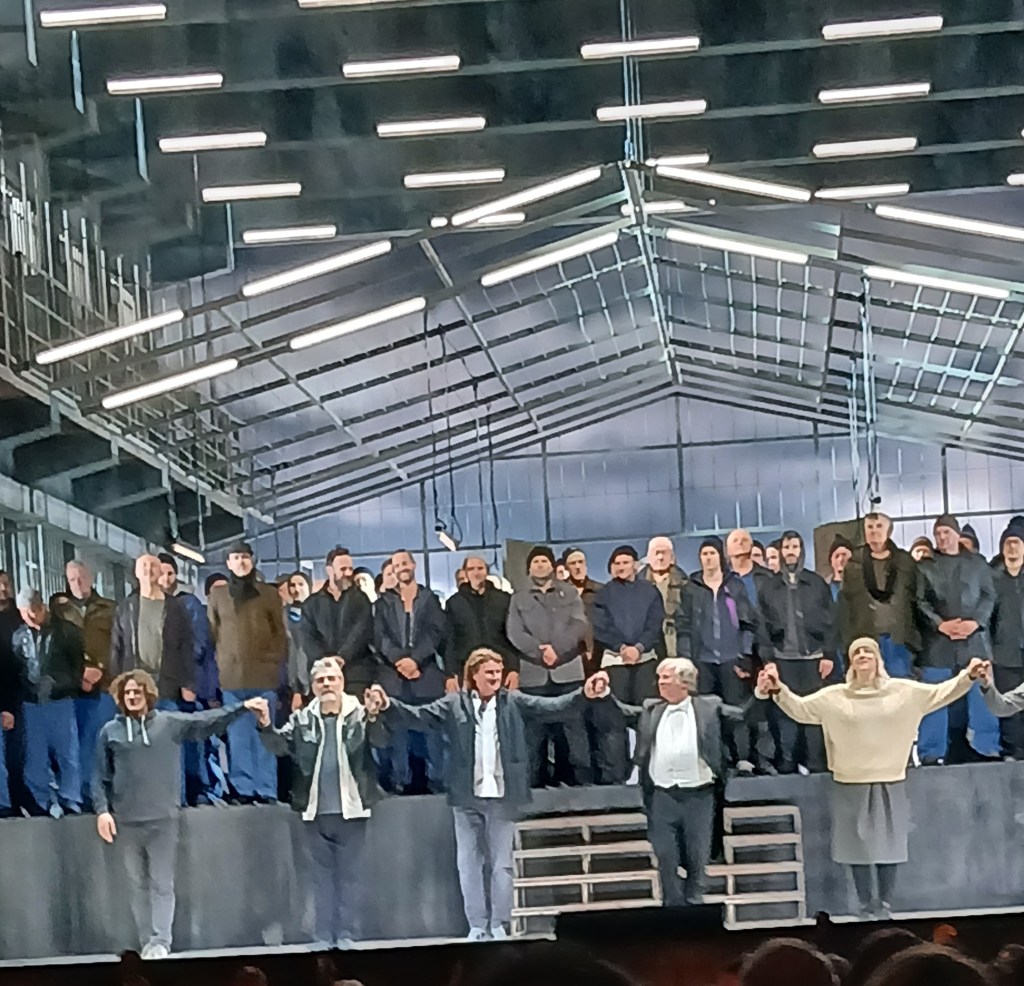
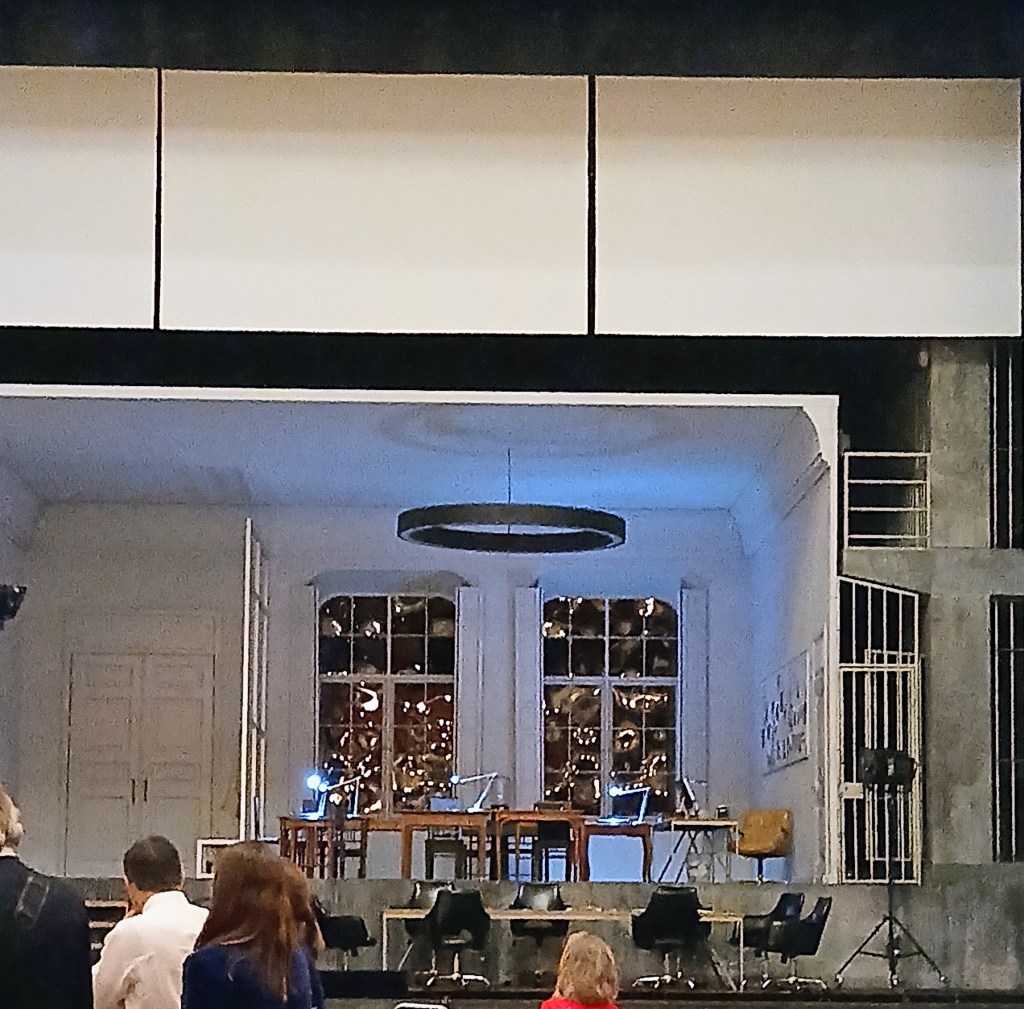
And….this was an excellent production and set of performances……….. The set as in the photo below was two greyish white walls of an institutional building which served as the school in the ‘projects’ where Sister Helen worked with poor children, the prison and the court room where appeals were heard. This allowed the many scenes in the opera to be deftly transitioned, often by means of characters ascending and then descending a staircase via the upper level of the walls. At the end, the execution chamber was realised in terrifying detail, moving onto the stage in blazing white light. All the characters were believable, their movements appropriate and realistic, and their reactions superbly timed and realised.  Annilese Miskimmon, one of the triumvirate who runs ENO currently, deserves huge credit for her brilliant production.

There was not one weak link in the cast. All sung and acted superbly. Christine Rice not only had the ability to sing the lyrics with a beautiful and varied line, but captured in great detail a character both awkward and sensitive – moving in an ungainly way, some hesitancy at times, faltering and self-doubting. I suspect the real Sister Helen is probably a more forthright person, but this was a brilliant representation of the character. Michael Mayes, who has sung the role in many productions since 2018, was outstanding as Joe – he has a big stage presence, a resounding voice and is a large man – all these elements making him very credible in the tough but ultimately fearful prisoner role, and he sang superbly. Sarah Connolly was luxury casting as Joe’s mother, and she offered a highly convincing and touching portrayal of someone not really coping with what’s happening to her, and awkward when faced with authority. She leaves the stage still convinced that Joe is innocent, and Ms Connolly’s singing and acting was very moving. All the smaller parts were very well-done – I was particularly taken by Madeline  Boreham’s account of Sister Rose. Kerem Hasan and the ENO orchestra did everything they could to realise Heggie’s music vividly and sensitively, and at the same time Hasan’s control of dynamics meant the singers were never overpowered by the big orchestra Heggie requires. Perhaps my only quibble would be the use of Southern US accents by the cast, which came and went a bit among the UK members of it.

So…..I think this was a powerful work, which we have waited too long to see in this country. I am still asking myself why, in the end, I was more impressed by Turnage’s Festen seen earlier this year. Both are works with powerful stories – in Festen’s case sexual abuse – which started life in other mediums (in Festen’s case film). Perhaps in the end the music has more character – I am not sure and need to think about it.

Messiaen, Ensemble 360 – Sheffield Crucible – 1/11/25

Klein, String Trio; Smit, Trio for Clarinet, Viola and Piano; Messiaen, Quartet for the End of Time

This concert was preceded by an hour or so with a lecturer from the Birmingham Conservatoire talking about Messiaen, with the aid of two of the evening’s players to provide musical illustrations. One of the fascinating things we learned is that Messiaen was a veritable thieving magpie among composers, constantly using and re-using segments of other people’s music. There was a brief extract from the Prelude to Boris Godunov which is used several times in the Quartet, as an example. We also heard a recording of birds singing outside Messiaen’s country summer composing house – they were extremely loud, and insistent their voices should be heard on his music! The cellist spoke about how difficult it was to sustain the long high notes of her glorious duet with the piano in the middle of the work. The lecturer pointed out how consistently Messiaen had worked on the Christian concepts of heaven, hell and eternity throughout his long life of composing, exemplifying this by looking at the Quartet, near the beginning of his career, and Eclairs sur l’au-dela, written 40 years later All in all, a very absorbing hour……….. 

The two compositions by Klein and Smit, who were both murdered in Nazi extermination camps., are very different in style. The Klein work was the more immediate and gripping. and i think one would feel that, even if you didn’t know that it was completed 9 days before he was transported to Auschwitz. Its writing is raw and bitter at times but it also uses Czech folk music, sometimes almost violently as though the composer is grabbing onto aspects of normal life, unwilling to let go. Smit (who was Dutch) had a more formal distanced style – it was written in 1938  – and had less intensity. I wasn’t as engaged with it.

The Messiaen Quartet i have heard several times live. The Crucible music in the round space is ideal for this work – you experience its drama at very close quarters. All four musicians conveyed the sense of both fear and bliss which any good performance of this work must have, and clarinet, violin and cello played their big moments superbly.  Gemma Rosefield and Benjamin Nabarro held the audience spellbound in the quiet beauty of their playing (except for the idiot who audibly moved out of his seat upstairs before the music faded into silence at the end). I don’t find this work easy listening but somehow you know – and you could feel everybody else in the audience knew – that every note counts in this piece and you have to listen intently. There was a rare stillness in the audience [apart from the idiot at the end) and at the end, after the whisper of the violin dies into silence, stomping of approval on the wooden floor and tiers