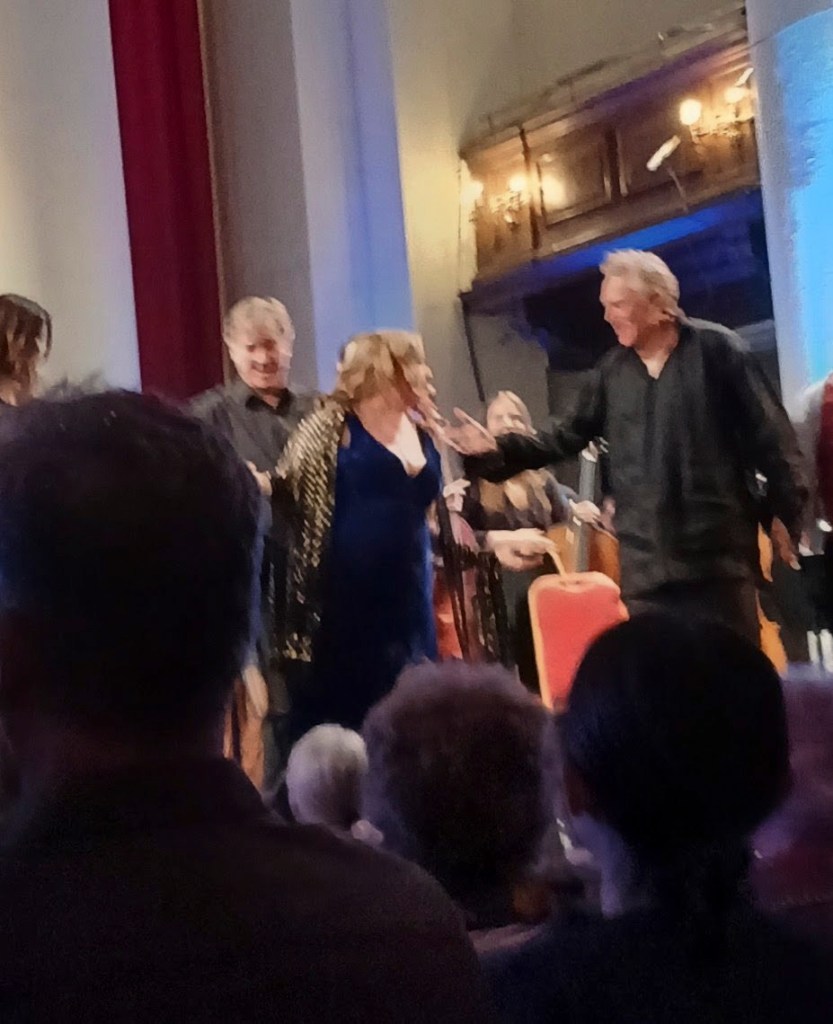
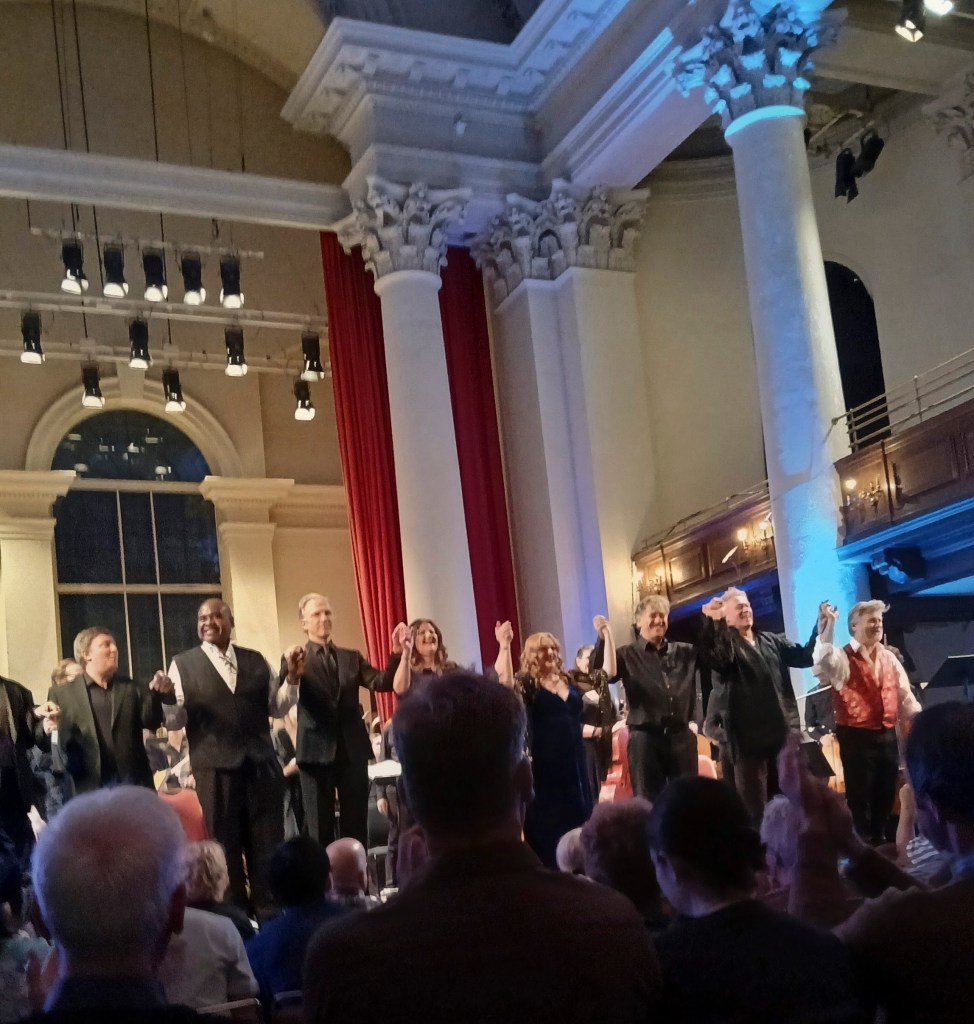
Cara McHardy, Isolde; Harriet Williams, Brangaene; Neal Cooper, Tristan, Simon Thorpe,Kurwenal Pauls Putnins, King Marke, Ronald Samm, Melot. LOC Chorus, Augmented Smith Square Sinfonia, conductor Peter Selwyn
It’s a busy few weeks for me Wagner-wise – Parsifal last week, this Tristan and then the Bieito Ring next month in Paris. And actually this is the 3rd Tristan I’ve been to this year – Lise Davidsen in Barcelona and the Pappano concert performance with the LSO being the others.
As Chair of the Manchester Wagner Society, I was lucky enough to hold a Zoom conversation earlier in October with the very experienced Tristan, Isolde and Brangaene for this performance as one of our monthly sessions. I asked among other questions about their approach to singing Wagner, their preparations before a performance, and how they felt afterwards. It was fascinating to hear them particularly on the latter topic – both Tristan and Isolde said it took several days before they felt normal again; they felt physically and emotionally overwhelmed and drained.
Much the same team, again led by Peter Selwyn, had performed Gotterdammerung last year, also as a concert performance, an event I much enjoyed; I think the original plan had been to perform Parsifal this year, but the ROHCG October new production meant that they went instead for a reprise of Tristan, which they had previously performed in 2022. Parsifal apparently comes next year.
It’s only 3 and a half months since I heard the LSO/Pappano concert performance of Tristan (or heard the last two acts of it anyway) but to me this London Opera Company (LOC) rendition was much more vivid. That must in part be due to positioning – it is thrilling to hear the big voices you need for this work from only about 7 rows back (for the LSO performance I was half way up the balcony), and you get much more visual information from the details of the singers’ facial expressions and how they react to each other at that distance. But it also has something to do with the ethos of the performance and the pace given it by Peter Selwyn, the conductor. What came through to me, time and again, as I listened, was how the work must have seemed like a complete thunderbolt heard for the first time in the late 1860’s/early 1870’s. There had never been anything remotely like it before – the screwing up of the tension in the 3rd act, the frenzied passion of the 2nd. No wonder by the end of the 19th century it had taken Europe and America by storm……The performance was fast-ish in pace (never gabbled, always singable and playable), immensely energetic, passionate but also structured in long lines, particularly in Act 2, and never excitable or over-dramatic. The bloom of the Smith Square Hall acoustics gives a wonderful richness to the string sound, and the orchestra rose to all the challenges, particularly in Act 3. The cor anglais playing was superb, and altogether there was much high quality woodwind and horn playing. I was also struck – but this again is a reflection of the quality of Selwyn’s conducting – by how little the orchestra swamped the singers; despite the ratcheting up of the tensions at points in all 3 Acts, there is (or seemed in this performance to be) relatively little heavy brass for the singers to battle it out with. The ethos of the performance I mentioned above was also important – these are singers gripped by the roles they are singing and making the very most of them in live performance; nothing routine about it. They communicated that sense of urgency to the audience, I think. The management of acting against the need to look at music stands was handled better and more consistently than last year’s Gotterdammerung, and there were also a couple of props – an Act 1 box of potions (many staged performances seem to lose this) and a lantern for Brangaene in Act 2 There were no weak links among the singers. Neal Cooper was notable for the unflagging generosity of his voice in Acts 2 and 3 and by his acting abilities (more restrained, and the better for it, than Clay Hilley hanging on to the conductor’s rostrum in Act 3 in the Pappano performance). He has a natural stage authority that he uses effectively. Cara McHardy had some wonderfully expressive moments – her references to Tristan and she looking at each other in Act 1, ‘hoechste lust’ at the end of the Liebestod, multiple moments in the Act 2 love duet; her rage and frustration, the sense of a strong woman at bay, were really felt by the audience in Act 1. Harriet Williams was a glowingly – voiced Brangaene, whose acting was also very effective. Simon Thorpe sung Kurwenal energetically and convincingly. Like Franz-Josef Selig for Pappano, Pauls Putnins made King Mark a convincingly tragic figure, whose long solo one sat back and enjoyed rather than getting increasingly restless. All the smaller parts were well taken and the choral contributions in Act 1 were very strong.
It was a pity that I had an idiot sitting next to me with a very bad cough, who was coughing unrestrainedly for the most part every 5 minutes throughout the performance. That’s unfair to the singers (and unfair to me). He should have stayed at home……(as – he said, self righteously – I remember doing a few years ago when similarly convulsed and missing several performances)