Saariaho Lumière et pesanteur; Mahler Rückert-Lieder; Mahler Symphony No. 4 in G major. Joyce DiDonato mezzo-soprano; The Met Orchestra, Yannick Nézet-Séguin conductor
The main attractions here for me were the Saariaho piece and hearing Joyce di Donato sing the Rückert-Lieder. I have tried to ration my experiences live of Mahler symphonies since the Leipzig Mahler festival of 2023, and I haven’t heard Mahler 4 since then, either live or in a recording. I have no particular live golden memories of this work from the 60’s and 70’s – certainly I heard Haitink, and Boulez conducting it, but no particular occasion sticks out in my memory – I grew up with a beautiful recording conducted by Jascha Horenstein.
Rather to my surprise, the UK premiere of the 4th Symphony was in Mahler’s lifetime, in 1905 at the Proms. The almost inconceivably long programme of that concert took place on 25 October 1905 at the Queen’s Hall – Programme: Tchaikovsky – Capriccio italien, Op 45; Suite No. 3 in G major, Op 55 – No. 4 Tema con variazioni; Gluck – Alceste – No. 3 Recitative & aria ‘Où suis-je?…Non! Ce n’est point un sacrifice!’ Act 1; MAHLER – SYMPHONY NO 4 IN G MAJOR – UK premiere; Henschel – 4 Sacred songs, Op 46 (arr. unknown for voice and orchestra) No. 4 Morning hymn; Tchaikovsky – Marche slave, Op 31. Interval. Schubert – Die Zauberharfe, D 644 – Overture; Tchaikovsky – 6 Romances, Op 6 – No. 6 Net, tol′ko tot, kto znal; 7 Romances, Op 47, No. 6 Den′ li tsarit? Proms premiere; Quilter – 3 Songs, Op 3 – No. 1 Love’s philosophy; Berlioz – The Damnation of Faust – Marche hongroise. All with Henry Wood, conductor, and the New Queen’s Hall Orchestra. Unbelievable……
Once again the hall was packed. On the Saariaho piece, (‘Light and Gravity’) the composer has written “Lumière et pesanteur is a gift for Esa-Pekka Salonen, inspired by his performance of my La Passion de Simone in Los Angeles, January 2009. This piece is an arrangement based on the eighth station of the Passion, which I know that he especially likes”. The 8th station of the Stations of the Cross is where Jesus meets the women of Jerusalem. During this moment, Jesus sees a group of women lamenting His suffering and instructs them not to weep for Him but to weep for themselves and for their children. This station emphasizes themes of compassion, conversion, and the call to recognize the injustices of the world. As such the piece links quite well with the seriousness of the Mahler works and with what they are trying to express. It’s not an easy listen, but in its slow chords it does actually sound very Mahlerian – a logical extension from the language of the 10th Symphony, music Mahler might have written had he lived another 20 years,
The Ruckert Lieder introduced us to Joyce DiDonato, a Proms regular, though obviously also a regular colleague of Yannick’s. The gold singing standard for me in this music is set by Janet Baker, who I heard singing these songs several times. I thought Joyce DiDonato was almost at that level, which is a pretty considerable achievement – she sung some lines beautifully in a pared down legato tone (eg in the Lindenbaum song), her diction was very clear, and her natural singing voice always provided a distinctive and attractive sound. Maybe at the climax of Um Mitternacht she faltered slightly (was she having to force her voice overmuch at the top of the range)? She can still float notes beautifully – as in Liebst Du Um Schoenheit…….Altogether this was a very distinguished performance, sensitively accompanied by Yannick and the Met Orchestra.
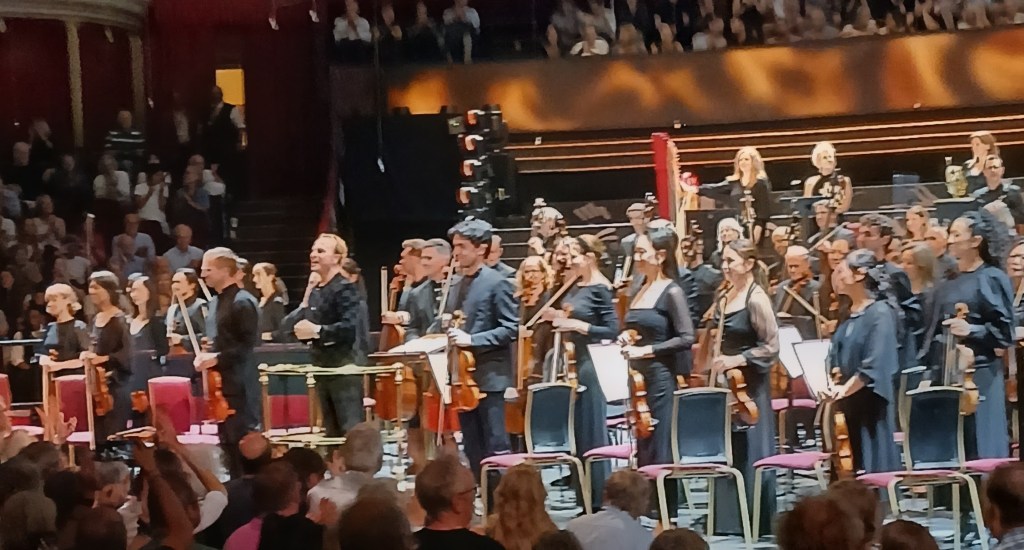
Mahler 4, as I am sure I have said before in this blog, is a work I have known for very nearly 60 years. I think this is probably the best account I have heard of it live – perfectly played (apart from one small fluff from the horn), unfailingly thoughtful and musical, never crude on the one hand or on the other too self-consciously beautiful. Repeatedly I felt the balance of instrumental blocs was well-handled by Yannick – with again that deep bass under-pinning. Again the Met orchestra were adept at handing over a theme from one section to another sensitively. Nezet-Seguin’s instinct by no means was to wallow, and on the whole the tempi were quite brisk – but allowing the room needed for the expanding of the Trio in the 2nd movement, and the glorious slow start to the 3rd movement. Whatever the pace chosen, the orchestra had no problem playing it precisely and clearly with all the note values in place and no slurring. Dynamic levels too were clearly and well handled – no full playing out until the end of the disturbed development section of the first movement, and the explosion of joy in the 3rd movement was as cataclysmic as it should be. Joyce DiDonato was unaffected and natural in her solo in the last movement (she was placed at the back of the orchestra – 2nd on the right of the harp in the photo below). And above all, I felt that all these details I was noticing were serving Mahler’s intentions, not any other agenda. The final optimism of this radiant work – despite the darkness along the way – must have seemed suspect at its first performance; now it is very hard indeed to accept the work’s generous positivity, but Mahler continues to appeal to the best in us, and that was reinforced by the excellence of this performance.
The encore, imaginatively, was Urlicht from the 2nd Symphony, with DiDonato, of course. It was beautifully done and in keeping with the mood of the 4th Symphony