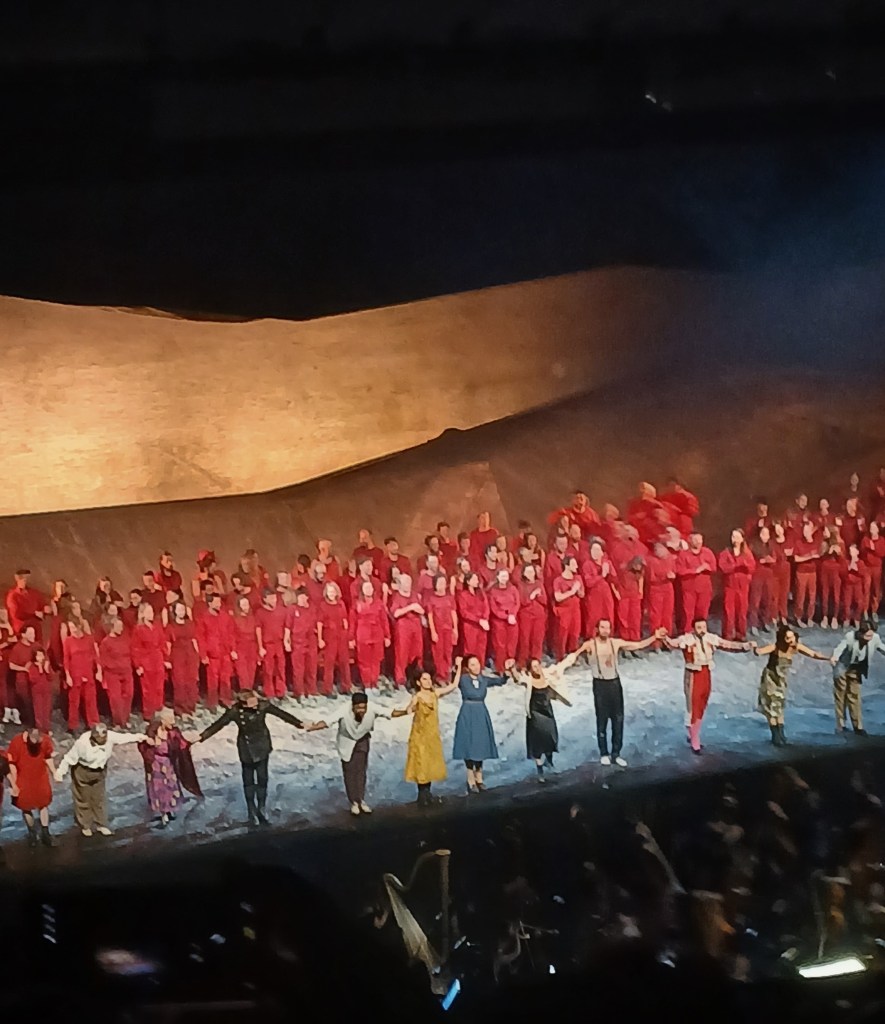
Teodor Currentzis Conductor; Gabriela Carrizo Director / Choreography; Christof Hetzer Sets / Costumes; Tom Visser Lighting. Asmik Grigorian Carmen; Jonathan Tetelman Don José; Kristina Mkhitaryan Micaëla; Davide Luciano Escamillo; Iveta Simonyan Frasquita; Anita Monserrat Mercédès; Matthias Winckhler Zuniga; Liviu Holender Moralès. Utopia Choir, Salzburg Bach Choir; Salzburger Festspiele und Theater Kinderchor , Utopia Orchestra
I had a – for once – smooth rail journey from London to Salzburg (nearly 14 hours from St Pancras). I’d forgotten that there was a UEFA Super Cup championship football match in Salzburg Wednesday evening between Paris St Germain and Aston Villa, so I found the Munich to Salzburg train full of (extremely well-behaved) Aston Villa fans on it, the group I talked to already convinced their team is going to lose……. (which in the event is what happened)
I wouldn’t normally go to a pricey performance of Carmen at Salzburg – but……it was on in the week I was due to go there; I haven’t heard the work live for about 7 years; I love hearing and seeing Asmik Grigorian perform, and I am always impressed by the work of Teodor Currentzis. I do though seem to have picked some controversial productions this year, operatically. This Carmen has had both the original spoken dialogue and the non-Bizet orchestral recitatives removed, and replaced by choreographed sequences. The director, Gabriela Carrizo is in fact also a choreographer, who has run the Brussels-based ‘Peeping Tom’ company for 20 years, and the decision was made to offer a set of dance/drama intervals to explore the characters’ inner emotions and thoughts, with sound effects. 8 or so dancers therefore worked with the standard opera cast. This is apparently the first time Ms Carrizo has worked on an opera, I was told. There were also some musical changes too – the opening chorus in Act 4 in part disappeared, I think
What struck me most about this performance was the quality of the music-making. I’ve not been to a performance in the Grosses Festpielhaus before, and I was impressed – sitting in the 9th row of the Balcony – by the immediacy of the sound of the orchestra and singers, both seeming as though I was sitting in the stalls. The immediacy of the orchestra also had a lot to do with Currentzis and his particular band of players. This must be the best played and orchestrally most vivid Carmen I have ever heard. Currentzis got into trouble in 2022 because of the Russian links of his previous band, Musica Aeterna, originally a period instrument group from the Urals (I heard him and them perform a phenomenal Beethoven 4 and 5 at the Proms about 8 years ago), but who by the beginning of this decade was performing all sorts of music – Tchaikovsky 6, Mahler 6. He’s now formed a new orchestra (described as an international orchestra with players from more than 30 countries) and he’s done enough in the way of anti-Russian positioning (not easy as he is half Russian) to bring him and them back into the Austro-German classical music sphere (though he and the orchestra have not appeared in Britain since that date in 2018. The orchestra was phenomenal – ultra-tight rhythms, rich, nutty string sound, rasping brass and extraordinarily violent timpani and percussion. The strings accompanying Micaela is her first arias as she sings to Don Jose about his mother were wonderfully sweet., As the old Musica Aeterna used to do, they stand up sometimes to deliver solos or to make even more noise! There was also some very beautiful playing – the flute and the beginning of the third act for instance, the solo horn at various points.
Having read some quite negative reviews about this production, I was quite surprised by how positive I felt about it at the end – much better than the two ROHCG ones I have seen in recent year (the Kosky one with the gorilla, and last year’s one). If there are problems, the issue was less the comings and goings of the dance sequences than the dim lighting pervading the crowd scenes. There was one point in Lilia Pastias tavern where I quite failed to identify where Don Jose and Carmen were in the melee. The situation was better in the last two acts, primarily because the crowd and the main characters are more tightly kept apart, but in Act 2 I was quite failing to identify who was Escamilio and who was Zuniga; in the opening scene in Act 1, it took a while to register who was Carmen and who was Do Jose. The other problem is that not having the dialogue/recitatives brings with it two issues: one, it must have been difficult to follow the story for anyone not familiar with it (though of course surtitles help); and two, without the dialogue it is very difficult to work out who the minor characters are – who is Frasquita, who is Mercedes, who the smugglers are (and the lighting merely adds to the confusion). But against that there is:
- a constant sense of menace and darkness. The set is something like a stone quarry, with a water basin, and steep platforms, and the texture of the way the rocks are lit conveys a dark stony colour, occasionally changed in part to brilliant reds -there’s no sense of a colourful Spanish town, just a sense of the bleakness of what lies between some of those Spanish towns, say near Toledo. There is a sometimes brightly lit back drop which allows mysterious figures to appear and disappear in silhouette. There is much violence – someone – male or female, it’s not clear – is beaten up in the opening moments of Act 1, in Act 3 there is almost a fight between Tetelman’s Don Jose and Grigorian’s Carmen, Carmen is stabbed not once but repeatedly,
- because of the absence of dialogue an increased emphasis on the relationship between Carmen and Don Jose, and the intensity of that was very powerful, added to of course by the mesmeric acting of the two fine singers in these roles. Somehow, having Don Jose’s mother on stage most of the time increases that intensity ………….
The dance scenes I did not find too disruptive as such – they seemed to feature tortured movements, violent encounters, which seemed to fit the mood of the overall staging. The sounds to accompany them were on the whole not a good idea – very jarring (but maybe that was the point) electronic sounds, a strange echoey sound of distant voices surrounding some sort of religious ritual (maybe) in Act 3. One more interesting sound was (in Act 2 and Act 3), having Amparo Cortés (a cante jondo performer from Seville) singing a traditional song – but again, this hardly fitted seamlessly into Bizet’s score.
There were three near ideal singers for the four main roles. Having not thought about it for 45 or more years, in the middle of this performance I suddenly remembered I had heard, at some point in the 70’s or 80’s, Jon Vickers singing the most tortured Don Jose I can recall (his Flower Song was intense to the point of madness). It was the intensity of Tetelman’s performance which brought that memory back – this was not only a finely sung performance but wildly felt performance, Don Jose literally becoming frenzied as we watched. The final scene was unbearably brutal. Tetelman, at 38, and with his tallness, has the ability to be absolutely convincing in this role. Asmik Gregorian too is every inch a singing actor, and she too was mesmerising (when you could spot her). Her Habanera, and the song with the castanets (here converted into flying plates) were utterly individual and extremely convincing. You felt every word she sang had been carefully thought through and balanced as to volume, tone and effect. The overall impact of her role was to be – it seemed – indifferent to the passions she roused, making the violence more shocking. Kristina Mkhitaryan I realise I had heard a couple of years ago as Tatiana at ROHCG, where she impressed, and she was beyond impressive here as Micaela. OK – Micaela is a wimpish character with little to do except sing sweetly, but she did this with immense colour and finesse – a truly beautiful performance. Only Escamilio was perhaps more ordinary as a performance, but this was still a very good account of the role. The Utopia and Salzburg Bach Chorus were as impressive (almost) as the orchestra, and the larger than usual children’s chorus very powerful and characterful
Here’s a trailer giving a sense of the design feel – if you scroll down to the videos
Carmen • Salzburg Festival 2026
I am very glad I went to this – it would have been very easy to give it a miss