Tarmo Peltokoski conductor; Silja Aalto soprano; Huw Montague Rendall baritone; Hallé Choir Matthew Hamilton, choral director, Hallé Youth Choir Stuart Overington, director. Mahler, Rückert-Lieder; Vaughan Williams Symphony No.1, ‘A Sea Symphony’
This was a somewhat odd piece of programming on the face of it – though obviously the Rückert-Lieder are broadly contemporary with the Sea Symphony, there’s not much in the way of other connections, unless it is the use of forms of folk-like music. Would not say Elgar’s Sea Pictures have been a better coupling (and one showing VW in quite a good light)?
Tarmo Peltokoski is one of those incredibly young and dynamic conductors who agents and orchestral managers seize on and promote vigorously. – and he’s Finnish, as so many leading conductors are these days! He’s younger than even Makela and seems to pop up all over the place – music director of the Orchestre national du Capitole de Toulouse, and Hong Kong Philharmonic for starters, as well as many guest appearances all over the place I seem to remember his conducting Parsifal somewhere recently (I think Berlin) and he’s conducted a Ring cycle and Tristan too! For someone aged 26 this is remarkable and it’s mildly surprising that in all his rushing around the world he should be interested in coming to Manchester and conducting Vaughan Williams. One of his teachers is Sakari Oramo – maybe that’s the connection………….
This was a most enjoyable concert. The Mahler Ruckert lieder I have loved since I bought Barbirolli’s recording (of Mahler 5) and discovered Janet Baer’s recording of these songs on the 4th side of the LPs, in my gap year. So, I have known these songs for 55 years and yet I heard details of orchestration I have never properly registered before in Peltokoski’s performance. I was particularly struck by a little minor key whispered nudge from the double basses just before the end of ‘Ich bin der welt abhanden gekommen’. Huw Montagu Rendll was an excellent soloist, with good diction and pointing of words, and a beautiful golden tone to his voice, plus the ability to fine it down to an expressive whisper at points. Um Mitternacht had all the angst and soul-searching I would want from a performance of this piece. Throughout there was a sophisticated blending of orchestral colours from the orchestra, which told me that Peltakoski was indeed a very good conductor.
The Sea Symphony is a work that in many ways is a surprising Edwardian survivor. It has the upholstered, plush sounds of its time, and I have to grit my teeth when I get down to reading the Whitman poetry, so dire do I find it. Yet it has survived and maybe that is because it has a youthful sweep and an energy which carries all before it, as well as some very un-Elgar/un-Brahms/un-Parry touches – a hint of Hymns Ancient and Modern in the third movement, something of Tallis and Byrd in the finale (‘Wherefore unsatisfied soul’). It’s a young person’s work and as i said in a review of the LSO performing the Sea Symphony more than a year ago, the more I listen to this symphony, particularly the last movement, the more I appreciate it. I enjoyed the LSO performance a lot last year, but here the Bridgewater Hall ‘s acoustics really allowed the massed forces to bloom gloriously – a gorgeously rich sound from choir, orchestra, and soloists (the choir completely filling the choir seats). And, apart from a perhaps over-stately first five minutes, Peltakoski led the work in a bright, breezy and vigorous way that kept it moving and glossed over the occasional longueurs in the finale. The choral singing was crisp and together, with very good diction, even if ‘A pennant universal’ was , as always, a bit of a scramble. Silja Aalto had a powerful voice which sailed over the top of the waves of sound with ease in the first movement, though her strong accent was a bit disconcerting at times. Huw Montagu Rendall was very adequate, though not as exceptional as in the Mahler. Peltokoski’s conducting, as there is so much fuss about him at present, I did take the time to look at fairly closely. His conducting is relatively undemonstrative, with a small, very clear and tight beat from his baton. Very occasionally his arms sweep out at climactic moments but for the most part he remains fairly still on the podium, and was certainly not being unduly extrovert in order to encourage the choir, though he was mouthing the words and, obviously, cueing them in. Certainly, he didn’t appear to be playing to or on the hype surrounding him, but was just seriously making marvellous music
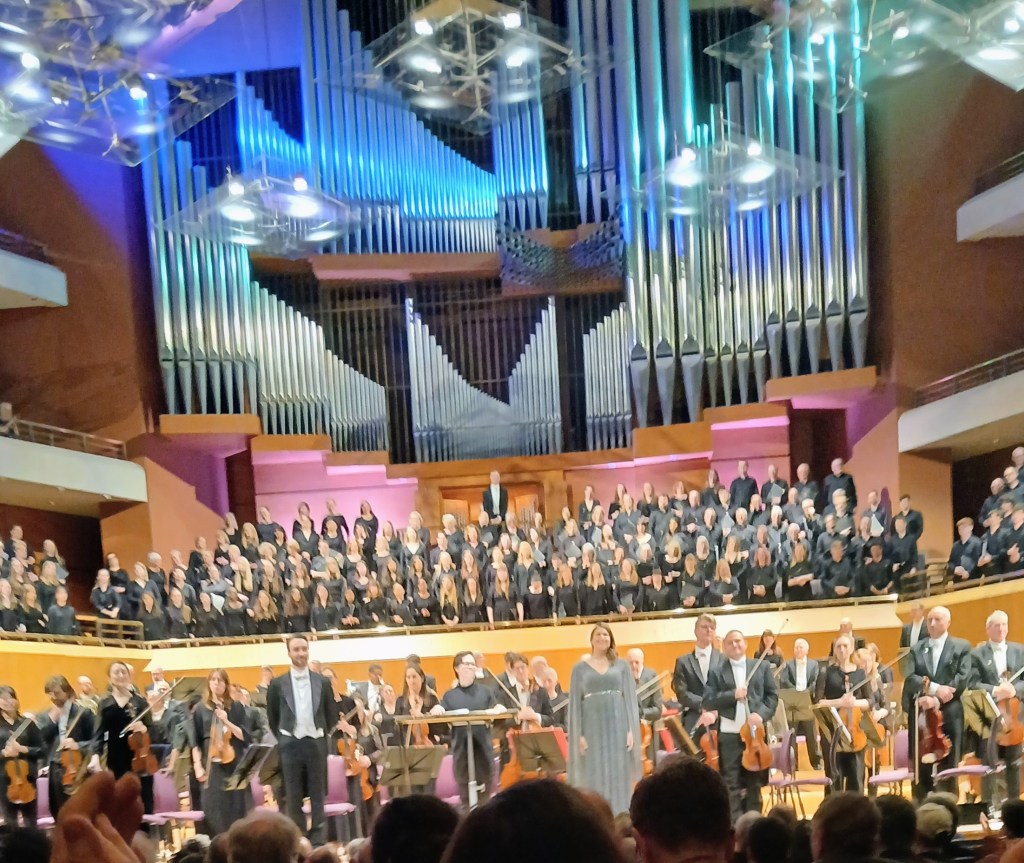

(c) Peter Rigaud

